

Nigeria has joined several other African countries in boosting planned use of fossil gas as a “transition fuel” in its updated climate plan, reflecting the continent’s struggles to quickly ramp up renewable energy output.
The West African nation aims to have 17 gigawatts (GW) of gas-fired power capacity in 2035 – nearly double the current level and more than the target for solar and hydro power combined, according to its new nationally determined contribution (NDC) plan.
Announcing the plan at the United Nations on Wednesday, Nigeria’s vice-president Kashim Shettima said gas was a “cleaner fuel”. Specifically, the NDC justifies it as a cleaner alternative to coal in electricity generation and as a replacement for diesel in transport.
Michael Ivenso, energy director at Nigeria’s National Council on Climate Change (NCCC), told Climate Home News that Nigeria has adopted the strategy because the transition to clean energy sources “will not happen overnight [and requires] a just, gradual and practical approach”.
-
Addis summit trumpets African climate solutions, while quietly backing gas
African nations sent a strong message on driving green growth with homegrown resources, but were criticised for their softer stance on fossil fuels -
To meet Africa’s clean energy goals, investors urged to tolerate higher risk
A risk-averse approach is holding back investment in African renewables projects, which need to be well-structured and supported by blended finance and guarantees, energy funders say


Nigeria – Africa’s biggest oil producer – needs “time and money to build out a sufficient installed base of renewable energy sources to support growth and development”, Ivenso added.
With plans to cut emissions by 32% from 2018 levels by 2035, the country requires $337 billion to mitigate and adapt to climate change, the climate plan says, with a fifth of the money expected to come from domestic sources, including carbon markets. The rest will come from international funding, it said in the NDC 3.0 submitted to the UN earlier this week. Shettima said the plan was Nigeria’s “highest ambition level to date”.
“Risky strategy”
According to Nigeria’s plan, greenhouse gas emissions from the natural gas industry will be reduced by phasing out routine gas flaring and reducing leaks.
Nigeria, which is plagued by unreliable and patchy power supplies, has a fossil gas reserve of about 210 trillion cubic feet, which could last for up to 93 years, the government says.
President Bola Tinubu’s administration is actively exploring the fuel’s potential, courting investors and unveiling gas infrastructure across the country. After his inauguration in 2023, Tinubu said his government would seek to add value to the nation’s gas assets, saying “it is all about growing the pie so that Nigerians will benefit”.

But critics say continuing to invest in natural gas could prove counterproductive, and more costly, in the long run – as well as making it harder for African countries to meet their commitments under the Paris Agreement.
“It is unfortunate that the Nigerian government is still planning so much fossil gas in its energy mix,” said Sofia Gonzales-Zuñiga, a senior policy analyst at the global institute Climate Analytics.
This is “a risky strategy that could either lead to stranded assets, or lock it into ongoing fossil fuel emissions, when it could be reaping the benefits of much cheaper – and cleaner – renewable energy”, she added.
Those concerns were echoed by Zainab Aliyu, a research consultant at the Fossil Fuel Non-Proliferation Treaty Initiative, who said Nigeria’s decision to keep betting on fossil gas was tying it to “a volatile industry at a time when the world is moving away from fossil fuels”.
Asked about the NDC’s proposal to scale up the use of liquefied petroleum gas (LPG) for cooking, Rajneesh Bhuee, manager of the “Stop Funding Gas Campaign” at the NGO Recourse, said treating LPG as a “clean solution risks entrenching fossil dependence in households and exposing low-income communities to global price volatility”.
Africa’s “transition fuel”
Nigeria is not the only African country that has added intentions to ramp up natural gas use in the new cycle of UN NDCs.
Angola’s climate plan says it plans to use natural gas systems to progressively replace diesel generators in industry, saying that will drive down emissions significantly.
Similarly, Zimbabwe’s NDC said it will ramp up a new gas-fired power plant until 2036 as “although it is a fossil fuel, natural gas can replace coal and reduce emissions considerably”.
Earlier this month, at the second Africa Climate Summit in Addis Ababa, leaders in the final declaration identified “the role of transitional energy sources” – widely taken to be a reference to fossil gas – “in ensuring a just transition that safeguards the energy security of developing countries”.
-
Ethiopia’s preparedness puts it ahead of Nigeria in bid to host COP32, campaigners say
Ethiopia’s logistics, infrastructure and climate diplomacy make it seem better placed to host the 2027 UN climate talks than its West African rival – for now -
UN experts accuse top oil firms of rights violations over Nigerian asset sales
Divestments were made without paying hefty clean-up bills or compensating communities in the pollution-scarred Niger Delta, UN working group says -
Boom in solar panel imports boosts hopes for clean energy take-off in Africa
Africa’s solar imports from China jumped 60% in the 12 months to June 2025, reaching an all-time high


Also, in January, at the Mission 300 energy summit in Tanzania, African leaders adopted a joint statement, citing gas as one of the energy sources needed to unlock “Africa’s full energy potential”.
Giza Gaspar-Martins, a former Angolan climate negotiator who served as chair of the Least Developed Countries group, said “it’s ok” for countries to use gas as a transition fuel “because it has less of a potential to increase global greenhouse gas emissions” compared with other fossil fuels.
Despite the general discouragement for continued investment in fossil fuel production, oil- and gas-producing countries, in particular, have adopted the same position to use gas as a transition fuel and “this is a reflection of national circumstances. It is what it is,” Gaspar-Martins told Climate Home News.
But climate campaigners say continuing to rely on fossil fuels, including gas, could hamper – not help – the continent’s development.
Aliyu urged policymakers to concentrate on renewables and green hydrogen, “rather than investing in a fuel source that is most likely to repeat the oil curse”.
The post Nigeria gives fossil gas a bigger role as “transition fuel” in climate plan appeared first on Climate Home News.
Nigeria gives fossil gas a bigger role as “transition fuel” in climate plan

Three countries have been named by the Paris Agreement’s compliance committee for failing to submit a nationally determined contribution (NDC) and repeatedly snubbing offers of help with their climate plans.
After months of internal debate over whether to identify serial non-responders, the Paris Agreement’s Implementation and Compliance Committee (PAICC) named the three countries which have failed to engage with it over their NDCs on Friday.
It named Democratic Republic of Congo, Senegal and North Korea in a footnote of its annual report, adding that it decided to name them “with a view to facilitating engagement”, adding that representatives of the three nations had been invited to its meeting in early 2027 “with the purpose of identifying any challenges and constraints”.
“The Committee noted the importance of Parties engaging with the Committee in a timely manner, while noting that some delays may be due to the national capabilities and circumstances of the Parties”, the report said.
-
Under US pressure, World Bank says it will back gas “where appropriate”
The US wants the World Bank to expand its gas support while climate campaigners are pushing for it to end – its head spoke this week of limited backing for the fossil fuel -
IPCC scientists vow to press on with climate reports despite political deadlock
After governments again failed to agree a timeline, nearly 120 IPCC authors pledged to complete their assessment on time and with full scientific rigour -
Paris Agreement committee snubbed over missing NDC climate plans
Many governments have still not submitted a nationally determined contribution to the UN, breaching a key requirement of the Paris Agreement

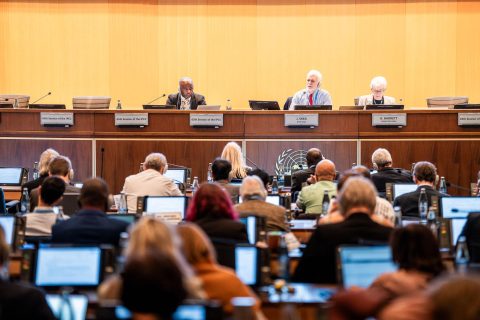

In July, PAICC said 12 countries had ignored its repeated attempts to discuss why they had not published an NDC as required every five years under the 2015 Paris accord.
Members of the committee had been divided over whether to name them, but at a September meeting decided to do so in their annual report to the annual climate COP summit.
By the time the report was published on Friday, only Congo, Senegal and North Korea “had not communicated an NDC or submitted a [Biennial Transparency Report] and had not yet responded to any of the Committee’s notifications, despite several reminders issued by the Committee in this regard”.
Rainforest and renewable energy ambitions
The silence from Congo and Senegal is notable because the former is home to much of the Congo Basin rainforest while the latter has sought billions of dollars in climate finance to support its renewable energy ambitions.
After Brazil, Congo has more rainforest than any country in the world. This forest, and the country’s peatlands, absorb huge amounts of greenhouse gas but are fast being lost to expanding farmland, charcoal production, logging and mining.
Senegal signed a Just Energy Transition Partnership with Canada and wealthy European nations in 2023, to help it meet its renewable energy targets under the-then government of Macky Sall. It was chair of the Least Developed Countries group between January 2022 and December 2023.

Tejas Rao, who is researching the PAICC as part of a doctoral thesis at Cambridge University, said the governments of the three countries should engage with the committee.
“Engagement costs these governments very little and the committee has shown it will listen,” he said.
“Silence leaves the committee with no basis to help, and it leaves the [governments] exposed to the narrative that they are simply disengaged,” he told Climate Home News.
Paris Agreement requirement
The 2015 Paris Agreement requires all parties to publish an NDC every five years outlining their emissions reduction targets, with each plan meant to be more ambitious than the country’s last NDC.
The latest set – the third round of plans, with new targets for 2035 – was due in February 2025. While most countries missed this deadline, all but around 30 – mostly small emitters but including Egypt, Vietnam and Argentina – have now submitted them.
Over the year, the PAICC – which is made up of government climate officials from developed and developing countries – has been communicating with governments that have not submitted NDCs and trying to overcome barriers to them doing so.
Some nations have cited exceptional circumstances as the reason for not submitting an NDC, a process that requires a significant amount of work in tracking emissions and consulting on how to curb them across the economy. For example, a letter from a Sudanese official to the PAICC, seen by Climate Home News, said that the country’s civil war had led to the suspension of its NDC preparation.
-
IPCC scientists vow to press on with climate reports despite political deadlock
After governments again failed to agree a timeline, nearly 120 IPCC authors pledged to complete their assessment on time and with full scientific rigour -
Under US pressure, World Bank says it will back gas “where appropriate”
The US wants the World Bank to expand its gas support while climate campaigners are pushing for it to end – its head spoke this week of limited backing for the fossil fuel -
Who shapes climate science? The equity question facing the IPCC
Early completion of the next global climate science assessment reports risks excluding research from the Global South, which is key to ensuring the findings are fair
The US and Iran are not signed up to the Paris Agreement and so do not have active NDCs, nor does Taiwan, which is not a UN member state.
Rao said that because the PAICC is “facilitative and non-punitive”, naming the countries “is meant to open a door, not close one – the invited consultation is the point”.
“In recent months, governments that explained their constraints, whether capacity, finance or domestic process, have been met with follow-up and support rather than sanction, and the number of silent governments has fallen sharply,” Rao said.
The post Paris Agreement committee names three countries snubbing it over NDCs appeared first on Climate Home News.
Paris Agreement committee names three countries snubbing it over NDCs