This December, the International Council on Clean Transportation (ICCT) released a report- “A Global and Regional Battery Material Outlook” that emphasized the critical need for major vehicle markets to achieve 100% BEV sales for new light-duty vehicles by 2035 and heavy-duty vehicles by 2040. This is in conjunction with the Paris Agreement’s target of limiting global warming to below 2°C. While progress lags behind this trajectory, many nations are setting ambitious targets and exploring new measures to accelerate vehicle electrification. This transition will drive a sharp rise in demand for batteries and essential materials like nickel, lithium, and cobalt.
Nickel Demand Soars with EV Batteries
Governments worldwide are adopting policies to expand battery electric vehicles (BEVs) and plug-in hybrid electric vehicles (PHEVs) to combat global warming and air pollution.
The surge in EV adoption has significantly boosted demand for nickel, a key component in battery production. This analysis highlights trends in battery technology and the growing importance of nickel while exploring strategies to manage the demand for this material.
To begin with, let’s study the growth trajectory of electric vehicles as explained in the ICCT report.
- Baseline projections estimate that global annual battery demand for road transport will grow from 808 GWh in 2023 to 3.8 TWh by 2030, reaching 7.0 TWh by 2040.
- Light-duty vehicle (LDV) BEV battery demand alone is expected to increase ninefold by 2050, while heavy-duty vehicles (HDVs) will see a 24-fold jump.

Moving on nickel’s role in the battery landscape continues to evolve. The silvery-white metal plays a vital role in high-performance batteries like lithium nickel manganese cobalt oxide (NMC) variants. This variant has higher nickel content and unique features like better energy storage and vehicle range. Thus, as EV adoption rises, nickel demand is expected to soar.
- The global nickel demand for EV batteries will reach 1.4 million metric tons (Mt) by 2030 and 2.2 Mt by 2040.
Image: Annual global demand for nickel under the baseline and demand reduction scenarios, all with the baseline battery technology share

Tracking Nickel Demand for Batteries Across Regions
China
Nickel demand for batteries in China is expected to grow significantly, increasing from 93 kt in 2023 to 273 kt in 2030 and 379 kt in 2040. This rise is mainly due to the emergence of high-nickel NMC variants, even when the overall share of NMC batteries declines. However, policy measures like recycling programs and the promotion of smaller battery sizes could help reduce nickel demand by up to 29% by 2050.
United States
In the U.S. demand for nickel demand is set to surge from 50 kt in 2023 to 359 kt in 2030 and 471 kt in 2040. This reflects rising sales of high-nickel, low-cobalt NMC variants, such as NMC811. Additionally, recycling and changes in cathode composition are expected to moderate long-term demand growth.
European Union
The EU forecasts demand for nickel to increase from 71 kt in 2023 to 353 kt in 2030 and 623 kt in 2040. High-nickel variants, including NMC811 and NMC955, will dominate the market. However, smaller battery sizes and recycling could cut demand by 29% in 2035 and 16% by 2050.
MUST READ: Powering the Future of Nickel with NMC 811 Batteries
India and Indonesia
Emerging economies like India will see a nickel demand surge, projected from 1 kt in 2023 to 20 kt in 2030 and 67 kt in 2040. Notably, industrialists predict that this growth will be driven by expanding BEV sales, especially two- and three-wheelers, and the adoption of high-nickel variants.
In Indonesia, nickel demand will climb from 0.18 kt in 2023 to 8 kt in 2030 and 27 kt in 2040. Indonesia’s rich nickel resources make it a top player in NMC battery production, potentially driving higher demand under NMC-dominant scenarios. On the contrary, a shift to high LFP market shares could reduce nickel demand.
Tackling Nickel Supply Challenges Amid Surging Demand
From the above study, we saw that high-nickel NMC batteries currently drive global nickel demand, with China, the United States, and the European Union leading this surge. However, advancements in battery technologies present viable pathways to reduce reliance on nickel.
For example, expanding LFP battery adoption could decrease nickel demand by 33% by 2030 and 21% by 2040 compared to baseline projections. Similarly, sodium-ion batteries, a promising technology with minimal nickel content, are expected to replace some LFP batteries. Thereby, further alleviating supply pressures.
These emerging technologies showcase the industry’s adaptability in overcoming supply chain challenges and addressing rising material costs. The growing shift toward diverse battery chemistries demonstrates the potential to balance material demand while maintaining electrification goals.
Strategies for a Sustainable Supply Chain
Ensuring a sustainable battery supply chain requires proactive strategies to manage nickel demand effectively. Key approaches include:
- Material Innovation: Developing and scaling low-nickel or nickel-free battery chemistries like sodium-ion and solid-state batteries to reduce dependency on critical materials.
- Battery Recycling: Investing in advanced recycling technologies to recover nickel and other valuable materials from used batteries, creating a circular economy.
- Smaller Batteries: Promoting EV models with smaller battery sizes to optimize material use and reduce the strain on raw material supplies.
Boosting Domestic Battery Production and Mining Capacities
Financial incentives are vital for strengthening domestic battery production and supporting material supply chains. Policies like the U.S. Inflation Reduction Act (IRA) provide tax credits for battery manufacturing, while the EU’s Battery Fund aims to boost battery production across Europe. Similarly, India’s FAME scheme and Indonesia’s reduced VAT for EVs link purchase incentives to the use of local components, enhancing domestic supply chains. These initiatives connect financial support to local manufacturing, fostering self-reliance and industry growth.
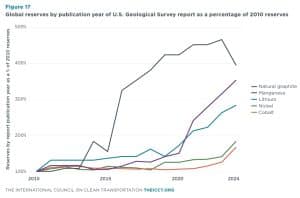
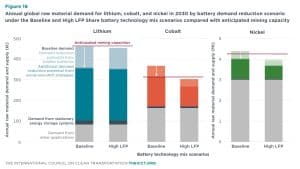
A robust EV supply chain also requires upstream investments in mining and refining capacities. Under baseline scenarios, nickel mining is projected to meet 97% of global demand by 2030. ICCP predicts if LFP batteries gain more market share then nickel supply could exceed demand to adapt to the industry dynamics.
Disclaimer: Visuals and Data Source
Alaska Energy Metals: An Emerging Nickel Player
However, mining and refining capacities face challenges, such as long project lead times and regional concentration. Governments with domestic reserves can step in with financial support to expand operations. For instance, the IRA mandates that some critical EV battery materials must be mined, refined, or recycled in the U.S. or allied countries. This ensures stable material flows, secures supply chains, and strengthens local economies.
By diversifying mining and refining capacities while promoting alternative battery chemistries, the industry can balance growth with sustainability and resource conservation.
Significantly amid all these challenging market conditions, an emerging player is targeting U.S. nickel independence. Alaska Energy Metals Corporation (AEMC) is leading efforts to support the U.S. energy transition through its flagship Nikolai project in Alaska. The site holds a significant resource of nickel, copper, cobalt, and platinum group metals. And the Canadian Nickel Junior is sourcing them sustainably.
Thus, a company like AEMC will play a significant role in reducing U.S. reliance on imports with robust exploration plans for nickel and other critical minerals.
- FEATURED: Live Nickel Prices
- CHECK OUT: Unlocking Alaska’s Nickel to Drive America’s Clean Energy Revolution
The post Nickel Supply Woes: Innovations Steering a Sustainable EV Future appeared first on Carbon Credits.
Carbon Footprint
Navigating Nature Based Solutions – The 2026 Forecast
Carbon Footprint
Surge Battery Metals Strengthens Nevada North With High-Grade Expansion and Infill Success
Surge Battery Metals (TSX-V: NILI | OTCQX: NILIF | FRA: DJ5C) delivered two strong updates from its Nevada North Lithium Project (NNLP) in February 2026. Together, these results confirm expansion potential, reinforce high-grade continuity, and advance technical work needed for the upcoming Pre-Feasibility Study (PFS).
On February 17, Surge reported a major step-out success. The company drilled a 31-meter intercept grading 4,196 ppm lithium from surface in a hole located 640 meters southeast of the existing resource boundary. This intercept sits well above the current resource average grade of 3,010 ppm lithium. The wide step-out confirms that high-grade mineralization extends significantly beyond the defined resource footprint.
Just one week later, on February 25, Surge released the final batch of results from its 2025 core drilling program. These infill holes focused on upgrading inferred resources to higher confidence categories and collecting technical data for the PFS. The results returned some of the strongest intercepts drilled to date.
Together, these two updates strengthen the project’s scale, quality, and development readiness.
Infill Drilling Confirms a Thick, High-Grade Core
The February 25 news highlighted Hole NNL-030 as a standout result. The hole intersected 116 meters, averaging 3,752 ppm lithium. Within that interval, a 32.1-meter zone graded 4,521 ppm lithium. These grades exceed the project’s current average and confirm the presence of a thick, ultra-high-grade core.
Hole NNL-032 also delivered strong results, returning 82.29 meters, averaging 3,664 ppm lithium. Hole NNL-036 intersected 78.63 meters, averaging 3,141 ppm lithium, including a deep 9.4-meter zone grading 4,580 ppm lithium.

These intercepts show both lateral and vertical continuity. They show that high-grade lithium persists across wide widths and at depth. Importantly, most of these zones occur near the surface. Near-surface mineralization reduces stripping requirements and can improve early-year mine economics.
The infill drilling supports resource upgrading efforts. It helps convert Inferred resources into Indicated and Measured categories. Higher confidence categories are critical for mine planning, financing, and permitting.
The results confirm that Nevada North’s high-grade core is consistent, thick, and scalable.
Mr. Greg Reimer, President & Chief Executive Officer and Director of Surge, stated,
“This infill drilling is doing exactly what it was designed to do: upgrade the resource, confirm continuity of some of our best lithium intercepts, and de-risk the early years of a potential mine plan at Nevada North. Coupled with a robust PEA economic profile, we believe Nevada North is strongly positioned as we move forward with the development of our PFS. We look forward to updating the Mineral Resource Estimate as our next key milestone.”
Expansion Beyond the Current Resource Boundary
The February 17 step-out result adds a new dimension to the project story. The 31-meter intercept grading 4,196 ppm lithium occurred 640 meters beyond the existing resource area. This large extension demonstrates strong mineral continuity outside the current pit-constrained model.
Step-out drilling is important because it tests the limits of a deposit. A successful 640-meter extension suggests the deposit remains open and may support future resource growth.
Nevada North already hosts a pit-constrained Inferred Resource of 11.24 million tonnes of lithium carbonate equivalent (LCE) grading 3,010 ppm lithium at a 1,250 ppm cutoff. High-grade step-out intercepts increase confidence that future resource updates may expand both tonnage and overall contained lithium.

Highly anomalous soil values and geophysical surveys also suggest the clay horizons could extend even further. The mineralized zone currently spans more than 4,300 meters in strike length and over 1,500 meters in width. Continued drilling could increase the overall scale of the project.
This combination of strong infill and wide step-out success strengthens Nevada North’s long-term growth profile.
Advancing Toward Pre-Feasibility and Permitting
The 2025 drilling program did more than confirm grade. It also collected critical technical data required for the upcoming PFS and environmental permitting.
Hole NNL-035 was strategically positioned near Texas Spring to gather hydrogeological data. The hole successfully installed the Vibrating Wire Piezometers (VWPs) to monitor groundwater conditions. This data will help model basin hydrology and support environmental approvals.
The company also completed detailed geotechnical logging across all holes. High-resolution televiewer surveys mapped fault structures. Representative samples from each rock unit are now undergoing rock strength testing. These tests will help determine safe pit wall angles for future mine planning.
Remarkably, quality control procedures were rigorous. Of the 806 total samples analyzed, 134 were QA/QC samples. Certified reference standards, blanks, and duplicates were systematically inserted.
Standards are performed within acceptable limits. Duplicate samples fell within 10% tolerance. These results confirm strong analytical accuracy and reproducibility.
This technical work reduces development risk. This, in turn, ensures that the PFS is built on high-quality geological and engineering data.
Strategic Upside: By-Products and Strong Economics
In addition to lithium, the infill drilling consistently returned elevated cesium and rubidium values. Cesium reached up to 163 ppm and rubidium up to 349 ppm in association with the lithium core. Surge is evaluating the deportment of these elements in ongoing metallurgical studies.
If recoverable, these critical minerals could add value to the project economics. By-product potential can improve revenue streams and enhance overall project returns.
Nevada North already shows strong economic metrics from its Preliminary Economic Assessment. The PEA reports an after-tax NPV (8%) of approximately US$9.17 billion and an after-tax IRR of 22.8% at a lithium price of US$24,000 per tonne LCE. Operating costs are estimated at roughly US$5,243 per tonne LCE.

High grades play a central role in these economics. Thick intervals averaging 3,500–4,500 ppm lithium reduce the tonnage required to produce each unit of lithium. This supports lower operating costs and stronger early cash flow potential.
The joint venture with Evolution Mining also strengthens the project’s development pathway. Evolution is a globally recognized mining company with operational expertise. This partnership adds technical depth and financial strength to the Nevada North project.
A Strengthened Position in the U.S. Lithium Landscape
The United States is working to strengthen its domestic lithium supply chain. Federal incentives and policy measures emphasize secure, locally sourced battery materials. Projects that combine high grade, large scale, and technical readiness are well-positioned in this environment.
Nevada North now demonstrates three key strengths at once:
- Proven high-grade core through infill drilling,
- Expansion potential through 640-meter step-out success, and
- Advancing technical data for PFS and permitting.
These updates reinforce Nevada North as one of the highest-grade lithium clay projects in the United States. They show both growth and de-risking in the same drilling campaign.
As global demand for lithium continues to rise, supply sources with strong grade, scale, and development momentum will stand out. Surge Battery Metals’ recent results highlight meaningful progress on all three fronts.
The company’s Nevada North Lithium Project is not only expanding. It is advancing toward higher confidence resources, improved technical definition, and future development milestones. These combined achievements strengthen Surge’s position within the evolving North American lithium supply chain.
DISCLAIMER
New Era Publishing Inc. and/or CarbonCredits.com (“We” or “Us”) are not securities dealers or brokers, investment advisers, or financial advisers, and you should not rely on the information herein as investment advice. Surge Battery Metals Inc. (“Company”) made a one-time payment of $50,000 to provide marketing services for a term of two months. None of the owners, members, directors, or employees of New Era Publishing Inc. and/or CarbonCredits.com currently hold, or have any beneficial ownership in, any shares, stocks, or options of the companies mentioned.
This article is informational only and is solely for use by prospective investors in determining whether to seek additional information. It does not constitute an offer to sell or a solicitation of an offer to buy any securities. Examples that we provide of share price increases pertaining to a particular issuer from one referenced date to another represent arbitrarily chosen time periods and are no indication whatsoever of future stock prices for that issuer and are of no predictive value.
Our stock profiles are intended to highlight certain companies for your further investigation; they are not stock recommendations or an offer or sale of the referenced securities. The securities issued by the companies we profile should be considered high-risk; if you do invest despite these warnings, you may lose your entire investment. Please do your own research before investing, including reviewing the companies’ SEDAR+ and SEC filings, press releases, and risk disclosures.
It is our policy that information contained in this profile was provided by the company, extracted from SEDAR+ and SEC filings, company websites, and other publicly available sources. We believe the sources and information are accurate and reliable but we cannot guarantee them.
CAUTIONARY STATEMENT AND FORWARD-LOOKING INFORMATION
Certain statements contained in this news release may constitute “forward-looking information” within the meaning of applicable securities laws. Forward-looking information generally can be identified by words such as “anticipate,” “expect,” “estimate,” “forecast,” “plan,” and similar expressions suggesting future outcomes or events. Forward-looking information is based on current expectations of management; however, it is subject to known and unknown risks, uncertainties, and other factors that may cause actual results to differ materially from those anticipated.
These factors include, without limitation, statements relating to the Company’s exploration and development plans, the potential of its mineral projects, financing activities, regulatory approvals, market conditions, and future objectives. Forward-looking information involves numerous risks and uncertainties and actual results might differ materially from results suggested in any forward-looking information. These risks and uncertainties include, among other things, market volatility, the state of financial markets for the Company’s securities, fluctuations in commodity prices, operational challenges, and changes in business plans.
Forward-looking information is based on several key expectations and assumptions, including, without limitation, that the Company will continue with its stated business objectives and will be able to raise additional capital as required. Although management of the Company has attempted to identify important factors that could cause actual results to differ materially, there may be other factors that cause results not to be as anticipated, estimated, or intended.
There can be no assurance that such forward-looking information will prove to be accurate, as actual results and future events could differ materially. Accordingly, readers should not place undue reliance on forward-looking information. Additional information about risks and uncertainties is contained in the Company’s management’s discussion and analysis and annual information form for the year ended December 31, 2024, copies of which are available on SEDAR+ at www.sedarplus.ca.
The forward-looking information contained herein is expressly qualified in its entirety by this cautionary statement. Forward-looking information reflects management’s current beliefs and is based on information currently available to the Company. The forward-looking information is made as of the date of this news release, and the Company assumes no obligation to update or revise such information to reflect new events or circumstances except as may be required by applicable law.
Carboncredits.com receives compensation for this publication and has a business relationship with any company whose stock(s) is/are mentioned in this article.
Additional disclosure: This communication serves the sole purpose of adding value to the research process and is for information only. Please do your own due diligence. Every investment in securities mentioned in publications of carboncredits.com involves risks that could lead to a total loss of the invested capital.
Please read our Full RISKS and DISCLOSURE here.
The post Surge Battery Metals Strengthens Nevada North With High-Grade Expansion and Infill Success appeared first on Carbon Credits.
Carbon Footprint
Canada Approves First Uranium Mine in 20 Years as Tech Giants Eye Nuclear Fuel for AI Power
Canada has taken a major step in its mining history. The country recently approved the first large-scale uranium mine in more than 20 years. This new project is part of Canada’s effort to support clean energy and nuclear power production.
The federal and provincial governments approved the Phoenix In Situ Recovery (ISR) uranium mine. This mine is part of Denison Mines’ Wheeler River Project in Saskatchewan. This approval allows the construction of both the mine and its processing mill.
Phoenix will use ISR mining, a method seen as more environmentally friendly than traditional open-pit or underground mining. The technique uses liquid to dissolve uranium underground. It then brings the uranium to the surface for processing. This method reduces land disturbance compared to traditional methods.
With its license now issued and environmental reviews completed, construction is expected to take about two years. The project remains on track for its first production by mid-2028.
The approval is a milestone for Canada’s nuclear fuel sector. It signals renewed interest in uranium mining at a time when nuclear power is gaining traction as a low-carbon energy source.
A New Era for Canada’s Uranium Sector
Uranium is the key fuel for nuclear power plants. Nuclear power provides large amounts of low-carbon electricity around the world. As countries seek to reduce greenhouse gas emissions, nuclear energy is playing a growing role in clean energy strategies.
Canada is one of the world’s top uranium producers. Mines like Cigar Lake, McClean Lake, and Rabbit Lake in Saskatchewan have been supplying uranium for decades.

However, no new large mining projects had been approved at the federal level in over two decades before Phoenix. Canada can now boost uranium production. This will help support nuclear fuel supply chains at home and abroad.
The Phoenix mine will create economic benefits. This includes jobs during both construction and operations in northern Saskatchewan. It will also contribute to local tax revenue and community development.
Rising Power Needs Put Nuclear Back in Focus
Nuclear power accounts for a significant share of clean electricity globally. Nuclear reactors produce constant, reliable power that does not depend on weather like wind or solar. Many countries view nuclear energy as critical to meeting climate goals while maintaining grid stability.
As electric grids transition to cleaner energy sources, the demand for uranium — the core fuel for nuclear plants — is rising.
According to the International Energy Agency (IEA), global electricity demand grew by 3 % in 2025, following a 4.4 % increase in 2024. The agency expects demand to rise by about 3.6% each year from 2026 to 2030. This growth will come from industrial use, electrification, electric vehicles, cooling needs, and more data centers.

This growth underscores the need for reliable, low-carbon generation capacity. Nuclear energy is a strong candidate because it supplies large volumes of consistent electricity with low emissions.
Tech Sector Turns to Nuclear for 24/7 Power
As electricity demand grows, especially from data centers, tech companies are focusing on long-term power solutions.
Executives at NexGen Energy, developing Canada’s largest uranium project in Saskatchewan, say they’ve talked with data center providers. They discussed financing uranium mining projects and securing a long-term uranium supply. These talks aim to ensure stable fuel for nuclear plants that could help power future data infrastructure.
CEO Leigh Curyer said,
“It’s coming. You’ve seen it with automakers. These tech companies, they’re under an obligation to ensure the hundreds of billions that they are investing in the data centres are going to be powered.”
NexGen is working on the Rook I uranium project in Saskatchewan’s Athabasca Basin. This area is one of the richest for uranium and hosts Canada’s largest development-stage uranium project.

The company anticipates full government approval soon, and it aims for production around 2030. NexGen executives say the mine could supply more than 20 % of global uranium demand once operational.
NexGen’s discussions with data center operators focus on financing and long-term supply agreements. The idea is like car makers investing in battery material mines. They do this to secure vital supplies for electric vehicles.
These talks do not involve giving tech firms any control of NexGen. Instead, they focus on ways to help ensure uranium supply and potentially support early project development.
- MUST READ: From Now to 2060: How Canada’s SMRs and Maritime Nuclear Power Will Drive a Net-Zero Future
Why Tech Firms Are Interested in Nuclear Fuel
Modern data centers need a lot of electricity. This is especially true for those supporting AI, cloud computing, and large digital services. Power demand from data centers is a key driver of rising global electricity use, according to the IEA.
Unlike intermittent renewables, nuclear power provides 24/7 electricity that is not affected by weather. This reliability makes it attractive for companies that need stable energy for critical infrastructure.
Some technology firms have already signaled interest in long-term arrangements with nuclear energy providers. These supply arrangements might involve financing for mining, long-term fuel contracts, or offtake agreements when projects start production.
Long-term contracts for uranium can help companies lock in fuel supply for decades. This can reduce risks related to supply shortages or price volatility in commodity markets.The discussions show how energy security and climate goals are intersecting with corporate planning in the tech sector.
- SEE MORE: Project Matador: America’s $90B Nuclear Power Solution for AI, Semiconductors, and Data Centers
Tight Supply and Rising Prices Reshape the Market
The uranium market has tightened in recent years. Uranium prices have gone up. This rise shows supply issues and increasing interest in nuclear energy. Recent trading values put uranium at almost US$89 per pound, after briefly exceeding US$100 per pound in end of January.

Projections suggest that global nuclear capacity will need more fuel in coming decades as new reactors come online and existing ones are extended. Countries like China and India are expanding nuclear power to meet their growing electricity needs.
In Canada, new mines such as Phoenix and big projects like Rook I can fill global supply gaps. They also support national energy plans.
Global Supply Strain: U.S. and China Reshape the Uranium Market
The scramble for uranium supply is accelerating beyond Canada.
In the United States, a ban on Russian enriched uranium imports will take full effect in January 2028. Russia holds around 44% of the world’s uranium enrichment capacity. In 2023, it provided 27% of U.S. utility enrichment purchases, according to S&P Global Commodity Insights.
To reduce this dependence, the U.S. Department of Energy announced $2.7 billion in task orders to expand domestic enrichment capacity. The funding supports Centrus Energy, General Matter, and Orano Federal Services.
- Orano got $900 million to build a new enrichment facility in Oak Ridge, Tennessee. They expect to submit a license application in the first half of 2026.
Conversion capacity is also expanding. Solstice Advanced Materials plans to increase uranium conversion output by 20% at its Metropolis Works plant in Illinois. The facility is expected to exceed 10 kilotonnes of UF₆ production in 2026, and it is reportedly sold out through 2030.
At the same time, China’s nuclear buildout is adding pressure to global supply. China operates 58 reactors, with 34 more under construction. Citi Research estimates China’s uranium needs will rise from 35 million pounds in 2025 to 58 million pounds by 2030, equal to about 27% of global demand. Yet, China produces only around 4 million pounds domestically.
Global uranium demand could reach 400 million pounds by 2040, more than double today’s levels. Meanwhile, about 70% of post-2027 uranium requirements remain uncontracted, highlighting the growing supply gap.

S&P Global expects a uranium market upcycle until 2028, fueled by rising nuclear demand, especially from AI data centers. Global capacity is set to double, reaching 561-992 GW by 2050. Production jumps 141% to 141.2 million pounds by 2033, generating $14.9 billion revenue at $98.7/lb—65% above current prices.
Kazatomprom and Cameco will lead in 2025, generating $5.4 billion in revenue. This accounts for 86% of the group’s output. After 2028, NexGen and Denison will drive the supply wave, peaking at $1.6 billion in capex. Big Tech (Meta, AWS, Google, Microsoft) signs PPAs and equity deals.
Nuclear Fuel Security Becomes a Climate Strategy
The approval of a new mine after more than 20 years shows that uranium is regaining importance in global energy planning. The Phoenix ISR project and other potential mines reflect renewed confidence in nuclear fuel production.
Early interest from tech companies in securing uranium supply shows a shift in energy planning. As power demand increases, companies are exploring new clean energy options. They want stable, low-carbon electricity.
For countries pushing decarbonization, nuclear power — supported by a stable uranium supply — offers a path to reduce emissions while meeting baseload electricity demand.
In this context, the Canadian uranium sector is poised for growth. New mines and potential private sector involvement may strengthen nuclear fuel security, supporting both national and global energy transitions.
The post Canada Approves First Uranium Mine in 20 Years as Tech Giants Eye Nuclear Fuel for AI Power appeared first on Carbon Credits.
-
Greenhouse Gases7 months ago
Guest post: Why China is still building new coal – and when it might stop
-
Climate Change7 months ago
Guest post: Why China is still building new coal – and when it might stop
-
Greenhouse Gases2 years ago嘉宾来稿:满足中国增长的用电需求 光伏加储能“比新建煤电更实惠”
-

Climate Change2 years ago
Bill Discounting Climate Change in Florida’s Energy Policy Awaits DeSantis’ Approval
-
Climate Change2 years ago
Spanish-language misinformation on renewable energy spreads online, report shows
-
Climate Change2 years ago嘉宾来稿:满足中国增长的用电需求 光伏加储能“比新建煤电更实惠”
-
Climate Change Videos2 years ago
The toxic gas flares fuelling Nigeria’s climate change – BBC News
-
Carbon Footprint2 years agoUS SEC’s Climate Disclosure Rules Spur Renewed Interest in Carbon Credits


