

Governments at the annual oceans summit reaffirmed commitments to protect key marine ecosystems including the high seas and coral reefs, but observers said funding barriers and polluting projects are hampering progress on putting them into practice.
At the Our Ocean Conference in Kenya’s coastal city of Mombasa this week, some 3,000 delegates – including government officials, scientists, business representatives and activists – gathered to discuss ocean protection and push for marine issues to move from the margins to the centre of global climate diplomacy.
Campaigners said the overall picture was positive. Oceans are gaining more visibility in international climate discussions: from blue carbon ecosystems such as mangroves, to coastal adaptation, marine biodiversity, ocean finance and the High Seas Treaty.
In this year’s preliminary conference report, the secretariat listed 320 existing ocean commitments worth $6.4 billion, with about $1.1 billion destined to address the climate crisis. Many of these pledges were already announced before the conference.
But as momentum builds ahead of the COP31 climate summit in Türkiye, John Kerry, former US climate envoy and founder of the Our Ocean Conference, warned that the conversations and commitments on ocean protection will mean little if implementation continues to lag behind action.
-
West African nations target Eastern Atlantic for early high seas protection
At the 11th Our Ocean Conference, African governments launched a bid to have the zone classified as one of the first high-seas protected areas -
Offshore oil and gas expansion threatens key marine ecosystems, report warns
Sea life in countries like Kenya is under threat from planned new oil and gas production, analysis by environmental groups has found -
How Shell is still benefiting from offloaded Niger Delta oil assets
Shell used its exit from onshore operations in Nigeria to boost its climate credentials, but new reporting shows that the firm continues to trade oil from its former business


“The ocean can no longer be an afterthought in climate policy,” Kerry told delegates at the opening ceremony of the conference. “Now it must become central to our climate solutions.”
“The challenge before us is not a lack of knowledge. We know exactly what has happened,” he said. “The challenge is whether political will can finally catch up with the science.”
He added that the meeting taking place on the shores of the Indian Ocean should be remembered as the moment the process moved “from commitments to implementation”.
The ocean has quietly shielded humanity from the worst impacts of climate change for decades, absorbing around 90% of the excess heat generated by global warming while sustaining the livelihoods of billions of people.
From pledges to progress
Oceans have been largely absent from international climate negotiations, often treated as a conservation issue rather than a core component of climate action.
Yet scientists say the ocean absorbs around a quarter of humanity’s annual carbon emissions and plays a critical role in regulating global temperatures.
Research suggests that ocean-based solutions – from restoring mangroves and seagrass meadows to decarbonising shipping and expanding marine protected areas – could deliver up to 35% of the emissions reductions needed to keep global warming within 1.5 degrees Celsius by mid-century.
That growing recognition has fuelled calls for oceans to play a larger role in climate policy and negotiations. Against that backdrop, the Our Ocean Conference – launched in 2014 to mobilise governments, business, philanthropies and activists – has emerged as a platform for advancing action to keep the planet’s seas healthy.
According to the conference secretariat, the process has generated more than 2,900 commitments worth nearly $170 billion in the 10 years since its launch. The gathering in Mombasa was the 11th conference and the first to take place in Africa.
This week, Canada and Jamaica were confirmed as the hosts of the next two Our Ocean conferences in 2027 and 2029. There is none planned for 2028, as the UN Ocean Conference will be co-hosted by South Korea and Chile that year, the secretariat said.
Science ‘under attack’ from fossil fuel interests at UN climate talks
In Mombasa, governments reaffirmed more than 300 commitments linked to the creation of new marine protected areas, reducing marine pollution, and developing sustainable fisheries, among others.
Most of the finance mobilised went to “blue economy” initiatives, including the European Union’s Ocean Eye initiative, which will mobilise €50 million ($57 million) to offset a Trump administration decision to scale back the US Ocean Observatories Initiative and weaken scientific marine data.
“More important than the new pledges is the actual delivery of commitments,” Cynthia Barzuna, who heads the conference secretariat at the World Resources Institute, told Climate Home News. “That is what makes a difference for marine ecosystems and coastal communities.”
Last year, the secretariat published its first comprehensive assessment of implementation, finding that nearly 80% of commitments made through the conference were either completed or progressing towards completion.

Barriers remain
Yet while oceans are climbing the political agenda, significant barriers remain to turning ambition into meaningful action.
The secretariat’s assessment found that successful projects involved local communities, strengthened local expertise, and secured long-term financing. Many organisations, however, reported difficulties accessing sustained funding, particularly in developing countries.
African initiatives, for example, tend to rely on short-term project grants, creating what Barzuna described as a “patchwork of impacts on the ground” rather than the systemic change needed to protect marine ecosystems and coastal livelihoods.
Campaigners say a broader challenge lies in ensuring that growing recognition of the ocean’s importance is reflected in wider climate and economic policies.
While countries have pledged to expand marine protected areas, restore coastal ecosystems and strengthen ocean governance, many continue to pursue activities that place additional pressure on marine environments, including offshore fossil fuel development.
“This year’s Our Ocean Conference comes at a critical moment where the incoming presidencies for COP31 – both Türkiye and Australia – have a strong interest increasing the prominence of the ocean in the COP,” Shamini Selvaratnam, director of International Climate and Clean Energy at the Ocean Conservancy, told Climate Home News.
“But we cannot talk about ocean health and then continue to explore offshore oil and gas – those two things are incompatible. It’s like asking the dolphin to swim on the land.”
For supporters of the ocean agenda, the question is no longer whether oceans matter to climate action. The challenge now is ensuring that governments match rising political ambition with funding, implementation and accountability.
“The ocean has actually been acting as Earth’s life support system – and it has been protecting us,” Kerry told delegates. “The question before us is whether we are willing to protect the ocean in return.”
The post Mombasa ocean summit drives progress on marine protection, but threats persist appeared first on Climate Home News.
Mombasa ocean summit drives progress on marine protection, but threats persist

For the first time, new-energy vehicles (NEVs) made up 67% of new car sales in China in September, according to the latest data from the China Passenger Car Association (CPCA).
The figures show that NEVs, which include battery electric cars and plug-in hybrids, captured a record share of sales, even though fewer were sold than last year.
This is because sales of combustion-engine cars are falling steeply, a trend that the CPCA has attributed to rising petrol prices following the start of the Hormuz crisis.
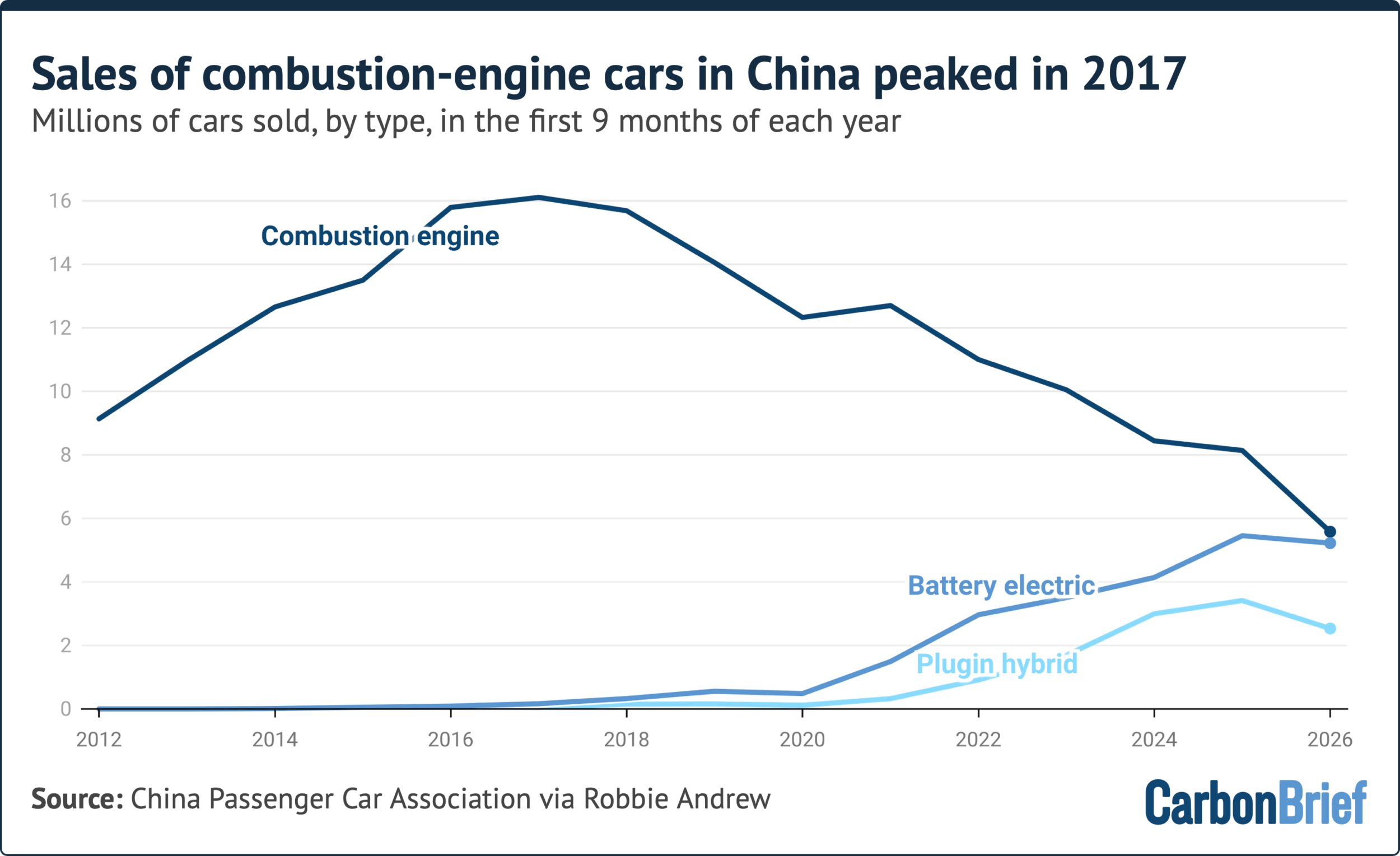
Indeed, sales of fuel-only cars were down 31% year-on-year in the first nine months of 2026, with plug-in hybrid sales down 26% – whereas battery EV sales were only down 4%.
One analyst tells Carbon Brief that China’s rapidly growing EV fleet has offset demand for 143m barrels of oil since the start of the Hormuz crisis.
Another says that the crisis is “reinforcing China’s electrification of road transport”.
Meanwhile, amid slowing domestic sales, Chinese carmakers’ exports of NEVs more than doubled [in 2026 to date / in September] from a year earlier.
NEV record
A record two out of every three cars sold in September in China were NEVs, according to CPCA data, as shown in the figure below.
(NEVs predominantly include battery electric vehicles – BEVs – and plug-in hybrids – PHEVs. BEVs only run on electricity, whereas PHEVs also have a combustion engine.)
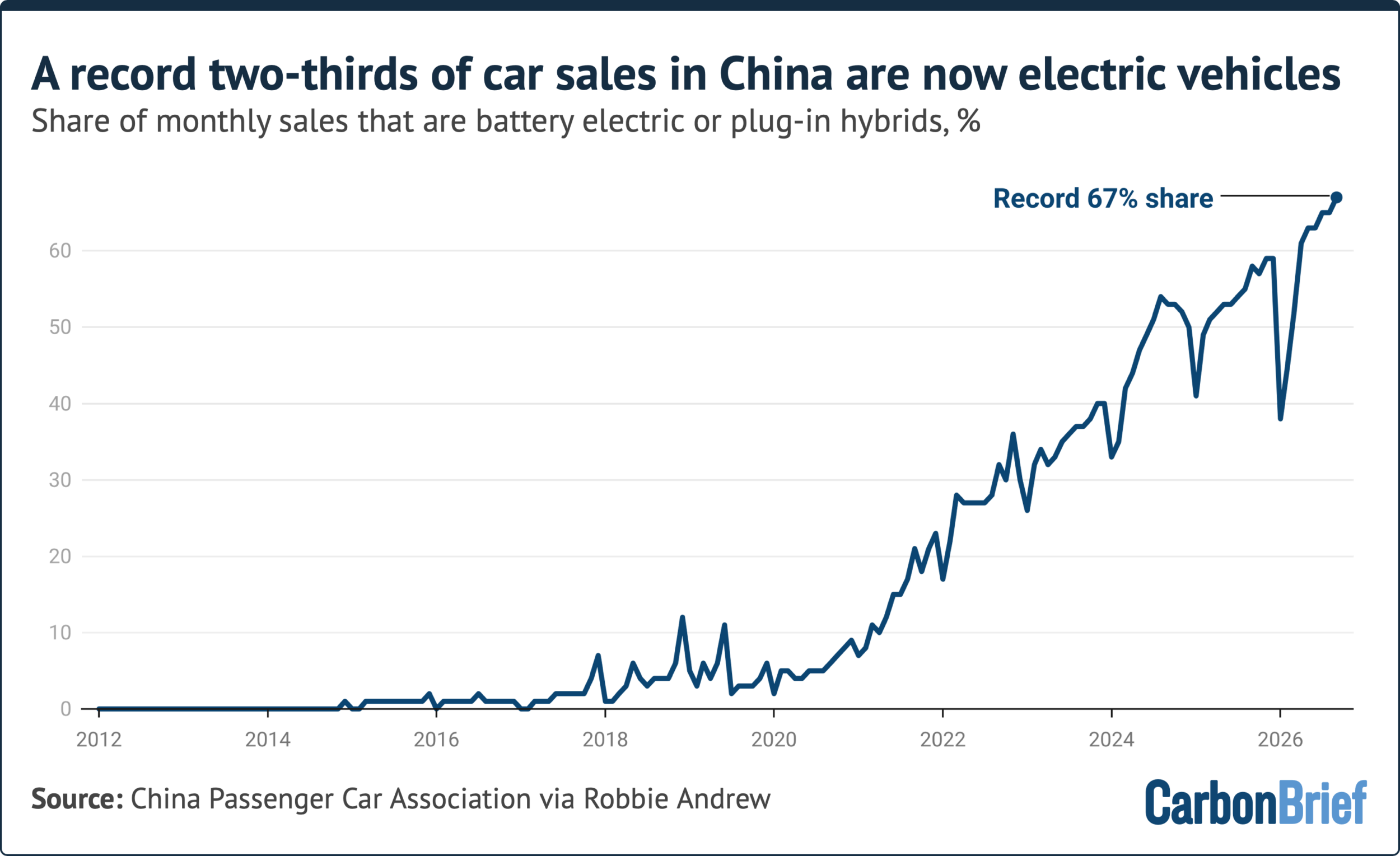
This marks a rapid rise for NEVs from just 6% of new car sales in 2020 up to 58% in 2026 to date – and a record 67% in the month of September.
This year, NEVs’ share of sales has also bounced back from a low of 39% in January, after the full purchase tax exemption that had been in place for more than a decade came to an end in December 2025.
The gain in NEV share in 2026 has come amid a slowdown across the wider domestic passenger-car market, which has hit sales of combustion-engine vehicles particularly hard.
This September, passenger-car retail sales across all categories declined, with overall sales volumes falling 28% year-on-year.
The contraction was led by combustion-engine vehicles, which saw sales fall 43% year-on-year in September and 31% in 2026 to date.
However, sales of PHEVs also fell by 36% year-on-year in September and by 26% in 2026 to date. By comparison, BEVs performed better, although sales still declined 8.5% from a year earlier in September and 4% in 2026 to date.
As a result, NEV sales overall fell by 17% in September and 13% in 2026 to date.
While the market changes in 2026 to date were particularly dramatic, they reflect a broad continuation of trends seen over the past decade.
Indeed, sales of combustion-engine cars in China peaked in 2017 and they have been declining ever since, shown in the figure below.
Impact of Hormuz
Part of the reason for the advance of NEVs in 2026, said Chinese technology news outlet OFweek, was petrol cars “giving up market share” as they were outperformed by electric alternatives.
Cui Dongshu, secretary-general of the CPCA, cited higher petrol prices as an explanation for September’s weak combustion-car sales, in comments to financial news outlet National Business Daily.
Imports of oil into China in January-September have fallen 15% compared to 2025, equivalent to 470m barrels, as ongoing conflict tightened supply and drove up prices.
China’s passenger-car NEV fleet has displaced 143m barrels of oil so far during the strait of Hormuz crisis, Euan Graham, senior energy analyst at thinktank Ember, tells Carbon Brief.
EVs “accounted for 12% of the decrease in China’s oil use post-Hormuz”, according to an estimate provided to thinktank the Brookings Institute by an unnamed analyst.