More than a dozen wildfires have been sweeping through Los Angeles in California, consuming tens of thousands of acres of land and devastating some of the wealthiest neighbourhoods in the US.
As firefighters battle to contain the blazes, at least 24 people have died, while tens of thousands of people have been forced to evacuate and thousands of properties have been razed to the ground.
The disaster has received widespread attention across international media, covering the scale of the damage through to the causes of the fires – and the political spats they have triggered.
Both US president Joe Biden and his Californian vice-president Kamala Harris made the link between climate change and the fires.
Meanwhile, many scientists have pointed to “climate whiplash” – rapid switches from wet to dry conditions that are becoming more common in a warmer climate – as a factor in the scale of the devastation.
Many outlets have highlighted misleading claims by right-wing commentators about the Los Angeles fire department, as well as statements from incoming president Donald Trump casting blame on California’s Democratic governor, Gavin Newsom.
A number of outlets have also explored the impact of the wildfires – which have already been dubbed the costliest in US history – on the state’s already-fragile property insurance market.
In this article, Carbon Brief examines the role of climate change in the Los Angeles wildfires and how the media has covered the disaster.
- How did the wildfires develop around Los Angeles?
- How were the fires ignited?
- What have been the impacts of the fires?
- Does climate change have a role in driving the fires?
- What has been the political reaction?
- How has the media responded to the wildfires?
- What are the implications for insurance in the state?
How did the wildfires develop around Los Angeles?
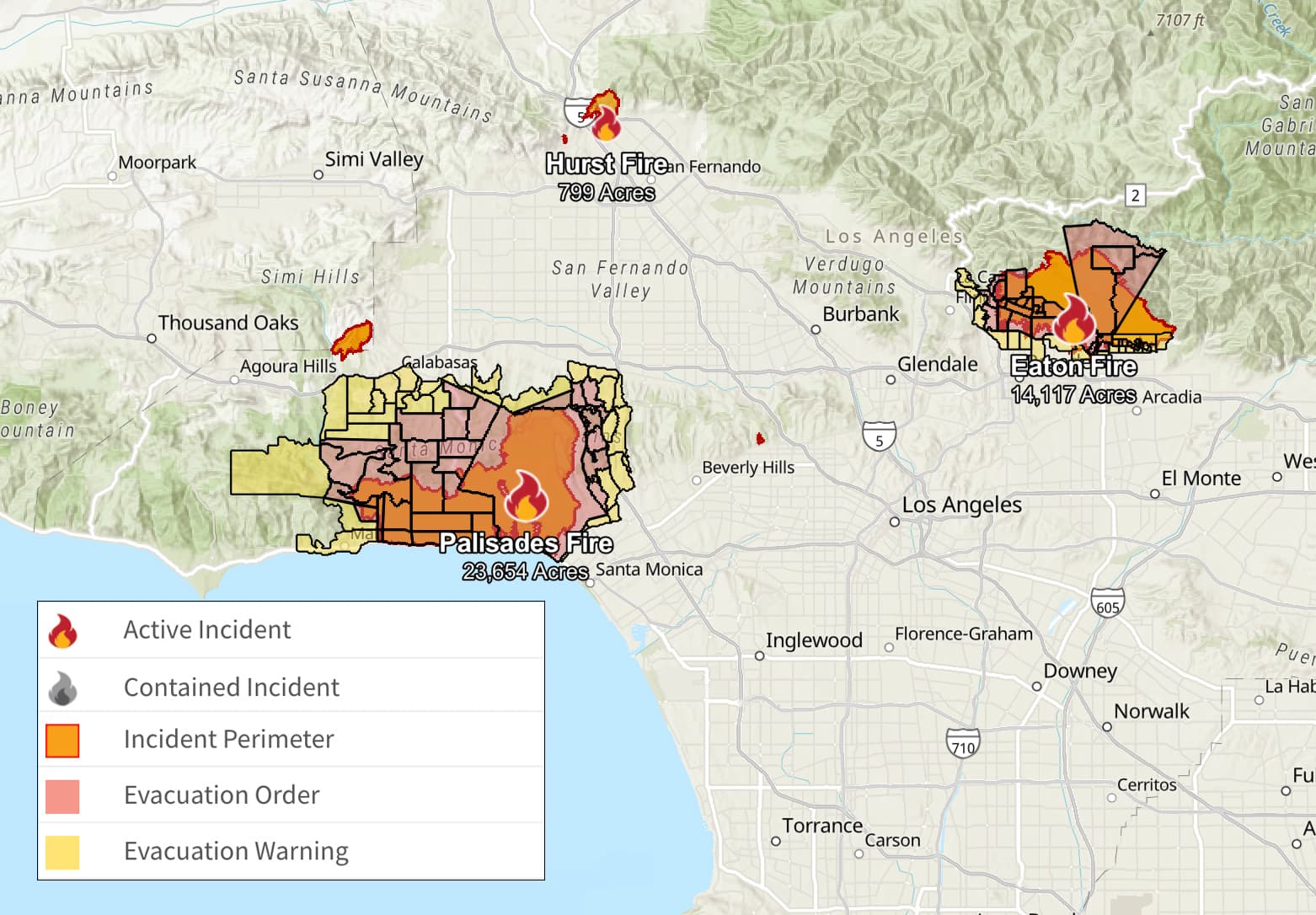
Over the course of just a week in early January, multiple fires erupted in and around Los Angeles in southern California.
The first – and what became the largest – wildfire was the Palisades fire. This was first reported at around 10:30am on Tuesday 7 January and quickly spread, explained the Washington Post, “as winds gust[ed] to about 50 mph in the area”.
The Financial Times reported that more than 29,000 acres [11,174 hectares] were burned on Tuesday in Palisades, “an affluent coastal community with some of the most expensive property in the US”. With thousands of homes at risk, evacuation orders were issued for around 30,000 people, according to the newspaper.
Rescuers were “forced to use a bulldozer to clear a path” through gridlocked, abandoned cars for emergency services to pass, reported the Times.
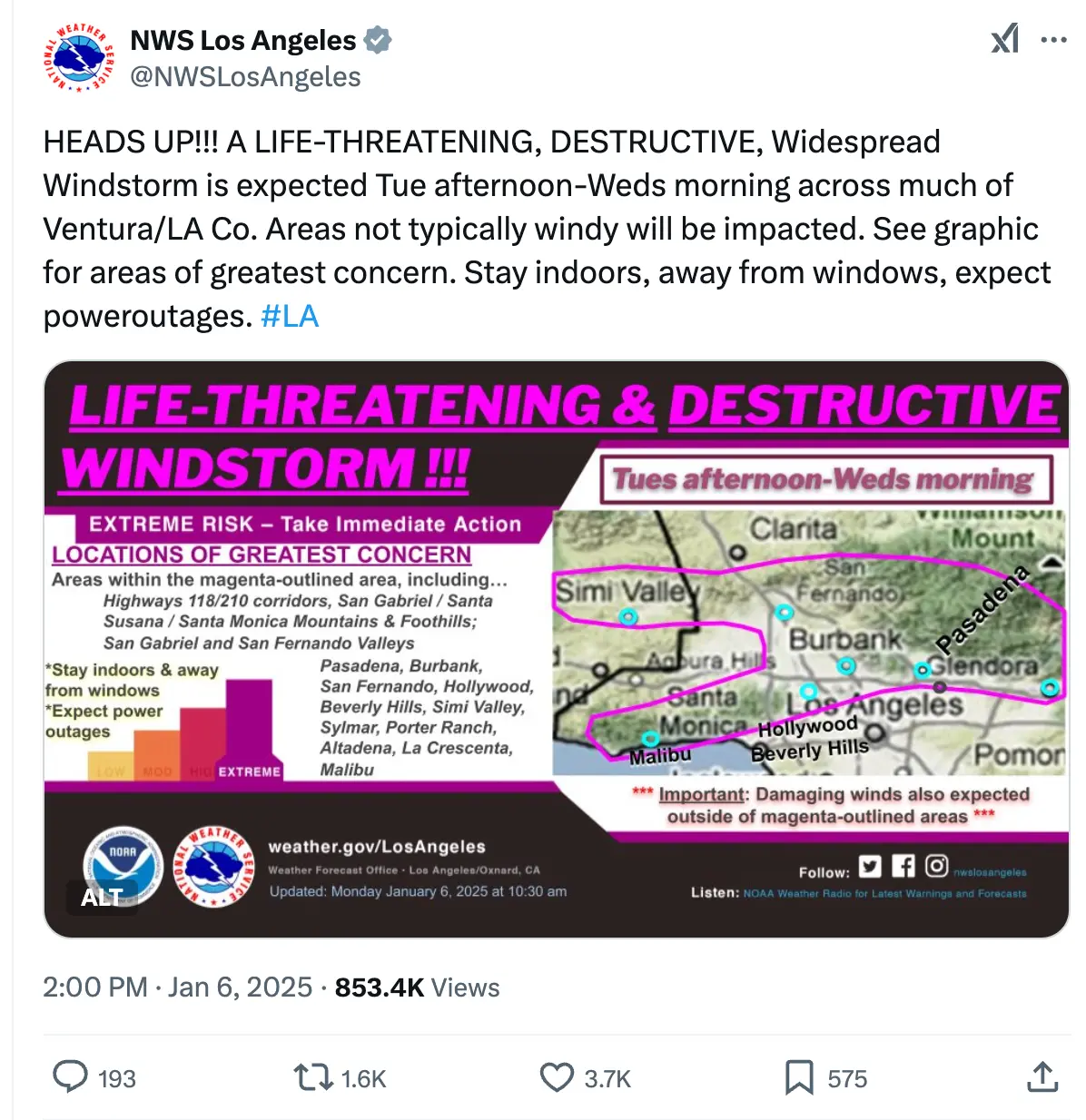
Through the day, a “life-threatening” windstorm “accelerated the fire’s spread across a parched landscape that has had very little rain in months”, the FT said. This storm was the “strongest to hit southern California in more than a decade”, the Associated Press noted.
An AP photographer reported seeing “multi-million dollar mansions on fire as helicopters overhead dropped water loads”.
The Washington Post described the Palisades fire as a “monster from the start”, noting that it spanned “the size of 150 football fields within half an hour and an area larger than Manhattan a day after that”.
On Tuesday night, a fast-moving fire broke out in the hills above Altadena near Eaton Canyon, reported the Los Angeles Times, prompting further evacuation orders.
The Eaton fire had “quickly grown to 200 acres” [81 hectares] by Tuesday night, said the Times, while “another fire had ignited in Sylmar, a suburb north-west of Los Angeles, and had already consumed 50 acres [20 hectares] with some nearby residents ordered to evacuate”.
These three fires – Palisade, Eaton and what would later be named the Hurst fire – would become the focus of media coverage, but a number of other fires, such as Kenneth, Archer, Sunset, Lidia, Woodley and Olivas, also ignited across the region through the week.
By Tuesday evening, California governor Gavin Newsom had declared a state of emergency, CBS News reported.
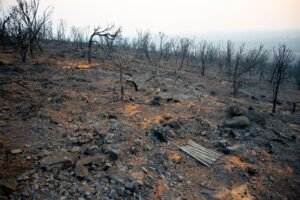
On Wednesday, the wildfires “burned uncontrollably across a wide swathe of greater Los Angeles”, reported the Washington Post, “transforming the landscape into scenes of apocalyptic destruction with blocks and blocks of neighborhoods reduced to ash”.
By the end of the day, more than 1,000 structures had been destroyed, at least 130,000 people were under evacuation orders and nearly 1.5 million residents were without power, the newspaper said. The fires were still raging with “almost zero containment”, it added.
The newspaper quoted Los Angeles county fire chief Anthony Marrone, who warned that his department was prepared for one or two major fires, but not for “this type of widespread disaster”. He added:
“There are not enough firefighters in LA county to address…fires of this magnitude.”
In response, firefighting teams from across California and the west “poured into the Los Angeles region in recent days to help relieve and reinforce local crews”, said the Washington Post.
Reports also emerged that firefighters were, in the words of BBC News, “struggl[ing] with water supply to their hoses and hydrants”. Reuters noted that “Los Angeles authorities said their municipal water systems were working effectively but they were designed for an urban environment, not for tackling wildfires”.
In total, at least a dozen fires have raged across the greater Los Angeles area over the past week. By Friday, the two largest fires of Palisades and Eaton were 8% and 3% contained, respectively, reported the Los Angeles Times. This increased to 11% and 15% by Saturday morning.
[As of early Monday 13 January (Pacific Standard Time), fire containment stood at 14%, 33% and 95% for the Palisades, Eaton and Hurst fires, respectively, according to California’s Department of Forestry and Fire Protection. All other fires have been contained.]
With more heavy winds expected this week, a local fire chief told BBC News that the fight against the blazes is “at a fork in the road”, warning that the fires could “take off on Tuesday or Wednesday”.
How were the fires ignited?
Investigators are still exploring the initial cause of the fires, reported the Associated Press.
While lightning is the “most common source of fires in the US…investigators were able to rule that out quickly”, the newswire said. It explained:
“There were no reports of lightning in the Palisades area or the terrain around the Eaton fire.”
The next two most-common causes are “fires intentionally set and those sparked by utility lines”, it added.
NBC News reported that the key to identifying the cause of the Palisades fire lies “on a brush-covered hilltop where the blaze broke out just after 10:30am on Tuesday”. A former battalion chief for the Los Angeles Fire Department told the outlet that arson was an unlikely cause:
“This is what we call inaccessible, rugged terrain…Arsonists usually aren’t going to go 500 feet off a trailhead through trees and brush, set a fire and then run away.”
Analysis by the Washington Post suggested the cause was an extinguished fire from New Year’s Eve. Combining photos, videos, satellite imagery, radio communications and interviews, the newspaper concluded that “the new fire started in the vicinity of the old fire, raising the possibility that the New Year’s Eve fire was reignited, which can occur in windy conditions”.
The Daily Mail picked up the Washington Post’s reporting, describing it as a “haunting new theory”.
Other fires, such as the Eaton fire, were linked to power lines, reported NBC News (link above):
“Whipping winds can cause the lines to slap together, shedding small balls of superhot molten metal.”
The Guardian noted that “it is routine for utilities to shut off power during ‘red-flag events’, but the power lines were on near the Eaton and Palisades fires” when they started last week.
However, NBC News said, this was just one theory, adding that “it’s also possible that it was started by a person operating a camping stove or a car or lawn mower that ejected a hot spark onto dry grass”.
What have been the impacts of the fires?
The fires that swept through Los Angeles have consumed more than 40,000 acres [16,187 hectares] of land, spread across a number of neighbourhoods in both the city and Los Angeles county, according to an update from the Washington Post on Monday 13 January.
The outlet also noted the fires had claimed the lives of 24 individuals at the latest count.
NPR added that more than 12,000 structures, including houses and businesses, had been destroyed by the fires over seven days.
In a separate article, the Washington Post mapped the wildfires in various areas in Los Angeles – Palisades, Eaton and Hurst. It noted that, as of 12 January, the Lidia, Sunset, Woodley, Archer and Kenneth fires had been contained.
In response to the fires, evacuation orders were issued for approximately 153,000 people in LA county, NBC Los Angeles reported.

The New York Times added that some evacuees found temporary housing in Los Angeles hotels, including a luxury hotel in Santa Monica and 19 hotels owned by the IHG chain, which includes Intercontinental, Regent and Holiday Inn.
Evacuations were ordered in “many parts of Pacific Palisades, Malibu, Santa Monica, Calabasas, Brentwood and Encino”, Los Angeles Times reported. Meanwhile, in areas including Glenoaks Canyon and Chevy Chase Canyon, evacuation orders were lifted, allowing residents to return to their homes, according to the outlet.
However, due to poor air quality affecting regions not directly impacted by the fires, schools in Los Angeles were cancelled on Friday, according to NBC Los Angeles. “Nearly all LA unified [school district] campuses and all offices would reopen Monday”, the Los Angeles Times added.
Cultural events have also been impacted, with the nominations for the 97th Academy Awards, and the Critics’ Choice Awards being postponed, as well as television shows such as Grey’s Anatomy and Jimmy Kimmel Live!, as reported by ABC News.
Meanwhile, an early estimate of total damages by insurance provider AccuWeather, widely cited in the media, including BBC News, predicts the fires have caused $135-150bn in total damages.
The fires are expected to have a major impact on California’s property insurance market. (See: What are the implications for insurance in Los Angeles?)
Does climate change have a role in driving the fires?
The severity and likelihood of wildfires are affected by a wide range of conditions. Some of these are related to the climate, such as temperature, wind speed and rainfall. Meanwhile, others are linked to land use, such as the density and type of vegetation, or human-implemented fire-suppression techniques.
Nevertheless, there is a wide body of evidence showing that climate change is making wildfire conditions more likely in many parts of the world. Attribution studies have revealed that climate change has already made many individual wildfires more intense or likely. However, no such attribution study has yet been published about the Los Angeles wildfires.
News outlets and experts across the world have been making the climate connection to the fires in recent days. Many outlets note that Los Angeles has seen rapid swings between extremely dry and wet conditions over the past few years.
BBC News reported that “decades of drought in California were followed by extremely heavy rainfall for two years in 2022 and 2023”, which allowed lots of vegetation to grow. However, the state saw a switch to very dry conditions in the autumn and winter of 2024, which dried out the vegetation, providing ideal fuel for the wildfire.
The outlet highlighted a timely academic paper, which explains that climate change has increased “hydroclimate whiplash” conditions – the rapid swings between periods of high and low rainfall – globally by 31-66% since the middle of the 20th century.
Dr Daniel Swain – a climate scientist from UCLA, who led the research – wrote a Bluesky thread explaining why climate “whiplash” can create the ideal conditions for fires to spread. He said:
“In coastal southern California, where grass and brush (including chaparral) are predominant vegetation types, there is actually a historical relationship between wetter winters and increased fire activity in [the] following fire season.”
Many outlets unpacked the rapid changes in California’s rainfall. The Guardian reported that in both the rainy seasons of 2023 and 2024, more than 25 inches of rain fell over southern California. However, it said this year’s rainy season “is running at just 2% of normal for Los Angeles, which has only seen 0.16in [4mm] of rain so far”.
Al Jazeera reported that, on 7 January, only 39% of California was completely drought-free, with the rest of the state described as “abnormally dry”. However, around the same time last year, 97% of the state was classed as “drought-free”, with only 3% classed as abnormally dry, it said.
Many outlets also pointed to the Santa Ana winds. According to the Guardian, these winds blow dry, warm air into California from the US western desert during cooler months, and have contributed to many forest fires in the past. The Associated Press reported that the winds were “much faster than normal” this year and have been “whipping flames and embers at 100mph – much faster than normal”.
BBC News reported that the low-humidity Santa Ana wind “strips the vegetation of a lot of its moisture, meaning that fire can catch quicker and the vegetation burn more readily”.
Inside Climate News said the “unusually warm” band of the Pacific Ocean near southern California is bending the jet stream, allowing high pressure to settle over the north-east of Los Angeles, while intensifying the Santa Ana winds.
In the Conversation, Prof Jon Keelet from the University of California, Los Angeles, explained his research, which shows a shift in the timing of Santa Ana winds. “Due to well-documented trends in climate change, it is tempting to ascribe this to global warming, but, as yet, there is no substantial evidence of this,” he said.
What has been the political reaction?
As the fires blazed, US president Joe Biden met with California’s Democratic governor, Gavin Newsom, and approved his request for a major disaster declaration, enabling increased federal funding, according to the Los Angeles Times.
When asked by NBC News if he thought these fires would be the worst “natural” disaster in US history, Newsom replied: “I think it will be just in terms of just the costs associated.”
Craig Fugate, the Federal Emergency Management Agency (FEMA) administrator under former president Barack Obama, told the Los Angeles Times that the fires were LA’s “Hurricane Katrina” – a moment that would “forever change the community”.
Bloomberg reported that Biden said federal support would cover 100% of the costs of the fire response for 180 days. The president also directed 400 additional federal firefighters and more than 30 helicopters and planes towards the region, the news outlet added.
Both Biden and his Californian vice-president Kamala Harris made the link between climate change and the fires in their public statements.
The wildfires come at a fraught political moment for the US. Biden, who has championed climate action during his presidency, will soon be replaced by Donald Trump, a climate sceptic who has vowed to roll back many of his predecessor’s policies.
Trump’s response to the fires was summarised in an Associated Press headline that stated: “As wildfires rage in LA, Trump doesn’t offer much sympathy. He’s casting blame.”
The article said Trump had taken aim at his “longtime political foe” and falsely blamed Newsom’s forest management policies and fish conservation efforts in California for the water shortages affecting the response effort . It added that Trump “has a history of withholding or delaying federal aid to punish his political enemies”.
The Los Angeles Times noted that both Biden and current FEMA administrator Deanne Criswell “stopped short” of guaranteeing that aid would continue under Trump.
Following the incoming president’s remarks, Newsom addressed a letter to Trump inviting him to visit LA fire victims and stating “we must not politicise human tragedy or spread disinformation”, according to the Los Angeles Times.
There were also claims in right-wing media that Democratic LA mayor Karen Bass had cut the fire department’s budget, but the Los Angeles Times noted that its budget “actually grew by more than 7%”. BBC News and Media Matters both ran articles fact-checking various claims made about Democrats by figures on the US right.
The Guardian reported on “misinformation” spread by the US right, including claims that the LA fire department prioritised “diversity schemes” – often referred to as “DEI” – over fighting fires. Elon Musk, Trump’s new “efficiency tsar”, supported such claims, and wrote on Twitter: “Wild theory: maybe, just maybe, the root cause wasn’t climate change?”
Meanwhile, another Guardian article noted that “nearby blue and red states as well as foreign countries are making their own political statements in their decisions to deploy firefighters to aid California”. CBS Austin reported that Republican Texas governor, Greg Abbott, has provided resources to California.
Canada and Mexico sent firefighters to help in California, with Canadian prime minister Justin Trudeau offering his nation’s “full support”. Trump has threatened to impose punitive tariffs on both nations.
How has the media responded to the fires?
There has been extensive coverage in the media of the wildfires, across the US and around the world.
This has taken many forms, but there has been a particular focus in editorials on political divisions and the role of climate denial. For example, an editorial in the Guardian argued that “political obstruction is deepening a climate crisis that needs urgent action”.
In the Washington Post, columnist Jennifer Rubin said that the fires should affect the spread of climate denial, “but won’t”. She wrote:
“The hellish fires tearing through the Los Angeles area are a preview of what’s to come if politicians, ideologues and big oil continue to ignore climate change…These sorts of horror shows will become routine if climate change deniers, led by the [Make America Great Again] anti-science crowd, get their way.”
Explainers on the role of climate change in the Los Angeles wildfires have formed a notable part of the media reaction. This included pieces from the Associated Press, Al Jazeera, Channel 4 News, Le Monde, Axios and the Los Angeles Times, among others.
Elsewhere, right-leaning, climate-sceptic media has called into question the role of climate change and conservation on the wildfires. Many have also criticised the Democratic government of California, as well as the Los Angeles fire chief and members of her department.
In the Daily Telegraph, Freddy Gray, deputy editor of the Spectator, argued that “the LA fires are an epitaph for Democrat misrule”, hitting out at the “climate change lobby” and arguing that the Biden administration “spent far too much time and resources pursuing politically correct causes at the expense of competent or even sane governance”.
An article in the New York Post hit out at Los Angeles mayor Karen Bass’s “botched response” to the fires. It also amplified the comments made across social media by celebrities such as actor James Woods, who claimed that “the fire is not from ‘climate change’” and instead blamed “liberal idiots” for electing “liberal idiots like Gavin Newsom and Karen Bass”.
As noted in a piece in Forbes, Youtubers have been among the right-wing influencers pushing criticism of fire department policy. For example, journalist Megyn Kelly – recently dubbed the “Rumplestiltskin of irritation” in Vox – alleged that the fire chief “has made not filling the fire hydrants top priority, but diversity” in a viral clip.
Similar misleading claims have been made on social media, including by Twitter CEO and leader of the new US Department of Government Efficiency Elon Musk, who, as noted above, argued the Los Angeles fire department “prioritised [DEI] over saving lives and homes”.
In response to the misinformation and disinformation being spread, there has also been a wave of articles attempting to counter or factcheck claims. This includes articles in the Guardian, the Los Angeles Times, BBC News and the Times, among others.
One specific aspect of the coverage of the Los Angeles wildfires has been the impact on celebrities, with the homes of Billy Crystal, Paris Hilton and Eugene Levy destroyed in the fires. As such, there has been a range of coverage from sources for whom disasters would generally fall outside their remit, including Hello!, Elle, TMZ and others.
An editorial in the Daily Mirror argued that “the destruction of celebrity mansions has captured attention, but we should not forget ordinary Americans”.
What are the implications for insurance in Los Angeles?
Media coverage has highlighted how the fires are set to deliver a major blow to the area’s property insurance market – seen as in “crisis” already – with major consequences for the Californian economy and households across the state.
Insured losses of the Los Angeles fires are expected to be in the tens of billions, according to early predictions from the insurance industry cited by Bloomberg and Reinsurance News.
The eye-watering damages are driven in part by Los Angeles’ expensive real estate. The National Post said the wildfires could prove to be “the costliest in US history, specifically because they have ripped through densely populated areas with higher end-properties”. Properties in the affected Palisades neighbourhood, for example, have a median home value of $3.1m, according to real-estate data cited in a CBS News report.
After wildfires in 2017 and 2018 decimated the industry’s profits, insurers have pulled back from California’s property insurance market in recent years, making it difficult for homeowners to find affordable cover. State Farm, Allstate and Farmers Insurance are among the insurers that have either dropped California policies or halted underwriting in recent years, CBS News said.
As a result, the Los Angeles Times said the fires threaten “to deepen a crisis that has already left hundreds of thousands of Californians struggling to find and keep affordable homeowners insurance”.
Meanwhile, the New Yorker said the “insurance crisis” has been “years in the making”, noting that people had been moving to wildfire-prone areas, despite fires “becoming more destructive, in large measure due to climate change”.
The retreat of insurers from California means a significant proportion of homeowners in Los Angeles rely on the state’s insurer of last resort, California’s Fair Access to Insurance Requirements (FAIR) plan.
There are now concerns the FAIR plan – which is run by the state government, but pools funds from insurers – could run out of money, putting private insurance firms on the hook to foot the bill. These costs – which could be as large as $24bn, according to the San Francisco Chronicle – would likely be passed on to insurance policyholders across the state.
The New York Times said such a scenario “would further strain the financial health of those insurers, adding to the pressure to pull back from the [California property insurance] market”. It adds:
“The potential consequences are huge. Without insurance, banks won’t issue a mortgage; without a mortgage, most people can’t buy a home. Fewer buyers mean falling home prices, threatening the tax base of fire-prone communities. It’s a scenario that could come to define California, as rising temperatures and drier conditions caused by climate change intensify the risk of wildfires.”
The Los Angeles Times said rising insurance costs for homeowners were just one way the fires would exacerbate the region’s “housing affordability crisis”. The paper has also pointed to higher rents and fierce competition for contractors that can rebuild destroyed and damaged properties.
The crisis comes as insurers around the world grapple with the rising costs attached to escalating climate impacts. Munich Re data – covered by Reuters – reveals that extreme weather events in 2024 caused an estimated $140bn in insured losses globally, up from $106bn the previous year.
Dave Jones, the former insurance commissioner of California and director of the Climate Risk Initiative at Berkeley School of Law, told Time the dynamics hurting California’s beleaguered insurance market could spread to other states as climate impacts intensified. He said:
“In the long term, we’re not doing enough to deal with the underlying driver, which is fossil fuels and greenhouse gas emissions, so we’re going to continue to see insurance unavailability throughout the US. We are marching steadily towards an uninsurable future in this country.”
The post Media reaction: The 2025 Los Angeles wildfires and the role of climate change appeared first on Carbon Brief.
Media reaction: The 2025 Los Angeles wildfires and the role of climate change
Greenhouse Gases
DeBriefed 27 February 2026: Trump’s fossil-fuel talk | Modi-Lula rare-earth pact | Is there a UK ‘greenlash’?
Welcome to Carbon Brief’s DeBriefed.
An essential guide to the week’s key developments relating to climate change.
This week
Absolute State of the Union
‘DRILL, BABY’: US president Donald Trump “doubled down on his ‘drill, baby, drill’ agenda” in his State of the Union (SOTU) address, said the Los Angeles Times. He “tout[ed] his support of the fossil-fuel industry and renew[ed] his focus on electricity affordability”, reported the Financial Times. Trump also attacked the “green new scam”, noted Carbon Brief’s SOTU tracker.
COAL REPRIEVE: Earlier in the week, the Trump administration had watered down limits on mercury pollution from coal-fired power plants, reported the Financial Times. It remains “unclear” if this will be enough to prevent the decline of coal power, said Bloomberg, in the face of lower-cost gas and renewables. Reuters noted that US coal plants are “ageing”.
OIL STAY: The US Supreme Court agreed to hear arguments brought by the oil industry in a “major lawsuit”, reported the New York Times. The newspaper said the firms are attempting to head off dozens of other lawsuits at state level, relating to their role in global warming.
SHIP-SHILLING: The Trump administration is working to “kill” a global carbon levy on shipping “permanently”, reported Politico, after succeeding in delaying the measure late last year. The Guardian said US “bullying” could be “paying off”, after Panama signalled it was reversing its support for the levy in a proposal submitted to the UN shipping body.
Around the world
- RARE EARTHS: The governments of Brazil and India signed a deal on rare earths, said the Times of India, as well as agreeing to collaborate on renewable energy.
- HEAT ROLLBACK: German homes will be allowed to continue installing gas and oil heating, under watered-down government plans covered by Clean Energy Wire.
- BRAZIL FLOODS: At least 53 people died in floods in the state of Minas Gerais, after some areas saw 170mm of rain in a few hours, reported CNN Brasil.
- ITALY’S ATTACK: Italy is calling for the EU to “suspend” its emissions trading system (ETS) ahead of a review later this year, said Politico.
- COOKSTOVE CREDITS: The first-ever carbon credits under the Paris Agreement have been issued to a cookstove project in Myanmar, said Climate Home News.
- SAUDI SOLAR: Turkey has signed a “major” solar deal that will see Saudi firm ACWA building 2 gigawatts in the country, according to Agence France-Presse.
$467 billion
The profits made by five major oil firms since prices spiked following Russia’s invasion of Ukraine four years ago, according to a report by Global Witness covered by BusinessGreen.
Latest climate research
- Claims about the “fingerprint” of human-caused climate change, made in a recent US Department of Energy report, are “factually incorrect” | AGU Advances
- Large lakes in the Congo Basin are releasing carbon dioxide into the atmosphere from “immense ancient stores” | Nature Geoscience
- Shared Socioeconomic Pathways – scenarios used regularly in climate modelling – underrepresent “narratives explicitly centring on democratic principles such as participation, accountability and justice” | npj Climate Action
(For more, see Carbon Brief’s in-depth daily summaries of the top climate news stories on Monday, Tuesday, Wednesday, Thursday and Friday.)
Captured

The constituency of Richard Tice MP, the climate-sceptic deputy leader of Reform UK, is the second-largest recipient of flood defence spending in England, according to new Carbon Brief analysis. Overall, the funding is disproportionately targeted at coastal and urban areas, many of which have Conservative or Liberal Democrat MPs.
Spotlight
Is there really a UK ‘greenlash’?
This week, after a historic Green Party byelection win, Carbon Brief looks at whether there really is a “greenlash” against climate policy in the UK.
Over the past year, the UK’s political consensus on climate change has been shattered.
Yet despite a sharp turn against climate action among right-wing politicians and right-leaning media outlets, UK public support for climate action remains strong.
Prof Federica Genovese, who studies climate politics at the University of Oxford, told Carbon Brief:
“The current ‘war’ on green policy is mostly driven by media and political elites, not by the public.”
Indeed, there is still a greater than two-to-one majority among the UK public in favour of the country’s legally binding target to reach net-zero emissions by 2050, as shown below.

Steve Akehurst, director of public-opinion research initiative Persuasion UK, also noted the growing divide between the public and “elites”. He told Carbon Brief:
“The biggest movement is, without doubt, in media and elite opinion. There is a bit more polarisation and opposition [to climate action] among voters, but it’s typically no more than 20-25% and mostly confined within core Reform voters.”
Conservative gear shift
For decades, the UK had enjoyed strong, cross-party political support for climate action.
Lord Deben, the Conservative peer and former chair of the Climate Change Committee, told Carbon Brief that the UK’s landmark 2008 Climate Change Act had been born of this cross-party consensus, saying “all parties supported it”.
Since their landslide loss at the 2024 election, however, the Conservatives have turned against the UK’s target of net-zero emissions by 2050, which they legislated for in 2019.
Curiously, while opposition to net-zero has surged among Conservative MPs, there is majority support for the target among those that plan to vote for the party, as shown below.

Dr Adam Corner, advisor to the Climate Barometer initiative that tracks public opinion on climate change, told Carbon Brief that those who currently plan to vote Reform are the only segment who “tend to be more opposed to net-zero goals”. He said:
“Despite the rise in hostile media coverage and the collapse of the political consensus, we find that public support for the net-zero by 2050 target is plateauing – not plummeting.”
Reform, which rejects the scientific evidence on global warming and campaigns against net-zero, has been leading the polls for a year. (However, it was comfortably beaten by the Greens in yesterday’s Gorton and Denton byelection.)
Corner acknowledged that “some of the anti-net zero noise…[is] showing up in our data”, adding:
“We see rising concerns about the near-term costs of policies and an uptick in people [falsely] attributing high energy bills to climate initiatives.”
But Akehurst said that, rather than a big fall in public support, there had been a drop in the “salience” of climate action:
“So many other issues [are] competing for their attention.”
UK newspapers published more editorials opposing climate action than supporting it for the first time on record in 2025, according to Carbon Brief analysis.
Global ‘greenlash’?
All of this sits against a challenging global backdrop, in which US president Donald Trump has been repeating climate-sceptic talking points and rolling back related policy.
At the same time, prominent figures have been calling for a change in climate strategy, sold variously as a “reset”, a “pivot”, as “realism”, or as “pragmatism”.
Genovese said that “far-right leaders have succeeded in the past 10 years in capturing net-zero as a poster child of things they are ‘fighting against’”.
She added that “much of this is fodder for conservative media and this whole ecosystem is essentially driving what we call the ‘greenlash’”.
Corner said the “disconnect” between elite views and the wider public “can create problems” – for example, “MPs consistently underestimate support for renewables”. He added:
“There is clearly a risk that the public starts to disengage too, if not enough positive voices are countering the negative ones.”
Watch, read, listen
TRUMP’S ‘PETROSTATE’: The US is becoming a “petrostate” that will be “sicker and poorer”, wrote Financial Times associate editor Rana Forohaar.
RHETORIC VS REALITY: Despite a “political mood [that] has darkened”, there is “more green stuff being installed than ever”, said New York Times columnist David Wallace-Wells.
CHINA’S ‘REVOLUTION’: The BBC’s Climate Question podcast reported from China on the “green energy revolution” taking place in the country.
Coming up
- 2-6 March: UN Food and Agriculture Organization regional conference for Latin America and Caribbean, Brasília
- 3 March: UK spring statement
- 4-11 March: China’s “two sessions”
- 5 March: Nepal elections
Pick of the jobs
- The Guardian, senior reporter, climate justice | Salary: $123,000-$135,000. Location: New York or Washington DC
- China-Global South Project, non-resident fellow, climate change | Salary: Up to $1,000 a month. Location: Remote
- University of East Anglia, PhD in mobilising community-based climate action through co-designed sports and wellbeing interventions | Salary: Stipend (unknown amount). Location: Norwich, UK
- TABLE and the University of São Paulo, Brazil, postdoctoral researcher in food system narratives | Salary: Unknown. Location: Pirassununga, Brazil
DeBriefed is edited by Daisy Dunne. Please send any tips or feedback to debriefed@carbonbrief.org.
This is an online version of Carbon Brief’s weekly DeBriefed email newsletter. Subscribe for free here.
The post DeBriefed 27 February 2026: Trump’s fossil-fuel talk | Modi-Lula rare-earth pact | Is there a UK ‘greenlash’? appeared first on Carbon Brief.
Greenhouse Gases
Analysis: Constituency of Reform’s climate-sceptic Richard Tice gets £55m flood funding
The Lincolnshire constituency held by Richard Tice, the climate-sceptic deputy leader of the hard-right Reform party, has been pledged at least £55m in government funding for flood defences since 2024.
This investment in Boston and Skegness is the second-largest sum for a single constituency from a £1.4bn flood-defence fund for England, Carbon Brief analysis shows.
Flooding is becoming more likely and more extreme in the UK due to climate change.
Yet, for years, governments have failed to spend enough on flood defences to protect people, properties and infrastructure.
The £1.4bn fund is part of the current Labour government’s wider pledge to invest a “record” £7.9bn over a decade on protecting hundreds of thousands of homes and businesses from flooding.
As MP for one of England’s most flood-prone regions, Tice has called for more investment in flood defences, stating that “we cannot afford to ‘surrender the fens’ to the sea”.
He is also one of Reform’s most vocal opponents of climate action and what he calls “net stupid zero”. He denies the scientific consensus on climate change and has claimed, falsely and without evidence, that scientists are “lying”.
Flood defences
Last year, the government said it would invest £2.65bn on flood and coastal erosion risk management (FCERM) schemes in England between April 2024 and March 2026.
This money was intended to protect 66,500 properties from flooding. It is part of a decade-long Labour government plan to spend more than £7.9bn on flood defences.
There has been a consistent shortfall in maintaining England’s flood defences, with the Environment Agency expecting to protect fewer properties by 2027 than it had initially planned.
The Climate Change Committee (CCC) has attributed this to rising costs, backlogs from previous governments and a lack of capacity. It also points to the strain from “more frequent and severe” weather events, such as storms in recent years that have been amplified by climate change.
However, the CCC also said last year that, if the 2024-26 spending programme is delivered, it would be “slightly closer to the track” of the Environment Agency targets out to 2027.
The government has released constituency-level data on which schemes in England it plans to fund, covering £1.4bn of the 2024-26 investment. The other half of the FCERM spending covers additional measures, from repairing existing defences to advising local authorities.
The map below shows the distribution of spending on FCERM schemes in England over the past two years, highlighting the constituency of Richard Tice.

By far the largest sum of money – £85.6m in total – has been committed to a tidal barrier and various other defences in the Somerset constituency of Bridgwater, the seat of Conservative MP Ashley Fox.
Over the first months of 2026, the south-west region has faced significant flooding and Fox has called for more support from the government, citing “climate patterns shifting and rainfall intensifying”.
He has also backed his party’s position that “the 2050 net-zero target is impossible” and called for more fossil-fuel extraction in the North Sea.
Tice’s east-coast constituency of Boston and Skegness, which is highly vulnerable to flooding from both rivers and the sea, is set to receive £55m. Among the supported projects are beach defences from Saltfleet to Gibraltar Point and upgrades to pumping stations.
Overall, Boston and Skegness has the second-largest portion of flood-defence funding, as the chart below shows. Constituencies with Conservative and Liberal Democrat MPs occupied the other top positions.

Overall, despite Labour MPs occupying 347 out of England’s 543 constituencies – nearly two-thirds of the total – more than half of the flood-defence funding was distributed to constituencies with non-Labour MPs. This reflects the flood risk in coastal and rural areas that are not traditional Labour strongholds.
Reform funding
While Reform has just eight MPs, representing 1% of the population, its constituencies have been assigned 4% of the flood-defence funding for England.
Nearly all of this money was for Tice’s constituency, although party leader Nigel Farage’s coastal Clacton seat in Kent received £2m.
Reform UK is committed to “scrapping net-zero” and its leadership has expressed firmly climate-sceptic views.
Much has been made of the disconnect between the party’s climate policies and the threat climate change poses to its voters. Various analyses have shown the flood risk in Reform-dominated areas, particularly Lincolnshire.
Tice has rejected climate science, advocated for fossil-fuel production and criticised Environment Agency flood-defence activities. Yet, he has also called for more investment in flood defences, stating that “we cannot afford to ‘surrender the fens’ to the sea”.
This may reflect Tice’s broader approach to climate change. In a 2024 interview with LBC, he said:
“Where you’ve got concerns about sea level defences and sea level rise, guess what? A bit of steel, a bit of cement, some aggregate…and you build some concrete sea level defences. That’s how you deal with rising sea levels.”
While climate adaptation is viewed as vital in a warming world, there are limits on how much societies can adapt and adaptation costs will continue to increase as emissions rise.
The post Analysis: Constituency of Reform’s climate-sceptic Richard Tice gets £55m flood funding appeared first on Carbon Brief.
Analysis: Constituency of Reform’s climate-sceptic Richard Tice gets £55m flood funding
Greenhouse Gases
Cropped 25 February 2026: Food inflation strikes | El Niño looms | Biodiversity talks stagnate
We handpick and explain the most important stories at the intersection of climate, land, food and nature over the past fortnight.
This is an online version of Carbon Brief’s fortnightly Cropped email newsletter.
Subscribe for free here.
Key developments
Food inflation on the rise
DELUGE STRIKES FOOD: Extreme rainfall and flooding across the Mediterranean and north Africa has “battered the winter growing regions that feed Europe…threatening food price rises”, reported the Financial Times. Western France has “endured more than 36 days of continuous rain”, while farmers’ associations in Spain’s Andalusia estimate that “20% of all production has been lost”, it added. Policy expert David Barmes told the paper that the “latest storms were part of a wider pattern of climate shocks feeding into food price inflation”.
-
Sign up to Carbon Brief’s free “Cropped” email newsletter. A fortnightly digest of food, land and nature news and views. Sent to your inbox every other Wednesday.
NO BEEF: The UK’s beef farmers, meanwhile, “face a double blow” from climate change as “relentless rain forces them to keep cows indoors”, while last summer’s drought hit hay supplies, said another Financial Times article. At the same time, indoor growers in south England described a 60% increase in electricity standing charges as a “ticking timebomb” that could “force them to raise their prices or stop production, which will further fuel food price inflation”, wrote the Guardian.
‘TINDERBOX’ AND TARIFFS: A study, covered by the Guardian, warned that major extreme weather and other “shocks” could “spark social unrest and even food riots in the UK”. Experts cited “chronic” vulnerabilities, including climate change, low incomes, poor farming policy and “fragile” supply chains that have made the UK’s food system a “tinderbox”. A New York Times explainer noted that while trade could once guard against food supply shocks, barriers such as tariffs and export controls – which are being “increasingly” used by politicians – “can shut off that safety valve”.
El Niño looms
NEW ENSO INDEX: Researchers have developed a new index for calculating El Niño, the large-scale climate pattern that influences global weather and causes “billions in damages by bringing floods to some regions and drought to others”, reported CNN. It added that climate change is making it more difficult for scientists to observe El Niño patterns by warming up the entire ocean. The outlet said that with the new metric, “scientists can now see it earlier and our long-range weather forecasts will be improved for it.”
WARMING WARNING: Meanwhile, the US Climate Prediction Center announced that there is a 60% chance of the current La Niña conditions shifting towards a neutral state over the next few months, with an El Niño likely to follow in late spring, according to Reuters. The Vibes, a Malaysian news outlet, quoted a climate scientist saying: “If the El Niño does materialise, it could possibly push 2026 or 2027 as the warmest year on record, replacing 2024.”
CROP IMPACTS: Reuters noted that neutral conditions lead to “more stable weather and potentially better crop yields”. However, the newswire added, an El Niño state would mean “worsening drought conditions and issues for the next growing season” to Australia. El Niño also “typically brings a poor south-west monsoon to India, including droughts”, reported the Hindu’s Business Line. A 2024 guest post for Carbon Brief explained that El Niño is linked to crop failure in south-eastern Africa and south-east Asia.
News and views
- DAM-AG-ES: Several South Korean farmers filed a lawsuit against the country’s state-owned utility company, “seek[ing] financial compensation for climate-related agricultural damages”, reported United Press International. Meanwhile, a national climate change assessment for the Philippines found that the country “lost up to $219bn in agricultural damages from typhoons, floods and droughts” over 2000-10, according to Eco-Business.
- SCORCHED GRASS: South Africa’s Western Cape province is experiencing “one of the worst droughts in living memory”, which is “scorching grass and killing livestock”, said Reuters. The newswire wrote: “In 2015, a drought almost dried up the taps in the city; farmers say this one has been even more brutal than a decade ago.”
- NOUVELLE VEG: New guidelines published under France’s national food, nutrition and climate strategy “urged” citizens to “limit” their meat consumption, reported Euronews. The delayed strategy comes a month after the US government “upended decades of recommendations by touting consumption of red meat and full-fat dairy”, it noted.
- COURTING DISASTER: India’s top green court accepted the findings of a committee that “found no flaws” in greenlighting the Great Nicobar project that “will lead to the felling of a million trees” and translocating corals, reported Mongabay. The court found “no good ground to interfere”, despite “threats to a globally unique biodiversity hotspot” and Indigenous tribes at risk of displacement by the project, wrote Frontline.
- FISH FALLING: A new study found that fish biomass is “falling by 7.2% from as little as 0.1C of warming per decade”, noted the Guardian. While experts also pointed to the role of overfishing in marine life loss, marine ecologist and study lead author Dr Shahar Chaikin told the outlet: “Our research proves exactly what that biological cost [of warming] looks like underwater.”
- TOO HOT FOR COFFEE: According to new analysis by Climate Central, countries where coffee beans are grown “are becoming too hot to cultivate them”, reported the Guardian. The world’s top five coffee-growing countries faced “57 additional days of coffee-harming heat” annually because of climate change, it added.
Spotlight
Nature talks inch forward
This week, Carbon Brief covers the latest round of negotiations under the UN Convention on Biological Diversity (CBD), which occurred in Rome over 16-19 February.
The penultimate set of biodiversity negotiations before October’s Conference of the Parties ended in Rome last week, leaving plenty of unfinished business.
The CBD’s subsidiary body on implementation (SBI) met in the Italian capital for four days to discuss a range of issues, including biodiversity finance and reviewing progress towards the nature targets agreed under the Kunming-Montreal Global Biodiversity Framework (GBF).
However, many of the major sticking points – particularly around finance – will have to wait until later this summer, leaving some observers worried about the capacity for delegates to get through a packed agenda at COP17.
The SBI, along with the subsidiary body on scientific, technical and technological advice (SBSTTA) will both meet in Nairobi, Kenya, later this summer for a final round of talks before COP17 kicks off in Yerevan, Armenia, on 19 October.
Money talks
Finance for nature has long been a sticking point at negotiations under the CBD.
Discussions on a new fund for biodiversity derailed biodiversity talks in Cali, Colombia, in autumn 2024, requiring resumed talks a few months later.
Despite this, finance was barely on the agenda at the SBI meetings in Rome. Delegates discussed three studies on the relationship between debt sustainability and implementation of nature plans, but the more substantive talks are set to take place at the next SBI meeting in Nairobi.
Several parties “highlighted concerns with the imbalance of work” on finance between these SBI talks and the next ones, reported Earth Negotiations Bulletin (ENB).
Lim Li Ching, senior researcher at Third World Network, noted that tensions around finance permeated every aspect of the talks. She told Carbon Brief:
“If you’re talking about the gender plan of action – if there’s little or no financial resources provided to actually put it into practice and implement it, then it’s [just] paper, right? Same with the reporting requirements and obligations.”
Monitoring and reporting
Closely linked to the issue of finance is the obligations of parties to report on their progress towards the goals and targets of the GBF.
Parties do so through the submission of national reports.
Several parties at the talks pointed to a lack of timely funding for driving delays in their reporting, according to ENB.
A note released by the CBD Secretariat in December said that no parties had submitted their national reports yet; by the time of the SBI meetings, only the EU had. It further noted that just 58 parties had submitted their national biodiversity plans, which were initially meant to be published by COP16, in October 2024.
Linda Krueger, director of biodiversity and infrastructure policy at the environmental not-for-profit Nature Conservancy, told Carbon Brief that despite the sparse submissions, parties are “very focused on the national report preparation”. She added:
“Everybody wants to be able to show that we’re on the path and that there still is a pathway to getting to 2030 that’s positive and largely in the right direction.”
Watch, read, listen
NET LOSS: Nigeria’s marine life is being “threatened” by “ghost gear” – nets and other fishing equipment discarded in the ocean – said Dialogue Earth.
COMEBACK CAUSALITY: A Vox long-read looked at whether Costa Rica’s “payments for ecosystem services” programme helped the country turn a corner on deforestation.
HOMEGROWN GOALS: A Straits Times podcast discussed whether import-dependent Singapore can afford to shelve its goal to produce 30% of its food locally by 2030.
‘RUSTING’ RIVERS: The Financial Times took a closer look at a “strange new force blighting the [Arctic] landscape”: rivers turning rust-orange due to global warming.
New science
- Lakes in the Congo Basin’s peatlands are releasing carbon that is thousands of years old | Nature Geoscience
- Natural non-forest ecosystems – such as grasslands and marshlands – were converted for agriculture at four times the rate of land with tree cover between 2005 and 2020 | Proceedings of the National Academy of Sciences
- Around one-quarter of global tree-cover loss over 2001-22 was driven by cropland expansion, pastures and forest plantations for commodity production | Nature Food
In the diary
- 2-6 March: UN Food and Agriculture Organization regional conference for Latin America and Caribbean | Brasília
- 5 March: Nepal general elections
- 9-20 March: First part of the thirty-first session of the International Seabed Authority (ISA) | Kingston, Jamaica
Cropped is researched and written by Dr Giuliana Viglione, Aruna Chandrasekhar, Daisy Dunne, Orla Dwyer and Yanine Quiroz.
Please send tips and feedback to cropped@carbonbrief.org
The post Cropped 25 February 2026: Food inflation strikes | El Niño looms | Biodiversity talks stagnate appeared first on Carbon Brief.
Cropped 25 February 2026: Food inflation strikes | El Niño looms | Biodiversity talks stagnate
-
Greenhouse Gases7 months ago
Guest post: Why China is still building new coal – and when it might stop
-
Climate Change7 months ago
Guest post: Why China is still building new coal – and when it might stop
-
Greenhouse Gases2 years ago嘉宾来稿:满足中国增长的用电需求 光伏加储能“比新建煤电更实惠”
-
Climate Change2 years ago
Bill Discounting Climate Change in Florida’s Energy Policy Awaits DeSantis’ Approval
-
Climate Change2 years ago
Spanish-language misinformation on renewable energy spreads online, report shows
-
Climate Change2 years ago嘉宾来稿:满足中国增长的用电需求 光伏加储能“比新建煤电更实惠”
-
Climate Change Videos2 years ago
The toxic gas flares fuelling Nigeria’s climate change – BBC News
-
Carbon Footprint2 years agoUS SEC’s Climate Disclosure Rules Spur Renewed Interest in Carbon Credits