

Large-scale banana plantations in Latin America and the Caribbean could face a “dramatic” reduction in “suitable” growing area by 2080 due to rising temperatures, a new study warns.
Banana production is a labour-intensive process and the $25bn banana industry provides employment for more than one million workers globally. Latin America and the Caribbean are responsible for 80% of the world’s banana exports.
The study, published in Nature Food, investigates how climate change could impact export-driven banana plantations in the world’s biggest banana-exporting region.
It finds rising temperatures will drive a 60% reduction in the land area currently suitable for large-scale banana plantations in the region by 2080.
As the suitable area for banana plantations shrinks, farmers will need to adapt through implementing irrigation, implementing drought-resilient varieties of banana and shifting their growing regions, the study says.
An expert not involved in the study warns that “the current intensive banana industrial model perpetuates certain injustices towards farmers”. She tells Carbon Brief that the research “provides valuable insight about the constraints [and] risks”, adding that it “should be a call for adaptation – and also transforming the industry for the better”.
The banana industry
Bananas are one of the most commonly exported and consumed fruits in the world and a key source of nutrition for more than four million people.
The banana sector is a growing industry, currently worth around $25bn globally. The map below shows the mass of bananas produced in 2022, in tonnes, per country.
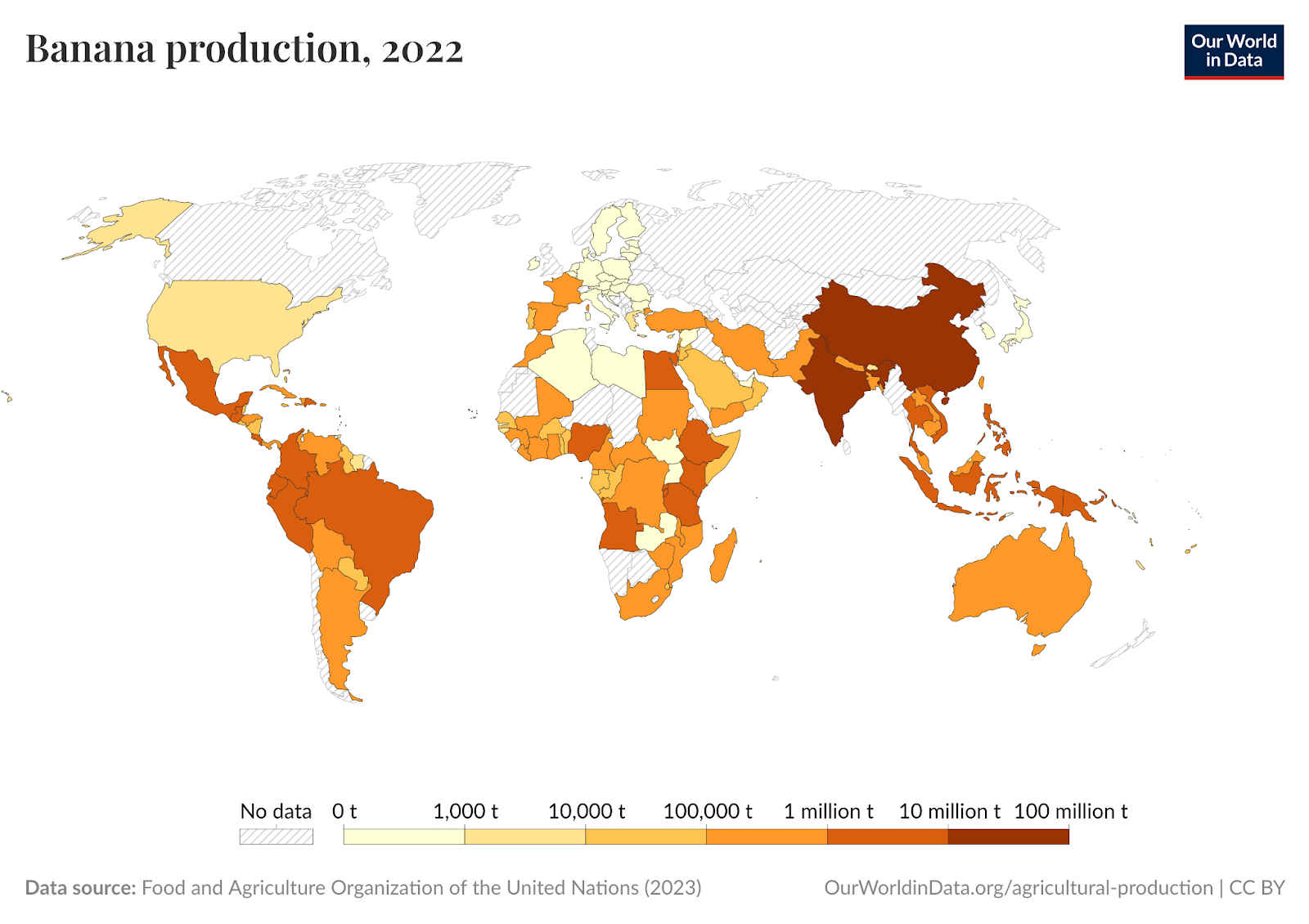
While Asia is the world’s largest banana producer, Latin America and the Caribbean are responsible for around 80% of the world’s banana exports – particularly from Ecuador and Costa Rica.
More than 1,000 different varieties of bananas are grown around the world, with the sweet yellow Cavendish banana making up around half of global banana production. This cultivar is typically grown in large-scale monoculture plantations in Latin America, using extensive irrigation and drainage facilities. Large export plantations can be up to 5,000 hectares in size (50 square kilometres).
Mapping plantations
To assess the distribution of banana plantations throughout Latin America and the Caribbean, the authors developed a high-resolution map of banana production for the year 2019. They used data from NASA’s Sentinel-1 SAR and an algorithm to identify banana plantations in the satellite images.
The authors only include banana plantations larger than 0.5 hectares in area in their map, because the study focuses on bananas grown at a large scale for export. They also do not include banana production by smallholder farmers, as their crops are often in sparser, mixed-cropping systems that are harder to identify in images.

The authors identified and validated more than 360,000 plantations in total.
They authors combined their banana plantation distribution map with a wide range of climatic and socioeconomic data, including temperature, rainfall, elevation, soil acidity, latitude, irrigation infrastructure, human population density and distance to the nearest port.
To identify the conditions best suited for banana plantations, the authors identified ranges for each of these variables where 90% of mapped banana plantations were observed.
The results show that banana plantations are typically found at lower elevations and in more acidic soils than other croplands in the region. They are also found in areas with higher population density and close to ports. Three-quarters of the mapped banana plantations in this study are within 86km of the nearest port, the study finds.
Dr Varun Varma, the lead author of the study, is an ecosystems services modeller at Rothamsted Research in the UK. He tells Carbon Brief that large-scale banana farming “relies heavily on access to labour”. He adds:
“In these intensive export-focussed farms, bananas – a perishable product – are continuously harvested, processed, packaged and made ready for transport by sea in large shipping containers. Being closer to a port would be a logistical advantage.”
The authors also find that irrigation plays an important role in determining where bananas can grow.
Prof Matti Kummu from Aalto University’s water and development research group, who was not involved in the study, praises the authors for considering so many variables. He tells Carbon Brief that this is an “important and impressive study”, adding that its approach could be used for other similar crops.
Rising temperatures
Next, the authors modelled temperature and rainfall over Latin America and the Caribbean, using 12 climate models from the sixth coupled model intercomparison project (CMIP6) under the “middle-of-the-road” SSP2-4.5 warming scenario.
By combining simulations of temperature and rainfall across Latin America and the Caribbean with data on elevation and soil acidity, the authors find that around 3,340,000 square kilometres (km2) of land is currently “suitable” for banana plantations.
Central America, coastal Brazil and the northern and southern borders of the Amazon basin are the most suitable, they say.
Factoring in socioeconomic conditions, such as population density and distance to a port, shrinks the “suitable area” to 990,000km2. This “brings into focus how important socioeconomic factors are, and will be, in adapting to climate change”, Varma says.
The authors also investigated how climate change may impact the “suitable” area for banana plantations over the 21st century. The maps below show how changes in temperature (left) and rainfall (right) are expected to impact the suitability of land for banana plantations under the projected climate in 2061-80.
The colours indicate regions suitable for producing bananas for export in both the recent past (1970 to 2000) and future (blue), those suitable in the recent past, but not in future (red) and those that were not suitable in the recent past, but will be in the future (green).

The authors find that under the SSP2-4.5 scenario, “increasing temperature is the sole climatic driver of suitable area loss”. In contrast, changes in annual rainfall will not noticeably change the distribution of land suitable for banana plantations – partly due to the presence of irrigation, the authors say.
Overall, they find that changes in climate will shrink the area of land suitable for banana plantations by 60%, if no changes are made to irrigation infrastructure or other socioeconomic factors.
Dr Monica Ortiz is an environmental scientist and assistant professor at the University of Concepción in Chile, who was not involved in the study. She tells Carbon Brief:
“60% is no small figure and this means that banana-growers need to do climate-resilient planning to maintain their livelihood and business model.”
The paper finds that implementing more irrigation infrastructure where needed could expand the future suitable area. Adding this adaptation measure would mean that future climate change would only shrink the current area of land suitable for growing bananas by 41%.
The authors find that due to warming, the suitable area for banana production will decline by 2080 in most exporting regions in Latin America and the Caribbean. The study says that Colombia and Venezuela will become “almost entirely suboptimal for export production”.
The authors then used a series of equations developed in paper they published in 2019 to calculate banana yields from data on temperature and rainfall.
Yield in current banana producing areas will decline for most countries, the study says. It finds that “Ecuador and Brazil are the only major producers expected to see yield increases in current banana production areas due to climate change”.
Adaptation
As the area suitable for banana production shrinks, farmers will need to adapt to the changing conditions. These measures include maintaining irrigation supplies and breeding “drought-tolerant banana varieties”, the authors say.
However, they note that farmers in the global south “may be less able to adapt agricultural practices to cope with changing climate than their counterparts in wealthier countries”.
Prof Kenneth Feeley from the University of Miami was not involved in the study, but has conducted separate research on the impacts of climate change on banana growing regions.
He tells Carbon Brief that as a result of widespread irrigation, many growers have turned large areas of “pristine desert habitat” with low rainfall into banana plantations. This is a “major transformation of the ecosystem”, which may not be “good for the environment”, he warns.
Feeley adds that Cavendish bananas are also facing “attacks” from the fungus Fusarium, which are becoming a “major problem for banana production”. The fungus is spread through raindrops bouncing between plants, but the use of drip irrigation can “limit” the spread of the fungus, he explains.
Additionally, lead author Varma notes that rising temperatures are creating “increasingly inhospitable working conditions in this labour-intensive sector”.
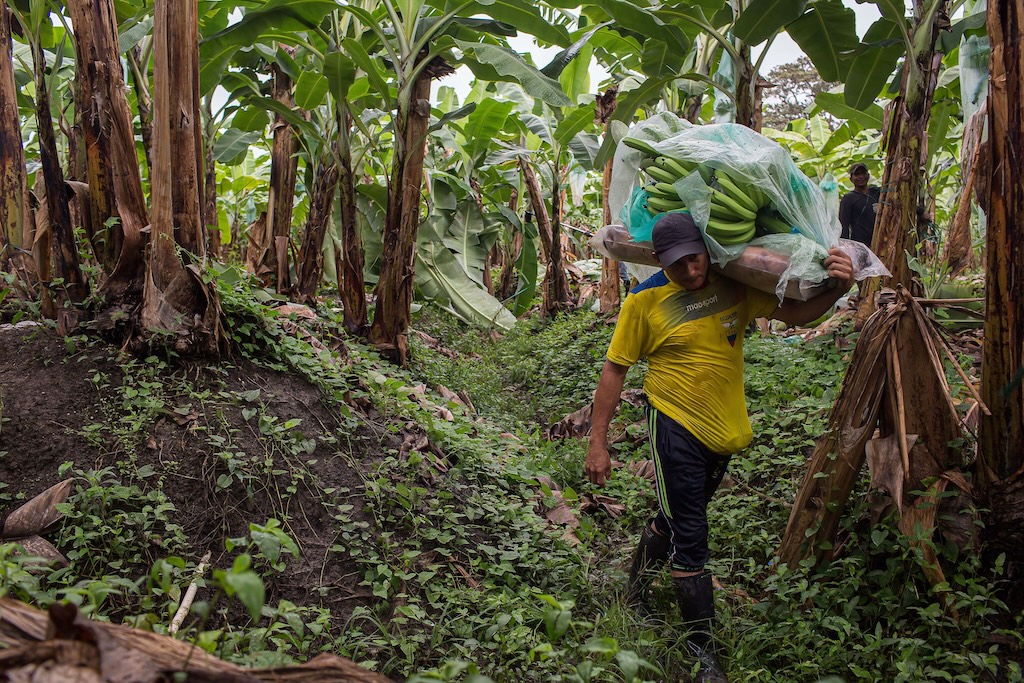
Ortiz tells Carbon Brief that “the current intensive banana industrial model perpetuates certain injustices towards farmers”. She explains that farmers “work hard and are paid little”, adding that women are typically assigned the tasks that are paid the least.
She adds:
“The time is indeed ripe for change. I think the study provides valuable insight about the constraints, risks and should be a call for adaptation – and also transforming the industry for the better.”


The post Major banana exporters could face ‘60% drop’ in growing area due to warming appeared first on Carbon Brief.
Major banana exporters could face ‘60% drop’ in growing area due to warming

Scientists have vowed to keep working on the next flagship set of reports for the Intergovernmental Panel on Climate Change (IPCC), after a political row over the timeline for their release saw its latest session suspended on Friday evening without agreement.
During the weekend, government officials and scientists alike expressed disappointment over the inability to reach a compromise before some delegates from developing countries and small island states had to leave the week-long meeting in Ethiopia to catch flights home.
The disagreement – which has persisted since early 2024 – turns on whether the three key parts of the AR7 assessment should all be published before the conclusion of the UN’s next Global Stocktake of global climate action, which is due to be completed in late 2028.
The IPCC issued a statement after the close of the session, saying that “key agenda items” – the timelines for the three AR7 reports, as well as the IPCC budget – remain open and under discussion. It said the IPCC’s plenary session and its deliberations on the pending agenda “will resume at the earliest opportunity”, giving no further details of when.
IPCC Chair Jim Skea told delegates in closing remarks that recent months had been some of the most turbulent for the climate science panel and that, if there were stronger words than “profound disappointment” he would use them, according to a summary published by the Earth Negotiators Bulletin (ENB). IPCC discussions happen behind closed doors.
IPCC scientists remained committed
In an open letter, issued on Monday, a group of nearly 120 scientists – from a total of 664 AR7 authors – said they “stand committed to continue working to deliver the AR7 reports in a manner that is rigorous, timely and inclusive, in line with our mandate to be policy-relevant”.
“An assessment that arrives after the decisions it is meant to inform cannot serve its purpose,” they emphasised. “The second Global Stocktake in 2028 is such a decision point, and the world should not have to face it without the IPCCʼs latest assessment.”
Europe, small islands and the least developed countries, plus many Latin American and developed nations, want the IPCC to meet this deadline, arguing that the findings from the UN climate science body are irreplaceable in the UN climate policy-making process.
However, around a dozen developing countries plus Russia have argued that the reports should come later in order to allow for greater research input from the Global South – something that, in their view, would make the findings fairer. They also claim that a shorter timeline would put excessive pressure on experts.
-
Who shapes climate science? The equity question facing the IPCC
Early completion of the next global climate science assessment reports risks excluding research from the Global South, which is key to ensuring the findings are fair -
Governments that support climate science must stand firm against naysayers
The IPCC is meeting to decide the timing of its next major report, as some countries try to delay it and weaken the case for faster emissions cuts


The most vocal of this group at last week’s meeting were India and Saudi Arabia, according to the ENB summary and a developed country diplomat. Critics see this push for a longer timeline as an excuse to deprive government decision-makers of the latest science and ease pressure on emerging economies to raise their ambition, particularly on cutting emissions.
Commenting on last week’s meeting, France’s ambassador for climate negotiations Benoît Faraco said a broad coalition of developed and developing countries from all five continents, “united in their support for science and the timeline proposed by scientists”, had withstood pressure “from a few countries” seeking to slow down the process of adopting the IPCC reports.
He added that France would not back down and would “continue to fight tirelessly for science, protect the integrity of information, and convince our partners that without the best available scientific data, we will be less effective in tackling climate change and protecting our populations”.
Inclusivity proposal stalled
In a bid to unlock a solution for the AR7 timeline, countries discussed ways to improve the inclusivity of the IPCC’s work. One option put on the table was for the IPCC to expand its funding for delegates from developing countries to attend some or all of its sessions from one to two participants, according to the ENB summary and a delegate speaking to Climate Home News.
That would increase the costs for the IPCC to complete AR7 by up to a quarter, according to an assessment shared by the secretariat. The panel’s budget is under severe strain and its officials have warned that, without additional voluntary contributions, it risks running out of money before it can deliver on this assessment cycle.
Climate Home News understands that some of the IPCC’s traditional donors – which mainly include European countries, Japan and Australia – indicated a willingness to support funding for an additional developing country participant. But without an agreement over the budget or the timeline for the reports, that option was ultimately not adopted.
‘Disappointed and worried’
The three reports are managed by working groups that collate and draw overall findings from the latest scientific studies and data on the physical effects of global warming around the world, how to adapt to it, and pathways for cutting planet-heating emissions in order to meet the temperature goals of the Paris Agreement.
Winston Chow, an urban climate professor at Singapore Management University who co-chairs Working Group II on adaptation, wrote in a LinkedIn post that he was “disappointed and worried” for the IPCC authors who have worked “extraordinarily hard” to assess the relevant climate science over the past two years.
He said he shared their concern that “the rigour, time and goodwill they’ve invested are now being put at risk by the Panel’s stalemate”.
As science comes under attack at UN talks, climate movement splits over how to respond
For Working Group II, a meeting for 250 experts writing that report is scheduled for January 2027, followed by the approval of a special report on cities and climate change in Singapore next March.
But because the IPCC’s budget has not been confirmed due to uncertainty about the AR7 schedule, travel support for those researchers is at risk, wrote Chow. “If they cannot participate, our assessments will lose vital expertise, perspectives and scientific breadth, and the collective effort of our authors will be undermined,” he warned.
Scientific work continues
Despite the political holdups, he – together with French climate scientist Robert Vautard, co-chair of Working Group 1 – agreed with IPCC head Skea who told the IPCC’s closing session on Friday: “The engine room of the IPCC is working, and it’s healthy.”
Vautard commented in a separate post on LinkedIn after it ended: “The boat is at full steam.” Working groups I and II are due to start revising the first drafts of their reports, while Working Group III on reducing emissions is finalising its first draft which will be out soon, he wrote.
“The most exciting two years of the cycle are ahead, for the authors. The momentum in the engine room is here and now. Trust the engine room!” he added.
The IPCC and some scientists report that progress has been made towards achieving an equitable balance of authors from the Global North and the Global South.
The group of researchers who signed the open letter on Monday noted that “inclusivity is at the heart of how we work”, with author teams bringing together experts from developed and developing countries with diverse backgrounds and at different stages of their careers.
Plea to overcome political differences
The signatories include several scientists from some of the countries opposed to the alignment of all IPCC reports with the Global Stocktake.
“We are committed to an assessment in which the knowledge, experience and priorities of every region are fully reflected, a commitment we share with the leadership of the IPCC.
Equity is built into how our assessment is being drafted,” they added.
They appealed to governments that make up the IPCC “to overcome their political differences and work together as we do as a global scientific community, so that we can deliver the IPCC reports the world needs to hear”.
In a statement published on Monday, IPCC chair Skea said reaching consensus on the schedule for the reports is “vital”. He added that the assessments provide authoritative scientific evidence to inform national climate policies, strengthen adaptation and resilience and support access to climate finance, as well as helping communicate the scale of the climate crisis and the urgency of efforts to tackle it.
The post IPCC scientists vow to press on with climate reports despite political deadlock appeared first on Climate Home News.
IPCC scientists vow to press on with climate reports despite political deadlock
An Lambrechts is a biodiversity politics expert at Greenpeace International with extensive experience in biodiversity-related multilateral negotiations. She is the head of the Greenpeace delegation at the Convention on Biological Diversity (CBD) COP17 happening in Yerevan, Armenia.
In 2022, COP15 delivered the landmark Kunming-Montreal Global Biodiversity Framework to halt and reverse biodiversity loss by 2030. With COP17 starting in Yerevan, we are now halfway to the deadline, and according to the first Global Review of progress, countries are not on track to meet the biodiversity targets, and implementation must accelerate fast.
One of the main findings of the Global Review is that funding falls far short of the scale needed to halt and reverse nature loss. But the crisis facing the world’s biodiversity is not an absolute scarcity of capital – it is a profound public policy distortion.
The global economy currently spends roughly $30 destroying nature for every single dollar invested in its protection. According to a report from the Intergovernmental Science-Policy Platform on Biodiversity and Ecosystem Services, a staggering $2.4 trillion is spent in public subsidies for fossil fuels, agriculture and water use, while global investment in biodiversity conservation and restoration stands at a mere $220 billion.
Countries urged to ramp up “insufficient” nature policies at COP17
Yet, discussions about how to close the biodiversity finance gap continue to claim that salvation lies in mobilising private capital, scaling offsets and “derisking” investments in nature. This is a fundamental misunderstanding of both the nature of ecological stewardship and of the global financial architecture.
Biodiversity conservation is not a speculative investment portfolio – it is the foundation of human survival. The health of our planet is a non-monetisable, non-excludable public good. Expecting profit-seeking private capital to protect nature perpetuates the structural drivers of ecosystem destruction in the first place.
But if private market mechanisms cannot save biodiversity, where will the necessary public resources come from?
Money going to the wrong places
The answer lies in recovering the vast public wealth currently drained by cross-border tax abuse, financial secrecy and corporate impunity. Finance and environment ministers meeting in Yerevan must give a strong political signal that, to avert ecological breakdown, countries need to take swift action to reform global tax rules, eliminate harmful public subsidies and cancel unsustainable sovereign debts for the public revenues to end up where they belong.
Extractive sectors such as industrial agriculture, fishing, timber and mining continue business-as-usual, often heavily subsidised by public treasuries, while voluntary carbon and biodiversity offset markets pose a serious risk to nature conservation. Offset schemes have delivered only a negligible fraction of the funding needed to preserve ecosystems, allowing industries to continue with their destructive business-as-usual practices.
