

After agreeing an interim set of rules for how it will operate, the global Fund for Responding to Loss and Damage (FRLD) will next month launch a call for proposals on how to address and repair the destruction caused by climate change.
At a meeting in the Philippines this week, the FRLD’s board decided on how the fund will operate next year, before permanent rules are agreed. In this interim period, it will have at least $250 million to spend and, at November’s COP30 climate summit in Belém, will ask for project proposals it could fund.
The board’s co-chair, South African climate negotiator Richard Sherman, said he expects to adopt the first set of proposals within six months. The fledgling fund – which was set up under the UN climate process – will then ask wealthy governments for more money, through a replenishment process, in 2027.
Elizabeth Thompson, an FRLD board member from the government of Barbados, said she was “happy” to see the fund’s interim rules adopted and hopes they will “spur innovative approaches” to allow countries “access to resources at scale – and that it will be a source of real support against rapid and slow onset climate events”.
-
AI and satellite data help researchers map world’s transition minerals rush
Filling “mind-boggling” gaps in mining data will make it easier to track the environmental impact of surging global appetite for critical minerals, experts say -
Panama environment minister backs calls for reform of UN climate process
Panama’s environment minister told Climate Home that decision-making rules at the UN climate talks should be reformed to deliver faster changes. -
Landmark ICJ climate ruling must be turned into concrete action on shipping
This month’s meeting of the International Maritime Organization is a critical test of whether governments are heeding July’s groundbreaking ruling


“That cannot happen however,” she warned, “unless the fund is filled, as the need and scale of the crisis far outstrip the monies in the fund to date.”
Citing the recent International Court of Justice advisory opinion on climate change, she said that “the countries responsible for the climate crisis need to fund the cost of loss and damage suffered by affected countries – this is now an urgent and legal matter and countries need to accept their responsibility.”
The Independent High-Level Expert Group on Climate Finance has estimated that, by 2030, developing countries could require $200 billion-$400 billion a year to address loss and damage caused by storms, droughts, flooding, extreme heat and rising seas made worse by climate change.
Since the fund was formally agreed two years ago, developed countries have pledged $788 million, signed commitments for over $560 million, and actually transferred less than $400 million of that total.
‘Fill the fund’ campaign
Harjeet Singh, founding director of India’s Satat Sampada Climate Foundation, told a press conference after the FRLD board meeting ended on Thursday that this amount was “absolutely insignificant compared to what is needed by communities and countries”, adding that civil society’s “Fill the Fund” campaign would push developed countries to make new pledges.
Italy is responsible for the biggest chunk of the gap between pledges and cash transfers. At COP28 two years ago, Prime Minister Giorgia Meloni promised €100 million ($115 million) to the fund but has yet to convert the pledge into a formal agreement that sets out how the money will be provided.
“Looking at official documents, the loss and damage fund is not mentioned anywhere,” Caterina Molinari, policy advisor on finance at Italian think-tank Ecco, told Climate Home News. “This is not some spending that Italy is planning to make,” she said, adding “they need to put their money where their mouth is”.
Comment: The ICJ climate ruling has major implications for the loss and damage fund
At this week’s board meeting, government representatives from developed and developing countries were unable to agree on a strategy to mobilise additional resources due to divisions on the role of capital markets and innovative sources of finance – like taxes on first-class plane tickets.
Other areas of disagreement – according to a draft document seen by Climate Home News – include how much funding should be loans versus grants, and how regular fundraising rounds should be. The board now aims to decide this at its board meeting in October 2026.
The post Loss and damage fund will launch call for proposals at COP30 appeared first on Climate Home News.
Loss and damage fund will launch call for proposals at COP30

For the first time, new-energy vehicles (NEVs) made up 67% of new car sales in China in September, according to the latest data from the China Passenger Car Association (CPCA).
The figures show that NEVs, which include battery electric cars and plug-in hybrids, captured a record share of sales, even though fewer were sold than last year.
This is because sales of combustion-engine cars are falling steeply, a trend that the CPCA has attributed to rising petrol prices following the start of the Hormuz crisis.
Indeed, sales of fuel-only cars were down 31% year-on-year in the first nine months of 2026, with plug-in hybrid sales down 26% – whereas battery EV sales were only down 4%.
One analyst tells Carbon Brief that China’s rapidly growing EV fleet has offset demand for 143m barrels of oil since the start of the Hormuz crisis.
Another says that the crisis is “reinforcing China’s electrification of road transport”.
Meanwhile, amid slowing domestic sales, Chinese carmakers’ exports of NEVs more than doubled [in 2026 to date / in September] from a year earlier.
NEV record
A record two out of every three cars sold in September in China were NEVs, according to CPCA data, as shown in the figure below.
(NEVs predominantly include battery electric vehicles – BEVs – and plug-in hybrids – PHEVs. BEVs only run on electricity, whereas PHEVs also have a combustion engine.)
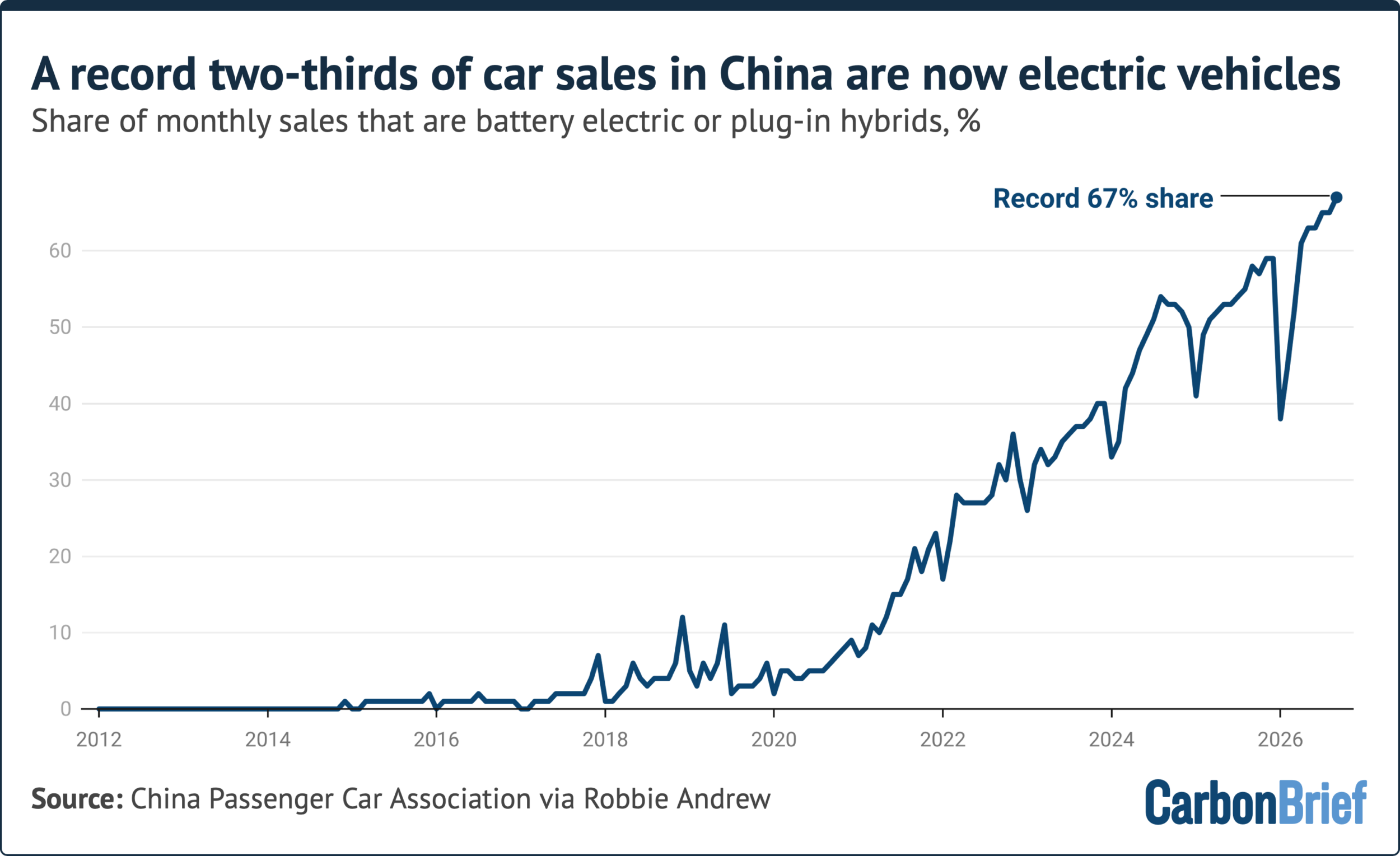
This marks a rapid rise for NEVs from just 6% of new car sales in 2020 up to 58% in 2026 to date – and a record 67% in the month of September.
This year, NEVs’ share of sales has also bounced back from a low of 39% in January, after the full purchase tax exemption that had been in place for more than a decade came to an end in December 2025.
The gain in NEV share in 2026 has come amid a slowdown across the wider domestic passenger-car market, which has hit sales of combustion-engine vehicles particularly hard.
This September, passenger-car retail sales across all categories declined, with overall sales volumes falling 28% year-on-year.
The contraction was led by combustion-engine vehicles, which saw sales fall 43% year-on-year in September and 31% in 2026 to date.
However, sales of PHEVs also fell by 36% year-on-year in September and by 26% in 2026 to date. By comparison, BEVs performed better, although sales still declined 8.5% from a year earlier in September and 4% in 2026 to date.
As a result, NEV sales overall fell by 17% in September and 13% in 2026 to date.
While the market changes in 2026 to date were particularly dramatic, they reflect a broad continuation of trends seen over the past decade.
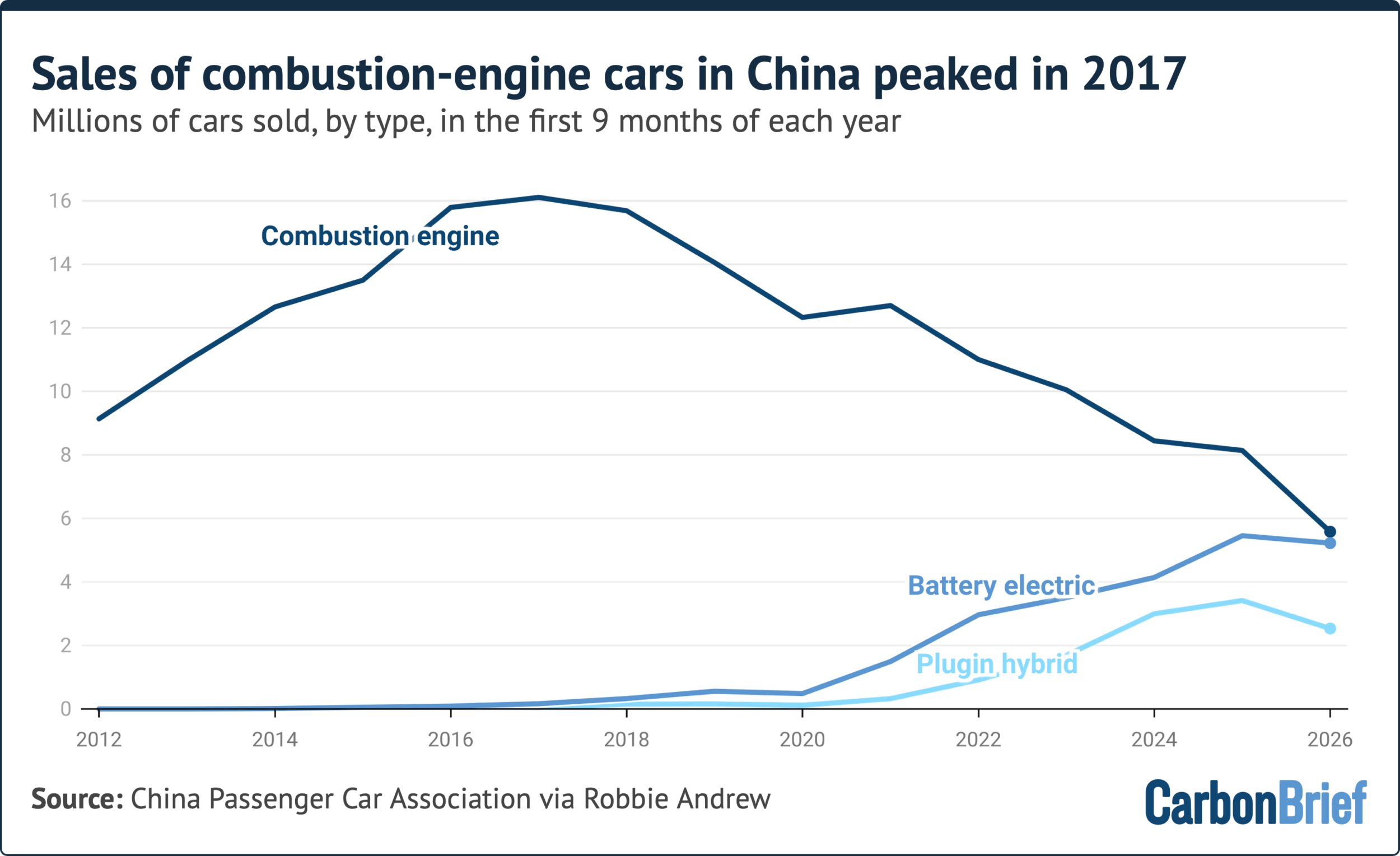
Indeed, sales of combustion-engine cars in China peaked in 2017 and they have been declining ever since, shown in the figure below.
Impact of Hormuz
Part of the reason for the advance of NEVs in 2026, said Chinese technology news outlet OFweek, was petrol cars “giving up market share” as they were outperformed by electric alternatives.
Cui Dongshu, secretary-general of the CPCA, cited higher petrol prices as an explanation for September’s weak combustion-car sales, in comments to financial news outlet National Business Daily.
Imports of oil into China in January-September have fallen 15% compared to 2025, equivalent to 470m barrels, as ongoing conflict tightened supply and drove up prices.
China’s passenger-car NEV fleet has displaced 143m barrels of oil so far during the strait of Hormuz crisis, Euan Graham, senior energy analyst at thinktank Ember, tells Carbon Brief.
EVs “accounted for 12% of the decrease in China’s oil use post-Hormuz”, according to an estimate provided to thinktank the Brookings Institute by an unnamed analyst.
Erica Downs, a senior research scholar at Columbia University’s Center on Global Energy Policy, tells Carbon Brief that the strait of Hormuz crisis and higher oil prices are “reinforcing China’s electrification of road transport”.
She says the “world’s largest oil supply disruption” vindicates China’s early bet on EVs, which was partly driven by concerns about oil-supply security.
NEV demand down
Nevertheless, NEV sales have fallen year-on-year, albeit at a slower rate than overall car sales. The growth in NEV market share has also been decelerating.
Zhang Yichao, a partner at consulting firm AlixPartners, tells Carbon Brief that NEVs benefit from government trade-in policies and a “strong pipeline” of new models, particularly those involving innovation.
He says these factors help explain why NEVs sales have fallen at a slower rate to their combustion-car counterparts.
Cui told the state-run China National Radio that the fall for NEVs and for cars overall in September 2026, is also due to a high baseline of sales from the same month in 2025, as well as changes to trade-in policies and disruptions from the holiday period.
Other factors, says consulting firm Wood Mackenzie, are the weakened demand due to “demand pull-forward” in 2025 caused by the end of subsidies, as well as “tighter financing conditions”.
Zhang tells Carbon Brief he does not “see much more room ahead” for further growth in NEVs’ market share.
He adds that, in his view, their share in China is unlikely to exceed 80%, as some premium-market segments and specific use cases will continue to require combustion-engine vehicles.
Exports surge
Meanwhile, while domestic NEV retail sales fell 17% in September 2026, exports more than doubled, increasing 164% year-on-year, according to the CPCA.
This extends the decline in domestic sales and very strong growth in exports seen across 2026 to date, as shown in the figure below.
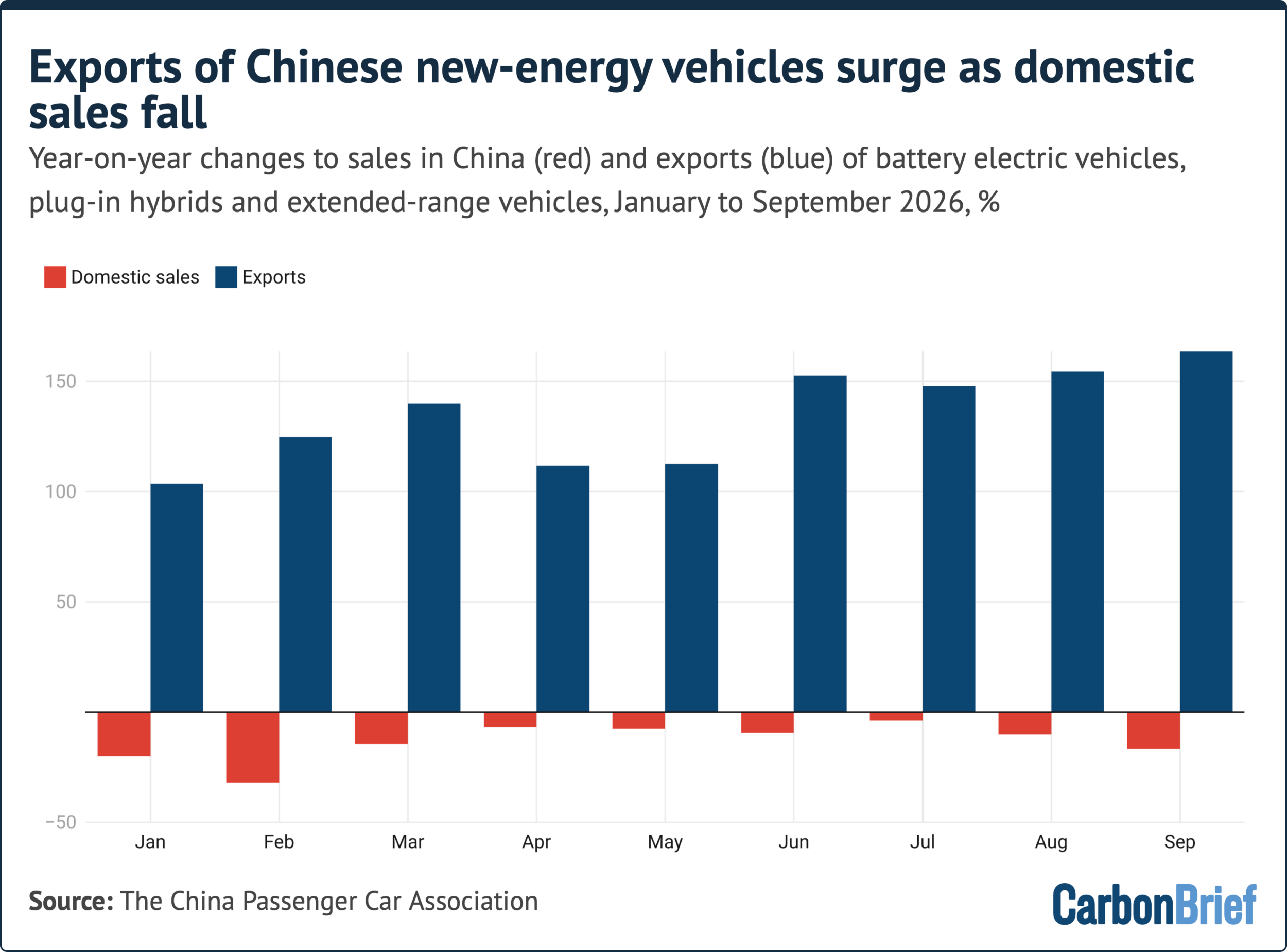
In September, 1,084,000 NEVs were sold domestically in China, while 558,000 NEVs were exported.
<