

Scientists’ understanding of how climate change and habitat loss could drive plant and fungi extinctions is being hamstrung by knowledge gaps in how many species currently exist, a new report warns.
More than 90% of fungi have yet to be found and formally described by scientists, according to a new report from the Royal Botanic Gardens, Kew.
The “State of the World’s Plants and Fungi” report, which is based on both peer-reviewed and preliminary studies, also says that almost half of all flowering plant species could be at risk of extinction.
Habitat and land-use changes are the biggest threat to plants and fungi, but climate change is expected to become an even larger issue in the future, the director of science at Kew tells Carbon Brief
Below, Carbon Brief outlines five key findings from the report.
- Three in four unknown plant species are at risk of extinction
- Climate change is having ‘detrimental’ impacts on fungi
- Plants are currently going extinct 500 times faster than before humans existed
- Scientists have assessed the risk of extinction for less than 1% of known fungi species
- Almost half of flowering plant species are under threat
1. Three in four unknown plant species are at risk of extinction
Thousands of new plant and fungi species are named by scientists each year, but many still remain unnamed.
Around 90% of fungi species have yet to be described, making this formal identification process particularly “urgent” for fungi, the report notes. It estimates that it would take 750-1,000 years to name all of the remaining unknown fungi species.
Thousands of plants remain unnamed, including up to 100,000 “vascular” plant species. (Vascular plants are a large group of plants that are characterised by having a vascular system for transporting water. This includes trees, shrubs, grasses and flowering plants.)
More than three in four plant species that have not yet been formally described by scientists are likely threatened with extinction, the report says.
The new research by Kew scientists analysed data from the World Checklist of Vascular Plants and the International Union for Conservation of Nature (IUCN) red list of threatened species – a global assessment of the extinction risk status of different animals, plants and fungi. The report was launched during a three-day conference held in Kew Gardens in London this week.
The researchers examined the links between the year a plant species was formally described and its extinction risk.
The findings, outlined in the chart below, show that the later a species is formally identified and described by science, the higher chance it has of being deemed at risk.

Based on this finding, Kew scientists are calling for all newly described plant species to be “presumed threatened with extinction unless proven otherwise”, the report says.
The IUCN extinction criteria used does not give a timeframe estimate for when an extinction is likely to occur.
Understanding extinction is “critical to conserving biodiversity”, the report adds. But unless formal naming accelerates, it says, “we are in danger of losing species before they have been described”.
This would mean “losing all of the potential that that species has”, Dr Matilda Brown, a conservation science analyst at Kew, said at the launch of the report.
The director of science at Kew, Prof Alexandre Antonelli, says that unless there is a “real shift” in trends, the number of unknown species at risk “will be even higher” in future.
He tells Carbon Brief that this would result in “basically all the new species that are found being threatened”. He adds:
“It just takes time to formally assess species and that timeline could be fatal basically because most resources for conservation are not allocated until you have a formal threat categorisation of a species. Therefore, we think that it’s very sensible to recommend all [undescribed] species be treated as such.”
The number of threatened plants has risen “shockingly” in recent years, says Dr Martin Cheek, a senior research leader at the Royal Botanic Gardens, Kew. In the report, he writes:
“When I started out as a taxonomist 30 years ago, you wouldn’t really even consider that a species you were publishing might go extinct; you just assumed it was going to still be around in the wild.
“Now, you might work out that you have [a] new species and go and look for its natural habitat only to not find any at all.”
2. Climate change is having ‘detrimental’ impacts on fungi
The main threat to both plant and fungi species is habitat loss and land-use change in the form of forestry, agriculture or residential and commercial development.
For example, timber production can reduce areas of older, natural forest, which can leave behind less deadwood and fewer old trees for fungi to populate.
Climate change is having “detrimental” impacts on fungi in different ways, the report says, with changes in temperature and moisture levels having a direct impact.
There have already been widespread plant and animal population extinctions caused by climate change, detected in almost half of 976 species examined, according to the UN’s authority on climate science, the Intergovernmental Panel on Climate Change (IPCC).
The IPCC also says that one in 10 species is likely to face a “very high” risk of extinction at 2C of global warming, the upper limit of the Paris Agreement. This rises to 12% at 3C, 13% at 4C and 15% at 5C.
Fungal diversity depends on plants, so any climate-related habitat change that negatively impacts plants “in turn affects their co-existing fungi”, the report says.
Antonelli explains that there is a certain “shortage of knowledge” on the specific role of climate change in extinction risks for many plant and fungi species.
However, climate change is “tremendously” significant to extinction risks and its impact is “expected to increase over time” to possibly become the biggest risk in future, Antonelli adds. He tells Carbon Brief:
“Every time a species is assessed, the experts assessing it will determine whether climate change is or is not a contributing factor to its threat.
“In many cases, the real acute changes we are seeing are in terms of habitat degradation and deforestation, or destruction of grasslands. But it’s harder to really know or predict how much climate change is going to affect particular species because there has not been [as much] experimental research testing that.”
He says more research is needed to test the effects of drought, heatwaves, extreme weather events and gradually increasing mean temperatures on species’ “fertility or seed prediction or dispersal”.
There are other ways climate change can affect extinction risks for plants and fungi, such as by driving increased droughts or reducing resilience to new diseases, Antonelli notes:
“Even though pathogens and disease are a separate category in the threat assessments, those two could be interplaying.”
The graphic below shows the different predictors of plant extinction risk and their significance in risk predictions. The main risk identified in the report is the number of “botanical countries” in which a species is present – an area used to define a plant’s distribution that may diverge from official country lines. This is because their area of inhabitance is already limited to begin with.

Brown says that “people aren’t taking extinction seriously enough”. She adds in the report:
“We wanted to show that extinction is being underrated and underestimated, and that we need to do something about it.”
Antonelli says that there are other climate benefits to increasing knowledge of plants and fungi, including understanding the different carbon storage abilities of species.
A recent study estimated that fungi attached to plant roots each year remove 13bn tonnes of CO2 from the atmosphere, the equivalent of around a third of annual fossil-fuel emissions.
The authors noted that this estimate is based on the best available evidence, but should still be “interpreted with caution”.
3. Plants are currently going extinct 500 times faster than before humans existed
On average, more than two plant species have gone extinct each year for the past 250 years, according to a 2019 study cited in the report.
This is 500 times faster than the “background extinction rate” – the rate of extinctions absent from human interference. Plants that were scientifically described more recently are becoming extinct twice as fast as those described before 1900, the study adds.
Nearly 600 plant species have been driven to extinction in modern times – but almost as many have been rediscovered after being declared extinct.
The map below shows the geographic distribution of recorded plant extinctions that have occurred in recent centuries. Darker colours indicate a higher number of extinctions. The study notes that the pattern is “strikingly similar” to that of animal extinctions, with a disproportionate number of extinctions occurring on islands.

Nearly every recorded plant species that has gone extinct was found only in a single area or region.
The Kew report says that these “endemic” plant species may be “particularly affected by habitat destruction and climate change” as their ranges are small to begin with.
Just 10 nations host more than half (55%) of endemic plant species, the report adds, with Brazil, Australia and China hosting the highest number.
The report says this is a significant point for countries to understand the “extent to which the unique species they host are threatened with extinction” and to include this in their conservation strategies.
Other studies have put the modern extinction rate closer to 1,000 times faster than pre-human extinction rates. And still others predict that this could rise to 10,000 times faster, if all species that are currently “threatened” go extinct within the next century.
Brown notes that a lot of human-caused changes to biodiversity patterns are “leading to homogenisation”. She adds in the report:
“By carting species around the world and losing unique threatened species, we are making regions that were once really distinct much more similar, so we are blurring the edges of our global biogeographical regions.”
4. Scientists have assessed the risk of extinction for less than 1% of known fungi species
“Fungal interactions are absolutely essential to ecosystem health,” Antonelli tells Carbon Brief.
Around 155,000 fungi species have been documented in scientific literature. But, of these, only 625 known fungi species have had their extinction threat assessed by the IUCN Red List – just 0.4%.
Over the past two decades, a concerted effort by scientists and hobbyists has seen the number of fungi species evaluated on the IUCN red list go from just two in 2003 to a predicted 1,000 by the end of this year.
The report estimates that there are 2.5m fungi species around the world, meaning only 0.02% have had their global extinction threat level assessed.
Bridging this gap, the report says, is “challenging but possible”.
More than 20,000 fungi and lichen species have had their extinction threat level assessed nationally – with a strong bias towards assessments in the global north. These national-level “red lists” can help policymakers identify priority areas for conservation and guide decision-making around land management.
The image below shows the number of IUCN red-list assessments for different groups of organisms. It shows that fungi are by far the least assessed organism.

The report calls for increased engagement with communities and citizen science projects to help document the as-yet-unnamed species.
Dr Kiran Dhanjal-Adams, postdoctoral researcher at Kew, notes in the report that, although many species have not been formally described by science, they “are, in fact, well known by Indigenous communities”. He says:
“Species extinctions and cultural extinctions are inextricably interlinked. With the Kunming-Montreal Global Biodiversity Framework [GBF] highlighting the importance of Indigenous and local communities in conservation, we have the basis for strengthening partnerships and increasing our capacity to describe species in a way that can help raise conservation interest and funds to support local communities, as well as shedding light on ‘darkspots’.”
The new report identifies 32 plant “darkspots” – areas estimated to be the most lacking in information on plant diversity and distribution. These include Colombia and New Guinea.
5. Almost half of flowering plant species are under threat
The Kew report says that 45% of all known flowering plant species are potentially threatened with extinction.
This figure and others outline the “scale” of the “biodiversity crisis”, Antonelli tells Carbon Brief, adding:
“I am absolutely struck. I think it’s a disaster and it’s a really extremely serious situation. But, that said, we do know there are solutions and we are absolutely confident that we can turn this around.”
Scientists used a dataset of more than 53,000 red-listed species to also train a model to predict extinction risks of all the unassessed flowering plant species, the report explains.
Their findings indicate that “epiphytes” – plants that grow on other plants – are the “most threatened plant form”.

The report helps to address some “basic questions” about biodiversity and furthering understanding of species numbers, locations, threats and support needs, Antonelli says.
This information is “fundamental” to meeting the global goals and targets aimed to halt and reverse biodiversity loss by the end of this decade. These were agreed between almost every country in the world at the COP15 biodiversity summit last year. Antonelli tells Carbon Brief:
“All species are important and invaluable to ecosystems, but I think there’s a real danger of not being able to create the baseline information about plants on time for those priorities for conservation and restoration to be designed.”


The post Kew report: Five key extinction risks facing the world’s plants and fungi appeared first on Carbon Brief.
Kew report: Five key extinction risks facing the world’s plants and fungi

Rising temperatures and overfishing have seen the U.K.’s iconic cod decline for over a decade. Now, consumers are warned to “completely avoid” eating the fish.
The days of Britain’s fish and chip shops might be numbered.
Climate Change
DeBriefed 10 April 2026: Worst energy crisis ‘ever’ | India withdraws COP33 bid | Drag artists and climate change
Welcome to Carbon Brief’s DeBriefed.
An essential guide to the week’s key developments relating to climate change.
This week
Ceasefire causes oil price drop
CEASEFIRE SLUMP: Following the announcement on Tuesday of a two-week ceasefire agreement between Iran and the US and Israel, oil prices dropped below $96 per barrel, according to the Associated Press. However, price volatility resumed when a Saudi Arabian oil pipeline was hit just hours later, according to Reuters.
CRISIS COMBINED: Reuters and other outlets covered comments made by the International Energy Agency’s Fatih Birol to Le Figaro, where he said that the current energy crisis is worse than those of “1973, 1979 and 2022 combined”. It added that Birol said the “world has never experienced a disruption to energy supply of such magnitude”.
POLLUTERS PROFIT: The Guardian covered how the “worst polluters hold [the] world’s future in their hands as they benefit from higher fossil fuel prices”, but it added “global trends favour renewables”. The South China Morning Post reported that, according to experts, the diversification of energy sources is set to accelerate as the war continues to disrupt the world’s energy supplies.
Around the world
- CLIMATE GOALS PERIL: The UK opening new oil and gas fields in the North Sea “would imperil” international climate goals, experts told the Guardian. The warning came as the government pushed back against the speculation that it is set to approve new drilling projects, according to Sky News.
- COP33 CHANGES: The Indian government has withdrawn its offer to host the COP33 climate summit, “following a review of its commitments for the year 2028”, reported Climate Home News.
- ‘LONG-LASTING’ SHOCK: The Financial Times covered comments by EU energy commissioner Dan Jørgensen that the bloc was bracing for a “long-lasting” energy shock from the Iran war. Reuters reported that five EU countries have called for a windfall tax on energy companies’ profits in response to rising fuel prices.
- US BUDGET CUTS: US president Donald Trump’s 2027 budget proposal included targeting the “green new scam” with substantial cuts to energy and environment programmes, according to the Los Angeles Times.
- AFGHAN FLOODS: Since 26 March, at least 148 people have died and 216 have been injured due to heavy rains, floods, earthquakes and landslides in Afghanistan, reported Reuters.
- PENGUINS ENDANGERED: The “mass drowning” of emperor penguin chicks as sea ice melts due to climate change has led the International Union for Conservation of Nature to declare the species officially in danger of extinction, according to the Guardian.
86,120
The record number of battery electric vehicle sales registered in the UK in March, making up 22.6% of the total car market, according to the Society of Motor Manufacturers and Traders.
Latest climate research
- More than a quarter of the world’s population will face more frequent and severe hot-and-dry extreme events by 2100 under current climate policies | Geophysical Research Letters
- Climate change will increase wildfire exposure for nearly 10,000 species by the end of the century | Nature Climate Change
- A variety of climate hazards critically expose up to 30% of southern Africa to “environmental degradation” | PLOS One
(For more, see Carbon Brief’s in-depth daily summaries of the top climate news stories on Tuesday, Wednesday, Thursday and Friday.)
Captured
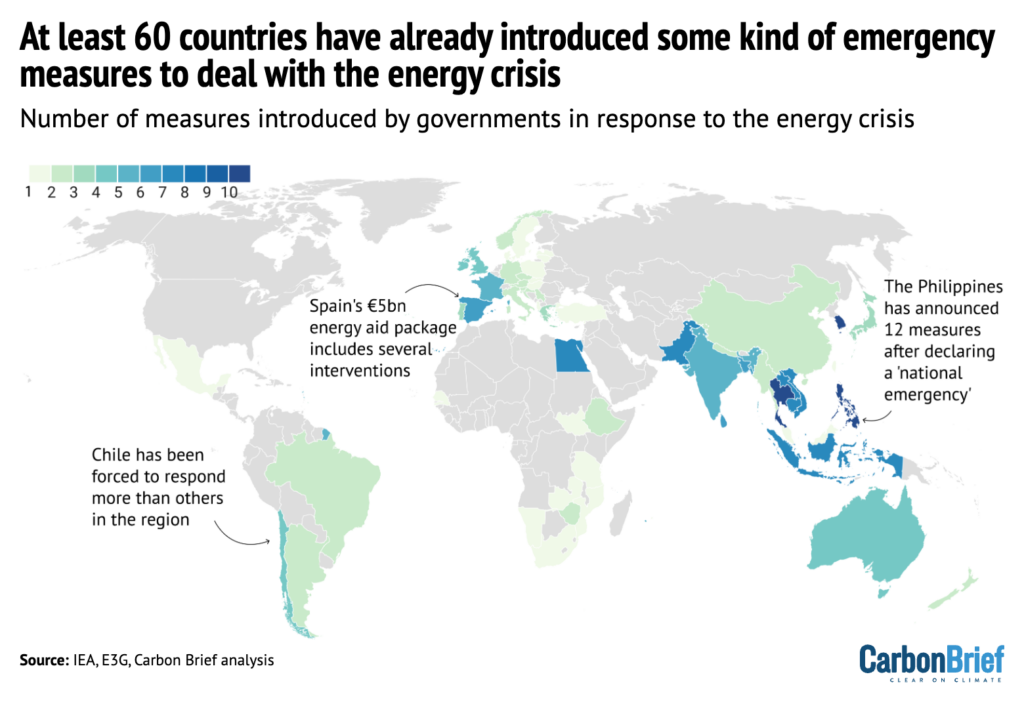
Carbon Brief analysis found that, since the beginning of the Iran war in late February, at least 60 countries have announced nearly 200 emergency energy-saving measures. Around 30 nations, from Norway to Zambia, have cut fuel taxes to help people struggling with rising costs, making this by far the most common domestic policy response to the crisis, said the analysis. Some countries have stressed the need to boost domestic renewable-energy construction, while others – including Japan, Italy and South Korea – have opted to lean more on coal, at least in the short term.
Spotlight
How drag is tackling climate change
This week, Carbon Brief looks at how some drag artists are using their performances to draw attention to climate change
Back in 2005, veteran climate journalist Bill McKibben wrote that “what the warming world needs now is art, sweet art” to help “build a general consciousness about climate change”.
Since then, the topic of climate change has spread to a host of art forms, from literature and music through to comedy and film.
One of the most recent art forms to take up the climate communication baton is drag, with performers using it as a “Trojan horse” to engage with audiences, according to Cheddar Gorgeous, a British drag performer.
‘Joy inspires momentum’
Drag artists around the world have begun to draw attention to the climate movement, using creativity, entertainment and their platforms to engage with their audiences.
In the UK, Cheddar Gorgeous declined a nomination for the British LGBT Awards due to its sponsorship by Shell and has made repeated calls for climate action.
Speaking on the “climate quickie” TEDx podcast, she argued:
“Drag can disrupt the master narratives that dictate our society. I love drag that makes you look at yourself and look at the world in a different way. And that can be deployed in all sorts of exciting ways.”
Drag has a proud history of disruption. As part of a TED talk titled, “Why joy is a serious way to take action”, US drag queen Pattie Gonia provided the audience with some “herstory” about the role of drag within protests. She said:
“Since the birth of the queer rights movement, drag performers and trans people have always been on the forefront of organising and protesting and community building.
“When we had the statistics and the facts on the millions of queer people dying of AIDS, yet no one was joining our fight, drag performers turned pain into joy and, in doing so, welcomed millions more people to fight with us.”

Pattie Gonia is arguably the best-known drag artist to engage with climate change. She is currently touring her environmental drag show “SAVE HER!” and has, according to her website, fundraised more than “$4.7m for LGBTQIA+, BIPOC and environmental non-profits”.
A key part of her message is the need for diversity and inclusion within the climate movement, adding that “our creativity is critical in this climate dilemma”. In her TED talk, she added:
“The problem in the climate movement isn’t just the abundance of carbon; it is the lack of joy. The scientific facts, the doom and gloom, they scare people, they wake them up. But joy is what will get people out of bed every day to take more action.”
Alongside Pattie Gonia, climate conversations are filtering into the wider drag movement, including being a topic repeatedly touched on in the highly successful TV drag contest, RuPaul’s Drag Race.
This ranges from drag artist Asia O’Hara explaining what global warming is in season 10 – telling her fellow contestants: “Bitch, the ice is melting!” – to queens dancing to “97% of scientists and four out of four Drag Race judges agree” that climate change “is real” during a challenge in season 11. (Drag Race host RuPaul Andre Charles has faced criticism for reportedly allowing fracking on his Wyoming ranch.)
Drag is opening up the climate movement to a wider audience, promoting diversity, inclusion and creativity in the space, according to its advocates. For Pattie Gonia, a key part of climate action has to be joy, she added:
“Joy provides an unbelievable opportunity to make the climate movement irresistible. Do not underestimate the power of joy. We deserve more than doom and gloom, because this is the only planet with a Beyoncé on it.”
Watch, read, listen
COOPERATION OVER CHAOS: In the Indian Express, Simon Stiell, the executive secretary of UN Climate Change, argued that “climate cooperation offers a way out of energy price chaos”.
ELECTRIC WORLD ORDER: On the Polycrisis podcast, Mark Blyth, a professor of international economics at Brown University, and Dr Naa Adjekai Adjei, a non-resident fellow, Africa, at the China Global South Project, discussed “what the US dollar has to do” with energy access in Africa.
‘THE RECKONING’: In the Equator, Mona Ali, associate professor of economics at the State University of New York, explored the closure of the Strait of Hormuz and the “end of American hegemony”.
Coming up
- 12 April: Hungarian elections
- 12 April: Peruvian elections
- 13-18 April: World Bank and International Monetary Fund Spring Meetings, Washington, DC, US
- 14 April: IEA Oil Market Report launch
Pick of the jobs
- Global Witness, several climate change jobs | Salary: Varied. Location: London
- London School of Economics, policy fellow – climate, gender and inclusivity | Salary: £53,949-£62,160. Location: London
- Climate Group, senior manager, international policy and advocacy | Salary: £47,160-£49,930. Location: London
- WWF, Nedbank green trust manager | Salary: Unknown. Location: Cape Town or Johannesburg, South Africa
- Greenpeace Australia Pacific, creative producer | Salary: AU$101,272. Location: Australia
- The Fairness Project, climate policy researcher | Salary: $96,000. Location: Remote (US)
DeBriefed is edited by Daisy Dunne. Please send any tips or feedback to debriefed@carbonbrief.org.
This is an online version of Carbon Brief’s weekly DeBriefed email newsletter. Subscribe for free here.


The post DeBriefed 10 April 2026: Worst energy crisis ‘ever’ | India withdraws COP33 bid | Drag artists and climate change appeared first on Carbon Brief.
The state Senate’s version of the bill offers more opportunities for utilities to profit, leading some observers to question whether the legislation will substantively lower costs for customers.
In its most recent energy affordability legislation, the Maryland Senate has reversed key utility accountability proposals passed by the state House and added new ways for utility companies to earn profit, including by reviving a billion-dollar gas subsidy that requires all ratepayers to cover the cost of running new gas pipelines to housing developments.
Utility Accountability Bills Divide Maryland’s Democratic Leadership

Britain’s Most Iconic Fish Nears Breaking Point
AI Data Centers Power Crisis: Massive Energy Demand Threatens Emissions Targets and Latest Delays Signal Market Shift

DeBriefed 10 April 2026: Worst energy crisis ‘ever’ | India withdraws COP33 bid | Drag artists and climate change
-
Climate Change8 months ago
Guest post: Why China is still building new coal – and when it might stop
-
Greenhouse Gases8 months ago
Guest post: Why China is still building new coal – and when it might stop
-

 Greenhouse Gases2 years ago
嘉宾来稿:满足中国增长的用电需求 光伏加储能“比新建煤电更实惠”
-
Climate Change2 years ago
Bill Discounting Climate Change in Florida’s Energy Policy Awaits DeSantis’ Approval
-

 Climate Change2 years ago
嘉宾来稿:满足中国增长的用电需求 光伏加储能“比新建煤电更实惠”
-
Climate Change Videos2 years ago
The toxic gas flares fuelling Nigeria’s climate change – BBC News
-

 Renewable Energy6 months ago
Sending Progressive Philanthropist George Soros to Prison?
-

 Carbon Footprint2 years ago
US SEC’s Climate Disclosure Rules Spur Renewed Interest in Carbon Credits