


- What happened at COP31?
- What has the reaction to the presidency been?
- How has the role of oil-rich nations been portrayed?
- How has the role of developed nations been portrayed?
- How has the role of developing nations been portrayed?
- How has the role of China been portrayed?
- What does this mean for the consensus process and reform?
- Could COP31 send a ‘positive signal’?

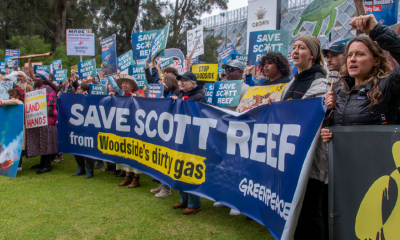
Greenpeace and allies will be protesting outside Woodside’s Annual General Meeting to show the WA and federal governments strong community opposition to Woodside’s proposal to drill for gas at Scott Reef.
What: Protest outside Woodside Energy’s Annual General Meeting
When: 8am Thursday 23rd April 2026Where: Kagoshima Park (on the corner of Great Eastern Highway and Bolton Avenue)
What’s at stake
Scott Reef is a pristine ocean ecosystem off the north-west coast of Australia.
It is home to endangered and endemic species, including pygmy blue whales and the dusky sea snake, and a nesting ground for green sea turtles. Scott Reef is a place of extraordinary natural beauty, and a vital marine environment that supports a wide range of marine life.
What Woodside is proposing
Dirty fossil fuel corporation, Woodside Energy, is seeking approval to drill more than 50 gas wells underneath and around Scott Reef as part of its Browse project.
The gas would be extracted and transported to the Burrup Hub, the most polluting fossil fuel project in Australia. This proposal would industrialise the doorstep of Australia’s largest freestanding oceanic reef system – threatening the marine life that relies on it and the climate.
Why this can’t go ahead
The WA Environmental Protection Authority has already identified the risks of this project as “unacceptable”, issuing a preliminary rejection.
Serious concerns include:
- The risk of an oil spill
- Impacts on pygmy blue whales
- Damage to green sea turtle nesting grounds
These risks are severe, and potentially irreversible. But the decision hasn’t been made yet. The project is still being assessed.
The Federal Environment Minister is approaching a decision that will determine whether Scott Reef is protected – or vulnerable to decades of industrial gas destruction.
This is a defining moment.
Make opposition visible
Across Australia, people are speaking out to protect Scott Reef and oppose Woodside’s Browse project.
Showing that opposition is visible, coordinated and growing helps increase pressure on decision-makers ahead of this critical decision.
Join the protest
A protest outside Woodside’s AGM is a key public moment to demonstrate opposition and help protect Scott Reef.
Kagoshima Park (on the corner of Great Eastern Highway and Bolton Avenue) 8am, Thursday 23rd April 2026
Join the protest and help show how many people support protecting Scott Reef before the government makes its decision.
Join Greenpeace to save Scott Reef from Woodside’s dirty gas
COP31 came to a dramatic close last weekend when a coalition of nations rejected the proposed “Antalya pact”, citing its failure to mention fossil fuels.
The tense final moments and lack of a much-anticipated “pact” have sparked extensive media coverage around the world.
Many commentators have rushed to label the COP31 outcome a “failure”, questioning what it means for the future of the UN climate process and a “divided world”.
There has been much finger-pointing, with some outlets attributing COP31’s “collapse” to “oil-rich nations”, while others blame Europe’s “reluctance” to provide more climate finance.
While it is not accurate to say there was “no agreement” at COP31, the media response demonstrates the complexity of the divergent views on display at the Antalya conference.
In this article, Carbon Brief draws together media reactions from around the world to show the diversity of responses to the COP31 outcome.
- What happened at COP31?
- What has the reaction to the presidency been?
- How has the role of oil-rich nations been portrayed?
- How has the role of developed nations been portrayed?
- How has the role of developing nations been portrayed?
- How has the role of China been portrayed?
- What does this mean for the consensus process and reform?
- Could COP31 send a ‘positive signal’?
What happened at COP31?
COP31 ended without agreement on a proposed “Antalya pact”, which had been pushed by the Turkey-Australia presidency.
The final text was rejected by at least 32 countries, including the EU, the UK and some climate-vulnerable countries, in chaotic scenes as the talks overran by two days.
An Irish Times editorial said the outcome was an “unprecedented ending of a COP without any agreement or roadmap forward”.
This view, while commonly expressed in the media, is incorrect.
As veteran “COP-watchers” explained for an article on CB Connect, the summit reached agreement on many decisions, even though the presidency’s “cover decision” failed.
Referring to the rejection of the cover decision, Melbourne University climate researchers Prof Jacqueline Peel and Prof Kathryn Bowen wrote in the Conversation that “these texts have always been add-ons to the formal negotiation process”.

They noted that there was “progress in a few areas” at COP31, including negotiations on supporting a just transition via a “phased approach” and “improving alignment in climate adaptation”.
For a full overview of what happened at COP31 – both inside and outside the negotiations – see Carbon Brief’s “key outcomes” article.
What has the reaction to the presidency been?
In the aftermath of COP31, commentators have critiqued decisions made by the presidency. An editorial in the Hindu noted that “usually, cover texts evolve as a final synthesis of deliberations”, but said the COP31 leadership “thought it fit to push for a cover text early in the proceedings”.
Australian “president of negotiations” Chris Bowen has also faced criticism over how he managed competing interests at the summit. An editorial in the climate-sceptic Australian said:
“One thing is clear: Chris Bowen, who presided over Australia’s $150m investment in the conference, has some explaining to do. International reporting has raised questions about Australia and Turkey, the two nations that co-hosted the summit. Some negotiators have criticised their handling of the talks.”
Similarly, climate-sceptic journalist Graham Lloyd wrote in the Australian that “globally, Bowen has embarrassed himself and diminished Australia’s reputation”.
For Australian news outlet Crikey, journalist Royce Kurmelovs said that Bowen “tried to run the world’s climate talks the way Labor [Australia’s ruling party] runs climate policy at home: quiet, pragmatic and without mentioning fossil fuels”, adding that “in Turkey, it didn’t work”.
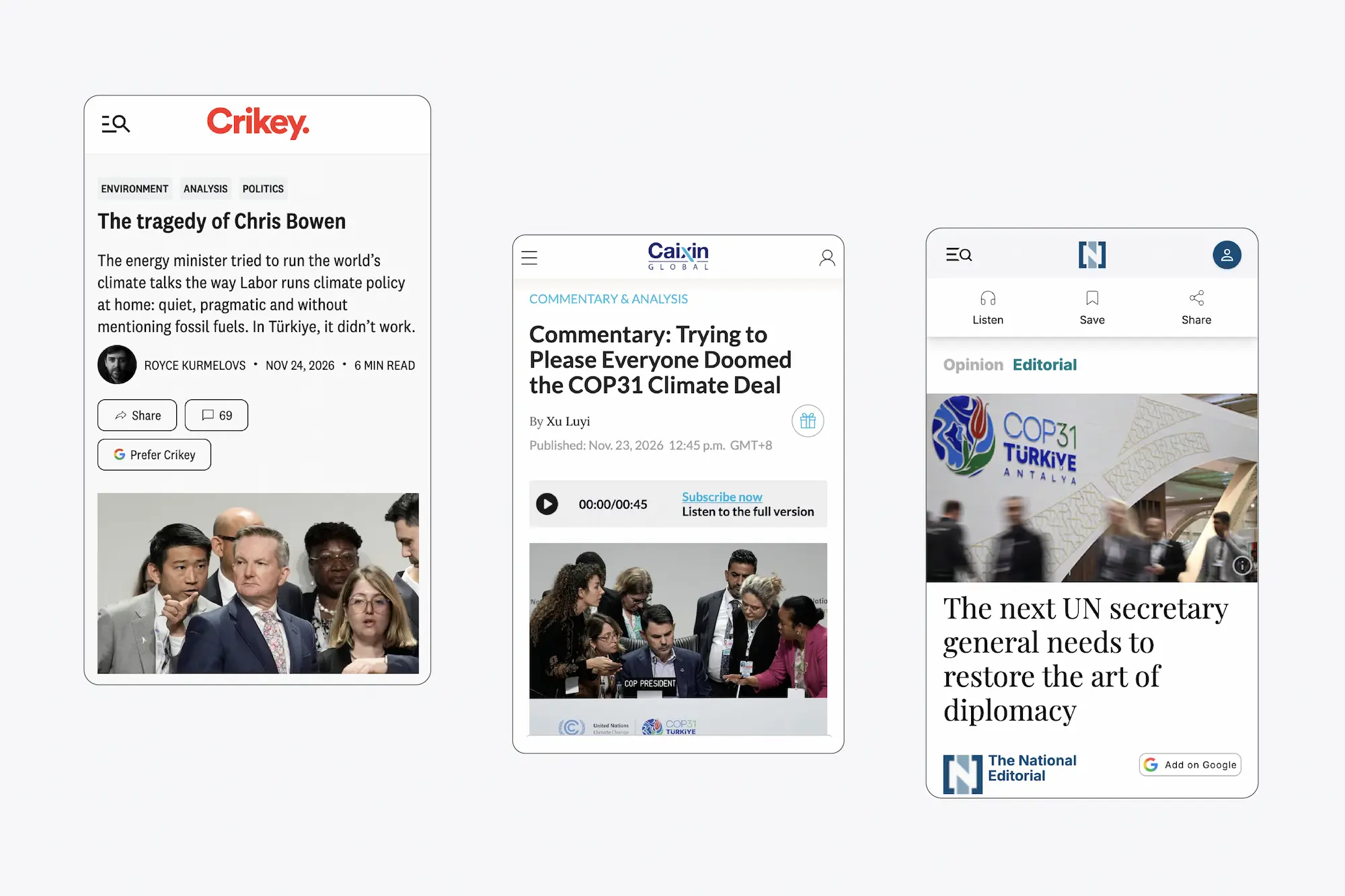
A commentary by journalist Xu Luyi in Chinese financial news outlet Caixin said that future COP presidencies should “distinguish achievable implementation measures from ambitions that lack a coalition capable of delivering them”.
Separately, an editorial in the National – a UAE state-owned English-language daily newspaper – said “the next UN secretary general needs to restore the art of diplomacy”.
How has the role of oil-rich nations been portrayed?
In media coverage, much of the blame for the perceived failure of COP31 has been placed on oil-producing nations – particularly with the final cover decision draft containing no mention of fossil fuels.
Even before the summit had finished, Panama’s minister of environment Juan Carlos Navarro