

Could a new mechanism to help countries transition to a cleaner, safer and fairer world be one of the main deliverables from the COP31 climate summit in Türkiye this November? Civil society groups – which played a key role in winning last year’s agreement in Brazil to set up a mechanism – want to see it come to life in Antalya and take shape in 2027.
The concept of a “just transition” has gained momentum and widespread support in recent years. It recognises that countries have varying levels of responsibility for planet-heating emissions and unequal resources to adapt to the impacts of global warming and move away from fossil fuels.
In July, UN Secretary General António Guterres told the High-Level Political Forum in New York: “We need to support the countries, communities and workers that depend on fossil fuels throughout the transition.” While few would dispute that need, governments at the UN climate talks are still working out how to respond to it with concrete action.
With discussions set to produce a decision making the mechanism a reality at COP31, observers want to ensure the new mechanism is more than just a talking shop.
Here’s what’s at stake in the just transition negotiations before and at COP31:
What has been agreed on the mechanism so far?
At the mid-year climate negotiations in Bonn, just transition was one of the few key issues on which governments reached a consensus, including on how to review the progress of the Just Transition Work Programme (JTWP) – a process that led to agreement on a mechanism last year at COP30 in Belém, Brazil.
Set up in 2022 and launched a year later, the aim of the JTWP is to discuss how to achieve a green economic and social shift that is fair, from the global down to the local level. Its accompanying mechanism will be tasked with strengthening international cooperation, technical support, capacity-building and knowledge-sharing to enable societies to become low-carbon and climate-resilient in a way that does not harm people and shares the benefits.
To phase out fossil fuels, developing countries need exit route from “debt trap”
Anabella Rosemberg, senior advisor on just transition with Climate Action Network (CAN) International, told Climate Home News that the most important outcome in Bonn was an informal document laying out various options for establishing the new mechanism.
However, this leaves a lot still to be worked out and the preliminary discussions at Bonn were not enough on their own to ensure the operationalisation of the mechanism at COP31, as planned.
“In the months ahead of COP31, this issue should be a priority for the COP31 presidencies – both Türkiye and Australia,” said Camila Mercure, climate policy coordinator at the Environment and Natural Resources Foundation (FARN), an Argentinian NGO, adding this would help secure more space for debate in the lead-up to and during the annual summit.
So far, an informal workshop for governments and NGOs to exchange views on the JTWP and the mechanism, and to push things forward has been organised from September 30 to October 2 in Sydney.
How will the review of the Just Transition Work Programme affect the mechanism?
One task for COP31 is to review the efficiency and effectiveness of the JTWP so far and to decide whether and how it will continue.
For Laura Restrepo Alameda, advocacy officer at Climate Action Network Latin America (CANLA), the main positive aspect is that it will include a mapping of instruments, initiatives and processes relevant to just transitions under the UN climate convention, the Paris Agreement and among other UN entities. “It’s a resource that will enable us to assess the complementarity and coherence of the various tools available to support the implementation of a [just transition] mechanism,” she told Climate Home News.
Not everyone wants the JTWP review and the work to launch a mechanism to feed into one another. Russia, Arab nations and a group of large emerging nations pushed for them to be separate – which they believe would make it easier to limit the scope of the mechanism – while the African Group defended joint work between the two processes.
According to Anthony Dane of Southern Transitions, a South Africa-based “think and do-tank”, governments also have varying concerns around the mapping exercise, which is being carried out by the UN climate change secretariat.
He noted in a recent webinar that some want to use it as a basis to argue that a lot is already being done on just transition and so the new mechanism does not need to offer much more, while others are preparing to argue the opposite, highlighting a lack of international cooperation and support.
For Dane, the mapping exercise also raises the bigger question of how to define the scope of “just transition” within the UN climate talks.
So far, richer countries have favoured a narrower view that focuses on phasing out fossil fuels, while developing countries have pushed for a broader “whole of economy, whole of society” approach that encompasses issues like green industrialisation and sustainable development.
Russia and some other high-emitting nations do not want the JTWP or its mechanism to become a tool for imposing new green trade restrictions, while the European Union has rejected attempts to use it as a forum to dispute its new carbon levy on imports. These debates are set to rumble on.
What will the mechanism do and when will it start?
In Bonn, countries discussed the design features of the mechanism – that is, the elements, governance arrangements, structures and functions it should have. The outcome was an informal preliminary note compiling a range of views and possible options.
While most country negotiating groups welcomed the document as a basis for further talks, Arab countries said it did not reflect their priorities, with Saudi Arabia insisting it had no formal status.
“The mechanism must contribute to international cooperation between countries, serve as a guide, support countries so that they can develop just transition strategies, and act as a channel for accessing funding to implement projects within their territories,” said Mercure of FARN.
But exactly what the mechanism should cover, and what it should not, remain a contentious subject for governments.
For example, the Like-Minded Developing Countries – a bloc of more than 20 low- and middle-income nations including China and India – and the Arab Group appear keen to avoid any targets, requirements or conditionalities being imposed on them with regard to transitioning away from fossil fuels (TAFF).
That contrasts with some Latin American and small island states that would like to see the mechanism used as a way of furthering global commitments already made in 2023 on TAFF and tripling renewable energy by 2030.
Developed countries, for their part, do not want the mechanism to put too much responsibility on them to provide finance and other forms of cooperation.
Some experts Climate Home News spoke to, meanwhile, called for the mechanism to lay out actions for different sectors – not just energy but also others like agriculture and heavy industries.
Sandeep Pai, senior lead for international energy transitions at Duke University, said the mechanism should focus on at least eight to ten high-emitting sectors, addressing how to support workers through the transition to cleaner ways of operating. But, he noted “talking about sectors was always an issue at the negotiations”.
Another issue important to civil society groups is that justice should be embedded in the process to operationalise what they have informally dubbed the BAM (short for the Belém Action Mechanism or, more recently, the Belém Antalya Mechanism).
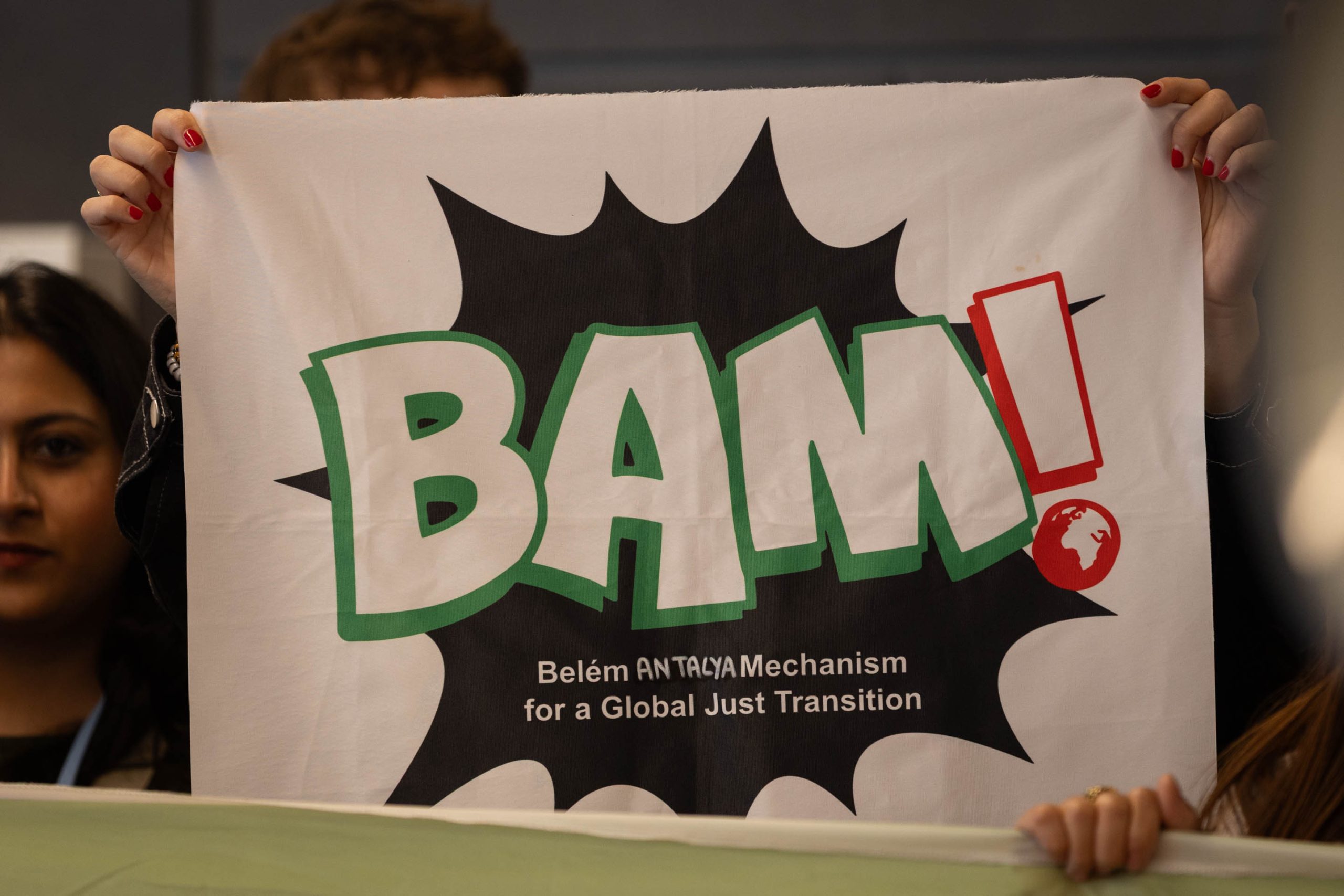
“The key milestone between now and COP31 must be to define a structure for the BAM with clear governance, coordination and the inclusion of civil society,” said CANLA’s Restrepo Alameda. The network, which represents hundreds of NGOs, is calling for groups that are likely to be hit hard by the transition, such as workers and Indigenous peoples, to have a seat at the table.
Given the short time-frame until a decision to operationalise the mechanism is due to be agreed and adopted at COP31, experts say all these thorny issues are unlikely to be ironed out by then and further discussions may be needed to refine the form and functions of the new body.
CAN’s Rosemberg told Climate Home News that “an ambitious outcome” at COP31 would be to establish the mechanism with its key functions and modalities in Antalya, while setting up a transitional committee to speed up technical work and ensure the BAM is fully operational by COP32 in Ethiopia in 2027.
What is needed on the ground for a just transition?
The top-down nature of decisions taken at COPs generally do not reflect the specific situations of individual countries and communities on the ground – and this is particularly so when it comes to just transition.
Pai of Duke University contrasted India – where much of the transition will be about moving away from coal mining and coal-fired power stations – with countries that use relatively few fossil fuels like Costa Rica and will need to implement a very different set of changes.
He added that each country must define what a “just transition” means to them, according to their contexts and needs: is it about using less oil and gas, promoting green steel-making and lower-emitting buildings, or transforming some other high-carbon activity? The next step is to establish government bodies and policies to plan and drive the transition.
COP30: Spain’s unions say just transition means renewing communities beyond jobs
“Global and broad declarations on a [just transition] mechanism are a good signal,” said Pai. “But we would be fooling ourselves if we think that just because something is getting declared, it will be implemented.”
When it comes to tackling dependence on coal, for example, Pai noted the difficulty of shutting down coal mines and replacing their role in local economies that tend to be heavily reliant on the industry for both jobs and revenues. According to the International Energy Agency, 3.1 million of the 7.8 million people working in coal-related activities in 2022 were employed in coal mining.

Why is finance the elephant in the room?
Finance – and finding more of it for climate action – has always been a bone of contention between developed and developing countries in the UN climate process, cropping up time and time again across negotiating streams, whether it’s the new goal for tripling resources for adaptation or filling the loss and damage fund.
In the corridors at Bonn, observers told Climate Home News that, for just transition, the discussions on the topic did not centre on setting up a new dedicated fund, but rather touched on how the mechanism could better connect available financial resources with just transition initiatives in countries.
The informal note on the new mechanism includes mobilising and facilitating “grant-based and non-debt-inducing finance” and channelling finance through North-South and other multilateral partnerships. It is unclear whether finance will be included in the final COP31 decision on the BAM. CAN’s Rosemberg has suggested a resource mobilisation taskforce could be set up to start identifying sources of funding.
An analysis by the Organisation for Economic Co-operation and Development (OECD) shows that, during the first year after mass layoffs, workers losing their jobs in energy-intensive industries – such as power supply, heavy manufacturing and transport – lose an average of 58% of their income, compared with 52% experienced in other sectors.
Pai flagged two challenges when it comes to funding just transitions: many large financial institutions don’t want to invest in low and middle-income countries because of their high-risk profile; and developing countries often lack a well-prepared pipeline of investable projects.
The Just Energy Transition Partnerships (JETPs) launched earlier this decade were an effort to overcome these barriers. The donor-backed initiatives, outside the UN climate process, mobilised billions of dollars from the public and private sectors to help several emerging economies, including South Africa and Indonesia, finance the transition to clean energy in an economically and socially fair manner.
But the JETPs have run up against some difficulties, such as Jakarta abandoning its plan to shut down a major coal plant early, which was a key part of the original deal.
Indonesia’s failing Just Energy Transition Partnership is a cautionary tale
With UN climate negotiations on finance seeing positions harden between developed and developing nations as donor governments struggle to meet existing targets, some observers believe talks on funding for just transition are unlikely to produce quick results in the form of hard dollars any time soon.
“Many of those who are asking for money don’t know what they’re asking for, and those who have the money don’t want to give. You can write a paragraph about finance [in the negotiations] but this fundamental reality will not change,” said Pai.
The post From Belém to Antalya – gains, gaps and challenges for a new Just Transition Mechanism appeared first on Climate Home News.
From Belém to Antalya – gains, gaps and challenges for a new Just Transition Mechanism

For the first time, new-energy vehicles (NEVs) made up 67% of new car sales in China in September, according to the latest data from the China Passenger Car Association (CPCA).
The figures show that NEVs, which include battery electric cars and plug-in hybrids, captured a record share of sales, even though fewer were sold than last year.
This is because sales of combustion-engine cars are falling steeply, a trend that the CPCA has attributed to rising petrol prices following the start of the Hormuz crisis.
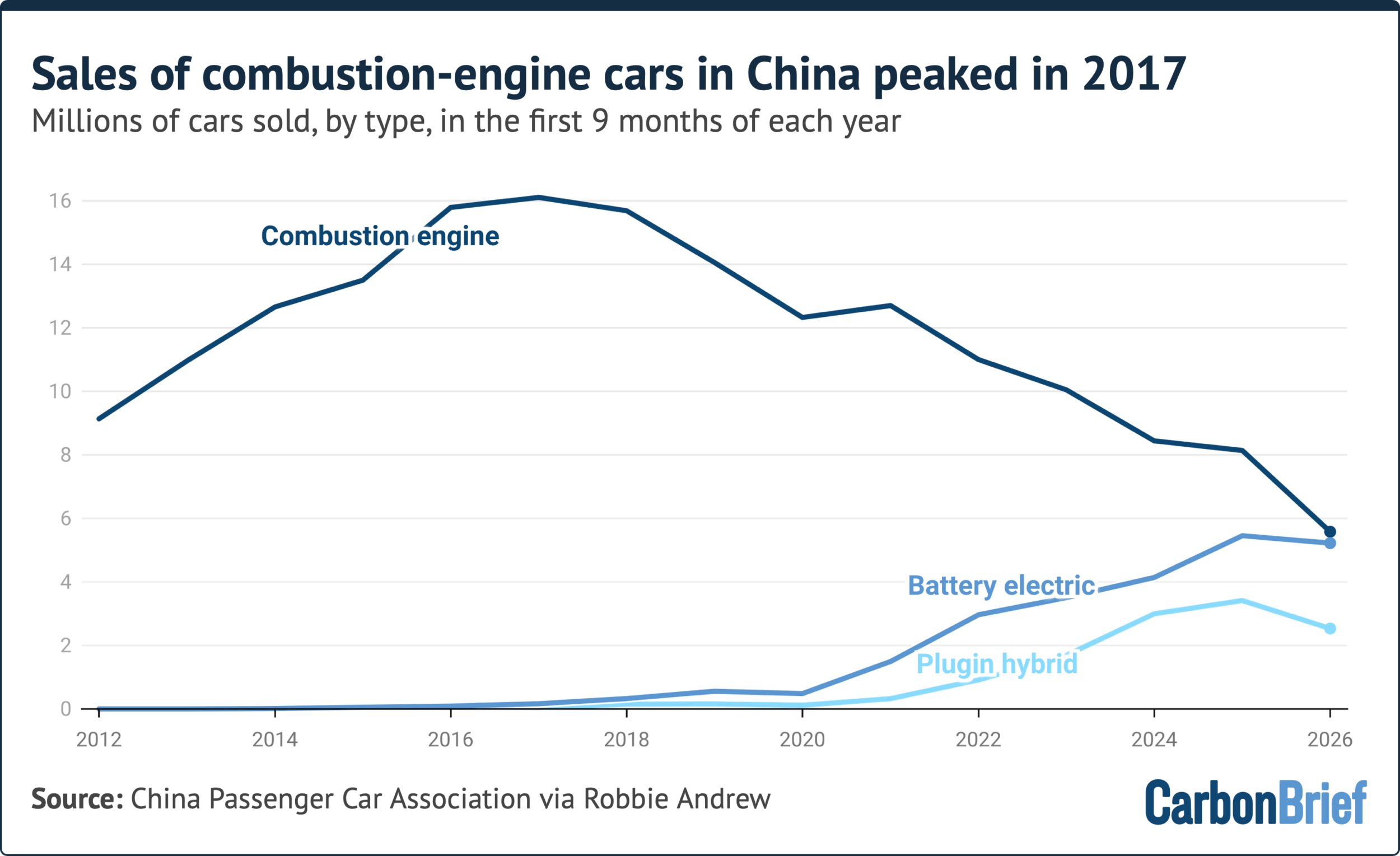
Indeed, sales of fuel-only cars were down 31% year-on-year in the first nine months of 2026, with plug-in hybrid sales down 26% – whereas battery EV sales were only down 4%.
One analyst tells Carbon Brief that China’s rapidly growing EV fleet has offset demand for 143m barrels of oil since the start of the Hormuz crisis.
Another says that the crisis is “reinforcing China’s electrification of road transport”.
Meanwhile, amid slowing domestic sales, Chinese carmakers’ exports of NEVs more than doubled [in 2026 to date / in September] from a year earlier.
NEV record
A record two out of every three cars sold in September in China were NEVs, according to CPCA data, as shown in the figure below.
(NEVs predominantly include battery electric vehicles – BEVs – and plug-in hybrids – PHEVs. BEVs only run on electricity, whereas PHEVs also have a combustion engine.)
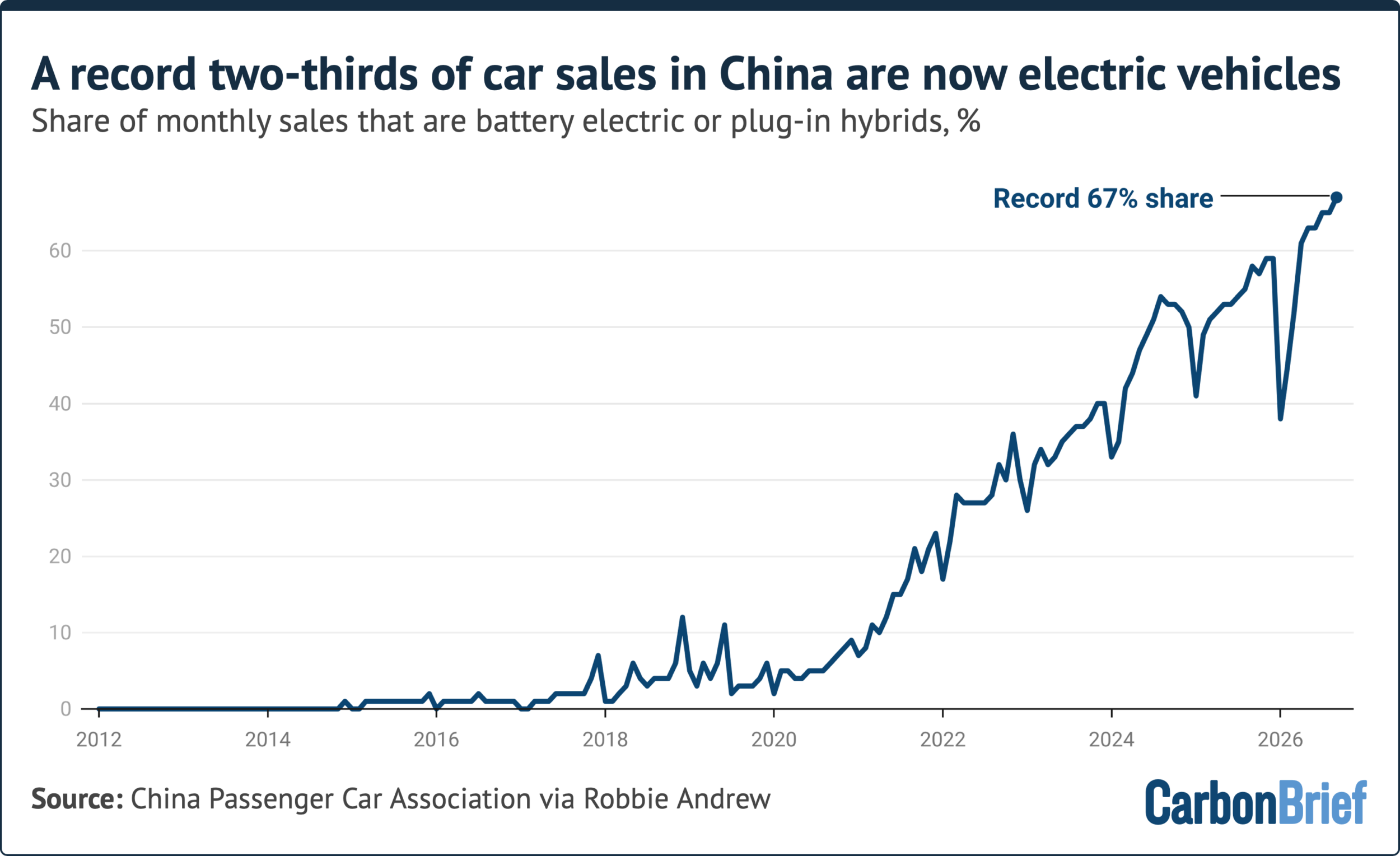
This marks a rapid rise for NEVs from just 6% of new car sales in 2020 up to 58% in 2026 to date – and a record 67% in the month of September.
This year, NEVs’ share of sales has also bounced back from a low of 39% in January, after the full purchase tax exemption that had been in place for more than a decade came to an end in December 2025.
The gain in NEV share in 2026 has come amid a slowdown across the wider domestic passenger-car market, which has hit sales of combustion-engine vehicles particularly hard.
This September, passenger-car retail sales across all categories declined, with overall sales volumes falling 28% year-on-year.
The contraction was led by combustion-engine vehicles, which saw sales fall 43% year-on-year in September and 31% in 2026 to date.
However, sales of PHEVs also fell by 36% year-on-year in September and by 26% in 2026 to date. By comparison, BEVs performed better, although sales still declined 8.5% from a year earlier in September and 4% in 2026 to date.
As a result, NEV sales overall fell by 17% in September and 13% in 2026 to date.
While the market changes in 2026 to date were particularly dramatic, they reflect a broad continuation of trends seen over the past decade.
Indeed, sales of combustion-engine cars in China peaked in 2017 and they have been declining ever since, shown in the figure below.
Impact of Hormuz
Part of the reason for the advance of NEVs in 2026, said Chinese technology news outlet OFweek, was petrol cars “giving up market share” as they were outperformed by electric alternatives.
Cui Dongshu, secretary-general of the CPCA, cited higher petrol prices as an explanation for September’s weak combustion-car sales, in comments to financial news outlet National Business Daily.
Imports of oil into China in January-September have fallen 15% compared to 2025, equivalent to 470m barrels, as ongoing conflict tightened supply and drove up prices.
China’s passenger-car NEV fleet has displaced 143m barrels of oil so far during the strait of Hormuz crisis, Euan Graham, senior energy analyst at thinktank Ember, tells Carbon Brief.
EVs “accounted for 12% of the decrease in China’s oil use post-Hormuz”, according to an estimate provided to thinktank the Brookings Institute by an unnamed analyst.