

PERTH, Thursday 23 April 2026 — Greenpeace Australia Pacific is calling on the WA and Federal Environment Ministers to slap down Woodside’s reckless plans to drill for gas at Scott Reef.
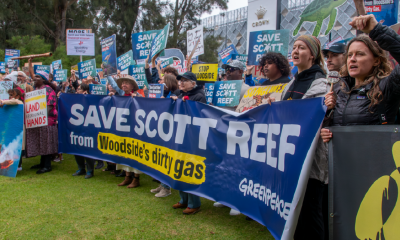
As Woodside holds its 2026 AGM at Crown Towers in Perth, Greenpeace, alongside the Save Scott Reef Alliance and hundreds of community members, will stage a protest calling on the WA and Federal governments to protect Scott Reef and reject the multinational fossil fuel corporation’s Browse gas drilling proposal on the doorstep of endangered whale and turtle habitat.
Due to speak outside Woodside’s AGM and participate as a proxy shareholder, David Ritter, CEO of Greenpeace Australia Pacific, said: “Woodside’s plan to drill for gas at the pristine, magnificent Scott Reef is a disaster waiting to happen.
“Newly appointed CEO Liz Westcott has been handed a poisoned chalice—one of the most controversial and ill-advised fossil fuel projects in Australia’s history—and now has to convince the WA and Federal Environment Ministers, shareholders and the community, that the project is not a toxic disaster waiting to be unleashed.
“The WA Environmental Protection Authority made an initial finding that Woodside’s plans to drill up to 57 wells near Scott Reef, home to nesting sea turtles, endangered pygmy blue whales and other endangered species, posed unacceptable risks to marine wildlife. Independent experts have now said that Woodside’s resubmitted plans still fail to address these risks—including potentially extinction-level harm—to whales and turtles.
“Woodside also plans to dump carbon pollution under the seabed as part of this monster project—a process that would likely involve repeated seismic blasting over the next 39 years, which can deafen whales, near Scott Reef.
“More than half a million Australians have called on the government to stop this nature and climate-wrecking project, in favour of a clean energy future for WA and the nation.
“Greenpeace and our partners are calling on WA Environment Minister Matthew Swinbourn and Federal Environment Minister Murray Watt to reject Woodside’s Browse proposal and protect Scott Reef once and for all.
“Protecting Scott Reef by rejecting Woodside’s appalling plans would be a legacy moment for the WA and Federal Labor governments—building foundations for the cleaner economy of the future, and safeguarding the oceans and wildlife that are part of our identity and all Australians cherish.”
—ENDS—


Climate Change
Australia’s climate credibility tested at Pacific Pre-COP talks, as High Court fossil fuel ruling puts government on notice
NADI, FIJI Thursday 8 October 2026 — As the Pacific Pre-COP talks wrap up and Australia prepares to take the reins of COP31 Negotiations in Türkiye next month, Greenpeace Australia Pacific says the government is on notice over fossil fuel expansion and exports, and must accelerate action to align with a 1.5°C pathway.
Following yesterday’s landmark High Court ruling that the climate impacts of coal and gas exports must be considered by New South Wales planning authorities, Greenpeace Australia Pacific is calling on the Albanese government to find the “courage, leadership and grit” to chart a new course away from fossil fuels.
High res images and video from yesterday’s ‘Keep 1.5C Alive’ flotilla in Nadi can be found here
Speaking from Nadi, Shiva Gounden, Head of Pacific at Greenpeace Australia Pacific, said:
“The outcomes of this week’s talks are a drop in the ocean given the scale of need, and urgency of the crisis our communities are facing. It is like taking a glass of water to a burning house if we do not urgently act to address the root cause of the existential threat facing Tuvalu, Fiji and all Pacific countries: fossil fuel expansion.
“The Electrification Pledge must end fossil fuel dependence, not be an end in itself — its ultimate success depends on ensuring electricity comes from renewable sources that displace fossil fuels and align with a 1.5°C pathway. It must be underpinned by justice and backed by finance flowing from polluters to communities.
“Limiting global warming to 1.5°C is a non-negotiable survival line for humanity and Australia must act. The landmark climate advisory ruling from the ICJ is clear — 1.5°C is the moral, the scientific and the legal limit. Continuing down the fossil fuel path, and failing to align efforts with limiting warming to 1.5°C, is a breach of our international legal obligations, and risks making Australia liable for future reparations from climate-vulnerable nations.”
Also in Nadi, Dr Simon Bradshaw, COP31 Lead and climate expert at Greenpeace Australia Pacific, said: “The Pacific was never going to be a mere backdrop for Australia in its role as incoming chair of the COP31 climate talks, but where its credibility and commitment to climate leadership would be tested.
“Here we see communities fighting for their survival and doing everything possible to hold the line on returning warming to 1.5°C. When governments profess to take their concerns seriously, only to then throw more fuel on the fire, the pain and sadness is visceral.
“This week the High Court of Australia recognised what the Federal Government refuses to — that Australia is responsible for the climate damage of our fossil fuel exports and if governments don’t act, the courts will intervene. The message is simple: this is not someone else’s problem, it is ours.
“We must now follow other countries in developing a national roadmap away from fossil fuels that ensures a managed wind-down of fossil fuel production, including exports, in line with our legal obligation to help return warming to 1.5°C.”
ENDS
Media contact: Kate O’Callaghan in Nadi on +61 406 231 892 (Whatsapp/Signal)
A Dutch NGO has filed the first climate complaint under the European Union’s trade rules, arguing that New Zealand violated the environmental provisions of its free trade agreement with the bloc by weakening its climate regulations.
The case will test whether binding climate provisions in the EU’s free trade deals can be enforced to hold governments accountable to their climate obligations, experts told Climate Home News.
The EU-New Zealand free trade agreement, which came into force in 2024, was the first in the world to include legally-binding climate provisions and possible sanctions for violating them, as the EU seeks to use its trade partnerships to advance greater environmental protection.
Under the deal, both parties committed not to weaken their environmental law to promote trade or investment and to “refrain from any action or omission that materially defeats the object and purpose of the Paris Agreement”.
-
International trade linked to 20% of global emissions – but imports ignored
Researchers say governments should discuss how to tackle emissions linked to globally traded goods and services, especially in large importing countries

At the time the agreement was signed, EU Commission President Ursula von der Leyen said the agreement included “unprecedented social and climate commitments”. But experts warned it was unclear how the Paris Agreement provisions would be enforced.
The EU included a similar “trade and sustainable development” clause in 14 other bilateral trade deals in recent years, with several others, including with China, awaiting ratification or being negotiated.
Climate activists at the Dutch NGO Both ENDS argue that the New Zealand government breached these terms by reopening its waters to offshore oil and gas exploration, releasing a climate plan that barely requires any emissions reductions, and passing a law that prevents corporations from getting sued over climate damages.
“Here, we have a so-called gold standard for free trade agreements with sustainability provisions but we have a trading partner that is doing exactly the opposite: regressing, as all the evidence points to, away from the Paris Agreement,” said Marius Troost, a senior policy advisor at Both ENDS.
Can the EU enforce its climate trading rules?
The Dutch environmental group filed the complaint under the EU Commission’s Single Entry Point, a mechanism that allows civil society to request enforcement of the bloc’s trade commitments.
The EU-New Zealand trade deal includes the possibility of suspending beneficial trading arrangements between the two parties in response to serious violations of its climate provisions. This, Troost said, is a “unique” tool to enforce both parties’ obligations under the deal.
“This is an opportunity for the EU and New Zealand to show that they are actually serious about these commitments,” he told Climate Home News.

A spokesperson for New Zealand’s Ministry of Foreign Affairs and Trade denied any violations of the agreement and said the government hadn’t received formal notice of the complaint. The country, they said, “takes its commitments under the NZ-EU Free Trade Agreement seriously, including the agreement’s environment and climate-related provisions”.
An EU Commission spokesperson said it will start a preliminary assessment of the complaint and engage with NGO Both ENDS. “Sustainability is a central pillar of the EU-New Zealand relationship,” they added.
The EU is New Zealand’s second-largest trading partner after China, with about 14% of the country’s exports going to the European market. Agricultural products like meat, diary, fruit and vegetables are the country’s biggest exports to Europe.
New Zealand is ‘having its cake and eating it’
Eliza Prestidge-Oldfield, a senior legal researcher at the New Zealand-based Environmental Law Initiative, which is supporting Both ENDS’s claim, told Climate Home News that if the EU upholds the complaint, both parties would begin a negotiation process.
“The idea is to try and resolve this positively with the New Zealand government acknowledging areas where it needs to change its actions in order to comply with the agreement, and get that change in place as soon as possible,” she said.
But New Zealand’s right-wing coalition government said it won’t take any directives from foreign actors regarding its policies. Trade minister Todd McClay told local media that it was “not for overseas countries, organisations or lobby groups to tell New Zealand how to meet its obligations”.
-
Coal mines and hypocrisy must not be Australia’s COP31 legacy
Still without a coal phase-out plan, Australia must course-correct to earn the mantle it has been given and do right by the Pacific nations that backed its bid for COP’s co-presidency -
Pacific leaders rail at climate finance failures after pre-COP trip to Tuvalu
Island nations seek invest in their own Pacific Resilience Facility, as they struggle with the red-tape of international climate funds -
As COP31 co-host, Australia should make its polluters pay for climate damage
With UN climate funds running short on cash, now is the time to start taxing the companies whose emissions are driving harm in the Pacific and other vulnerable parts of the world


Prestidge-Oldfield argued the complaint isn’t about “Europe telling anyone what to do at all”, but rather stressing the conditions under which they are willing to import goods from New Zealand. “The New Zealand government is trying to have its cake and eat it too,” she said.
If New Zealand refuses to adjust its policies in line with the agreement, the complaint will be assessed by an independent panel, which can require the country to make changes. If those changes are not implemented, the panel could decide that New Zealand should lose its preferential EU market access.
A negotiated resolution is more likely, however, with no prior labour-related complaints to the EU having ever reached the panel stage.
Alexander Gillespie, a law professor at the University of Waikato in New Zealand, said sanctions would be a “last resort”. “This is a test case, which will generate considerable attention – as it is not just about climate change, but how free trade and environmental sustainability have been woven together,” he said in a statement.
Trade deals as tool for climate accountability
Experts said the case could set a precedent for how trade deals can be used to hold governments accountable on climate action. The EU has enacted similar “trade and sustainable development” clauses in its trade agreements with Canada, Japan and South Korea.
While still pending ratification, the EU’s 2024 trade agreement with Mercosur – which encompasses Argentina, Brazil, Paraguay and Uruguay – also includes climate provisions, including a commitment to “effectively implement” the Paris Agreement and promote low-carbon trade.
In addition, legal researcher Prestidge-Oldfield noted that last year’s landmark advisory opinion on climate change by the International Court of Justice (ICJ) laid out stronger climate obligations for developed countries like New Zealand and could strengthen allegations of violations of the terms of the trade deal.
“It will be an interesting area to watch how the EU free trade agreement is interpreted in the light of this advisory opinion,” she said.
The post New Zealand accused of breaching EU trade deal over climate rollbacks appeared first on Climate Home News.
New Zealand accused of breaching EU trade deal over climate rollbacks
Australia and Türkiye have agreed to take forward a “presidency-led decision for COP31” after consulting with different countries and groups, Australia’s climate change and energy minister said on Wednesday at the pre-COP meeting in Fiji.
The announcement that November’s climate conference will produce what is known among negotiators as a “cover decision” lays to rest the annual speculation over how the main outcomes of the UN climate conference will be presented this year.
Unlike other formal decision texts at COP, cover decisions are not negotiated word by word between governments. They are often summaries crafted during the proceedings by the presidency, although they still need to be adopted by consensus. Cover texts bring together key elements and initiatives emerging from the discussions at the two-week UN climate talks and give a sense of the political direction of travel for the coming year.
Australian minister Chris Bowen, who will preside over the negotiations at COP31 in the Turkish seaside resort of Antalya, said the presidency did not want to negotiate “a lengthy political statement”. The two countries are sharing the presidency in an unusual arrangement, although Türkiye has the formal title of COP31 President.
The decision, he explained, will be one that “captures the global moment and calls for action”, adding that it would offer “a focused and concrete response to the challenges and opportunities of our time”.
-
Pacific leaders rail at climate finance failures after pre-COP trip to Tuvalu
Island nations seek invest in their own Pacific Resilience Facility, as they struggle with the red-tape of international climate funds -
At pre-COP, UN climate chief warns of heat threat to mothers and babies
The spotlight on maternal health came on the first day of the pre-COP31 meeting in Fiji, where Pacific concerns are set to top the agenda as ministers gather for talks


Bowen said the text could recognise the recent UN report acknowledging that an overshoot of the 1.5C warming limit is now inevitable, but temperatures could be brought back down to that level. The decision could also stress “the urgent need for climate action, support and international cooperation to go further and faster”, he added.
With COP31 President Murat Kurum sitting next to him, smiling and nodding, Bowen said the joint presidency aimed to be open and transparent, giving governments an early idea of what to expect from the COP31 process.
Earlier in the week, they published a second joint letter laying out key areas for progress at the negotiations, from setting up a just transition mechanism to putting science at the centre of the next global stocktake of climate plans and focusing governments on the need to increase adaptation finance.
Cosima Cassel, climate diplomacy lead at think-tank E3G, said a COP31 cover decision should send a clear political signal that accelerating climate action is central to global security, prosperity and resilience, show that faster implementation can help address 1.5C overshoot, and support developing countries to put their climate plans into practice.
EU keen to know “what success looks like”
Earlier on Wednesday, Europe’s climate commissioner Wopke Hoekstra told journalists in Fiji that the European Commission had asked the UN and COP31 organisers to provide clarity on the summit’s agenda and “what success would look like” in Antalya.
That is why, he added, “I… like it a lot that the organisers are pushing for electrification and are already clear about it upfront”.
A voluntary