

Every year, understanding of climate science grows stronger.
With each new research project and published paper, scientists learn more about how the Earth system responds to continuing greenhouse gas emissions.
But with many thousands of new studies on climate change being published every year, it can be hard to keep up with the latest developments.
Our annual “10 new insights in climate science” report offers a snapshot of key advances in the scientific understanding of the climate system.
Produced by a team of scientists from around the world, the report summarises influential, novel and policy-relevant climate research published over the previous 18 months.
The insights presented in the latest edition, published in the journal Global Sustainability, are as follows:
- Questions remain about the record warmth in 2023-24
- Unprecedented ocean surface warming and intensifying marine heatwaves are driving severe ecological losses
- The global land carbon sink is under strain
- Climate change and biodiversity loss amplify each other
- Climate change is accelerating groundwater depletion
- Climate change is driving an increase in dengue fever
- Climate change diminishes labour productivity
- Safe scale-up of carbon dioxide removal is needed
- Carbon credit markets come with serious integrity challenges
- Policy mixes outperform stand-alone measures in advancing emissions reductions
In this article, we unpack some of the key findings.
A strained climate system
The first three insights highlight how strains are growing across the climate system, from indications of an accelerating warming and record-breaking marine heatwaves, to faltering carbon sinks.
Between April 2023 and March 2024, global temperatures reached unprecedented levels – a surge that cannot be fully explained by the long-term warming trend and typical year-to-year fluctuations of the Earth’s climate. This suggests other factors are at play, such as declining sulphur emissions and shifting cloud cover.
(For more, Carbon Brief’s in-depth explainer of the drivers of recent exceptional warmth.)
Ocean heat uptake has climbed as well. This has intensified marine heatwaves, further stressing ecosystems and livelihoods that rely on fisheries and coastal resources.
The exceptional warming of the ocean has driven widespread impacts, including massive coral bleaching, fish and shellfish mortality and disruptions to marine food chains.
The map below illustrates some of the impacts of marine heatwaves from 2023-24, highlighting damage inflicted on coral reefs, fishing stocks and coastal communities.

Land “sinks” that absorb carbon – and buffer the emissions from human activity – are under increasing stress, too. Recent research shows a reduction in carbon stored in boreal forests and permafrost ecosystems.
The weakening carbon sinks means that more human-caused carbon emissions remain in the atmosphere, further driving up global temperatures and increasing the chances that warming will surpass the Paris Agreement’s 1.5C limit.
This links to the fourth insight, which shows how climate change and biodiversity loss can amplify each other by leading to a decrease in the accumulation of biomass and reduced carbon storage, creating a destabilising feedback loop that accelerates warming.
New evidence demonstrates that climate change could threaten more than 3-6 million species and, as a result, could undermine critical ecosystem functions.
For example, recent projections indicate that the loss of plant species could reduce carbon sequestration capacity in the range of 7-145bn tonnes of carbon over the coming decades. Similarly, studies show that, in tropical systems, the extinction of animals could reduce carbon storage capacity by up to 26%.
Human health and livelihoods
Growing pressure on the climate system is having cascading consequences for human societies and natural systems.
Our fifth insight highlights how groundwater supplies are increasingly at risk.
More than half the global population depends on groundwater – the second largest source of freshwater after polar ice – for survival.
But groundwater levels are in decline around the world. A 2025 Nature paper found that rapid groundwater declines, exceeding 50cm each year, have occurred in many regions in the 21st century, especially in arid areas dominated by cropland. The analysis also showed that groundwater losses accelerated over the past four decades in about 30% of regional aquifers.
Changes in rainfall patterns due to climate change, combined with increased irrigation demand for agriculture, are depleting groundwater reserves at alarming rates.
The figure below illustrates how climate-driven reductions in rainfall, combined with increased evapotranspiration, are projected to significantly reduce groundwater recharge in many arid regions – contributing to widespread groundwater-level declines.
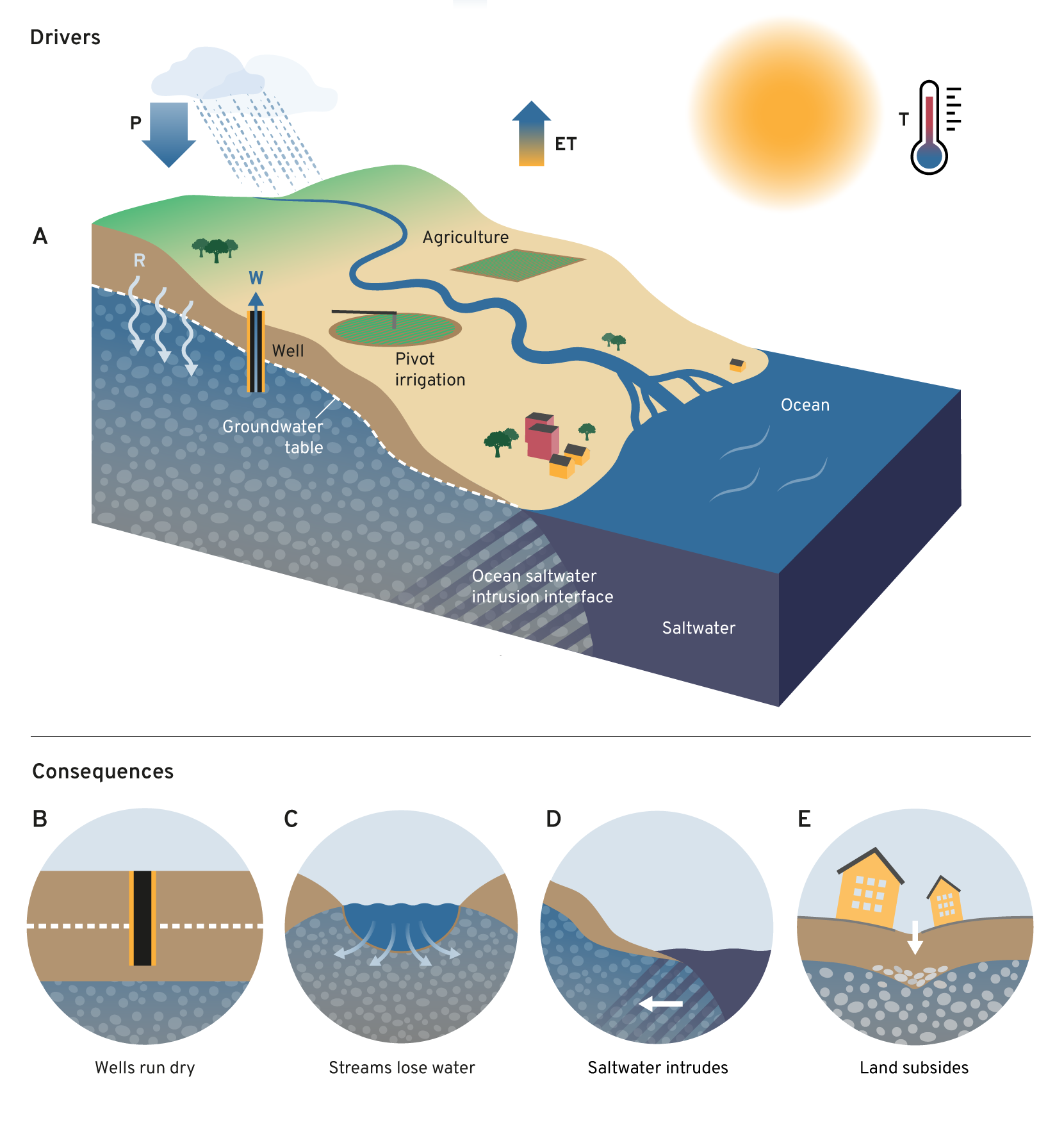
These losses threaten food security, amplifying competition for scarce resources and undermining the resilience of entire communities.
Human health and livelihoods are also being affected by changes to the climate.
Our sixth insight spotlights the ongoing and projected expansion of the mosquito-borne disease dengue fever.
Dengue surged to the largest global outbreak on record in 2024, with the World Health Organization reporting 14.2m cases, which is an underestimate because not all cases are counted.
Rising temperatures are creating more favourable conditions for the mosquitoes that carry dengue, driving the disease’s spread and increasing its intensity.
The chart below shows the regions climatically suitable for Aedes albopictus (blue line) and Aedes aegypti (green line) – the primary mosquitoes species that carry the virus – increased by 46.3% and 10.7%, respectively, between 1951-60 and 2014-23.
The maps on the right reveal how dengue could spread by 2030 and 2050 under an emissions scenario broadly consistent with current climate policies. It shows that the climate suitable for the mosquito that spreads dengue could expand northwards in Canada, central Europe and the West Siberian Plain by 2050.

The ongoing proliferation of these mosquito species is particularly alarming given their ability to transmit the zika, chikungunya and yellow fever viruses.
Heat stress is also a growing threat to labour productivity and economic growth, which is the seventh insight in our list.
For example, an additional 1C of warming is projected to expose more than 800 million people in tropical regions to unsafe heat levels – potentially reducing working hours by up to 50%.
At 3C warming, sectors such as agriculture, where workers are outdoors and exposed to the sun, could see reductions in effective labour of 25-33% across Africa and Asia, according to a recent Nature Reviews Earth & Environment paper.
Meanwhile, sectors where workers operate in shaded or indoor settings could also face meaningful losses. This drain on productivity compounds socioeconomic issues and places a strain on households, businesses and governments.
Low-income, low-emitting regions are set to shoulder a greater relative share of the impacts of extreme heat on economic growth, exacerbating existing inequalities.
Action and policy
Our report illustrates not only the scale of the challenges facing humanity, but also some of the pathways toward solutions.
The eighth insight emphasises the critical role of carbon dioxide removal (CDR) in stabilising the climate, especially in “overshoot” scenarios where warming temporarily surpasses 1.5C and is then brought back down.
Scaling these CDR solutions responsibly presents technical, ecological, justice, equity and governance challenges.
Nature-based approaches for pulling carbon out of the air – such as afforestation, peatland rewetting and agroforestry – could have negative consequences for food security, biodiversity conservation and resource provision if deployed at scale.
Yet, research has suggested that substantially more CDR may be needed than estimated in the scenarios used in the Intergovernmental Panel on Climate Change (IPCC’s) last assessment report.
Recent findings showed that a pathway where temperatures remain below 1.5C with no overshoot would require up to 400Gt of cumulative CDR by 2100 in order to buffer against the effect of complex geophysical processes that can accelerate climate change. This figure is roughly twice the amount of CDR assessed by the IPCC.
This underscores the need for robust international coordination on the responsible scaling of CDR technologies, as a complement to ambitious efforts to reduce emissions. Transparent carbon accounting frameworks that include CDR will be required to align national pledges with international goals.
Similarly, voluntary carbon markets – where carbon “offsets” are traded by corporations, individuals and organisations that are under no legal obligation to make emission cuts – face challenges.
Our ninth insight shows how low-quality carbon credits have undermined the credibility of these largely unregulated carbon markets, limiting their effectiveness in supporting emission reductions.
However, emerging standards and integrity initiatives, such as governance and quality benchmarks developed by the Integrity Council for Voluntary Carbon Markets, could address some of the concerns and criticism associated with carbon credit projects.
High-quality carbon credits that are verified and rigorously monitored can complement direct emission reductions.
Finally, our 10th insight highlights how a mix of climate policies typically have greater success than standalone measures.
Research published in Science in 2024 shows how carefully tailored policy packages – including carbon pricing, regulations, and incentives – could consistently achieve larger and more durable emission reductions than isolated interventions.
For example, in the buildings sector, regulations that ban or phase out products or activities achieve an average effect size of 32% when included in a policy package, compared with 13% when implemented on their own.
Importantly, policy mixes that are tailored to the country context and with attention to distributional equity are more likely to gain public support.
These 10 insights in our latest edition highlight the urgent need for an integrated approach to tackling climate change.
The science is clear, the risks are escalating – but the tools to act are available.




The post Guest post: 10 key climate science ‘insights’ from 2025 appeared first on Carbon Brief.

Climate Change
Commencement of NSW Forestry assessment a ‘chance to fix a broken system’ and deliver urgent forest protection
SYDNEY, Friday 18 September 2026 — In response to the Federal and NSW government’s announcement to commence an assessment of NSW forestry under the new national nature laws, Adele Chasson, Nature Policy Lead at Greenpeace Australia Pacific said:
“This is the Federal Government’s chance to fix a broken system that has enabled the destruction of NSW’s precious forests for far too long.
“Native forest logging continues to smash threatened species habitat. In NSW, it is pushing unique wildlife like koalas, greater gliders and glossy black cockatoos towards extinction. The state-owned logging agency has a disastrous record of environmental damage and breaches.
“The Regional Forest Agreement (RFA) system has failed, allowing the industrial logging of special forests for decades across Australia with no oversight. Thankfully, the Federal Government has started the process to finally remove the logging industry’s exemption from national nature laws.
“It’s time for the Federal Government to deliver the protection that forests urgently need, and that Australians overwhelmingly want. The Government must ensure a thorough assessment of the devastating impacts of native forest logging in NSW, and establish strong environmental rules that states must follow.
“These forests have been cared for by First Nations people for tens of thousands of years. They are some of the most biodiverse on the planet, store carbon, clean our air and water. It’s critical we protect them.”
ENDS
Media contact:
Kate O’Callaghan on 0406 231 892 or kate.ocallaghan@greenpeace.org
What happens when a love of marine life meets a playful imagination?
Sydney artist, illustrator and children’s author Sha’an d’Anthes, better known as Furry Little Peach, has teamed up with Greenpeace to create Happy Ocean Happy Planet: a joyful celebration of the extraordinary creatures that call our oceans home.
Sha’an felt inspired to create an illustration celebrating the beauty and resilience of marine life. Its hopeful message, A Happy Ocean is a Happy Planet, sparked a special collaboration with Greenpeace and a limited-edition t-shirt designed to help protect the oceans that inspired it.
The exclusive Furry Little Peach tee is available as a gift to new regular Greenpeace donors who give $30 or more and make at least three donations. By becoming a regular giver, you’ll help Greenpeace campaign for ocean protection.

ARTIST INTERVIEW: Sha’an d’Anthes (Furry Little Peach)
Sha’an shares the story behind the artwork, the local marine creatures featured in the design and why hope can be such a powerful force for action.
Hi Sha’an! Can you tell us a little about yourself and what you do?
My name is Sha’an d’Anthes, I also go by the pseudonym Furry Little Peach and I’m an illustrator, artist and children’s author based in Sydney, Australia. I love creating joyful, vibrant and nostalgic art that looks at the world through the lens of childlike wonder.

What do you love about drawing animals and nature?
I love all of the different shapes, colour and narrative you get to explore when drawing animals and nature. I’m also a city-slicker these days, and so I think that my work is a sort of escapism (for myself and hopefully for my audience).
How did the Greenpeace collaboration come about?
I went to the premiere of David Attenborough’s documentary Ocean, and felt compelled to create something to share the message of the film. This t-shirt is actually based off of that illustration including the tagline in I included when I shared it “A Happy Ocean is a Happy Planet”. I’m so grateful Greenpeace approached me for the project – it was a blast.
Where did you start when creating the Happy Ocean Happy Planet design?
The Happy Ocean tee starts the same as all of my work – with a brainstorm/braindump and really loose concept sketches.
How did you choose the animals for the illustration?
I actually asked Greenpeace to help me with the research of local marine life and they were so accommodating. They very quickly delivered me a huge list of local species of fish, mammals and coral and I just went through and looked up each creature and curated a little group of sea life that I thought would look sweet together – a mix of sizes, types, colours, textures and shapes.
What did you use to create the artwork?
So much of my work is traditional, but when it comes to things like t-shirts I always use digital drawing programs because I like to draw each colour in a separate layer which requires me to jump in and out of layers because it allows me to control colour and printing. When working digitally I always sketch in Procreate (an Australian digital art app), and then with this project I created final art in Adobe Fresco because it called for a vector graphic (an image that can be blown up to any size).
Do you have a favourite creature in the design?
I love painting Humpback Whales and always have, but I also have a soft spot for the sweet little Jelly Blubber jellyfish.
What did you want people to feel when they saw the artwork?
I specifically wanted to focus on the outcome that all of us want to see – a happy, thriving ocean where creatures are given the time and space to balance themselves. I feel that even when tackling tough subjects, leaning into hope is my natural inclination. As long as we have hope that things can be better, we will continue to take action.
What was the most fun part of creating it?
I actually documented the entire process of this project in a studio vlog on YouTube – and you can see how much fun I’m having doing final art jumping between layers and building the image. I had just come off completing final art for two books which are multi-year long projects, so being able to do a project that from start to finish in just a few days was really freeing at the time.
What does a “happy ocean” mean to you?
An ocean that given the time and space to repair and balance itself. Something I really took away from David Attenborough’s Ocean is that ocean ecosystems are actually really good at repairing themselves if we just let them do their thing.
How can people get their hands on the t-shirt?
The shirt is a reward for regular givers to Greenpeace – those who commit to at least 3 months of donations will receive the tee as a gift. Read about how at http://act.gp/flp-tee
How is Greenpeace helping to make our oceans happier places?
They have a deep focus on the health and happiness of our oceans through advocating for the set up of marine sanctuaries, holding big ocean polluters to account and calling for a ban on deep sea mining.
What are you working on next?
I will be jumping headfirst into Peachtober – an annual daily art challenge I run each year in October, if there are any artists reading this it’s a great time so please come join! In terms of publications my next picture book The Late Bird will be out in February 2027 (published by Harper Collins US) and then I have an creative activity book for adults coming out next August with Chronicle US and Penguin Australia. Otherwise you can always check out what I’m tinkering away with in my studio on Instagram and YouTube.

Climate Change
AI giant Anthropic’s first Australian data centre deal an “egregious” example of Big Tech double talk
SYDNEY, Thursday 17 September 2026 — Greenpeace Australia Pacific has slammed AI giant Anthropic’s deal for its first Australian site in Queensland’s Western Downs, the heart of coal seam gas country, saying the project will entrench gas and turbocharge climate pollution.
The expected electricity demand from the data centre site, situated in the middle of the Western Downs coal seam gas fields, is comparable to 1.5 million Australian households. Greenpeace’s report Energy Vampires: The AI data centres draining Australia called for a moratorium on frenzied data centre development until appropriate guardrails are in place.
Joe Rafalowicz, Head of Climate and Energy at Greenpeace Australia Pacific, said: “This is an egregious example of Big Tech giants being given carte blanche to drain energy and water, and use polluting gas to fuel their hyperscale data centres.
“AI and Big Tech corporations claim to bring new renewable energy to the grid, while blatantly planning to power their operations with polluting fossil fuels.
“Planning documents show the first stage of this behemoth project could be powered by ‘behind the metre’ gas — the same playbook AI companies have used in the US, leading to a 20% increase in climate pollution from electricity. Now these companies want to bring their cowboy plans to Australia and the Federal Government is allowing it.
“If they plugged into the local grid, the power required would increase Queensland’s electricity grid emissions by around 6.6 million tonnes — an 18% rise. If they build their own gas-fired power plants, this will drive up Queensland’s emissions even more.
“Billions of dollars are now pouring into a massive pipeline of proposed new data centres, of unprecedented size, being built at incredible speed across the country. Australians should be worried about the extreme lack of scrutiny being applied to these projects, and the corporations leading the data centre charge.
“The data centre build-out is happening without the endorsement of the Australian people, yet we are the ones who will pay the price. We can not allow unchecked data centre expansion to derail our renewable energy transition, entrench gas and turbocharge climate pollution — that’s why Greenpeace has called for an urgent moratorium until appropriate guardrails are in place.”
ENDS
Media contact: Kate O’Callaghan on 0406 231 892 or kate.ocallaghan@greenpeace.org



-

 Greenhouse Gases2 years ago
嘉宾来稿:满足中国增长的用电需求 光伏加储能“比新建煤电更实惠”
-
Climate Change1 year ago
Guest post: Why China is still building new coal – and when it might stop
-
Greenhouse Gases1 year ago
Guest post: Why China is still building new coal – and when it might stop
-

 Climate Change2 years ago
嘉宾来稿:满足中国增长的用电需求 光伏加储能“比新建煤电更实惠”
-

 Renewable Energy11 months ago
Sending Progressive Philanthropist George Soros to Prison?
-
Climate Change2 years ago
Bill Discounting Climate Change in Florida’s Energy Policy Awaits DeSantis’ Approval
-
Greenhouse Gases1 year ago
嘉宾来稿:探究火山喷发如何影响气候预测
-

 Carbon Footprint2 years ago
US SEC’s Climate Disclosure Rules Spur Renewed Interest in Carbon Credits