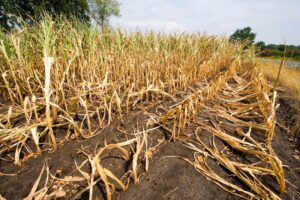
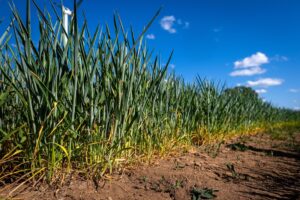
Growing tall trees to provide shade for cocoa plantations in west Africa could sequester millions of tonnes of carbon, according to a new study.
The research, published in Nature Sustainability, finds that the additional carbon stored in shade trees, such as banana and palm trees, could entirely “offset” cocoa-related emissions in Ghana and Ivory Coast, without reducing production.
West Africa produces about 60% of the world’s cocoa, which is one of the most emissions-intensive crops to grow.
The authors map the shade provided by trees across cocoa agricultural systems in west Africa, then project how much additional carbon storage would be created by expanding it.
An author of the study tells Carbon Brief that cocoa plantations have been a “big” driver of deforestation and the emissions it causes, but the findings show that there is “huge potential” for cocoa to be “part of the solution”.
Cocoa plantations
Cocoa trees thrive in rainforests, as they need abundant rain, high humidity and stable temperatures. They often grow under the shadow of other plants, such as bananas, plantains and palm trees.
Two countries in west Africa – Ivory Coast and Ghana – dominate global cocoa production and are major exporters to the US and Europe.
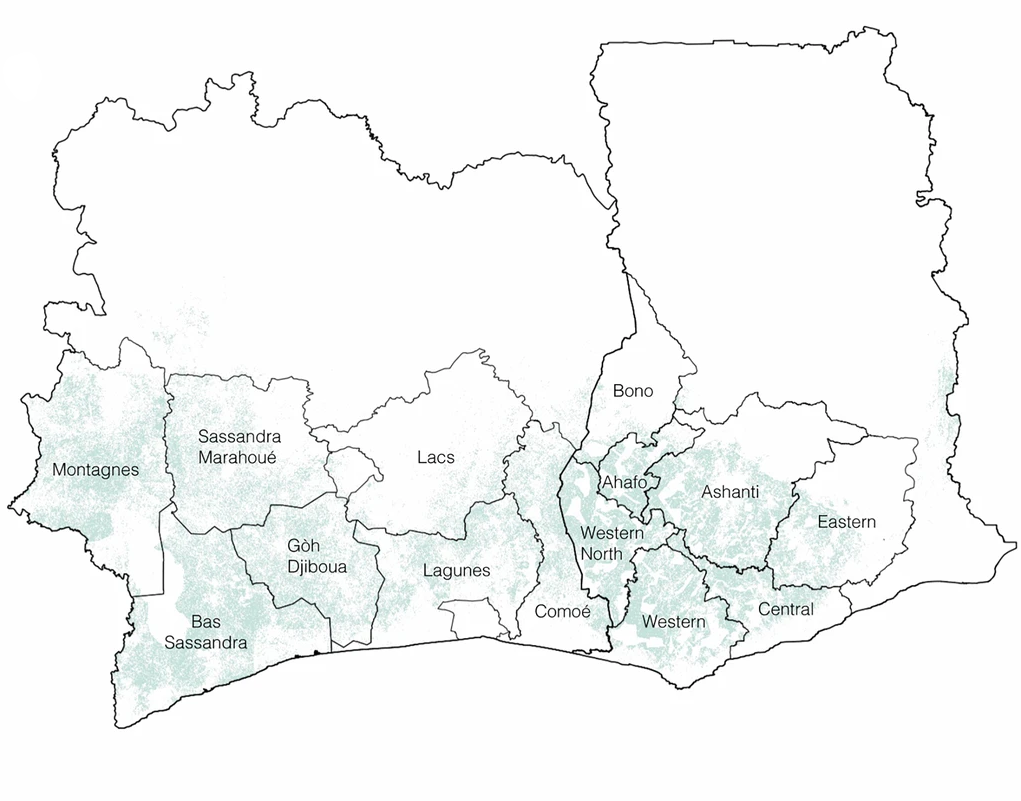
The shading on the map below shows where cocoa is grown in Ivory Coast (left) and Ghana (right).
Both countries have favourable conditions for cocoa production, including tropical forests – which provide nutrients to the soil – a great deal of rain, warm temperatures and low production costs.
Two million farmers in the region rely on cocoa farming for their livelihoods, the study says, and cocoa contributes 10-20% of the two countries’ gross domestic product.
However, cocoa has “one of the most emissions-intensive footprints of all foods”, the study adds.
A 2022 study found that producing 1kg of cacao beans in Ivory Coast releases, on average, 1.5kg of CO2-equivalent (CO2e) – largely a result of deforestation. Since 2000, cocoa plantations have driven 37% of forest loss in protected areas in Ivory Coast and 13% of the loss in protected areas in Ghana.
Cocoa plantations cover more than three-and-a-half times as much land as the remaining intact forests in west Africa, according to the study.
Dr Wilma Blaser Hart, a research fellow at the University of Queensland and an author of the study, tells Carbon Brief:
“That land-use change is what makes cocoa such a carbon-intensive product, because there has just been so much forest loss for being able to produce cocoa.”
Shade-grown cocoa crops
Agroforestry is an agricultural method that combines the planting of crops with trees. Agroforestry can raise incomes for farmers and provide ecosystem services, including soil health improvement, biodiversity conservation and carbon sequestration.
The study investigates the amount of carbon that is currently stored in cocoa plantations in Ivory Coast and Ghana, as well as the potential carbon sequestration if agroforestry were expanded in these countries.
The authors use drones and machine learning to map the cover of shade trees, finding that 13% of the combined area of Ivory Coast and Ghana is currently covered with these trees.
In the study, “shade trees” refers to any trees taller than eight metres – the maximum height of cocoa trees.
The map below shows the area of shade trees in cocoa-growing areas specifically for 2022. The colours indicate levels of tree cover from 0-15% (blue), through to 15-30% (green) and more than 30% (yellow).
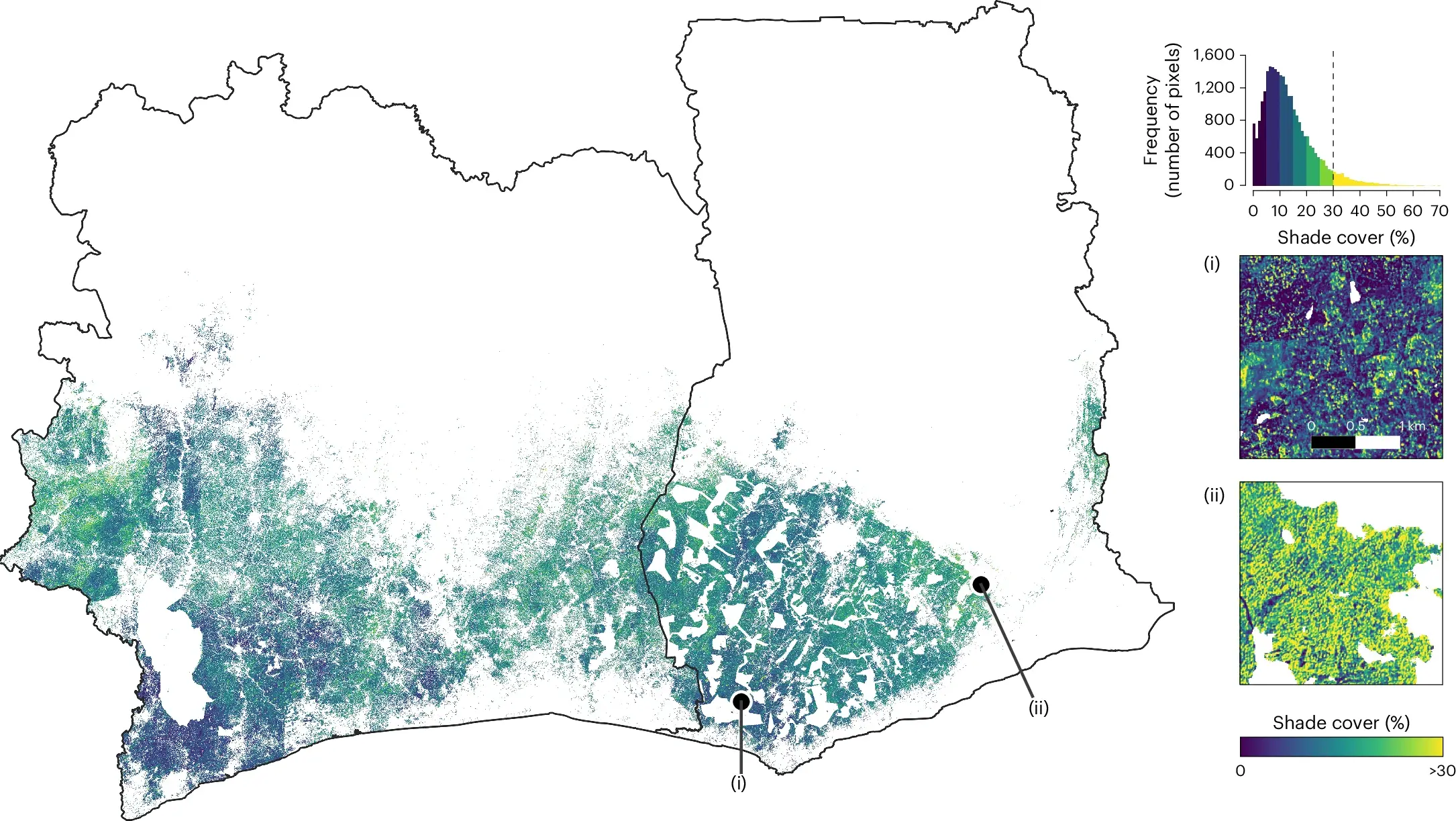
The map reveals that cocoa production is “overwhelmingly dominated by full-sun monocultures and low shade-agroforestry”, the study says.
Using satellite data, global maps of tree canopy height and on-ground verification, the researchers map the amount of “aboveground biomass” held by cocoa plantations.
Aboveground biomass comprises all living vegetation that lies above the soil – trees, leaves and other plant matter.
The map below shows the amount of aboveground biomass in both countries. The areas in yellow are those with the highest biomass and, therefore, more stored carbon.
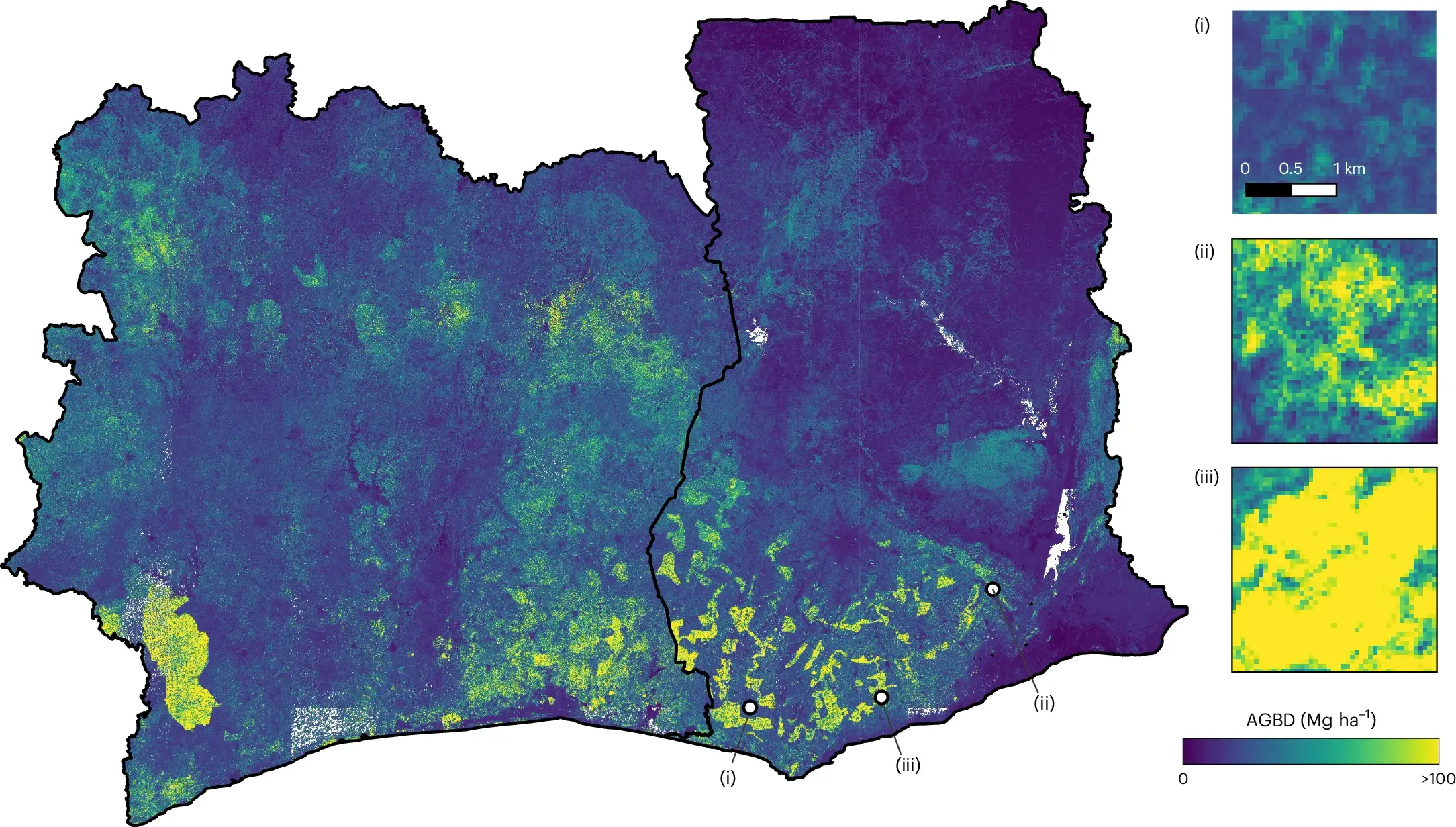
The authors project that if all cocoa plantations increased their cover of shade trees to at least 30%, the additional, taller trees could sequester an “enormous” amount of carbon – 307m tonnes of CO2e (MtCO2e) – enough to fully counterbalance the current cocoa-related emissions in both countries, without reducing production.
Blaser Hart tells Carbon Brief:
“Cocoa itself is a small tree. [It] can grow up to about eight metres tall, so it also sequesters carbon. [But] we found that tall trees that are towering high above cocoa – often timber trees – sequester much more carbon than cocoa.”
In addition, she says, the cover from large trees is “much better for cocoa” since it protects them during the hottest hours of the day, while allowing light through. They also shed large amounts of “litter”, which gets incorporated as organic matter into the soil, sequestering carbon from the atmosphere.
Barriers and limitations
The authors acknowledge several limitations to their study.
For example, they say, the analysis may underestimate the proportion of shade tree cover by excluding trees shorter than eight metres. They also note that the analysis does not consider all of the features of agroforestry systems, such as which species are planted.
Kayeli Laurence is a PhD student of landscape ecology at Jean Lorougnon Guédé University in Ivory Coast and an expert in agroforestry. The researcher, who was not involved in the study, tells Carbon Brief:
“The identified limitations call for caution, particularly when it comes to local, small-scale analyses. However, they do not undermine the general trends highlighted by the study.”
Laurence notes that the study results are consistent with other research highlighting the carbon sequestration potential of agroforestry systems. She says that the projection of carbon sequestration is “ambitious, but credible”. However, she adds:
“In practice, achieving this goal will strongly depend on local conditions: availability of species, technical support, farmers’ willingness and, above all, economic incentives.”
The study also acknowledges that smallholder farmers in west Africa “face several barriers” to adopting agroforestry, including limited incentives and insecure land tenure.
The non-profit scientific research organisation Project Drawdown notes that implementing a certain category of agroforestry called “multistrata” – a combination of long-lasting crops and multiple layers of trees or vegetation – in humid tropical climates would cost more than $1,300 per hectare.
Blaser Hart tells Carbon Brief:
“That’s a huge cost. And it’s not money that farmers have available.”
International landscape
Blaser Hart says that cocoa agroforestry provides further benefits to ecosystems, besides carbon sequestration. These include cooling the air, improving soil fertility and nutrient cycling and providing habitat for wildlife. She adds:
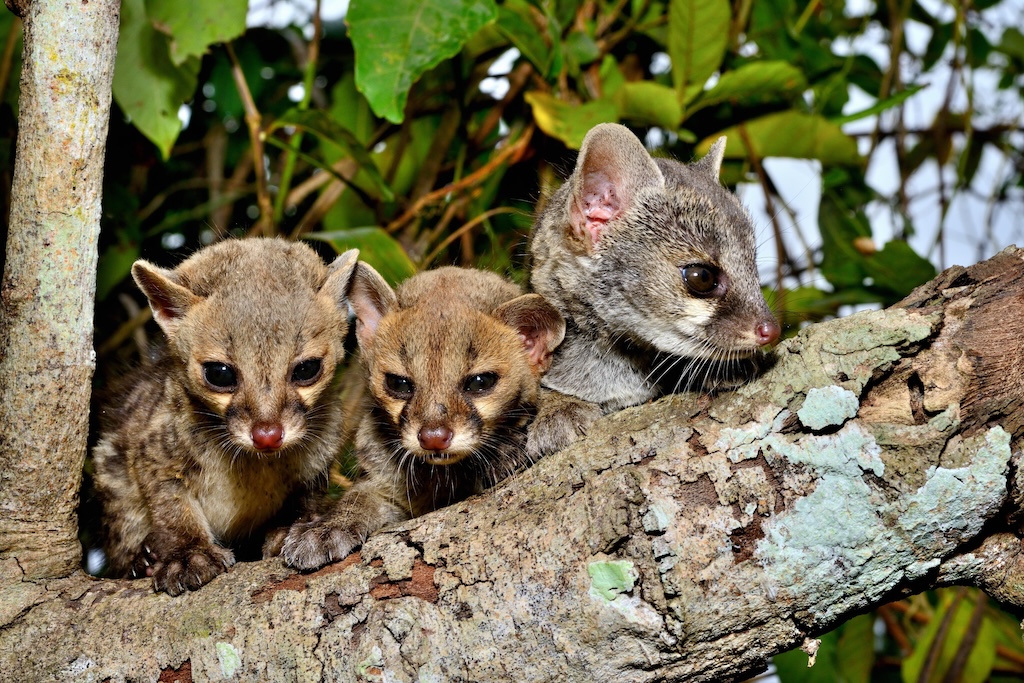
“We’re currently doing a big study on how agroforestry can help to provide habitat for birds. There also seems to be a bit of mammals that use cocoa agroforestry systems. In Ghana, we’re finding quite a bit of genets and civets that are in these systems. From Brazil, there’s a bit of research in the Atlantic Rainforest that shows that some monkeys use them as permanent habitat and others just as corridors to move through.”
Agroforestry is included in the climate commitments of around 40% of developing countries under the Paris Agreement, according to the study.
At the corporate level, the cocoa industry has made commitments to plant “millions of shade trees in agroforests to improve the sustainability of the sector”, the study says.
Blaser Hart tells Carbon Brief that the researchers hope the work will encourage the cocoa industry to better plan its agroforestry interventions, “rather than just haphazardly handing out trees here and there”.
Laurence suggests that policymakers should improve climate finance to support farmers in transitioning to sustainable agricultural systems, while chocolate producers and certification bodies should make stronger commitments to create “real demand for sustainable cocoa produced through agroforestry”.
Ultimately, the study notes that the methods it developed to assess the status of trees in agricultural systems can be used for other commodities grown in agroforests, such as coffee.
The post Growing trees for shade has ‘enormous’ potential for cutting cocoa emissions appeared first on Carbon Brief.
Growing trees for shade has ‘enormous’ potential for cutting cocoa emissions
Climate Change
Outdated geological data limits Africa’s push to benefit from its mineral wealth
Resource-rich African nations risk missing out on the investment needed to extract and refine their mineral wealth into high-value products for the clean energy transition because they lack accurate information on what they have, experts are warning.
African countries have attracted huge interest as the world scrambles to access the minerals and metals needed for the energy transition and digital and military technologies, with investors from the US, China, the United Arab Emirates and Europe jostling to secure access to the continent’s resources.
But any knowledge of Africa’s mineral wealth is, at best, an estimate based on century-old-mapping and haphazard geological data, policy experts and investors told Climate Home News.
The United Nations says Africa is home to 30% of the world’s mineral reserves, including cobalt, copper, lithium and manganese, which are needed to manufacture batteries and other clean energy technologies.
But experts like Bright Simons, who tracks natural resource spending in Africa for the Ghana-based IMANI Centre for Policy and Education, said the 30% number is not backed by any “empirical, evidence-based assessment” of the continent’s mineral wealth. While some analysts like Simons think the figure could be an overestimate, others argue it is likely an underestimate of the continent’s mineral reserves.
Up-to-date and accurate data is critical for governments to negotiate better deals with prospecting mining companies and to help drive investment in mineral extraction and processing facilities that can add value to the continent’s resources.
But the lack of good mapping has negatively impacted the continent’s efforts to capture the economic benefits of booming mineral demand and to create jobs by extracting and processing raw materials into higher-value products before export, experts said.
Colonial maps
Under-exploration and scant information about Africa’s resources have made it challenging for states to attract investment and develop their resources, said Pritish Behuria, a political economist at the Global Development Institute at the UK’s University of Manchester.
“In many cases, former colonial powers retain more current knowledge of the kinds of mineral deposits that exist in African countries – and often, this has proven difficult to access for African governments,” he told Climate Home News.
Thabit Jacob, a researcher of extractive and energy resources at Roskilde University in Denmark, said many African countries “still rely on colonial maps”.
“There’s a growing realisation that Africa must know its true value in mineral richness and investment in geological mapping is crucial,” he added.
Mapping inequality
However, mapping investment is falling short. Africa’s share of global exploration investment has fallen in the last two decades, data shows.
In 2024 alone, both Canada and Australia received significantly more investment in geological mapping than the whole of Africa, even though the continent’s landmass is three times the size of the two countries combined, according to the Center for Strategic and International Studies.
Even in South Africa, a major mining destination, only 12% of the country has been mapped at a detailed level “which compares poorly with other popular mining destinations such as Canada and Australia where there is near complete coverage at similar scales”, explained Tania Marshall, of the Geological Society of South Africa.
Nigeria’s push to cash in on lithium rush gets off to a rocky start
To address the dearth in data, multinational institutions like the World Bank have provided African countries with finance for mapping, but have simultaneously encouraged them to liberalise and privatise their mining industries.
As a result, international investors prioritising project development have come to dominate the continent’s mining sector, crowding out state-sponsored initiatives with stronger incentives to invest in data-gathering, researchers have found.
Digging blind
Orina Chang, an investor leading geological mapping across Somaliland, which has reserves of copper and zinc ore, said she was surprised to find out that even countries attracting huge interest from institutional miners, such as the Democratic Republic of the Congo (DRC), do not have systematic up-to-date mapping.
Instead, mining firms rely on artisanal mining and surface signs, like exposed ores on the ground – and crossing their fingers, she told Climate Home News.
The mapping deficit means there is little certainty on the size and quality of mineral deposits and provides few incentives for miners to invest in processing plants, Chang explained.
“Without mapping, everyone is blindly digging and you just get people who are not interested in really investing in your country,” she said. “With mapping, you’re able to attract much better players and build plants, create jobs, drive economic growth, help the GDP.”
The rise of AI-driven exploration tools
Today, AI-driven mapping tools have created new opportunities to obtain high-precision information with less on-the-ground investment. Geophysical data and satellite imagery are fed into a model that creates a geological map which can help point to high-potential deposits.
Last year, California-based KoBold Metals, which is backed by US billionaires Jeff Bezos and Bill Gates, discovered a massive copper deposit in Zambia using AI-driven exploration. In July, the firm signed an agreement with the DRC to lead critical mineral exploration there.
But the technology is expensive and not widely available to governments.
Instead, in its 2024 Green Minerals Strategy, the African Union called for some of the revenues from mineral rents to be reinvested into mapping using low-cost techniques such as satellite imagery and drones, which are less precise.
The case for co-operation
For Gerald Arhin, a research fellow at University College London, greater regional collaboration and pooling resources could also help reduce the costs of mapping for individual governments. Last year, for example, South Africa signed an agreement with South Sudan to co-operate on mineral exploration.
“The sharing of data, industrial intelligence and technical expertise across borders could be transformative for African countries, as well as for developing countries in other regions,” Clovis Freire, who heads the Extractive Commodities Section at UN Trade and Development (Unctad), told Climate Home News.
Mapping, however, is only one element of a complicated equation when it comes to developing minerals for the energy transition, said Eszter Szedlacsek, who researches climate justice in the context of the green transition at the Vrije Universiteit Amsterdam.
“In the race for Africa’s critical minerals, deals hinge only partly on where resources are found, and more on geopolitics, investment conditions and longstanding trade ties,” she said.
The post Outdated geological data limits Africa’s push to benefit from its mineral wealth appeared first on Climate Home News.
Outdated geological data limits Africa’s push to benefit from its mineral wealth
Climate Change
From Baku to Belém and beyond: How we turn a climate finance roadmap into reality
Mukhtar Babayev is COP29 President and Special Representative of the President of Azerbaijan for Climate Issues.
COP has entered “late-stage multilateralism”. We have already agreed the processes, targets and mechanisms to guide action. The system is now fully operational, resilient and delivering results. Success today depends less on what new things all countries agree and more on what individual actors achieve.
And we are in a race against the clock, so there is a desperate need for speed. This will require new modes of working, rather than repeating the lumbering mechanisms of generations past. Our conversations at COP30 confirmed to us that the will and energy is there in bundles. It now needs to be directed.
On finance, there is much to do. At COP29 we set the Baku Finance Goal to scale up support for the developing world to $1.3 trillion per year by 2035. This was no small ask.
We are trying to intervene in the normal functioning of the world economy and channel the forces of global finance. Success will require great political will, sustained focus, and relentless action from all of us – the private sector, central banks, financial institutions, and everyone in between.
But while the problems are easy to identify, the solutions are often missing. Efforts to reform the global financial system have been disjointed and the COP process needed a new framework to engage with actors outside our normal systems.
More room for creativity outside negotiations
In recognition of the need to try something new, countries mandated the Azerbaijani and Brazilian COP Presidencies to produce the Baku-to-Belém Roadmap to $1.3 trillion to set out the next steps. This was an innovative format, outside the negotiations and therefore given a free hand to be more creative.
We opened the process to everyone. And while we promised that we would not be prescriptive, we were clear that we would be fearless at providing an honest look at a wide range of options.
Countries have warmly welcomed the approach, and we were pleased to see the Roadmap recognised in COP30’s Global Mutirão decision. In Belém, they told us that while they don’t necessarily agree with every line, they still see the value of the exercise and want to build on it. This is a radical change from the normal process where we argue over every word and comma of each formal text.
Practical next steps
The Roadmap can act as a focal point and a coherent reference framework that incorporates existing initiatives. It identifies key action fronts and thematic priorities. And it concludes with practical short-term steps to guide early implementation.
Many of these were designed to address the problems that COP presidencies have seen firsthand – lack of consistent data and reporting, uncertainty about forward projections, silos and a lack of continuity and interoperability between different processes.
But we must acknowledge that this exercise has made some feel uneasy. They have feared that by broadening our focus, we are providing cover for governments not to fulfill their traditional responsibilities. And it is unacceptable that we have indeed seen cases of donors cutting funds and expecting the private sector to fill the gap.
Donors must deliver in full
So as we set out the Roadmap for all to follow, we have a duty to be unequivocal with governments. The COP29 negotiations to agree on the historic target for $300 billion per year in public funds by 2035 were hard. Now, there can be no excuses. We asked vulnerable communities to accept the limits of how much support they could expect. In equal measure, we insist that donors deliver in full, with developed countries taking the lead.
COP30 fails to land deal on fossil fuel transition but triples finance for climate adaptation
Too often, when we set a target for everyone, no one steps up, as collective responsibility undermines individual accountability. That must change. And in the Roadmap we have asked developed countries to work together on a delivery plan that explains how they will meet the $300 billion per year climate finance goal.
Innovative approaches needed
Late-stage multilateralism demands that we are ready to innovate with our processes. They did well to get us this far and they need to be preserved. But we also need to think outside the box on how we deliver the aims and objectives that we have set ourselves.
COP30 showed that there is an appetite for new approaches and new ideas. The Baku-to-Belém Roadmap could be a template for one such evolution of the COP process.
Now we need other ideas, more creativity and real-world action to show that this template can work. The COP29 Presidency will continue to work with everyone to find new solutions, scale promising initiatives and deliver on the promises we have all made.
The post From Baku to Belém and beyond: How we turn a climate finance roadmap into reality appeared first on Climate Home News.
From Baku to Belém and beyond: How we turn a climate finance roadmap into reality
Climate Change
Bittersweet
I write with a bittersweet announcement. I am moving on from Climate Generation at the end of December. It has been an honor to share my thoughts with you each month here.
For 19 years, Climate Generation has been supporting educators, young people and communities to build climate change literacy and ignite action to arrive at a just and abundant world beyond the climate crisis. This critical and powerful work is essential and will continue with the current team and new leadership.
My time with Climate Generation has been an amazing three years. I have appreciated each of you and the solidarity we built to continue the work despite unprecedented threats from the federal administration, entrenched climate change denialism and the erasure of critical resources. Climate Generation has persevered in spite of those challenges, filling a critical need in the climate justice movement. I am so proud of the work we have accomplished together in this time. Some of the highlights include:
- Increasing the quality and impact of YEA! (Youth Environmental Activists!) programming with adoption of the Youth Program Quality Assessment tool and experiential learning frameworks.
- Retooling our Window into COP program by leveraging relationships to send locally based, intergenerational, and mostly BIPOC delegations to the COPs (Conference of the Parties, also known as the United Nations Climate Talks)
- Launching the Schools As Solutions Fellowship to support educators in becoming climate justice changemakers.
- Adding two youth seats to our Board of Directors.
- Helping to pass groundbreaking legislation, including the 100% Clean Energy bill, the Cumulative Impacts Bill (protecting environmental justice communities), and Ethnic Studies (bringing the experiences of ALL Minnesotans, especially those that have been marginalized, into our curriculum).
Climate Generation has put together a Transition Committee with board and staff representation and is working with Mighty Consulting to bring in an Interim Executive Director. I deeply trust this leadership team and am confident that they will chart the path to carry Climate Generation forward.
I am excited about the work that Climate Generation will continue doing to ignite and sustain the ability of educators, youth, and community to take action on the systems perpetuating the climate crisis. Together we are building a movement.
In solidarity,

Susan Phillips
Executive Director
The post Bittersweet appeared first on Climate Generation.
https://climategen.org/blog/bittersweet/
-
Climate Change4 months ago
Guest post: Why China is still building new coal – and when it might stop
-
Greenhouse Gases4 months ago
Guest post: Why China is still building new coal – and when it might stop
-
Climate Change2 years ago
Spanish-language misinformation on renewable energy spreads online, report shows
-
Greenhouse Gases2 years ago嘉宾来稿:满足中国增长的用电需求 光伏加储能“比新建煤电更实惠”
-
Climate Change Videos2 years ago
The toxic gas flares fuelling Nigeria’s climate change – BBC News
-

Climate Change2 years ago嘉宾来稿:满足中国增长的用电需求 光伏加储能“比新建煤电更实惠”
-
Carbon Footprint2 years agoUS SEC’s Climate Disclosure Rules Spur Renewed Interest in Carbon Credits
-
Climate Change2 years ago
Why airlines are perfect targets for anti-greenwashing legal action