Since its head office opened in Johannesburg 16 years ago, the African arm of environmental campaign group Greenpeace has made a name for itself, battling governments and corporations to defend forests, protect oceans and tackle climate change. It was an organisation staff said they were proud to work for.
But an internal restructuring – which Greenpeace Africa’s board asked newly-appointed executive director Oulie Keita to implement in June 2023 – has left management fighting affected employees as well as the planet’s foes.
Climate Home spoke to former staff and has seen leaked documents, meeting recordings and email correspondence that expose the disarray caused by the drive by Greenpeace Africa’s management to lay off around 40 people – about half of its total staff – at three of its five offices, in the Democratic Republic of Congo (DRC), South Africa and Senegal. The organisation cited financial and security reasons in justifying the job cuts.
Some ex-employees interviewed by Climate Home, however, expressed doubt about those motives, saying they felt unfairly targeted for dismissal. They also criticised the new management’s approach to interaction with African governments, as well as Greenpeace Africa’s stance on LGBT+ rights and trade union representation.
Sign up to get our weekly newsletter straight to your inbox, plus breaking news, investigations and extra bulletins from key events
In a written response to those grievances, Climate Home was told that Greenpeace Africa “values the rights and voices of our employees and fosters an inclusive and collaborative work environment”. “Our policies align with the legal requirements in each country,” it added.
As one of the highest-profile environmental organisations on the African continent, Greenpeace has an ambitious vision to bring about “an Africa where people live in harmony with nature in a peaceful state of environmental and social justice”. The internal turmoil uncovered by Climate Home raises questions about its ability to meet that goal.
The terms of reference for a three-month operational review of the organisation, which was due to start in August 2023, cited a need for cultural change as a key reason for the restructuring. It said collaborative processes intended to boost productivity and accountability had failed, slowing down the delivery of a 2022-2025 strategic plan.
As COP Troika dithers on 1.5C-aligned climate plans, experts set the bar high
That four-year strategy “aimed to transform Greenpeace Africa, to be a viable organisation working on campaigns delivering systemic impacts in Africa, with an operating model that is fit for purpose and responsive to the challenges facing the continent”, the document added.
It also showed that Greenpeace Africa wanted to ensure it had enough of a presence in richer African nations to improve fundraising – an argument that was later used by management as a justification for downsizing offices in poorer nations like DRC.
Greenpeace told Climate Home this shift was “part of a broader effort to ensure that Greenpeace Africa remains financially sustainable. This approach strengthens our capacity to promote environmental justice in all regions, including those with fewer resources.”
Following the shake-up, Climate Home understands that more than 10 former employees have launched legal action against Greenpeace Africa in labour courts in South Africa and Senegal, alleging unfair treatment by the organisation. Greenpeace Africa did not respond to questions on the cases, which are ongoing.
It said, however, that its 2023-2024 restructuring was conducted “with the utmost care”, and “in accordance with all relevant labour laws in each of our countries and ethical guidelines”.
New strategy
On March 1, 2023, the Greenpeace Africa board announced that, after a series of interim bosses, Keita had been appointed as executive director.
In a statement, it said she would “lead the implementation of the organisation’s new strategy which, grounded in African consciousness, seeks to dismantle systems which have historically served only to benefit the colonial powers, still plundering Africa for its resources”.
Amazon state that will host COP30 strikes “largest carbon credit sale in history”
Then board chair Oury Traoré, a fellow Malian who resigned this year, said in the statement that it was “critical to build a movement led by women and youth”. As a woman joining from the United Nations youth platform YouthConnekt Africa, Keita seemed well-placed to do that.
She had studied law, sociology, international development and human rights at universities in Morocco, the US and Austria and then worked as a trainer, facilitator and consultant for NGOs and Western embassies across Africa. She joined the Greenpeace Africa board in April 2012.
Staff were initially pleased with Keita’s appointment as executive director, which ended the long hunt for a permanent leader. “We were very excited,” said one then staff member in Senegal. “We had the sense that the organisation would become more stable.”
But that did not happen. Just a week later, an email landed in the inbox of Greenpeace Africa’s people and culture director Paul Ngugi and its then lead campaigner on climate and energy Melita Steele, flagging earlier support by Keita for Rwandan President Paul Kagame.
Sent by the head of Greenpeace Africa’s Congo rainforest campaign at the time, and signed on behalf of “the Congo Basin team”, the email raised “serious concerns” about Keita’s appointment, due to her alleged “very high admiration of Paul Kagame and her public communication to praise and admire him”.
The email, seen by Climate Home, included 15 posts by Keita on X (formerly Twitter), sent between November 2020 and October 2022. They praised Kagame’s “exemplary leadership”, calling him a “visionary”, “rare jewel” and “my Favourite President in the world”. Keita said she had moved to Rwanda “because of the admiration and respect I have for this man!”
A post on Oulie Keita’s X account on November 14, 2020 (Screenshot)
Commenting on this, the email from the Congo Basin team said that having a leader of Greenpeace Africa with that kind of admiration for Kagame was a serious problem for them and their work.
The United Nations has accused the military forces of Rwanda, governed by Kagame since 2000, of sending 4,000 troops to invade parts of neighbouring DRC and of backing Congolese rebel group M23. The violence has displaced millions of people in the DRC, which is home to large swathes of the world’s second-largest rainforest – a huge carbon store whose protection is regarded as vital to curbing global warming.
The email noted that the Congo Basin team had been preparing a statement on the DRC conflict for Greenpeace Africa’s leadership to endorse, “as for us our organisation’s silence on this conflict is no longer acceptable”. It added that the DRC office now believed “our new ED [Keita] would never accept such a statement”.

A mourning ceremony for the victims of the DRC conflict took place in the city of Goma on September 2, 2024. (Photo: Arlette Bashizi/Reuters)
Internal “smear campaign”
The email led to frantic activity at the top of Greenpeace Africa. The organisation’s engagement director brought forward training on social media use and prepared what she called a “risk mitigation comms plan for this particular concern”.
On March 16, 2023, Greenpeace Africa’s then head of communication, Johannesburg-based Mbong Akiy Fokwa Tsafack, sent an email to staff on the subject of “the smear campaign” against the new executive director.
Greenpeace Africa, it said, wanted “to express its ultimate concern and disgust at the onslaught”. It accused unnamed people of using a “colonial approach, of divide and rule, taking advantage of the fragile political situation in the DRC to drive their agenda” and to “resist the transformation that is required to bring credibility to the presence of Greenpeace in Africa”.
UN climate chief warns of “two-speed” global energy transition
Shortly afterwards, Keita herself sent a conciliatory email with no reference to Tsafack’s message. Keita said she had “heard with distress, yet with solidarity, the cries of the staff in the DRC who are rightfully disturbed about tweets on my social media handle”.
The posts, she noted, were made while she led YouthConnekt, which was chaired by Rwanda. “Cheering, supporting and celebrating the political will of these African leaders towards investing in the youth of Africa, including the main Champion the President of Rwanda as the co-initiator of this continental initiative was a big part of the job,” she wrote.
Keita added that she had “no personal political affiliations with any African countries”, thanked colleagues for raising “valid” concerns, and appealed for unity “to build the Africa we all want to live in”.
Keita did not respond to a request for comment for this article. Greenpeace Africa’s website states that the organisation “does not take sides in conflicts and wars on the African continent”, in line with Greenpeace’s global policy on peace.
Congo office closure
About seven months later, in October, Greenpeace Africa’s finance director, South African Gerhard Combrink, held a video call with the DRC office to tell staff there that management had decided “to close down” their office and centralise activities for the Congo Basin in Cameroon.
The announcement seemed to come as a surprise to those attending, many of whom criticised the decision. Combrink said the Greenpeace Africa board had “consulted widely with Greenpeace International and with other [national or regional offices], especially Belgium”, the DRC’s former colonial ruler. But staff in the DRC said on the call they had not been included.
The then lead for the Congo Basin team said that, as three-fifths of the Congo rainforest is in the DRC, losing the office there would be a “historical error” and would damage the organisation’s credibility globally.
The forest – and its central role in keeping climate change in check – is threatened by government-backed efforts to drill for oil and by industrial logging.
“It’s like closing an office in Brazil, and you say you’ll be campaigning from somewhere else to try to save the Amazon forest. It doesn’t work,” the team lead said. “Closing it will send a signal to many other African countries saying that no, this Greenpeace is not an organisation that we can count on,” she warned.

Environmental activists, with a banner co-signed by Greenpeace Africa, protest in Kinshasa, DRC, on November 29, 2019. (Photo: Hereward Holland/Reuters)
Combrink said one “fundamental” reason for the decision was “the security issues we face and our inability to openly confront the government without placing our staff at risk”. He noted that the organisation had evacuated staff to safeguard them against threats. The campaigner, who did not respond to Climate Home’s request for comment, replied that these evacuations had only been “preventive” and no DRC employees had been arrested.
Fundraising prioritised
Combrink said another reason for shutting the DRC office was that, due to the war in Ukraine, funding from Germany – a key source of income for Greenpeace Africa – was drying up. He said that “the [Greenpeace Africa] board is adamant that if we do have activities, it is necessary that we focus on fundraising within those countries”, adding it was not possible to “substantially” raise funds in the DRC, one of Africa’s poorest countries.
In the terms of reference seeking an external consultant to conduct the review – to be hired in August 2023 and reporting to Combrink and Keita – Greenpeace Africa stipulated that its future footprint should “reflect adequate presence in countries affluent enough to raise income for the rest of the organisation”.
In its earlier June 2023 letter to Keita, mandating her to carry out the restructuring, the Greenpeace Africa board had noted that Greenpeace’s global revenue was decreasing against inflation, with the war in Ukraine negatively affecting its donor base and leading to a reduction in grants to regional offices including Africa.
It said staff alone accounted for almost two-thirds of Greenpeace Africa’s total annual projected costs, leaving it “poorly equipped to reduce its expenditure in the short term when its income streams diminish”.
“Given the large fixed overhead costs required to maintain a formal office within a country, it is crucial that we utilize current grant income streams to grow within geographical areas that can provide future donor income streams,” it added.
Several months later, on the call with DRC staff, Combrink said the review had identified Ghana, Nigeria and Mauritius as good targets for expansion, adding that fundraising in Kenya had “started to pick up”.
Responding to his comments, Greenpeace’s then Congo Basin lead argued that, while decisions on where to locate offices should be based on more than finances, DRC was “getting a lot of money compared to other offices”, particularly for its campaign to save the country’s huge rainforest.

A PhD student measures the circumference of a tree in a forest reserve near the village of Masako in the DRC on August 8, 2012. (Photo: Ollivier Girard/CIFOR)
In spite of the subsequent restructuring, which led to most of the DRC office staff leaving, Greenpeace Africa told Climate Home its operations in the country had not ceased and had been strengthened in 2024.
During its latest mission to the DRC in August, to engage with “key stakeholders”, including the government, Greenpeace Africa said the Hydrocarbons Minister confirmed his government’s commitment to remove oil concessions overlapping protected forest areas, including in the Virunga National Park, and invited Greenpeace Africa to help identify the areas threatened by the concessions.
“Such political dialogue provides us a platform to campaign to achieve positive outcomes for the environment and the people in Africa,” Greenpeace Africa told Climate Home by email.
It added that the board’s decision to conduct a “geographic footprint” exercise to consider fundraising potential across the continent also supported this objective – and was not a threat to its activities in poorer countries like DRC.
“This approach does not diminish – in fact it strengthens – our capacity to promote environmental justice in all regions, including those with fewer financial resources,” it told Climate Home.
Union members sue in South Africa
As part of the broader restructuring of the organisation, further job cuts were announced at Greenpeace Africa’s offices in Senegal and South Africa.
Sources who worked at Greenpeace South Africa at that time said unionised staff members were affected by the retrenchment.
A document put together by trade union members, seen by Climate Home, lists 34 union members in Greenpeace Africa’s head office in Johannesburg. Of these, ten were in the fundraising department which trade union sources said was excluded from the restructuring.
Of the remaining 24, 15 were deemed “not suitable” for their positions and were laid off, as were several non-union staff, out of an overall headcount of around 50 employees.

Chart: Climate Home News
A legal document seen by Climate Home, dated May 2024, shows that lawyers acting for affected union members filed a case against Greenpeace Africa with the Labour Court of South Africa in Johannesburg alleging unfair dismissal and failure to follow due process.
It said court-ordered efforts at consultation between the employees and Greenpeace Africa had not resulted in any agreed selection criteria for retrenchment, but their contracts were terminated nonetheless. The case is pending and if not resolved in arbitration, will be heard by the court. Greenpeace did not comment on the proceedings.
Sources also raised questions about whether new staff, brought in after the restructuring, were permitted to unionise in the workplace.
A Greenpeace Africa employment contract from the end of 2023, seen by Climate Home, asked a potential employee in South Africa to “acknowledge that Greenpeace Africa is a non-unionised employer due to the nature of its operations, being a Non-Governmental not-for-profit institution relying on external grants for its survival”.
It requested that the employee “acknowledge that any [trade union] recognition agreement signed before 1 January 2024 is deemed cancelled and should a recognition agreement be required under local labour law, a new agreement will need to be signed in line with Greenpeace Africa’s new policies”.
Senegalese banker Ibrahima Cheikh Diong picked to lead new loss and damage fund
It is not known whether this is a standard clause in employment contracts for Greenpeace Africa staff. The organisation did not respond directly to Climate Home’s questions on this issue, or provide information on its unionisation policy, as requested.
In Senegal too, Climate Home understands that three former staff members have taken Greenpeace Africa to the local labour court. They are seeking damages and a declaration that their dismissals were unfair after they were accused of financial irregularities and other misdemeanours – which they deny. Greenpeace Africa declined to comment on the case, which is at a pre-trial stage pending conciliation efforts.
While Greenpeace’s management have insisted the job losses across their African offices were necessary to keep the organisation financially sustainable, many former staff members told Climate Home the restructuring was used as a way to ram through the changes wanted by the board in the face of internal opposition.
“It’s just a way to kill [the influence of] some activists who do not agree with what they say,” said a former staffer in Senegal “They want people who are very docile.”
Greenpeace Africa told Climate Home it recognised that “some people may not be happy with the growing success of the new management”.
“We understand that organisational changes can be challenging, and we made sure that the change management process was carried out legally, fairly and transparently,” it added.
Row over LGBT issues
During the restructuring period, Greenpeace Africa management also took issue with staff members’ criticism of its approach to LGBT+ rights.
In June 2023, Greenpeace Africa debated internally how to mark Pride month and how to respond to the Ugandan government’s new Anti-Homosexuality Act.

Ugandan LGBTQ activists protest against their government in the South African city of Pretoria on March 31, 2023. (Photo: Alet Pretorius/Reuters)
Some LGBT+ employees criticised a plan to hold an all-staff meeting in Johannesburg to discuss these issues, where LGBT+ workers were going to be asked to share their experiences.
In a letter to Greenpeace Africa management, they said this would require them to out themselves and “identify us for further victimisation later”.
Instead, they proposed that external experts on South African labour law, discrimination and gender sensitivity should be brought in to educate staff.
They accused management of “a refusal to maintain professional standards” and of not following South African labour and equality law.
Their email elicited a strongly worded response from Greenpeace Africa governance officer Eugene Perumal, who wrote that they did not represent all of the organisation’s LGBT+ employees. He added that it was “disingenuous and disrespectful to insinuate that Greenpeace Africa Management paid no attention to this particular area”.
He then warned them: “You need to revise the disrespectful manner you engage with Greenpeace Africa senior management, the defamation, false statements and undermining are unacceptable behaviour patterns and [Senior Leadership Team] will take action accordingly.”
COP29 aims to boost battery storage and grids for renewables, as pledges proliferate
Greenpeace Africa told Climate Home it had engaged external experts to provide LGBT+ education and support, and ensured that “all staff feel safe and respected during these discussions”. A training workshop in March on this issue “proved very successful”, it added.
The organisation, it said, is “firmly committed to promoting the principles of Justice, Equity, Diversity, Inclusion, and Safety (JEDIS) across all aspects of our work”, including by fostering and maintaining “a safe, inclusive, and supportive environment for all employees, including our LGBTQ+ colleagues”.
More government “collaboration”
The organisational strife and contentious reforms inside Greenpeace Africa have been accompanied by a shift in external strategy, according to documents seen by Climate Home.
An internal report on Greenpeace Africa’s activities at the COP28 UN climate summit in Dubai last December, said that, during meetings, ministers from the Republic of Congo and Cameroon “expressed their strong displeasure with Greenpeace’s confrontational approach in trying to address the issues around climate change”.

A screenshot of Greenpeace Africa’s internal report on the COP28 climate summit
The report did not describe what they objected to, but said that Keita “reassured [the ministers] of a new approach of collaboration” and noted they “were willing to reset the relationship with [Greenpeace Africa] under the new leadership and map out areas of collaboration in the near future”.
This approach was criticised by former staff members. “It’s not the DNA of Greenpeace,” one said. “How can you be friendly with the government and it is killing people?” Another said, “it felt like we were being neutered.”
Greenpeace Africa, told Climate Home that, under its current management, it “supports the building of a climate justice movement across Africa to hold the extractive industries and governments to account”. It had launched its first such movement in the DRC, Cameroon and Ghana, with plans to expand into the Republic of Congo and Nigeria in 2025, it added.
In addition, Greenpeace Africa pointed to its lobbying work against the oil industry and its impacts on the continent, as well as its advocacy calling for plastic waste to be cleaned up in Kenya, and more protection for oceans and the livelihoods of African fishing communities, among other campaigns.
Greenpeace International silent
Despite the apparent turmoil experienced at Greenpeace Africa over the past 18 months, Climate Home understands that its parent organisation Greenpeace International has not intervened to help resolve the documented issues. Greenpeace did not respond directly when asked about this.
Greenpeace Africa is one of 26 Greenpeace branches around the world, known as national/regional organisations or NROs. They all have some independence but are overseen by Greenpeace International, which is based in the Dutch city of Amsterdam.
Nairobi-based development officer Yvonne Muyoti, who is in charge of monitoring Greenpeace Africa for Greenpeace International, was copied on the emails from Keita and Tsafack about DRC staff concerns over Rwanda.
Greenpeace Africa told Climate Home it is an independent NRO guided by its board of directors but collaborates closely with Greenpeace International. “We value the support and oversight provided by Greenpeace International,” it said.
Some former staff members of Greenpeace Africa, however, are concerned that a lack of racial diversity in the upper levels of Greenpeace international – whose senior executives are mostly white and from rich countries – is preventing the global parent organisation from intervening in the African disarray.
One black female former Greenpeace Africa staff member told Climate Home she believed Greenpeace International was reluctant to challenge Keita over her leadership style: “I think they are worried about how it will look – a Eurocentric organisation taking on a black woman.”
Another former employee described Greenpeace Africa as his “baby”, but said those now in charge “don’t know the DNA of the organisation”.
“People in Greenpeace have to be strong and be up against all the injustice they are facing in the organisation,” he said. “The fight must start inside before it goes outside.”
_
Nairobi-based development officer Yvonne Muyoti, who is in charge of monitoring Greenpeace Africa for Greenpeace International, was copied on the emails from Keita and Tsafack about DRC staff concerns over Rwanda.
Greenpeace Africa told Climate Home it is an independent NRO guided by its board of directors but collaborates closely with Greenpeace International. “We value the support and oversight provided by Greenpeace International,” it said.
Some former staff members of Greenpeace Africa, however, are concerned that a lack of racial diversity in the upper levels of Greenpeace International – whose top executives are mostly white and from rich countries – is preventing the global parent organisation from intervening in the African disarray.
One black female former Greenpeace Africa staff member told Climate Home she believed Greenpeace International was reluctant to challenge Keita over her leadership style: “I think they are worried about how it will look – a Eurocentric organisation taking on a black woman.”
Another former employee described Greenpeace Africa as his “baby”, but said those now in charge “don’t know the DNA of the organisation”.
“People in Greenpeace have to be strong and be up against all the injustice they are facing in the organisation,” he said. “The fight must start inside before it goes outside.”
(Reporting by Joe Lo; fact-checking by Sebastian Rodriguez; editing by Megan Rowling, Sebastian Rodriguez and Matteo Civillini)
The post Greenpeace Africa in disarray as restructuring meets resistance appeared first on Climate Home News.
Greenpeace Africa in disarray as restructuring meets resistance

Climate Change
“Sink or swim”: WA Gov hugely underestimating decline in regional gas demand while sleeping on green exports, new report finds
PERTH, Tuesday 13 October 2026 — A new report from Greenpeace Australia Pacific and Springmount Advisory reveals green commodity exports are an untapped economic opportunity for Western Australia in a declining Asian gas market, while offering a genuine solution for decarbonising Asia.
From Gas to Green: Building Western Australia’s Future State is a comprehensive analysis of the declining gas market in Asia, and the untapped economic opportunity for WA to become a global leader in green commodity exports while driving the regional shift away from fossil fuels.
The report offers key recommendations for the WA Government to support regional decarbonisation through an orderly phase out of gas exports in favour of green iron and other green exports. It comes as global climate leaders from across business, politics and advocacy prepare to meet for the Global Citizen Now: Perth event focused on decarbonising WA.
Key findings:
- Gas demand is falling across WA’s core markets in Asia: Gas demand fell in 2025 and is projected to continue to decline, driven by a combination of global geopolitical factors and domestic concerns.
- Policy shifts in key markets since the war on Iran now prioritise renewables and nuclear over gas: Japan, South Korea and China have legislated energy plans that prioritise renewables and nuclear over gas.
- New WA gas would arrive in a saturated, uncertain Asian market filled with cheaper gas: The US is now the world’s largest liquefied gas producer and plans to double its capacity as it also targets Asian markets.
- Green commodities offer a real solution to sustain WA’s economy: WA can lead Australia’s green commodity exports, which by 2060 could be worth almost a trillion dollars.
- Exporting more WA gas is likely to delay or impede Asia decarbonisation: Despite claims by the gas industry, there is no evidence that WA gas is displacing coal in Asia, and in fact diverts resources from genuine decarbonisation options.
Geoff Bice, WA Campaign Lead at Greenpeace Australia Pacific said: “As our export partners in Asia shift away from expensive and polluting gas, the WA Government has a golden opportunity to pivot our economy to green exports, like green iron, which is the most effective way to help our region to decarbonise.
“The writing is on the wall: gas is in decline, renewables are our future. In this context, it makes zero sense for the government to encourage high risk projects like Woodside’s reckless Browse gas proposal at Scott Reef.
“This report clearly shows that the WA Government faces a choice: sink or swim. They can either allow the gas industry to keep ripping off West Australians and continue propping up its decline, or choose the path that will deliver enormous benefits to the state and the world by becoming a leader in the rapidly expanding green economy.”
Tom Quinn, Managing Director of Springmount Advisory: “Western Australia prospers when it looks to the future and builds for future demand. Twenty years from now, what the world needs is green commodities made using WAs abundant renewable resources. Just like it did with iron ore in the 1950s and gas in the 1970s, WA should look to the future and build what the world will need, not sunsetting industries like gas that are already past their peak.”
-ENDS-
Media contact
Kate O’Callaghan on 0406 231 892 or kate.ocallaghan@greenpeace.org
Lucy Keller on 0491 135 308 or lucy.keller@greenpeace.org
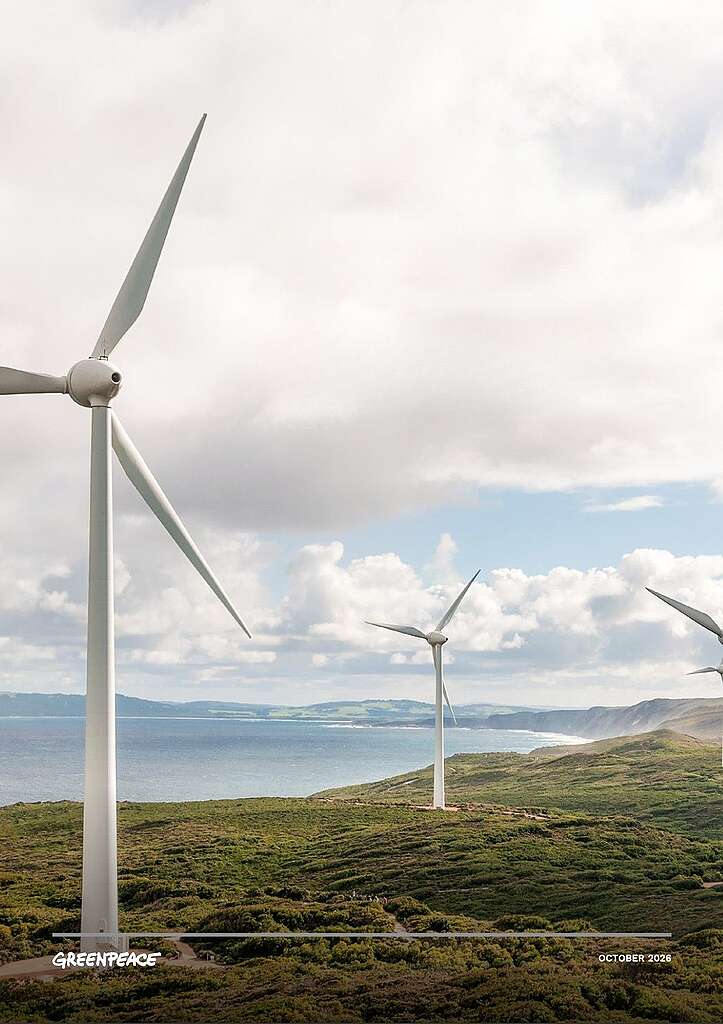
A report from Greenpeace Australia Pacific and Springmount Advisory reveals the untapped green economic opportunity for Western Australia in a declining Asian gas market, which also offers a genuine solution for decarbonisation in Asia.
Is Western Australia clinging to a fading gas industry while a thriving green future passes it by? As major Asian trading partners rapidly pivot away from volatile gas imports toward cheap solar and battery storage, this report exposes a high-stakes choice: risk becoming stranded in an oversupplied fossil fuel market, or harness WA’s unmatched sun and wind to lead the global clean energy transition.