As artificial intelligence (AI) continues to transform industries and unlock new opportunities, its environmental impact is also a matter of concern. While AI holds immense potential to combat climate change, it paradoxically contributes to the problem it aims to solve. The computational intensity of AI training and deployment leaves a significant carbon footprint. So, what’s the responsible way to savor the benefits of AI without worsening the climate crisis? The answer is Green AI.
So, What Is Green AI?
Green AI is a movement and an innovation that seeks to balance technological advancement with environmental sustainability. Green AI, also referred to as Sustainable AI or Net Zero AI, encompasses practices to reduce the carbon footprint of artificial intelligence technologies. Unlike traditional approaches, Green AI integrates sustainability into every stage of the AI lifecycle, from research and development to deployment and maintenance.
Furthermore, understanding the differences between conventional AI and Green AI is key to addressing this growing challenge.
Traditional AI vs. Green AI: A World of Difference
Traditional AI focuses on achieving unmatched accuracy in tasks like language translation, image recognition, and autonomous driving. While its applications are groundbreaking, this accuracy comes at a cost. Training large-scale AI models often require enormous computational resources, consuming vast amounts of energy.
For example, a nature.com study revealed the carbon footprint of training a single big language model is equal to around 300,000 kg of carbon dioxide emissions. This could be quantified as equivalent to 125 round-trip flights between New York and Beijing, a quantification that laypersons can visualize.
Thus, conventional AI overlooks energy efficiency. It also increases costs for businesses and excludes smaller players from entering the AI landscape. The worst outcome is the damage done to the environment from its carbon footprint, suppressing its potential to mitigate climate change.
In contrast, Green AI prioritizes energy-efficient practices. By focusing on sustainable development and deployment of AI systems, it seeks to minimize environmental harm without compromising innovation. Green AI introduces efficiency as a key metric alongside accuracy. It also advocates solutions that deliver high performance while conserving resources.
AI Powering Innovation but at What Cost?
We projected this study from ScienceDirect to understand the energy appetite of AI solutions. AI is growing rapidly, with bigger data needs and more complex models. However, this doesn’t always lead to equally big improvements in accuracy. While large language models (LLMs) like ChatGPT drive innovation, they come with significant environmental costs. Let’s dig deeper…
AI’s Growing Energy Appetite
The same report explains training GPT-3, for instance, consumed 1287 MWh of electricity and emitted 550 tons of carbon dioxide—comparable to flying 33 times between Australia and the UK.
The energy required for AI isn’t just during training. Using systems like GPT-3 also carries a hefty price. In January 2023 alone, GPT-3 processed 590 million queries, consuming energy equivalent to that of 175,000 people. On a smaller scale, each ChatGPT query uses as much power as running a 5W LED bulb for over an hour.
Fig: CO2 equivalent emissions for training ML models (blue) and of real-life cases (violet). In brackets, the billions of parameters adjusted for each model.
Source: ScienceDirect
Deloitte’s recent report, “Powering Artificial Intelligence: A study of AI’s environmental footprint”, revealed the following findings:
- Between 2021 and 2022, data centers accounted for 98% of Meta’s additional electricity use and 72% of Apple’s between 2022 and 2023.
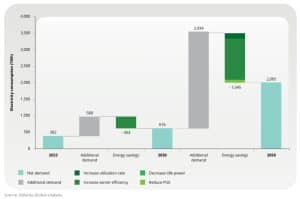
- AI adoption will fuel data center power demand, likely reaching 1,000 terawatt-hours (TWh) by 2030, and potentially climbing to 2,000 TWh by 2050.
- This will account for 3% of global electricity consumption, indicating faster growth than in other uses like electric cars and green hydrogen production.
AI Data Centers: Energy Efficient or Energy Waste?
Data centers are the backbone of AI training and deployment, often referred to as the “cloud.” However, they rely on physical infrastructure for computing, processing, storing, and exchanging data. They require massive power and contribute heavily to the energy consumption of tech companies.
Different types of data centers have unique energy demands. Basic computer rooms handle simple tasks, while mid-size and large-scale enterprise data centers manage more complex operations. Hyperscale data centers, owned by tech giants have maximum hardware density and handle massive computational workloads, consuming the most energy.
Within this category, AI hyperscale data centers are emerging as a distinct segment. These centers are specifically built for generative AI and machine learning tasks, requiring high-performance GPUs for model training and inference.
This results in higher server power usage and the need for advanced cooling systems, further increasing energy consumption. Smaller data centers often lack the capacity for these high-demand workloads, driving the growth of AI-focused hyperscale facilities.
Fig: Data centers’ electricity consumption by server type and scenarios
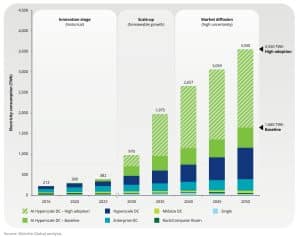
But as they expand, a critical question remains: How sustainable are AI hyperscale data centers in the fight against climate change?
Well, this is where the demand for Green AI garners importance.
Why Green AI Matters?
The environmental cost of AI is no longer a hypothesis, it is palpable all around. Even blockchain technologies like cryptocurrency mining have demonstrated how unchecked digital innovation can lead to unsustainable energy consumption.
Coming straight to the topic, Green AI holds the promise of reversing this trend. For example, AI-powered tools can optimize supply chains, reduce waste, and improve energy grid efficiency. If developed responsibly, AI could become the key driving force behind the global effort to achieve carbon neutrality.
Thus, by combining innovation with sustainability, Green AI can meet the growing demand for computational power while reducing its impact on the environment.
Core Principles of Green AI
This means leveraging AI solutions that are not only effective in optimizing energy use in applications but are also inherently low-energy consumers. It’s crucial to balance AI’s benefits with its environmental impact. It means AI should support sustainability goals and not worsen the problems that it aims to solve.
Energy Efficiency
Green AI encourages the design of algorithms and models that consume less energy. Researchers can achieve this by developing lightweight models or installing techniques like pruning, quantization, and model distillation, which reduce computational requirements.
Hardware Optimization
Using energy-efficient hardware, such as GPUs with higher FLOPS per watt or specialized Tensor Processing Units (TPUs), can significantly cut AI’s energy consumption. Parallelizing tasks across multiple cores also helps reduce training times and emissions, though excessive cores may increase energy use disproportionately.
Another technique is edge computing which means processing data locally to avoid energy-intensive transmissions to cloud or data centers and optimizing resources for IoT (The Internet of Things) devices. Together, these strategies enable powerful AI performance with a smaller environmental footprint.
Data Center Optimization
Adopting renewable energy sources for powering data centers and AI operations is a significant milestone of Green AI. Companies like Google and Microsoft are already leading the charge by transitioning their cloud services to run on clean energy.
To make data centers more energy-efficient, researchers have created algorithms and frameworks that balance server loads, optimize cooling systems, and allocate resources more effectively. All these processes are included in data center optimization that cuts down energy use and emissions.
Transparency and Accessibility
Green AI promotes transparency in reporting the environmental costs of AI projects. Standardized metrics for energy consumption and emissions can help developers and organizations make informed decisions about their AI strategies.
Some of the tools that are used to estimate the carbon footprint of AI technologies are CarbonTracker, CodeCarbon, Green algorithms, and PowerTop.
Additionally, by lowering computational barriers, Green AI fosters inclusivity. Smaller organizations and researchers gain access to advanced tools without burdening themselves with high environmental and financial costs.
Fig: Achievable electricity demand reduction through energy savings, “High adoption” scenario
Policies Driving Green AI
The United Nations’ Sustainable Development Goals (SDGs) highlight the need for a sustainable future. Goals like Affordable and Clean Energy and Industry, Innovation, and Infrastructure are driving the rise of Green AI. Industry leaders are rethinking data center designs and operations to lower energy consumption and environmental impacts. This shows their eagerness to demonstrate proactive efforts toward sustainability.
While Green AI initiatives are mostly industry-led, some regions are implementing supportive policies. These range from monitoring low-impact data centers to stricter regulations for areas where grid stability is at risk. Thus, balancing these policies can encourage sustainable practices without moving operations to less regulated regions.
Notable policies include:
- European Code of Conduct for Data Centers (EU DC CoC)
- Energy Efficiency Directive (EED)
- Singapore Green Data Centre Roadmap
China has also introduced measures like the Three-Year Action Plan on New Data Centres, while the U.S. lacks federal-level regulations specific to data centers.
Policymakers can amplify these efforts by co-developing standards with industry leaders. Collaborative strategies ensure data centers meet climate goals without compromising growth or grid stability.
Green AI demonstrates that with the right policies and innovations, the tech industry can lead the way to a more sustainable future.
Green AI Takes the Spotlight at COP29
As world leaders convened in Baku, Azerbaijan, for COP29, discussions pointed to the role of AI in promoting environmental sustainability. A Deloitte-hosted panel brought together experts from NVIDIA, Crusoe Energy Systems, EON, and the International Energy Agency (IEA) to explore strategies for reducing AI’s environmental footprint.
Josh Parker, senior director of legal–corporate sustainability at NVIDIA, said,
“We see a very rapid trend toward direct-to-chip liquid cooling, which means water demands in data centers are dropping dramatically right now.”
According to NVIDIA, designing data centers while keeping energy efficiency at the highest priority right from the beginning is very much essential. As AI demands grow, sustainable infrastructure will be critical. Parker highlighted that current data centers are becoming outdated and inefficient.
He added, accelerated computing platforms are 10X more efficient than traditional systems for running workloads. This creates a significant opportunity to cut energy consumption in existing infrastructures.
Accelerated Computing: A Path to Green AI
Parker once again emphasized that accelerated computing represents the most energy-efficient platform for AI and many other applications. Over the past few years, energy efficiency for accelerated computing has improved dramatically, with a 100,000x reduction in energy consumption.
- In just the last two years, energy use for AI inference tasks dropped by 96%, with systems becoming 25x more efficient for the same workload.
Accelerated computing uses GPUs to process tasks faster and more efficiently than traditional CPUs. By handling multiple tasks simultaneously, GPUs reduce the energy required for AI workloads. It’s one of the techniques that come under hardware efficiency and data center optimization.
Furthermore, NVIDIA emphasized the need for energy-efficient infrastructure in data centers. Innovations like liquid-cooled GPUs are transforming cooling methods. Unlike traditional air conditioning, direct-to-chip liquid cooling consumes less power and water while maintaining effective temperature control.
The Bottom Line
Deloitte’s findings have adeptly showcased AI’s potential in driving climate-neutral economies. Green AI strategies focus on minimizing environmental impact by improving hardware design and increasing the use of renewable energy.
Industry leaders are spearheading these efforts, highlighting the effectiveness of sustainable computing practices. The shift toward accelerated computing and energy-efficient design is paving the way for AI to support global climate goals.
As we face a climate crisis, the integration of Green AI principles is no longer optional—it is essential. By redefining how AI solutions are developed, we can harness their power for good while minimizing their environmental toll. The road ahead demands collective effort, innovation, and accountability. Last but not least, Green AI is not just a technological imperative but a moral responsibility to ensure a greener future.
Key Sources:
- A review of green artificial intelligence: Towards a more sustainable future – ScienceDirect
- AI at COP29: Balancing Innovation and Sustainability | NVIDIA Blog
The post Green AI Explained: Fueling Innovation with a Smaller Carbon Footprint appeared first on Carbon Credits.
Carbon Footprint
L’Oréal Taps 13 Global Startups to Boost Climate, Nature, and Circular Innovation
L’Oréal, the global beauty giant, has unveiled its first cohort of startups participating in its new sustainable innovation program, L’AcceleratOR. The program chose 13 startups focused on climate, nature, and circularity. They were selected from nearly 1,000 applicants across 101 countries. It aims to find, pilot, and scale solutions that address key environmental challenges in the beauty industry and beyond.
The initiative is part of L’Oréal’s larger sustainability plan, called “L’Oréal for the Future.” This plan includes bold goals for climate action, resource use, and a shift to a circular economy by 2030 and beyond.
Inside L’AcceleratOR: Funding, Pilots, and Scale
L’AcceleratOR is a €100 million (about US$116 million) sustainable innovation program. The funding will be provided over a five-year period. The program helps startups and small to medium-sized enterprises (SMEs) that create sustainable solutions for L’Oréal and the beauty industry.
L’AcceleratOR is in partnership with the University of Cambridge Institute for Sustainability Leadership (CISL). Selected startups will enter an intensive support phase led by CISL. They will receive funding, expert guidance, and access to L’Oréal’s research and testing capabilities. The aim is to help these companies become pilot-ready and scale their solutions for broader use.
The accelerator focuses on key strategic themes tied to L’Oréal’s sustainability goals:
- Next-generation packaging and materials
- Nature-sourced ingredients
- Circular solutions
- Data intelligence tools to measure and reduce environmental impacts
Startups may run six- to nine-month pilots with L’Oréal and its partners. Successful pilots may be scaled across global operations if they show measurable benefits.
Ezgi Barcenas, Chief Corporate Responsibility Officer, remarked:
“To accelerate sustainable solutions to market, we are being even more intentional and inclusive in our pursuit of partnerships through “L’AcceleratOR”. We are really energized to be co-designing the future of beauty with the University of Cambridge Institute for Sustainability Leadership, and these 13 change makers.”
The 13 Startups and Their Focus Areas
The selected startups and SMEs represent a range of sustainable innovations across climate, nature, and circularity. They fall into four main categories:
- Packaging and materials
- Nature-sourced ingredients
- Circular solutions
- Data intelligence

These 13 startups use different ways to cut environmental impact. They focus on product design, supply chain management, and manufacturing to promote circularity.
How L’AcceleratOR Fits L’Oréal’s 2030 Strategy
L’AcceleratOR is part of L’Oréal’s broad 10-year sustainability roadmap, “L’Oréal for the Future.” The roadmap covers four main areas: climate, nature, materials circularity, and communities. It includes the 2030 goals that aim to transform operations while driving innovation in sustainable solutions.

Some of L’Oréal’s key targets under the roadmap include:
- 100% renewable energy for all operations.
- Sustainable sourcing of at least 90% bio-based materials in formula and packaging.
- 100% recycled or reused water for industrial purposes.
- Reducing virgin plastic use by 50%.
- Sourcing 50% of packaging from recycled or bio-based materials.
- Cutting Scope 1 and 2 emissions by 57% and some Scope 3 emissions by 28% against a baseline year.

The L’AcceleratOR program expands these efforts by tapping external innovation. L’Oréal supports startups to speed up solutions that can cut environmental impacts throughout its value chain.
L’Oréal’s Scope 3 emissions are by far the largest part of its footprint, as seen below. This reflects impacts from sourcing, production inputs, logistics, product use, and end-of-life. In 2024, Scope 1 and 2 fell further to about 227,051 tCO₂e, showing continued reductions in direct and energy-related emissions. Total emissions, though, remained roughly stable at 7.41 million tCO₂e, increased with Scope 3 again the largest component.

L’Oréal also has other sustainability initiatives. For example, its Fund for Nature Regeneration has invested more than €25 million (about US$29.1 million) in projects like forest, mangrove, and marine ecosystem restoration. This reflects L’Oréal’s commitment to nature and biodiversity alongside climate action.
Water stewardship is another strategic focus. In 2024, 53% of the water used in L’Oréal’s industrial processes came from reused and recycled sources. This was supported through water recycling systems in areas facing water stress.
Implications for the Beauty and Consumer Goods Sector
L’Oréal’s accelerator initiative reflects a larger industry trend. Many global companies are increasingly investing in sustainable technologies through partnerships, incubators, and venture funds. These partnerships aim to speed up climate, nature, and circular solutions. They combine corporate scale with startup agility.
The L’AcceleratOR program connects L’Oréal with companies that use innovation and partnerships to achieve their environmental goals. It also shows that sustainability strategies can go beyond internal changes. They can support the larger ecosystem, too. Helping startups scale can benefit whole industries, not just single companies.
This trend is important in areas like packaging, materials science, green chemistry, and digital climate tools. Packaging waste and carbon emissions from supply chains are major problems for consumer goods. This is especially true in beauty and personal care.
The beauty industry accounts for about 0.5% to 1.5% of global greenhouse gas emissions. Most of these emissions come from the value chain, not from company factories. For many beauty companies, around 90% of total emissions are Scope 3, such as raw materials, packaging, transport, and product use.
Raw material sourcing, including agricultural inputs and plastics, can make up 30% to 50% of industry emissions. Consumer use also adds a large share, especially for products that require water and heat.

The industry produces about 120 billion beauty packaging units each year worldwide. Much of this packaging is single-use and hard to recycle. A typical beauty product can generate several kilograms of CO₂-equivalent over its life cycle, from production to disposal.
Notably, most emissions are in the value chain. So, new solutions in packaging, materials, and data tools are key to cutting the beauty sector’s climate impact. This is what L’Oréal seeks to address. By supporting solutions in these areas, it hopes to change old industry practices.
Early Expectations and Next Steps
The 13 selected startups will now enter the pilot readiness phase of the L’AcceleratOR program. During this phase, the startups will refine their technologies with CISL guidance and L’Oréal support. The goal is to ensure their solutions are ready for real-world testing in commercial environments.
If pilot outcomes are successful, solutions may be scaled beyond initial tests. Some could fit into L’Oréal’s global operations or be used by industry partners. This would speed up sustainable progress.
L’Oréal and CISL plan future cohorts for the L’AcceleratOR program. Future rounds will create chances for more companies. They will also expand the pipeline of sustainable solutions.
By partnering with the University of Cambridge Institute for Sustainability Leadership and supporting startups across packaging, materials, ingredients, circular systems, and data tools, L’Oréal aims to fast-track real solutions that reduce environmental impacts.
The initiative boosts L’Oréal’s sustainability plan, “L’Oréal for the Future.” This plan sets bold goals for 2030, focusing on renewable energy, resource use, cutting emissions, and promoting circularity.
The pilot and scaling opportunities in the program can help new technologies join global supply chains. This support will aid L’Oréal and its partners in tackling climate, nature, and circular economy challenges towards its net-zero goals.
The post L’Oréal Taps 13 Global Startups to Boost Climate, Nature, and Circular Innovation appeared first on Carbon Credits.
Carbon Footprint
Microsoft (MSFT) Signs 2.85 Million Soil Carbon Credit Deal With Indigo in Landmark Regenerative Agriculture Move
On January 15, Indigo Carbon PBC announced one of the largest soil carbon transactions to date, marking a major milestone for regenerative agriculture in the voluntary carbon market. Under a 12-year agreement, Microsoft will purchase 2.85 million soil carbon credits generated through the Carbon by Indigo program, a large-scale, U.S.-based initiative focused on delivering high-integrity carbon removals.
This agreement underscores the increasing confidence of large corporate buyers in nature-based carbon removal pathways, particularly those that integrate climate impact with tangible on-the-ground benefits for farmers and ecosystems.
Third Transaction Strengthens Microsoft’s Carbon-Negative Path
Microsoft’s FY24 climate data reflects a 23.4% increase in overall emissions compared to its base year, largely due to rapid business expansion. Despite this, Microsoft retired 595,922 metric tons of carbon removals to meet its annual carbon-neutral target.
The latest purchase represents the third carbon credit transaction between Microsoft and Indigo. It follows earlier deals for 40,000 tonnes of credits in 2024 and 60,000 tonnes in 2025. Together, these agreements underscore Microsoft’s long-term strategy to meet its commitment to become carbon negative by 2030.
Looking ahead, Microsoft has contracted for nearly 22 million metric tons of carbon removals to be delivered over the next 15 years or more. This includes 2.8 million tons expected in FY30, the company’s carbon-negative target year, with additional volumes planned beyond FY31.

READ MORE:
- Microsoft Buys 60,000 Soil Carbon Credits from Indigo’s Largest Carbon Crop
- Microsoft Strikes 2 Record-Breaking Carbon Credit Deals
Indigo Ag Strengthens High-Integrity Carbon Removal Supply
The broader regenerative agriculture market continues to gain momentum.
- Research showed that, valued at $1.52 billion in 2025, the market is projected to grow from $1.76 billion in 2026 to around $5.77 billion by 2034, reflecting a CAGR of 15.97%.
Practices such as cover cropping, rotational grazing, reduced tillage, and compost application improve soil carbon levels and microbial diversity. As voluntary carbon markets mature, regenerative agriculture is emerging as a durable climate solution and a scalable economic opportunity for farmers.
For Indigo, the deal further cements its leadership in scaling verified soil carbon removals, demonstrating that regenerative agriculture can deliver credits at volumes large enough to meet enterprise-level demand.

Regenerative Agriculture: Climate Impact Plus Farm Productivity
Governments and climate institutions increasingly recognize regenerative agriculture as a powerful carbon removal tool.
- Research suggests these practices could remove more than 3.5 gigatons of CO₂ equivalent annually, while also improving soil health, increasing crop resilience, and stabilizing yields.
Beyond carbon, regenerative practices deliver critical co-benefits. They enhance water infiltration, reduce erosion, and support water conservation—key advantages as drought and water scarcity intensify across agricultural regions. These outcomes also strengthen rural economies by improving long-term farm productivity.
New Revenue Streams for Farmers
At a time when farmers face rising costs, climate volatility, and market uncertainty, the Microsoft-Indigo agreement delivers meaningful financial incentives. By rewarding farmers for adopting regenerative practices, the deal improves farm resilience while creating new, non-government revenue streams.
Indigo currently works with farmers across more than eight million acres and has paid $40 million through its programs to date. These payments are independent of government subsidies, offering farmers greater financial flexibility and stability.
High-Integrity Credits Meet ICVCM Core Carbon Principles
Credit integrity is a defining feature of the agreement. It is among the first soil carbon deals to include credits approved under the Integrity Council for the Voluntary Carbon Market’s (ICVCM) Core Carbon Principles.
Indigo has issued 927,296 carbon removal and reduction credits under CAR1459 using the Climate Action Reserve’s Soil Enrichment Protocol. The company relies on peer-reviewed science, field data, remote sensing, and machine learning to measure and verify soil carbon outcomes.
To address permanence risks, Indigo has added safeguards across the 40-year durability period agreed with Microsoft, complementing the protocol’s 100-year monitoring and reversal compensation requirements.
On an end note, Meredith Reisfield, Senior Director of Policy, Partnerships, and Impact at Indigo, said:
“Microsoft’s purchase highlights the transformative power of regenerative agriculture to support watersheds, support farming communities, and advance global net-zero goals. Indigo is a proud catalyst of today’s soil carbon market, with our long-standing history of farmer collaboration and proven impact, already saving 64 billion gallons of water and issuing nearly one million tonnes of CO2e carbon removal credits since 2018.”
The post Microsoft (MSFT) Signs 2.85 Million Soil Carbon Credit Deal With Indigo in Landmark Regenerative Agriculture Move appeared first on Carbon Credits.
Carbon Footprint
eBay Maps Out Path to Net-Zero by 2045 with Science-Based Climate Plan
eBay has released its first Climate Transition Plan, outlining how the company will reduce emissions and reach net‑zero greenhouse gas (GHG) emissions by 2045. The plan covers actions across eBay’s operations and its broader business ecosystem. It also sets near‑term milestones and embeds climate action into corporate governance and planning.
The strategy was validated by the Science Based Targets initiative (SBTi), aligning it with climate science and the Paris Agreement’s 1.5°C goal.
The Climate Transition Plan reflects eBay’s commitment to sustainable commerce. It builds on years of progress in cutting emissions, scaling renewable energy, and driving circular economy practices.
The plan also shows how the company will cut emissions in its operations and value chain. This includes transportation, logistics, and the marketplace. At the same time, it aims to grow its global business.
eBay’s Climate Transition Plan: Sustainable Commerce at the Core
eBay’s Climate Transition Plan is a detailed roadmap for climate action through 2045. It identifies both climate risks and opportunities for the business. The plan focuses on four main areas: sustainable commerce, emissions reduction, governance integration, and value chain collaboration.

Sustainable Commerce
The plan emphasizes eBay’s circular marketplace model, which extends the life of products and reduces waste. This model supports resale and reuse, helping customers make more sustainable choices. The company has framed this as a way to grow while cutting environmental impact.
Clear Path to Net Zero
eBay has outlined science‑aligned pathways to reach net‑zero GHG emissions by 2045. These pathways include near-term targets for 2030 and long-term goals for 2045. The SBTi validates them to ensure they align with climate science.
Governance and Planning
Climate action is now embedded into how eBay governs and plans its business. The company has strengthened oversight by senior leadership and aligned climate goals with financial planning. eBay says this integration helps ensure climate‑related decisions influence business outcomes.
Value Chain Collaboration
eBay will partner with carriers, suppliers, policymakers, and its buyers and sellers to cut emissions beyond its own operations. The focus is on expanding low-carbon delivery options. It also aims to reduce emissions from shipping and logistics.
eBay’s Net Zero Targets: 2030 Milestones and Beyond
eBay’s climate goals cover both emissions cuts and long‑term net‑zero targets. These goals are science‑based and validated by the Science-Based Targets initiative. This validation shows that the targets match the reductions needed. They aim to keep global warming below 1.5°C above pre-industrial levels, which aligns with the Paris Agreement.
Net‑Zero by 2045: eBay has committed to achieving net‑zero GHG emissions across its entire value chain by 2045. This means cutting total emissions by 90% from 2019 levels. Also, we will use strong, lasting carbon removals to offset any emissions left between 2030 and 2045.
2030 Near‑Term Targets: To support the long‑term net‑zero goal, eBay set interim targets for 2030:
- Reduce absolute Scope 1 and 2 emissions by 90% compared with 2019.
- Reduce Scope 3 emissions from downstream transportation and distribution by 27.5% compared with 2019.
Progress to Date: eBay has already achieved significant cuts in operational emissions:

- The company has achieved a 92% reduction in Scope 1 and 2 emissions relative to 2019.
- It has reached 100% renewable electricity for all offices, data centers, and authentication centers ahead of its original 2025 target.

- Downstream transportation and distribution emissions have fallen 21% compared with 2019, moving toward the 27.5% 2030 target.
These results show that eBay is ahead in some areas and making progress in others as it works toward its future climate goals.
Scope 3 Challenges: The largest portion of eBay’s emissions comes from Scope 3, particularly shipping. Shipping accounts for almost 84% of Scope 3 emissions, making it the toughest category to decarbonize. eBay is focusing on partnerships with carriers and low‑carbon options to reduce these emissions over time.

eBay’s Broader Sustainability Initiatives
eBay goes beyond reducing greenhouse gases. It takes various sustainability steps that link climate goals to its business strategy.
- Renewable Energy
eBay achieved its goal of sourcing 100% renewable energy for its operations in 2024, one year ahead of schedule. This renewable energy covers electricity for offices, data centers, and related facilities.
- Circular Economy and Recommerce
eBay focuses on recommerce. This means used and refurbished goods are bought and sold. In 2024, this recommerce activity:
-
- Generated about $5 billion in positive economic impact.
- Helped avoid 1.6 million metric tons of carbon emissions.
- Prevented 70,000 metric tons of waste. These figures show how extending product life can reduce environmental impact.
eBay aims to build on these results by encouraging resale and reuse as mainstream shopping choices. The company views a circular business model as a climate tool and a way to create value for its users.
- Tracking and Transparency
eBay tracks its environmental performance through frameworks like the Task Force on Climate‑Related Financial Disclosures (TCFD). It also takes part in the CDP Corporate Questionnaire.
These actions help ensure the e-commerce’s transparency and accountability in climate reporting.
Leading by Example
eBay’s climate goals align it with other tech and retail companies. They have set science-based net-zero targets and interim reduction goals. For example, other e‑commerce and tech firms like Amazon and Alibaba have also set long‑term climate targets. However, their timelines and scopes differ.
Validating targets through the SBTi adds credibility and aligns eBay with companies that aim to match the most ambitious climate science benchmarks. The SBTi’s validation process makes sure that reduction goals are clear. They follow a framework that aims to keep global temperature rise to 1.5°C.
In addition, eBay’s focus on shipping emissions highlights a common challenge for online retail platforms. Many companies are exploring low-carbon logistics. They are using consolidated delivery, local pickup, and shifting modes, like moving from air to ground transport. These steps help cut supply chain emissions.

eBay focuses on circular commerce and sustainable logistics in its transition plan. This aligns environmental efforts with business trends that value resource efficiency and low-carbon operations.
Low-Carbon Innovation for the Future
eBay’s Climate Transition Plan sets a clear and science‑based path to net‑zero GHG emissions by 2045. The plan includes near‑term and long‑term targets that have been validated by the Science Based Targets initiative.
The e-commerce company has already achieved major milestones, such as a 92% reduction in direct emissions and 100% renewable electricity by 2024. It also continues to invest in renewable energy, promote reuse and resale, and engage partners to cut emissions across its value chain.
The plan further shows eBay’s goal to include climate action in its strategy, governance, and financial planning. It also illustrates how sustainable commerce and circular economy practices can support long‑term environmental and business goals. As shipping and logistics remain the largest emissions source, future efforts will focus on creative and low‑carbon solutions to meet eBay’s ambitious climate goals by 2045.
The post eBay Maps Out Path to Net-Zero by 2045 with Science-Based Climate Plan appeared first on Carbon Credits.
-
Climate Change5 months ago
Guest post: Why China is still building new coal – and when it might stop
-
Greenhouse Gases5 months ago
Guest post: Why China is still building new coal – and when it might stop
-
Greenhouse Gases2 years ago嘉宾来稿:满足中国增长的用电需求 光伏加储能“比新建煤电更实惠”
-

Climate Change2 years ago
Spanish-language misinformation on renewable energy spreads online, report shows
-
Climate Change2 years ago
Bill Discounting Climate Change in Florida’s Energy Policy Awaits DeSantis’ Approval
-
Climate Change Videos2 years ago
The toxic gas flares fuelling Nigeria’s climate change – BBC News
-
Climate Change2 years ago嘉宾来稿:满足中国增长的用电需求 光伏加储能“比新建煤电更实惠”
-
Carbon Footprint2 years agoUS SEC’s Climate Disclosure Rules Spur Renewed Interest in Carbon Credits


