

European judges have ruled that Switzerland has breached the human rights of its citizens by not doing enough to cut national greenhouse gas emissions, in a decision with wide implications for state action on climate change.
In a landmark judgment issued today, the European Court of Human Rights upheld a complaint brought by more than 2,000 older Swiss women, saying their government had violated their rights to life and to respect for private and family life under the European Convention on Human Rights (ECHR).
It ruled that Article 8 of the ECHR, which refers to the right to a private and family life and home, “encompasses a right to effective protection by the State authorities from the serious adverse effects of climate change on lives, health, well-being and quality of life”.
Anne Mahrer, co-president of the Swiss KlimaSeniorinnen group that brought the case, said the ruling is a “landmark in the struggle for a liveable climate for everyone” as “the ECHR has now confirmed that climate protection is a human right”.
The decision is likely to encourage other campaign groups to bring cases against governments that are parties to the ECHR. This includes all European Union states, the United Kingdom, Norway, Turkey and some Central Asian states. A number of climate lawsuits had been adjourned at the court pending decisions in this and two other cases ruled on this morning.
Forest carbon accounting allows Guyana to stay net zero while pumping oil
Climate litigation is a growing trend around the world, and courts have previously linked climate with human rights violations. But this is the first time an international court has ruled on whether climate change infringes human rights.
Johan Rockström, director of the Potsdam Institute for Climate Impact Research, said heatwaves, droughts, floods and forest fires are already threatening human lives today, and will worsen as climate change intensifies, making it urgent for states to take action to reduce planet-warming emissions.
“Climate lawsuits can put pressure on governments to increase their climate policy efforts and thus advance diplomatic negotiations,” he said in a statement after the ruling.
Swiss seniors
The KlimaSeniorinnen Schweiz, an association of older women, argued that those it represents are particularly vulnerable to climate change and presented scientific evidence showing that older people – particularly women – are more likely to die during heatwaves. They wanted the Swiss government to do more to meet the tougher 1.5C warming goal it signed up to in the Paris Agreement.
The Swiss government had agreed that rising temperatures were harming people’s health – but denied that the KlimaSeniorinnen should be treated as victims under the law and said the link between its actions and their suffering was “too tenuous and remote”.
It maintained that some of the claimants – several of whom were over the age of 80 and some of whom had died since the case was first filed – were unlikely to be alive by the time the global temperature rise breaches the 1.5C threshold.

KlimaSeniorinnen Schweiz activists outside the courtroom in Strasbourg 9/4/24 (Photo: Global Legal Action Network)
The 17-judge panel ruled today that there were critical gaps in Switzerland’s attempt to put a domestic climate regulation framework in place.
It said Swiss authorities had failed to quantify how they would cut national greenhouse gas emissions, through a carbon budget or otherwise, and had failed to meet past emission reduction targets.
While recognising that states have wide discretion in setting their own laws and developing measures to cut national emissions, the court said Swiss authorities had not acted quickly or decisively enough.
The court did not say what Switzerland should do to solve the problem, leaving it to the Council of Europe’s Committee of Ministers to come up with a solution.
The judgment, which follows hearings last year, cannot be appealed.
Sébastien Duyck, human rights and climate campaign manager for the Center for International Environmental Law, said the decision has implications “way behind Switzerland” because all members of the Council of Europe have the same human rights obligations.
Beyond Europe, he said it would influence how other courts interpret the human rights obligations of states on climate action.
Two failures
The court also ruled on two other climate-related lawsuits this morning in Strasbourg.
One, brought by former French mayor and current member of the European Parliament Damien Carême against the government of France, was deemed inadmissible because he no longer lives in France and could not show that he was a victim.

19-year old Portugese applicant Sofia Oliveira in the court room in Strasbourg 9/4/24 (Photo: Global Legal Action Network)
It also threw out a case brought by six Portuguese young people against 32 countries, including all EU member states, Norway, Switzerland, the UK and Turkey.
The judges ruled that the plaintiffs could only bring a case against their home country of Portugal, striking out their case against other states. But action against Portugal was not allowed to proceed at the European level because legal avenues in Portugal had not been exhausted.
Although she was disappointed that her lawsuit was not successful, 19-year-old Portuguese applicant Sofia Oliveira expressed solidarity with the Swiss women. “Their win is a win for us too, and a win for everyone”, she said.
The post European court rules climate inaction by states breaches human rights appeared first on Climate Home News.
European court rules climate inaction by states breaches human rights

An exceptional El Niño is building. The World Meteorological Organization (WMO) says it has intensified to very strong levels and is likely to last at least through February 2027. If its current trajectory holds, it could become stronger than anything seen since WMO monitoring began four decades ago.
That is bad news for agriculture. El Niño – a naturally occurring weather phenomenon – can scramble rainfall patterns across the world, bringing drought to some regions and floods to others. And this time it is unfolding against the backdrop of a significantly hotter climate, with farmers already contending with unreliable growing seasons, extreme heat and less predictable rainfall because of global warming.
El Niño expected to bring next record-hot year as soon as 2027
We are seeing the consequences already. In Sri Lanka, drought linked to El Niño has dried wells and reservoirs and cut into crops and farmer incomes. Indonesia is experiencing its worst wildfire season in 11 years, with prolonged drought and extreme heat exacerbated by El Niño. And in Peru, authorities are preparing for the opposite extreme: intense rains, flooding and landslides which the national civil-defence agency says could affect around 1.2 million people.
These impacts will multiply as El Niño intensifies.
And yet, just as the risks to food production are rising, the money available to help farmers withstand them is shrinking.
10% funding decline in 2024
A forthcoming analysis from the Food and Agriculture Organization (FAO) shows that climate-related development finance for agrifood systems is moving in the wrong direction. In 2024, the latest year for which data is available, it fell by 10 percent compared with a 2 percent overall decline. The sectors that put food on our tables — crops, livestock, forestry and fisheries — received just 5 percent.
Yet this is precisely the moment when climate investment in agriculture needs to grow, not shrink. It can help communities adapt, build resilience and protect food security, while unlocking larger flows of public and private finance. Agriculture feeds us, supports the livelihoods of well over a billion people, and is often the first sector hit by drought, floods and extreme heat. Cutting that investment now is a false economy.
One failed harvest can plant the seed for the next crisis, forcing farmers to eat the seed they have saved for planting, sell livestock or tools, or take on debt. It can also deepen food insecurity, disrupt supply chains and drive up prices, showing up months later in supermarket aisles far away.
The Central American Dry Corridor, stretching through much of the region, shows both how exposed farmers are, and what investment can do. Based on an analysis of 41 years of satellite observations, FAO finds that some crop and pasture areas there face more than a 50 percent chance of agricultural drought over the coming months.
About half of Central America’s 1.9 million producers of maize, beans and other basic grains live in the Dry Corridor. Many grow food both for sale and for their own families. When a harvest fails, they lose both income and dinner.
El Salvador project conserves water and soil
In El Salvador, which lies within the Dry Corridor, more than 50,000 farmers have adopted practices to better withstand drought and increasingly unreliable rainfall through RECLIMA, a project financed by the Green Climate Fund and implemented by FAO in partnership with the government of El Salvador. It has substantial national co-financing, including from the country’s Environmental Investment Fund.
El Niño can intensify El Salvador’s annual mid-season dry spell, known as the canícula, turning it into a longer, harsher drought just as maize needs water most.
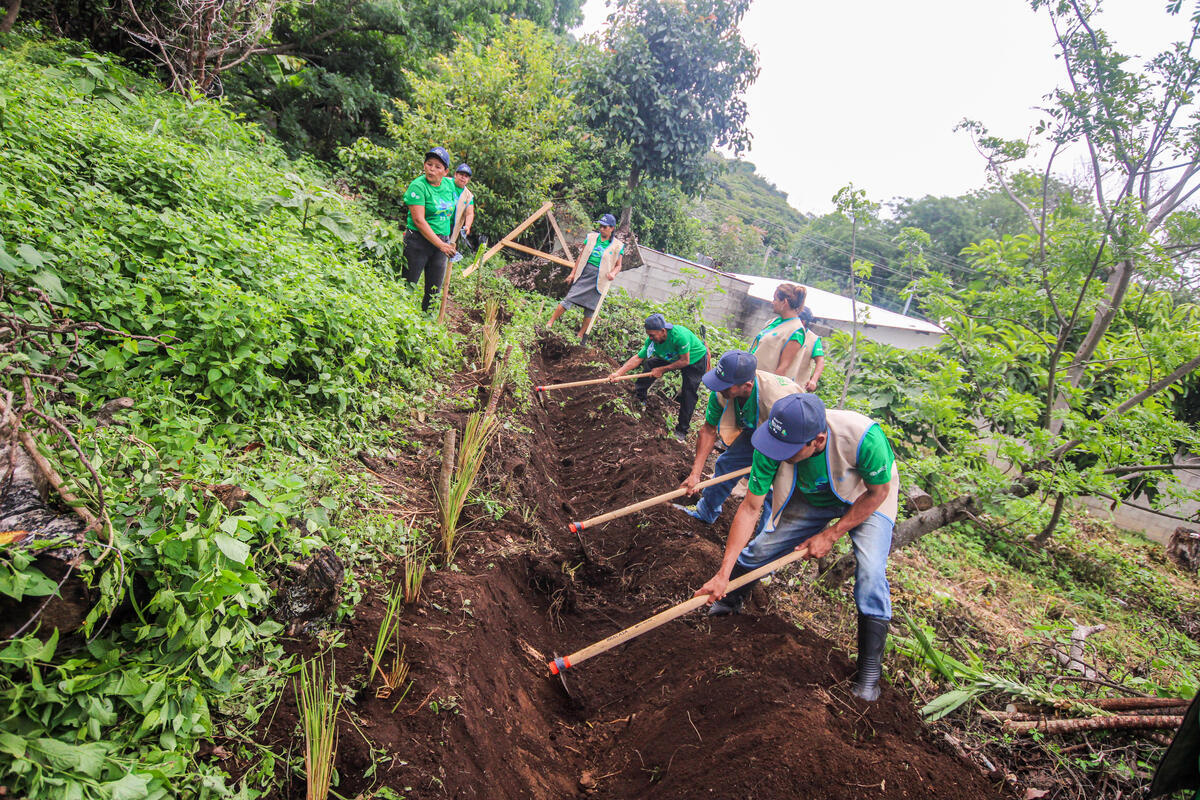
For María Cristina Corvera de López, a second-generation farmer in rural Nahualapa, adapting means changing how every drop of rain is captured and used. She plants trees alongside her crops to provide shade and minimise evaporation and uses simple irrigation channels and a homemade drip system to conserve water. Instead of burning stalks, leaves and husks after harvest, as generations before her did, she turns them into mulch to hold moisture in the soil.
“The effects of climate change are a constant challenge,” she says. But the new techniques have made her farm more resilient to El Niño as well. Where she once harvested about 50 bags of maize per acre, she now gets around 80, even during droughts. It’s enough to feed her family and sell the surplus.
Managing risk now cuts future costs
Together, these adaptations can mean the difference between losing a crop and getting through a dry season with enough food, seed and income to plant again. They are also the result of climate finance invested before disaster strikes.
RECLIMA shows what that kind of adaptation investment can buy. Adaptation accounted for 45 percent of climate-related development finance to agrifood systems in 2024, and multilateral development banks are directing more agricultural finance towards resilience. That shift reflects a growing recognition that adaptation is a form of risk management, not just a development cost.
We need much more of it. The same investments that help farmers withstand El Niño also enable them to adapt to a hotter, more unpredictable future. Cutting investment in the people who produce our food just as climate risks intensify does not save money. It simply pushes a much larger bill into the next harvest, the next food crisis, and the next El Niño.
The post As El Niño intensifies, we should be investing more in the world’s farmers appeared first on Climate Home News.
As El Niño intensifies, we should be investing more in the world’s farmers
An area of Amazon forest roughly the size of the US state of New Jersey has remained standing due to Luiz Inácio Lula da Silva’s leadership of Brazil, according to Carbon Brief analysis.
Lula beat Jair Bolsonaro in the 2022 election to become president of the nation that is home to nearly 60% of the Amazon rainforest.
Forest loss surged during Bolsonaro’s far-right presidency and dropped sharply under the left-wing Lula, with Amazon deforestation likely to hit its lowest level on record this year.
Now, as another presidential election approaches, Lula is facing off against Bolsonaro’s son, Flávio Bolsonaro, whose “anti-environmental” policies are similar to his father’s.
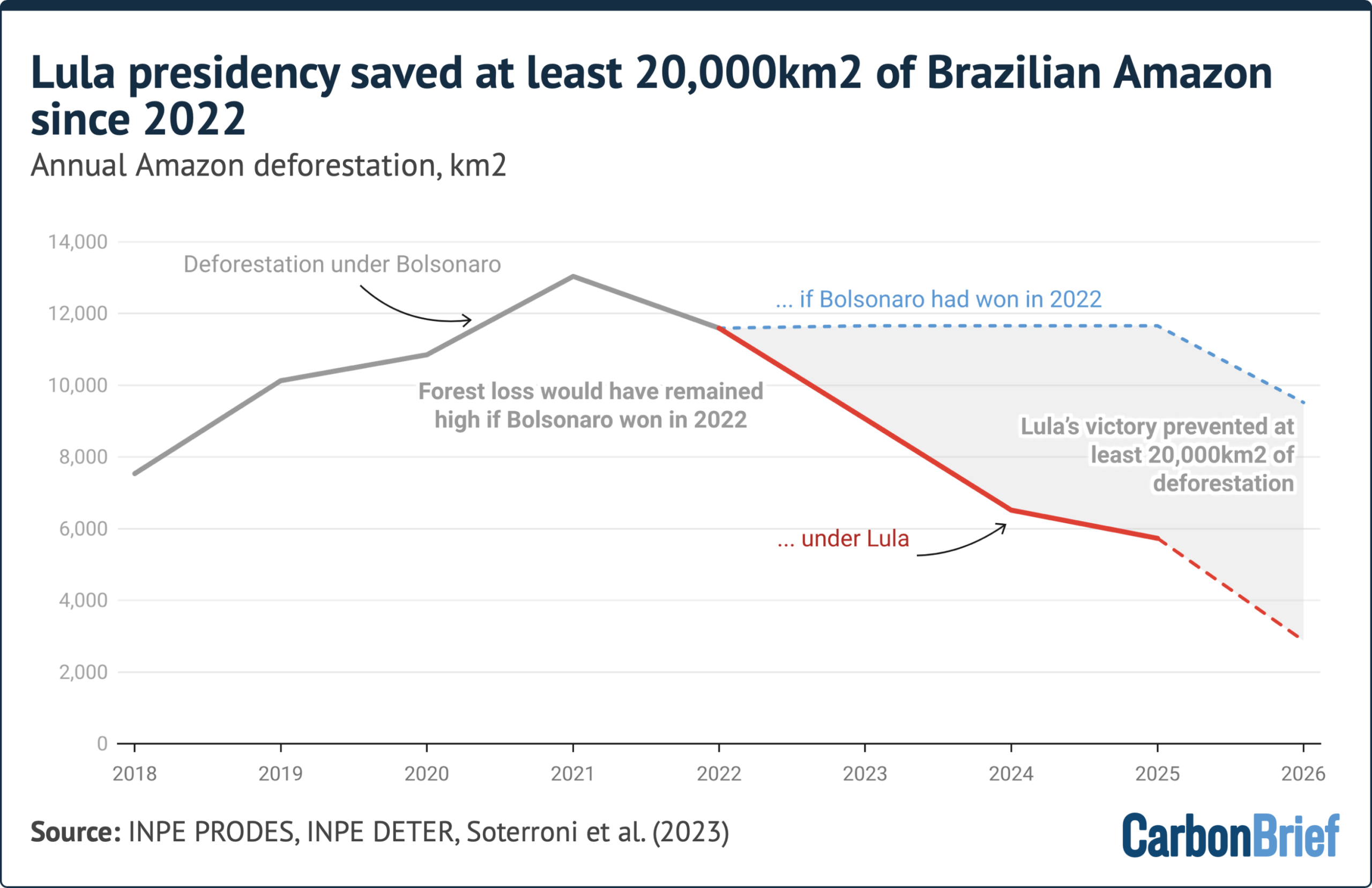
Carbon Brief’s analysis suggests that at least 20,000 square kilometres (km2) of deforestation has been avoided since Lula took office and prioritised Amazon protection.
The analysis is based on modelling by an international research team of an alternative scenario in which Brazil’s flagship forest code legislation was not enforced – a proxy for Jair Bolsonaro’s leadership.
Experts tell Carbon Brief that this estimate is likely “conservative” and that actual deforestation under Bolsonaro could have been “much higher”.
With Lula and Flávio Bolsonaro tied in the polls, the upcoming election is expected to significantly shape the level of environmental action in the world’s fourth-largest emitter, whose emissions are largely driven by deforestation.
‘Brazil is back’
When Jair Bolsonaro was president of Brazil between 2019 and 2022, he championed the nation’s powerful agribusiness sector and oversaw an unprecedented increase in Amazon deforestation.
Bolsonaro weakened regulations, slashed federal agency budgets and empowered illegal activities in the Amazon, while attacking Indigenous and environmental groups.
This meant that the forest code – Brazil’s flagship legislation that requires landowners to preserve and restore forest on their property – was not properly enforced.
After Lula’s presidential victory in 2022, he promised to target “zero deforestation” by 2030, telling the COP27 UN climate summit that “Brazil is back”.
Lula rolled back Bolsonaro’s wave of deregulation and reinstated a deforestation “action plan”. Led by celebrated environmentalist Marina Silva, the environment ministry scaled up enforcement and policing activities in the Amazon.
As a result, annual deforestation in the Amazon has more than halved from 11,594km2 per year in 2022 to 5,731km2 in 2025.
Data from August 2025 to July 2026 – the timespan used in government records – is yet to be released, but preliminary satellite alerts put the deforestation figure at 2,874km2.
While the final figure is likely to be higher, experts still think Amazon deforestation in 2026 could hit its lowest level since records began in 1988.
New Jersey-sized forest
Compared to a scenario in which Bolsonaro won in 2022, Carbon Brief analysis suggests that at least 20,000km2 of Amazon forest remains standing today due to Lula’s leadership.
This area – roughly the size of Wales, Belize, Slovenia or the US state of New Jersey – is indicated by the grey area in the chart below.
This analysis is based on a 2023 study on the role of nature-based solutions in Brazil’s pathway to net-zero emissions. This was a refined update of a 2018 study that used the same GLOBIOM-Brazil model, from researchers at the University of Oxford, the International Institute for Applied Systems Analysis and Brazil’s National Institute for Space Research (INPE).
It is based on a comparison of forest code implementation with a “baseline” scenario in which the code is not enforced, reflecting the kind of weak governance seen under the Bolsonaro administration. (See Carbon Brief’s 2022 article for more details of this modelling.)
Dr Aline Soterroni, a University of Oxford researcher who led the 2023 analysis, tells Carbon Brief that the reversal seen under Lula “shows how quickly deforestation can respond to political will”.
However, she stresses that the modelling of the “no forest code” scenario is “relatively conservative”, with deforestation remaining high but not rising.
Deforestation in this scenario – used here as a proxy for a Bolsonaro election win – is tempered by slower demand growth for Brazilian beef and soy, says Soterroni. She notes that the scenario also does not capture the potential for illegal forest clearing in response to weak governance.
Indeed, some experts anticipated in 2022 that a Bolsonaro victory would send deforestation rates rising to near-record levels.
Claudio Angelo, international policy coordinator at Brazil’s Climate Observatory, tells Carbon Brief that if Bolsonaro had won in 2022, “we have reason to believe [this would have resulted] in much higher rates than during his first term”.
Angelo says the “political signal” would likely have driven an “explosion of wildcat mining” and illegal deforestation in the Amazon. He also points to efforts – including by Flávio Bolsonaro – to formally dismantle the forest code in the Brazilian congress, during Jair Bolsonaro’s first term.
Soterroni notes that deforestation rates did not immediately drop following Lula’s election, as suggested by modelling of a full “forest code compliance” scenario. She says this reflects the “gradual and imperfect process” of restoring and enforcing the law.
Nevertheless, she tells Carbon Brief:
“The key message from our modelling is the contrast between these trajectories: weak environmental governance keeps deforestation substantially higher than full implementation of the forest code. That message remains relevant today.”
Election significance
With Jair Bolsonaro in prison for plotting a coup after losing the 2022 election, his son Flávio Bolsonaro, a senator for Rio de Janeiro, is standing against Lula in the upcoming contest for president.
There are 13 candidates, but Flávio Bolsonaro and Lula are by far the frontrunners and are currently neck-and-neck in opinion polls.
If Lula wins, experts say he is likely to continue with the “zero deforestation by 2030” agenda that has already had a pronounced impact on forest loss.
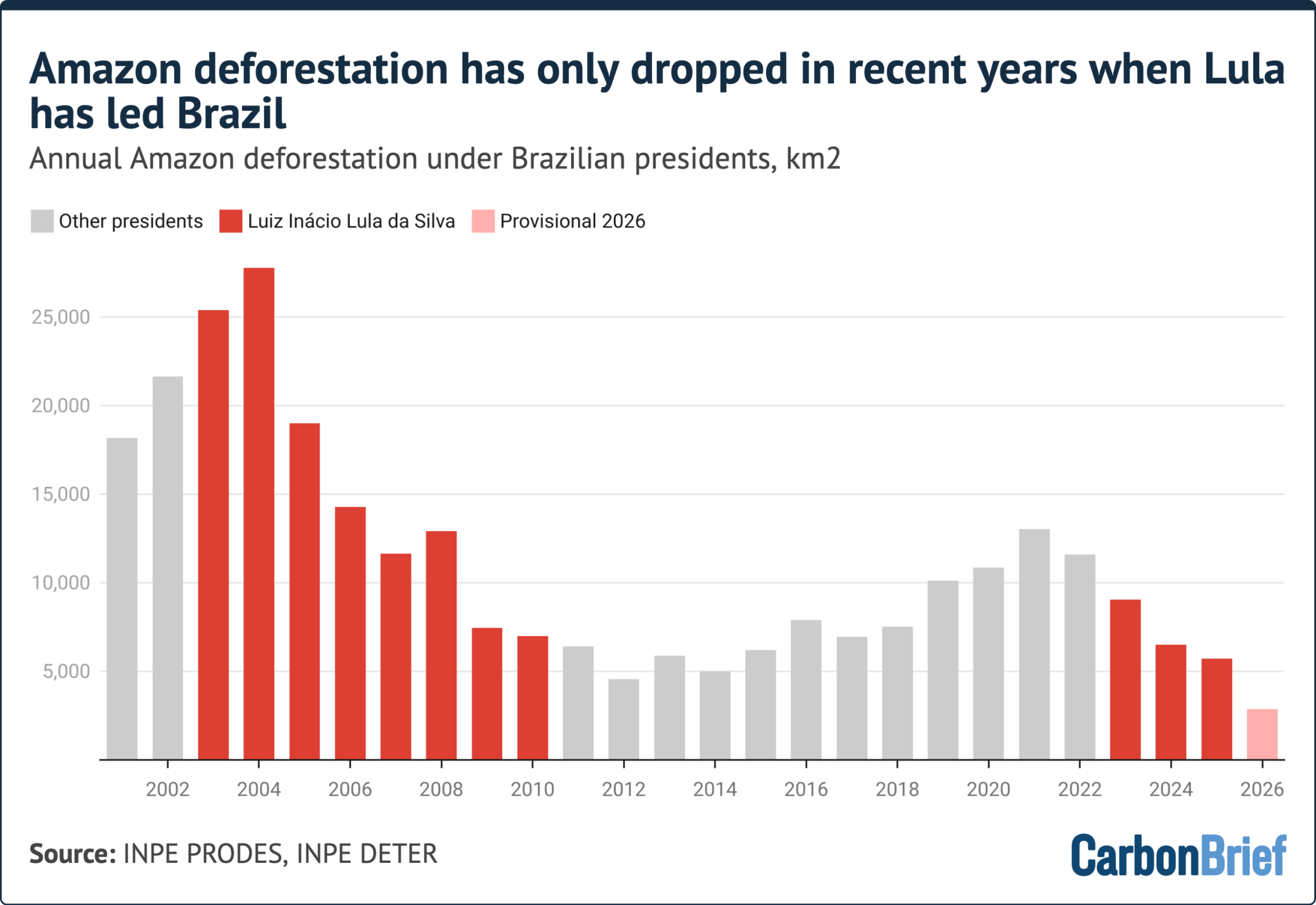
As the chart below shows, periods when Amazon deforestation fell in recent history all occurred during Lula’s three terms as president.
In contrast, experts say Flávio Bolsonaro, a climate sceptic who has indicated he will continue his father’s political agenda and favour agribusiness and mining, will likely drive a surge in deforestation. Angelo tells Carbon Brief:
“At the risk of sounding alarmist, I’ve been saying that Lula’s re-election is the only thing standing between us and a wide destruction of the Amazon.”
A Bolsonaro win would be a “tremendous disaster”, says Dr Patricia Pinho, deputy science director at the Amazon Environmental Research Institute, adding:
“I don’t think we can afford four years of increasing deforestation [and] violence against Indigenous peoples.”
Dr David Lapola, an ecologist focused on Amazon research at the University of Campinas in Brazil, says he believes deforestation “would certainly rise” and Brazil’s climate and deforestation goals “would be thrown in the trash bin”. He tells Carbon Brief:
“The Bolsonaro administration in the 2019-2022 period showed that the deconstruction of environmental policies and institutes can be done very, very quickly.
“In a matter of a few months, they can destroy what has been constructed over decades of environmental policy and activism in Brazil.”
‘Greenest’ policies
Lula has the “greenest” policy proposals of Brazil’s six top-polling presidential candidates, according to analysis by the Climate Observatory.
The analysis identifies 16 “positive and detailed” environmental commitments in Lula’s proposals, including reaffirming his “zero deforestation by 2030” goal.
Flávio Bolsonaro, on the other hand, has one positive environmental commitment and seven “clearly anti-environmental” proposals.
The right-wing politician has committed to zero “illegal” deforestation by 2029. However, he has also previously led an attempt to change the forest code, opening up large tracts of previously out-of-bounds forest for legal clearance by extractive industries.
Given this, Angelo tells Carbon Brief that he is sceptical about the 2029 pledge.
“The only way you can trust him on this is to think that he is going to revoke the forest code and make all illegal deforestation legal.”

Lula is also the only major candidate to list a clear target for cutting national emissions, sticking with Brazil’s existing goal to cut emissions by 59-67% by 2035, compared to 2005 levels.
Overall, the Climate Observatory notes that climate change and environmental issues “are off the radar for most candidates”, who are instead focusing on the economy and security issues.
Pinho adds that deforestation and the Amazon have not been at the “forefront” of this election, compared to 2022.
If Bolsonaro wins, up to 95% of the Amazon would fall under the leadership of right-wing national governments – including those in Bolivia, Colombia, Ecuador and Peru – reported Mongabay. It noted that presidents in all these nations “explicitly favour agribusiness and mining over environmental conservation”.
If no candidate receives a majority of votes in the first round of Brazil’s election on 4 October, a runoff will take place on 25 October, as has happened at every presidential election since 1998.
Soy moratorium and Brazilian congress
Other factors will also play a role in future deforestation in Brazil, regardless of the next president.
One is the effective end of the Amazon soy moratorium. This is a voluntary agreement signed by companies committing to not buy soya beans grown on land in the Brazilian Amazon that was deforested after 2008.
Conservation organisation WWF’s international director general, Kirsten Schuijt, previously described it as the “most impactful voluntary supply chain policy ever implemented”.
However, major grain traders withdrew from the agreement earlier this year, effectively bringing it to an end. Pinho describes this move as a “huge destruction” of Brazil’s environmental protections.
Research shows the moratorium prevented around 18,000km2 of deforestation in its first decade of operation from 2005-16.
In contrast, a 2026 study estimated that the end of the moratorium could result in 14,000km2 of additional deforestation in the Amazon by 2036.
Alongside choosing a new president on 4 October, Brazilian voters will elect state governors and members of congress, which will also factor into future environmental impacts.
Right-leaning parties, including the far-right Liberal Party linked to the Bolsonaros, currently hold half the seats of the two chambers of congress.
This has led to conflict between lawmakers and Lula. For example, in 2025, congress bypassed Lula’s veto of several aspects of a controversial piece of legislation dubbed the “devastation bill”.
Pinho says that the potential for a right-wing congress and president would be “devastating for the environmental and climate agenda”.
Lapola notes that a Flávio Bolsonaro presidency “would consolidate the view in Brazil that environmental protection is solely a matter of political preference, and not a crucial need of all people”. He adds:
“Land pillage, destruction of precious biodiversity and scorning of Indigenous peoples simply cannot be a nation’s project in the 21st century. We have got to be smarter than that, for sure.”
related
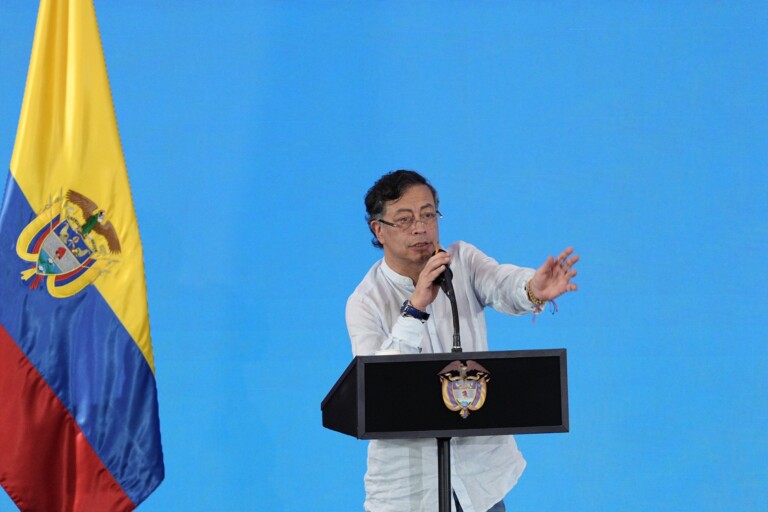
Q&A: What change of power in Colombia could mean for world’s fossil-fuel transition
Brazil’s biodiversity pledge: Six key takeaways for nature and climate change
COP30: Could Brazil’s ‘Tropical Forest Forever’ fund help tackle climate change?
Guest post: How Caribbean states are shaping climate legislation
The post Analysis: Lula presidency saved at least 20,000km2 of Brazilian Amazon since 2022 appeared first on Carbon Brief.
Analysis: Lula presidency saved at least 20,000km2 of Brazilian Amazon since 2022
This letter is a bit more direct and longer than most of those which I write, but I hope you will be okay with that, because the times seem to call for being plain.
A few weeks ago I got a text message from an old and dear friend —let’s call her Hannah.
I have enough shared life with Hannah that, whenever we talk, the conversation always feels current and effortless, despite gaps of months or even years.
Hannah has been talking with her son — we’ll call him Neil — who is a teenager and doing well in school, but wildly worried about the state of the world, including the imminent trajectory of global warming. Hannah and I don’t text each other other very often, but on this occasion she’s reached out with something visceral:
Neil has challenged me to point him to something hopeful, if I can find it. He says so far no one is showing any will to uphold the Paris Agreement. I am checking in to see how you still manage to have real hope.*
Then, just a few days later, the United Nations Environment Programme Limiting Overshoot report landed, containing the principal finding that it is likely the global temperature will soon exceed 1.5°C.
After that news, and the real time devastation in Nepal, and in the context of the broader state of the world, I found myself having multiple conversations with friends and colleagues about the structure of hope. I want to openly share that after a few of these exchanges, I metaphorically closed the blinds, and wondered how to feel, and what to do, because there is no avoiding the dreadfulness of the news, and what it means for the suffering of people and life on Earth.
But if you are fortunate enough to have time, space and security to do so, then after the darkness, you open the shutters and once again there is light. This is the structure of my innermost resolve.
* * *
Our lives — those of us living on our magnificent earth now — have the greatest possible purpose.
There is virtually no problem that we endlessly clever and creative, human beings cannot solve, when we work together.
And we are not just intelligent and ingenious; we are inherently social, nurturing and brave; capable of the deepest enduring love.
Each of the roughly 12,000 generations of humanity so far has made life possible for those who have followed, through acts of devotion.
Babies have been held and fed. Water and food have been found and shared. Shelter has been built. For 12,000 generations we have held the hands of our children.
Every single one of us was once carried in the arms of another, unable to walk ourselves. It is our thoughtfulness, kindness and care that have seen us through as a species. Sometimes this has been in the most exigent of circumstances, when enough of our ancestors did not give in, faced incredibly difficult things, to somehow make it through.
And so it comes to this. To what we now must do. We must do as 12,000 generations of people did for us.
The struggle to keep global warming to under 1.5 degrees may be over. The battle of return—to get our planet back to safe temperatures at emergency speed and scale — is just beginning. Upon this struggle depends the future of all we care about, and that of all life on Earth. The prospects of the next 12,000 generations are conditioned by our efforts now.
Our work now is to keep the overshoot as low as we can, make it as brief as possible, and do everything within our power to alleviate other pressures on nature. It is to take care of humanity — of one another — in the face of mounting climate and ecological damage. And by these efforts, create the conditions for future flourishing. Every fraction of every degree matters.
What must now be done is hard, much tougher than should have been necessary, because of the vested interests in coal, oil and gas and deforestation, and the failures of decision makers. And while renewable energy has surged, making the case for change much simpler, on the other side of the ledger there’s the reactionary and gangsterist turn of politics and the multiplier effects of wars and mass violence, with the existential destabilisation of big tech looming over all.
There is no sugarcoating the scale of difficulty. But what is necessary remains within our collective power. We must never, for one second, say that returning our planet to flourishing is impossible — many of the obvious solutions already exist; but even where transformation relies on reforms, technologies or capabilities that might sound fanciful, or historical changes that are unprecedented, this can be no barrier to our conviction. After all, much of what we take for granted today as ordinary features of social life, would have been considered impossible by every single generation before us.
The world has not been destroyed by nuclear war; we solved the growing hole in the ozone layer; Antarctica was kept sacrosanct from exploitation. Humanity has collectively triumphed before, and can do so again.
We can find the necessary social and political will to do what is needed because these are endlessly renewable resources. The necessary financial capital exists. Apart from the fossil fuel industry, the greatest barrier we face is to mistakenly concede that what lies before us is insurmountable. It is not.
We must avoid the siren song of fatalism. Because. It. Is. Never. Too. Late.
None of which is to be insensitive to the horrors already unleashed — the deadly and grotesque harm to people, places and species that cannot be undone; or to be blind to the impacts that are coming. But where we have the power to act, we also have the responsibility — and the extraordinary privilege — to do what must be done.
Although she is wounded, our planet is still alive and beautiful beyond all of our comprehension. Hundreds of billions of creatures live and thrive still upon this earth. Nothing has happened until it has happened, and life fights for life. Every beetle, every tree, all the fish in the ocean, the smallest of the geothermal shrimps, the greatest of the whales and the mightiest of the birds — all demand life every second of their existence, so that their species too may have future generations.
No individual has to know how to solve this alone. Indeed, finding some detachment and humility is essential to concentrate on the role that each of us can play.
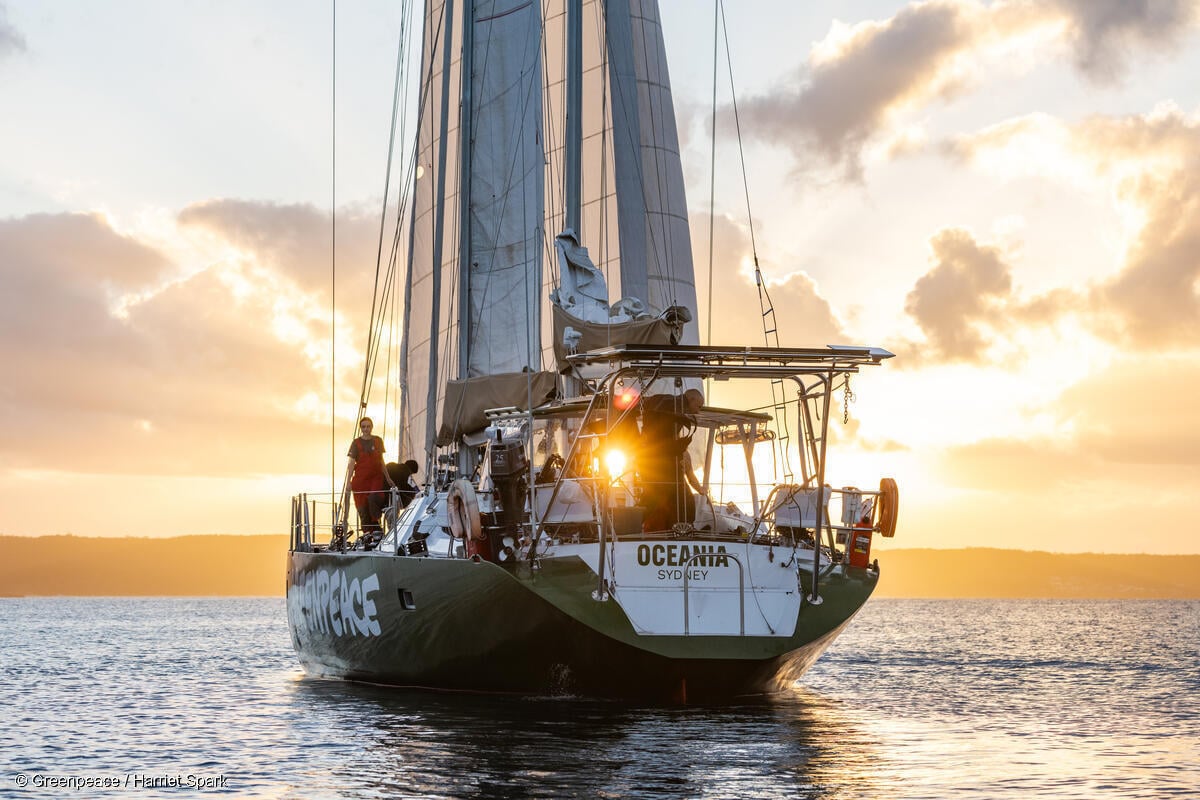
Hope is not merely a mindset or a story we tell ourselves. Collective power is not abstract; it is what we do, together, applying ourselves to the practical mechanics of change and contestation within society, by being part of the organisations and networks of people that are dedicated to effective strategies. It is why I am so committed to Greenpeace.
Working from without and within, there are opportunities to make rapid change within institutions, governments, businesses and communities to create the social, economic and political momentum for emissions reduction at speed and scale, reminding ourselves always of what remains possible, even if it hasn’t happened yet.
We can return the planet to safer temperatures. We can put technologies back in the service of people and life. We can return to the assumptions that seemed so obvious just one generation ago — that it is both possible, and our obligation, to build a better future for all people, and for life on Earth.
I did write back to Hannah and Neil, to say honestly to a treasured friend and her son, that yes, as a matter of faith, conviction, evidence and strategy, absolutely there is real hope. And this is a pledge not just to Neil and his generation, but to the next 12,000.
Together, we have the power. Together, we cross this bridge through the dark. To secure an Earth capable of nurturing life in all of its magnificent diversity.
We did not choose to carry this historic responsibility, but here we are. And it is so lucky that we are here.
I wouldn’t choose any other time to be here, alive on Earth, with you.




-
Climate Change1 year ago
Guest post: Why China is still building new coal – and when it might stop
-

 Greenhouse Gases2 years ago
嘉宾来稿:满足中国增长的用电需求 光伏加储能“比新建煤电更实惠”
-
Greenhouse Gases1 year ago
Guest post: Why China is still building new coal – and when it might stop
-

 Climate Change2 years ago
嘉宾来稿:满足中国增长的用电需求 光伏加储能“比新建煤电更实惠”
-

 Renewable Energy11 months ago
Sending Progressive Philanthropist George Soros to Prison?
-
Climate Change2 years ago
Bill Discounting Climate Change in Florida’s Energy Policy Awaits DeSantis’ Approval
-
Greenhouse Gases1 year ago
嘉宾来稿:探究火山喷发如何影响气候预测
-

 Climate Change2 years ago
Analysis: China’s CO2 falls 1% in Q2 2024 in first quarterly drop since Covid-19