


The European Commission (EC) has launched a nearly €2 billion hydrogen auction as part of its broader €4.6 billion initiative to accelerate net-zero technologies. This marks a significant step in the EU’s push for renewable hydrogen as part of region’s clean energy transition.
The auction, funded by the EU’s Emissions Trading System, aims to support the production of Renewable Fuel of Non-Biological Origin (RFNBO) hydrogen within the European Economic Area (EEA).
The funding allocation includes €1.2 billion from the Innovation Fund and an additional €700 million from Spain, Lithuania, and Austria. These resources focus on reducing greenhouse gas emissions in key industries such as steel, chemicals, and maritime transport.
€2 Billion on the Table: EC Powers Europe’s Hydrogen Future
The Renewable Hydrogen Auction plays a pivotal role in consolidating green hydrogen’s position as a cornerstone of Europe’s decarbonization efforts. Unlike traditional calls under the Innovation Fund, this auction does not mandate innovation requirements. Thus, it is accessible to a broader range of participants.
The funding has two distinct categories:
- General Production: A budget of €1 billion is allocated to RFNBO production projects without restrictions on the sectors or end-users.
- Maritime Sector: €200 million is specifically dedicated to advancing renewable hydrogen applications in maritime transport, such as vessel bunkering.
The EC particularly notes that:
“With a budget increased by €400 million compared to the first IF23 Auction, the new IF24 Auction will support projects for renewable hydrogen production regardless of the sector in which it will be consumed, with a dedicated budget of €1 billion; as well as hydrogen production in projects with off-takers in the maritime sector, with a dedicated budget of €200 million.”
This auction also introduces an innovative “Auctions-as-a-Service” mechanism. This means Member States can provide national funding for high-potential projects that were not selected for EU funding due to budget constraints. Such a streamlined approach reduces administrative burdens and ensures additional support for hydrogen projects across Europe.
The video explains what is the European Hydrogen Bank.
Eligibility and Selection Criteria
To ensure alignment with the EU’s climate goals, the auction enforces stringent technical, operational, and financial criteria. Projects must meet the following conditions:
- Geographic Location: Must be located within the EEA.
- Technical Specifications: Require a minimum electrolyzer capacity of 5 MW at a single location.
- Resilience Standards: Limit reliance on Chinese-manufactured electrolyzer stacks to 25%, promoting supply chain resilience within Europe.
- Timelines: Projects must achieve financial closure within 2.5 years and operational status by 2030.
The auction process involves several phases, starting with the publication of terms and conditions in September 2024. Participants must submit funding requests in the form of fixed premium bids, capped at €4 per kilogram of hydrogen produced.
Projects are evaluated based on the bid price and assessed for their readiness to meet technical, operational, and financial milestones.
Learning from Success: The First Hydrogen Auction
The second auction builds on the success of the European Commission’s first Renewable Hydrogen Auction, which concluded in February 2024. The pilot initiative garnered 132 proposals, with seven projects from Spain, Finland, Norway, and Portugal securing funding.
Projects from the first auction, which included participants from Spain, Norway, and Finland, achieved impressive cost reductions, producing hydrogen at €0.37 to €0.48 per kilogram.
- These projects will produce 1.58 million tonnes of renewable hydrogen over the next decade, equivalent to preventing the emission of 10 million tonnes of CO2.
Funding from the first auction bridged the gap between the higher production costs of renewable hydrogen and market prices dominated by non-renewable producers.
Hydrogen’s Role in the EU’s Climate and Net Zero Goals
The EU recognizes hydrogen as a crucial element in achieving its 2050 net-zero targets. In the Net Zero Scenario, Europe fully transitions to electrification and green hydrogen, eliminating fossil fuels by 2050.

Hydrogen is not only key to decarbonizing hard-to-abate sectors like heavy industry and transport but also serves as a strategic energy vector that complements renewable energy sources such as wind and solar.
A BloombergNEF analysis reveals that Europe’s green hydrogen economy demands extensive hydrogen-ready infrastructure, including transport, storage, and usage assets. Achieving this vision under the Net Zero Scenario needs 1.2-1.5 terawatts of new wind and solar capacity. This renewable energy expansion will power over 1 terawatt of electrolyzers by 2050, fueling the hydrogen transition.
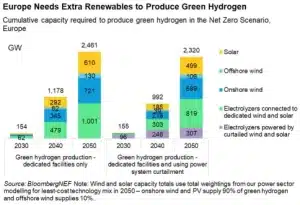
This is where the European Hydrogen Bank’s auctions come in. They are instrumental in addressing the economic barriers that hinder large-scale hydrogen adoption.
Speaking of which, just recently, ArcelorMittal announced delaying its green steel investment plans, which involve using green hydrogen to produce green steel. This is mainly due to a lack of clarity in the EU policy regarding hydrogen.
By bridging the gap between renewable hydrogen’s production costs and its market price, the EU aims to establish a competitive and sustainable hydrogen economy through this second hydrogen auction.
Driving Decarbonization Across Industries
The Renewable Hydrogen Auction reflects Europe’s commitment to decarbonizing high-emission sectors through green hydrogen innovation. The initiative targets industries such as steel production, chemical manufacturing, and maritime transport, aiming to accelerate the transition from fossil fuels to renewable alternatives.
By providing financial incentives, the auction encourages industry leaders to overcome economic barriers and adopt green hydrogen solutions. Additionally, it supports the EU’s broader objectives of energy independence and supply chain resilience, fostering regional innovation.
Key Deadlines and Next Steps
- Application Deadline: February 20, 2025.
- Evaluation Period: Following the submission deadline, projects will be ranked and assessed for maturity and feasibility.
- Grant Finalization: Successful applicants will enter into agreements within nine months of the call’s closure.
As the EU continues to lead the global race to decarbonize, renewable hydrogen remains at the forefront of its vision for a sustainable and net zero future.
The post EU Launches €2 Billion Second Renewable Hydrogen Auction to Fuel Net Zero appeared first on Carbon Credits.

EU carbon credit claims changed on 27 September 2026, the day the Directive (EU) 2024/825 began to apply across the European Union. The change is narrow. It changes how a company can talk about the credits it buys. A product can no longer be called neutral on the strength of compensation alone; however, every specific, evidenced statement about what a company measured, reduced, and funded stays fully available.

The post Promoting Improved Cooking Practices in Nigeria appeared first on Terrapass.


Ming Yang Eyes 33 MW Turbine, Greenvolt Delays FID
‘A strong start’: WA’s transition to renewable energy powerhouse aided by Premier’s announcement
WA EPA warned Woodside of ‘serious, significant and irreversible’ harms to Scott Reef from gas plans, new documents reveal
-
Climate Change1 year ago
Guest post: Why China is still building new coal – and when it might stop
-

 Greenhouse Gases2 years ago
嘉宾来稿:满足中国增长的用电需求 光伏加储能“比新建煤电更实惠”
-
Greenhouse Gases1 year ago
Guest post: Why China is still building new coal – and when it might stop
-

 Climate Change2 years ago
嘉宾来稿:满足中国增长的用电需求 光伏加储能“比新建煤电更实惠”
-

 Renewable Energy1 year ago
Sending Progressive Philanthropist George Soros to Prison?
-
Climate Change2 years ago
Bill Discounting Climate Change in Florida’s Energy Policy Awaits DeSantis’ Approval
-
Greenhouse Gases1 year ago
嘉宾来稿:探究火山喷发如何影响气候预测
-

 Climate Change2 years ago
Analysis: China’s CO2 falls 1% in Q2 2024 in first quarterly drop since Covid-19