

Welcome to Carbon Brief’s DeBriefed.
An essential guide to the week’s key developments relating to climate change.
This week
Secrets and layoffs
UNLAWFUL PANEL: A federal judge ruled that the US energy department “violated the law when secretary Chris Wright handpicked five researchers who rejected the scientific consensus on climate change to work in secret on a sweeping government report on global warming”, reported the New York Times. The newspaper explained that a 1972 law “does not allow agencies to recruit or rely on secret groups for the purposes of policymaking”. A Carbon Brief factcheck found more than 100 false or misleading claims in the report.
DARKNESS DESCENDS: The Washington Post reportedly sent layoff notices to “at least 14” of its climate journalists, as part of a wider move from the newspaper’s billionaire owner, Jeff Bezos, to eliminate 300 jobs at the publication, claimed Climate Colored Goggles. After the layoffs, the newspaper will have five journalists left on its award-winning climate desk, according to the substack run by a former climate reporter at the Los Angeles Times. It comes after CBS News laid off most of its climate team in October, it added.
WIND UNBLOCKED: Elsewhere, a separate federal ruling said that a wind project off the coast of New York state can continue, which now means that “all five offshore wind projects halted by the Trump administration in December can resume construction”, said Reuters. Bloomberg added that “Ørsted said it has spent $7bn on the development, which is 45% complete”.
Around the world
- CHANGING TIDES: The EU is “mulling a new strategy” in climate diplomacy after struggling to gather support for “faster, more ambitious action to cut planet-heating emissions” at last year’s UN climate summit COP30, reported Reuters.
- FINANCE ‘CUT’: The UK government is planning to cut climate finance by more than a fifth, from £11.6bn over the past five years to £9bn in the next five, according to the Guardian.
- BIG PLANS: India’s 2026 budget included a new $2.2bn funding push for carbon capture technologies, reported Carbon Brief. The budget also outlined support for renewables and the mining and processing of critical minerals.
- MOROCCO FLOODS: More than 140,000 people have been evacuated in Morocco as “heavy rainfall and water releases from overfilled dams led to flooding”, reported the Associated Press.
- CASHFLOW: “Flawed” economic models used by governments and financial bodies “ignor[e] shocks from extreme weather and climate tipping points”, posing the risk of a “global financial crash”, according to a Carbon Tracker report covered by the Guardian.
- HEATING UP: The International Olympic Committee is discussing options to hold future winter games earlier in the year “because of the effects of warmer temperatures”, said the Associated Press.
54%
The increase in new solar capacity installed in Africa over 2024-25 – the continent’s fastest growth on record, according to a Global Solar Council report covered by Bloomberg.
Latest climate research
- Arctic warming significantly postpones the retreat of the Afro-Asian summer monsoon, worsening autumn rainfall | Environmental Research Letters
- “Positive” images of heatwaves reduce the impact of messages about extreme heat, according to a survey of 4,000 US adults | Environmental Communication
- Greenland’s “peripheral” glaciers are projected to lose nearly one-fifth of their total area and almost one-third of their total volume by 2100 under a low-emissions scenario | The Cryosphere
(For more, see Carbon Brief’s in-depth daily summaries of the top climate news stories on Monday, Tuesday, Wednesday, Thursday and Friday.)
Captured
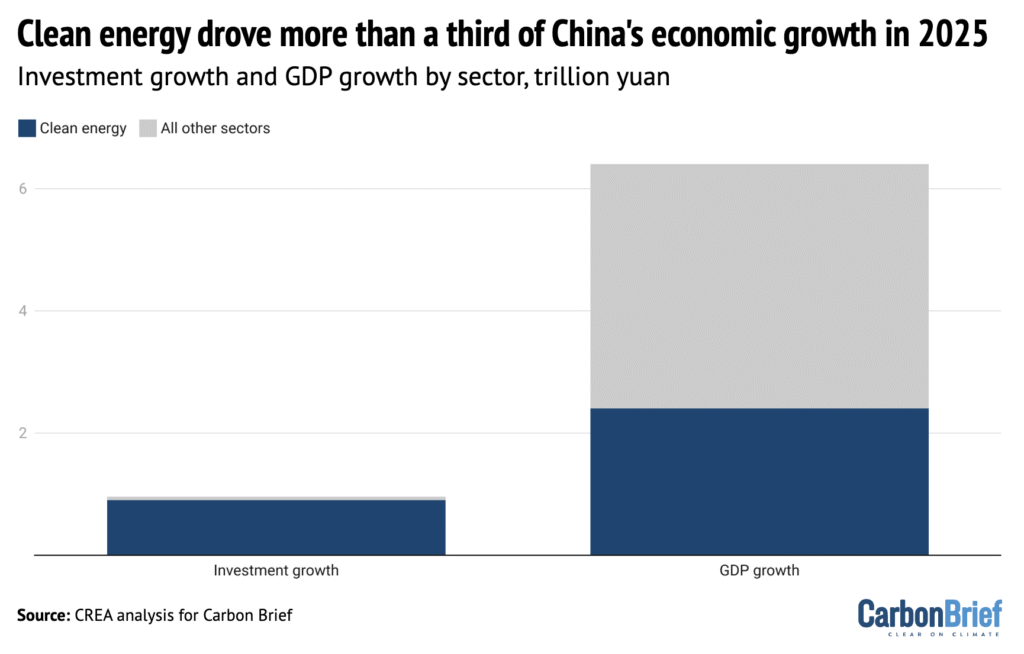
Solar power, electric vehicles and other clean-energy technologies drove more than a third of the growth in China’s economy in 2025 – and more than 90% of the rise in investment, according to new analysis for Carbon Brief (shown in blue above). Clean-energy sectors contributed a record 15.4tn yuan ($2.1tn) in 2025, some 11.4% of China’s gross domestic product (GDP) – comparable to the economies of Brazil or Canada, the analysis said.
Spotlight
Can humans reverse nature decline?
This week, Carbon Brief travelled to a UN event in Manchester, UK to speak to biodiversity scientists about the chances of reversing nature loss.
Officials from more than 150 countries arrived in Manchester this week to approve a new UN report on how nature underpins economic prosperity.
The meeting comes just four years before nations are due to meet a global target to halt and reverse biodiversity loss, agreed in 2022 under the landmark “Kunming-Montreal Global Biodiversity Framework” (GBF).
At the sidelines of the meeting, Carbon Brief spoke to a range of scientists about humanity’s chances of meeting the 2030 goal. Their answers have been edited for length and clarity.
Dr David Obura, ecologist and chair of Intergovernmental Science-Policy Platform on Biodiversity and Ecosystem Services (IPBES)
We can’t halt and reverse the decline of every ecosystem. But we can try to “bend the curve” or halt and reverse the drivers of decline. That’s the economic drivers, the indirect drivers and the values shifts we need to have. What the GBF aspires to do, in terms of halting and reversing biodiversity loss, we can put in place the enabling drivers for that by 2030, but we won’t be able to do it fast enough at this point to halt [the loss] of all ecosystems.
Dr Luthando Dziba, executive secretary of IPBES
Countries are due to report on progress by the end of February this year on their national strategies to the Convention on Biological Diversity [CBD]. Once we get that, coupled with a process that is ongoing within the CBD, which is called the global stocktake, I think that’s going to give insights on progress as to whether this is possible to achieve by 2030…Are we on the right trajectory? I think we are and hopefully we will continue to move towards the final destination of having halted biodiversity loss, but also of living in harmony with nature.
Prof Laura Pereira, scientist at the Global Change Institute at Wits University, South Africa
At the global level, I think it’s very unlikely that we’re going to achieve the overall goal of halting biodiversity loss by 2030. That being said, I think we will make substantial inroads towards achieving our longer term targets. There is a lot of hope, but we’ve also got to be very aware that we have not necessarily seen the transformative changes that are going to be needed to really reverse the impacts on biodiversity.
Dr David Cooper, chair of the UK’s Joint Nature Conservation Committee and former executive secretary of the Convention on Biological Diversity
It’s important to look at the GBF as a whole…I think it is possible to achieve those targets, or at least most of them, and to make substantial progress towards them. It is possible, still, to take action to put nature on a path to recovery. We’ll have to increasingly look at the drivers.
Prof Andrew Gonzalez, McGill University professor and co-chair of an IPBES biodiversity monitoring assessment
I think for many of the 23 targets across the GBF, it’s going to be challenging to hit those by 2030. I think we’re looking at a process that’s starting now in earnest as countries [implement steps and measure progress]…You have to align efforts for conserving nature, the economics of protecting nature [and] the social dimensions of that, and who benefits, whose rights are preserved and protected.
Neville Ash, director of the UN Environment Programme World Conservation Monitoring Centre
The ambitions in the 2030 targets are very high, so it’s going to be a stretch for many governments to make the actions necessary to achieve those targets, but even if we make all the actions in the next four years, it doesn’t mean we halt and reverse biodiversity loss by 2030. It means we put the action in place to enable that to happen in the future…The important thing at this stage is the urgent action to address the loss of biodiversity, with the result of that finding its way through by the ambition of 2050 of living in harmony with nature.
Prof Pam McElwee, Rutgers University professor and co-chair of an IPBES “nexus assessment” report
If you look at all of the available evidence, it’s pretty clear that we’re going to keep experiencing biodiversity decline. I mean, it’s fairly similar to the 1.5C climate target. We are not going to meet that either. But that doesn’t mean that you slow down the ambition…even though you recognise that we probably won’t meet that specific timebound target, that’s all the more reason to continue to do what we’re doing and, in fact, accelerate action.
Watch, read, listen
OIL IMPACTS: Gas flaring has risen in the Niger Delta since oil and gas major Shell sold its assets in the Nigerian “oil hub”, a Climate Home News investigation found.
LOW SNOW: The Washington Post explored how “climate change is making the Winter Olympics harder to host”.
CULTURE WARS: A Media Confidential podcast examined when climate coverage in the UK became “part of the culture wars”.
Coming up
- 2-8 February: 12th session of the Intergovernmental Science-Policy Platform on Biodiversity and Ecosystem Services (IPBES), Manchester, UK
- 8 February: Japanese general election
- 8 February: Portugal presidential election
- 11 February: Barbados general election
- 11-12 February: UN climate chief Simon Stiell due to speak in Istanbul, Turkey
Pick of the jobs
- UK Met Office, senior climate science communicator | Salary: £43,081-£46,728. Location: Exeter, UK
- Canadian Red Cross, programme officer, Indigenous operations – disaster risk reduction and climate change adaptation | Salary: $56,520-$60,053. Location: Manitoba, Canada
- Aldersgate Group, policy officer | Salary: £33,949-£39,253. Location: London (hybrid)
DeBriefed is edited by Daisy Dunne. Please send any tips or feedback to debriefed@carbonbrief.org.
This is an online version of Carbon Brief’s weekly DeBriefed email newsletter. Subscribe for free here.


The post DeBriefed 6 February 2026: US secret climate panel ‘unlawful’ | China’s clean energy boon | Can humans reverse nature loss? appeared first on Carbon Brief.

Climate Change
Greenpeace delivers 47 metre-long petition with half a million signatures to Woodside HQ following major gas protest
Greenpeace delivers 47 metre-long petition with half a million signatures to Woodside HQ following major gas protest
PERTH, Monday 19 October 2026 — Dozens of Perth community members delivered a giant petition, signed by almost half a million people, to Woodside’s corporate headquarters this morning, calling on the government to save Scott Reef from Woodside’s reckless Browse gas proposal.
Dressed in sea creature costumes and hats, supporters carried one of Australia’s biggest environmental petitions to Woodside’s headquarters, and a local choir performed a ‘Scott Reef’ rendition of Angie McMahon’s iconic cover of ‘Reckless’ by Australian Crawl.
On the sidelines of the Perth Global Citizen Now event, it comes following a two day-long protest at Woodside’s Scarborough gas platform that saw activists scale and occupy the Floating Production Unit calling to “Stop Woodside’s Dirty Gas” and “Save Scott Reef”. The activists were taken from the platform by police helicopter on Sunday afternoon.
David Ritter, CEO at Greenpeace Australia Pacific, said: “Less than a day after two Greenpeace Australia Pacific activists were arrested for their peaceful protest at Woodside’s Scarborough gas platform to save Scott Reef, we are here again with another message to Woodside: half a million of us do not want your dirty gas at Scott Reef.
“Community pressure on Woodside is rising. Today we are here to show Woodside that they can’t ignore half a million people who want Scott Reef protected, not turned into an industrialised gas zone.
“Woodside can’t be trusted with our oceans. Woodside’s plans to drill up to 57 toxic wells at Scott Reef, Australia’s largest oceanic reef, putting endangered pygmy blue whales at risk, and jeopardising a nesting ground for unique green sea turtles.
“We Australians love our oceans and this is an opportunity for our governments to do the right thing, to reject Woodside’s reckless drilling plans, and save Scott Reef.”
-ENDS-
Media contact
Kate O’Callaghan on +61 406 231 892 or Emma Sangalli on +61 431 513 465
Climate Change
Greenpeace Australia Pacific activists in police custody after two-day protest against Woodside’s Browse gas project at Scott Reef
PERTH, Sunday 18 October 2026 — Two Greenpeace Australia Pacific activists are in police custody after occupying a gas platform at Woodside’s Scarborough gas project, in peaceful protest of the fossil fuel corporation’s plans to drill for oil and gas at Scott Reef.
NEW footage and photos of the peaceful protest available here and on Instagram
The activists used specialised climbing equipment to scale and attach themselves to a Floating Production Unit (FPU), a key piece of gas processing infrastructure at the Scarborough gas field over 200km off the coast of Exmouth, at around 05:45am AWST on Saturday and proceeded to occupy the platform for two days, displaying banners reading “Stop Woodside’s Dirty Gas. Save Scott Reef.”
Special police forces landed a helicopter on the FPU at around 11:30am AWST. The activists safely removed themselves from their equipment before being taken into police custody around 1:00pm AWST. At the time of writing, no charges have been laid.
David Ritter, CEO at Greenpeace Australia Pacific, said: “It takes guts and conviction to do what our activists have done, peacefully protesting Woodside’s reckless gas plans at Scott Reef.
“Woodside’s plans to drill up to 57 toxic wells at Scott Reef are outrageous. If allowed to go ahead Woodside would turn Scott Reef, Australia’s largest oceanic reef, home to nesting green sea turtles and elusive pygmy blue whales, into an industrial gas zone. Around half a million people have called on our governments to stop Woodside and to save Scott Reef.
“Our activists are highly trained and experienced in these activities. West Australia has a proud history of peaceful, democratic protest at sea, to protect our oceans from environmental threats. From whaling in Albany in the seventies, to Woodside’s threat to Scott Reef today, there’s more than fifty years of history, of Greenpeace taking action off WA’s coast to protect the places we love.
“Peaceful protest has long been part of what has given us so many of the things that are great about Australia and is part of the fabric of our democracy and our national identity.”
“The right to peaceful protest is fundamental to a healthy democracy. From Australia to the Arctic and the Amazon, Greenpeace has been peacefully protesting for more than 50 years to expose the biggest environmental threats around the world. We will not be silenced by corporations like Woodside who actively try to stop everyday people from speaking out against their reckless plans.
“Woodside’s reckless proposal to drill at Scott Reef is an unacceptable risk to Scott Reef and to the climate, which our government should emphatically reject.”
Speaking from the Rainbow Warrior, Captain of the Rainbow Warrior Hettie Geenen, said:
“It felt powerful watching from the Rainbow Warrior as these brave activists scaled Woodside’s enormous and imposing gas infrastructure, which has no place at Scott Reef. We are all out here because we feel an urge to act, in the face of Woodside’s grave threat to Scott Reef and to our climate. Now we ask for the Australian government to act too, and reject Woodside’s reckless Browse project.
“Just before this peaceful protest, the Rainbow Warrior sailed to Scott Reef, where our whole crew got to witness the magic of an untouched, healthy reef ecosystem full of marine life. It was my second time visiting Scott Reef with the Rainbow Warrior. When you see Scott Reef up close and witness its magic first hand, it is impossible not to feel driven to try and protect it.”
The activists sailed to Scarborough on the Rainbow Warrior, Greenpeace’s flagship vessel, which is in the region campaigning to protect Australia’s oceans, including Scott Reef.
-ENDS-
Media contact
Greenpeace Australia Pacific media team in Perth on +61 406 231 892 or +61 407 581 404 or email media.au@greenpeace.org
Climate Change
GREENPEACE GAS PROTEST DAY TWO: Activists spend first night on Woodside’s Scarborough gas platform, “in this for the long haul”
- NEW footage and photos available here and on Instagram – more being uploaded today.
- Interviews available with campaigners on board the Rainbow Warrior on request.
Greenpeace Australia Pacific activists have slept overnight on Woodside’s Floating Production Unit and dropped a massive 12×14-metre banner reading “Stop Woodside’s Dirty Gas. Save Scott Reef”.
Two activists have set up temporary hanging tents on the South East pillar, while the other two returned to the Rainbow Warrior late yesterday afternoon, after fulfilling their initial role. The activists will occupy the platform for as long as possible.
The environmental advocacy group is peacefully protesting Woodside’s plans to drill for oil and gas at Scott Reef as part of its Browse proposal.
Sakyo Noda, one of the Greenpeace Australia Pacific activists, said: “As a Japanese person living in Australia, I feel incredibly passionate about stopping Australia’s gas exports to Asia.
“Despite what the gas industry tells us, Australia’s gas is not helping to decarbonise Asia. It is simply not true. We shouldn’t be allowing fossil fuel companies like Woodside to extract new fossil fuels, let alone at extraordinary places like Scott Reef”.
Aboard the Rainbow Warrior, Geoff Bice, WA Campaign Lead at Greenpeace Australia Pacific, added, “Everyone is in good spirits. We’re in it for the long haul.”
Links:
Photos and video of Scott Reef here
Audio and footage of yesterday’s press conference here
Content and live updates will be uploaded to a live blog and Instagram
In-person interviews in Perth with David Ritter, CEO of Greenpeace Australia Pacific, can be organised. Dial-in, SimSat and Zoom interviews with Geoff Bice, WA Campaign Lead at Greenpeace Australia Pacific, currently aboard the Rainbow Warrior, can be organised.

Greenpeace delivers 47 metre-long petition with half a million signatures to Woodside HQ following major gas protest
