Connect with us

Published

on

Welcome to Carbon Brief’s DeBriefed.
An essential guide to the week’s key developments relating to climate change.

This week

UK considers cuts

EMISSIONS ADVICE: New recommendations from the UK’s climate advisers, the Climate Change Committee, said the nation should reduce its emissions to 87% below 1990 levels by 2040. This would keep the country on track for reaching net-zero by 2050 and take £1,400 off household bills by the same year, according to the advice. Read Carbon Brief’s in-depth summary of the findings, which show that the estimated cost of reaching net-zero is now 73% lower than thought just five years earlier.

‘Y BOTHER’: Despite not being a major focus of the new analysis, much of the UK media coverage zoned in on how achieving the emissions cut might affect people’s lives. The Guardian reported that the average person might need to skip “two kebabs’ worth of meat a week”, while a frontpage Daily Telegraph story raged at the idea that frequent fliers may need to pay a higher rate of tax, which was not a recommendation. It comes shortly after a satirical Private Eye piece by correspondent Y Bother reported that “getting net-zero done might be a massive faff”, asking: “Shall we just not do it?”

UK AID CUT: Elsewhere, prime minister Keir Starmer announced plans to cut the UK aid budget from 0.5% to 0.3% of national income and spend more on defence, the Guardian reported, just as officials entered international finance negotiations in Rome (more on this below). The newspaper said it understood the UK’s £11.6bn climate finance would be “ringfenced” from cuts, but Climate Home News reported that climate groups were “dismayed” by the move.

Around the world

  • BIG VOTE: The centre-right Christian Democrats party won Germany’s federal election, with far-right Alternative for Germany in second place, Al Jazeera reported. Clean Energy Wire said the future government would still be committed to climate neutrality by 2045 but is likely to have a “reduced focus on climate policies”. 
  • REGULATORY REVERSAL: The US Environmental Protection Agency is aiming to reverse the “endangerment finding”, a key legal ruling that required the agency to regulate CO2 and other greenhouse gas emissions, according to the Washington Post
  • SETBACK: Energy company BP announced it will slash investment in renewables, while boosting oil and gas spending by 20%, the Associated Press reported. 
  • UKRAINE-US PACT: Ukraine made an agreement with the US to jointly explore its mineral resources – including oil and gas, according to a frontpage story in the Financial Times.

45%

The proportion by which Tesla’s electric vehicle sales have fallen in Europe since Elon Musk’s “political meddling”, reported Bloomberg.


Latest climate research

  • A new Nature study suggested that the Atlantic Meridional Overturning Circulation (AMOC) – a system of ocean currents that moves water, heat and nutrients around the Atlantic Ocean and the globe –  is unlikely to collapse this century. The research has promoted discussion around what AMOC “collapse” means.
  • Climate change could lead to the creation of new carbon sinks in some ice-free areas of Antarctica, according to a study in Communications Earth and Environment.
  • Peatland fires in the UK released 800,000 tonnes of carbon from 2000-21, a study in Environmental Research Letters found, accounting for 90% of the country’s total fire emissions.

(For more, see Carbon Brief’s in-depth daily summaries of the top climate news stories on Monday, Tuesday, Wednesday, Thursday and Friday.)

Captured
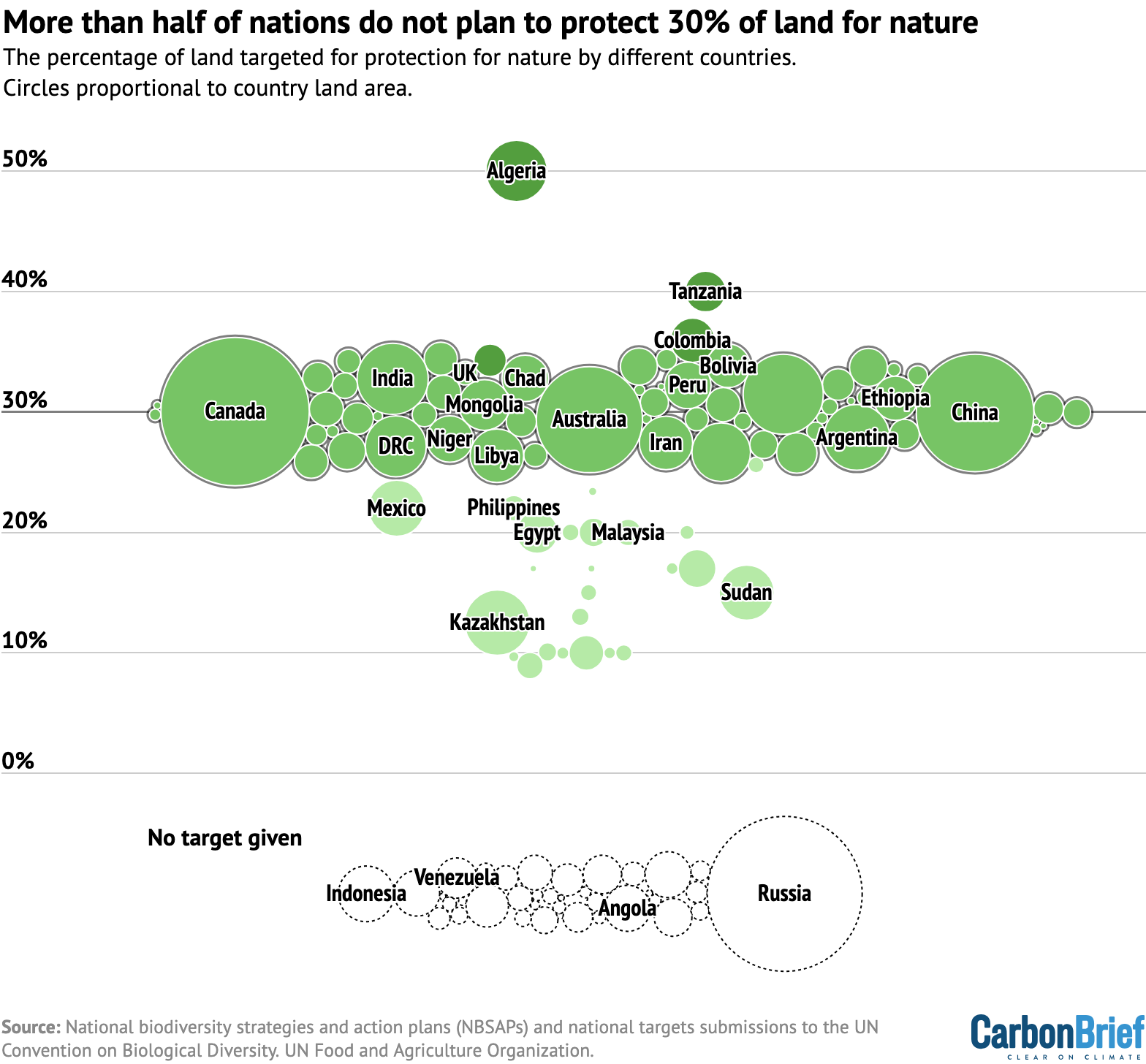
The various pledges made by countries when it comes to protecting a proportion of their land for nature

In December 2022, nearly all countries agreed to a flagship global target to protect 30% of Earth by the end of the decade. But a new investigation of hundreds of country plans submitted to the UN by Carbon Brief and the Guardian found that more than half of nations are not willing to commit to protecting 30% of their own land and seas. It comes as nations met in Rome this week to try to find agreement on outstanding biodiversity issues (more on this below). The chart above shows the various pledges made by countries when it comes to protecting a proportion of their land for nature, illustrating how less than half have committed to the key 30% figure.

Spotlight

COP16 talks reach finance deal

This week, Carbon Brief reports from COP16 nature talks in Rome, where countries landed a landmark finance deal in the early hours of Friday morning.

Last year saw a run of fraught and fractious environmental talks play out around the world.

Talks on reversing biodiversity loss, plastic pollution and desertification all ended in failure, while a UN climate summit in Azerbaijan produced a finance deal that was bitterly disappointing for many developing countries.

However, in the early hours of Friday morning at the Food and Agricultural Organization (FAO) headquarters in Rome, countries delivered what they described as a signal of hope for multilateralism in uncertain times.

Against a backdrop of foreign aid freezes and cutbacks in the US and Europe, nations agreed to a “permanent arrangement” to pay to help developing countries conserve biodiversity and a strategy to “mobilise” at least $200bn per year by 2030.

Striking a deal

The decision came after finance dominated discussions during the three-day resumed session of COP16 in Rome. Countries agreed to meet again in the Italian capital after failing to reach consensus at COP16 in Colombia in October 2024.

Different versions of the financing texts were negotiated throughout the week. Most countries agreed on the need to find a solution, but key disagreements still fractured the path to a deal until the summit’s final plenary.

In the end, two proposals – one from the COP16 presidency and another from Brazil on behalf of the BRICs – were merged to enable countries to find consensus on finance.

A UK official told Carbon Brief that Brazil’s leading role in the negotiations is a “very positive sign” of its commitment to working with countries ahead of hosting the COP30 climate summit in November.

Biodiversity in the balance

Colombian politician and COP16 president Susana Muhamad received a lengthy standing ovation for her role in guiding parties to consensus in the early hours of Friday morning in Rome.

But, amid celebrations, some speakers noted that nations are still far off track for meeting the targets of the Kunming-Montreal Global Biodiversity Framework (GBF). The GBF is a landmark deal, first made in 2022, aiming to halt and reverse biodiversity loss by 2030.

Some three-quarters of nations have still not submitted their UN biodiversity plans for how they will achieve the targets of the GBF – four months after the deadline.

And a recent investigation by Carbon Brief and the Guardian revealed that more than half of nations that have submitted UN biodiversity plans do not commit to the GBF’s flagship target of protecting 30% of land and seas for nature by 2030.

Carbon Brief’s in-depth summary of all of the key outcomes from the COP16 talks in Rome has just been published.

Watch, read, listen

CLIMATE DATA: A short video report by ABC News explained how the US National Oceanic and Atmospheric Administration uses automated techniques to record climate data.

‘FIRE AND FURY’: An editorial in Nature urged the global science community to resist Donald Trump’s “assault on science and international institutions”.

UNLOCK LOVELOCK: A BBC Sounds podcast told the life of James Lovelock, the co-author of the Gaia scientific theory and a former advisor to Shell who in 1966 warned the company about the risks of fossil fuels.

Coming up

Pick of the jobs

DeBriefed is edited by Daisy Dunne. Please send any tips or feedback to debriefed@carbonbrief.org.

This is an online version of Carbon Brief’s weekly DeBriefed email newsletter. Subscribe for free here.

The post DeBriefed 28 February 2025: COP16 lands finance deal; More than half of nations skip key nature pledge; UK eyes cost-saving emissions plan appeared first on Carbon Brief.

DeBriefed 28 February 2025: COP16 lands finance deal; More than half of nations skip key nature pledge; UK eyes cost-saving emissions plan

Continue Reading

Climate Change

The Stakes for the ISA and Deep Sea Mining for 2026 and Beyond

Published

on

An unprecedented territory grab for extraction

Deep sea mining is a speculative industry. Everywhere it has tried to launch, it has failed. From Norway to New Zealand, efforts to exploit the seabed have crashed into a wall of opposition: legal challenges, parliamentary blocks, and fierce resistance from local communities, scientists, the fishing industry, and environmental groups. The world is not waiting for deep sea mining; it is actively mobilising against it.

From left: Solomon “Uncle Sol” Kaho`ohalahala, Kanaka Maoli cultural practitioner and Indigenous Knowledge Keeper,
Kanaka Maoli mural artist, Kaiʻili Kaulukukui
Brittany Lehua Kamai, Kanaka Maoli Ph.D., Astrophysicist, apprentice navigator, and ocean advocate (Mana Moana Institute) 
Edwin “Ekolu” Lindsey III, Director & Co-Founder, Maui Nui Makai Network


Kanaka Maoli artist Kaiʻili Kaulukukui, Native Hawaiian leaders, and cultural practitioners dedicate a 6,500-square-foot mural in Kapālama Kai on Oʻahu inspired by the Kumulipo, the Hawaiian genealogical creation chant. The artwork reflects Native Hawaiian relationships with the ocean and comes as Indigenous leaders across the Pacific call for greater representation in decisions about ocean protection and deep sea mining.
© Marco Garcia / Greenpeace

As scientists increasingly warn of potentially irreversible ecological destruction to the planet’s last pristine wilderness, independent financial audits have exposed the industry’s underlying economic model as it underestimates its own financial and legal risks. A powerful coalition of over 43 governments, Indigenous activists, hundreds of scientists, and corporate giants, from the fishing industry to major automakers, has formed a global line of defence to keep the deep ocean off-limits to mining.

Greenpeace International activists protest against deep sea mining company Global Sea Mineral Resources (GSR), a subsidiary of the Belgian company DEME, in the Pacific Ocean. 
The activists deploy a flying banner reading “Stop Deep Sea Mining!” from an inflatable boat.  The banner  is displayed in front of the ship Normand Energy, chartered by GSR, while the Patania II nodule collector is deployed. The company is currently testing mining gear roughly 1,000 nautical miles off Mexico’s west coast in the Clarion Clipperton Zone – with the aim of future commercial extraction of minerals from the seabed. This new industry could cause devastating effects on the environment and people, including the livelihoods of Pacific island and coastal communities. 

The Rainbow Warrior is in the Pacific to bear witness to the  deep sea mining industry. Part of the ongoing 'Protect the Oceans' campaign.
© Marten van Dijl / Greenpeace

Major global banks such as BNP Paribas, Deutsche Bank and the Asian Development Bank have refused to finance these projects. Faced with international deadlock and financial stress, key players in an increasingly desperate industry have abandoned multilateral diplomacy. Instead, they have pivoted to a dangerous geopolitical gamble: teaming up with the Trump administration to unilaterally claim the global commons in blatant defiance of international law.

Ahead of the upcoming meeting of the International Seabed Authority (ISA), Greenpeace Mexico issued a strong call to participating nations, including Mexico, not to yield to unilateral pressure and not to allow the United States (U.S.) government, led by Donald Trump, to authorize undersea mining in the Clarion-Clipperton Zone (CCZ), violating international agreements and jeopardizing the region’s marine biodiversity.                 
From Santiago Beach in Manzanillo, Colima, the organization unfurled a massive underwater image on the  sea depicting the face of Donald Trump, representing the main “sea monster” that stalks the oceans,  “thirsty” to extract minerals from the seabed for economic gain, despite the existing global restrictions and the irreversible, long-term environmental costs  that such mining would entail.
© Greenpeace

A unilateral power grab

Deep sea mining isn’t just an environmental disaster, it is a unilateral power grab disguised as a resource war, and a modern iteration of colonial history in the Pacific. For centuries, Western empires exploited Pacific nations; today, Global North corporations are attempting a new wave of “blue colonisation.” By treating the Pacific Ocean as an empty warehouse of commodities, tech ventures are undermining the sovereign rights, cultural heritage, and birthright guardianship of Indigenous Pacific peoples who have protected and been sustained by these waters for generations.

Victor Pickering, a Greenpeace International activist from Fiji  displays a banner reading “Our Pacific Is Not Yours To Destroy” in front of the Maersk Launcher, a ship chartered by DeepGreen, one of the companies spearheading the drive to mine the barely understood deep sea ecosystem.

The Rainbow Warrior is in the Clarion Clipperton Zone in the Pacific to bear witness to the deep sea mining industry. Part of the ongoing 'Protect the Oceans' campaign.
© Marten van Dijl / Greenpeace

Time and time again we’ve been reminded that decisions are already being made about us, without us. It’s a never-ending pattern of colonial oppression and extraction… The people of Guam [are] not asking or slow progress. They are asking not to be sacrificed.

Sheila Babauta (Northern Marianas) / Delegate James Moylan (Guam)

But the rush by global superpowers and corporations to seize deep sea minerals has become a critical catalyst for unity across the Pacific. While a few states (such as Nauru, Cook Islands, and Tonga) sponsor exploration contracts, a powerful regional front is forming to resist what local leaders and Indigenous advocates describe as a new wave of resource exploitation.

Key Priorities for the July 2026 ISA Session

The July International Seabed Authority (ISA) Council session represented a critical crossroads for the protection of our global commons. This gathering offered a pivotal opportunity for responsible governments to wrestle control of the timeline away from commercial actors, reject corporate bullying, and prioritise precaution for the common good. Fast- tracking the Mining Code is not a neutral administrative step; it is a monumental, irreversible trigger that opens the floodgates to commercial exploitation. The only way to finalise these regulations this year would be for governments to abandon their legal obligations to protect the marine environment and deny safeguarding global equity. Rushing this process would permanently erode multilateral norms and inadvertently validate lax, unilateral mining pathways.

Governments have the opportunity and tools to diffuse this threat and demonstrate global cooperation for the common good at the International Seabed Authority.

  • Governments have the tools to create major barriers to unlawful mining efforts and defend this global commons. The legal obligations of 170+ governments to constrain any companies or nationals from participating in unlawful deep sea mining are clear. This provides the opportunity to shut off access to personnel, offshore engineering, ports, financing, processing, refining, and markets for unlawful mining. A recent legal opinion concludes that Allseas’ May 2026 contract to operate deep sea mining machinery for The Metals Company under unilateral U.S. authorisation triggered the obligation under international and Dutch law for the Dutch government to intervene against this corporate violation.123 Failing to do so would constitute a breach of its binding obligations under UNCLOS.
  • Unless the ITLOS Seabed Disputes Chamber decides to order a suspension of the ISA’s inquiry into any contractors involved in unilateral mining, the ISA’s advisory commission and governments should conclude the ISA inquiry into whether any contractors are supporting unilateral efforts, and support punitive consequences for any companies breaching their obligations. It would be untenable for contractors to retain internationally legitimate rights to exploration while simultaneously participating in a violation of international law.
  • This common ground across delegations is that the international community does not want mining to start right now, and is not ready to adopt a Mining Code that would open the gates to exploitation applications. Governments can join the 43-strong coalition calling for a moratorium, and show their support for the centrality of science-based decision-making at the Assembly by supporting a resolution tabled by Vanuatu.
  • The ISA Council is due to establish a roadmap for the next phase of its work. Progressive governments must stand united to ensure this decision formalises strong pre-conditions before any mining can begin – including having enough scientific knowledge to make informed decisions. Adopting flawed, premature regulations will not stop unilateralism; it will only legitimise bad faith action. Rushing to adopt weak regulations means falling into a trap set by corporate actors who are trying to make a mockery of international law. Whereas agreeing a clear set of conditions for international approval of mining would help the ISA to shield itself from receiving commercial mining applications submitted under false expectations of the Mining Code being ready for adoption.

A line in the sand

As geopolitical tensions rise and the erosion of international norms by a few rogue actors breeds global instability, it is vital that governments act decisively to safeguard the collective interest. There is no better place to demonstrate the power of international cooperation than over the high seas, the waters that connect all continents. This collective strength is already proven, buoyed by the historic success story of the Global Ocean Treaty dedicated to protection, which triumphantly entered into force in January 2026.

The biggest threat to our oceans is not industrial fisheries or deep sea mining machines. It is the infection of doom and gloom that fools us into thinking we are powerless to stop things from getting worse.

But people power and international cooperation are showing their resilience. Despite intense corporate headwinds, the Global Ocean Treaty is now law, and deep sea mining has been successfully held back from the Arctic to the Pacific. We can win big together—even in the toughest of times.

Cook Island activists peacefully confront the Nautilus at Rarotonga port as it returns from a 21-day deep sea exploration expedition visiting sites in the mineral exploration areas licensed by the Cook Islands authorities, who are consistently supporting the development of deep sea mining.
© Robin Hammond / Greenpeace

As Greenpeace, we know we can win historic victories for the oceans. People before us in our movement had a harder time and they fought – and won. Putting Antarctica off-limits to mining and drilling during the Cold War.

Stopping deep sea mining through international agreement can signal a shift. It builds on the growing momentum that when Indigenous peoples are included and involved in decision-making, nature and the life-support system it provides for us all win. It’s a site battle where we can agree to limit private greed for the common good.

Governments who believe in the importance of international cooperation, the rule of law and science need to stand up and make progress where they can.

The threat of deep sea mining represents a new potential source of conflict over minerals, environmental degradation, and unilateral efforts to seize resources and territories in breach of international law. This is the last thing the world needs right now.


Published by Greenpeace International, July 2026

The Stakes for the ISA and Deep Sea Mining for 2026 and Beyond

Continue Reading

Climate Change

Will the world’s drying lands get relief from COP17 in Mongolia?

Published

on

Starting on Monday, about 10,000 government negotiators, scientists, journalists and campaigners will gather at a purpose-built venue in a national park in Mongolia’s capital Ulaanbaatar to discuss how to stop land turning into desert as the world warms.

Drought is currently sweeping much of the Northern hemisphere, leaving normally green urban parks looking like dry savannah, causing crops to fail, food prices to rise and billions to be shaved off economic output.

On Wednesday, Britain’s prime minister chaired an emergency meeting of the government’s Cobra committee. These are usually reserved for wars, terrorist attacks, riots and pandemics – but this one was on the extreme heat and drought the UK has been suffering since May. 

With many countries facing far worse with fewer resources than the UK, the issues to be discussed at the UN’s COP17 summit in Mongolia – often overlooked – should be nearer the top of policy-makers minds.

But what is COP17?  What will be decided and announced there over the next two weeks? How does it relate to climate change and how will it help restore the lands on which we all rely for our food, water and other essential resources? Climate Home News explains all below.

What is COP17?

It is the conference of parties (COP) to the United Nations Convention to Combat Desertification (UNCCD). The parties are 196 governments, which includes all of the countries recognised by the UN.

The convention was conceived at the Rio Earth Summit in 1992, at the same time as the other two larger “Rio trio” conventions on climate and biodiversity. 

While the climate convention’s COP takes place every year, the UNCCD COP happens only once every two years. COP17 will be its seventeenth gathering.

Negotiators at COP16 in Riyadh (Photo: IISD/ENB | Anastasia Rodopoulou)

What is desertification?

It is the process by which land degrades and becomes more like a desert, making it harder – and sometimes impossible – to grow crops or graze livestock there.

Climate change and other human activities – like excessive irrigation which depletes ground water – are making this process worse, causing poverty, hunger, health problems, forced migration and loss of species.

It’s a widespread problem. The UN estimates that half a billion people live within areas that have experienced desertification since the 1980s and that two-fifths of the world’s land is degraded.

What has it got to do with climate change?

The planet’s climate is heating up, mainly due to humans burning fossil fuels, and drying out its land. This kills plants and exposes the soil which can then be blown away by wind and washed away by water.

Without a top layer of soil, plants struggle to grow again and the land gets closer to being a desert. So combating desertification is a way of adapting to climate change.

It is also a way of lessening the pace of climate change, as land degradation releases carbon dioxide previously stored in healthy soils and plants.

What will be negotiated at COP17?

The main issue is what form a new initiative to tackle drought could take. The last COP saw Africa push hard for this to be a protocol – a kind of binding sub-treaty to the UNCCD.

But the US, Europe, Argentina and others argued that would take too long to set up, cost too much and take money away from what can be spent on the ground. They prefer a legally weaker alternative – a framework instead of a protocol. 

Negotiations went late into the last night of talks in Riyadh, with the Saudis hosting informal consultations, but eventually governments had to agree to disagree and pick up talks again in Ulaanbaatar. 

As Earth dries out, countries fail to reach drought agreement

Governments will also negotiate a new policy on protecting rangelands and pastoralists from degradation. Rangelands are areas where animals graze. They cover around half the Earth’s land and include almost everything other than forest, deserts, farms, glaciers and cities. Pastoralists are people who herd animals on these rangelands, often moving from place to place to find fresh pasture. 

COP17 host country Mongolia has a lot of both – and pushed successfully for the UN to declare 2026 the International Year of Rangelands and Pastoralists. It is keen to agree a decision at COP17 bringing those issues more to the forefront of the UNCCD.

Negotiators will also debate the UNCCD’s post-2030 strategic framework, which they hope to adopt at COP18 in 2028. Campaign groups like the World Wildlife Fund want a stronger focus on biodiversity and nature-positive food systems.

What will happen when?

The COP will formally open with a ceremony on Monday August 17, followed by opening statements by governments and the adoption of the agenda.

Negotiations will begin, mostly behind closed doors for two weeks until the closing plenaries on Friday August 28.

While talks rumble on in the background, the second week will see senior government representatives including ministers get involved, with a “high-level segment” running from August 24-26.

A delegate at COP16 in Riyadh (Photo: IISD/ENB | Anastasia Rodopoulou)

They will discuss issues like drought resilience, finance and pastoralist communities. This is likely to be when any announcements – of new funding, for instance – are made.

On Monday August 24, there will also be an open dialogue between government officials and civil society members. Here, local practitioners are likely to share stories of how they are helping their communities reverse land degradation. UNCCD prides itself on being a bottom-up convention.

Unlike climate COPs, which often end a day or two over time, UNCCD COPs usually finish on the evening of their last day and – while they have gone late into the night – have never run into the next day.

What else should we watch out for?

At the last COP two years ago, host Saudi Arabia led the creation of an initiative called the Riyadh Global Drought Resilience Partnership to help 80 of the poorest nations deal with drought.

It received $12 billion in pledges, mainly from Gulf-based development finance institutions. Saudi Arabia is expected to report back on whether these pledges have been delivered and how the money will reach those in need now.

There are also hopes that governments will announce financial support for Mongolia’s Rangelands Flagship Initiative, which aims to mobilise investment in projects to fight land degradation.

Who will preside over COP17?

While the last five and the next two climate COPs have been or will be presided over by men, COP17 will be woman-led with Mongolia’s foreign minister, Battsetseg Batmunkh, as president.

Mongolia’s foreign minister and COP17 president Battsetseg Batmunkh (Photo: Uugansukh Byamba)

This will also be the first COP for the UNCCD’s new executive director Yasmin Fouad. Before being appointed environment minister in her native Egypt, Fouad was a scientist and lead author of the Intergovernmental Panel on Climate Change’s special report on desertification. She played a key role at the COP27 climate summit in Egypt in 2022.

Although Saudi Arabia’s UNCCD COP presidency is ending, the Gulf power house will likely continue to be influential. It has supported the COP financially as part of the Riyadh-Ulaanbaatar action agenda and will be following up on initiatives announced two years ago.

While Saudi Arabia is often blamed for obstructing progress at climate talks, as a desert nation it is generally thought to have played a constructive role at UNCCD COPs.

What are the negotiating dynamics?

The UNCCD has six main negotiating groups: Africa, Asia, Latin America and the Caribbean, the Northern Mediterranean, Central and Eastern Europe, and developed donor countries. Governments can also speak in their own capacities.

While divisions between the Global North and Global South do exist at UNCCD COPs, they are not as stark as at climate COPs. The Global South’s umbrella group – the G77 and China – usually only speaks on finance issues, on which developing countries tend to be united.

    Civil society groups are present but not as vocal or as confrontational as at climate COPs. There are generally no protests and campaigners tend to try to hold governments accountable more quietly. There are likely to be far fewer journalists than at climate COPs too.

    What role will the US play?

    While the US has left the UN’s climate convention, it remains in the UNCCD and is expected to bring a delegation of officials from its departments of agriculture and state. It is likely to resist any renewed push from Africa for a drought protocol.

    The post Will the world’s drying lands get relief from COP17 in Mongolia? appeared first on Climate Home News.

    Will the world’s drying lands get relief from COP17 in Mongolia?

    Continue Reading

    Climate Change

    Pushing the climate crisis: How advertising fuels high-carbon lifestyles

    Published

    on

    Helen Phillips’ book, ‘Hum’, is set in a dystopian near future, in a city suffering the effects of climate breakdown and with dire air quality. Robots (the Hums) press advertising messages during conversations, meetings and even as they carry out medical procedures.

    The Hums are vehicles for these ad messages, which are often for products like cosmetics, sweets or anything that might be relevant during interactions with humans. This advertising is poorly disguised, and merges with sentiments that lean towards concerns of well-being, convincing people how much better off they’ll be if they make a purchase.

    While the novel is futuristic, the insidious way advertising permeates daily life is resonant of how adverts show up in our world today. And these ads are directly contributing to the worsening future climate Phillips describes in her book.

      Already by the summer of 2026, Europe had seen a 57% increase in wildfires in just four years with western Europe recording the hottest ever June and July on record. We’re facing droughts and floods, as well as predicted hikes in food costs or even chronic food shortages – and that’s before the expected additional effects of a strong El Niño later this year.

      Frequent flying and bigger burgers

      A portion of this climate breakdown is fuelled by over-consumption in richer countries, particularly of products that are high carbon – for which advertising can take some of the blame. Research shows that adverts drive citizens to consume about a third more goods and services in general, over and above what they might have purchased.

      Yet despite a clear link between promoting high-carbon behaviours and climate breakdown, little advertising regulation exists in the UK. Take frequent flying for instance, one of the most carbon-intensive activities we can partake in.

      EasyJet’s latest ad campaign is called “Drop Everything”. It encourages consumers to book cheap flights departing within the next 48 hours for presumably short or weekend getaways. Rather than promoting a specific destination, “Drop Everything” promotes a mindset that encourages indiscriminate consumption of flying. The ads were shown on billboards with clever creative slogans, as well as on digital media and through influencer campaigns.

      Overall, flight numbers are increasing. The UK Civil Aviation Authority reported the highest number of UK passengers in the first quarter of 2026 (more than 61 million, breaking previous records for travel between January and March). It seems we’re still not joining the dots between flying and a worsening climate.

      And how about meat consumption? Scientists advocate for less meat-eating, especially beef which has the highest carbon footprint of nearly all foods. Yet adverts from McDonald’s proliferate, helping make it one of the highest-volume sellers of fast-food chain beef burgers. In 2024, the outdoor advertising budget for McDonald’s UK rose to £86 million, an increase of 71% on previous years.

      A billboard carrying McDonald’s UK advertising for one of its biggest burgers, which won “Badvert” of the month in May 2026 (Photo: Badvertising)

      A billboard carrying McDonald’s UK advertising for one of its biggest burgers, which won “Badvert” of the month in May 2026 (Photo: Badvertising)

      Small share for sustainability

      While over half of UK ad professionals feel increasingly queasy about their profession and its effects on the climate crisis, the people running the show – the UK trade bodies – prefer to focus on the growth advertising brings.

      In the first three months of 2026, they stated that UK advertising spend increased by 9.3%, reaching a total of £11.7 billion for that quarter, fuelling consumption and market growth.

      But how many of those adverts actually promote low carbon goods and services? Kantar’s Sustainable Ads Tracker shows the percentage of ads featuring sustainability messaging in 2026 is around 4.3%. That’s woefully low, and much of this is made up of messaging that promotes recycling.

      PR firm working for Shell wins COP30 media contract

      Additionally, the ad industry continues to happily produce adverts for the large oil and gas corporations that are fuelling climate breakdown. These adverts only narrowly pass the Advertising Standards Authorities’ advertising codes, allowing the continued greenwashing of the world’s most polluting brands.

      There is essentially no leadership from the UK trade bodies, likely because they are directly funded by the brands and advertisers themselves. They are essentially ‘ad shushing’ – pushing for indiscriminate growth and directing attention to their sustainability awards, while confusingly denying that adverts drive higher consumption overall.

      Let’s ‘un-shush’

      Where does this leave us as we are subjected to hundreds, if not thousands, of persuasive advertising messages every day that support high-carbon lifestyles? Most ad professionals are unable to push back against this agenda at work, often due to the threat of job loss. The advertising trade bodies won’t take the lead as they work in service to big brands and advertisers.

      NGOs urge Brazil to prevent fossil fuel capture of COP30 climate summit

      So, who can push for the changes we need? Members of the public.

      Through pressuring our city officials and governments, we can force through restrictions, such as the watershed bans on unhealthy foods on TV before 9pm in the UK. Through supporting the efforts of organisations such as Ad Free Cities and others, we can help achieve bans on outdoor advertising for fossil fuels, aviation, meat and even single-use plastics in cities and regions such as Amsterdam, The Hague, Edinburgh, Florence, Uppsala and many more.

      If we’re serious about climate change and stopping big global brands pushing their high-carbon products onto us, then advertising restrictions are one of the best ways to achieve this. If we don’t want a world like the one Phillips describes in her book, we need to make our voices heard above the advertising noise.

      The post Pushing the climate crisis: How advertising fuels high-carbon lifestyles appeared first on Climate Home News.

      Pushing the climate crisis: How advertising fuels high-carbon lifestyles

      Continue Reading

      Trending

      Copyright © 2022 BreakingClimateChange.com