

Welcome to Carbon Brief’s DeBriefed.
An essential guide to the week’s key developments relating to climate change.
This week
World court’s ‘landmark’ climate opinion
POLLUTERS ‘ACCOUNTABLE’: The UN’s highest court has told “wealthy” countries “they must comply with their international commitments to curb pollution or risk having to pay compensation to nations hard hit by climate change”, reported Reuters. The International Court of Justice (ICJ) issued a much-awaited advisory opinion that small island states have described as a “legal stepping stone to make big polluters accountable”, the newswire added.
‘INHERENT RIGHT’: The Associated Press said that, during a two-hour hearing to present the unanimous opinion, Japanese judge Yuji Iwasawa told the court that the “human right to a clean, healthy and sustainable environment is…inherent in the enjoyment of other human rights”. The newswire said activists described this as a “turning point in international climate law”.
‘LEGAL WEIGHT’: The Times noted that the “view is non-binding on governments, including the [UK], and the US does not recognise the court’s jurisdiction”. However, the “ICJ’s advisory opinions carry great legal weight and are seen to contribute to the clarification of international law”, the newspaper added. Carbon Brief has just published an in-depth Q&A on what the opinion means for climate change.
Renewables ‘breakthrough’
BRINK OF BREAKTHROUGH: UN secretary-general António Guterres said on Tuesday that the “world is on the brink of a breakthrough in the climate fight and fossil fuels are running out of road”, the Guardian reported, as two new reports were published illustrating the growing dominance of renewable energy. In his online speech, Guterres said the global energy transition is now “unstoppable” due to “smart economics”.
RENEWABLES ‘CHEAPER’: The first of the new reports, from the International Renewable Energy Agency (IRENA), said that around 90% of renewable power projects globally are now cheaper than fossil fuel alternatives, Reuters said. The second, from the UN drawing on data from multiple international agencies, found that renewables made up 92.5% of all new electricity capacity additions and 74% of electricity generation growth in 2024, the Financial Times reported. Carbon Brief pulled out five key takeaways from both reports.
Around the world
- IN DANGER: The Trump administration has “drafted a plan to repeal a fundamental scientific finding”, known as the “endangerment finding”, that “gives the US government its authority to regulate greenhouse-gas emissions and fight climate change”, reported the New York Times.
- EU-CHINA SUMMIT: The EU and China have “committed to leading the world in the fight against climate change” in a joint statement released on Thursday following a meeting between the two superpowers, Bloomberg said. Carbon Brief’s China Briefing newsletter provided more details.
- JAPAN EYES NUCLEAR: A Japanese utility has become the first since the Fukushima nuclear disaster 14 years ago to take steps towards building a new reactor, reported Channel News Asia.
- SHELL QUITS INITIATIVE: Shell and other fossil-fuel companies have “abandoned” a six-year-long attempt to define a net-zero emissions strategy “after being told that such a standard would require them to stop developing new oil and gas fields”, according to the Financial Times.
- FLASH FLOODS: Ongoing flash flooding in Pakistan has killed at least 266 people over the past month, the Hindu reported.
50C
The temperature in some parts of Iran this week – as authorities asked people to limit drinking water amid an ongoing drought crisis, reported the Guardian.
Latest research
- Climate change is creating “new vulnerabilities” for pandemics | Carbon Brief
- South American lands stewarded by “Afro-descendant” people coincide with areas with “high biodiversity” and are associated with a 29-55% reduction in forest loss, compared to control sites | Communications Earth & Environment
- The “true price” of solar geoengineering is “much higher than its modest technical costs would indicate” | npj Climate Action
(For more, see Carbon Brief’s in-depth daily summaries of the top climate news stories on Monday, Tuesday, Wednesday, Thursday and Friday.)
Captured
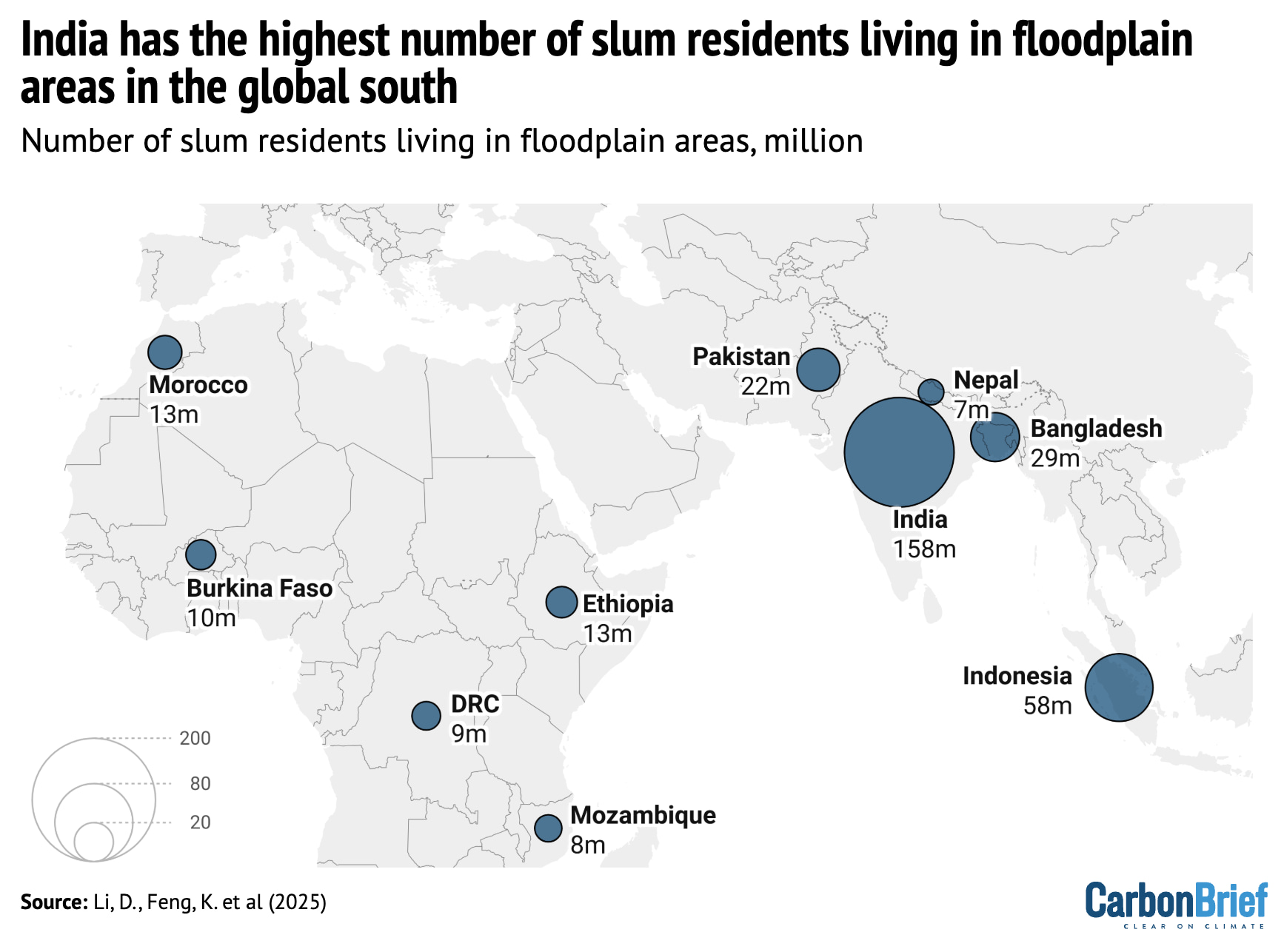
New research covered by Carbon Brief this week found that one in three people in informal settlements in the global south live in floodplains and are at risk of a “disastrous flood”. The chart above draws on data from the study, published in Nature Cities, to illustrate where in the world has the highest number of “slum residents” living in floodplains.
Spotlight
Antarctica’s oldest ice arrives in UK
Carbon Brief recently visited British Antarctic Survey scientists responsible for uncovering the secrets of Antarctica’s oldest ice.
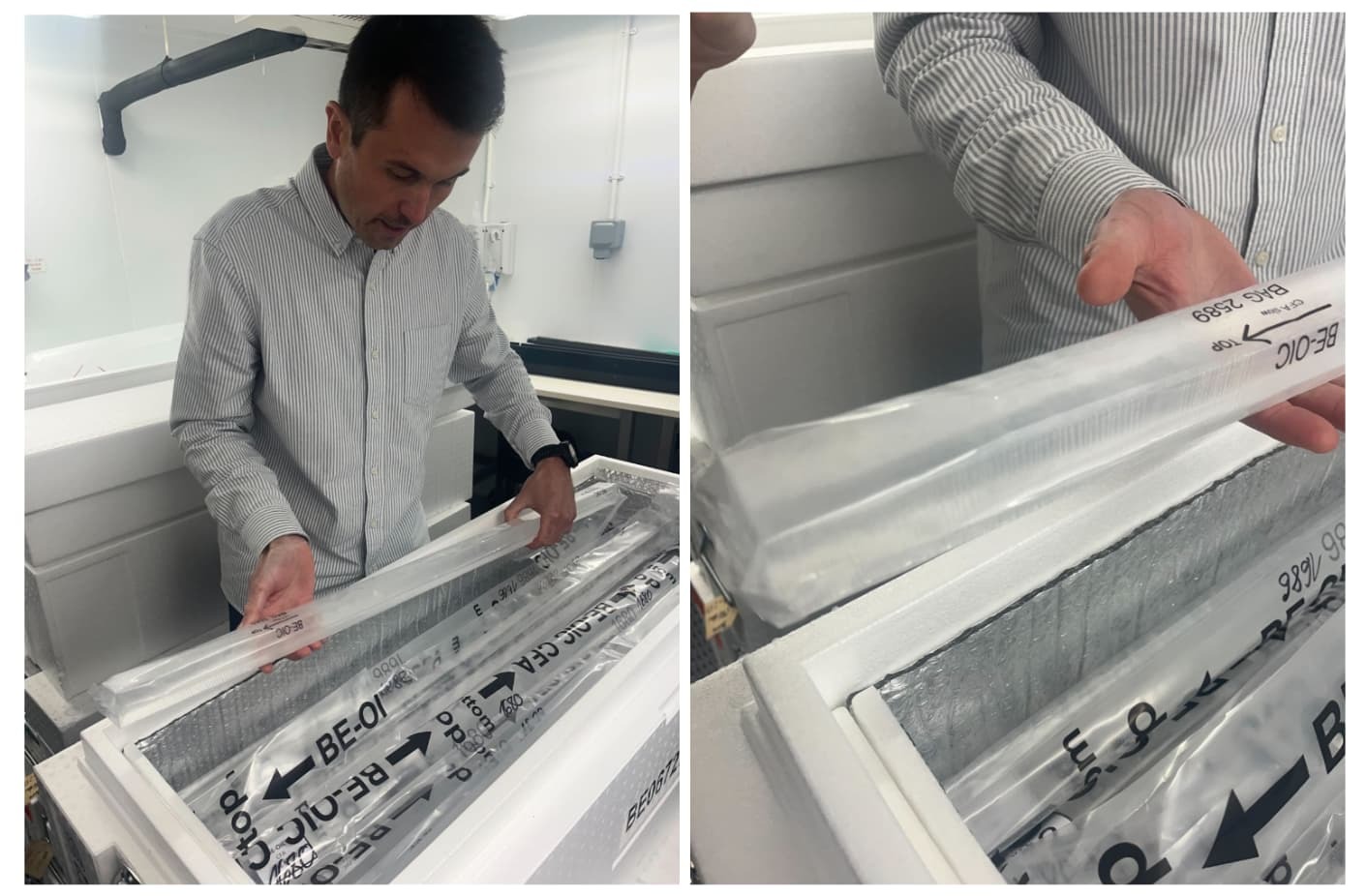
Standing in a freezer in Cambridge – with a -25C chill licking at his nostrils – British Antarctic Survey (BAS) lab manager Jack Humby excitedly opens up an unassuming polystyrene box.
Using his bare hands, he pulls out its contents. Long square-shaped sections of crystal clear ice – wrapped in plastic labelling which way is up – are revealed.
Little about the appearance of the ice gives away that it is at least 1.2m years old.
It has journeyed to the BAS headquarters on the outskirts of Cambridge from an ice core drilling camp in East Antarctica.
In January, scientists at the camp vertically drilled a 2,800m-long ice core, with on-site tests revealing it was likely to be at least 1.2m years old. The ice was then flown to a nearby port and shipped to Europe aboard the Italian icebreaker Laura Bassi.
The ice was drilled as part of the Beyond Epica Oldest Ice project, a large-scale field operation involving multiple research teams and laboratories across Europe.
‘One shot’
Owing to its specialist equipment and research expertise, BAS has been tasked with analysing the ice to reveal its secrets.
Though not visible to the human eye, the ice contains organic compounds and tiny pockets of air from periods stretching back hundreds of thousands of years.
Over the next seven weeks, the research team at BAS will work around the clock to analyse these features. However, in order to do so, they will have to melt the ice.
Dr Liz Thomas, head of the ice cores team at BAS, told journalists:
“It’s a huge responsibility because this is a one shot. Given how much effort has gone into drilling these cores, we have to get this absolutely right.”
To conduct their analysis, the team plan to use a gold-plated instrument to melt the square-shaped sections of ice being stored in the freezer room.
The meltwater will then be piped into a specially designed lab next door, which contains millions of pounds worth of analysis equipment, according to Humby.
Climates past
The analysis will help scientists work out how old the ice actually is. Though initial tests suggest it is at least 1.2m years old, but the team believe it could be up to 1.5m years old or even older.
It will also enable researchers to paint a more detailed picture of Earth’s past climates.
In turn, this could inform scientists’ understanding of how large swings in temperature in the past have affected various parts of the Earth climate system, including its ice sheets and ecosystems.
Ultimately, this could help researchers to make more informed projections about the likely impacts of human-caused climate change, Thomas explained:
“As climate scientists, it’s our job to provide as much information as we can. What we’re relying on to understand the next steps is climate models. They are fantastic, but they’re only as good as the information we put into them. That really is the justification for looking back in time.”
Watch, read, listen
COP30 LOOMS: A long-read in the Brazilian culture magazine Piauí examined the fraught road that the nation faces to host the next UN climate summit in November.
ARCTIC ‘MELTING POINT’: In Nature Communications, researchers recounted how the Arctic island of Svalbard is facing a “dramatic shift” to high air temperatures and rainfall in the depths of winter.
STUDENT VICTORY: The Guardian spoke to a group of students from the Pacific islands who started the campaign for the world’s top court, the ICJ, to take on the issue of climate change.
Coming up
- 23-31 July: COP15 of the Ramsar Convention on Wetlands, Victoria Falls, Zimbabwe
- 30 July: International Energy Agency electricity mid-year update
- 30 July: Advancing the implementation of the Chilean framework Law on Climate Change, Santiago, Chile
Pick of the jobs
- Boston Globe, climate science and environment reporter | Salary: Unknown. Location: Boston, US
- Science Museum London, curator of climate and earth sciences | Salary: £41,770. Location: London
- Netflix, manager, sustainability standards and partnerships | Salary: Unknown. Location: Amsterdam, Netherlands
DeBriefed is edited by Daisy Dunne. Please send any tips or feedback to debriefed@carbonbrief.org.
This is an online version of Carbon Brief’s weekly DeBriefed email newsletter. Subscribe for free here.


The post DeBriefed 25 July 2025: World court delivers climate ‘turning point’; Renewables ‘unstoppable’; Antarctica’s oldest ice examined appeared first on Carbon Brief.

A first set of biodiversity plans filed by countries to reverse nature loss are “insufficient” to meet this decade’s global targets, including a landmark goal to protect at least 30% of the world’s land and marine ecosystems by 2030, a landmark UN report warned on Thursday.
The State of Biodiversity Action, put together by a panel of technical experts for the UN Convention on Biological Diversity (CBD), was released in Yerevan, ahead of the COP17 nature talks starting on Monday in the Armenian capital.
Over the next two weeks, governments will for the first time take stock of progress towards the Global Biodiversity Framework (GBF) agreed in 2022 – a set of 23 targets also known as the “Paris Agreement for nature” – and will decide on policy guidelines for ramping up ambition before the 2030 deadline. The UN report will be the main basis for these negotiations.
At a press conference in Armenia, UN Secretary-General António Guterres highlighted that, while there has been some progress on the GBF, the “bad news” is that less than half of country plans are on track to meet its targets.
If current commitments are met by the end of the decade, only 26% of land ecosystems and 12% of marine ecosystems will be protected – falling “real short” of the 30% target agreed in Montreal in 2022, Guterres said. “The war on nature has not yet ended,” he added.
UN Environment chief Inger Andersen said the report “sets the tone for the focus, ambition and urgent action we need to deliver” in Armenia, including by reducing subsidies that harm nature and mobilising new finance for biodiversity. “All leaders and all negotiators must respond to these findings,” she emphasised.
Andersen added that climate change amplifies threats to biodiversity, which makes protection all the more important as global warming is now almost certain to rise above a key threshold. “Exceedence of 1.5C increases the likelihood of forest diebacks, phenological shifts, warming oceans that become more inhospitable to species, irreversible tipping points and so much more,” she said.
-
Global deforestation slowed in 2025 but Brazil’s election could undo “fragile” gains
Countries remain 70% off track to meet a goal to end deforestation by 2030, as progress in Latin America offset by failures in Africa -
Carbon capture industry faces tough future, as UK raids green spending
Despite a spate of projects getting underway, the mood at an industry conference in London this week was low with government subsidies set to shrink -
World Bank and IMF should lead the financial system in responding to the climate crisis
Multilateral development banks have a vital role to play in delivering on donors’ climate finance promises and protecting the most vulnerable



Progress on land but ocean lags behind
The report shows that if countries meet all the biodiversity targets in their plans, this would protect about 27% of the world’s land and sea by 2030, a fivefold increase in the span of ten years.
Progress has been uneven, with most conservation efforts focused on terrestrial ecosystems. The report suggests that currently about 19% of land ecosystems are protected, up two percentage points from 2020, which UN authorities welcomed but said is not a fast enough pace.
However, the real gap is at sea, where only about 10% of the global ocean has some sort of protection. Coastal areas under national jurisdiction have done better, as currently 23% of this marine territory is protected, but the report shows most of the deep ocean is not.
Brian O’Donnell, director of Campaign for Nature, an advocacy group, said the new High Seas Treaty – which entered into force this year and will allow for the creation of Marine Protected Areas in the deep ocean – represents an opportunity, as only about 1.5% is under protection so far.
A group of environmental NGOs including WWF and Bloomberg Philanthropies has issued a call for governments to scale up ocean conservation and to designate $16 billion annually for marine protection measures, up from $1.8bn now.
SE Asia speeds up plan for connected clean power grid after oil shock
Some countries did not set a conservation target at all for both land and sea, the report says, blaming technical challenges like how to account for overlapping protected areas, difficulty recognising protections for private land and land-accounting methodologies changing over time.
A separate report by Campaign for Nature suggests that the 30×30 goal could still be met with “increased ambition and commitment”, and says that around 50 countries have already protected about 30% of their land.
A group of environmental NGOs has warned that, beyond the 30% headline figure, protected areas need to be “high integrity” and recognise the stewardship of local communities and Indigenous peoples.

Developing countries call for finance
Rich countries will arrive at COP17 with shrinking aid budgets and geopolitical preoccupations – yet they will likely hear the same plea they’ve heard for the past few years: stepping up commitments will require finance.
A submission by African countries in August said the “implementation gap” has at its core a shortfall in the provision of funds, and that bridging it will require predictable and accessible finance.
Pacific island nations launched a similar call, arguing there is “a treaty obligation” that developing countries, including themselves, will effectively implement commitments depending on the finance and technology made available by developed nations.
To close this gap, the EU made a proposal at preliminary talks in Nairobi in August to expand the base of donors so that richer developing countries could voluntarily assume donor responsibilities. Saudi Arabia and Qatar rejected the idea, while China said this should not weaken the responsibility of developed nations.
Pre-COP draws attention to Pacific’s climate plight and 1.5C goal
So far, wealthy governments have missed a target to provide $20bn per year in international public finance for nature protection by 2025, reaching only about $16bn per year from 2023 to 2025, according to an OECD report. By 2030, the GBF aims for developed countries to directly transfer $30bn per year, and mobilise $200bn from all sources.
The UN report released on Thursday shows even slower progress in redirecting harmful subsidies such as those which encourage the overuse of fertilisers and the production and consumption of new fossil fuels, and below-market fees that encourage overfishing. UN Environment estimates that for every dollar spent protecting nature, $30 goes on destroying it.
UN biodiversity chief Astrid Schomaker told journalists in Yerevan that “if you hear there is no finance, please do not believe it” because economies are continuing to grow. “It is being spent on activities that harm the economy rather than those that work with nature and sustain life on this planet,” she said.
Guterres said developed countries tend to say they are grappling with budget constraints due to increased defence expenditure, which “in my view does not justify a reduction” in international aid. He added that existing resources can be multiplied if they are used to mobilise private capital.
Campaigners, companies and the Armenian government want to shift the needle on this situation at COP17 by highlighting how positive subsidies help restore biodiversity. They will launch a flagship call to action that will be taken forward by countries and groups working to reform damaging incentives.

Global review: the main act
The Global Review of Collective Progress – a bit like the Global Stocktake for climate action – is set to be the most important outcome from COP17, and it will be the first time this process unfolds at the biodiversity talks. The actions decided in Yerevan will respond to the gaps outlined in the State of Biodiversity Action report and determine whether countries can turn the tide of biodiversity loss this decade.
Overall, the report shows that while countries have taken action to address all 23 targets in the GBF, none “present a fully positive picture”. A target to strengthen the resilience of ecosystems to climate impacts is the only one with high relative progress, the report says, as government have already made effective interventions that show “a positive trend”.
The report assessed each country’s national targets, which define their contribution to the global goals, as well as their separate National Biodiversity Strategy and Action Plans (NBSAPs) outlining how they will achieve the national targets.
But it does not paint a complete picture, since at the cut-off date, only 89 NBSAPs and national targets from 162 countries had been submitted, leaving out a couple of dozen plans that arrived late. Pacific island nations said this might undercount commitments.
Many of those lacking an NBSAP are biodiversity-rich developing countries, which say they need financial and technical support to fully develop these plans. Some large nations pending an NBSAP include South Africa, Bolivia and Russia.
Since the GBF was agreed in 2022, governments have mostly focused on developing their biodiversity targets and plans, while the lion’s share of implementation is expected to happen towards the end of the decade, according to UN biodiversity chief Schomaker.
But O’Donnell said “accelerated political ambition” is still needed to improve commitments and translate them into effective protection on the ground or at sea.
The post Countries urged to ramp up “insufficient” nature policies at COP17 appeared first on Climate Home News.
Countries urged to ramp up “insufficient” nature policies at COP17