

Welcome to Carbon Brief’s DeBriefed.
An essential guide to the week’s key developments relating to climate change.
This week
Climate chaos
DEADLY DISASTER: Devastating landslides have killed 167 people, with another 191 missing, in the Wayanad district in Kerala, India, reported the Indian Express. Prime minister Narendra Modi announced compensation of 200,000 Indian rupees (about $2,390) per person for the families of the deceased and 50,000 rupees (about $600) for those injured, the newspaper said.
CLIMATE FACTOR: The Hindustan Times noted that scientists have attributed the landslide to a “combination of climate change, excessive mining and loss of forest cover in the region”. Opposition leader Rahul Gandhi called for “mapping of landslide-prone areas and…an action plan to address the growing frequency of natural calamities in the ecologically fragile region”, reported the Independent.
FLASH FLOODS: More than 10,000 people displaced from conflict in Sudan’s Sennar state – alongside other refugee and host communities – have been severely impacted by extreme rainfall and flash floods in Kassala state, reported the UN Office for the Coordination of Humanitarian Affairs. At least five people have reportedly died, including a child, the report said. Other affected areas include Aj Jazirah, East Darfur and North Kordofan, according to ReliefWeb.
Sizzling Olympics
HEATWAVE GAMES: A rapid attribution analysis found that the “heat dome” striking the Paris Olympics and the “scorching temperatures” across western Europe and North Africa this week would have been “impossible” without the “fossil-fuelled climate crisis”, reported the Guardian. Scientists at the World Weather Attribution (WWA) group said human-caused global warming made the heatwave “2.5C to 3.3C hotter”. Leading climate scientist Dr Friederike Otto told reporters: “Climate change crashed the Olympics on Tuesday.”.
KEEPING COOL: BBC Sport said that organisers used hoses and misters to keep spectators cool at the Paris Olympics. In Marseille, where temperatures reached around 40C, athletes taking part in sailing events wore “ice vests” to try to counteract the heat, the broadcaster added.
TRIATHLON TIMEOUT: The men’s triathlon was postponed due to “unsafe pollution levels” in the Seine following heavy rainfall in the French capital, reported Sky Sports. The organisers blamed the postponement on climate change, with Aurélie Merle – the Paris 2024 director of sports – saying: “We are living in the 21st century where, unfortunately, there are far more meteorological events…which are beyond the control of the organisers.”
Around the world
- UK RENEWABLES: UK energy secretary Ed Miliband announced an increase to this year’s renewable energy auction budget to a record £1.56bn on Wednesday, reported BBC News.
- HARRIS APPROVED: Inside Climate News reported that Kamala Harris has clinched an endorsement from the Green New Deal Network – “a key coalition of progressive, youth-led and environmental justice-focused climate advocates” – which had previously held back its endorsement for president Joe Biden.
- FUND FIGHT: The EU is gearing up to pressure wealthier “emerging” economies, such as China, to pay into the climate fund at the COP29 climate summit, reported Politico. Currently, only countries categorised as “industrialised” under the 1992 UN climate treaty contribute climate finance under the Paris Agreement.
- OFFSETS BLOW: A review by the Science Based Targets initiative, a global auditor of corporate climate targets, has concluded that “various types of carbon credits are ineffective”, reported Bloomberg.
- COP16 SAFE: Reuters reported that “Colombian rebel group” Estado Mayor Central has withdrawn its threat, issued earlier this month, to disrupt the UN biodiversity summit COP16 taking place in October in the Colombian city Cali – as a “gesture of [their] will for peace”.
7,500,000
The methane emissions, in tonnes, from US oil and gas facilities – four times more than the estimates of regulators – which is equivalent to the annual energy needs of over half of US homes, reported the Financial Times.
Latest climate research
- A new research paper published in Nature Communications found that current policies put the world on a trajectory with a 45% chance of crossing tipping points in the Earth system by 2300, even if the global average temperature is brought back to 1.5C later on. Carbon Brief had all the details.
- The UK would gain “benefits” worth £164bn if it meets its 2033-2037 climate targets, said a study published in the Journal of Environmental Studies and Sciences covered by Carbon Brief.
- A new study in BioScience proposed a way to preserve the Earth’s “increasingly threatened” biodiversity on the moon through the creation of a lunar biorepository – a storage facility for biosamples – by developing a system using cryopreserved fish fins.
(For more, see Carbon Brief’s in-depth daily summaries of the top climate news stories on Monday, Tuesday, Wednesday, Thursday and Friday.)
Captured
Deep-sea mining mapped

Carbon Brief published an in-depth explainer this week into what the emerging field of deep-sea mining means for climate change and biodiversity. The map, taken from the article, shows the current designated areas for deep-sea mining exploration, with each of the orange dots representing exploration contracts within four significant zones: Clarion-Clipperton Zone, Mid-Atlantic Ridge, Indian Ocean and Northwest Pacific Ocean. The colours indicate the types of deep-sea mineral resources targeted. Polymetallic nodules – formed of iron and manganese silicates and hydroxides – are in green. Polymetallic sulphides – with copper, zinc, lead, iron, silver and gold – are in blue. Cobalt-rich ferromanganese crusts – with high cobalt concentration and other rare elements – are in pink.
Spotlight
Tuvalu’s plan to be first ‘digital nation’
This week, Carbon Brief reports on how the Pacific island nation of Tuvalu is aiming to become the world’s first digital nation in response to climate change.
Tuvalu, a small nation comprising a group of nine islands in the South Pacific, is among the most vulnerable to climate change. The Guardian has reported that rising sea levels are an “existential threat” for island nations such as Tuvalu. In 2023, a NASA report indicated that sea levels in Tuvalu had risen nearly six inches (15cm) over the past 30 years.
Estimates show that, by 2050, more than half of the land area of Funafuti – the capital – could be flooded.
According to the Pacific Regional Environment Programme, less than 0.03% of global greenhouse gas emissions come from the Pacific Island region.
Yet, as Tuvaluan minister Simon Kofe noted in his address to the COP26 climate summit in Glasgow in 2021 while standing knee-deep in the sea, “Tuvalu is sinking”. Invoking the issue of climate justice, he said:
“In Tuvalu, we are living with the realities of climate change and sea level rise.”
Rising sea levels in Tuvalu are already “leaching soil, killing crops and spoiling drinking water”. A recent National Geographic article also underscored food security challenges, with cultivating staple crops such as taro, breadfruit and coconut becoming difficult due to seawater infiltration. Flooding has become routine, with intense tides sweeping over the sole airstrip and homes monthly.
Facing the possibility of becoming entirely submerged and uninhabitable, Tuvalu has developed the Future Now project and aims to become the world’s “first digital nation”, existing in the “metaverse”, a virtual reality project started by Facebook.
Digital replicas
Addressing delegates in his COP27 speech, Kofe, standing in front of a digital replica of Te Afualiku, the first island in Tuvalu to be digitised, said:
“As our land disappears, we have no choice but to become the world’s first digital nation.”
This serves as the model for the digital recreation of all Tuvalu’s islands and its landscape, including “the coral atolls and reefs, the lagoon, the porous sandy soil, the palm trees and what is left of the pandanus, breadfruit and taro” – before it potentially physically disappears, he said.
The plan includes using satellite imagery, photographs and drone footage capable of capturing details as fine as grains of sand on the beach and the direction of ocean currents.
Tuvalu has completed a thorough three-dimensional LIDAR scan of all 124 islands and islets and began enhancing its national communications network – laying the groundwork for its digital nation, Kofe told delegates at COP28.
It has also started exploring a digital ID system using blockchain technology to connect the Tuvaluan diaspora, enabling their participation from across the world, the project developers said. This digital platform will allow Tuvaluans to connect, explore their heritage and engage in new business opportunities across various sectors, they added.
Additionally, the project has begun the development of a digital archive of Tuvaluan culture, with contributions from citizens who were encouraged to preserve their most valued personal items to create an evolving record of their heritage.
‘Digital sovereignty’
If Tuvalu’s physical land becomes uninhabitable, it also prompts a discussion of statehood and sovereignty. Under current international law, a defined physical territory is a prerequisite for statehood.
In order to become the first digital nation, Tuvalu – recognising the evolving notion of state sovereignty – redefined statehood through a constitutional amendment in 2022 to say:
“The State of Tuvalu within its historical, cultural and legal framework shall remain in perpetuity in the future, notwithstanding the impacts of climate change or other causes resulting in loss to the physical territory of Tuvalu.”
Tuvalu’s permanent and digital sovereignty is now recognised by 25 countries, with the Pacific Island Forum also redefining its territory, maintaining that its statehood would continue regardless of the impacts of climate change.
Watch, read, listen
GLACIAL MELT: Tortoise Media’s Slow Newscast podcast talked about the “unlikely” climate activists in Switzerland who won a key climate change case, but now face backlash.
SOLARE CANTARE: The Volts podcast spoke with Joel Jean, co-founder and CEO of Swift Solar, to explain all about perovskite solar.
NIGERIA’S ‘OIL CURSE’: A new FT Film explored the challenges facing Nigeria’s oil sector and whether ending fuel subsidies could help to break the “oil curse”.
Coming up
- 6 August: G20 fourth energy transition working group, virtual
- 9 August: International day of the world’s Indigenous peoples
Pick of the jobs
- Harris for President, climate engagement director | Salary: $90,000-$110,000. Location: Wilmington, US
- Ember, climate policy analyst I Salary: AU$78,246. Location: Remote
- Carbon Brief, section editor (science) I Salary: £47,000. Location: UK/hybrid
- Reuters, senior energy correspondent I Salary: Unknown. Location: London
DeBriefed is edited by Daisy Dunne. Please send any tips or feedback to debriefed@carbonbrief.org.
This is an online version of Carbon Brief’s weekly DeBriefed email newsletter. Subscribe for free here.


The post DeBriefed 2 August 2024: Deadly rains from India to Sudan; ‘Fossil-fuelled’ heat hits Olympics; Tuvalu’s plan to be first ‘digital nation’ appeared first on Carbon Brief.

Three countries have been named by the Paris Agreement’s compliance committee for failing to submit a nationally determined contribution (NDC) and repeatedly snubbing offers of help with their climate plans.
After months of internal debate over whether to identify serial non-responders, the Paris Agreement’s Implementation and Compliance Committee (PAICC) named the three countries which have failed to engage with it over their NDCs on Friday.
It named Democratic Republic of Congo, Senegal and North Korea in a footnote of its annual report, adding that it decided to name them “with a view to facilitating engagement”, adding that representatives of the three nations had been invited to its meeting in early 2027 “with the purpose of identifying any challenges and constraints”.
“The Committee noted the importance of Parties engaging with the Committee in a timely manner, while noting that some delays may be due to the national capabilities and circumstances of the Parties”, the report said.
-
Under US pressure, World Bank says it will back gas “where appropriate”
The US wants the World Bank to expand its gas support while climate campaigners are pushing for it to end – its head spoke this week of limited backing for the fossil fuel -
IPCC scientists vow to press on with climate reports despite political deadlock
After governments again failed to agree a timeline, nearly 120 IPCC authors pledged to complete their assessment on time and with full scientific rigour -
Paris Agreement committee snubbed over missing NDC climate plans
Many governments have still not submitted a nationally determined contribution to the UN, breaching a key requirement of the Paris Agreement

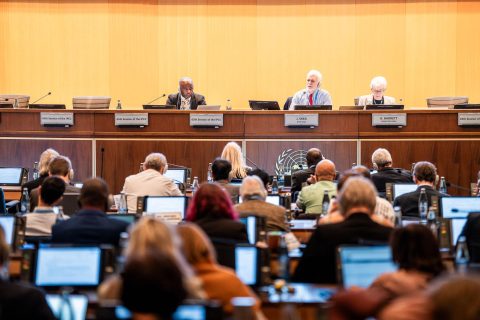

In July, PAICC said 12 countries had ignored its repeated attempts to discuss why they had not published an NDC as required every five years under the 2015 Paris accord.
Members of the committee had been divided over whether to name them, but at a September meeting decided to do so in their annual report to the annual climate COP summit.
By the time the report was published on Friday, only Congo, Senegal and North Korea “had not communicated an NDC or submitted a [Biennial Transparency Report] and had not yet responded to any of the Committee’s notifications, despite several reminders issued by the Committee in this regard”.
Rainforest and renewable energy ambitions
The silence from Congo and Senegal is notable because the former is home to much of the Congo Basin rainforest while the latter has sought billions of dollars in climate finance to support its renewable energy ambitions.
After Brazil, Congo has more rainforest than any country in the world. This forest, and the country’s peatlands, absorb huge amounts of greenhouse gas but are fast being lost to expanding farmland, charcoal production, logging and mining.
Senegal signed a Just Energy Transition Partnership with Canada and wealthy European nations in 2023, to help it meet its renewable energy targets under the-then government of Macky Sall. It was chair of the Least Developed Countries group between January 2022 and December 2023.

Tejas Rao, who is researching the PAICC as part of a doctoral thesis at Cambridge University, said the governments of the three countries should engage with the committee.
“Engagement costs these governments very little and the committee has shown it will listen,” he said.
“Silence leaves the committee with no basis to help, and it leaves the [governments] exposed to the narrative that they are simply disengaged,” he told Climate Home News.
Paris Agreement requirement
The 2015 Paris Agreement requires all parties to publish an NDC every five years outlining their emissions reduction targets, with each plan meant to be more ambitious than the country’s last NDC.
The latest set – the third round of plans, with new targets for 2035 – was due in February 2025. While most countries missed this deadline, all but around 30 – mostly small emitters but including Egypt, Vietnam and Argentina – have now submitted them.
Over the year, the PAICC – which is made up of government climate officials from developed and developing countries – has been communicating with governments that have not submitted NDCs and trying to overcome barriers to them doing so.
Some nations have cited exceptional circumstances as the reason for not submitting an NDC, a process that requires a significant amount of work in tracking emissions and consulting on how to curb them across the economy. For example, a letter from a Sudanese official to the PAICC, seen by Climate Home News, said that the country’s civil war had led to the suspension of its NDC preparation.
-
IPCC scientists vow to press on with climate reports despite political deadlock
After governments again failed to agree a timeline, nearly 120 IPCC authors pledged to complete their assessment on time and with full scientific rigour -
Under US pressure, World Bank says it will back gas “where appropriate”
The US wants the World Bank to expand its gas support while climate campaigners are pushing for it to end – its head spoke this week of limited backing for the fossil fuel -
Who shapes climate science? The equity question facing the IPCC
Early completion of the next global climate science assessment reports risks excluding research from the Global South, which is key to ensuring the findings are fair
The US and Iran are not signed