Welcome to Carbon Brief’s DeBriefed.
An essential guide to the week’s key developments relating to climate change.
This week
Energy outlook
DEMAND SURGING: The International Energy Agency (IEA) published its annual World Energy Outlook report – a “comprehensive” summary of global energy trends – the New York Times reported. The outlet said, over the next decade, the world will add the equivalent of Japan’s annual electricity demand each year, driven by demand for new factories, electric vehicles, air-conditioners and data centres. (Axios said the IEA included a “reality check” about data centre demand, which would only make up a “small share” of growth by 2030.)
AGE OF ELECTRICITY: Reuters reported that the “world is on the brink of a new age of electricity”, with global fossil fuel demand set to peak by the end of the decade. The newswire added that “surplus oil and gas supplies could drive investment into green energy”. The Wall Street Journal said clean energy would grow faster than global energy demand, becoming the largest source of power in the mid-2030s, according to the IEA. Carbon Brief has just published an in-depth analysis of the report’s findings. (See Captured below.)
COP16 kickoff
BIODIVERSITY TALKS: The COP16 biodiversity summit begins in Cali, Colombia, on Monday. It will be the first set of UN biodiversity negotiations since the world’s nations agreed a landmark deal in 2022 to “halt and reverse” nature loss by the end of the decade.
MISSED PLEDGES: Joint analysis published on Tuesday by Carbon Brief and the Guardian showed that more than 85% of countries are set to miss the UN’s deadline to submit new nature pledges, known as national biodiversity strategies and action plans (NBSAPs).
WHAT TO WATCH: Carbon Brief’s team of journalists on the ground in Cali will host a webinar on Tuesday at 3pm UK time to discuss the key issues facing negotiators and answering questions. (Sign up for free.) Through the fortnight of the talks, they will also be scrutinising each new draft negotiating text as it lands, explaining areas of disagreement and updating Carbon Brief’s interactive text tracker.
After the storm
DEVASTATING DAMAGES: Hurricanes Helene and Milton are “likely” to each rack up costs of more than $50bn, the Associated Press reported. According to the newswire, “government and private experts” say the hurricanes could join the “infamous ranks” of Katrina, Sandy and Harvey – which are among the eight US storms to have ever caused damages of more than $50bn.
PAYOUTS: The US Small Business Administration has exhausted funds for its disaster loan program following increased demand from Hurricane Helene, Reuters warned. Officials said the program needs about $1.6bn amid heightened demand following Hurricane Helene, according to the Hill. The Financial Times estimated that Milton alone will lead to about $36bn of insurance payouts for the private sector.
Around the world
- DIRTY ENERGY: Burning household rubbish to make electricity is now the “dirtiest way the UK generates power”, BBC News reported.
- COP BID: Australia has launched a bid to host the COP31 climate summit in 2026 in Adelaide, according to the Guardian.
- FINANCE FAIL: The EU unveiled its negotiating stance for the COP29 climate talks next month, but did not address how it will boost funding for developing countries, according to Bloomberg.
- CURBING COAL: The US Supreme Court allowed the Environmental Protection Agency to move ahead with its plans to limit carbon emissions by power plants, despite a pending challenge from 27 mainly-Republican states, the New York Times reported.
- WARNING MESSAGE: Activist group Friends of the Earth warned the UK government to drop its support for a Mozambique gas project “embroiled in allegations of abduction, murder and rape”, said Politico.
- WIND POWER: A Chinese company developed the world’s “most powerful” floating offshore wind turbine with a capacity of 20 megawatts, state news agency Xinhua said.
60%
Global increase in forest fire carbon emissions over 2001-23, according to a new paper in Science.
Latest climate research
- Recent floods that killed at least 244 people in Nepal were driven by rainfall made “about 10% more intense” by human-caused climate change, according to a rapid attribution study.
- Drought and aridity are already having a “significant impact” on internal migration – especially in arid and “hyper-arid” regions of southern Europe, South Asia, Africa and the Middle East and South America – new research found.
- Many people in the US are experiencing “psychological distress” from climate change, but those who do are more involved in collective climate action, a new study said.
(For more, see Carbon Brief’s in-depth daily summaries of the top climate news stories on Monday, Tuesday, Wednesday, Thursday and Friday.)
Captured

Electricity generation from solar is set to quadruple by 2030, sending coal power tumbling and becoming the world’s largest source of electricity by 2033, according to Carbon Brief analysis of the International Energy Agency’s World Energy Outlook. The report finds that global CO2 emissions are set to peak “imminently”, as the “age of electricity” sends fossil fuels into decline. See Carbon Brief’s in-depth coverage of the report.
Spotlight
Is global warming ‘accelerating’?
A recent “surge” in global warming is not statistically “detectable”, according to a study published this week. But does this mean it is not happening? Carbon Brief speaks to the lead author of the study and explores the debate on a warming acceleration.
Global temperatures are soaring. Last year was the hottest year on record, with global surface temperatures reaching 1.34-1.54C above pre-industrial levels. But 2024 is already setting blistering new records and is expected to knock 2023 off the top spot.
Against this backdrop of ever-worsening heat, a new study in Communications Earth and Environment used statistical methods to see whether an acceleration in global warming could be formally detected.
The authors find a “changepoint” in the rate of warming around the year 1970, but find no “statistically detectable” acceleration since then.
Dr Claudie Beaulieu is the paper’s lead author and an associate professor in the Ocean Sciences Department at UC Santa Cruz. She told Carbon Brief: “If an acceleration in global warming is occurring, the size of that acceleration is either too small or too recent to robustly detect it in globally-averaged surface temperature records.”
However, some scientists questioned the methods used in the study. Prof Richard Allan, a professor of climate science at the University of Reading, said the surface warming data used in this study is “influenced by natural variation”. He argued that “when all lines of evidence are scrutinised” – such as satellite data and ocean measurements – “it is apparent that climate change is accelerating rather than continuing steadily”.
Carbon Brief’s climate science contributor, Dr Zeke Hausfather, published a factcheck earlier this year on the acceleration in global warming. Assessing observations and climate model output, he concluded that “that there is increasing evidence of an acceleration in the rate of warming over the past 15 years”.
Beaulieu told Carbon Brief that present-day discussion about an acceleration in warming is similar to the debate over a warming “hiatus” about a decade ago. She continued:
“Back then, also using statistical methods, we showed that a ‘hiatus’ in warming was not detectable. With hindsight of more years of observations it is now obvious warming had just continued leading to the record heat of 2023. We need to keep monitoring.”
Dr John Kennedy is the co-chair of the World Meteorological Organisation (WMO) expert team on climate monitoring and assessment and scientific coordinator for the annual WMO State of the Global Climate reports.
He warned that this statistical method can mean waiting many years for warming – or a lack of warming – to be detectable. In a blog post earlier this year, Kennedy wrote:
“One thing that became clear during the ‘hiatus’ is that this kind of analysis is the kind of thing you do when you’re set (for whatever reason) on being the last person to know there is a hiatus.”
He added: “There are good physical reasons to expect an increase in the underlying warming.”
Beaulieu does not refute that warming might be accelerating. She said that “the point of the paper is that it will take additional years of observations to detect a sustained acceleration”.
Watch, read, listen
CLIMATE LINGO: Author and climate change activist Genevieve Guenther joined the Drilled podcast to discuss her new book, The Language of Climate Politics, which digs into rhetorical devices that she says are being used to slow or block climate action.
FAILING SINKS: “Is nature’s carbon sink failing?” asked a feature in the Guardian. The article warned that forest, plants and soil absorbed almost no carbon in 2023, and asked whether this “could rapidly accelerate global heating”.
FARM SUBMERGED: A short video by BBC News follows Nigerian farmers discussing the impacts of climate change on their livelihoods and highlights possible solutions.
Coming up
- 21 October-1 November: United Nations Biodiversity Conference, COP16, Cali, Colombia.
- 23 October: Ministerial Meeting of the Coalition of Finance Ministers for Climate Action, Washington DC, US.
- 25 October: Kiribati Presidential elections, Kiribati.
Pick of the jobs
- University of Bath, Centre for Climate Change and Social Transformations, research associate | Salary: £37,999-45,163. Location: Bath, UK
- Intergovernmental Panel on Climate Change (IPCC), science coordinator in the Working Group I Technical Support Unit | Salary: unknown. Location: Gif-sur-Yvette, France.
- Cornell University, Oceanography of a Changing Planet – assistant/early associate professor | Salary: $90,000-130,000. Location: New York.
DeBriefed is edited by Daisy Dunne. Please send any tips or feedback to debriefed@carbonbrief.org.
This is an online version of Carbon Brief’s weekly DeBriefed email newsletter. Subscribe for free here.
The post DeBriefed 18 October 2024: IEA projects solar surge; US counts cost of hurricanes; Is global warming ‘accelerating’? appeared first on Carbon Brief.

Climate Change
Large flotilla brings Pacific voices and message to leaders at Pre-COP meeting: Keep 1.5C Alive
NADI, FIJI Wednesday 7 October 2026 — Around 80 people including Pacific and Torres Strait community members, Elders and youth activists travelled as part of a colourful flotilla past the Pre-COP venues with a message for leaders: ‘Keep 1.5°C Alive’.
High res footage and images available here
The large flotilla included traditional Fijian voyaging vessel the Uto Ni Yalo, six 6-person outrigger canoes, and Greenpeace campaigning vessel the Oceania which sailed from Sydney to the Pre-COP in Nadi. On board were Elders, climate-vulnerable communities members from across the Pacific and Torres Strait, youth activists and poets, and campaigners and climate experts from across the region.
Messaging on canoes and banners said ‘Hold the Line at 1.5°C’ and ‘Keep 1.5°C Alive’ — a reminder to leaders that the climate limit established under the Paris Agreement is a non-negotiable survival line.
Shiva Gounden, Head of Pacific at Greenpeace Australia Pacific, said: “People from across the Pacific and Australia have come together today to make sure the voices of our communities are heard by leaders meeting here in Nadi for the Pre-COP climate talks. The Taku Pakasoa Declaration adopted here at Pre-COP means ‘Strength in Unity’, and that’s how we’re coming together today.
“Our message is clear: Hold the Line on 1.5°C and centre those most impacted by the climate crisis in your decision-making. Our children’s futures must not be stolen away so that polluting nations can continue down the fossil-fuel path.
“Limiting global heating to 1.5°C is a non-negotiable survival line for Pacific communities and for humanity. Every cyclone, every storm now blows with the deadly force of accumulated emissions and gives a warning of what is to come as we face a dangerous summer of climate-fuelled extreme weather. Do not ignore our voices.”
On board, Aigagalefili Fepulea’i-Tapua’i, Pacific youth climate advocate and poet from Aotearoa Climate Action Network, said: “To hold the line on 1.5C for our Pacific family, New Zealand, as the only country where the connection between environmental protection and indigenous rights is legally validated by our constitutional document, must protect the rights of Māori.”
ENDS
Media contact: Kate O’Callaghan in Nadi on +61 406 231 892 (Whatsapp/Signal)
Large flotilla brings Pacific voices and message to leaders at Pre-COP meeting: Keep 1.5C Alive
Climate Change
A ‘victory’ for communities as High Court rules climate impacts from coal and gas must be considered even where fossil fuels are exported
SYDNEY, Wednesday 7 October 2026 — In response to the landmark High Court ruling that climate impacts of fossil fuel projects must be considered by NSW planning authorities, the following lines can be attributed to Joe Rafalowicz, Head of Climate and Energy at Greenpeace Australia Pacific
“The High Court decision today is a victory for communities that bear the brunt of the storms, bushfires and extreme weather fuelled by Australian fossil fuel corporations.
“Coal and gas companies have claimed they are not responsible for their pollution because it happens overseas, but today Australia’s highest court sided with common sense and scientific evidence to find that every new coal and gas approval in this country could put us at risk, no matter where it is sold or burnt.
“As leaders meet at the Pre-COP talks in Fiji this week, Pacific communities are reaffirming the importance of the 1.5C temperature limit as a survival line for humanity, and is a scientific, moral and legal obligation as affirmed by the landmark Pacific-led ICJ Advisory Opinion. The highest court in the world, and now in Australia, have been clear: it is legally imperative that all of the pollution from fossil fuel projects be considered before approving a new project.
“Now is the moment for the Australian Government, as COP31 President of Negotiations, to find the courage, leadership and grit our country is known for to chart a new course away from fossil fuels. This begins with showing leadership at home by ending new coal and gas approvals.”
-ENDS-
After witnessing the effects of sea-level rise in the low-lying island nation of Tuvalu, Pacific leaders on Tuesday used the pre-COP31 summit in Fiji to voice their frustration at the difficulties they have experienced in tapping the global climate finance system.
A small group of government leaders, climate negotiators and heads of development banks and climate funds took a trip to Tuvalu’s Funafuti atoll on Tuesday morning, travelling by road over land just 10-20 metres wide to visit a project that is building barriers to keep the sea from the land.
They then flew to Fiji for the pre-COP summit, where several Pacific leaders said they had been let down by the insufficient quantity, bad terms and slow speed of international finance to help them adapt to a warming climate that is bringing higher oceans, drought and more powerful storms to their shores.
“Right now, our islands are like a canoe that has been rammed by a massive foreign ship. Our canoe is taking on water, we are sinking, and what is the world’s response?” asked Palau’s President Surangel Whipps Jr.
“They hand us a tiny patch to cover a gaping hole,” he continued, “but the bureaucratic process just to receive that patch is so slow that the water fills the hole while we wait. Then to rebuild the vessel so that we can survive the next storm, we are offered loans, debt that adds weight to a sinking boat packaged in red tape so thick we can barely access it. And while we wait, the water continues to fill.”

Pacific leaders and Australia called again on governments to invest in the new Pacific Resilience Facility (PRF), which has been designed by the Pacific Islands Forum and is seeking $500 million in investments by COP31 in November.
It has around $180 million so far, but did not receive additional pledges during the UN General Assembly in New York. The PRF aims to invest to generate annual returns which it can give to projects like water tanks for drought-hit communities.
Witnessing sea level rise
The annual pre-COP gathering is usually a low-profile technical meeting of climate negotiators. But this year, Australia – which is the president of negotiations at COP31 – partnered with the Pacific to introduce a “leaders segment” in an attempt to shine a spotlight on climate issues affecting the region.
Fourteen government leaders – from Australia, Timor-Leste, Mauritius and the Pacific – made the trip. They were joined by the European Union’s climate commissioner Wopke Hoekstra, the heads of the Green Climate Fund and the Asian Development Bank and former Australian prime minister Julia Gillard.
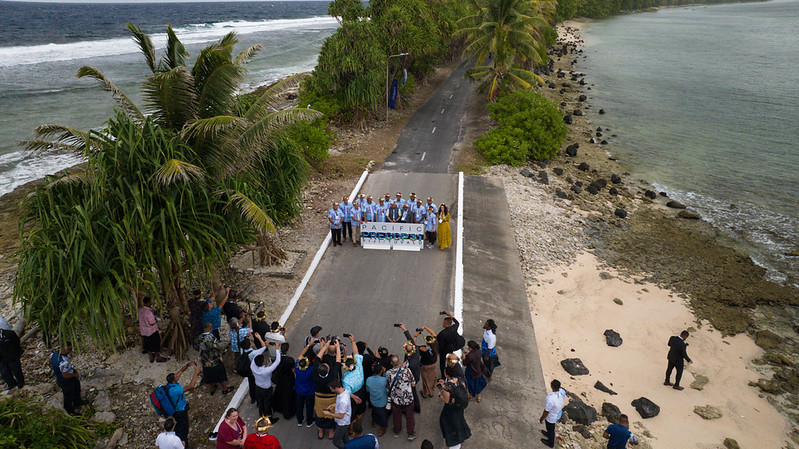
On their return to Fiji, Solomon Islands Prime Minister Matthew Wale told the pre-COP leaders roundtable that the sea level rise they had witnessed was personal for him.
“Tuvalu was not just a site visit for me. I saw the story of my own saltwater people,” he said, adding that he, his daughter and his grandfather had lost their houses to sea level rise and that three-quarters of his electorate live on land that will be underwater in the next 30 years.
From the other side of the world, Antigua and Barbuda’s environment minister Michael Joseph said Tuvalu’s problems felt similar to those of his own Caribbean islands. “I saw vulnerable communities… just metres from the sea and people determined to remain on their land, preserve their culture and way of life,” he said.

A group of Fijian schoolchildren told the leaders it was not just sea level rise the Pacific struggles with but also heatwaves, droughts and storms, which worry their families and prevent them from learning.
Climate finance red-tape
Several Pacific leaders criticised the world’s leaders for not doing enough to combat climate change. Cook Islands Prime Minister Mark Brown expressed disappointment that only two non-Pacific leaders had come to the pre-COP, a fact Australian media widely picked up on to label the event a flop and question its A$20 million (US$14m) price tag.
“We’ve heard a lot of numbers these last two days,” Brown said. “Let me share one of my own. More than 50 invitations extended to world leaders… to see for themselves what high emissions are doing to our nations and our ocean – an ocean that covers nearly one-third of the Earth’s surface.”
-
Pacific islands seek backing for new regional fund ahead of COP31
Pacific leaders will appeal for pledges to a new regional fund designed to swiftly channel climate finance to local communities -
The Pacific made history in the courts – now we must do it in the negotiations
Legal clarity alone will not lead to reduced emissions, more finance or stronger national climate plans – political will is key to meeting states’ obligations -
Civil servants warn fossil fuel exploration could harm New Zealand’s climate reputation
Advice to politicians