Connect with us

Published

on

Welcome to Carbon Brief’s DeBriefed. 
An essential guide to the week’s key developments relating to climate change.

This week

Oil prices rebound

OIL UP AGAIN: Oil prices surged by more than 7% and back above $100 a barrel on Monday after US-Iran peace talks faltered and US president Donald Trump ordered the blockading of Iranian ports, reported BBC News. The jump came after prices fell last week in the wake of the announcement of a conditional two-week ceasefire, it said.

RESCUE PLANS: European countries unveiled plans to protect citizens and businesses from rising energy prices. Ireland announced a support package worth €505m, reported BBC News, while Germany agreed on measures worth €1.6bn, said Bloomberg. Meanwhile, Reuters reported on a draft EU proposal due to be unveiled next week that would see the bloc reduce electricity prices and roll out clean energy more quickly in response to the crisis.

UNSOLICITED ADVICE: Trump renewed his criticism of UK energy policy and called on the government to “drill, baby drill”, reported the Independent. Via social media, the president said: “Europe is desperate for energy, and yet the United Kingdom refuses to open North Sea oil, one of the greatest fields in the world. Tragic!!!” (See Carbon Brief’s recent factcheck of various false claims about the North Sea.)

Around the world

  • C-WORD: Faced with pressure from the US, countries attending spring meetings of the International Monetary Fund and World Bank were urged to “not mention the climate”, reported the Guardian. It added that plans to agree a new “climate change action plan” for the World Bank “may be shelved, along with substantive discussion of the climate crisis”.
  • NEW DIRECTION: Péter Magyar’s landslide victory over Victor Orbán in Hungary’s elections “presents new opportunities for the country to reduce emissions and invest in clean energy”, reported Time. Carbon Brief explored what it means for European climate action.
  • ‘FURNACE’ SUMMER: There was widespread coverage – including in the Boston Globe, ABC News, CNN, Euro Weekly News, Guardian and New Scientist – of warnings from meteorologists of the development of a “super” El Niño phenomenon that could ramp up temperatures and drive extreme weather.
  • ANTALYA COP: The Turkish government unveiled the dates and venues for the “leaders’ summit” segment of November’s COP31 conference, according to Climate Home News.
  • PACIFIC PRE-COP: Meanwhile, the Guardian reported that Tuvalu will host a special meeting of world leaders before the climate summit in Antalya.

€10bn a year

The amount of state support that French prime minister Sébastien Lecornu has pledged for electrification through to 2030 in a bid to reduce the country’s dependence on fossil fuels. In a speech late on Friday 10 April, Lecornu noted the figure amounted to a “doubling” of existing support.


Latest climate research

  • Over a four-month period of 2023, more than 70% of editorials discussing net-zero in four right-leaning UK newspapers included “at least one misleading statement”  | Climate Policy
  • Air pollution from global transport currently has a net cooling effect that offsets 80% of the warming impact of the sector’s CO2 emissions | npj Climate and Atmospheric Science
  • The incorporation of “observational constraints” into climate-model projections suggests that the Atlantic Meridional Overturning Circulation could weaken by 50% by 2100 in a medium-emissions scenario | Science Advances

(For more, see Carbon Brief’s in-depth daily summaries of the top climate news stories on Monday, Tuesday, Wednesday, Thursday and Friday.)

Captured
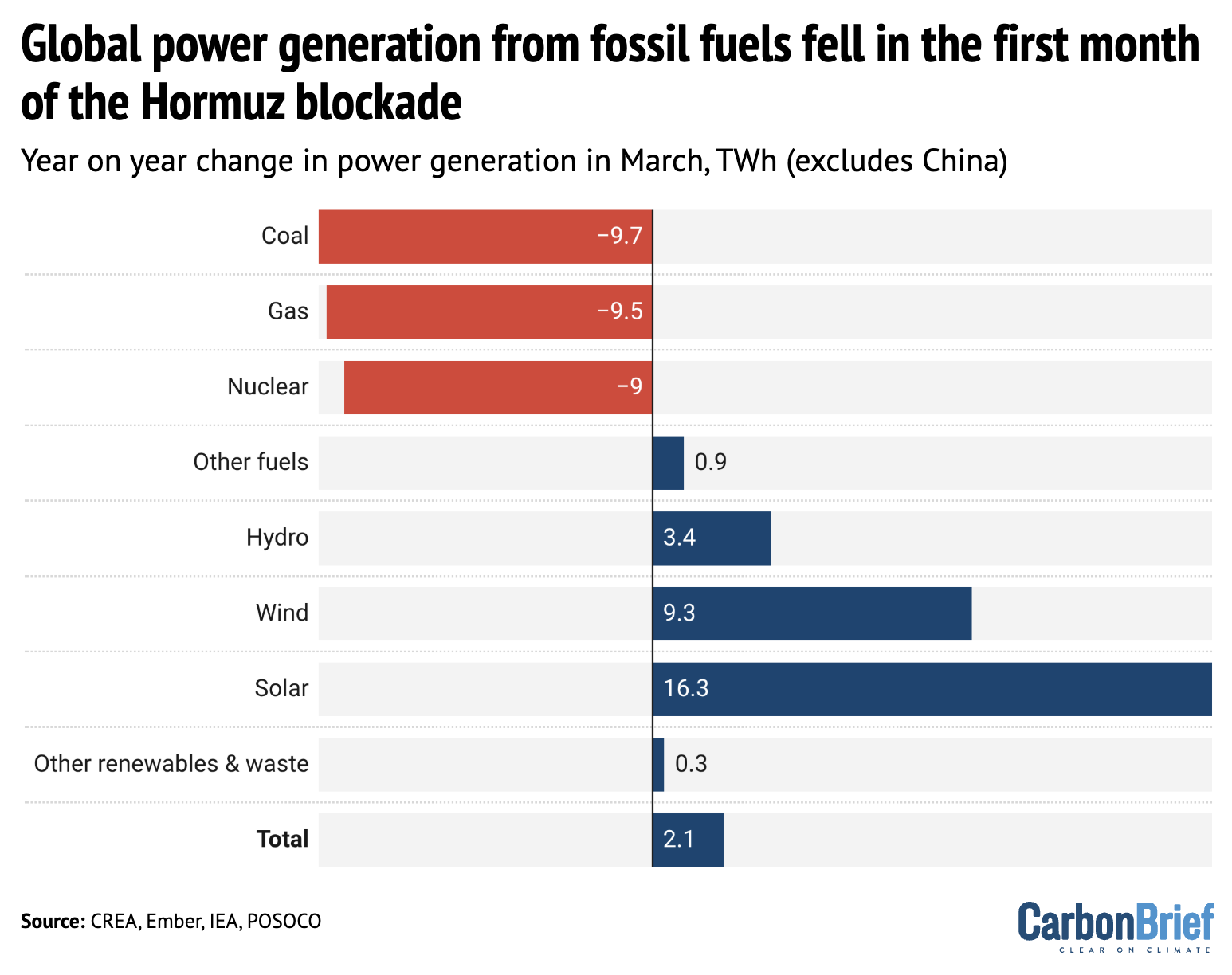
Global power generation from fossil fuels fell in the first month of the Hormuz blockade.

Analysis by the Centre for Research on Energy and Clean Air (CREA) found that global electricity generation from fossil fuels fell in the first month of the closure of the Strait of Hormuz. Across all countries with real-time electricity data outside of China, coal-fired power generation fell 3.5% and gas-fired power generation fell 4.0%, according to CREA. This was offset by a rise in solar power and wind generation, which increased by 14% and 8%, respectively. Hydropower generation also saw a small increase, the analysis showed, but this was “more than offset” by a drop in nuclear power generation.

Spotlight

How climate change affects Afghan lives

This week, Carbon Brief reports on the impact of climate change in Afghanistan, following deadly floods this year.

Earlier this month, heavy rains, flash floods and landslides struck large parts of Afghanistan, damaging thousands of homes, destroying crops, bridges and roads and taking nearly 100 lives.

The flooding – reported to have affected 74,000 people in 31 of 34 provinces – is the latest weather-related catastrophe to afflict the nation, whose communities have suffered the brunt of repeated flash floods, droughts and landslides in recent years.

Hameed Hakimi, non-resident senior fellow at the Atlantic Council’s South Asia Center, told Carbon Brief the recent floods would hurt livelihoods and food security, noting reports of destroyed wheat and rice crops in the most affected eastern parts of the country. He said:

“This is common. For at least a decade now, [we have seen] these flash floodings and the damage that happens to rural life, farming, the disruption to crops…Flash flooding physically eats up the land. So, it not only damages where people live, but also people’s livelihoods, based on what they grow.”

The damage to crops will be felt acutely, he explained, given that food security in the landlocked nation is already strained by the blockage of its main transit trade artery through Pakistan and international sanctions that have frozen long-term development aid.

Speaking to Carbon Brief, Abdulhadi Achakzai, founding CEO of the Environmental Protection Trainings and Development Organization (EPTDO), an Afghan NGO, described flooding in Afghanistan as a “chronic situation”.

Achakzai, whose organisation runs projects that help urban and rural communities adapt to climate impacts, says climate change hurts the country in four key ways: extreme drought; extreme temperature; “natural hazards”, including landslides and dust storms; and, finally, flash flooding. He said:

“Climate change is a serious matter in Afghanistan. Every nation and every corner within this country is severely affected.”

Ranked 176 of 187 on the University of Notre Dame “global adaptation index”, Afghanistan is among the countries most vulnerable to climate change.

Average temperature across the country has increased from 12.2C in 1960 to 14.2C in 2024, according to the World Bank’s climate change knowledge portal. Drought is widespread, severe and persistent – harming food and water security in a nation of subsistence farmers.

Meanwhile, extreme weather events are the leading driver of internal displacement in the country. More than three-quarters of the 710,000 people who relocated within Afghanistan in 2024 did so driven by “environmental hazards”, such as drought and flood, according to a recent climate vulnerability assessment from the International Organization for Migration.

A UNDP-funded workshop run by EPTDO in Badakhshan, north-eastern Afghanistan
A UNDP-funded workshop run by EPTDO in Badakhshan, north-eastern Afghanistan Credit: EPTDO.

Finance struggles

Despite feeling the impacts of extreme weather, Afghanistan has been barred from UN climate negotiations and had limited access to climate finance since 2021. (The government attended COP29 in Baku as guests of the Azerbaijan hosts, but did not take part in formal negotiations.)

This is because the international community does not recognise the Taliban government, which resumed power in 2021, due to its record on human rights and its repression of women and girls in particular.

Almost all financing from key climate funds has been suspended, with the exception of a few projects where UN agencies and NGOs act simultaneously as a “requesting” and “implementation” partner.

Aid from UN climate funds fell from $5.9m annually over 2014-20 to $3.9m annually over 2021-24, according to recent analysis by the Berghof Foundation. Multilateral development banks provided a further $337m of funds badged as “climate finance” over 2021-23, it said.

By comparison, Afghanistan’s national climate plan, submitted to the UN Framework Convention on Climate Change (UNFCCC) in 2016, requested $17.4bn in climate finance over 2020-30. An updated national climate plan seen by Carbon Brief – completed in 2021 and later endorsed by the Taliban government, but not accepted by member governments of the UNFCCC – called for $20.6bn through to 2030.

Achakzai, whose organisation attends the COP climate summit each year in an observer capacity, has in the past been the sole delegate from Afghanistan to the conference.

He is calling on the UNFCCC to accept the country’s latest climate plan – and to find an “alternative solution” that would give the people of the country a voice in negotiations. He said:

“Every year we are losing hundreds, thousands of people because of climate change-related matters. Every year we are losing hundreds, thousands of hectares of crops. We are affected by [the decisions of] other countries. Why are we not part of this process?”

Watch, read, listen

BLOSSOM WATCHER: The Guardian reported on the successful search to find a researcher to continue Japan’s 1,200-year cherry blossom record.

COP OUT: Deutsche Welle spoke to experts to understand why India walked away from its bid to host COP33 in 2028.

‘BOMBS AND PORN’: The New Republic looked at who is set to benefit from the rapid build-out of energy-intensive AI datacentres.

Coming up

  • 20-24 April: Intergovernmental Panel on Climate Change (IPCC) working group one report author meeting, Santiago, Chile
  • 22 April: Earth day
  • 22 April: Launch of third edition of the Lancet Countdown’s Europe report
  • 24-29 April: First conference on transitioning away from fossil fuels, Santa Marta, Colombia

Pick of the jobs

DeBriefed is edited by Daisy Dunne. Please send any tips or feedback to debriefed@carbonbrief.org.

This is an online version of Carbon Brief’s weekly DeBriefed email newsletter. Subscribe for free here.


The post DeBriefed 17 April 2026: Fossil-fuel power slumps | ‘Super’ El Niño warning | Afghanistan’s climate struggle appeared first on Carbon Brief.

DeBriefed 17 April 2026: Fossil-fuel power slumps | ‘Super’ El Niño warning | Afghanistan’s climate struggle

Continue Reading

Climate Change

The 2026 budget test: Will Australia break free from fossil fuels?

Published

on

In 2026, the dangers of fossil fuel dependence have been laid bare like never before. The illegal invasion of Iran has brought pain and destruction to millions across the Middle East and triggered a global energy crisis impacting us all. Communities in the Pacific have been hit especially hard by rising fuel prices, and Australians have seen their cost-of-living woes deepen.

Such moments of crisis and upheaval can lead to positive transformation. But only when leaders act with courage and foresight.

There is no clearer statement of a government’s plans and priorities for the nation than its budget — how it plans to raise money, and what services, communities, and industries it will invest in.

As we count down the days to the 2026-27 Federal Budget, will the Albanese Government deliver a budget for our times? One that starts breaking the shackles of fossil fuels, accelerates the shift to clean energy, protects nature, and sees us work together with other countries towards a safer future for all? Or one that doubles down on coal and gas, locks in more climate chaos, and keeps us beholden to the whims of tyrants and billionaires.

Here’s what we think the moment demands, and what we’ll be looking out for when Treasurer Jim Chalmers steps up to the dispatch box on 12 May.

1. Stop fuelling the fire
2. Make big polluters pay
3. Support everyone to be part of the solution
4. Build the industries of the future
5. Build community resilience
6. Be a better neighbour
7. Protect nature

1. Stop fuelling the fire

Action Calls for a Transition Away From Fossil Fuels in Vanuatu. © Greenpeace
The community in Mele, Vanuatu sent a positive message ahead of the First Conference on Transitioning Away from Fossil Fuels. © Greenpeace

In mid-April, Pacific governments and civil society met to redouble their efforts towards a Fossil Fuel Free Pacific. Moving beyond coal, oil and gas is fundamental to limiting warming to 1.5°C — a survival line for vulnerable communities and ecosystems. And as our Head of Pacific, Shiva Gounden, explained, it is “also a path of liberation that frees us from expensive, extractive and polluting fossil fuel imports and uplifts our communities”.

Pacific countries are at the forefront of growing global momentum towards a just transition away from fossil fuels, and it is way past time for Australia to get with the program. It is no longer a question of whether fossil fuel extraction will end, but whether that end will be appropriately managed and see communities supported through the transition, or whether it will be chaotic and disruptive.

So will this budget support the transition away from fossil fuels, or will it continue to prop up coal and gas?

When it comes to sensible moves the government can make right now, one stands out as a genuine low hanging fruit. Mining companies get a full rebate of the excise (or tax) that the rest of us pay on diesel fuel. This lowers their operating costs and acts as a large, ongoing subsidy on fossil fuel production — to the tune of $11 billion a year!

Greenpeace has long called for coal and gas companies to be removed from this outdated scheme, and for the billions in savings to be used to support the clean energy transition and to assist communities with adapting to the impacts of climate change. Will we see the government finally make this long overdue change, or will it once again cave to the fossil fuel lobby?

2. Make big polluters pay

Activists Disrupt Major Gas Conference in Sydney. © Greenpeace
Greenpeace Australia Pacific activists disrupted the Australian Domestic Gas Outlook conference in Sydney with the message ‘Gas execs profit, we pay the price’. © Greenpeace

While our communities continue to suffer the escalating costs of climate-fuelled disasters, our Government continues to support a massive expansion of Australia’s export gas industry. Gas is a dangerous fossil fuel, with every tonne of Australian gas adding to the global heating that endangers us all.

Moreover, companies like Santos and Woodside pay very little tax for the privilege of digging up and selling Australians’ natural endowment of fossil gas. Remarkably, the Government currently raises more tax from beer than from the Petroleum Resource Rent Tax (PRRT) — the main tax on gas profits.

Momentum has been building to replace or supplement the PRRT with a 25% tax on gas exports. This could raise up to $17 billion a year — funds that, like savings from removing the diesel tax rebate for coal and gas companies, could be spent on supporting the clean energy transition and assisting communities with adapting to worsening fires, floods, heatwaves and other impacts of climate change.

As politicians arrive in Canberra for budget week, they will be confronted by billboards calling for a fair tax on gas exports. The push now has the support of dozens of organisations and a growing number of politicians. Let’s hope the Treasurer seizes this rare window for reform.

3. Support everyone to be part of the solution

As the price of petrol and diesel rises, electric vehicles (EVs) are helping people cut fuel use and save money. However, while EV sales have jumped since the invasion of Iran sent fuel prices rising, they still only make up a fraction of total new car sales. This budget should help more Australians switch to electric vehicles and, even more importantly, enable more Australians to get around by bike, on foot, and on public transport. This means maintaining the EV discount, investing in public and active transport, and removing tax breaks for fuel-hungry utes and vans.

Millions of Australians already enjoy the cost-saving benefits of rooftop solar, batteries, and getting off gas. This budget should enable more households, and in particular those on lower incomes, to access these benefits. This means maintaining the Cheaper Home Batteries Program, and building on the Household Energy Upgrades Fund.

4. Build the industries of the future

Protest of Woodside and Drill Rig Valaris at Scarborough Gas Field in Western Australia. © Greenpeace / Jimmy Emms
Crew aboard Greenpeace Australia Pacific’s campaigning vessel the Oceania conducted a peaceful banner protest at the site of the Valaris DPS-1, the drill rig commissioned to build Woodside’s destructive Burrup Hub. © Greenpeace / Jimmy Emms

If we’re to transition away from fossil fuels, we need to be building the clean industries of the future.

No state is more pivotal to Australia’s energy and industrial transformation than Western Australia. The state has unrivaled potential for renewable energy development and for replacing fossil fuel exports with clean exports like green iron. Such industries offer Western Australia the promise of a vibrant economic future, and for Australia to play an outsized positive role in the world’s efforts to reduce emissions.

However, realising this potential will require focussed support from the Federal Government. Among other measures, Greenpeace has recommended establishing the Australasian Green Iron Corporation as a joint venture between the Australian and Western Australian governments, a key trading partner, a major iron ore miner and steel makers. This would unite these central players around the complex task of building a large-scale green iron industry, and unleash Western Australia’s potential as a green industrial powerhouse.

5. Build community resilience

Believe it or not, our Government continues to spend far more on subsidising fossil fuel production — and on clearing up after climate-fuelled disasters — than it does on helping communities and industries reduce disaster costs through practical, proven methods for building their resilience.

Last year, the Government estimated that the cost of recovery from disasters like the devastating 2022 east coast floods on 2019-20 fires will rise to $13.5 billion. For contrast, the Government’s Disaster Ready Fund – the main national source of funding for disaster resilience – invests just $200 million a year in grants to support disaster preparedness and resilience building. This is despite the Government’s own National Emergency Management Agency (NEMA) estimating that for every dollar spent on disaster risk reduction, there is a $9.60 return on investment.

By redirecting funds currently spent on subsidising fossil fuel production, the Government can both stop incentivising climate destruction in the first place, and ensure that Australian communities and industries are better protected from worsening climate extremes.

No communities have more to lose from climate damage, or carry more knowledge of practical solutions, than Aboriginal and Torres Strait Islander peoples. The budget should include a dedicated First Nations climate adaptation fund, ensuring First Nations communities can develop solutions on their own terms, and access the support they need with adapting to extreme heat, coastal erosion and other escalating challenges.

6. Be a better neighbour

The global response to climate change depends on the adequate flow of support from developed economies like Australia to lower income nations with shifting to clean energy, adapting to the impacts of climate change, and addressing loss and damage.

Such support is vital to building trust and cooperation, reducing global emissions, and supporting regional and global security by enabling countries to transition away from fossil fuels and build greater resilience.

Despite its central leadership role in this year’s global climate negotiations, our Government is yet to announce its contribution to international climate finance for 2025-2030. Greenpeace recommends a commitment of $11 billion for this five year period, which is aligned with the global goal under the Paris Agreement to triple international climate finance from current levels.
This new commitment should include additional funding to address loss and damage from climate change and a substantial contribution to the Pacific Resilience Facility, ensuring support is accessible to countries and communities that need it most. It should also see Australia get firmly behind the vision of a Fossil Fuel Free Pacific.

7. Protect nature

Rainforest in Tasmania. © Markus Mauthe / Greenpeace
Rainforest of north west Tasmania in the Takayna (Tarkine) region. © Markus Mauthe / Greenpeace

There is no safe planet without protection of the ecosystems and biodiversity that sustain us and regulate our climate.

Last year the Parliament passed important and long overdue reforms to our national environment laws to ensure better protection for our forests and other critical ecosystems. However, the Government will need to provide sufficient funding to ensure the effective implementation of these reforms.

Greenpeace has recommended $500 million over four years to establish the National Environment Agency — the body responsible for enforcing and monitoring the new laws — and a further $50 million to Environment Information Australia for providing critical information and tools.

Further resourcing will also be required to fulfil the crucial goal of fully protecting 30% of Australian land and seas by 2030. This should include $1 billion towards ending deforestation by enabling farmers and loggers to retool away from destructive practices, $2 billion a year for restoring degraded lands, $5 billion for purchasing and creating new protected areas, and $200 million for expanding domestic and international marine protected areas.

Conclusion

This is not the first time that conflict overseas has triggered an energy crisis, or that a budget has been preceded by a summer of extreme weather disasters, highlighting the urgent need to phase out fossil fuels. What’s different in 2026 is the availability of solutions. Renewable energy is now cheaper and more accessible than ever before. Global momentum is firmly behind the transition away from fossil fuels. The Albanese Government, with its overwhelming majority, has the chance to set our nation up for the future, or keep us stranded in the past. Let’s hope it makes some smart choices.

The 2026 budget test: Will Australia break free from fossil fuels?

Continue Reading

Climate Change

What fossil fuels really cost us in a world at war

Published

on

Anne Jellema is Executive Director of 350.org.

The war on Iran and Lebanon is a deeply unjust and devastating conflict, killing civilians at home, destroying lives, and at the same time sending shockwaves through the global economy. We, at 350.org, have calculated, drawing on price forecasts from the International Monetary Fund (IMF) and Goldman Sachs, just how much that volatility is costing us. 

Even under the IMF’s baseline scenario – a de facto “best case” scenario with a near-term end to the war and related supply chain disruptions – oil and gas price spikes are projected to cost households and businesses globally more than $600 billion by the end of the year. Under the IMF’s “adverse scenario”, with prolonged conflict and sustained price pressures, we estimate those additional costs could exceed $1 trillion, even after accounting for reduced demand.

Which is why we urgently need a power shift. Governments are under growing pressure to respond to rising fuel and food costs and deepening energy poverty. And it’s becoming clearer to both voters and elected officials that fossil dependence is not only expensive and risky, but unnecessary. 

People who can are voting with their wallets: sales of solar panels and electric vehicles are increasing sharply in many countries. But the working people who have nothing to spare, ironically, are the ones stuck with using oil and gas that is either exorbitantly expensive or simply impossible to get.

Drain on households and economies

In India, street food vendors can’t get cooking gas and in the Philippines, fishermen can’t afford to take their boats to sea. A quarter of British people say that rising energy tariffs will leave them completely unable to pay their bills. This is the moment for a global push to bring abundant and affordable clean energy to all.

In April, we released Out of Pocket, our new research report on how fossil fuels are draining households and economies. We were surprised by the scale of what we found. For decades, governments have reassured people that energy price spikes are unfortunate but unavoidable – the result of distant conflicts, market forces or geopolitical shocks beyond anyone’s control. But the numbers tell a different story. 

    What we are living through today is not an energy crisis. It is a fossil fuel crisis. In just the first 50 days of the Middle East conflict, soaring oil and gas prices have siphoned an estimated $158 billion–$166 billion from households and businesses worldwide. That is money extracted directly from people’s pockets and transferred, almost instantly, into fossil fuel company balance sheets. And this figure only captures the immediate impact of price spikes, not the permanent economic drain of fossil dependence. Fossil fuels don’t just cost us once, they cost us over and over again.

    First, through our bills. Every time there is a war, an embargo or a supply disruption, fossil fuel prices surge. For ordinary people, this means higher costs for energy, transport and food. Many Global South countries have little or no fiscal space to buffer the shock; instead, workers and families pay the price.

    Second, through our taxes. Governments around the world continue to pour vast sums of public money into fossil fuel subsidies. These are often justified as a way to protect the most vulnerable at the petrol pump or in their homes. But in reality, the benefits are overwhelmingly captured by wealthier households and corporations. The poorest 20% receive just a fraction of this support, while public finances are drained.

    Third, through climate impacts. New research across more than 24,000 global locations gives a granular account of the true costs of extreme heat, sea level rise and falling agricultural yields. Using this data to update IMF modelling of the social cost of carbon, we found that fossil fuel impacts on health and livelihoods amount to over $9 trillion a year. This is the biggest subsidy of all, because these massive and mounting costs are not charged to Big Oil – they are paid for by governments and households, with the poorest shouldering the lion’s share. 

    Massive transfer of wealth to fossil fuel industry

    Adding up direct subsidies, tax breaks and the unpaid bill for climate damages, the total transfer of wealth from the public to the fossil fuel industry amounts to $12 trillion even in a “normal” year without a global oil shock. That’s more than 50% higher than the IMF has previously estimated, and equivalent to a staggering $23 million a minute.

    The fossil fuel industry has become extraordinarily adept at profiting from instability. When conflict drives up prices, companies do not lose, they gain. In the current crisis, oil producers and commodity traders are on track to secure tens of billions of dollars in additional windfall profits, even as households face rising bills and governments struggle to manage the fallout.

    Fossil fuel crisis offers chance to speed up energy transition, ministers say

    This growing disconnect is impossible to ignore. Investors are advised to buy into fossil fuel firms precisely because of their ability to generate profits in times of crisis. Meanwhile, ordinary people are told to tighten their belts.

    In 2026, unlike during the oil shocks of the 1970s, clean energy is no longer a distant alternative. Now, even more than when gas prices spiked due to Russia’s invasion of Ukraine in 2022, renewables are often the cheapest option available. Solar and wind can be deployed quickly, at scale, and without the volatility that defines fossil fuel markets.

    How to transition from dirty to clean energy

    The solutions are clear. Governments must implement permanent windfall taxes on fossil fuel companies to ensure that extraordinary profits generated during crises are redirected to support households. These revenues can be used to reduce energy bills, invest in public services, and accelerate the rollout of clean energy.

    Second, we must shift subsidies away from fossil fuels and towards renewable solutions, particularly those that can be deployed quickly and equitably, such as rooftop and community solar. This is not just about cutting emissions. It is about building a more stable, fair and resilient energy system.

    Finally, we need binding plans to phase out fossil fuels altogether, replacing them with homegrown renewable energy that can shield economies from future shocks. Because what the current crisis has made clear is this: as long as we remain dependent on fossil fuels, we remain vulnerable – to conflict, to price volatility and to the escalating impacts of climate change.

    The true price of fossil fuels is no longer hidden. It is visible in rising bills, strained public finances and communities pushed to the brink. And it is being paid, every day, by ordinary people around the world.

    It’s time for the great power shift

    Full details on the methodology used for this report are available here.

    The Great Power Shift is a new campaign by 350.org global campaign to pressure governments to bring down energy bills for good by ending fossil fuel dependence and investing in clean, affordable energy for all

    Logo of 350.org campaign on “The Great Power Shift”

    Logo of 350.org campaign on “The Great Power Shift”

    The post What fossil fuels really cost us in a world at war appeared first on Climate Home News.

    What fossil fuels really cost us in a world at war

    Continue Reading

    Climate Change

    Traditional models still ‘outperform AI’ for extreme weather forecasts

    Published

    on

    Computer models that use artificial intelligence (AI) cannot forecast record-breaking weather as well as traditional climate models, according to a new study.

    It is well established that AI climate models have surpassed traditional, physics-based climate models for some aspects of weather forecasting.

    However, new research published in Science Advances finds that AI models still “underperform” in forecasting record-breaking extreme weather events.

    The authors tested how well both AI and traditional weather models could simulate thousands of record-breaking hot, cold and windy events that were recorded in 2018 and 2020.

    They find that AI models underestimate both the frequency and intensity of record-breaking events.

    A study author tells Carbon Brief that the analysis is a “warning shot” against replacing traditional models with AI models for weather forecasting “too quickly”.

    AI weather forecasts

    Extreme weather events, such as floods, heatwaves and storms, drive hundreds of billions of dollars in damages every year through the destruction of cropland, impacts on infrastructure and the loss of human life.

    Many governments have developed early warning systems to prepare the general public and mobilise disaster response teams for imminent extreme weather events. These systems have been shown to minimise damages and save lives.

    For decades, scientists have used numerical weather prediction models to simulate the weather days, or weeks, in advance.

    These models rely on a series of complex equations that reproduce processes in the atmosphere and ocean. The equations are rooted in fundamental laws of physics, based on decades of research by climate scientists. As a result, these models are referred to as “physics-based” models.

    However, AI-based climate models are gaining popularity as an alternative for weather forecasting.

    Instead of using physics, these models use a statistical approach. Scientists present AI models with a large batch of historical weather data, known as training data, which teaches the model to recognise patterns and make predictions.

    To produce a new forecast, the AI model draws on this bank of knowledge and follows the patterns that it knows.

    There are many advantages to AI weather forecasts. For example, they use less computing power than physics-based models, because they do not have to run thousands of mathematical equations.

    Furthermore, many AI models have been found to perform better than traditional physics-based models at weather forecasts.

    However, these models also have drawbacks.

    Study author Prof Sebastian Engelke, a professor at the research institute for statistics and information science at the University of Geneva, tells Carbon Brief that AI models “depend strongly on the training data” and are “relatively constrained to the range of this dataset”.

    In other words, AI models struggle to simulate brand new weather patterns, instead tending forecast events of a similar strength to those seen before. As a result, it is unclear whether AI models can simulate unprecedented, record-breaking extreme events that, by definition, have never been seen before.

    Record-breaking extremes

    Extreme weather events are becoming more intense and frequent as the climate warms. Record-shattering extremes – those that break existing records by large margins – are also becoming more regular.

    For example, during a 2021 heatwave in north-western US and Canada, local temperature records were broken by up to 5C. According to one study, the heatwave would have been “impossible” without human-caused climate change.

    The new study explores how accurately AI and physics-based models can forecast such record-breaking extremes.

    First, the authors identified every heat, cold and wind event in 2018 and 2020 that broke a record previously set between 1979 and 2017. (They chose these years due to data availability.) The authors use ERA5 reanalysis data to identify these records.

    This produced a large sample size of record-breaking events. For the year 2020, the authors identified around 160,000 heat, 33,000 cold and 53,000 wind records, spread across different seasons and world regions.

    For their traditional, physics-based model, the authors selected the High RESolution forecast model from the Integrated Forecasting System of the European Centre for Medium-­Range Weather Forecasts. This is “widely considered as the leading physics-­based numerical weather prediction model”, according to the paper.

    They also selected three “leading” AI weather models – the GraphCast model from Google Deepmind, Pangu-­Weather developed by Huawei Cloud and the Fuxi model, developed by a team from Shanghai.

    The authors then assessed how accurately each model could forecast the extremes observed in the year 2020.

    Dr Zhongwei Zhang is the lead author on the study and a researcher at Karlsruhe Institute of Technology. He tells Carbon Brief that many AI weather forecast models were built for “general weather conditions”, as they use all historical weather data to train the models. Meanwhile, forecasting extremes is considered a “secondary task” by the models.

    The authors explored a range of different “lead times” – in other words, how far into the future the model is forecasting. For example, a lead time of two days could mean the model uses the weather conditions at midnight on 1 January to simulate weather conditions at midnight on 3 January.

    The plot below shows how accurately the models forecasted all extreme events (left) and heat extremes (right) under different lead times. This is measured using “root mean square error” – a metric of how accurate a model is, where a lower value indicates lower error and higher accuracy.

    The chart on the left shows how two of the AI models (blue and green) performed better than the physics-based model (black) when forecasting all weather across the year 2020.

    However, the chart on the right illustrates how the physics-based model (black) performed better than all three AI models (blue, red and green) when it came to forecasting heat extremes.

    Accuracy of the AI models
    Accuracy of the AI models (blue, red and green) and the physics-based model (black) at forecasting all weather over 2020 (left) and heat extremes (right) over a range of lead times. This is measured using “root mean square error” (RMSE) – a metric of how accurate a model is, where a lower value indicates lower error and higher accuracy. Source: Zhang et al (2026).

    The authors note that the performance gap between AI and physics-based models is widest for lower lead times, indicating that AI models have greater difficulty making predictions in the near future.

    They find similar results for cold and wind records.

    In addition, the authors find that AI models generally “underpredict” temperature during heat records and “overpredict” during cold records.

    The study finds that the larger the margin that the record is broken by, the less well the AI model predicts the intensity of the event.

    ‘Warning shot’

    Study author Prof Erich Fischer is a climate scientist at ETH Zurich and a Carbon Brief contributing editor. He tells Carbon Brief that the result is “not unexpected”.

    He adds that the analysis is a “warning shot” against replacing traditional models with AI models for weather forecasting “too quickly”.

    The analysis, he continues, is a “warning shot” against replacing traditional models with AI models for weather forecasting “too quickly”.

    AI models are likely to continue to improve, but scientists should “not yet” fully replace traditional forecasting models with AI ones, according to Fischer.

    He explains that accurate forecasts are “most needed” in the runup to potential record-breaking extremes, because they are the trigger for early warning systems that help minimise damages caused by extreme weather.

    Leonardo Olivetti is a PhD student at Uppsala University, who has published work on AI weather forecasting and was not involved in the study.

    He tells Carbon Brief that “many other studies” have identified issues with using AI models for “extremes”, but this paper is novel for its specific focus on extremes.

    Olivetti notes that AI models are already used alongside physics-based models at “some of the major weather forecasting centres around the world”. However, the study results suggest “caution against relying too heavily on these [AI] models”, he says.

    Prof Martin Schultz, a professor in computational earth system science at the University of Cologne who was not involved in the study, tells Carbon Brief that the results of the analysis are “very interesting, but not too surprising”.

    He adds that the study “justifies the continued use of classical numerical weather models in operational forecasts, in spite of their tremendous computational costs”.

    Advances in forecasting

    The field of AI weather forecasting is evolving rapidly.

    Olivetti notes that the three AI models tested in the study are an “older generation” of AI models. In the last two years, newer “probabilistic” forecast models have emerged that “claim to better capture extremes”, he explains.

    The three AI models used in the analysis are “deterministic”, meaning that they only simulate one possible future outcome.

    In contrast, study author Engelke tells Carbon Brief that probabilistic models “create several possible future states of the weather” and are therefore more likely to capture record-breaking extremes.

    Engelke says it is “important” to evaluate the newer generation of models for their ability to forecast weather extremes.

    He adds that this paper has set out a “protocol” for testing the ability of AI models to predict unprecedented extreme events, which he hopes other researchers will go on to use.

    The study says that another “promising direction” for future research is to develop models that combine aspects of traditional, physics-based weather forecasts with AI models.

    Engelke says this approach would be “best of both worlds”, as it would combine the ability of physics-based models to simulate record-breaking weather with the computational efficiency of AI models.

    Dr Kyle Hilburn, a research scientist at Colorado State University, notes that the study does not address extreme rainfall, which he says “presents challenges for both modelling and observing”. This, he says, is an “important” area for future research.

    The post Traditional models still ‘outperform AI’ for extreme weather forecasts appeared first on Carbon Brief.

    Traditional models still ‘outperform AI’ for extreme weather forecasts

    Continue Reading

    Trending

    Copyright © 2022 BreakingClimateChange.com