

Welcome to Carbon Brief’s Cropped.
We handpick and explain the most important stories at the intersection of climate, land, food and nature over the past fortnight.
This is an online version of Carbon Brief’s fortnightly Cropped email newsletter. Subscribe for free here.
Key developments
Europe focuses on biodiversity
‘WORSE THAN TERRORISM’: Climate change and biodiversity loss pose a more “fundamental threat” to the UK than terrorism or Vladimir Putin, UK foreign secretary David Lammy said in his first major policy address, the Independent reported. Giving a speech at London’s Kew Gardens, Lammy said that climate change and biodiversity loss “may not feel as urgent as a terrorist or an imperialist autocrat”, but they are “more fundamental…systemic…pervasive…and accelerating towards us”, the Independent said. The Financial Times said that Lammy pledged that climate change and biodiversity loss would be “central to all the Foreign Office does”, and that he will create “special representatives” in each area. The Guardian noted this will be the first time the UK has appointed a special envoy for nature.
RISE OF RIBERA: Elsewhere, Teresa Ribera, Spain’s ecological transition minister, has been appointed as EU commissioner Ursula von der Leyen’s second-in-command, with a “vast portfolio” including climate and competition policy, Politico reported. The Guardian said that the “outspoken” Ribera is to become one of six vice-presidents in the incoming EU executive led by von der Leyen, which is expected to start work at the end of the year. Euronews said that green activists have “breathed a sigh of relief” at the appointment.
AGRICULTURE COMMISSIONER: Von der Leyen has also appointed a new agricultural commissioner in Christophe Hansen, a Luxembourg MP from the centre-right Christian Social People’s party, the Irish Independent reported. According to the newspaper, von der Leyen has given Hansen “100 days to prepare a vision for the EU agriculture and food sectors”, tasking him with ensuring they are both competitive and “within the boundaries of our planet”. Portuguese news agency Lusa said that Portuguese farmers have “high expectations” that Hansen will prioritise the needs of agricultural workers. Elsewhere, DeSmog has mapped “Ireland’s powerful farming lobby”.
Australia’s deforestation hotspots
OUTLIERS: A new report from the environment and heritage department of the New South Wales government found that more than 45,000 hectares of native vegetation were cleared in 2022 to make way for farming, infrastructure and other projects. Nathaniel Pelle, a campaigner with the Australian Conservation Foundation, told the Sydney Morning Herald that Australia is an “outlier among wealthy countries for forest loss”. He added: “Europe has been historically cleared, Canada has been historically cleared, the US and Australia have been historically cleared, but what separates us from them is that we’re still doing it.” Deforestation in the state is “among [the] worst in the world”, the newspaper wrote.
‘ZOMBIE INDUSTRY’: The report showed that land clearing has been on the rise since 2015, when the previous government announced upcoming changes to its land-clearing laws, the outlet said. In a separate article, the Sydney Morning Herald called logging in the neighbouring state of Victoria the “‘zombie’ industry that won’t die”. According to the newspaper, “commercial logging officially ended” on 1 January, but timber mills “continue to process native hardwood timbers” – sourced from private landowners and from the government’s “fuel-reduction” wildfire-prevention strategies. The outlet wrote: “Environment groups say logging is now taking place without proper planning or oversight, leaving threatened species at risk.”
EPA ON THE AGENDA: Despite promises to “develop new nature legislation” and put nature “back on the priority list”, Australia’s Labor government – elected in May 2022 – “has not lived up to…early rhetoric” around nature protection, Adam Morton wrote in a column for the Guardian. Morton noted that the push to create a national environment agency, Environment Protection Australia, “look[s] to be in trouble”, as deals with either the Greens or the Coalition look unlikely. Writing in the Conversation, environmental-law expert Dr Justine Bell-James said: “All this is bad news for our threatened species and sick ecosystems. We know what needs to be done. But our government is showing worrying signs of letting industry and developers control their environmental agenda.”
Spotlight
Humans and polar bears collide at Earth’s Arctic research hub
In this spotlight, Carbon Brief reports from the Earth’s most-northerly human settlement, which is increasingly facing polar bear encounters amid rapid Arctic change.
Ask anyone living and working in Ny-Ålesund – the Earth’s most northern human settlement, located on the Norwegian archipelago of Svalbard in the Arctic Ocean – what they perceive to be the number one threat to their safety and they will each offer the same answer: polar bears.
A little more than 1,200km from the North Pole, the tiny Arctic town of Ny-Ålesund started life as a coal mining district in the early 20th century, but today operates solely as an international climate research hub, hosting about 60 scientists at its busiest time in the summer months.
The vast Arctic wilderness surrounding the town is home to one of the world’s largest permanent polar bear populations.
Protective measures
Ever since Ny-Ålesund’s inception, the company running logistics in the town has implemented strict protocols with the aim of protecting people from polar bears.
The few roads leading out of town are marked with polar bear hazard signs. Nearly every communal building in the town carries posters with instructions of what to do in the event of a polar bear sighting.
When researchers go out into the field to carry out their research, at least one of them must act as a “polar bear guard” – meaning they need to pass shooting practice and carry a rifle in case they need to kill a bear in an emergency.
“We are entering a habitat that is not ours,” Dorothea Moser, an ice cores researcher with the British Antarctic Survey, the UK’s polar research institute, told Carbon Brief. “With polar bear protection, we’re trying to protect both us as researchers and the polar bear.”
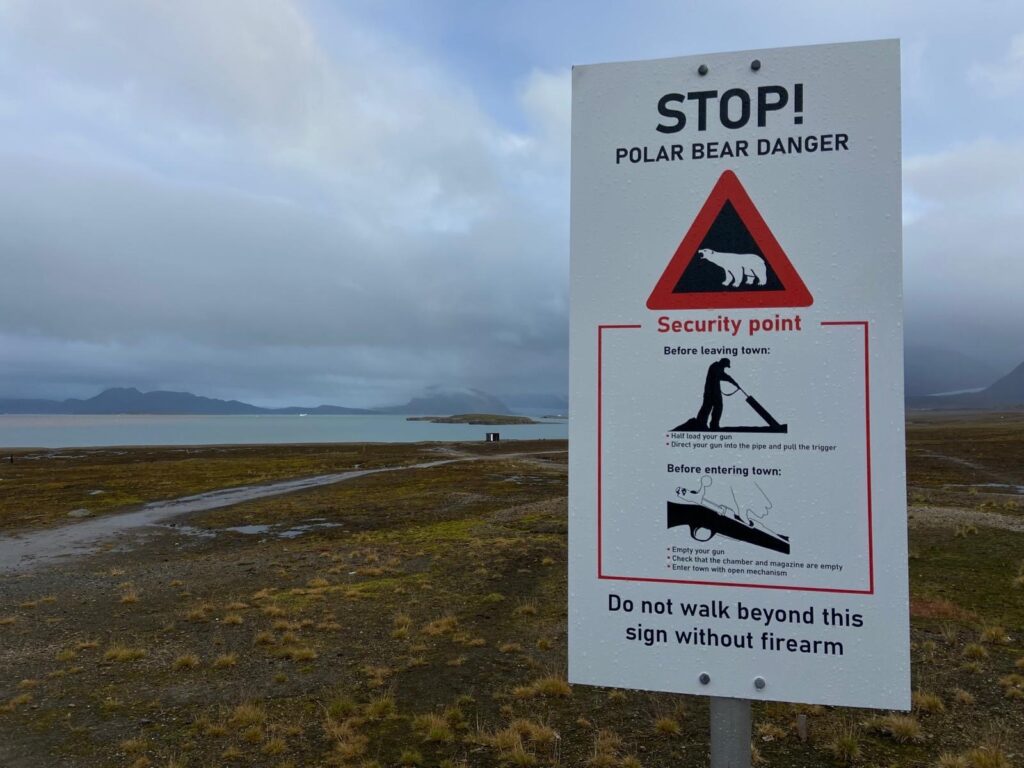
As part of the protective measures when out in the field, guards carry binoculars and constantly scan the environment around them. If they spot a bear on the horizon, the research team will immediately leave the area and notify the town.
If a polar bear is spotted within contact distance – the animals can run at speeds up to 25 miles per hour – then researchers will let off a flare in an attempt to scare it away.
“We can defend ourselves with flares, we’re scaring away the polar bear and creating more space between us in a defensive way,” Moser added. “Of course, we also have to carry a weapon, but we hope that we never have to use it. In the past 30 years, we have not had any lethal encounters.”
Rapid change
These strict measures have protected both scientists and bears for decades in Ny-Ålesund, but rapid change in the region could threaten this delicate balance.
Svalbard bears were nearly hunted to extinction in the 20th century. However, a ban was put in place in 1973, which saw numbers recover. Now, the Beaufort Sea subpopulation, which includes Svalbard bears, is considered “stable”.
However, climate change is causing Svalbard’s environment to shift rapidly, with temperatures rising seven times faster than the global average.
Rapid warming has had a devastating impact on sea ice, which blankets the Arctic Ocean in the cooler winter months before shrinking back at the height of summer. As the Earth warms, the extent of the sea ice in summer is becoming smaller every year.
This is a problem for polar bears, which use sea ice to hunt seals, their main source of prey. Research has found that the disappearance of sea ice is forcing bears to search further afield for food, sometimes bringing them closer towards human settlements.
Ingrid Kjerstad, research coordinator at the Norwegian Polar Institute in Ny-Ålesund, which oversees all scientific research in the town, told Carbon Brief that their records show the number of polar bears coming into contact with humans in the region has increased in recent years.
An increase in human-bear encounters is a worry for both researchers and wildlife. Although scientists in Ny-Ålesund have avoided shooting a bear, there have been several lethal incidents involving both human and animal fatalities in Svalbard’s capital of Longyearbyen.
The evidence of more human-bear encounters in Ny-Ålesund is still “anecdotal” and has not yet been published in a peer-reviewed science journal, Kjerstad added, but is yet another sign of how rapid environmental change is transforming life at Earth’s northern edge.
News and views
BIODIVERSITY FINANCE: Funding to help developing nations address biodiversity loss grew by more than $4bn in 2022, but mostly in the form of loans, rather than grants, according to new figures from the Organisation for Economic Cooperation and Development (OECD) reported by Climate Home News. The OECD report, which analysed the period from 2015 to 2022, showed that biodiversity funding grew from $11.1bn in 2021 to $15.4bn in 2022. Climate Home News added that the increase came largely from multilateral institutions – mainly development banks – which increased their funding from $2.7bn in 2021 to $5.7bn in 2022, “mostly by offering concessional loans, which are cheaper than borrowing on commercial terms”.
DAM IT: Dams around the world will struggle to cope with increasingly common severe rainfall, “leading to an increased likelihood of failure and risk of catastrophic flooding”, according to two researchers at the IHE Delft Institute for Water Education. They added that “it is not clear what climate and hydrological data was used to design” most of the world’s dams and spillways. Covering the IHE Delft commentary, Sudanese outlet Dabanga wrote that, due to a lack of preventative maintenance, the Jebel Aulia dam south of Khartoum “may lead to a failed agricultural season” this winter. It added: “A collapse of the dam also threatens people in Khartoum.”
CALI INCOMING: The COP16 nature summit will be a key “political moment and a very important moment for biodiversity”, UN biodiversity chief Astrid Schomaker told a press conference on 23 September. Unlike the previous summit, a number of high-profile politicians are due to attend the upcoming talks in Cali, Colombia – including Brazilian president Luiz Inácio Lula da Silva and Mexico’s president-elect, Dr Claudia Sheinbaum. There will also be a “very strong presence” of Indigenous peoples at the talks, Colombia’s environment minister, Susana Muhamad, told the press briefing. Muhamad also called on richer countries to put more money into the dedicated fund to support biodiversity goals. Meanwhile, Carbon Brief has updated its interactive tracker of national biodiversity strategies and action plans to include new submissions.
ECOCIDE RECOGNITION: Vanuatu has renewed its push to recognise “ecocide” – “the severe and reckless destruction of nature” – under the Rome Statute of the International Criminal Court, the Pacific Island News Association reported. The Pacific nation first proposed the addition of ecocide in 2019, the news outlet said, and its bid received a boost from a 2021 independent expert report that “outlined the legal framework for ecocide”. The article quoted Vanuatu’s UN ambassador, Odo Tevi, who said that existing laws protecting nature “are insufficient” and that the definition should “focu[s] on the severity of the outcome rather than specific prohibited behaviours”.
SHAPE UP OR SHIP OUT: Drought in South America is forcing grain shippers “to look for alternatives” as the water level on the Paraná River has dropped precipitously, the Argentine trade publication ArgenPorts reported. Argentine officials noted that while water levels are far below normal at present, the effects of the drought “will not be as cruel and harsh as the one that occurred from 2020 to 2022”. Elsewhere, the “unprecedented drought” in Ecuador has led to “mass power cuts”, forest fires and the declaration of a “red alert” in several parts of the country, according to MercoPress.
Watch, read, listen
FOOD FOR THOUGHT: In Scientific American, science historian Prof Naomi Oreskes argued that the Svalbard Global Seed Vault “illustrate[s] why we need to prevent climate disaster rather than plan for it”.
HISTORY REPEATS: Nigeria’s the Cable examined how a burst dam that displaced 400,000 people in Borno state 30 years ago has flooded once again amid extreme rainfall in the country.
CONTINUED STRUGGLE: Despite legal wins across the world, Indigenous peoples still face evictions from their lands and struggle to obtain the reparations promised to them, a Mongabay investigation found.
PESTICIDE LOOPHOLE: An investigation by Unearthed alleged that companies are exploiting loopholes in France’s landmark pesticide ban to ship growing amounts of harmful chemicals overseas.
New science
- Extreme permafrost thaw could lead to a “rapid intensification” of wildfires in western Siberia and Canada, said research in Nature Communications. Using a wide range of climate simulations, the study found that warming-driven rapid permafrost thaw could lead to “massive soil drying, surface warming and reduction of relative humidity”, which could in turn boost fires.
- Prioritising boosting carbon stores on agricultural land could draw down as much CO2 as global tree-planting by 2050 and provide farmers with hundreds of billions of dollars in economic benefits, a new Nature Food study found. The authors used an economic land-use model to project how boosting carbon in agriculture could benefit producers and the planet.
- New research in Environmental Research Letters found that the number of heatwave days affecting global cropland will increase nearly 4.5-fold by the end of the century under a medium-emissions scenario. Using observational data and climate models, researchers found “consistent increases” in the frequency and intensity of heatwaves affecting croplands in the future.
In the diary
- 10-30 September: 79th session of the UN General Assembly | New York
- 22-28 September: Climate Week NYC 2024 | New York
- 23-27 September: 20th meeting of the Persistent Organic Pollutants Review Committee to the Stockholm Convention | Rome
- 29 September: International day of awareness of food loss and waste
- 1-2 October: Forest Europe ministerial conference | Königswinter, Germany
- 8-10 October: Global Nature Positive Summit | Sydney
Cropped is researched and written by Dr Giuliana Viglione, Aruna Chandrasekhar, Daisy Dunne, Orla Dwyer and Yanine Quiroz. Please send tips and feedback to cropped@carbonbrief.org.
The post Cropped 25 September 2024: Biodiversity loss ‘worse than terrorism’; Human-polar bear conflict; Australia’s ‘zombie’ forestry appeared first on Carbon Brief.

When José Antonio Kast took office as Chile’s new president in March, one of his first moves was to put the brakes on plans to expand two protected marine parks – raising doubts about the country’s high-profile bid to host the headquarters of the High Seas Treaty.
But during the UN General Assembly last month, the right-wing leader reaffirmed his leftist predecessor’s ambition for Chile to host the landmark global pact, which came into effect in January and provides a legal framework to protect the waters of the high seas beyond national jurisdiction that cover about two-thirds of the world’s oceans.
Hailing the country’s “maritime vocation”, Kast’s government said the bid to host the treaty’s secretariat in the port city of Valparaíso was state policy and testament to its commitment to multilateralism.
“For the government of Chile, it is of high interest to achieve this recognition, and we will carry out all the efforts to obtain the necessary support,” Foreign Minister Francisco Pérez Mackenna was quoted as saying by local media.
-
At pre-COP, UN climate chief warns of heat threat to mothers and babies
The spotlight on maternal health came on the first day of the pre-COP31 meeting in Fiji, where Pacific concerns are set to top the agenda as ministers gather for talks -
Big banks behind “net zero” alliance continued lending to coal firms
New data shows coal finance has stayed steady at the global level since 2022, as international efforts to cut the ties between lending and emissions faded -
Jordan’s mega-plan for water security risks locking in fossil gas demand
A giant desalination plant will help Jordan confront water scarcity, but solar power’s limited role in the energy-hungry project has raised questions about how climate adaptation finance is being spent


Tough competition from Chinese, Belgian bids
But to garner the votes it needs, Chile must fend off competing bids by Belgium – which has proposed its well-connected capital, Brussels – and China, whose well-funded bid includes the provision of free premises in the coastal city of Xiamen and five years of free utility costs.
Parties to the treaty, formally called the Agreement on Marine Biological Diversity of Areas Beyond National Jurisdiction (BBNJ), will choose the headquarters at their first summit (COP1), in New York from January 11 to January 22, 2027. They will seek consensus, falling back on a two-thirds majority in successive secret ballots.
Chile has offered to provide a restored waterside warehouse “at its own expense” as office space, pitching itself to developing countries as a Global South alternative to Europe-centred Brussels. Among richer countries, it is promoting its democratic credentials and greater transparency as an alternative to China.
Rolling back environmental safeguards at home?
While the South American country remains the top pick among environmental campaigners and other civil society groups, critics of Kast’s government say recent policy moves may make it harder for the country to garner the support it needs.
On March 12, the day after Kast took office, the Environment Ministry withdrew 43 decrees awaiting legal approval, including a push to expand the Mar de Juan Fernández and Nazca-Desventuradas marine parks – vast protected areas in Chile’s Pacific Ocean waters. Both remain under review, the ministry told Climate Home News.
The decrees also included an emission standard for coal power plants and regulations for Chile’s new biodiversity and protected areas service.
A month after holding up the decrees, Kast questioned aspects of Chile’s urban wetlands protection law, suggesting it was sometimes an unjustified obstacle to much-needed housing development, and his administration has also sought to ease the rules on salmon farming in the world’s second-largest producer.
In August, the Constitutional Court struck down the salmon farming reform after a challenge by opposition lawmakers and warnings from green groups including Greenpeace, which said it could help farms relocate into protected areas such as the Kawésqar National Reserve.
Valparaíso mayor Camila Nieto, from former leftist President Gabriel Boric’s party, backs the bid to host the High Seas Treaty, but said she hoped “the government’s support also translates into public policies consistent with the goals of protecting and conserving the oceans”.
“The decisions a country makes on environmental matters can influence international perceptions of its commitment to protecting the oceans. That is something we cannot ignore,” Nieto told Climate Home News.

China’s bid stirs concerns over data access, fishing
Chile’s past record on marine protection – it has protected 43% of its jurisdictional waters – could yet give it an edge.
“Chile deserves it for its conservation record as a state. For more than 15 years Chile has been following this path,” Liesbeth van der Meer, executive director at conservation group Oceana in Chile, told Climate Home News.
Concerns in some quarters about the rival bid by China – for example, over a potential conflict of interest due to the vast Chinese fishing industry – may also weigh in Chile’s favour, experts say.
Chinese-flagged vessels did about 30% of detected high seas fishing between 2022 and 2024, according to an Oceana analysis of Global Fishing Watch data. China also sponsors five of the International Seabed Authority’s 31 deep-sea mining exploration contracts, more than any other country.
The secretariat would host sensitive marine data, making transparency paramount, experts say.
China says hosting the secretariat in Xiamen would help make the treaty more globally representative, fostering cooperation between rich and developing countries and aiding equitable access to marine science and technology.
Wang Yi, China’s minister of foreign affairs, said in a statement that the country has “all along championed true multilateralism” and “firmly defended” UN institutions. Given Xiamen’s $38-billion ocean industry, the city lives up to the treaty’s “significance and promising future”, he added.
Meanwhile, Chile is proposing the treaty’s first high seas marine protected area for the Salas y Gómez and Nazca ridges, a chain of more than 110 seamounts stretching about 4,000 km from off Peru to Rapa Nui (Easter Island) that is rich in endemic fish and other marine species.
The ridges are “a true oasis of productivity”, said Carlos Gaymer, director of the Centre for Ecology and Sustainable Management of Oceanic Islands at Universidad Católica del Norte and co-author of a 2021 scientific review of the area.
The water is so clear that phytoplankton thrive around 200 metres down, feeding zooplankton, small fish and, up the chain, sharks and seabirds. Whales, turtles and sharks use the ridges as “a real highway” across the Pacific, Gaymer said. Parts of the Nazca ridge are likely nursery grounds for