

We handpick and explain the most important stories at the intersection of climate, land, food and nature over the past fortnight.
This is an online version of Carbon Brief’s fortnightly Cropped email newsletter.
Subscribe for free here.
Key developments
Food ‘catastrophe’
FAO WARNING: On Monday, the UN Food and Agriculture Organization (FAO) warned that a prolonged closure of the strait of Hormuz could lead to a “global food catastrophe”, reported Al Jazeera. With 20-45% of the world’s key agrifood inputs dependent on the sea passage, the outlet explained, poorer countries would be the “most exposed”, with delays in accessing fertilisers “quickly translating into lower output”. A Financial Times essay detailed how the Gulf region has come to “sit at the centre of modern agriculture” over the past two decades”.
-
Sign up to Carbon Brief’s free “Cropped” email newsletter. A fortnightly digest of food, land and nature news and views. Sent to your inbox every other Wednesday.
‘PERFECT STORM’: The FAO also warned countries to “not limit shipments” of energy and fertilisers, warning that such restrictions have led to food price spikes in the past, wrote Bloomberg. The UN body asked countries to “closely ponder” biofuel mandates, given the choice between high oil prices and curtailing global food supplies. In a statement, FAO chief economist Dr Maximo Torero warned of a “perfect storm”, if the world is also affected by a strong El Niño.
COUNTRIES RESPOND: Sri Lanka, already “burdened with old fertiliser debts”, has promised to provide fertiliser subsidies to farmers, reported Sri Lanka’s Sunday Times. In India, “fear of a fertiliser shortage is particularly heightened”, wrote Scroll.in. In Australia – where 60% of urea comes from the Persian Gulf – the war could herald a fertiliser “manufacturing comeback”, reported ABC News. Reuters looked at how China is “clamping down on fertiliser exports to protect its domestic market”.
Study: Wood vs gas burning
BASHING BECCS: A new study found that “bioenergy with carbon capture and storage (BECCS) is unlikely to generate negative emissions within 150 years”. The paper added that BECCS is likely to “produce higher emissions for decades than using natural gas without carbon capture” and to “increase electricity costs by ~3.5-fold”. The Guardian covered the research, stating that its findings “cast doubt” on government plans to offer subsidies for carbon capture attached to wood-burning power, such as the UK’s Drax power station.
INTERPRET WITH CAUTION: Prof Joana Portugal Pereira, an assistant professor at the Federal University of Rio de Janeiro, told Carbon Brief that the study is “clearly framed and the modelling approach is transparent”. However, she said the results are “very sensitive to the assumptions made” and advised “caution” in drawing conclusions from the analysis. For example, she noted that the study “focuses on BECCS supplied from existing forests”, which is likely to “emphasise higher emissions outcomes”.
MISLEADING HEADLINE: Dr Isabela Butnar, a lecturer in environmental policy at University College London, praised parts of the methodology and agreed that “forest-based BECCS for electricity is a no-go”. However, she argued that the title of the paper – “Decades of increased emissions from forest-fuelled BECCS” – might be “a bit misleading”. The title should specify that the analysis only applies to BECCS for electricity production, she said.
News and views
- TOO HOT TO FARM: A major new joint report by the FAO and the World Meteorological Organization estimated that extreme heat “currently threatens” the livelihoods of more than 1 billion people, with agricultural workers on the “frontlines…absorbing the greatest impacts”. Farmers in much of south Asia, sub-Saharan Africa and central and South America could find it “simply too hot to work” for up to 250 days a year, the report cautioned.
- PALM READING: Demand for palm oil has “surged as the war in Iran drives countries to build up stockpiles” and “boost” biofuel programmes in response to higher crude oil prices, reported Nikkei Asia. While Malaysian and Indonesian palm oil exports have risen to their “highest level in months”, longer-term supply could be “threatened” by rising fertiliser prices and “high temperatures caused by climate change”, added the outlet.
- RED LIST: Emperor penguins and the Antarctic fur seal “have joined the list of wildlife endangered by global warming”, according to the International Union for Conservation of Nature’s (IUCN) Red List, reported the New York Times. Conversely, “iconic” blue-and-yellow macaws have returned to Rio de Janeiro after a 200-year absence, following an ambitious “refaunation” programme, wrote the Guardian.
- CATTLE CLASS: A new Unearthed investigation found that a major US biofuels producer supplied the UK with “sustainable aviation fuel” derived from “beef fat linked to illegal Amazon deforestation”. Darling Ingredients – the producer’s parent company – denied sourcing tallow from slaughterhouses sourcing cattle from illegal farms in the Amazon. It told the outlet it was “in the process” of requiring suppliers to prove their products were “deforestation-free”.
- FUND OPEN: On 10 April, Ecuador issued its “first call” for grants to protect 1.8m hectares of the Ecuadorian Amazon using the $460m Amazon Biocorridor Fund, reported EFE Verde. The trust fund is linked to what is considered the “largest debt-for-land nature swap”, added the outlet. [For more on debt-for-nature swaps, see Carbon Brief’s 2024 explainer.]
- SUPER EL NIÑO: Scientists expect a strong El Niño event to develop by early autumn, driving up global temperatures, according to Carbon Brief’s latest state of the climate update. The analysis said that if a super El Niño develops this year, it is likely that 2027 will top the charts as the hottest year on record. It added that “the latest climate models give a central estimate of 2.2C warming by September – a scenario which would put the world firmly in ‘super’ El Niño territory”.
Spotlight
Oxford solar farm under fire
This week, Carbon Brief unpacks what the UK’s Botley West solar farm development would mean for farmland and biodiversity in the area.
Planning permission for one of Europe’s largest solar farms has been delayed, after the UK government asked for more time to consider the proposal from the developer.
Oxfordshire’s Botley West solar farm has been under consultation since 2022.
If approved, the site – located 80km north-west of London – will deliver 840m watts (MW) to the UK power grid.
However, the development faces vehement opposition – most notably from the Stop Botley West campaign group, which has said the “vast” solar farm will have “unprecedented” visual impact, drive the loss of “arable farmland” and will “disregard Oxford’s green belt”.
Politicians frequently use solar farms to score points with their supporters, with some MPs describing the developments as hazards for rural communities and food supply.
Farmland loss
Most of the land earmarked for the solar farm belongs to the Blenheim estate – a 12,000-acre expanse surrounding the UNESCO world heritage site of Blenheim Palace.
Dr Jonathan Scurlock – the former chief climate adviser at the National Farmers’ Union, which represents farmers in England and Wales – told Carbon Brief that the estate rents out much of its land to tenant farmers. However, he added, it is “not terribly good quality farmland”.
The UK government has a ranking system for agricultural land that is being considered for large-scale development projects, where five indicates “very poor quality” and one indicates “excellent quality”. Developers are generally encouraged to build on lower-quality land, leaving the high-quality land for farming.
According to the Botley West website, 62% of the land surveyed for the proposed solar farm is agricultural grade 3b – defined as “moderate-quality agricultural land”. The remainder is mostly 3a, defined as “good-quality agricultural land”.
Many opponents of Botley West argue that the farm will take away vital farmland. However, Scurlock said:
“Solar is perceived as very challenging to land use and yet the evidence nationally really doesn’t support that…Solar farms do not really represent lots of agricultural land capacity”.
(A 2025 Carbon Brief factcheck found that golf courses currently take up six times as much land in the UK as solar farms.)
The developers plan for the solar panels to remain on-site for about 40 years, after which the fields will be returned to use for agriculture.
Biodiversity gain
The proposed solar farm has also promised to improve local biodiversity.
New development projects in the UK must deliver a “biodiversity net gain” (BNG) under a 2024 regulation.
Developers must arrange for the “biodiversity value” of the land to be assessed, considering factors including the size, quality, location and type of each habitat. They must then ensure that the final project increases this value by at least 10%.
If the Botley West project is approved, the developers will aim for 70% BNG.
Prof Alona Armstrong, an energy researcher from Lancaster University, told Carbon Brief that around two-thirds of solar farms in the UK are built on “ex-arable lands”.
She explained that biodiversity outcomes on solar farms depend on where the farms are located and how they are designed and managed. Much agricultural land is “intensively managed”, with the use of chemicals and farming machinery. In contrast, there is less chemical and machinery use on solar farms, potentially benefiting biodiversity.
Armstrong added that solar farms are often lined with hedges, which are “really good for biodiversity”, acting as refuges for a wide range of plant and animal species.
The latest BNG statement for Botley West filed with the government featured a “habitat and hedgerows creation and enhancement plan”.
The plan included creating 26.5km of new species-rich hedgerow, enhancing 25km of existing hedgerows and developing a range of grassland types within the solar arrays to be managed for conservation.
Watch, read, listen
EARTH ANGELS: From protecting Nigeria’s rare bats to pushing higher climate targets in South Korea, Mongabay profiled the six women who won this year’s Goldman Prize.
CHERRY (BLOSSOM) PICKING: The Guardian reported on the hunt to find a researcher to continue Japan’s 1,200-year record of cherry-blossom blooming dates.
‘SOYA REPUBLICS’: A Phenomenal World essay argued that global grain traders in South America’s soya supply chains “sowed the seeds of anti-democratic politics”.
ZACH IS BACK: Actor-comedian Zach Galifianakis debuted a new Netflix series, called “This is a gardening show”, meant to be an “oddball celebration of the food we eat”.
New science
- Preventing the loss of intact biomes, ecosystems and species is the “most critical strategy” to achieve the “nature positive” future outlined in the Kunming-Montreal Global Biodiversity Framework | Frontiers in Science
- Climate change will lead to “increased pest damage” in North American forests, as “temperature-boosted pest performance” and “climate-induced stress”, such as drought, make trees more susceptible to pests | Nature Ecology and Evolution
- There are 160m “small wetlands” in “non-forested” parts of the world, which together contribute to 24% of total wetland methane emissions | Nature Climate Change
In the diary
- 22-24 April: Eighth meeting of the board for the loss and damage fund | Livingstone, Zambia
- 24 April: Launch of the 2026 global report on food crises | London
- 24-29 April: First conference on transitioning away from fossil fuels | Santa Marta, Colombia
- 5-7 May: Workshop on invasive alien species for Spanish-speaking countries in Latin America and the Caribbean | Panama City
Cropped is researched and written by Dr Giuliana Viglione, Aruna Chandrasekhar, Daisy Dunne, Orla Dwyerand Yanine Quiroz. Please send tips and feedback to cropped@carbonbrief.org

The post Cropped 22 April 2026: Global food ‘catastrophe’ | BECCS emissions | UK solar farm controversy appeared first on Carbon Brief.
Cropped 22 April 2026: Global food ‘catastrophe’ | BECCS emissions | UK solar farm controversy

For the first time, new-energy vehicles (NEVs) made up 67% of new car sales in China in September, according to the latest data from the China Passenger Car Association (CPCA).
The figures show that NEVs, which include battery electric cars and plug-in hybrids, captured a record share of sales, even though fewer were sold than last year.
This is because sales of combustion-engine cars are falling steeply, a trend that the CPCA has attributed to rising petrol prices following the start of the Hormuz crisis.
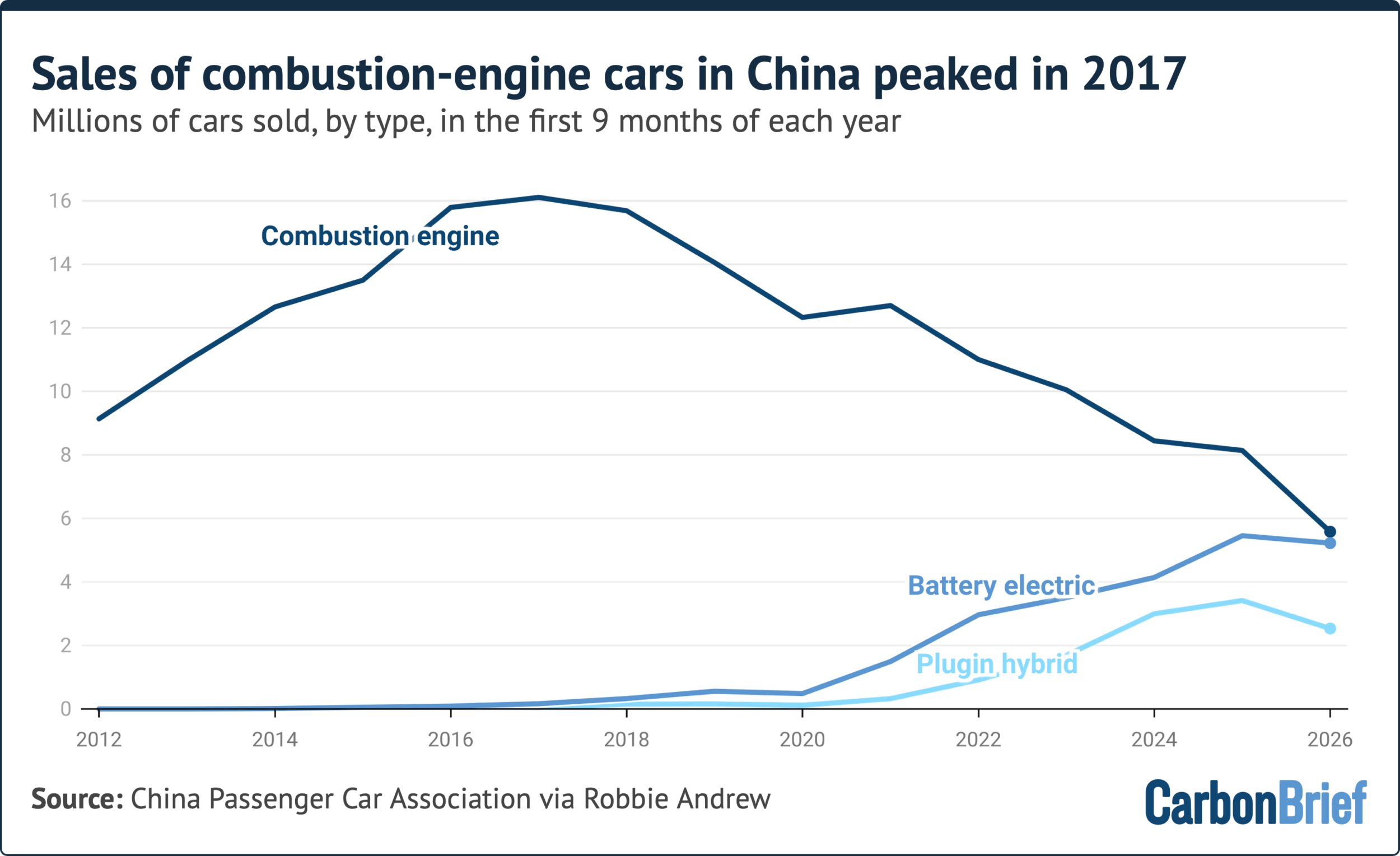
Indeed, sales of fuel-only cars were down 31% year-on-year in the first nine months of 2026, with plug-in hybrid sales down 26% – whereas battery EV sales were only down 4%.
One analyst tells Carbon Brief that China’s rapidly growing EV fleet has offset demand for 143m barrels of oil since the start of the Hormuz crisis.
Another says that the crisis is “reinforcing China’s electrification of road transport”.
Meanwhile, amid slowing domestic sales, Chinese carmakers’ exports of NEVs more than doubled [in 2026 to date / in September] from a year earlier.
NEV record
A record two out of every three cars sold in September in China were NEVs, according to CPCA data, as shown in the figure below.
(NEVs predominantly include battery electric vehicles – BEVs – and plug-in hybrids – PHEVs. BEVs only run on electricity, whereas PHEVs also have a combustion engine.)
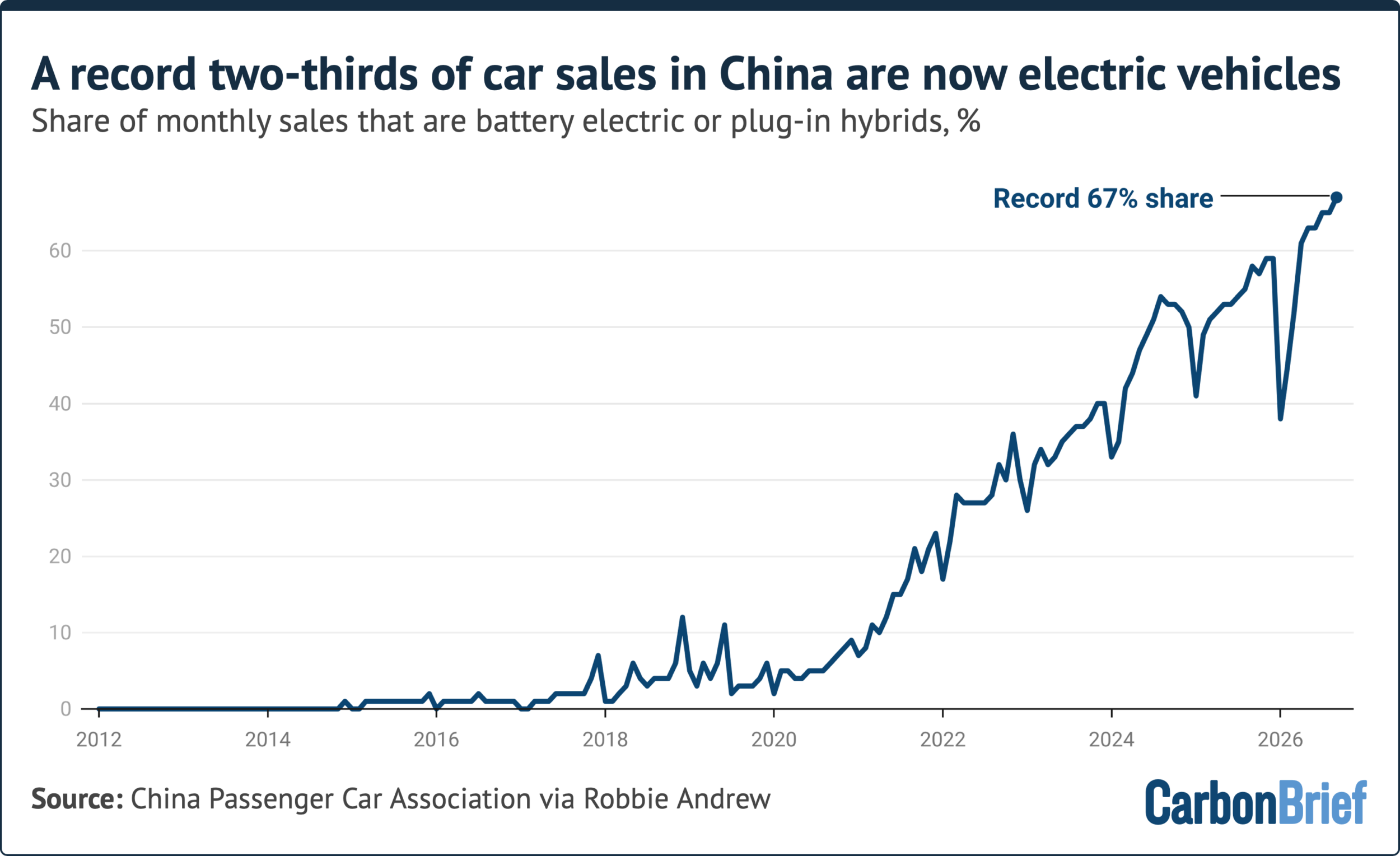
This marks a rapid rise for NEVs from just 6% of new car sales in 2020 up to 58% in 2026 to date – and a record 67% in the month of September.
This year, NEVs’ share of sales has also bounced back from a low of 39% in January, after the full purchase tax exemption that had been in place for more than a decade came to an end in December 2025.
The gain in NEV share in 2026 has come amid a slowdown across the wider domestic passenger-car market, which has hit sales of combustion-engine vehicles particularly hard.
This September, passenger-car retail sales across all categories declined, with overall sales volumes falling 28% year-on-year.
The contraction was led by combustion-engine vehicles, which saw sales fall 43% year-on-year in September and 31% in 2026 to date.
However, sales of PHEVs also fell by 36% year-on-year in September and by 26% in 2026 to date. By comparison, BEVs performed better, although sales still declined 8.5% from a year earlier in September and 4% in 2026 to date.
As a result, NEV sales overall fell by 17% in September and 13% in 2026 to date.
While the market changes in 2026 to date were particularly dramatic, they reflect a broad continuation of trends seen over the past decade.
Indeed, sales of combustion-engine cars in China peaked in 2017 and they have been declining ever since, shown in the figure below.
Impact of Hormuz
Part of the reason for the advance of NEVs in 2026, said Chinese technology news outlet OFweek, was petrol cars “giving up market share” as they were outperformed by electric alternatives.
Cui Dongshu, secretary-general of the CPCA, cited higher petrol prices as an explanation for September’s weak combustion-car sales, in comments to financial news outlet National Business Daily.
Imports of oil into China in January-September have fallen 15% compared to 2025, equivalent to 470m barrels, as ongoing conflict tightened supply and drove up prices.
China’s passenger-car NEV fleet has displaced 143m barrels of oil so far during the strait of Hormuz crisis, Euan Graham, senior energy analyst at thinktank Ember, tells Carbon Brief.
EVs “accounted for 12% of the decrease in China’s oil use post-Hormuz”, according to an estimate provided to thinktank the Brookings Institute by an unnamed analyst.