

The Brazilian COP30 presidency has published a “Baku to Belém roadmap” on how climate finance could be scaled up to “at least $1.3tn” a year by 2035.
The idea for the roadmap was a late addition to the outcome of COP29 last year, following disappointment over the formal $300bn-per-year climate-finance goal agreed in Baku.
The new document, published ahead of the UN climate talks in Belém, Brazil, says it is not designed to create new financing schemes or mechanisms.
Instead, the roadmap says it provides a “coherent reference framework on existing initiatives, concepts and leverage points to facilitate all actors coming together to scale up climate finance in the short to medium term”.
It details suggested actions across grants, concessional finance, private finance, climate portfolios, capital flows and more, designed to drive up climate finance over the next decade.
Despite geopolitical uncertainty, there is hope that this roadmap can lay out a pathway to the “trillions” in climate finance that developing countries say they need to meet their climate targets.
Countries have divergent views on how to get there, but some notable trends have emerged from the roadmap, which was spearheaded by the Azerbaijani and Brazilian COP presidencies.
Below, Carbon Brief details what the Baku to Belém roadmap is, why it was launched and what the key points within it are.
- Why was the ‘Baku to Belém roadmap’ launched?
- What is the goal of the roadmap?
- What are different countries’ views on climate finance?
- What are the solutions that the roadmap has identified?
- What happens next?
Why was the ‘Baku to Belém roadmap’ launched?
A mounting body of evidence shows that developing countries will need trillions of dollars in the coming years if they are to achieve their climate goals.
While much of this finance will likely be sourced domestically within those countries, a large slice is expected to come from international actors.
This climate finance is part of the “grand bargain” at the heart of the Paris Agreement, whereby developing countries agree to set more ambitious climate plans if they receive financial support from developed countries.
Ahead of COP29, developing countries hoped that the post-2025 climate finance target – known as the new collective quantified goal (NCQG) – would reflect their full “needs and priorities”, as set out in the Paris Agreement.
They also pushed for developed-country parties such as the EU, the US and Japan to contribute a large portion of this finance, preferably on favourable terms such as grants.
They were left largely disappointed, with a final target that fell well short of what many developing countries had been proposing.
The central target agreed at COP29 was “at least” $300bn a year by 2035, with an expectation that developed countries would “take the lead” in providing these funds from “a wide variety of sources”, including private finance.
This goal – which was effectively the successor to the previous $100bn-per-year target – was far short of what developing countries had wanted. However, another key part of the text agreed in Baku alludes to their ambitions, with a loose request that “all actors” scale up finance to at least $1.3tn per year by 2035:
“[The COP] calls on all actors to work together to enable the scaling up of financing to developing country parties for climate action from all public and private sources to at least $1.3tn per year by 2035.”
In contrast to the $300bn target, this $1.3tn figure, which first appeared in a proposal by the African Group in 2021, reflects developing-country demands and needs. It also aligns with influential analysis of developing-country needs by the Independent High-Level Expert Group on Climate Finance (IHLEG).
Yet, this part of the text lacked binding language and detail on who precisely would be responsible for providing these funds. It has therefore been described by civil-society groups as more of an aspirational “call to action” than a target.
(“Calls on” is the weakest form of words in which UN legal texts can make a request.)
However, the COP29 text contained another relevant decision, added as negotiations drew to a close. It mentioned a “Baku to Belém roadmap to $1.3tn” – a report that could flesh out ways to scale up finance further and help developing countries achieve their climate targets.

The Azerbaijani COP29 presidency and the incoming Brazilian presidency were tasked with assembling this roadmap ahead of COP30 in 2025.
In the months that followed, the presidencies engaged with governments, civil-society groups, businesses and other relevant actors. They gathered information to build a “library of knowledge and best practices”, which could boost climate finance for developing countries.
What is the goal of the roadmap?
The roadmap comes at a difficult time for climate finance, with a particularly “bleak” outlook for public funding from developed countries. Major donors – particularly the US – have made large cuts to their aid budgets, threatening climate spending overseas.
At the same time, private investment has also faltered, with successive economic shocks raising the cost of capital for clean-energy projects in developing countries.
For years, finance experts and development leaders have talked of a “billions to trillions” agenda, suggesting that public money could help to “mobilise” trillions of dollars of private investments that could be used to build low-carbon infrastructure in the global south.
Yet, the “billions to trillions” concept has also faced growing scrutiny, with even the World Bank chief economist Indermit Gill branding it “a fantasy”. Critics have highlighted wider issues constraining developing countries, such as high levels of debt.
The NCQG text from COP29 set out the roadmap’s overarching goal of scaling up annual climate finance to $1.3tn, through means including “grants, concessional and non-debt-creating instruments, and measures to create fiscal space”.
On the current trajectory, financial sources potentially covered by the target could hit around $427bn for developing countries a year by 2035, less than a third of the goal, according to analysis by the thinktank NRDC.
Achieving $1.3tn of finance relies on what one report calls “yet-to-be-defined mechanisms”, which go beyond the ones covered by the $300bn target.
Countries and other relevant parties were asked by the presidencies for their views on “short-term” – actions by 2028 and “medium-to-long term” actions beyond 2028 that could ramp up finance further. They were asked about new sources of finance and thoughts on scaling up adaptation finance, in particular.
There have already been numerous ideas and programmes put forward for scaling up international climate finance. These include G20-led reforms of the multilateral development banks (MDBs), this year’s International Conference on Financing for Development, as well as UN sovereign debt restructuring efforts.
Accordingly, the Baku to Belém roadmap was also given a remit to “tak[e] into account relevant multilateral initiatives as appropriate”. Parties were also asked for suggestions of organisations and initiatives that should be involved.
Rebecca Thissen from Climate Action Network (CAN) International tells Carbon Brief:
“The roadmap could support the UNFCCC to be sending strong signals to the international community…But also using the convening power that the UNFCCC could have, so bringing those different actors to the table in a more structured and predictable way.”
What are different countries’ views on climate finance?
There were over 227 submissions into the Baku to Belém roadmap, including 38 from countries and party groupings. The remainder came mainly from NGOs, businesses, financial experts and researchers, as shown in the figure below.
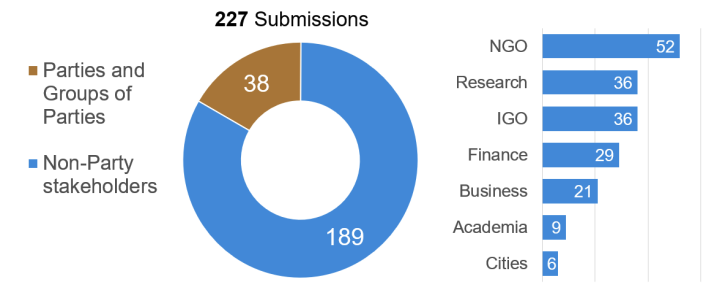
The submissions partly reflect what the thinktank C2ES describes as the “pockmarked baggage of the climate finance negotiations”, with many parties demonstrating the same entrenched, often opposing views on climate finance that they have held for decades.
Carbon Brief has captured the submissions by countries and party groupings in the interactive table below, comparing their views on key issues.
There is broad agreement among countries that the roadmap should not reopen the NCQG discussions or involve a new, negotiated outcome at COP30.
However, some parties still call for more accountability in achieving the existing goals.
Latin American countries within the AILAC grouping call for the roadmap to “define concrete milestones for scaling up climate finance”. Egypt goes further, proposing that developed countries alone commit “at least $150bn annually in public concessional finance by 2028”, mainly as grants.
A key divergence in submissions is on which governments and institutions, precisely, should be responsible for scaling finance up to $1.3tn.
Several developing-country groups stress the importance of centring developed countries as the primary contributors, referencing Article 9.1 of the Paris Agreement.
The Like-Minded Developing Countries (LMDCs) group, which includes India, China and Saudi Arabia, states that “the roadmap must place Article 9.1 as its central pillar”. The G77 and China – a group representing all developing countries – stresses the “additional role developed countries will play in the context of Article 9.1, which is additional to the $300bn”.
Meanwhile, many developed countries focus on what Canada refers to as “a necessary broadening of climate finance” within the roadmap. In practice, this often amounts to a greater push for private finance, as well as “innovative” new sources such as global levies.
While developing countries do not often outright oppose such sources, some of them propose tighter limits. For example, China says “purely commercial investment flows should not be included” in the $1.3tn, which should only count funds “mobilised through public interventions”.
A related dispute centres on the roadmap’s scope, with the EU suggesting it should “extend beyond the UNFCCC framework”.
Parties such as India reject the idea of involving other multilateral fora, such as the G20. This would involve moving beyond the UN climate process, where developed countries have traditionally been the ones responsible for channelling climate finance.
The submissions also show notable differences among developing-country groupings. On the topic of defining what should be counted as “climate finance”, the Alliance of Small Island States (AOSIS) opposes the inclusion of funding for fossil-fuel projects, while the Arab Group says it does not support “any exclusionary criteria”.
There is coalescence between parties around other issues, albeit with various subtle differences.
Areas of broad agreement include the importance of more funding for climate adaptation, dealing with “barriers” to funding in developing countries and improving the transparency of climate-finance provision.
The roadmap details some of the potential sources of finance identified within the submissions.
This includes direct budget contributions, which the submissions suggest could generate an additional $197bn in financing; improved rechanneling and new issuances of special drawing rights ($100-500bn per year); carbon pricing ($20-4,900bn, dependent on rate and geographies); and fees on aviation or maritime transport($4-223bn).
Additionally, a range of taxes were identified as candidates for raising new climate finance. These include taxes on specific goods such as luxury fashion, technology and military goods ($34-112bn), financial transactions taxes ($105-327bn), minimum corporate taxes ($165-540bn) and wealth taxes ($200-1,364bn).
In a statement, Rebecca Newsom, global political expert at Greenpeace International, said:
“It’s notable that the roadmap recognises new taxes and levies as key to unlocking public climate finance. Given reported profits from just five international oil and gas giants over the last decade reached almost $800bn, taxing fossil fuel corporations is clearly a huge opportunity to overcome national fiscal constraints.
“The roadmap’s recognition that the UN tax convention provides an opportunity to raise new sources of concessional climate finance is also highly welcome, and is an opportunity governments must now seize.”
What are the solutions that the roadmap has identified?
The roadmap sets out “five action fronts” for reaching $1.3tn by 2035.
These are designed to “help deliver on the at-least-$1.3tn aspiration by strengthening supply, making demand more strategic, and accelerating access and transparency”.
The report titles these five action fronts as “replenishing, rebalancing, rechanneling, revamping and reshaping”.
Within each of these, the roadmap lays out key points to help “transform scientific warning into a global blueprint for cooperation and tangible results”.
The first, “replenishing”, refers to grants, concessional finance and low-cost capital, including multilateral climate funds and MDBs.
It notes that there is a “growing role” for MDBs in advancing climate action, as well as a need for developed countries to achieve “manyfold increases in the delivery of grants and concessional climate finance, including through bilateral and multilateral channels”.
Access to grants and concessional finance is a key enabling factor for an “efficient” flow of public funding, the roadmap notes.
The roadmap calls for coordination in the international finance system, bilateral finance that is concessional and low-cost, multilateral climate funds, innovative sources of concessional finance with simplified access pathways and more.
This coordination could be key, with Sarah Colenbrander, director of ODI’s climate and sustainability programme, telling Carbon Brief:
“The bigger risk is probably that some countries will allocate their climate finance differently, so that they can report more money going out the door without a commensurate increase in fiscal effort. For example, they might shift from grants to concessional loans, and from concessional loans to market-rate loans. If the money will be repaid, there is less lift for taxpayers at home.
“Alternatively, countries might focus on using public finance to mobilise private finance that can also count towards the $300bn goal. Private finance has a very important role to play in both mitigation and adaptation, but it is very unlikely to meet the needs of the most vulnerable communities, given their high adaptation investment needs and very limited ability to pay.”
In particular, the roadmap suggests MDBs “intensify their engagement on climate finance through a strategic approach that recognises and amplifies their catalytic role in providing and mobilising capital”.
Second, “rebalancing” refers to fiscal space and debt sustainability. The roadmap calls on creditor countries, the International Monetary Fund (IMF) and MDBs to work together to “alleviate onerous debt burdens faced by developing countries”.
The roadmap notes that external debt servicing costs of developing countries have more than doubled since 2014, to $1.7tn per year in 2023.
Developing countries’ net interest payments on public debt reached $921bn in 2024, a 10% increase compared to 2023, it adds.
The roadmap notes the need to “remove barriers and address disenablers faced by developing countries in financing climate action”. It adds that developing countries face at least two- to four-times the borrowing costs of developed countries.
It points to a number of “promising” solutions already being implemented, such as climate-resilient debt clauses and “debt-for-climate swaps” and debt restructuring.
In particular, MDBs, the IMF, UN agencies and regional UN economic commissions could work together to create a “one-stop shop” for assistance in these areas, the roadmap says.
Third, “rechannelling” refers to “transformative” private finance and affordable cost of capital.
It notes that mobilisation of private finance has been “stubborn to scale”: The level of private finance leveraged by official development interventions has grown by 7% per year from 2016 to 2019 and then 16% per year from 2020 to 2023, to reach $46bn.
The roadmap says that “blended finance” can play a role in scaling up climate finance and that private finance for the implementation of “nationally determined contributions” to cutting global emissions (NDCs) and national adaptation plans (NAPs) has “significant potential for growth”.
“Innovative instruments” are listed as a key approach to improving private finance, including “catalytic equity”, guarantees, foreign exchange risk management, securitisation platforms and more.
To support this, the roadmap calls for target-setting and data transparency, along with increasing, coordinating and harmonising guarantee offerings and channelling concessional finance into long-term foreign exchange hedging facilities, along with other actions.
Relying heavily on private finance could pose a risk, Jan Kowalzig, senior policy adviser for climate at Oxfam Germany, tells Carbon Brief, adding:
“The much larger problem, however, is the plan to massively rely on private finance in the future. While private finance has a key role to play to transform economies, [it] cannot replace much-needed public finance, especially for adaptation and for responding to loss and damage.
“Interventions in these sectors often do not generate return to satisfy investors’ expectations. Forcing projects to become profitable can come at great social cost for frontline communities struggling to survive in the worsening climate crisis.”
The roadmap suggests financial institutions move towards “originate-to-distribute” and “originate-to-share” business models, support the development of climate-aligned domestic financial systems and expand investor bases and diverse sources of capital, amongst other proposals.
Fourth is “revamping”, referring to capacity and coordination for scaled climate portfolios. This “demands institutions to manage risks locally, develop project pipelines, ensure country ownership and track progress and impact”.
It notes that “whole-of-government” approaches to the transition can be strengthened, with NDCs and NAPs integrated throughout national investment strategies. Additionally, it points to country-led coordination or platforms as a route for improving investment.
The roadmap suggests readiness support and project preparation as routes to “revamp” climate finance, alongside support to scale, coordinate and tailor capacity building, the development of country platforms and the provision of “predictable and flexible support for investment frameworks”.
The final “R” is “reshaping”, focused on systems and structures for capital flows. It highlights a number of barriers that still remain for capital flows through developing countries, including outdated clauses in investment treaties.
It recommends prudential regulation, interoperability of taxonomies, climate disclosure frameworks and investment treaties, as key actions to support the reshaping of capital flows.
Additionally, the roadmap suggests that credit rating agencies further refine their methodologies, that jurisdictions adopt voluntary disclosure of climate-related financial risks of financial institutions and that climate stress-test requirements are gradually embedded in supervisory reviews and bank risk management.
Beyond the “five [finance] action fronts”, the roadmap sets out five thematic areas, noting that “where and how finance is directed” matters.
These are: adaptation and loss and damage; clean-energy access and transitions; nature and supporting its guardians; agriculture and food systems; and just transitions.
Within each, it sets out some of the key challenges and suggests routes for financial support.
What happens next?
The Baku to Belem roadmap is not a formal part of COP30 negotiations, but there will be a major launch event at the summit.
Beyond that, the final section of the roadmap sets out that this is the “beginning [of] the journey”. It and details suggested short-term contributions (2026-2028), to serve as “initial, practical steps to inform and guide the early implementation of the roadmap”.
This includes the Azerbaijani and Brazilian presidencies convening an expert group tasked with refining data and developing “concrete financing pathways” to get to $1.3bn in 2035. This will build on the action fronts set out in the roadmap, with the first such report due by October 2026.
Throughout 2026, the presidencies will convene dialogue sessions with parties and stakeholders to discuss how to progress the action fronts over the medium to long term.
The roadmap suggests that to improve predictability, developed countries “could consider” working together on a delivery plan to outline how they expect to achieve the at-least $300bn goal by 2030, as well as other elements of the NCQG.
Additional suggestions in the roadmap are listed in the table below.
(Notably, almost all of these suggestions are made using loose, voluntary language. For example, the roadmap says that developed countries “could” create a delivery plan for their NCQG pathways.)
| Who | What | When |
|---|---|---|
| COP29 and COP30 presidencies | Convene an expert group to develop “concrete financing pathways” | October 2026 |
| COP29 and COP30 presidencies | Convene dialogue sessions with parties and stakeholders | 2026 |
| Developed countries | Creating a delivery plan to set out intended contributions and pathways for NCQG targets | End of 2026 |
| Parties to the Paris Agreement | Request the Standing Committee on Finance to provide an aggregate view on pathways for NCQG | 2027 |
| Governments | Request UN entities to examine and review collaboration options | October 2026 |
| Multilateral climate funds | Report annually on the implementation of their “operational framework” on complementarity and coherence, to enhance cross-fund collaboration. | Annually |
| Multilateral climate funds | Develop monitoring and reporting frameworks and coordination plans, explaining their operations by region, topic and sector | October 2027 |
| Multilateral development banks | Collective report on achieving a new aspirational climate finance target for 2035 | October 2027 |
| Multilateral development banks | Adopt “explicit, ambitious and transparent targets for adaptation and private capital mobilisation” | October 2027 |
| International Monetary Fund | Conduct an assessment of the costs, benefits and feasibility of a new issuance of “special drawing rights” | October 2027 |
| UN regional economic commissions | Develop a study on the potential for expanding debt-for-climate, debt-for-nature and sustainability-linked finance | End of 2027 |
| UNSG-convened working group | Propose a consolidated set of voluntary principles on responsible sovereign borrowing and lending. | October 2026 |
| Crediting rating agencies | Develop a structured dialogue platform with ministries of finance to make progress on refinements to credit rating methodologies. | October 2027 |
| Philanthropies | Expand funding of knowledge hubs | October 2026 |
| UN treaty executive secretariats | Develop a joint report with proposals on economic instruments to support co-benefits and efficiencies | End of 2027 |
| Insurance Development Forum and the V20 | Establish a plan for achieving cheaper and more robust insurance and pre-arranged finance mechanisms for climate disasters | October 2026 |
| Financial Stability Board, the Basel Committee on Banking Supervision and the International Association of Insurance Supervisors | Conduct a joint assessment of whether and how barriers to investment in developing countries could be reduced | October 2027 |
| World’s 100 largest companies | Report annually on how they are contributing towards the implementation of NDCs and NAPs | Annually |
| World’s 100 largest institutional investors | Report annually on how they are contributing towards the implementation of NDCs and NAPs | Annually |
COP29 president Mukhtar Babayev and COP30 president André Aranha Corrêa do Lago conclude in the foreword of the report that while the $1.3bn “journey” is beginning amid “turbulent times”, they are confident that “technological and financial solutions exist”. They add:
“Communities and cities are acting. Families and workers are ready to roll up their sleeves and deliver more action. If resources are strategically redirected and deployed effectively – and if the international financial architecture is reset to fulfil its original purpose of ensuring decent prospects for life – the $1.3tn goal will be an achievable global investment in our present and our future. We are optimistic.”


The post COP30: What does the ‘Baku to Belém roadmap’ mean for climate finance? appeared first on Carbon Brief.
COP30: What does the ‘Baku to Belém roadmap’ mean for climate finance?

An Lambrechts is a biodiversity politics expert at Greenpeace International with extensive experience in biodiversity-related multilateral negotiations. She is the head of the Greenpeace delegation at the Convention on Biological Diversity (CBD) COP17 happening in Yerevan, Armenia.
In 2022, COP15 delivered the landmark Kunming-Montreal Global Biodiversity Framework to halt and reverse biodiversity loss by 2030. With COP17 starting in Yerevan, we are now halfway to the deadline, and according to the first Global Review of progress, countries are not on track to meet the biodiversity targets, and implementation must accelerate fast.
One of the main findings of the Global Review is that funding falls far short of the scale needed to halt and reverse nature loss. But the crisis facing the world’s biodiversity is not an absolute scarcity of capital – it is a profound public policy distortion.
The global economy currently spends roughly $30 destroying nature for every single dollar invested in its protection. According to a report from the Intergovernmental Science-Policy Platform on Biodiversity and Ecosystem Services, a staggering $2.4 trillion is spent in public subsidies for fossil fuels, agriculture and water use, while global investment in biodiversity conservation and restoration stands at a mere $220 billion.
Countries urged to ramp up “insufficient” nature policies at COP17
Yet, discussions about how to close the biodiversity finance gap continue to claim that salvation lies in mobilising private capital, scaling offsets and “derisking” investments in nature. This is a fundamental misunderstanding of both the nature of ecological stewardship and of the global financial architecture.
Biodiversity conservation is not a speculative investment portfolio – it is the foundation of human survival. The health of our planet is a non-monetisable, non-excludable public good. Expecting profit-seeking private capital to protect nature perpetuates the structural drivers of ecosystem destruction in the first place.
But if private market mechanisms cannot save biodiversity, where will the necessary public resources come from?
Money going to the wrong places
The answer lies in recovering the vast public wealth currently drained by cross-border tax abuse, financial secrecy and corporate impunity. Finance and environment ministers meeting in Yerevan must give a strong political signal that, to avert ecological breakdown, countries need to take swift action to reform global tax rules, eliminate harmful public subsidies and cancel unsustainable sovereign debts for the public revenues to end up where they belong.
Extractive sectors such as industrial agriculture, fishing, timber and mining continue business-as-usual, often heavily subsidised by public treasuries, while voluntary carbon and biodiversity offset markets pose a serious risk to nature conservation. Offset schemes have delivered only a negligible fraction of the funding needed to preserve ecosystems, allowing industries to continue with their destructive business-as-usual practices.