

Edelman, the international media advisor to Brazil’s COP30 team, relies on its work with fossil fuel companies for its revenues more than any other public relations agency, new research has found.
An estimated 5.64% of the PR giant’s turnover comes from contracts with fossil fuel clients, including Shell and Chevron – a figure far higher than any of its rivals, according to a report released on Tuesday by the Clean Creatives campaigning group.
As Climate Home News first revealed in July, Edelman has been working with Brazil to hone the COP30 host nation’s media strategy for this year’s UN climate summit.
Communications firm Edelman won a $835,000 contract via a UN agency to help the COP30 presidency “craft a strategic narrative”, manage international media relations, create digital content and navigate any PR crises, according to an agreement filed with the US government.
Duncan Meisel, executive director of Clean Creatives, said Edelman is “uniquely reliant” on fossil fuel contracts. “There is literally no agency worse suited for a role at COP30,” he added in a statement. “If the UN climate talks succeed in their goal, Edelman faces an existential threat to their revenue – that’s the definition of a conflict of interest.”
-
COP observers invited to reveal who is bank-rolling their participation at climate talks
As UN climate change body introduces new voluntary transparency measures, campaigners welcome “much needed step” to keep fossil fuel influence out of the talks

The United Nations Development Programme (UNDP), which awarded the COP30 media contract on behalf of Brazil, told Climate Home in July that Edelman’s selection did not contravene its rules on conflicts of interest. The COP30 presidency defended Edelman’s appointment, saying in a statement that the firm met the desired criteria for the role and had won a “rigorous” selection process.
A spokesperson for Edelman said the company believed climate change was “the greatest crisis of our time, requiring bold solutions, collaboration, and innovation”.
“Edelman is committed to being part of the change by working with diverse clients, including energy companies, who have a vital role to play in the transition as affirmed at COP28,” they told Climate Home when asked to comment on its work with both COP30 and Shell.
The “Mad Men” selling Big Oil’s image
Calls are growing for PR and advertising companies to stop promoting fossil fuel producers as the world battles to reduce carbon emissions. UN Secretary-General António Guterres, a vocal advocate of climate action, has described PR firms that work with fossil fuel companies as “Mad Men … fuelling the madness”.
But Clean Creatives catalogued 1,217 active or recent contracts between polluting firms and over 700 PR and advertising agencies as part of its annual F-List – a database of relationships between fossil fuel companies and their PR partners.
American conglomerate Omnicom holds the biggest number of contracts with fossil fuel firms at 120, followed by the British ad giant WPP with 82, according to the research.

Clean Creatives linked Edelman to deals with just ten oil, gas and coal companies in 2024 and 2025. But the New York-headquartered PR giant topped the new “Fossil Fuel Income Risk Exposure” (FFIRE) index, which estimates the weight of fossil fuel contracts in the total revenue of top agencies.
While, overall, fossil fuel advertising and PR make up less than 1% of global marketing spend, Edelman relies on work with polluting companies for more than 5% of its revenue, Meisel noted. WPP and Omnicom rely on fossil fuel contracts for 0.68% and 0.55% of their earnings, respectively, according to the analysis.
Clean Creatives said Edelman’s score is the result of its global partnership with Shell, as well as its longstanding relationship with Chevron and Abu Dhabi-based ADNOC.
Appeal to keep fossil fuel interests out of COP
With growing calls to keep fossil fuel influence out of the UN climate talks, campaigners criticised Edelman’s appointment to the strategic COP30 media role.
In response to Climate Home’s article, the Global Climate and Health Alliance, a network of over 200 organisations, called on Brazil to reconsider its contract. It also urged Australia and Turkey, the countries vying to host next year’s COP, to commit to not hiring PR firms that also have fossil fuel clients.
“Future host countries should take a clear stand that will avoid this kind of conflict of interest and prevent the influence of the fossil fuel industry on negotiations to deal with the problem that industry created,” the coalition’s executive director Jeni Miller said.
The post COP30 PR firm found to be “uniquely reliant” on fossil fuel clients appeared first on Climate Home News.
COP30 PR firm found to be “uniquely reliant” on fossil fuel clients

Three countries have been named by the Paris Agreement’s compliance committee for failing to submit a nationally determined contribution (NDC) and repeatedly snubbing offers of help with their climate plans.
After months of internal debate over whether to identify serial non-responders, the Paris Agreement’s Implementation and Compliance Committee (PAICC) named the three countries which have failed to engage with it over their NDCs on Friday.
It named Democratic Republic of Congo, Senegal and North Korea in a footnote of its annual report, adding that it decided to name them “with a view to facilitating engagement”, adding that representatives of the three nations had been invited to its meeting in early 2027 “with the purpose of identifying any challenges and constraints”.
“The Committee noted the importance of Parties engaging with the Committee in a timely manner, while noting that some delays may be due to the national capabilities and circumstances of the Parties”, the report said.
-
Under US pressure, World Bank says it will back gas “where appropriate”
The US wants the World Bank to expand its gas support while climate campaigners are pushing for it to end – its head spoke this week of limited backing for the fossil fuel -
IPCC scientists vow to press on with climate reports despite political deadlock
After governments again failed to agree a timeline, nearly 120 IPCC authors pledged to complete their assessment on time and with full scientific rigour -
Paris Agreement committee snubbed over missing NDC climate plans
Many governments have still not submitted a nationally determined contribution to the UN, breaching a key requirement of the Paris Agreement

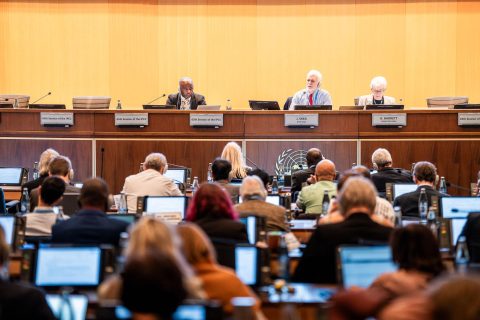

In July, PAICC said 12 countries had ignored its repeated attempts to discuss why they had not published an NDC as required every five years under the 2015 Paris accord.
Members of the committee had been divided over whether to name them, but at a September meeting decided to do so in their annual report to the annual climate COP summit.
By the time the report was published on Friday, only Congo, Senegal and North Korea “had not communicated an NDC or submitted a [Biennial Transparency Report] and had not yet responded to any of the Committee’s notifications, despite several reminders issued by the Committee in this regard”.
Rainforest and renewable energy ambitions
The silence from Congo and Senegal is notable because the former is home to much of the Congo Basin rainforest while the latter has sought billions of dollars in climate finance to support its renewable energy ambitions.
After Brazil, Congo has more rainforest than any country in the world. This forest, and the country’s peatlands, absorb huge amounts of greenhouse gas but are fast being lost to expanding farmland, charcoal production, logging and mining.
Senegal signed a Just Energy Transition Partnership with Canada and wealthy European nations in 2023, to help it meet its renewable energy targets under the-then government of Macky Sall. It was chair of the Least Developed Countries group between January 2022 and December 2023.

Tejas Rao, who is researching the PAICC as part of a doctoral thesis at Cambridge University, said the governments of the three countries should engage with the committee.
“Engagement costs these governments very little and the committee has shown it will listen,” he said.
“Silence leaves the committee with no basis to help, and it leaves the [governments] exposed to the narrative that they are simply disengaged,” he told Climate Home News.
Paris Agreement requirement
The 2015 Paris Agreement requires all parties to publish an NDC every five years outlining their emissions reduction targets, with each plan meant to be more ambitious than the country’s last NDC.
The latest set – the third round of plans, with new targets for 2035 – was due in February 2025. While most countries missed this deadline, all but around 30 – mostly small emitters but including Egypt, Vietnam and Argentina – have now submitted them.
Over the year, the PAICC – which is made up of government climate officials from developed and developing countries – has been communicating with governments that have not submitted NDCs and trying to overcome barriers to them doing so.
Some nations have cited exceptional circumstances as the reason for not submitting an NDC, a process that requires a significant amount of work in tracking emissions and consulting on how to curb them across the economy. For example, a letter from a Sudanese official to the PAICC, seen by Climate Home News, said that the country’s civil war had led to the suspension of its NDC preparation.
-
IPCC scientists vow to press on with climate reports despite political deadlock
After governments again failed to agree a timeline, nearly 120 IPCC authors pledged to complete their assessment on time and with full scientific rigour -
Under US pressure, World Bank says it will back gas “where appropriate”
The US wants the World Bank to expand its gas support while climate campaigners are pushing for it to end – its head spoke this week of limited backing for the fossil fuel -
Who shapes climate science? The equity question facing the IPCC
Early completion of the next global climate science assessment reports risks excluding research from the Global South, which is key to ensuring the findings are fair
The US and Iran are not signed up to the Paris Agreement and so do not have active NDCs, nor does Taiwan, which is not a UN member state.
Rao said that because the PAICC is “facilitative and non-punitive”, naming the countries “is meant to open a door, not close one – the invited consultation is the point”.
“In recent months, governments that explained their constraints, whether capacity, finance or domestic process, have been met with follow-up and support rather than sanction, and the number of silent governments has fallen sharply,” Rao said.
The post Paris Agreement committee names three countries snubbing it over NDCs appeared first on Climate Home News.
Paris Agreement committee names three countries snubbing it over NDCs