

Welcome to Carbon Brief’s China Briefing.
Carbon Brief handpicks and explains the most important climate and energy stories from China over the past fortnight. Subscribe for free here.
Key developments
China to achieve emission peak, carbon neutrality ‘ahead of its deadline’
ENERGY OPTIMISM: China’s post-Covid economic “situation” has led to “growing optimism” among energy experts that the country could peak carbon emissions earlier than its deadline of 2030, said the South China Morning Post, citing the second China Climate Transition Outlook survey by the Centre for Research on Energy and Clean Air (CREA) and the International Society for Energy Transition Studies. More than 70% of experts in the survey believe that China can achieve its goal of peak carbon emissions before 2030, while just over a fifth believe China could peak emissions before 2025, compared with 15% in the 2022 survey, reported the state-run newspaper China Daily. It also mentioned that experts had “mixed views” on when the country would witness a peak in coal consumption. Economic news outlet Jiemian quoted Shen Xinyi, a policy analyst with CREA, saying that coal power plants in China were seeing a “boom” because of power shortages in the past two years and the government needs to guide existing coal power plants to improve their operational flexibility. (See Carbon Brief’s newly published in-depth profile of China, which covers a wide range of topics including: climate laws; policies for fossil fuels, renewables, hydro and nuclear; transport; agriculture and forests; plus climate impacts and adaptation.)
EARLY NEUTRALITY: China’s target of net-zero by 2060 is “likely to be achieved” a decade earlier than previously assumed, wrote Ambrose Evans-Pritchard, world economy editor of the UK’s Daily Telegraph. He quoted Lauri Myllyvirta, co-founder, CREA, saying that the roll-out of renewables is outpacing the rise in electricity demand in China and there will be a fall in total carbon dioxide emitted in the first half of next year. (The piece draws heavily on Myllyvirta’s recent analysis for Carbon Brief.) Evans-Pritchard said that China approving two new coal plants a week does not mean what many in the West think it means. China is adding one gigawatt (GW) of coal power, on average, as back-up for every six GW of new renewable power, he said: “The two go hand in hand.” Although president Xi Jinping “was never going to let climate worries alone hold back China’s rise”, he concluded, the alignment of Xi’s personal interest in environmental policy with China’s strength in “clean-tech” industries drove China’s commitment to peaking carbon emissions, which will be “a watershed moment for global geopolitics, and for humanity”.
More signals emerge around CCER restart
CCER RESTART: Energy news outlet IN-EN.com reported that Lai Xiaoming, chairman of the Shanghai Environmental Energy Exchange, remarked in a speech that the China Certified Emissions Reduction (CCER) voluntary carbon market scheme will restart “soon”. According to the outlet, he added that the new CCERs will “follow the three principles of authenticity, uniqueness and additionality”. Earlier this month, the central government released the trial registration rules and the project design and implementation guidelines for CCERs, two key documents that could signal the imminent resumption of trading, energy news outlet BJX News said. The central government continues to back the Beijing Green Exchange as a key administrative body in the carbon market, calling for the ministry of commerce and Beijing municipal government to support it in “build[ing] a national unified greenhouse gas voluntary emission reduction trading centre”, another BJX News piece reported.
CBAM PREPARATION: As China continues to eye the impact of the EU’s carbon border adjustment mechanism (CBAM), it has pledged to establish carbon-footprint accounting rules and standards for 50 key products by 2025, finance newswire Wall Street CN reported. This will be expanded to 200 products by 2030, it added. Regulators will “initially focus on developing standards for cement, iron and steel, aluminium and fertilisers” in order to meet CBAM requirements, analysis by consulting firm Trivium China explained. “China-EU trade will be substantially affected” by CBAM, a representative of the National Energy Group wrote for BJX News. As far as China is concerned, he argued, “the introduction of the EU carbon tariff system will directly affect the ability of Chinese companies to make profits, survive and develop, and also have a substantial impact on China’s import and export trade and production structures”. Days before the opening of the COP28 climate talks in Dubai, UAE, the BASIC group of countries, including China, tabled a request to put “unilateral trade measures” – such as the CBAM – on the official agenda. Carbon Brief understands this and other additions to the agenda will not be officially adopted, but will be taken up elsewhere.
OFFSET CONTROVERSY: A new report by Greenpeace revealed that 85% of all “carbon-neutral LNG [liquified natural gas]” cargoes have been sold to buyers in Asia. There are concerns around the transparency of the forestry offsets used to certify “carbon neutral” LNG, Greenpeace added, especially in terms of “impermanence, baseline, additionality and double-counting”. In a statement, Greenpeace East Asia project leader Li Jiatong said “carbon offsets are a smoke screen to obscure their continued, redoubled carbon emissions. And China is emerging as a major marketplace for such credits.”
Xi: Sustainable development is ‘golden key’ to tackle climate change
‘GOLDEN KEY’: Chinese president Xi Jinping said “sustainable development” is the “golden key” to fixing current global problems on 16 November, during the APEC meeting in San Francisco, the state news agency Xinhua reported. Xi proposed accelerated implementation of the UN 2030 agenda for sustainable development, joint multilateral action to “promote carbon reduction, pollution reduction, green expansion and growth in a coordinated manner” and building global synergy to address climate change, the news agency added. A separate Xinhua article published a speech delivered by Xi shortly before the summit, in which he said “construction of an ecological civilisation requires skilful navigation of various key relationships”, including the balance between “development and protection”. His speech also stressed China’s commitment to its “dual carbon” goals are “unwavering”, but the path and pace of achieving them must be determined by China alone.
CORRECT UNDERSTANDING: Elsewhere, the Communist party-affiliated newspaper People’s Daily published a commentary by “Zhongsheng” – a collective pseudonym that signals the approval of top party leadership – saying that, during the Xi-Biden meeting, Xi highlighted that “it is in the interests of both countries and the expectation of the international community that China-US relations should stabilise and improve”, but that “suppressing China’s science and technology means curbing China’s high-quality development and depriving the Chinese people of their right to development, which China will never agree to and will never succeed”.
Spotlight
What China climate experts expect at COP28
At the opening of the China pavilion at COP28, ministry of ecology and environment head Huang Runqiu said he hopes that COP28 will “fully respond to the demands of developing countries”, while climate envoy Xie Zhenhua said that China is “ready to continue to work with all parties to…send a positive signal…in this crucial decade”.
With a “vanishingly small” remaining carbon budget meaning there is only a “14% chance” of keeping global warming below 1.5C under current pledges, there are high expectations and many unanswered questions as COP28 opens. Chief among these are what the outcomes of the global stocktake will be, who will contribute to the loss and damage fund and what language around fossil fuels will look like.
At COP27, China was seen as engaged and “genial” in public forums, but “stuck to its familiar positions” in formal negotiations. This year, the recent US-China climate agreement may create greater space for a global consensus at COP, but, in many cases, the two superpowers may be on “opposite sides of the negotiating table”.
As delegates flood into Dubai for the conference, Carbon Brief asks leading experts what they expect from COP – and what China’s role will be. Their responses have been edited for clarity and length.
Li Shuo, director of the China Climate Hub at the Asia Society Policy Institute:
China will be under the spotlight at COP28, as in previous COPs. The meeting’s main tasks – the first global stocktake, a robust energy transition package including the need to move away from fossil fuel and support to vulnerable countries for their losses and damages – all require active Chinese contribution.
The recent stabilisation of the US-China relationship provides necessary, but insufficient, conditions for success at COP28. Dubai remains a test on China’s climate appetite in light of its domestic and international challenges. Political signals from COP28 will also play a critical role for China’s domestic climate agenda and will shape Beijing’s decisions in 2024 on a number of key issues including its 2035 NDC (nationally determined contribution, or climate pledge), its role in providing financial support to the global south and its direction on coal consumption.
Lauri Myllyvirta, lead analyst at the Centre for Research on Energy and Clean Air:
The potentially most impactful agreement that could come from COP28 is a target to triple renewable energy capacity globally from 2022 to 2030, which would put the power sector on track to the emission reductions required to meet the goals of the Paris Agreement. This is a target that China should be able to support and even agree to contribute to financing…China has supported the creation of the loss and damage fund and even said it would be willing to contribute on a voluntary basis.
It’s unlikely that China would commit to any specific targets for 2035 right now, but at least an indication that there will be an absolute emission reduction target for 2035 would be a step forward. So far, China has refused to set absolute emission targets, sticking with CO2 intensity targets that are designed to allow emissions to rise.
Symbolically, agreeing to “phase down” or “phase out” unabated fossil fuels could be an important outcome. China already accepted the language to “phase down” coal at Glasgow in 2021 and, given that oil and gas are less important for China than coal, agreeing on the same language on all fossil fuels should not be too hard. However, a phase-out, especially with a deadline such as 2050, might be more than China’s leaders are willing to agree on.
Bernice Lee, Hoffmann distinguished fellow for sustainability at Chatham House:
First of all, China does not want to be blamed as a blocker of multilateral progress, a lesson it has learned from Copenhagen [in 2009]. Second, it will likely emphasise its achievements in renewable energy and electric vehicle production, investments and deployment, as well as its role in cost reduction of these much-needed products in a low-carbon economy. In general, [China will place] an emphasis on implementation of current goals rather than [further] target-setting. It will also likely join forces with poor countries in asking developed economies to deliver the billions needed for climate finance.
Dr Fang Li, China country director at the World Resources Institute:
Alarm bells are ringing, as the window to secure a livable future is rapidly closing. Countries, cities, businesses and financial institutions must urgently get on a new path, transitioning away from systems that exploit people and nature toward those where people’s essential needs are met, land is managed sustainably and emissions are sharply reduced.
COP28 is not just about carbon, it is also about nature, about livelihood, etc. Solutions are not solely based in specific countries or regions. We hope COP28 can be a place that motivates and accelerates more inspiring, ambitious and practical collaborations. As one of the biggest emitters, China is also trying to be one of the biggest contributors to the sustainable future. We’ve observed many positive actions and signals, including on reducing non-CO2 emissions, accelerating food sustainable transition, engaging more resources from private sectors, greening global value chain, strengthening climate actions at subnational levels, etc. We hope to see further discussions and actions from China and other parties during and after the conference.
Watch, read, listen
CLIMATE POLITICS: Prof Brian Wong and Kevin Zongzhe Li argued in China-US Focus that the US and China must consider ASEAN as a partner in developing climate policy and not as “just another battleground”.
FROM THE ROOFTOPS: An article in Nature explored the development of distributed solar in China, which is allowing the government to “vigorously develop renewable energy”.
COP28 CHATTER: The Oxford Institute for Energy Studies discussed the key themes that will dominate conversations at COP28 and China’s position on many of these issues.
REUSING WASTE: The South China Morning Post reported how one company is turning leftover hotpot oil in the city of Chengdu – which can total 150,000 tonnes annually – into jet fuel.
New science
Public discourses and government interventions behind China’s ambitious carbon neutrality goal
Nature Communications Earth & Environment
A new study examines the public discourses around China’s climate goals of peaking carbon emissions by 2030 and achieving carbon neutrality by 2060, and how they might have been influenced by the Chinese government. Through analysis of approximately one million microblogs from China, the researchers find seven types of climate discourses emerging, including scientific, moral, economic, co-benefit, energy security, political and global frames. They also reveal that there is generally a high level of support towards China’s carbon neutrality goal.
Assessing the effectiveness of emissions trading schemes: evidence from China
Climate Policy
New analysis explored the effect of low carbon prices in China’s emissions trading system (ETS) on the country’s ability to reduce carbon dioxide (CO2) emissions, while maintaining economic growth. The results indicate that an increase of $1 in the carbon price would reduce CO2 emissions by 1.69% and increase per-capita GDP by $286. The study found that these benefits were brought about by technological innovation, foreign direct investment and improvements to the energy mix and industrial structure. Carbon leakage to neighbouring regions was not evident, it added.
Storyline attribution of human influence on a record-breaking spatially compounding flood-heat event
Science Advances
New research conducted a storyline attribution analysis to discover possible causes of the 2020 record-breaking spatially compounding flood-heat event in China. The researchers found that there could be a further intensification of compound events by the end of this century, with moderate emissions making the rainfall totals approximately 14% larger and the season approximately 2.1C warmer in south China compared to 2020.
China Briefing is compiled by Anika Patel and edited by Wanyuan Song and Simon Evans. Please send tips and feedback to china@carbonbrief.org.
The post China Briefing 30 November: China at COP28; Xi’s ‘unwavering’ climate commitment; Voluntary carbon market restart appeared first on Carbon Brief.

Next week, diplomats from around the world will descend on Yerevan, Armenia, to negotiate a series of decisions under the UN Convention on Biological Diversity (CBD).
Between 19 and 30 October, 196 parties will gather to hammer out the precise wording of the dozens of legal texts that make up the decisions under the Conference of the Parties (COP) to the CBD.
This year’s summit is particularly significant, as it marks the halfway point between the agreement of the Kunming-Montreal Global Biodiversity Framework and the deadline for achieving its targets.
The CBD has found that countries are currently not on track to meet 22 out of the framework’s 23 targets.
During the fortnight, delegates will also be negotiating decisions relating to the two supplemental protocols to the CBD: the Cartagena Protocol, which covers biosafety; and the Nagoya Protocol, which covers access and benefit-sharing for the use of genetic resources.
(The Cartagena and Nagoya Protocols, which are each governed by a “meeting of the parties”, or “MOP”, have fewer parties than the CBD as a whole, with 173 and 141, respectively.)
Carbon Brief is tracking the progress of countries towards consensus on dozens of negotiating texts using the interactive table below.
The tracker includes texts from the COP, as well as the MOPs for the Cartagena and Nagoya protocols. It also includes draft decisions from the most recent subsidiary body meetings, as these form the starting point for the negotiations in Yerevan.
The CBD has three subsidiary bodies: the subsidiary body on scientific, technical and technological advice (SBSTTA), the subsidiary body on implementation (SBI) and the subsidiary body on article 8(j) and other provisions (SB8J).
SB8J focuses on issues related to the Indigenous peoples and local communities. It was established at COP16 in Cali, Colombia, in 2024.
The first two columns of the interactive tracker list the topic of each agenda item and the relevant body, with subsequent columns including dates, page counts and links to the original documents.
The table is searchable and can be sorted using the arrows in the header.
Areas of disagreement in UN draft texts are denoted by square brackets. Counting the brackets in a particular iteration of a text therefore gives a sense of how far parties are from reaching consensus.
The bracket column is colour-coded, with dark green indicating a low number of brackets and red indicating a high number of brackets remaining.
Texts can also present parties with choices using “options” or alternatives (“alt”), which are counted together in the sixth column of the table.
The key discussions in Yerevan will centre around two agenda items in particular. The first is the global review, which will assess progress towards the GBF and make recommendations for accelerating action.
The second is finance, which can be separated into two parts: resource mobilisation and the financial mechanism. On resource mobilisation, biodiverse global south countries are likely to push for an increased amount of international finance for conservation.
Disagreement over the creation of the financial mechanism led to the suspension of COP16 in Cali in October 2024, as parties failed to find agreement on the mobilisation of finance before the end of the summit.
Global south countries want the establishment of a separate financial mechanism under the control of the CBD; global north countries largely prefer to maintain the existing mechanism, which sits under the Global Environment Facility.
At the resumed session of COP16 in Rome in early 2025, countries agreed on a roadmap that would lead to the establishment of a permanent mechanism.
related

Analysis: Lula presidency saved at least 20,000km2 of Brazilian Amazon since 2022
Why land-use emissions have fallen by a third this century – in six charts

Analysis: 84% of nations miss deadline to identify ‘nature-harming’ subsidies by 2025
UK withdraws millions in funding from world’s second-largest rainforest in Congo
The post Interactive: Tracking negotiating texts at the COP17 biodiversity summit appeared first on Carbon Brief.
Interactive: Tracking negotiating texts at the COP17 biodiversity summit
A beacon of love
On an outer island of Fiji, two thousand nautical miles from Sydney, is a shining light of hope and resilience for our troubled world.
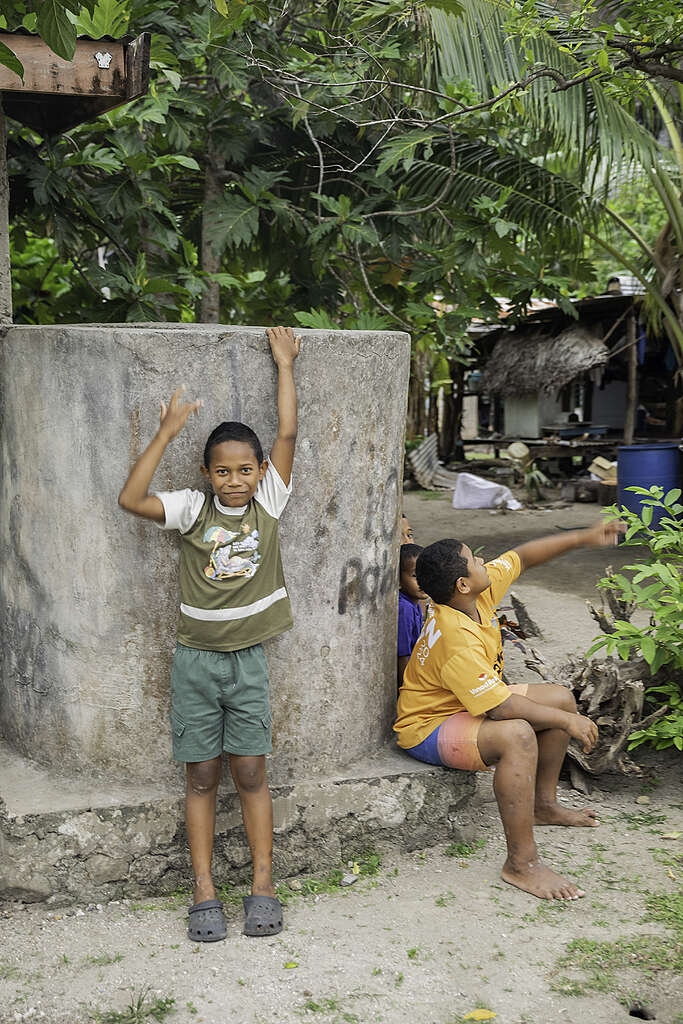
The island of Kioa is home to a Tuvaluan community who migrated from their atoll of Vaitupu in the late 1940s. It is a land of warm hearts, big smiles, and deep cultural roots; a place where the sound of a conch still summons the island together, where islanders paddle out to fish in carved outrigger canoes, and healthy happy children walk barefoot to school.
Here, culture is life. Kioans live sustainably through their traditional knowledge and practices. The island is alive with song, dance and the rhythms of a life tied to the tides, the winds, and the seasons.
Facing the future
Greenpeace has been lucky to have a relationship with Kioa for a number of years now, and we are continually learning from this remarkable community.
Last week, as part of our Voyaging Oceania project, we returned to the island. Our purpose was twofold —- to carry messages from the island to leaders gathering in Nadi this week for the Pacific Pre-COP, and to support the Kioa community in their efforts to improve water security for the island.
Unlike Tuvalu itself, with its eight atolls, Kioa is a mountainous, forested and richly fertile island. It will remain habitable far into the future. Kioans did not initially migrate from Vaitupu due to climate change, but the move was prophetic. They now have a lifeboat.
However, even Kioa faces challenges on our rapidly warming planet, in particular when it comes to water. Climate change is shifting once reliable rainfall patterns. On top of this, the island is already feeling the effect of this year’s intensifying El Niño event, which for Fiji means reduced rainfall and prolonged dry spells.
Right now, fresh water has to be carefully rationed, and is only available for a few hours a day. During last week’s visit aboard our campaigning ship Oceania, Greenpeace was privileged to work with the Kioa community on a new solar-powered water distribution project for the island.
Designed and led by the island, the project involves using a solar pump to move water from a reliable source to a storage tank and then using gravity to distribute the water around the village.
It was a lesson in how local knowledge and ingenuity can be the backbone of today’s climate solutions. To build a dam around the source, the local community knew the exact spot where they could gather gravel at low tide to mix with the cement. They took only what was needed, knowing that all resources must be carefully conserved. Kioa has no roads and no machinery, and it was an all-of-island effort to carry the materials up to the project site, including many heavy bags of sand and rock.
Such projects truly bring to life the vision of a resilient, locally-led, fossil fuel free Pacific.