

Welcome to Carbon Brief’s China Briefing.
China Briefing handpicks and explains the most important climate and energy stories from China over the past fortnight. Subscribe for free here.
Key developments
Huang reported to lawmakers on climate action
NPCSC REPORT: Huang Runqiu, head of the Ministry of Ecology and Environment, told Chinese lawmakers that managing the country’s carbon dioxide (CO2) intensity has become “more challenging” due to the effects of the Covid-19 pandemic, extreme weather and growing trade tensions, Bloomberg reported. According to the full text of Huang’s remarks, made during a report to the National People’s Congress (NPC) Standing Committee, the minister remarked that China’s progress on meeting the target is “broadly in line” with its current international climate pledge for 2030. [Its CO2 intensity target for 2025 is likely to be missed.] He added that challenges have worsened around balancing climate action with economic development, managing “overall and local interests” and “aligning short-term with medium-to-long-term goals”.
TARGETS ‘SURPASSED’: Huang also highlighted the progress China had made in other areas, having “already surpassed” targets for wind and solar power capacity additions and new forest stock volume, the state-run newspaper China Daily said. According to current affairs outlet China News, Huang also noted that China has continued its “efforts to enhance the clean and efficient utilisation of fossil fuels”, including “reforms” for coal-fired power plants and “steadily increasing” gas production and utilisation.

GLOBAL INFLUENCE: China is “making important contributions to the implementation of the Paris Agreement”, Huang also said, according to the full text of his remarks, having “driven substantial reductions in the costs of wind and solar power” and “advanced international cooperation on climate change”, such as in south-south collaboration. He noted that in the face of “uncertainties”, such as the US withdrawal from the Paris Agreement and the expansion of the EU’s carbon border adjustment mechanism, China will enhance its “influence, guidance and shaping power in global climate governance”.
Movements ahead of UNGA
COP30 SIGNALS: Former climate envoy Xie Zhenhua travelled with Huang to Brussels to meet EU climate lead Teresa Ribera on 16 September, Reuters reported, in order to restart “climate negotiations” ahead of the UN general assembly and COP30. It added that current climate envoy Liu Zhenmin was not expected to be present. (A photo posted on Bluesky confirmed Xie’s presence in the city.) A few days earlier, COP30 executive director Ana Toni met Huang in Beijing, where he told her that China will support Brazil in hosting a COP that “sends a strong signal” about the importance of the Paris Agreement, climate news outlet Tanpaifang reported. Toni told reporters that Brazil expects a “huge Chinese delegation” at COP, the Global Times said. She also spoke at an event at Tsinghua University attended by Xie and followed online by Carbon Brief.
UK-CHINA: Meanwhile, the UK and China established a new industrial decarbonisation working group, according to a UK government statement, focusing on areas including carbon capture, utilisation and storage. Daniel Brooker, the head of the China office at UK Research and Innovation, told finance news outlet Yicai that climate cooperation with China is “one of our immediate priorities”.
INTERCONNECTED WORLD: Separately, vice-president Han Zheng used a conference speech to urge other countries to cooperate on developing “renewable energy generation, grid interconnectivity and smart energy systems” as a way of advancing the global energy transition, according to the Communist party-affiliated newspaper People’s Daily.
First auction under new renewable pricing system
LOWER PRICES: Shandong province held the country’s first renewable power auction, following the launch of new rules for the pricing of wind and solar power, industry news outlet BJX News reported, with the auction price of wind power set at 0.319 yuan per kilowatt-hour (yuan/kWh) and those for solar set at 0.225 yuan/kWh. The low prices set by the “bellwether” province signalled that “renewables prices [across China] in the future will be lower than under the previous system”, Reuters said, adding that it could “discourage” further investment. On LinkedIn, David Fishman, principal at the Lantau Group, said that while the wind power prices would likely be acceptable for developers, the solar prices would be “very tough”, citing one as saying they would likely “abandon” all future projects in the province.
-
Sign up to Carbon Brief’s free “China Briefing” email newsletter. All you need to know about the latest developments relating to China and climate change. Sent to your inbox every Thursday.
PLANS ‘PROMPT’: Meanwhile, the National Energy Administration (NEA) urged local governments during a video conference to “promptly” release their plans for implementing the pricing reforms, energy news outlet International Energy Net said, to “stabilise” industry expectations. Separately, the NEA revealed during the conference that, between January and July 2025, China’s installed renewable energy capacity grew by 283 gigawatts (GW) to 2,171GW, current affairs outlet China News reported. In August, BJX News said, thermal-power generation grew by 1.7% – slower than July’s growth rate – while wind power grew by just over 20%, solar grew by 16% and hydropower fell by 10%.
LOCALISED PROJECTS: The NEA also co-released a notice on “improving pricing mechanisms” for localised new-energy projects, International Energy Net reported, referring to projects that “both generate and consume electricity” such as zero-carbon industrial parks. The notice outlined benchmarks for how much of their own renewable energy such projects should sell and consume, clarifying that such projects should “bear transmission and distribution fees, system operation costs and other expenses”, it added.
China set targets for new AI energy projects
AI PILOTS: China plans to increase the use of AI in the country’s energy sector, state news agency Xinhua reported, in order to “enhance energy security, improve operational efficiency and support the country’s green and low-carbon transition”. China will “promote the deep application of at least five specialised large models”, which could be used in the power grid, power generation, coal, oil, gas or other areas, according to industry news outlet China Energy News. It also reported that China plans to identify ten or more “replicable, scalable and competitive” pilot projects. Consulting firm Trivium China wrote in a note that the plan “positions AI as an indispensable tool” on climate change.
DOUBLING STORAGE: China aims to “almost double” new-energy storage capacity by 2027 to 180GW, according to a new industry plan, Reuters reported. Lithium-ion battery storage is likely to comprise the bulk of new additions, economic news outlet Jiemian said. Meanwhile, according to a new government action plan for 2025-2026, new-energy power equipment companies are expected to achieve “steady” annual revenue increase, while traditional power equipment firms should aim to grow “approximately 6%” and “leading” companies by 10%, Xinhua said.
POLICY WATCH: China adopted the atomic energy law, its first foundational law for the nuclear sector, Jiemian reported. China’s environmental code – also the first of its kind – remains under discussion, according to China News. Elsewhere, the country updated its plan to “advance the three-north shelterbelt forest programme”, China Daily said. The National Development and Reform Commission called for “exploring” pathways for real estate investment trusts to invest in ultra-high voltage transmission projects, BJX News reported. BJX News also covered new guidance on improving electricity spot markets.
Spotlight
Q&A: Will China and the BRICS fill the ‘leadership gap’ on climate change?
Amid a rapidly fracturing geopolitical order, there have been growing calls for China to “step into [the] leadership gap” left by the US on climate change.
One platform that it could use to do so is BRICS, an increasingly influential and assertive group that includes COP30 host Brazil.
In this issue, Carbon Brief explores whether or not China, alongside the BRICS, could become climate leaders. The full article is available on Carbon Brief’s website.
The BRICS group represents a number of emerging economies that aim to “increas[e] the influence of global south countries in international governance”.
Active full members include founding members Brazil, Russia, India and China, as well as South Africa, Egypt, the United Arab Emirates, Ethiopia, Indonesia and Iran.
Together, they represent 27% of global gross domestic product, 49% of the world’s population and 52% of carbon dioxide emissions, according to Carbon Brief calculations.
Four of the members – Brazil, China, India and South Africa – also form the BASIC bloc, a group with a significant voice at UN climate summits and other negotiations.
How do the BRICS approach climate change?
Lucas Carlos Lima, professor of international law at the Federal University of Minas Gerais in Brazil, wrote that recent joint statements show the BRICS had “placed climate change squarely at the centre of the bloc’s agenda”.
In July, the BRICS summit resulted in a joint declaration demanding that “accessible, timely and affordable climate finance” is provided to developing countries.
The statement also highlighted the nations’ “resolve to remain united in the pursuit of the purpose and goals of the Paris Agreement”.
However, the BRICS leaders’ declaration also “acknowledge[s] fossil fuels will still play an important role in the world’s energy mix”.
The inclusion of this language “undermin[es] the positives” of the bloc’s other statements on climate action, according to a response from Jacobo Ocharan, head of political strategies at Climate Action Network International.
What is the role of fossil fuels in the BRICS?
Many BRICS nations remain heavily reliant on fossil fuels, both for electricity generation and to support their wider energy systems.
However, this picture is starting to shift, with almost all BRICS members having adopted net-zero targets ranging from 2050 to 2070.
More tangibly, the addition of new clean-power projects means that fossil-fueled electricity generating capacity now makes up less than half of the installed total in the BRICS group as a whole in 2024, as shown in the figure below.
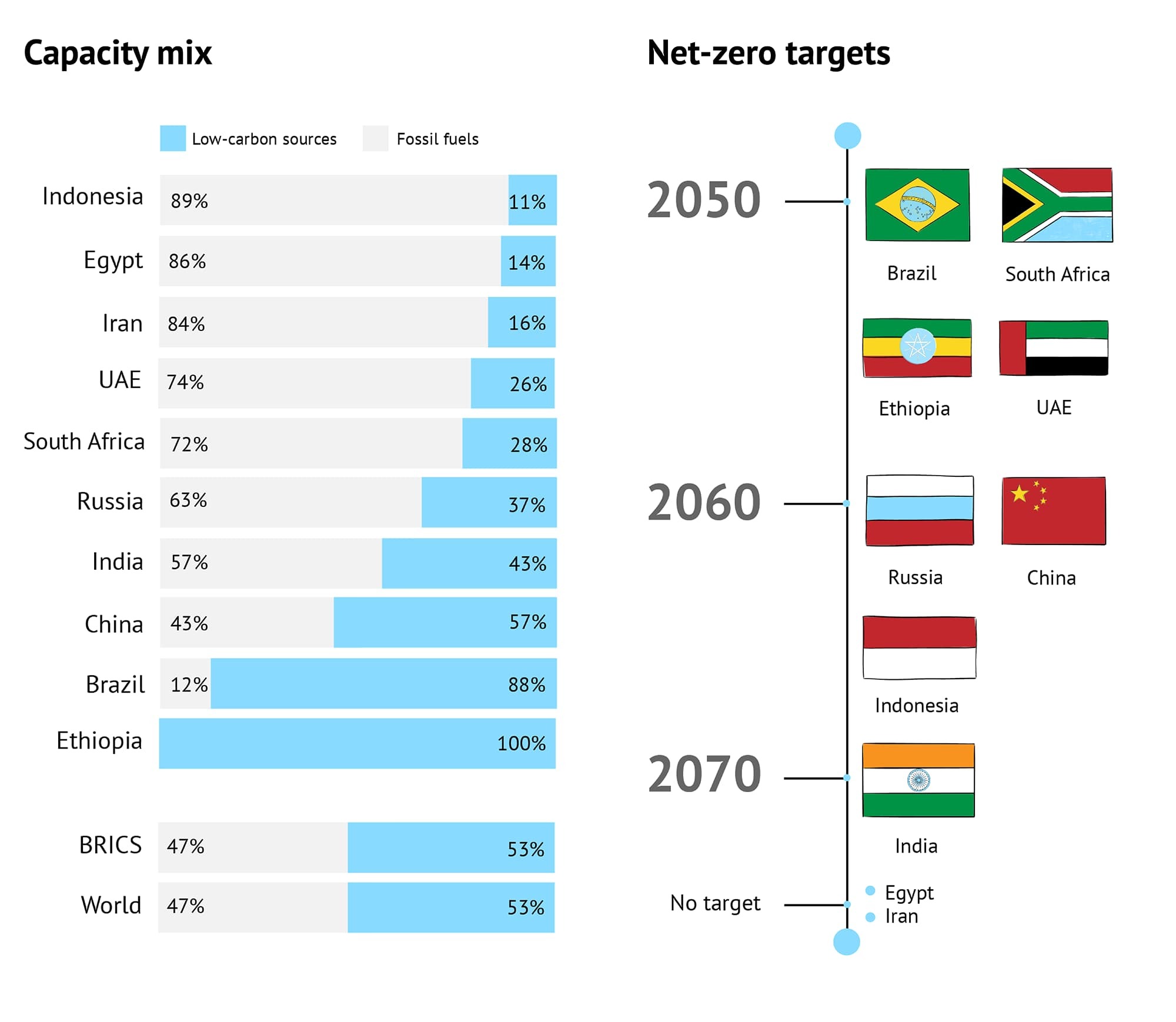
Non-fossil power, driven by “unprecedented” renewable energy growth in China, India and Brazil, accounted for 53% of the installed electricity generating capacity in BRICS countries in 2024, according to thinktank Global Energy Monitor (GEM).
Continued BRICS focus on clean energy makes it “unlikely that fossil capacity will overtake non-fossil again”, James Norman, research analyst at GEM, told Carbon Brief.
Several BRICS members, including Russia, the UAE, Iran and Indonesia, are nevertheless leading producers and exporters of fossil fuels.
China and India, meanwhile, are by some distance the world’s largest and second-largest coal users, respectively.
Nevertheless, in the short term, this might not affect the BRICS group’s climate ambition overall.
Russia does not seem to be “blocking” the “solid outcomes” of recent BRICS climate negotiations, said Kate Logan, director of the China climate hub and climate diplomacy at the Asia Society Policy Institute (ASPI).
Will China and the BRICS emerge as climate leaders?
With the withdrawal of the US from the Paris Agreement under the Trump administration, there have been increasing calls for China to take up the mantle of climate leadership.
China, at least publicly, is eschewing these calls, but does seem to be open to agreeing to “demonstrate leadership” in tandem with others, as seen in an EU-China joint statement on climate change published in late July.
Many are watching for signs of whether China’s upcoming international climate pledge, which may be published next week, will contain ambitious targets that will encourage greater global ambition.
Beatriz Mattos, research coordinator at Brazil-based climate-research institute Plataforma CIPÓ, tells Carbon Brief that China’s position as a “major investor in the renewable energy sector” means there is “enormous potential” for both it and the BRICS to assume a climate leadership role.
Watch, read, listen
NEW PARTNERS: The China-Global South Podcast examined the “stunning 113% jump” in Chinese investment into Brazil, a significant share of which was in oil and renewable energy.
PEAK ESTIMATE: A new report by Greenpeace East Asia found that China could “peak its power emissions in 2025”, at just over 5bn tonnes.
INSIDER VOICES: Three leading experts on China’s energy transition shared their insights in an event broadcasted by the Center for China and Globalization.
RESHAPING ENERGY: Ember published a “comprehensive review” of China’s energy transition and how it is “transforming global energy realities”.
$210 billion
The amount of foreign investment pledged by Chinese clean-energy technology manufacturers since 2022, according to a new report by the Net Zero Industrial Policy Lab covered by Bloomberg.
New science
Agricultural and Forest Meteorology
A new study examined the combined role of “forest activities and fire disturbance” (FAFD) on the effectiveness of China’s carbon sinks. It estimated that, between 1986 and 2020, the carbon emissions resulting from harvesting forests and forest fires offset around 54% of the carbon sequestration occurring through forestation. These findings, the authors said, “highlight the importance of accounting for carbon emissions from deforestation and forest fire when aiming to maximise carbon sequestration through forestation”.
Temperature extremes in early life and human capital: evidence from China’s labour market
Climatic Change
“Early-life exposure” to both extreme heat and extreme cold has “significant and persistent negative effects on adult labour income”, new research has found. The study, which draws from a dataset of more than one million individuals from China, said that, under a scenario with moderate warming (SSP2-4.5), average labour-income loss across China could total 0.77%, with the provinces of Qinghai, Henan, Fujian and Gansu most severely affected. It added that the impact of extreme heat on foetuses is “particularly pronounced”, with significant implications for future earnings.
China Briefing is compiled by Wanyuan Song and Anika Patel. It is edited by Wanyuan Song and Dr Simon Evans. Please send tips and feedback to china@carbonbrief.org

The post China Briefing 18 September 2025: MEE on the move; AI and energy; BRICS and climate appeared first on Carbon Brief.
China Briefing 18 September 2025: MEE on the move; AI and energy; BRICS and climate

Three countries have been named by the Paris Agreement’s compliance committee for failing to submit a nationally determined contribution (NDC) and repeatedly snubbing offers of help with their climate plans.
After months of internal debate over whether to identify serial non-responders, the Paris Agreement’s Implementation and Compliance Committee (PAICC) named the three countries which have failed to engage with it over their NDCs on Friday.
It named Democratic Republic of Congo, Senegal and North Korea in a footnote of its annual report, adding that it decided to name them “with a view to facilitating engagement”, adding that representatives of the three nations had been invited to its meeting in early 2027 “with the purpose of identifying any challenges and constraints”.
“The Committee noted the importance of Parties engaging with the Committee in a timely manner, while noting that some delays may be due to the national capabilities and circumstances of the Parties”, the report said.
-
Under US pressure, World Bank says it will back gas “where appropriate”
The US wants the World Bank to expand its gas support while climate campaigners are pushing for it to end – its head spoke this week of limited backing for the fossil fuel -
IPCC scientists vow to press on with climate reports despite political deadlock
After governments again failed to agree a timeline, nearly 120 IPCC authors pledged to complete their assessment on time and with full scientific rigour -
Paris Agreement committee snubbed over missing NDC climate plans
Many governments have still not submitted a nationally determined contribution to the UN, breaching a key requirement of the Paris Agreement

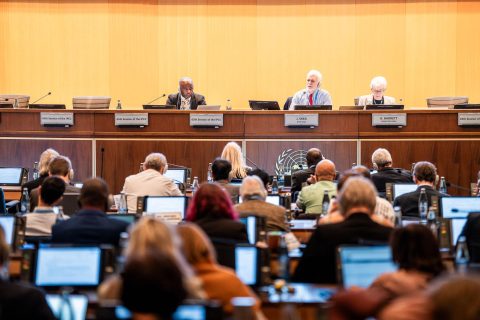

In July, PAICC said 12 countries had ignored its repeated attempts to discuss why they had not published an NDC as required every five years under the 2015 Paris accord.
Members of the committee had been divided over whether to name them, but at a September meeting decided to do so in their annual report to the annual climate COP summit.
By the time the report was published on Friday, only Congo, Senegal and North Korea “had not communicated an NDC or submitted a [Biennial Transparency Report] and had not yet responded to any of the Committee’s notifications, despite several reminders issued by the Committee in this regard”.
Rainforest and renewable energy ambitions
The silence from Congo and Senegal is notable because the former is home to much of the Congo Basin rainforest while the latter has sought billions of dollars in climate finance to support its renewable energy ambitions.
After Brazil, Congo has more rainforest than any country in the world. This forest, and the country’s peatlands, absorb huge amounts of greenhouse gas but are fast being lost to expanding farmland, charcoal production, logging and mining.
Senegal signed a Just Energy Transition Partnership with Canada and wealthy European nations in 2023, to help it meet its renewable energy targets under the-then government of Macky Sall. It was chair of the Least Developed Countries group between January 2022 and December 2023.

Tejas Rao, who is researching the PAICC as part of a doctoral thesis at Cambridge University, said the governments of the three countries should engage with the committee.
“Engagement costs these governments very little and the committee has shown it will listen,” he said.
“Silence leaves the committee with no basis to help, and it leaves the [governments] exposed to the narrative that they are simply disengaged,” he told Climate Home News.
Paris Agreement requirement
The 2015 Paris Agreement requires all parties to publish an NDC every five years outlining their emissions reduction targets, with each plan meant to be more ambitious than the country’s last NDC.
The latest set – the third round of plans, with new targets for 2035 – was due in February 2025. While most countries missed this deadline, all but around 30 – mostly small emitters but including Egypt, Vietnam and Argentina – have now submitted them.
Over the year, the PAICC – which is made up of government climate officials from developed and developing countries – has been communicating with governments that have not submitted NDCs and trying to overcome barriers to them doing so.
Some nations have cited exceptional circumstances as the reason for not submitting an NDC, a process that requires a significant amount of work in tracking emissions and consulting on how to curb them across the economy. For example, a letter from a Sudanese official to the PAICC, seen by Climate Home News, said that the country’s civil war had led to the suspension of its NDC preparation.
-
IPCC scientists vow to press on with climate reports despite political deadlock
After governments again failed to agree a timeline, nearly 120 IPCC authors pledged to complete their assessment on time and with full scientific rigour