

Dr Laura-Jane Nolan is a carbon consultant and operations director at BOM Systems.
War leaves destruction in its wake – cities levelled, economies disrupted, lives lost. But another cost rarely enters the conversation: carbon emissions.
As the conflict in the Middle East grinds on, the world’s attention remains fixed on geopolitics and the loss of life and infrastructure. Yet the climate impact of modern warfare is largely invisible in both reporting and policy.
Using UK government greenhouse gas accounting frameworks and publicly available expenditure data, it is possible to estimate the emissions generated and the far larger footprint likely to follow during reconstruction.
Iran war could boost fossil fuel phase-out push, says Colombian minister
According to researchers at Queen Mary University of London, in just the first 14 days, US-Israeli war with Iran generated more than 5 million tonnes of carbon dioxide equivalent (CO₂e). While this represents only part of the total, it provides a rare, quantified entry point into the scale of the environmental damage caused so far.
Let’s be clear, direct measurement is not simple. Military fuel use, logistics and procurement data are rarely disclosed in detail. Researchers therefore rely on spend-based estimates, that is, the amount of CO2 equivalent per pound or dollar spent.
Post-conflict reconstruction
According to Reuters, the United States alone spent at least $11.3 billion (around £8.5 billion) in the first six days of the conflict. Using a conservative estimate of around 0.4 kg CO₂e per pound spent, the first six days of documented operations correspond to roughly 3.4 million tonnes of CO₂e.
After another week of conflict, the conservative estimate of over 5 million tonnes of CO₂e is not a small amount of greenhouse gases. It is roughly equivalent to 1.1 million cars driven for a year – all the cars in a large European city. It is also comparable to a million transatlantic flights.
If this seems shocking, these estimates likely underplay the situation. We haven’t considered the rebuilding of the destroyed buildings and infrastructure yet. Evidence from past conflicts shows that emissions from rebuilding, through cement, steel, asphalt and heavy machinery, can exceed those generated during active combat.
UK government data indicates that every £1 billion spent on construction generates approximately 250,000 to 350,000 tonnes of CO₂e, before accounting for debris clearance and supply-chain disruption.
In policy terms, this should prompt critical questions about how reconstruction should be financed and delivered, as investing in the green economy for new infrastructure will positively shape long-term emissions trajectories. Rebuilding antiquated infrastructure will be good money thrown after bad.
Gap in climate policy governance
Despite this, the climate cost of war remains largely absent from international frameworks. A loophole in the Kyoto Protocol even allowed countries to exclude military emissions from their national reporting. While the Paris Agreement removed Kyoto’s limited, sector-specific reporting rules and its focus on only developed countries – which had enabled greenhouse gases from overseas military activity to be kept out of the equation – military emissions are still inconsistently reported and rarely disaggregated.
This creates a gap in climate governance at precisely the historical moment when the climate system is shifting from predictable, linear change to a regime in which self-reinforcing, potentially irreversible changes will likely occur.
-
Nigerians bet on solar as global oil shock hits wallets and power supplies
Fed up with an increase in outages and surging fuel prices, a growing number of homes and businesses are ditching their backup generators for solar systems -
Nepal’s EV revolution pays off as oil crisis causes pain at the pumps
Import subsidies, abundant hydropower and charging investments have spurred EV adoption, with electric vehicles now making up about three-quarters of new car sales


Systematic carbon accounting for conflict and reconstruction using internationally agreed-upon frameworks such as ISO 14064-1 could set a new precedent for environmental accountability. Following Iraq’s invasion of Kuwait, the United Nations Compensation Commission awarded billions of dollars for environmental damage, including oil fires and ecosystem loss. Carbon accounting could support post-conflict environmental assessments and contribute to just liability frameworks and reparations.
Assessing infrastructure finance
International institutions are already moving in this direction. Multilateral development banks increasingly apply climate conditions to infrastructure finance, and post-conflict reconstruction funding could follow similar principles. Embedding emissions accounting into these processes would align recovery efforts with existing climate commitments.
The economic case is also completely clear for most people. The £8.5 billion spent in the first six days of the Iran conflict could have financed large-scale clean energy deployment, solar, wind, electrified heating and transport, delivering long-term returns, reducing fossil fuel dependence and strengthening energy security.
Major oil producers among 46 nations joining fossil fuel phase-out summit
Unlike military expenditure, these investments generate ongoing economic value. Yet the absence of systematic accounting for all aspects of war means these trade-offs remain largely invisible to policymakers, markets and the public.
As debates grow around recognising ecocide as a crime under international law, the legal and institutional frameworks for addressing environmental harm are evolving. Integrating carbon accounting into conflict and reconstruction processes would be a pragmatic next step, reflecting both climate realities and existing policy trends.
The climate cost of war is not hypothetical. It is measurable, material and increasingly unavoidable. The question is whether it will continue to be ignored.
The post Carbon accounting can help tackle the hidden emissions of war appeared first on Climate Home News.
Carbon accounting can help tackle the hidden emissions of war

Countries’ climate plans would cut global emissions only half as much by 2035 as the UN projected a year ago, its annual assessment showed, after the US exit from the Paris Agreement and weaker new pledges worsened the outlook.
Taking into account the nationally determined contributions (NDCs) of 154 countries, which cover about 71% of global emissions, and current policies in the rest of the world, global emissions would fall to about 6% below 2019 levels by 2035. Last year’s update, based on 113 countries, put the figure at 12%.
According to the Intergovernmental Panel on Climate Change, emissions need to go down by 60% over the same period to limit global warming to 1.5C – a threshold that is now inevitably going to be breached, at least temporarily.
The latest NDCs put the world on course for between 2.1C and 3.2C of warming by the end of the century, depending on what countries do beyond 2035. That is slightly higher than the 1.9C–3.0C range that the UN climate body estimated in last year’s update, published during COP30.
-
Early speakers’ list suggests few powerful leaders will attend COP31
Just 77 heads of state or government are scheduled to address the COP31 climate summit in Antalya, a third less than the COP28 peak -
Paris Agreement committee names three countries snubbing it over NDCs
More than 30 countries have failed to submit an NDC, but only three have repeatedly ignored the committee’s efforts to engage with them


US exit worsens picture
A major factor is the US, the world’s second-largest emitter. Last year’s UN assessment included the pledge to cut emissions by between 61% and 66% by 2035, made under the administration of former President Joe Biden.
But, since the US has officially left the Paris Agreement, its NDC has been excluded from the tally and its emissions projections have now been derived from current policies, which point to far higher levels of pollution.
US emissions grew significantly last year as a result of growing electricity demand and the policies of President Donald Trump’s administration, which has rolled back support for clean energy and backed the burning of fossil fuels.
Weak new NDCs
Another reason for weaker emission reduction projections is that the approximately 40 new NDCs submitted since last year’s update have been less ambitious than the earlier UN modelling had hoped for.
India, the world’s third-largest emitter, submitted its NDC in April. Its plan would let emissions climb to 6.3 billion tonnes by 2035, almost 64% above 2023 levels, according to analysis by Climate Action Tracker (CAT). Its targets are weaker than India’s current policies and it could meet them as early as 2030.
-
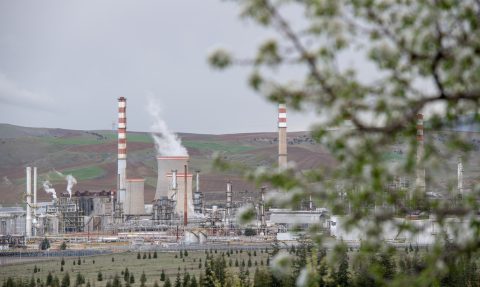
Turkish giant sponsoring COP31 cut climate goals then cashed in on oil boom
COP31 sponsors should be screened for “climate integrity”. Yet Koç Holding has become a top partner while its oil refiner runs flat out and its climate targets slip -
Early speakers’ list suggests few powerful leaders will attend COP31
Just 77 heads of state or government are scheduled to address the COP31 climate summit in Antalya, a third less than the COP28 peak -
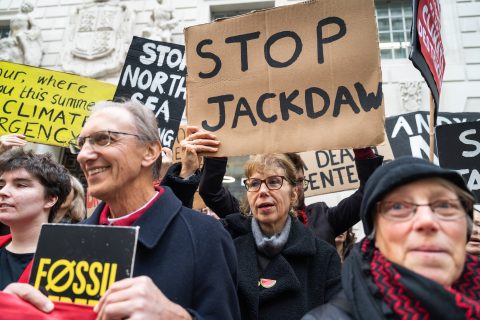
UK approves gas drilling despite admitting blow to “climate leadership” status
The government accepts that approving the Jackdaw field will weaken its climate reputation and downplays the legal weight of the International Court of Justice opinion
Saudi Arabia’s plan, submitted at the end of last year, sets no 2035 target, but has only a 2040 goal to reduce, avoid or remove 335 million tonnes a year against an undisclosed baseline. CAT rates it “critically insufficient”, estimating 2035 emissions at between 13% below and 18% above 2019 levels.
About 30 countries, including Egypt, Vietnam and Argentina, have still not produced an updated NDC, which all governments should have submitted more than a year and a half ago.
UN climate chief Simon Stiell said this year’s assessment report demonstrates again that collective progress remains insufficient, that global transitions are very uneven and that many countries face substantial barriers to delivering their targets and pledges.
He added that COP31 in Türkiye can help address some of the key gaps highlighted in this year’s reports, through ambitious outcomes on emission-cutting efforts, adaptation, climate finance and just transitions, as well as presidency-led initiatives on electrification, curbing methane emissions and progressing towards zero waste.
The post National climate plans now promise half the emission cuts expected by UN appeared first on Climate Home News.
National climate plans now promise half the emission cuts expected by UN
Climate Change
‘A strong start’: WA’s transition to renewable energy powerhouse aided by Premier’s announcement
PERTH, Tuesday 27 October 2026 — In response to WA Premier Roger Cook’s announcement of a doubled renewable energy target for WA’s main energy system, reported today, the following comments can be attributed to WA Campaign Lead at Greenpeace Australia Pacific, Geoff Bice:
“A Western Australian renewable energy target of 75% by 2030-31 is a welcome step in the right direction following sustained calls from across the WA community including unions, industry and advocacy groups.
“This common sense policy is a vital roadmap for WA’s shift to affordable and reliable solar and wind backed by batteries, and gives certainty to business and investors in a volatile global environment.
“Clear policy on renewable energy for WA’s main electricity grid will allow the phase out of polluting coal-fired power from the system and begin to remedy our reliance on expensive and polluting gas.
“This commitment is a positive first step for WA’s clean energy future, but the Cook Government must also address the state’s rising climate pollution driven by the gas industry and industrial processing.
“A natural step towards tackling rising emissions is rejecting any new fossil fuel projects, including Woodside’s proposal to drill for gas at Scott Reef.
“Expert advice and analysis compiled by Greenpeace and Springmount Advisory clearly lays out a viable pathway for WA to follow a staged transition away from fossil fuels and unlock almost $1 trillion of economic value by 2060 by replacing gas exports with green exports.
“The renewable energy target is a strong start — it must now be paired with emissions reduction targets to ensure climate pollution from WA starts falling urgently, and a plan for WA to become a renewable energy powerhouse must be prioritised.”
-ENDS-
Media contact
Emma Sangalli at emma.sangalli@greenpeace.org or 0431 513 465
‘A strong start’: WA’s transition to renewable energy powerhouse aided by Premier’s announcement
Climate Change
WA EPA warned Woodside of ‘serious, significant and irreversible’ harms to Scott Reef from gas plans, new documents reveal
SYDNEY/PERTH, Tuesday 27 October 2026 — In response to Western Australian Environmental Protection Authority (WA EPA) documents about Woodside’s plans to drill for gas at Scott Reef, as reported today, the following comments can be attributed to Glenn Walker, Head of Nature at Greenpeace Australia Pacific:
“These WA EPA documents show the depth of concern echoed by multiple regulators about Woodside’s plans to drill for oil and gas at Scott Reef, a proposal that flouts legislated nature protection principles.
“The WA EPA appears to have informed Woodside that the Browse project was bound for rejection based on an extensive review process and the opinion of multiple state government departments and independent experts.
“Greenpeace analyses have confirmed this year that Woodside’s gas drilling plans at Scott Reef still risk destroying vulnerable green turtle homes, further endangering pygmy blue whales with atomic bomb-level seismic blasting noise, and unleashing the worst oil spill in Australian history.
“The federal environment department raised similar red flags about oil spill risk from Woodside’s Scott Reef drilling plans in 2025 and 2026 before handing the project’s assessment over to the National Environmental Protection Authority.
“Woodside’s suggested ‘fixes’ in response to grave concerns for the wellbeing of Scott Reef and threatened species have been unilaterally criticised by independent experts for lacking in scientific basis and adequate detail.
“It would be a major backflip for both the WA EPA and the National EPA to now recommend approving this project. It is now critical that these regulators maintain their independence from corporate and political influence and reject this destructive project once and for all.”
-ENDS-
Notes to editor
Greenpeace Technical assessments of Woodside’s Browse Pygmy Blue Whale Management Plan, the Turtle Management Plan, and an analysis of Woodside’s Browse Oil Spill Modelling and Risk Mitigation Plan
High res images and footage of Scott Reef can be found here
Media contact:
Emma Sangalli at emma.sangalli@greenpeace.org or 0431 513 465
