




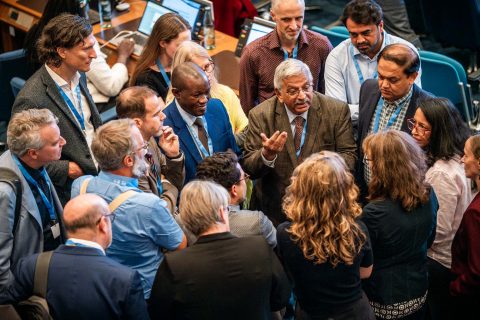
- What timeline options were delegates debating?
- How did the timeline discussions unfold?
- What were the main points of disagreement?
- Why is the IPCC in a ‘serious funding crisis’?
- How have scientists reacted?
- What other issues remain unresolved?
- How are the IPCC AR7 reports progressing?
- How might the IPCC use AI and enhance gender inclusivity?

As the rapid deployment of clean energy technologies fuels demand for their components, human rights abuses linked to the supply of critical minerals show no sign of letting up.
New data from a Transition Minerals Tracker compiled by the Business & Human Rights Resource Centre (BHRRC) shows that more than 630 allegations of human rights violations have been associated with minerals mining since 2010. Of those, 91 were made in the last year alone.
The tracker monitors human rights abuses associated with the extraction of seven minerals including copper, lithium and bauxite, which is new in this year’s update. These elements are essential for the production of solar panels, wind turbines, electric vehicles and electrification more broadly.
The latest BHRRC data points to widespread violations of Indigenous peoples’ rights – such as forced relocation, water pollution and denial of access to traditional land – as well as attacks on human rights defenders and workers’ rights abuses.
BHRRC also registered 53 allegations of work-related deaths since 2010, with 30 percent of those newly reported in 2023.
Supply chain FAQ: What you need to know about critical minerals
Caroline Avan, BHRRC’s head of natural resources and just transition, said the situation is not improving. “The sector is blatantly failing at protecting those who generate its profits, and this is only the tip of the iceberg,” she said.
“We are probably only capturing a fraction of abuses because we rely on public data and so many issues don’t get reported,” she added. The BHRRC gives companies an opportunity to respond to the allegations it documents.
Just ten companies are associated with more than half of all allegations registered since 2010 – including China Minmetals, Glencore, Grupo Mexico, First Quantum Minerals and Solway Group – while 46% of the total originated in South America.
Allegations of human rights abuses linked to transition minerals by category
Avan explained that many abuses follow a pattern that begins with environmental violations – such as water or soil pollution – compounded by inadequate consultation with local communities, which then leads to protracted conflict.
This has been the case at the Las Bambas copper mine in Peru, now owned by MMG Ltd, whose major shareholder is China Minmetals Corporation (CNC), and formerly controlled by Glencore. It received the most allegations of rights abuses not only in 2023, but across the tracker’s full 13-year monitoring period.
The mine’s infrastructure, activities and expansion plans have led to a series of social and environmental impacts, provoking protests and blockades by Indigenous communities. Most recently, last November, 1,500 workers went on strike to ask for a larger share of profits.
CNC, MMG and Las Bambas have not responded to the BHRCC over the reported allegations.
New global principles
The persistence of human rights abuses in mineral mining is set to attract more attention, with the International Energy Agency estimating that mineral demand for clean energy applications is set to grow by three and a half times by 2030.
The BHRRC’s report notes that the mining sector is under pressure from civil society, Indigenous peoples and global policymakers alike to strengthen human rights protections.
For example, the new EU Batteries Regulation, adopted last July, obliges end users of battery minerals to carry out thorough supply chain due diligence.
“We are seeing the automotive industry asking more of the upstream mining sector, and that is good news,” said Avan. “But we are not seeing enough from the renewable energy sector in terms of asking mineral suppliers to ensure their operations are not linked with abuses.”
Days after climate talks, US slaps tariffs on Chinese EVs and solar panels
Last month, UN Secretary-General Antonio Guterres launched a high-level Panel on Critical Energy Transition Minerals tasked with developing a set of global principles to “safeguard environmental and social standards and embed justice in the energy transition”.
Guterres said supply chains must be “managed properly” to ensure that developing countries get a fair share of benefits and that the environment and human rights are protected.
“Too often, production of these minerals leaves a toxic cloud in its wake: pollution; wounded communities, childhoods lost to labour and sometimes dying in their work. And developing countries and communities have not reaped the benefits of their production and trade,” the UN chief said in comments at the launch.
“This must change… The race to net zero cannot trample over the poor,” he added. The panel is expected to deliver initial recommendations ahead of the UN General Assembly in September.
In Nagorno-Karabakh, Azerbaijan’s net zero vision clashes with legacy of war
The BHRRC’s Avan told Climate Home it was “concerning that countries in the Global North are rushing to sign strategic partnerships with resource-rich countries in the Global South because they want to secure their mineral supply chains, but the companies who will be involved in delivering those minerals are not asked much in terms of requirements for human rights protections”.
For companies, recommendations from the centre’s new report include adopting human rights policies and giving affected communities access to the benefits and governance of projects.
Avan said government regulation and better business practices are essential “to ensure that the global energy transition is a just one, centred on respect for human rights, fair negotiations and shared prosperity”.
“The alternative is rising resistance, conflict, and distrust – all threatening to slow the pace of the transition,” she added.
(Reporting by Daisy Clague, editing by Megan Rowling)
The post Calls for responsible mining fail to stem rights abuses linked to transition minerals appeared first on Climate Home News.
Calls for responsible mining fail to stem rights abuses linked to transition minerals
Continue Reading
Three countries have been named by the Paris Agreement’s compliance committee for failing to submit a nationally determined contribution (NDC) and repeatedly snubbing offers of help with their climate plans.
After months of internal debate over whether to identify serial non-responders, the Paris Agreement’s Implementation and Compliance Committee (PAICC) named the three countries which have failed to engage with it over their NDCs on Friday.
It named Democratic Republic of Congo, Senegal and North Korea in a footnote of its annual report, adding that it decided to name them “with a view to facilitating engagement”, adding that representatives of the three nations had been invited to its meeting in early 2027 “with the purpose of identifying any challenges and constraints”.
“The Committee noted the importance of Parties engaging with the Committee in a timely manner, while noting that some delays may be due to the national capabilities and circumstances of the Parties”, the report said.
-
Under US pressure, World Bank says it will back gas “where appropriate”
The US wants the World Bank to expand its gas support while climate campaigners are pushing for it to end – its head spoke this week of limited backing for the fossil fuel -
IPCC scientists vow to press on with climate reports despite political deadlock
After governments again failed to agree a timeline, nearly 120 IPCC authors pledged to complete their assessment on time and with full scientific rigour -
Paris Agreement committee snubbed over missing NDC climate plans
Many governments have still not submitted a nationally determined contribution to the UN, breaching a key requirement of the Paris Agreement
In July, PAICC said 12 countries had ignored its repeated attempts to discuss why they had not published an NDC as required every five years under the 2015 Paris accord.
Members of the committee had been divided over whether to name them, but at a September meeting decided to do so in their annual report to the annual climate COP summit.
By the time the report was published on Friday, only Congo, Senegal and North Korea “had not communicated an NDC or submitted a [Biennial Transparency Report] and had not yet responded to any of the Committee’s notifications, despite several reminders issued by the Committee in this regard”.
Rainforest and renewable energy ambitions
The silence from Congo and Senegal is notable because the former is home to much of the Congo Basin rainforest while the latter has sought billions of dollars in climate finance to support its renewable energy ambitions.
After Brazil, Congo has more rainforest than any country in the world. This forest, and the country’s peatlands, absorb huge amounts of greenhouse gas but are fast being lost to expanding farmland, charcoal production, logging and mining.
Senegal signed a Just Energy Transition Partnership with Canada and wealthy European nations in 2023, to help it meet its renewable energy targets under the-then government of Macky Sall. It was chair of the Least Developed Countries group between January 2022 and December 2023.

Tejas Rao, who is researching the PAICC as part of a doctoral thesis at Cambridge University, said the governments of the three countries should engage with the committee.
“Engagement costs these governments very little and the committee has shown it will listen,” he said.
“Silence leaves the committee with no basis to help, and it leaves the [governments] exposed to the narrative that they are simply disengaged,” he told Climate Home News.
Paris Agreement requirement
The 2015 Paris Agreement requires all parties to publish an NDC every five years outlining their emissions reduction targets, with each plan meant to be more ambitious than the country’s last NDC.
The latest set – the third round of plans, with new targets for 2035 – was due in February 2025. While most countries missed this deadline, all but around 30 – mostly small emitters but including Egypt, Vietnam and Argentina – have now submitted them.
Over the year, the PAICC – which is made up of government climate officials from developed and developing countries – has been communicating with governments that have not submitted NDCs and trying to overcome barriers to them doing so.
Some nations have cited exceptional circumstances as the reason for not submitting an NDC, a process that requires a significant amount of work in tracking emissions and consulting on how to curb them across the economy. For example, a letter from a Sudanese official to the PAICC, seen by Climate Home News, said that the country’s civil war had led to the suspension of its NDC preparation.
-
IPCC scientists vow to press on with climate reports despite political deadlock
After governments again failed to agree a timeline, nearly 120 IPCC authors pledged to complete their assessment on time and with full scientific rigour -
Under US pressure, World Bank says it will back gas “where appropriate”
The US wants the World Bank to expand its gas support while climate campaigners are pushing for it to end – its head spoke this week of limited backing for the fossil fuel -
Who shapes climate science? The equity question facing the IPCC
Early completion of the next global climate science assessment reports risks excluding research from the Global South, which is key to ensuring the findings are fair
The US and Iran are not signed up to the Paris Agreement and so do not have active NDCs, nor does Taiwan, which is not a UN member state.
Rao said that because the PAICC is “facilitative and non-punitive”, naming the countries “is meant to open a door, not close one – the invited consultation is the point”.
“In recent months, governments that explained their constraints, whether capacity, finance or domestic process, have been met with follow-up and support rather than sanction, and the number of silent governments has fallen sharply,” Rao said.
The post Paris Agreement committee names three countries snubbing it over NDCs appeared first on Climate Home News.
Paris Agreement committee names three countries snubbing it over NDCs
Countries have failed – for the sixth time running – to agree on the timeline for publishing the Intergovernmental Panel on Climate Change’s (IPCC) next set of influential reports.
The IPCC’s 65th session (IPCC-65) was seen by many to be the final opportunity for countries to agree on a schedule where its seventh assessment report (AR7) would be published in time for the UN’s second “global stocktake” of climate action.
Before last week’s meeting in Addis Ababa, Ethiopia, IPCC chair Prof Sir Jim Skea had warned that releasing the reports in ti