Connect with us

Published

on

A major biodiversity fund – which could, in theory, generate billions of dollars annually for conservation – received its first donation of just $1,000 in November.

The Cali Fund was created under the UN Convention on Biological Diversity (CBD) at the COP16 nature negotiations in Cali, Colombia, last year.

On 19 November, nine months after the fund officially launched, UK start-up TierraViva AI put forward the first contribution.

The $1,000 payment is an “ice-breaker”, the company’s chief executive tells Carbon Brief, aimed at encouraging others “who may be hesitating” to pay in.

The fund is designed to be a way for companies that rely on nature’s genetic resources to share some of their earnings with the developing, biodiverse countries where many of the original resources are found.

Companies use genetic data from these materials to develop products, such as vaccines and skin cream.

One expert describes the $1,000 as a good “first step”, but says it is “time for larger actors to step forward”. Another says it “squarely points the finger to the profit-making enterprises that are not contributing”.

The CBD is “pleased” about the first payment, a spokesperson tells Carbon Brief, adding that “many discussions” are ongoing about future donations.

Funding biodiversity action

Companies all around the world use genetic materials from plants, animals, bacteria and fungi often found in biodiversity-rich, global south countries to develop their products.

There are existing rules in place to secure consent and ensure compensation if companies or researchers travel to a country to physically gather these materials.

Today, however, much of this information is available in online databases – with few rules in place around access. This genetic data is known as digital sequence information (DSI).

The Cali Fund is part of an effort to close this loophole.

The COP16 agreement on the creation of the fund outlined that large companies in several sectors, including pharmaceutical, cosmetic, biotechnology, agribusiness and technology, “should” contribute a cut of the money they earn from the use of these materials. (See: Carbon Brief’s infographic on DSI.)

The money is intended to fund biodiversity action, with 50% of resources going to Indigenous peoples and local communities who protect vast swathes of the world’s nature and biodiversity.

These contributions, however, are voluntary.

The fund officially launched at the resumed COP16 negotiations in Rome in February 2025, where a spokesperson for the CBD said that first contributions could be announced in spring.

However, Carbon Brief reported in August that the fund was still empty.

On 19 November, the first contribution was announced during the COP30 UN climate summit. At $1,000, the amount was significantly lower than the potential millions that larger companies could pay in. 

A UK government press release described it as a “major milestone” that will “pav[e] the way for others to do the same and mobilise private sector finance for nature at scale”.
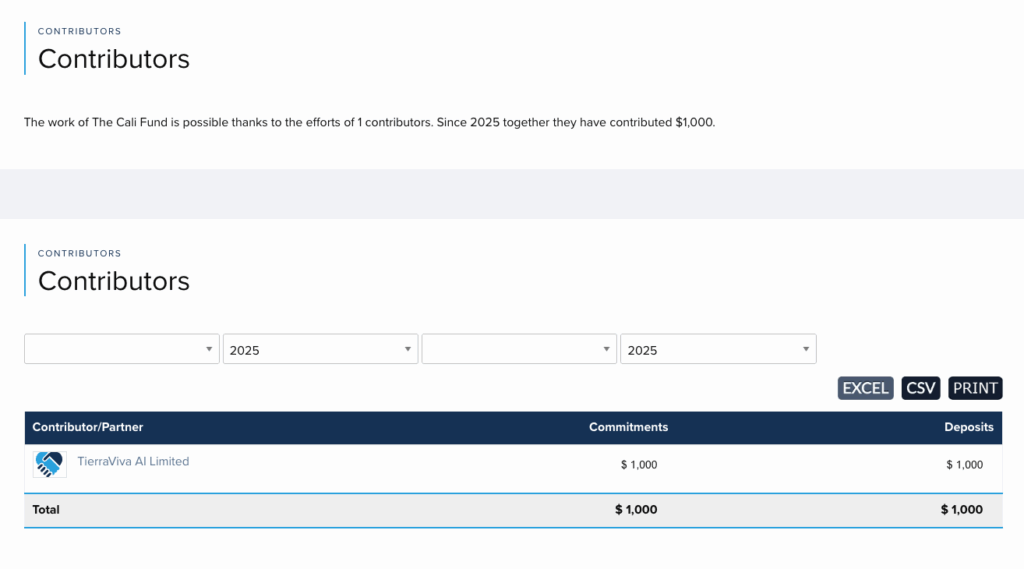
The contribution page on the Cali Fund website, which shows the first payment of $1,000.
The contribution page on the Cali Fund website, which shows the first payment of $1,000. Source: Multi-Partner Trust Fund Office.

The payment was an “expression of our commitment to the objectives of the Cali Fund”, TierraViva AI chief executive Dr Paul Oldham wrote in a letter to the executive secretary of the CBD, Astrid Schomaker.

The $1,000 is an “initial contribution”, Oldham said, and the company plans to give more “as our business grows”. Based in the UK with a team of programmers in Nairobi, TierraViva AI was set up in 2023 and uses AI to support conservation.

An anthropologist who worked on Indigenous peoples’ rights in the Amazon, Oldham’s research helped inform the list of sectors most likely to “directly or indirectly benefit from the use of DSI”, including “generative biology” and AI companies.

Oldham noted in a speech at the sidelines of COP30 that although the company’s earnings are not large enough to meet the contribution thresholds set out in the Cali Fund agreement, its contribution showed that companies “of any size” can pay in.

Mary Creagh CBE MP (account name @MaryCreagh_) says in a tweet: "Delighted to announce the first private sector contribution to the Cali fund by UK company Tierra Viva Al. The fund will mobilise private sector finance for nature. At least half will go to indigenous peoples and local communities." A photo is attached to the tweet, showing two men and one woman smiling at the camera.

He tells Carbon Brief that while “some” companies “are not serious about contributing and are seeking to delay” paying into the fund, others have different concerns, including the “need for a level playing field” and positive incentives to contribute:

“This will be hard-earned company money, so it’s reasonable enough to imagine that one of the first questions companies will want an answer to is: ‘well, what is this actually going to be spent on?’ And: ‘what is the benefit of this to us’, which is likely to vary by sector.

“In my view, the best way forward would be for companies that can to make contributions. That would give everybody, including governments, confidence that there might be constructive ways to address difficult topics.” 

Future contributions

A spokesperson for the CBD tells Carbon Brief:

“We are pleased that the Cali Fund is not only ‘open for business’, but that this first contribution also demonstrates it is fully operational. We thank and congratulate TierraViva AI for being the first company to step up.”

“Many discussions” are ongoing around future donations to the fund, the spokesperson says, and the CBD is “hopeful that further announcements can be made soon”, ahead of the next UN biodiversity summit, COP17, in October 2026.

Asked whether the CBD was expecting more contributions at this stage, the spokesperson says the fund was set up in “very short order” and that the first payment shows that companies are “able to contribute”.

US biotechnology company Ginkgo Bioworks was the first to pledge to contribute to the fund earlier this year, but has so far not put forward any money. The company did not respond to Carbon Brief’s request for comment.

Carbon Brief reported earlier this year that at least two companies were contacted by a UK department with opportunities to be involved in the Cali Fund before its launch in February, but no company took up on the offer.

Launch of the Cali Fund at the resumed COP16 negotiations in Rome, Italy on 25 February 2025.
Launch of the Cali Fund at the resumed COP16 negotiations in Rome, Italy on 25 February 2025. Credit: IISD/ENB | Mike Muzurakis.

The first contribution coming from a “startup that has just begun operations squarely points the finger to the profit-making enterprises that are not contributing”, Dr Siva Thambisetty, associate professor of law at the London School of Economics, tells Carbon Brief. Thambisetty adds:

“Strident cries of lack of legal certainty, unfairness or stacking obligations [combining responsibilities from different agreements and laws] would be more credible if industry organisations encouraged large firms that use DSI to begin contributing, instead of denying the last 20 years of multilateral [negotiations] that have led to this point.”

Dr June Rubis – Indigenous peoples and local communities (IPLC) lead from Asia on the Cali Fund’s steering committee – welcomes TierraViva AI’s “first step”, but tells Carbon Brief that the “real test lies ahead” and that it is “now time for larger actors to step forward”.

She says the Cali Fund offers “clarity” on how the private sector can directly increase support to UN-backed funds at a time when “states are retreating” from their climate and biodiversity finance obligations:

“It’s not a voluntary offsetting scheme or a…risky or fringe fund; it’s a multilateral mechanism designed to meet the highest fiduciary and equity standards. We invite companies to see this not as philanthropy, but as participation in a globally endorsed system where trust is institutionalised, benefits are traceable and equity is operationalised.

“Contributing to the Cali Fund isn’t just ethical, it’s strategic. [But] It’s about more than funding: it’s about trust, power-sharing and making sure IPLCs are part of the decisions, not just the outcomes.”

The post ‘Cali Fund’ aiming to raise billions for nature receives first donation – of just $1,000 appeared first on Carbon Brief.

‘Cali Fund’ aiming to raise billions for nature receives first donation – of just $1,000

Continue Reading

Greenhouse Gases

China Briefing 22 January 2026: 2026 priorities; EV agreement; How China uses gas

Published

on

Welcome to Carbon Brief’s China Briefing.

China Briefing handpicks and explains the most important climate and energy stories from China over the past fortnight. Subscribe for free here.

Key developments

Tasks for 2026

‘GREEN RESOLVE’: The Ministry of Ecology and Environment (MEE) said at its annual national conference that it is “essential” to “maintain strategic resolve” on building a “beautiful China”, reported energy news outlet BJX News. Officials called for “accelerating green transformation” and “strengthening driving forces” for the low-carbon transition in 2026, it added. The meeting also underscored the need for “continued reduction in total emissions of major pollutants”, it said, as well as for “advancing source control through carbon peaking and a low-carbon transition”. The MEE listed seven key tasks for 2026 at the meeting, said business news outlet 21st Century Business Herald, including promoting development of “green productive forces”, focusing on “regional strategies” to build “green development hubs” and “actively responding” to climate change.

CARBON ‘PRESSURE’: China’s carbon emissions reduction strategy will move from the “preparatory stages” into a phase of “substantive” efforts in 2026, reported Shanghai-based news outlet the Paper, with local governments beginning to “feel the pressure” due to facing “formal carbon assessments for the first time” this year. Business news outlet 36Kr said that an “increasing number of industry participants” will have to begin finalising decarbonisation plans this year. The entry into force of the EU’s carbon border adjustment mechanism means China’s steelmakers will face a “critical test of cost, data and compliance”, reported finance news outlet Caixin. Carbon Brief asked several experts, including the Asia Society Policy Institute’s Li Shuo, what energy and climate developments they will be watching in 2026.   

COAL DECLINE: New data released by the National Bureau of Statistics (NBS) showed China’s “mostly coal-based thermal power generation fell in 2025” for the first time in a decade, reported Reuters, to 6,290 terawatt-hours (TWh). The data confirmed earlier analysis for Carbon Brief that “coal power generation fell in both China and India in 2025”, marking the first simultaneous drop in 50 years. Energy news outlet International Energy Net noted that wind generation rose 10% to 1,053TWh and solar by 24% to 1,573TWh. 

上微信关注《碳简报》

EV agreement reached

‘NORMALISED COMPETITION’?: The EU will remove tariffs on imports of electric vehicles (EV) made in China if the manufacturers follow “guidelines on minimum pricing” issued by the bloc, reported the Associated Press. China’s commerce ministry stated that the new guidelines will “enable Chinese exporters to address the EU’s anti-subsidy case concerning Chinese EVs in a way that is more practical, targeted and consistent with [World Trade Organization] rules”, according to the state-run China Daily. An editorial by the state-supporting Global Times argued that the agreement symbolised a “new phase” in China-EU economic and trade relations in which “normalised competition” is stabilised by a “solid cooperative foundation”. 

SOLAR REBATES: China will “eliminate” export rebates for solar products from April 2026 and phase rebates for batteries out by 2027, said Caixin. Solar news outlet Solar Headlines said that the removal of rebates would “directly test” solar companies’ profitability and “fundamentally reshape the entire industry’s growth logic”. Meanwhile, China imposed anti-dumping duties on imports of “solar-grade polysilicon” from the US and Korea, said state news agency Xinhua

OVERCAPACITY MEETINGS: The Chinese government “warned several producers of polysilicon…about monopoly risks” and cautioned them not to “coordinate on production capacity, sales volume and prices”, said Bloomberg. Reuters and China Daily covered similar government meetings on “mitigat[ing] risks of overcapacity” with the battery and EV industries, respectively. A widely republished article in the state-run Economic Daily said that to counter overcapacity, companies would need to reverse their “misaligned development logic” and shift from competing on “price and scale” to competing on “technology”.

High prices undermined home coal-to-gas heating policy

SWITCHING SHOCK: A video commentary by Xinhua reporter Liu Chang covered “reports of soaring [home] heating costs following coal-to-gas switching [policies] in some rural areas of north China”. Liu added that switching from coal to gas “must lead not only to blue skies, but also to warmth”. Bloomberg said that the “issue isn’t a lack of gas”, but the “result of a complex series of factors including price regulations, global energy shocks and strained local finances”.

Subscribe: China Briefing
  • Sign up to Carbon Brief’s free “China Briefing” email newsletter. All you need to know about the latest developments relating to China and climate change. Sent to your inbox every Thursday.

HEATED DEBATE: Discussions of the story in China became a “domestically resonant – and politically awkward – debate”, noted the current affairs newsletter Pekingnology. It translated a report by Chinese outlet Economic Observer that many villagers in Hebei struggled with no access to affordable heating, with some turning back to coal. “Local authorities are steadily advancing energy supply,” People’s Daily said of the issue, noting that gas is “increasingly becoming a vital heating energy source” as part of China’s energy transition. Another People’s Daily article quoted one villager saying: “Coal-to-gas conversion is a beneficial initiative for both the nation and its people…Yet the heating costs are simply too high.”

DEJA-VU: This is not the first time coal-to-gas switching has encountered challenges, according to research by the Oxford Institute for Energy Studies, with nearby Shanxi province experiencing a similar situation. In Shanxi, a “lack of planning, poor coordination and hasty implementation” led to demand outstripping supply, while some households had their coal-based heating systems removed with no replacement secured. Others were “deterred” from using gas-based systems due to higher prices, it said.

More China news

  • LOFTY WORDS: At Davos, vice-premier He Lifeng reaffirmed commitments to China’s “dual-carbon” goals and called for greater “global cooperation on climate change”, reported Caixin
  • NOT LOOKING: US president Donald Trump, also at Davos, said he was not “able to find any windfarms in China”, adding China sells them to “stupid” consumers, reported Euronews. China installed wind capacity has ranked first globally “for 15 years consecutively”, said a government official, according to CGTN
  • ‘GREEN’ FACTORIES: China issued “new guidelines to promote green [industrial] microgrids” including targets for on-site renewable use, said Xinhua. The country “pledged to advance zero-carbon factory development” from 2026, said another Xinhua report.
  • JET-FUEL MERGER: A merger of oil giant Sinopec with the country’s main jet-fuel producer could “aid the aviation industry’s carbon reduction goals”, reported Yicai Global. However, Caixin noted that the move could “stifl[e] innovation” in the sustainable air fuel sector.
  • NEW TARGETS: Chinese government investment funds will now be evaluated on the “annual carbon reduction rates” achieved by the enterprises or projects they support, reported BJX News.
  • HOLIDAY CATCH-UP: Since the previous edition of China Briefing in December, Beijing released policies on provincial greenhouse gas inventories, the “two new” programme, clean coal benchmarks, corporate climate reporting, “green consumption” and hydrogen carbon credits. The National Energy Administration also held its annual work conference

Spotlight 

Why gas plays a minimal role in China’s climate strategy

While gas is seen in some countries as an important “bridging” fuel to move away from coal use, rapid electrification, uncompetitiveness and supply concerns have suppressed its share in China’s energy mix.

Carbon Brief explores the current role of gas in China and how this could change in the future. The full article is available on Carbon Brief’s website.

The current share of gas in China’s primary energy demand is small, at around 8-9%

It also comprises 7% of China’s carbon dioxide (CO2) emissions from fuel combustion, adding 755m tonnes of CO2 in 2023 – twice the total CO2 emissions of the UK. 

Gas consumption is continuing to grow in line with an overall uptick in total energy demand, but has slowed slightly from the 9% average annual rise in gas demand over the past decade – during which time consumption more than doubled.

The state-run oil and gas company China National Petroleum Corporation (CNPC) forecast in 2025 that demand growth for the year may slow further to just over 6%. 

Chinese government officials frequently note that China is “rich in coal” and “short of gas”. Concerns of import dependence underpin China’s focus on coal for energy security.

However, Beijing sees electrification as a “clear energy security strategy” to both decarbonise and “reduce exposure to global fossil fuel markets”, said Michal Meidan, China energy research programme head at the Oxford Institute for Energy Studies

A dim future?

Beijing initially aimed for gas to displace coal as part of a broader policy to tackle air pollution

Its “blue-sky campaign” helped to accelerate gas use in the industrial and residential sectors. Several cities were mandated to curtail coal usage and switch to gas. 

(January 2026 saw widespread reports of households choosing not to use gas heating installed during this campaign despite freezing temperatures, due to high prices.)

Industry remains the largest gas user in China, with “city gas” second. Power generation is a distant third.

The share of gas in power generation remains at 4%, while wind and solar’s share has soared to 22%, Yu Aiqun, research analyst at the thinktank Global Energy Monitor, told Carbon Brief. She added: 

“With the rapid expansion of renewables and ongoing geopolitical uncertainties, I don’t foresee a bright future for gas power.”

However, gas capacity may still rise from 150 gigawatts (GW) in 2025 to 200GW by 2030. A government report noted that gas will continue to play a “critical role” in “peak shaving”. 

But China’s current gas storage capacity is “insufficient”, according to CNPC, limiting its ability to meet peak-shaving demand. 

Transport and industry

Gas instead may play a bigger role in the displacement of diesel in the transport sector, due to the higher cost competitiveness of LNG – particularly for trucking. 

CNPC forecast that LNG displaced around 28-30m tonnes of diesel in the trucking sector in 2025, accounting for 15% of total diesel demand in China. 

However, gas is not necessarily a better option for heavy-duty, long-haul transportation, due to poorer fuel efficiency compared with electric vehicles. 

In fact, “new-energy vehicles” are displacing both LNG-fueled trucks and diesel heavy-duty vehicles (HDVs). 

Meanwhile, gas could play a “more significant” role in industrial decarbonisation, Meidan told Carbon Brief, if prices fall substantially.

Growth in gas demand has been decelerating in some industries, but China may adopt policies more favourable to gas, she added.

An energy transition roadmap developed by a Chinese government thinktank found gas will only begin to play a greater role than coal in China by 2050 at the earliest.

Both will be significantly less important than clean-energy sources at that point.

This spotlight was written by freelance climate journalist Karen Teo for Carbon Brief.

Watch, read, listen

EV OUTLOOK: Tu Le, managing director of consultancy Sino Auto Insights, spoke on the High Capacity podcast about his outlook for China’s EV industry in 2026.

‘RUNAWAY TRAIN’: John Hopkins professor Jeremy Wallace argued in Wired that China’s strength in cleantech is due to a “runaway train of competition” that “no one – least of all [a monolithic ‘China’] – knows how to deal with”.

‘DIRTIEST AND GREENEST’: China’s energy engagement in the Belt and Road Initiative was simultaneously the “dirtiest and greenest” it has ever been in 2025, according to a new report by the Green Finance & Development Center.

INDUSTRY VOICE: Zhong Baoshen, chairman of solar manufacturer LONGi, spoke with Xinhua about how innovation, “supporting the strongest performers”, standards-setting and self-regulation could alleviate overcapacity in the industry.


$574bn

The amount of money State Grid, China’s main grid operator, plans to invest between 2026-30, according to Jiemian. The outlet adds that much of this investment will “support the development and transmission of clean energy” from large-scale clean-energy bases and hydropower plants.


New science 

  • The combination of long-term climate change and extremes in rainfall and heat have contributed to an increase in winter wheat yield of 1% in Xinjiang province between 1989-2023 | Climate Dynamics
  • More than 70% of the “observed changes” in temperature extremes in China over 1901-2020 are “attributed to greenhouse gas forcing” | Environmental Research Letters

China Briefing is written by Anika Patel and edited by Simon Evans. Please send tips and feedback to china@carbonbrief.org 

The post China Briefing 22 January 2026: 2026 priorities; EV agreement; How China uses gas appeared first on Carbon Brief.

China Briefing 22 January 2026: 2026 priorities; EV agreement; How China uses gas

Continue Reading

Greenhouse Gases

Explainer: Why gas plays a minimal role in China’s climate strategy

Published

on

Ten years ago, switching from burning coal to gas was a key element of China’s policy to reduce severe air pollution.

However, while gas is seen in some countries as a “bridging” fuel to move away from coal use, rapid electrification, uncompetitiveness and supply concerns have suppressed its share in China’s energy mix.

As such, while China’s gas demand has more than doubled over the past decade, the fuel is not currently playing a decisive role in the country’s strategy to tackle climate change.

Instead, renewables are now the leading replacement for coal demand in China, with growth in solar and wind generation largely keeping emissions growth from China’s power sector flat.

While gas could play a role in decarbonising some aspects of China’s energy demand – particularly in terms of meeting power demand peaks and fuelling heavy industry – multiple factors would need to change to make it a more attractive alternative.

Small, but impactful

The share of gas in China’s primary energy demand is small and has remained relatively unchanged at around 8-9% over the past five years.

It also comprises 7% of China’s carbon dioxide (CO2) emissions from fuel combustion, according to the International Energy Agency (IEA).

Gas combustion in China added 755m tonnes of CO2 (MtCO2) into the atmosphere in 2023 – double the total amount of CO2 emitted by the UK.

However, its emissions profile in China lags well behind that of coal, which represented 79% of China’s fuel-linked CO2 emissions and was responsible for almost 9bn tonnes of CO2 emissions in 2023, according to the same IEA data.

Gas consumption continues to grow in line with an overall uptick in total energy demand. Chinese gas demand, driven by industry use, grew by around 7-8% year-on-year in 2024, according to different estimates.

This rapid growth is, nevertheless, slightly below the 9% average annual rise in China’s gas demand over the past decade, during which consumption has more than doubled overall, as shown in the figure below.

Chart showing China's gas consumption has doubled in a decade
Total demand for gas in China, 1965-2024, billion cubic metres. Source: Energy Institute statistical review of world energy 2025.

The state-run oil and gas company China National Petroleum Corporation (CNPC) forecast in 2025 that demand growth for the year may slow further to just over 6%.

The majority of China’s gas demand in 2023 was met by domestic gas supply, according to the Institute for Energy Economics and Financial Analysis (IEEFA).

Most of this supply comes from conventional gas sources. But incremental Chinese domestic gas supply in recent years has come from harder-to-extract unconventional sources, including shale gas, which accounted for as much as 45% of gas production in 2024.

Despite China’s large recoverable shale-gas resources and subsidies to encourage production, geographical and technical limitations have capped production levels relative to the US, which is the world’s largest gas producer by far.

CNPC estimates Chinese gas output will grow by just 4% in 2025, compared with 6% growth in 2024. Nevertheless, output is still expected to exceed the 230bn cubic metre national target for 2025.

Liquified natural gas (LNG) is China’s second most-common source of gas, imported via giant super-cooled tankers from countries including Australia, Qatar, Malaysia and Russia.

This is followed by pipeline imports – which are seen as cheaper, but less reliable – from Russia and central Asia.

One particularly high-profile pipeline project is the Power of Siberia 2 pipeline project. However, Beijing has yet to explicitly agree to investing in or purchasing the gas delivered by the project. Disagreements around pricing and logistics have hindered progress.

Evolving role

Beijing initially aimed for gas to displace coal as part of a broader policy to tackle air pollution.

A three-year action plan from 2018-2020, dubbed the “blue-sky campaign”, helped to accelerate gas use in the industrial and residential sectors, as gas displaced consumption of “dispersed coal” (散煤)”– referring to improperly processed coal that emits more pollutants. 

Meanwhile, several cities across northern and central China were also mandated to curtail coal usage and switch to gas instead. Many of these cities were based in provinces with a strong coal mining economy or higher winter heating demand.

China’s pollution levels saw “drastic improvement” as a result, according to a report by research institute the Centre for Research on Energy and Clean Air (CREA).

(In January 2026, there were widespread media reports of households choosing not to use gas heating despite freezing temperatures, as a result of high prices following the expiry of subsidies for gas use.)

Industry remains the largest gas user in China, with “city gas” – gas delivered by pipeline to urban areas – trailing in second, as shown in the figure below. Power generation is a distant third.

Chart showing that industry is the largest gas user in China, followed by residential gas sue
Gas consumption by sector in 2023, billion cubic metres. Source: China Natural Gas Development Report (2024).

Gas has never gained momentum in China’s power sector, with its share of power generation remaining at 4% while wind and solar power’s share has soared from 4% to 22% over the past decade, Yu Aiqun, a research analyst at the US-based thinktank Global Energy Monitor, tells Carbon Brief.

Yu adds that this stagnation is largely due to insufficient and unreliable gas supply, which drives up prices and makes gas less competitive compared to coal and renewables. She says:

“With the rapid expansion of renewables and ongoing geopolitical uncertainties, I don’t foresee a bright future for gas power.”

Average on-grid gas-fired power prices of 0.56-0.58 yuan per kilowatt hour (yuan/kWh) in China are far higher than that of around 0.3-0.4 yuan/kWh for coal power, according to some industry estimates. Recent auction prices for renewables are even cheaper than this.

Meanwhile, the share of renewables in China’s power capacity stood at 55% in 2024, compared with gas at around 4%.

Generation from wind and solar in particular has increased by more than 1,250 terawatt-hours (TWh) in China since 2015, while gas-fired generation has increased by just 140TWh, according to IEEFA.

As the share of coal has shrunk from 70% to 61% during this period, IEEFA suggests that renewables – rather than gas – are displacing coal’s share in the generation mix.

However, China’s gas capacity may still rise from approximately 150 gigawatts (GW) in 2025 to 200GW by 2030, Bloomberg reports.

A report by the National Energy Administration (NEA) on development of the sector notes that gas will continue to play a “critical role” in “peak shaving”, where gas turbines can be used for short periods to meet daily spikes in demand. As such, the NEA says gas will be an “important pillar” in China’s energy transition.

In 2024, a new policy on gas utilisation also “explicitly promoted” the use of gas peak-shaving power plants, according to industry outlet MySteel.

China’s current gas storage capacity is “insufficient”, according to CNPC, reducing its ability to meet peak-shaving demand. The country built 38 underground gas storage sites with peak-shaving capacity of 26.7bn cubic metres in 2024, but this accounts for just 6% of its annual gas demand.

Transport use

Gas is instead playing a bigger part in the displacement of diesel in the transport sector, due to the higher cost competitiveness of LNG as a fuel – particularly in the trucking sector.

CNPC expects that LNG displaced around 28-30m tonnes of diesel in the trucking sector in 2025, accounting for 15% of total diesel demand in China.

This is further aided by policy support from Beijing’s equipment trade-in programme, part of efforts to stimulate the economy.

However, gas is not necessarily a better option for heavy-duty, long-haul transportation, due to poorer fuel efficiency compared with electric vehicles (EVs).

In fact, “new-energy vehicles” (NEVs) – including hydrogen fuel-cell, pure-electric and hybrid-electric trucks – are displacing both LNG-fueled trucks and diesel heavy-duty vehicles (HDVs).

In the first half of 2025, battery-electric models accounted for 22% of all HDV sales, a year-on-year increase of 9%, while market share for LNG-fueled trucks fell from 30% in 2024 to 26%.

Gas can be cheaper than oil but is not competitive with EVs and – with the emergence of zero-emission fuels such as hydrogen and ammonia – gas may eventually lose even this niche market, says Yu.

Supply security

Chinese government officials frequently note that China is “rich in coal, poor in oil and short of gas” (“富煤贫油少气”). Concerns around import dependence have underpinned China’s focus on coal as a source of energy security.

However, Beijing increasingly sees electrification as a more strategic way to decarbonise its transport sector, according to some analysts.

“Overall, electrification is a clear energy security strategy to reduce exposure to global fossil fuel markets,” says Michal Meidan, head of the China energy research programme at the Oxford Institute for Energy Studies.

Chinese oil and gas production grew dramatically in the last few years under a seven-year action plan from 2019-25, as Beijing ordered its state oil firms to ramp up output to ensure energy security.

Despite this, gas import dependency still hovers at around 40% of demand. This, according to assessments in government documents, exposes the country to price shocks and geopolitical risks.

The graph below shows the share of domestically produced gas (dark blue), LNG imports (mid-blue) and pipeline imports (light blue), in China’s overall gas supply between 2017 and 2024.

Chart showing that China produces most of its gas domestically, but imports around 40% of its supply
China’s gas supply by source, 2017-2024, billion cubic metres (bcm). Source: IEEFA.

“Gas use is unlikely to play a significant role in decarbonising the power system, but could be more significant in industrial decarbonisation,” Meidan tells Carbon Brief.

She estimates that if LNG prices fall to $6 per million British thermal units (btu), compared to an average of $11 in 2024-25, this could encourage fuel switching in the steel, chemical manufacturing, textiles, ceramics and food processing industries.

The chart below shows the year-on-year change in gas demand between 2001-2022.

Chart showing that industrial gas demand rising overall, although some years see growth slowing
Year-on-year changes in Chinese industry’s gas demand by sector, 2001-2023, bcm. Source: National Bureau of Statistics (NBS), OIES.

Growth in gas demand has been decelerating in some industries in recent years, such as refining. But it also remains unclear if Beijing will adopt more aggressive policies favouring gas, Meidan adds.

A roadmap developed by the Energy Research Institute (ERI), a thinktank under the National Development and Reform Commission’s Academy of Macroeconomic Research, finds that gas only begins to play an equivalent or greater role in China’s energy mix than coal by 2050 at the earliest – 10 years ahead of China’s target for achieving carbon neutrality.

Both fossil fuels play a significantly smaller role than clean-energy sources at this point.

Wang Zhongying and Kaare Sandholt, both experts at the ERI, write in Carbon Brief:

“Gas does not play a significant role in the power sector in our scenarios, as solar and wind can provide cheaper electricity while existing coal power plants – together with scaled-up expansion of energy storage and demand-side response facilities – can provide sufficient flexibility and peak-load capacity.”

Ultimately, China’s push for gas will be contingent on its own development goals. Its next five-year plan, from 2026-2030, will build a framework for China’s shift to controlling absolute carbon emissions, rather than carbon intensity.

Recent recommendations by top Chinese policymakers on priorities for the next five-year plan did not explicitly mention gas. Instead, the government endorses “raising the level of electrification in end-use energy consumption” while also “promoting peaking of coal and oil consumption”.

The Chinese government feels that gas is “nice to have…if available and cost-competitive but is not the only avenue for China’s energy transition,” says Meidan.

The post Explainer: Why gas plays a minimal role in China’s climate strategy appeared first on Carbon Brief.

Explainer: Why gas plays a minimal role in China’s climate strategy

Continue Reading

Greenhouse Gases

Guest post: 10 key climate science ‘insights’ from 2025

Published

on

Every year, understanding of climate science grows stronger.

With each new research project and published paper, scientists learn more about how the Earth system responds to continuing greenhouse gas emissions.

But with many thousands of new studies on climate change being published every year, it can be hard to keep up with the latest developments.

Our annual “10 new insights in climate science” report offers a snapshot of key advances in the scientific understanding of the climate system.

Produced by a team of scientists from around the world, the report summarises influential, novel and policy-relevant climate research published over the previous 18 months.

The insights presented in the latest edition, published in the journal Global Sustainability, are as follows:

  1. Questions remain about the record warmth in 2023-24
  2. Unprecedented ocean surface warming and intensifying marine heatwaves are driving severe ecological losses
  3. The global land carbon sink is under strain
  4. Climate change and biodiversity loss amplify each other
  5. Climate change is accelerating groundwater depletion
  6. Climate change is driving an increase in dengue fever
  7. Climate change diminishes labour productivity
  8. Safe scale-up of carbon dioxide removal is needed
  9. Carbon credit markets come with serious integrity challenges
  10. Policy mixes outperform stand-alone measures in advancing emissions reductions

In this article, we unpack some of the key findings.

A strained climate system

The first three insights highlight how strains are growing across the climate system, from indications of an accelerating warming and record-breaking marine heatwaves, to faltering carbon sinks.

Between April 2023 and March 2024, global temperatures reached unprecedented levels – a surge that cannot be fully explained by the long-term warming trend and typical year-to-year fluctuations of the Earth’s climate. This suggests other factors are at play, such as declining sulphur emissions and shifting cloud cover.

(For more, Carbon Brief’s in-depth explainer of the drivers of recent exceptional warmth.)

Ocean heat uptake has climbed as well. This has intensified marine heatwaves, further stressing ecosystems and livelihoods that rely on fisheries and coastal resources.

The exceptional warming of the ocean has driven widespread impacts, including massive coral bleaching, fish and shellfish mortality and disruptions to marine food chains.

The map below illustrates some of the impacts of marine heatwaves from 2023-24, highlighting damage inflicted on coral reefs, fishing stocks and coastal communities.

The impacts of the exceptional marine heatwaves over 2023–24, a period which saw the warmest sea surface temperature in the satellite record since 1985.
The impacts of the exceptional marine heatwaves over 2023–24, a period which saw the warmest sea surface temperature in the satellite record since 1985. Dataset used is the ESA Climate Change Initiative’s sea surface temperature v3 featured in Embury et al. (2024). Credit: 10 new insights in climate science report (2025).

Land “sinks” that absorb carbon – and buffer the emissions from human activity – are under increasing stress, too. Recent research shows a reduction in carbon stored in boreal forests and permafrost ecosystems.

The weakening carbon sinks means that more human-caused carbon emissions remain in the atmosphere, further driving up global temperatures and increasing the chances that warming will surpass the Paris Agreement’s 1.5C limit.

This links to the fourth insight, which shows how climate change and biodiversity loss can amplify each other by leading to a decrease in the accumulation of biomass and reduced carbon storage, creating a destabilising feedback loop that accelerates warming.

New evidence demonstrates that climate change could threaten more than 3-6 million species and, as a result, could undermine critical ecosystem functions.

For example, recent projections indicate that the loss of plant species could reduce carbon sequestration capacity in the range of 7-145bn tonnes of carbon over the coming decades. Similarly, studies show that, in tropical systems, the extinction of animals could reduce carbon storage capacity by up to 26%.

Human health and livelihoods

Growing pressure on the climate system is having cascading consequences for human societies and natural systems.

Our fifth insight highlights how groundwater supplies are increasingly at risk.

More than half the global population depends on groundwater – the second largest source of freshwater after polar ice – for survival.

But groundwater levels are in decline around the world. A 2025 Nature paper found that rapid groundwater declines, exceeding 50cm each year, have occurred in many regions in the 21st century, especially in arid areas dominated by cropland. The analysis also showed that groundwater losses accelerated over the past four decades in about 30% of regional aquifers.  

Changes in rainfall patterns due to climate change, combined with increased irrigation demand for agriculture, are depleting groundwater reserves at alarming rates.

The figure below illustrates how climate-driven reductions in rainfall, combined with increased evapotranspiration, are projected to significantly reduce groundwater recharge in many arid regions – contributing to widespread groundwater-level declines.

The top panel shows the impact of climate change on terrestrial water fluxes and groundwater recharge.
The top panel shows the impact of climate change on terrestrial water fluxes and groundwater recharge. It illustrates how climate change directly and indirectly affects groundwater resources by altering precipitation (P) and temperature (T) patterns, increasing evapotranspiration (ET), which further reduces groundwater recharge (R) and leads to declining levels. The lower panel illustrates how lower water tables can cause wells to run dry (B), streams to lose water to surrounding aquifers (C), saltwater to intrude into coastal aquifers (D) and land subsidence (E). Credit: 10 new insights in climate science report (2025).

These losses threaten food security, amplifying competition for scarce resources and undermining the resilience of entire communities.

Human health and livelihoods are also being affected by changes to the climate.

Our sixth insight spotlights the ongoing and projected expansion of the mosquito-borne disease dengue fever.

Dengue surged to the largest global outbreak on record in 2024, with the World Health Organization reporting 14.2m cases, which is an underestimate because not all cases are counted.

Rising temperatures are creating more favourable conditions for the mosquitoes that carry dengue, driving the disease’s spread and increasing its intensity.

The chart below shows the regions climatically suitable for Aedes albopictus (blue line) and Aedes aegypti (green line) – the primary mosquitoes species that carry the virus – increased by 46.3% and 10.7%, respectively, between 1951-60 and 2014-23.

The maps on the right reveal how dengue could spread by 2030 and 2050 under an emissions scenario broadly consistent with current climate policies. It shows that the climate suitable for the mosquito that spreads dengue could expand northwards in Canada, central Europe and the West Siberian Plain by 2050.

The chart on the left shows how climate affects the ability of mosquitoes to spread dengue.
The chart on the left shows how climate affects the ability of mosquitoes to spread dengue. R0 (the basic reproduction) on the y-axis represents the average number of new infections in a completely susceptible population generated by a single new case (adapted from Romanello et al. (2024)).The world maps on the right show how the global risk of dengue transmission is expected to change by 2030 and 2050, measured as the number of months in a year when the climate is suitable for mosquitoes to spread the virus, under the SSP2-4.5 scenario (adapted from Ryan et al. (2019), using CMIP6 climate projections). Credit: 10 new insights in climate science report (2025).

The ongoing proliferation of these mosquito species is particularly alarming given their ability to transmit the zika, chikungunya and yellow fever viruses.

Heat stress is also a growing threat to labour productivity and economic growth, which is the seventh insight in our list.

For example, an additional 1C of warming is projected to expose more than 800 million people in tropical regions to unsafe heat levels – potentially reducing working hours by up to 50%.

At 3C warming, sectors such as agriculture, where workers are outdoors and exposed to the sun, could see reductions in effective labour of 25-33% across Africa and Asia, according to a recent Nature Reviews Earth & Environment paper.

Meanwhile, sectors where workers operate in shaded or indoor settings could also face meaningful losses. This drain on productivity compounds socioeconomic issues and places a strain on households, businesses and governments.

Low-income, low-emitting regions are set to shoulder a greater relative share of the impacts of extreme heat on economic growth, exacerbating existing inequalities.

Action and policy

Our report illustrates not only the scale of the challenges facing humanity, but also some of the pathways toward solutions.

The eighth insight emphasises the critical role of carbon dioxide removal (CDR) in stabilising the climate, especially in “overshoot” scenarios where warming temporarily surpasses 1.5C and is then brought back down.

Scaling these CDR solutions responsibly presents technical, ecological, justice, equity and governance challenges.

Nature-based approaches for pulling carbon out of the air – such as afforestation, peatland rewetting and agroforestry – could have negative consequences for food security, biodiversity conservation and resource provision if deployed at scale.

Yet, research has suggested that substantially more CDR may be needed than estimated in the scenarios used in the Intergovernmental Panel on Climate Change (IPCC’s) last assessment report.

Recent findings showed that a pathway where temperatures remain below 1.5C with no overshoot would require up to 400Gt of cumulative CDR by 2100 in order to buffer against the effect of complex geophysical processes that can accelerate climate change. This figure is roughly twice the amount of CDR assessed by the IPCC.

This underscores the need for robust international coordination on the responsible scaling of CDR technologies, as a complement to ambitious efforts to reduce emissions. Transparent carbon accounting frameworks that include CDR will be required to align national pledges with international goals.

Similarly, voluntary carbon markets – where carbon “offsets” are traded by corporations, individuals and organisations that are under no legal obligation to make emission cuts – face challenges.

Our ninth insight shows how low-quality carbon credits have undermined the credibility of these largely unregulated carbon markets, limiting their effectiveness in supporting emission reductions.

However, emerging standards and integrity initiatives, such as governance and quality benchmarks developed by the Integrity Council for Voluntary Carbon Markets, could address some of the concerns and criticism associated with carbon credit projects.

High-quality carbon credits that are verified and rigorously monitored can complement direct emission reductions.

Finally, our 10th insight highlights how a mix of climate policies typically have greater success than standalone measures.

Research published in Science in 2024 shows how carefully tailored policy packages – including carbon pricing, regulations, and incentives – could consistently achieve larger and more durable emission reductions than isolated interventions.

For example, in the buildings sector, regulations that ban or phase out products or activities achieve an average effect size of 32% when included in a policy package, compared with 13% when implemented on their own.

Importantly, policy mixes that are tailored to the country context and with attention to distributional equity are more likely to gain public support.

These 10 insights in our latest edition highlight the urgent need for an integrated approach to tackling climate change.

The science is clear, the risks are escalating – but the tools to act are available.

The post Guest post: 10 key climate science ‘insights’ from 2025 appeared first on Carbon Brief.

Guest post: 10 key climate science ‘insights’ from 2025

Continue Reading

Trending

Copyright © 2022 BreakingClimateChange.com