

Welcome to Carbon Brief’s DeBriefed.
An essential guide to the week’s key developments relating to climate change.
This week
EU sets 2040 goal
CUT CRUNCHED: The EU agreed on a legally binding target to reduce greenhouse gas emissions by 90% from 1990 levels by 2040, reported the EU Observer. The publication said that this agreement is “weaker” than the European Commission’s original proposal as it allows for up to five percentage points of a country’s cuts to be achieved by the use of foreign carbon credits. Even in its weakened form, the goal is “more ambitious than most other major economies’ pledges”, according to Reuters.
PETROL CAR U-TURN: Commission president Ursula von der Leyen has agreed to “roll back an imminent ban on the sale of new internal combustion-engined cars and vans after late-night negotiations with the leader of the conservative European People’s Party,” reported Euractiv. Car makers will be able to continue selling models with internal combustion engines as long as they reduce emissions on average by 90% by 2035, down from a previously mandated 100% cut. Bloomberg reported that the EU is “weighing a five-year reprieve” to “allow an extension of the use of the combustion engine until 2040 in plug-in hybrids and electric vehicles that include a fuel-powered range extender”.
CORPORATE PRESSURE: Reuters reported that EU countries and the European parliament struck a deal to “cut corporate sustainability laws, after months of pressure from companies and governments”. It noted that the changes exempt businesses with fewer than 1,000 employees from reporting their environmental and social impact under the corporate sustainability reporting directive. The Guardian wrote that the commission is also considering a rollback of environment rules that could see datacentres, artificial intelligence (AI) gigafactories and affordable housing become exempt from mandatory environmental impact assessments.
Around the world
- EXXON BACKPEDALS: The Financial Times reported on ExxonMobil’s plans to “slash low-carbon spending by a third”, amounting to a reduction of $10bn over the next 5 years.
- VERY HOT: 2025 is “virtually certain” to be the second or third-hottest year on record, according to data from the EU’s Copernicus Climate Change Service, covered by the Guardian. It reported that global temperatures from January-November were, on average, 1.48C hotter than preindustrial levels.
- WEBSITE WIPE: Grist reported that the US Environmental Protection Agency has erased references to the human causes of climate change from its website, focusing instead on “natural processes”, such as variations in the Earth’s orbit. On BlueSky, Carbon Brief contributing editor Dr Zack Labe described the removal as “absolutely awful”.
- UN REPORT: The latest global environment outlook, a largest-of-its-kind UN environment report, “calls for a new approach to jointly tackle the most pressing environmental issues including climate change and biodiversity loss”, according to the Associated Press. However, report co-chair Sir Robert Watson told BBC News that a “small number of countries…hijacked the process”, diluting its potential impact.
$80bn
The amount that Chinese firms have committed to clean technology investments overseas in the past year, according to Reuters.
Latest climate research
- Increases in heavy rainfall and flooding driven by fossil-fuelled climate change worsened recent floods in Asia | World Weather Attribution
- Human-caused climate change played a “substantial role” in driving wildfires and subsequent smoke concentrations in the western US between 1992-2020 | Proceedings of the National Academy of Sciences
- Thousands of land vertebrate species over the coming decades will face extreme heat and “unsuitable habitats” throughout “most, or even all” of their current ranges | Global Change Biology
(For more, see Carbon Brief’s in-depth daily summaries of the top climate news stories on Monday, Tuesday, Wednesday, Thursday and Friday.)
Captured
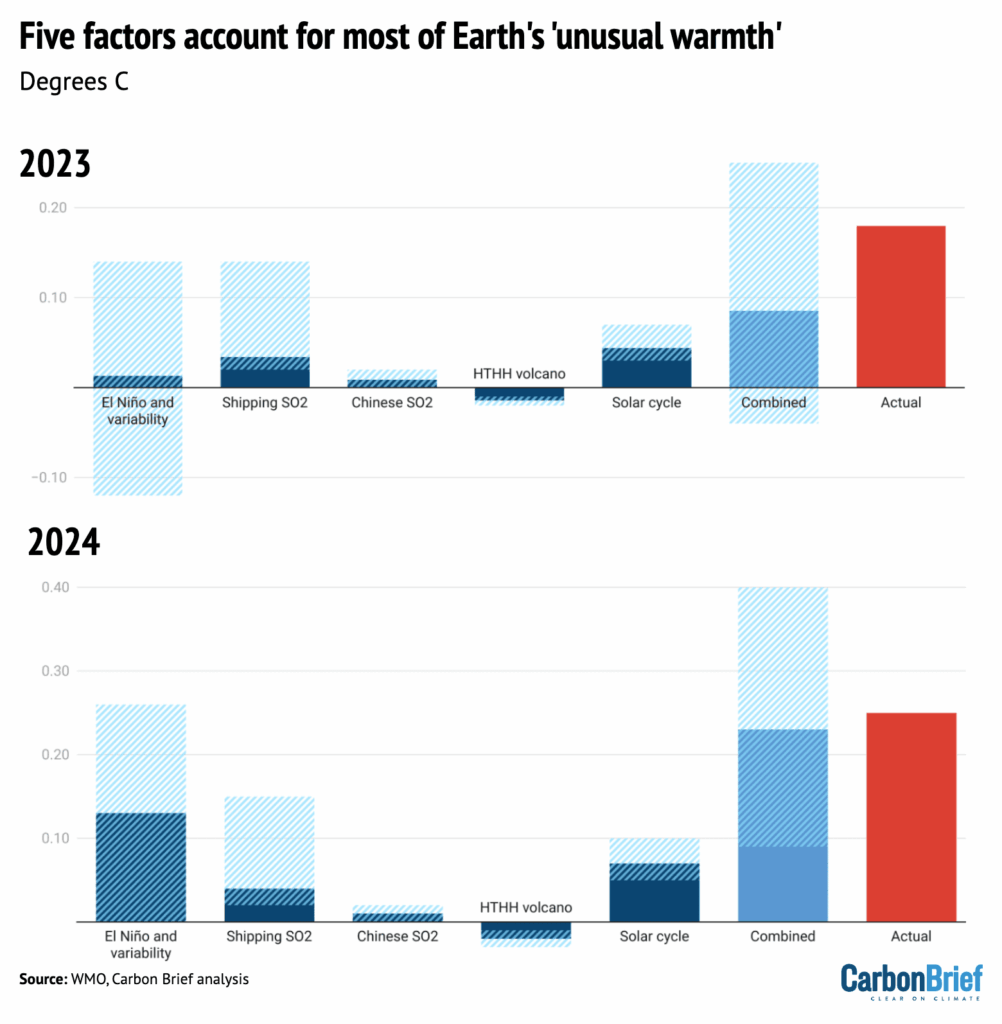
The years 2023 and 2024 were the warmest on record – and 2025 looks set to join them in the top three. The causes of this apparent acceleration in global warming have been subject to a lot of attention in both the media and the scientific community. The charts above, drawn from a new Carbon Brief analysis, show how the natural weather phenomenon El Niño, sulphur dioxide (SO2) emissions from shipping, Chinese SO2, an eruption from the Hunga Tonga-Hunga Ha’apai volcano and solar cycle changes account for most of the “unusual warmth” of recent years. Dark blue bars represent the contribution of individual factors and their uncertainties (hatched areas), the light blue bar shows the combined effects and combination of uncertainties and the red bar shows the actual warming, compared with expectations.
Spotlight
Climate change boardgames
This week, Carbon Brief reports on the rise of climate boardgames.
Boardgames have always made political arguments. Perhaps the most notorious example is the Landlord’s Game published by US game designer and writer Lizzie Magie in 1906, which was designed to persuade people of the need for a land tax.
This game was later “adapted” by US salesman Charles Darrow into the game Monopoly, which articulates a very different set of values.
In this century, game designers have turned to the challenge of climate change.
Best-selling boardgame franchise Catan has spawned a New Energies edition, where players may choose to “invest in clean energy resources or opt for cheaper fossil fuels, potentially causing disastrous effects for the island”.
But perhaps the most notable recent release is 2024’s Daybreak, which won the prestigious Kennerspiel des Jahre award (the boardgaming world’s equivalent of the Oscars).
Rolling the dice
Designed by gamemakers Matteo Menapace and Matt Leacock, Daybreak sees four players take on the role of global powers: China, the US, Europe and “the majority world”, each with their own strengths and weaknesses.
Through playing cards representing policy decisions and technologies, players attempt to reach “drawdown”, a state where they are collectively producing less CO2 than they are removing from the atmosphere.
“Games are good at modelling systems and the climate crisis is a systemic crisis,” Daybreak co-designer Menapace told Carbon Brief.
In his view, boardgames can be a powerful tool for getting people to think about climate change. He said:
“In a video game, the rules are often hidden or opaque and strictly enforced by the machine’s code. In contrast, a boardgame requires players to collectively learn, understand and constantly negotiate the rules. The players are the ‘game engine’. While videogames tend to operate on a subconscious level through immersion, boardgames maintain a conscious distance between players and the material objects they manipulate.
“Whereas videogames often involve atomised or heavily mediated social interactions, boardgames are inherently social experiences. This suggests that playing boardgames may be more conducive to the exploration of conscious, collective, systemic action in response to the climate crisis.”
Daybreak to Dawn
Menapace added that he is currently developing “Dawn”, a successor to Daybreak, building on lessons he learned from developing the first game, telling Carbon Brief:
“I want the next game to be more accessible, especially for schools. We learned that there’s a lot of interest in using Daybreak in an educational context, but it’s often difficult to bring it to a classroom because it takes quite some time to set up and to learn and to play.
“Something that can be set up quickly and that can be played in half the time, 30 to 45 minutes rather than an hour [to] an hour and a half, is what I’m currently aiming for.”
Dawn might also introduce a new twist that explores whether countries are truly willing to cooperate on solving climate change – and whether “rogue” actors are capable of derailing progress, he continued:
“Daybreak makes this big assumption that the world powers are cooperating, or at least they’re not competing, when it comes to climate action. [And] that there are no other forces that get in the way. So, with Dawn, I’m trying to explore that a bit more.
“Once the core game is working, I’d like to build on top of that some tensions, maybe not perfect cooperation, [with] some rogue players.”
Watch, read, listen
WELL WATCHERS: Mother Jones reported on TikTok creators helping to hold oil companies to account for cleaning up abandoned oil wells in Texas.
RUNNING SHORT: Wired chronicled the failure of carbon removal startup Running Tide, which was backed by Microsoft and other tech giants.
PARIS IS 10: To mark the 10th anniversary of the Paris Agreement, climate scientist Prof Piers Forster explained in Climate Home News “why it worked” and “what it needs to do to survive”.
Coming up
- 15-19 December: American Geophysical Union (AGU) annual meeting, New Orleans
- 15-19 December: 70th Meeting of the Global Environment Facility (Gef) Council, online
- 16 December: International Energy Agency: Future of electricity in the Middle East and North Africa webinar, online
Pick of the jobs
- Natural Resources Wales, senior strategic environmental policy specialist | Salary: Unknown. Location: Wales (hybrid)
- The Nature Conservancy, director of conservation – Mata Atlântica | Salary: Unknown. Location: São Paulo, Belo Horizonte, Rio de Janeiro and nearby cities, Brazil
- Barcelona Supercomputing Centre, postdoctoral researcher – downscaling for climate services | Salary: Unknown. Location: Barcelona, Spain
DeBriefed is edited by Daisy Dunne. Please send any tips or feedback to debriefed@carbonbrief.org.
This is an online version of Carbon Brief’s weekly DeBriefed email newsletter. Subscribe for free here.


The post DeBriefed 12 December: EU under ‘pressure’; ‘Unusual warmth’ explained; Rise of climate boardgames appeared first on Carbon Brief.
DeBriefed 12 December: EU under ‘pressure’; ‘Unusual warmth’ explained; Rise of climate boardgames

Drought and heatwaves occurring together – known as “compound” events – have “surged” across the world since the early 2000s, a new study shows.
Compound drought and heat events (CDHEs) can have devastating effects, creating the ideal conditions for intense wildfires, such as Australia’s “Black Summer” of 2019-20 where bushfires burned 24m hectares and killed 33 people.
The research, published in Science Advances, finds that the increase in CDHEs is predominantly being driven by events that start with a heatwave.
The global area affected by such “heatwave-led” compound events has more than doubled between 1980-2001 and 2002-23, the study says.
The rapid increase in these events over the last 23 years cannot be explained solely by global warming, the authors note.
Since the late 1990s, feedbacks between the land and the atmosphere have become stronger, making heatwaves more likely to trigger drought conditions, they explain.
One of the study authors tells Carbon Brief that societies must pay greater attention to compound events, which can “cause severe impacts on ecosystems, agriculture and society”.
Compound events
CDHEs are extreme weather events where drought and heatwave conditions occur simultaneously – or shortly after each other – in the same region.
These events are often triggered by large-scale weather patterns, such as “blocking” highs, which can produce “prolonged” hot and dry conditions, according to the study.
Prof Sang-Wook Yeh is one of the study authors and a professor at the Ewha Womans University in South Korea. He tells Carbon Brief:
“When heatwaves and droughts occur together, the two hazards reinforce each other through land-atmosphere interactions. This amplifies surface heating and soil moisture deficits, making compound events more intense and damaging than single hazards.”
CDHEs can begin with either a heatwave or a drought.
The sequence of these extremes is important, the study says, as they have different drivers and impacts.
For example, in a CDHE where the heatwave was the precursor, increased direct sunshine causes more moisture loss from soils and plants, leading to a drought.
Conversely, in an event where the drought was the precursor, the lack of soil moisture means that less of the sun’s energy goes into evaporation and more goes into warming the Earth’s surface. This produces favourable conditions for heatwaves.
The study shows that the majority of CDHEs globally start out as a drought.
In recent years, there has been increasing focus on these events due to the devastating impact they have on agriculture, ecosystems and public health.
In Russia in the summer of 2010, a compound drought-heatwave event – and the associated wildfires – caused the death of nearly 55,000 people, the study notes.

The record-breaking Pacific north-west “heat dome” in 2021 triggered extreme drought conditions that caused “significant declines” in wheat yields, as well as in barley, canola and fruit production in British Columbia and Alberta, Canada, says the study.
Increasing events
To assess how CDHEs are changing, the researchers use daily reanalysis data to identify droughts and heatwaves events. (Reanalysis data combines past observations with climate models to create a historical climate record.) Then, using an algorithm, they analyse how these events overlap in both time and space.
The study covers the period from 1980 to 2023 and the world’s land surface, excluding polar regions where CDHEs are rare.
The research finds that the area of land affected by CDHEs has “increased substantially” since the early 2000s.
Heatwave-led events have been the main contributor to this increase, the study says, with their spatial extent rising 110% between 1980-2001 and 2002-23, compared to a 59% increase for drought-led events.
The map below shows the global distribution of CDHEs over 1980-2023. The charts show the percentage of the land surface affected by a heatwave-led CDHE (red) or a drought-led CDHE (yellow) in a given year (left) and relative increase in each CDHE type (right).
The study finds that CDHEs have occurred most frequently in northern South America, the southern US, eastern Europe, central Africa and south Asia.

Threshold passed
The authors explain that the increase in heatwave-led CDHEs is related to rising global temperatures, but that this does not tell the whole story.
In the earlier 22-year period of 1980-2001, the study finds that the spatial extent of heatwave-led CDHEs rises by 1.6% per 1C of global temperature rise. For the more-recent period of 2022-23, this increases “nearly eightfold” to 13.1%.
The change suggests that the rapid increase in the heatwave-led CDHEs occurred after the global average temperature “surpasse[d] a certain temperature threshold”, the paper says.
This threshold is an absolute global average temperature of 14.3C, the authors estimate (based on an 11-year average), which the world passed around the year 2000.
Investigating the recent surge in heatwave-leading CDHEs further, the researchers find a “regime shift” in land-atmosphere dynamics “toward a persistently intensified state after the late 1990s”.
In other words, the way that drier soils drive higher surface temperatures, and vice versa, is becoming stronger, resulting in more heatwave-led compound events.
Daily data
The research has some advantages over other previous studies, Yeh says. For instance, the new work uses daily estimations of CDHEs, compared to monthly data used in past research. This is “important for capturing the detailed occurrence” of these events, says Yeh.
He adds that another advantage of their study is that it distinguishes the sequence of droughts and heatwaves, which allows them to “better understand the differences” in the characteristics of CDHEs.
Dr Meryem Tanarhte is a climate scientist at the University Hassan II in Morocco, and Dr Ruth Cerezo Mota is a climatologist and a researcher at the National Autonomous University of Mexico. Both scientists, who were not involved in the study, agree that the daily estimations give a clearer picture of how CDHEs are changing.
Cerezo-Mota adds that another major contribution of the study is its global focus. She tells Carbon Brief that in some regions, such as Mexico and Africa, there is a lack of studies on CDHEs:
“Not because the events do not occur, but perhaps because [these regions] do not have all the data or the expertise to do so.”
However, she notes that the reanalysis data used by the study does have limitations with how it represents rainfall in some parts of the world.
Compound impacts
The study notes that if CDHEs continue to intensify – particularly events where heatwaves are the precursors – they could drive declining crop productivity, increased wildfire frequency and severe public health crises.
These impacts could be “much more rapid and severe as global warming continues”, Yeh tells Carbon Brief.
Tanarhte notes that these events can be forecasted up to 10 days ahead in many regions. Furthermore, she says, the strongest impacts can be prevented “through preparedness and adaptation”, including through “water management for agriculture, heatwave mitigation measures and wildfire mitigation”.
The study recommends reassessing current risk management strategies for these compound events. It also suggests incorporating the sequences of drought and heatwaves into compound event analysis frameworks “to enhance climate risk management”.
Cerezo-Mota says that it is clear that the world needs to be prepared for the increased occurrence of these events. She tells Carbon Brief:
“These [risk assessments and strategies] need to be carried out at the local level to understand the complexities of each region.”




The post Heatwaves driving recent ‘surge’ in compound drought and heat extremes appeared first on Carbon Brief.
Heatwaves driving recent ‘surge’ in compound drought and heat extremes
Greenhouse Gases
DeBriefed 6 March 2026: Iran energy crisis | China climate plan | Bristol’s ‘pioneering’ wind turbine
Welcome to Carbon Brief’s DeBriefed.
An essential guide to the week’s key developments relating to climate change.
This week
Energy crisis
ENERGY SPIKE: US-Israeli attacks on Iran and subsequent counterattacks across the Middle East have sent energy prices “soaring”, according to Reuters. The newswire reported that the region “accounts for just under a third of global oil production and almost a fifth of gas”. The Guardian noted that shipping traffic through the strait of Hormuz, which normally ferries 20% of the world’s oil, “all but ground to a halt”. The Financial Times reported that attacks by Iran on Middle East energy facilities – notably in Qatar – triggered the “biggest rise in gas prices since Russia’s full-scale invasion of Ukraine”.
‘RISK’ AND ‘BENEFITS’: Bloomberg reported on increases in diesel prices in Europe and the US, speculating that rising fuel costs could be “a risk for president Donald Trump”. US gas producers are “poised to benefit from the big disruption in global supply”, according to CNBC. Indian government sources told the Economic Times that Russia is prepared to “fulfil India’s energy demands”. China Daily quoted experts who said “China’s energy security remains fundamentally unshaken”, thanks to “emergency stockpiles and a wide array of import channels”.
‘ESSENTIAL’ RENEWABLES: Energy analysts said governments should cut their fossil-fuel reliance by investing in renewables, “rather than just seeking non-Gulf oil and gas suppliers”, reported Climate Home News. This message was echoed by UK business secretary Peter Kyle, who said “doubling down on renewables” was “essential” amid “regional instability”, according to the Daily Telegraph.
China’s climate plan
PEAK COAL?: China has set out its next “five-year plan” at the annual “two sessions” meeting of the National People’s Congress, including its climate strategy out to 2030, according to the Hong Kong-based South China Morning Post. The plan called for China to cut its carbon emissions per unit of gross domestic product (GDP) by 17% from 2026 to 2030, which “may allow for continued increase in emissions given the rate of GDP growth”, reported Reuters. The newswire added that the plan also had targets to reach peak coal in the next five years and replace 30m tonnes per year of coal with renewables.
ACTIVE YET PRUDENT: Bloomberg described the new plan as “cautious”, stating that it “frustrat[es] hopes for tighter policy that would drive the nation to peak carbon emissions well before president Xi Jinping’s 2030 deadline”. Carbon Brief has just published an in-depth analysis of the plan. China Daily reported that the strategy “highlights measures to promote the climate targets of peaking carbon dioxide emissions before 2030”, which China said it would work towards “actively yet prudently”.
Around the world
- EU RULES: The European Commission has proposed new “made in Europe” rules to support domestic low-carbon industries, “against fierce competition from China”, reported