

Bonn agenda finally adopted after tough fight
Anyone would think there’s no climate emergency. The mid-year UN climate talks in Bonn were meant to open on Monday morning, to advance negotiations on the road to COP30 in Brazil on issues such as how to measure adaptation, transitioning away from fossil fuels and climate finance. More than a day and a half later, they finally started for real.
A delayed opening plenary was abandoned on Monday night as countries rowed over the agenda. After much wrangling behind closed doors, it was restarted and ended early Tuesday evening with the adoption of items to be negotiated, to polite applause and a bigger sense of discontent than satisfaction, especially among developing countries.
The most contentious issue was developing countries’ request to include two agenda items on the implementation of Article 9.1 of the Paris Agreement – on finance provided by rich nations – and on climate change-related unilateral trade measures.
The European Union (EU) expressed its opposition from the beginning and later attempted to bring Articles 9.2 and 9.3 to the table, which refer to the possibility of other sources of finance, including voluntary contributions from other countries – always a red flag for China.
Developing countries appeared united in their requests for negotiations on climate finance and trade on the first two days of the Bonn talks. The results? They managed to get those issues onto the work agenda for the next eight days, but not quite as they had hoped.
On Article 9.1, the chairs of the talks at Bonn will hold “substantive consultations” and report back on their outcomes at COP30 in Belem.
And regarding the unilateral trade measures – code for carbon taxes on imports to the EU and some other developed countries – a footnote was added to the agenda saying the topic would be discussed under under relevant agenda items, including the Just Transition Work Programme.
“The past 30 hours have been hard and have not reflected the urgency that we face,” the UN climate chief Simon Stiell told the subdued end of the session.
The aftershocks of the bitter exchanges between countries rippled through the plenary hall as delegates took to the floor after the agenda was adopted.
Speaking on behalf of the Like-Minded Group of Developing Countries (LMDC) – which had initially put forward the contentious agenda items – Bolivia’s Diego Pacheco blamed the delay on developed countries, accusing them of refusing to discuss “issues that impact developing countries” while shifting their financial responsibilities to the private sector. “This is unacceptable,” he added.
Echoing Pacheco’s words, India’s negotiator said he was “extremely disappointed” with rich countries’ “reluctance” to talk about their “financial obligations”.
“It is hard to remain silent when our positions and motivations are mischaracterised by our partners,” hit back a representative of the EU, which had most fiercely resisted the inclusion of the agenda items (some said in the absence of the US at the talks). “When we don’t agree, we work together to reach compromises that allow us to move forward,” he added.
With the agenda finally sorted, negotiators can now turn their full attention to equally thorny discussions on things like the transition away from fossil fuels and indicators to help countries adapt to a warming world.
“We need to demonstrate to the world that climate cooperation can deliver,” Stiell pleaded with delegates, “now more than ever”.
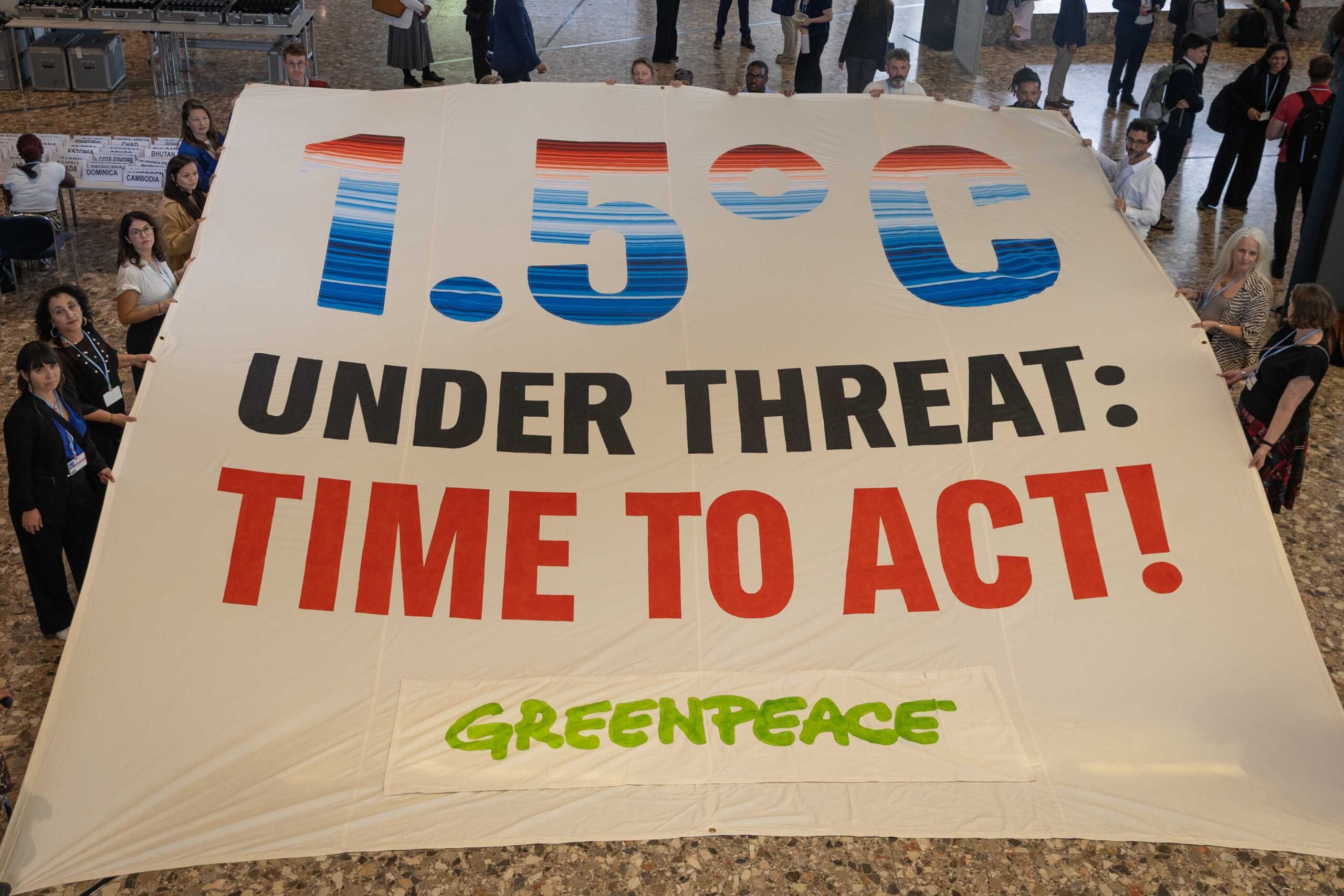
UN climate body’s work balloons – but not its funding
For that desperately needed climate action to be stepped up, Stiell warned in his planned welcome speech – not delivered but only posted on the UNFCCC website due to the delayed opening – that “the acceleration still needed will only be possible if our process is adequately resourced”.
He said in the written comments that governments had given the UNFCCC more work to do but not more money to do it with. The body has been cutting costs, he said, “but this approach is not sustainable”.
The UNFCCC has released a document showing which parts of its work are under-funded. Particularly cash-strapped activities include communications campaigns promoting the UNFCCC process’s achievements, facilitating civil society participation in the process and enhancing the capacity of young negotiators.
A note from Stiell says that funding constraints “hindered efforts to modernise digital platforms and conferencing systems, including cybersecurity infrastructure; and adversely affected the timely processing of applications for UNFCCC observer status and the implementation of the gender and [Action for Climate Empowerment] workstreams”
Another document shows how much things cost. About three-quarters of the UNFCCC’s costs are salaries and these are set under a UN-wide system – so hard to get down.
Smaller costs like a five-day workshop with 100 people can cost €0.68m euros ($0.79m) to put on while a five-day official trip costs €3,700 per person ($4,284).
The tight budget situation has also led to “significantly reduced interpretation services” at the Bonn talks, with negotiators told they would not have them available at Tuesday’s delayed plenary and would need to speak in English.
Brazil’s ‘act of sabotage’ on oil
As the Brazilian COP30 Presidency attempts to take forward discussions at UN climate talks on the transition away from fossil fuels, their government colleagues back home today auctioned off the rights to extract oil and gas in 172 areas of Brazil and its waters – 47 of them offshore near the mouth of the Amazon River.
In Rio de Janeiro, the auction unfolded live on camera. The national anthem was played and a room of men in suits from around the world sat down to begin the bidding. An introductory video showed a plant being watered with bare hands while a caption advertised incentives to reduce the greenhouse gases from oil production.
Patricia Baran, head of the national oil agency ANP, told the cameras that other countries are still announcing new oil and gas fields too and that the blocks auctioned off will include additional environmental and social protections.
The bidding started with the controversial Amazon blocks – and Brazil’s national oil company Petrobras, American firms ExxonMobil and Chevron, and China’s state-owned CNPC were the winners of those.
Brazilian climate campaigners in Bonn expressed sympathy with the COP30 Presidency – whose CEO Ana Toni spent decades in environmental NGOs like Greenpeace and Action Aid.

Stela Herschmann, a climate specialist at Observatório do Clima, told a press conference that the auction was “an act of sabotage” against the climate and against “the Brazilian diplomats that are here and doing their best in Bonn to rally the world towards an ambitious COP in November”.
A press statement from 350.org picked out two saboteurs: the president of national oil company Petrobras, Magda Chambriard, who last month copied Donald Trump’s “drill baby drill” slogan, and Brazil’s mines and energy minister, Alexandre Silveira, who has said Brazil “should not be ashamed of being oil producers”.
ClimaInfo research estimates that, when burned, the oil and gas from the blocks being auctioned off would release 11 billion tonnes of carbon dioxide. Observatório do Clima’s Claudio Angelo told Climate Home today that an oil spill from the 47 offshore blocks near Belém and the Amazon River would devastate coral reefs, mangroves and the coastlines of both Brazil and neighbouring French Guiana.
The Amazon region now holds nearly one-fifth of the world’s recently discovered oil and natural gas reserves, establishing itself as a new global frontier for the fossil fuel industry, a recent investigation by Climate Home’s partner InfoAmazonia found.
All this comes on the same day that the International Energy Agency released its oil report for 2025, suggesting that growth in oil supply will be twice as fast growth in oil demand during the rest of the decade. The IEA’s head Fatih Birol said “oil markets look set to be well-supplied”.
Angelo said this means there’s a risk that Brazil will make a loss on these oil and gas fields, especially if the world limits fossil fuel use to curb global warming.
Bonn or London – where’s the action at?
On the ground in Bonn, it feels like much of the climate energy is slipping away from the UNFCCC process. Just 7,731 people have registered to participate, a 10% drop on last year – and there definitely seem to be fewer journalists.
Many of the COP30 Presidency’s big-hitters will be skipping some or all of Bonn’s second week to go to London Climate Action Week, where they will be joined by Stiell’s boss – the head of the UN, Antonio Guterres. He will give a special address at E3G’s State of Climate Politics Forum next Tuesday.
One of Stiell’s predecessors, Christiana Figueres, wrote recently that the “potential for impact” is shifting from climate diplomacy to climate economics “and that shift is being staged not so much within COP venues, but at Climate Weeks in New York, London, and other cities around the world.” (London may eclipse NYC in importance this year, some are saying, as Trump’s policies threaten to scare the green crowd away.)
Nonetheless, Stiell asserted in his undelivered opening speech for the Bonn talks, “this process matters, deeply”, adding that it is “delivering real progress”.
He noted that “without UN-convened climate multilateralism”, the world would be headed for up to 5C of global warming, which has been cut to around 3C, adding: “it’s a measure of how far we’ve come, and how far to go.”
“These sessions are where we move from concept to clarity – across sectors, systems, and societies. You are laying down the tracks that further deliver implementation,” he said in words that were never heard by negotiators.
The post Bonn Bulletin: Slow start to climate talks fails to reflect urgency appeared first on Climate Home News.
Bonn Bulletin: Slow start to climate talks fails to reflect urgency

Cleaner cooking projects in the UN carbon market will have to set aside a share of their credits to insure against the risk that the trees they save are lost to fire, drought or logging, after the market’s regulator rejected calls to exempt the sector.
The requirement is part of a new rulebook that the Paris Agreement carbon market regulator – the Article 6.4 Supervisory Body – approved last Friday for programmes that aim to cut emissions by distributing new and cleaner cookstoves in regions that still burn wood or charcoal for cooking.
These are the UN mechanism’s first rulebooks for cookstoves, one of the carbon market’s most popular credit types and also one of its most criticised for overstating climate benefits.
They consist of two methodologies: one for programmes that aim to cut greenhouse gas emissions by distributing more efficient cookstoves that burn less wood or charcoal, and a separate methodology for projects shifting households to lower-emissions cookers running on electricity or liquid petroleum gas (LPG).
Mkhuthazi Steleki, the South African chair of the Supervisory Body, said “this decision gives cleaner cooking projects a new pathway under the UN carbon market, with clear rules to ensure that each credit represents a real and credible emission reduction”.
Industry and NGOs lobby to weaken UN carbon credit rules in “coordinated” push
In copycat submissions and a private briefing to government officials, the groups have opposed a proposal to tighten safeguards for emissions offsetsLaunch of Africa Energy Bank delayed again in blow to oil and gas hopes
Repeated delays are raising questions about the bank’s momentum and whether it can mobilise investment to finance Africa’s oil and gas ambitions in an era of energy transition

Exemption push rejected
More efficient cookstove projects earn credits based on the amount of carbon they save by preserving trees that would have otherwise been cut down and burned for fuel. But if those trees later burn in a wildfire or are logged, the carbon stored would be released anyway, erasing the climate benefits of the credits.
Several carbon credit developers, conservation NGOs and the UN Environment Programme (UNEP) disputed that cookstove projects face this risk, in what critics described as a “coordinated lobbying campaign”.
They argued that, unlike forest protection schemes, this type of credit represents a “flow” of avoided emissions rather than a “stock” of stored carbon that can be released. They also warned that requiring a buffer would impose disproportionate costs and undermine the financial viability of these activities.
But the UN carbon market regulator was not persuaded by the argument. It decided that projects would have to protect against this reversal risk by handing over a percentage of credits to a so-called “buffer pool” instead of selling them.
‘New paradigm’
The amount of credits to be given up is calculated by applying different methods for natural risks, like wildfires, droughts or hurricanes, and human-caused ones, such as logging or land clearing.
For natural risks, project developers will need to apply local risk values derived from new modelling published by a group of independent scientists.
Campaigners have broadly welcomed the decision. Federica Dossi, an expert at Brussels-based advocacy group Carbon Market Watch, said it sets a new paradigm for calculating reversal risk based on empirical data. “This approach is grounded in science and we hope to see this now being adopted by other carbon crediting mechanisms in the voluntary market,” she added.
Backers claim this method is more rigorous than current practice in the voluntary carbon market, which largely relies on expert guesswork.
Pre-COP draws attention to Pacific’s climate plight and 1.5C goal
Pushback over science
As Climate Home News previously revealed, the same industry and NGO groups that sought an exemption from the “buffer pool”, along with some corporate buyers, criticised the use of a study backed by the UN carbon market’s experts that recommended the new risk assessment approach.
The groups pushed for more flexible rules that would have allowed natural risk values drawn from other sources, including national databases, or from the project developers themselves.
While the Supervisory Body rejected this approach, it gave project developers and countries the option to propose alternative values that would first need to be vetted by the mechanism’s expert panel and then approved by the regulator.
A carbon market expert told Climate Home News that, while it is too early to say how this provision will be used, they expect requests will have to be backed up with solid scientific evidence, lowering the risk of unfounded claims.

Policy discounts questioned
To guard against human-caused risks, projects will need to apply a flat 20% value set by the Supervisory Body, at the bottom of the 20-45% range recommended by its technical experts ahead of last week’s meeting.
That value can be further reduced by up to two-thirds if the host country has an emission-reduction plan covering forests, a long-term climate strategy and a framework for the UN’s REDD+ forest protection scheme.
Injy Johnstone, senior research fellow at the Munich-based Max Planck Institute, said that, while these are important governance measures, their existence does not necessarily demonstrate that the underlying risk of forest carbon loss has been reduced.
“It is important to distinguish between evidence of actual risk reduction and assumptions about the effectiveness of policy commitments,” she added.
Moving target
A UN source told Climate Home News that, under the approved formula, improved cookstove projects must set aside at least 9% of credits linked to saved wood if they operate in the lowest-risk areas and the host country can claim all available discounts. The share of credits rises significantly in regions with high natural risk values, such as Guyana, Sri Lanka and Timor Leste, or that do not have REDD+ programmes.
These factors could change in the future as the Supervisory Body asked its technical experts to recommend revisiting the risk values “should credible new evidence arise”.
Climate change is likely to make forest destruction events, such as wildfires or hurricanes, more frequent and more severe in certain regions. Meanwhile, national policies on forest protection can shift significantly depending on government changes.
Johnstone said the UN carbon market needs periodic reassessment to respond to new evidence showing that previously assumed levels of risk were too low.
“The integrity of credits is not guaranteed simply because a reversal risk tool exists,” she added. “The real test will be whether the mechanism provides equivalent atmospheric protection over time, rather than simply introducing another layer of accounting requirements”.
The post UN carbon market forces cookstove projects to protect against forest loss appeared first on Climate Home News.
UN carbon market forces cookstove projects to protect against forest loss
Next week, diplomats from around the world will descend on Yerevan, Armenia, to negotiate a series of decisions under the UN Convention on Biological Diversity (CBD).
Between 19 and 30 October, 196 parties will gather to hammer out the precise wording of the dozens of legal texts that make up the decisions under the Conference of the Parties (COP) to the CBD.
This year’s summit is particularly significant, as it marks the halfway point between the agreement of the Kunming-Montreal Global Biodiversity Framework and the deadline for achieving its targets.
The CBD has found that countries are currently not on track to meet 22 out of the framework’s 23 targets.
During the fortnight, delegates will also be negotiating decisions relating to the two supplemental protocols to the CBD: the Cartagena Protocol, which covers biosafety; and the Nagoya Protocol, which covers access and benefit-sharing for the use of genetic resources.
(The Cartagena and Nagoya Protocols, which are each governed by a “meeting of the parties”, or “MOP”, have fewer parties than the CBD as a whole, with 173 and 141, respectively.)
Carbon Brief is tracking the progress of countries towards consensus on dozens of negotiating texts using the interactive table below.
The tracker includes texts from the COP, as well as the MOPs for the Cartagena and Nagoya protocols. It also includes draft decisions from the most recent subsidiary body meetings, as these form the starting point for the negotiations in Yerevan.
The CBD has three subsidiary bodies: the subsidiary body on scientific, technical and technological advice (SBSTTA), the subsidiary body on implementation (SBI) and the subsidiary body on article 8(j) and other provisions (SB8J).
SB8J focuses on issues related to the Indigenous peoples and local communities. It was established at COP16 in Cali, Colombia, in 2024.
The first two columns of the interactive tracker list the topic of each agenda item and the relevant body, with subsequent columns including dates, page counts and links to the original documents.
The table is searchable and can be sorted using the arrows in the header.
Areas of disagreement in UN draft texts are denoted by square brackets. Counting the brackets in a particular iteration of a text therefore gives a sense of how far parties are from reaching consensus.
The bracket column is colour-coded, with dark green indicating a low number of brackets and red indicating a high number of brackets remaining.
Texts can also present parties with choices using “options” or alternatives (“alt”), which are counted together in the sixth column of the table.
The key discussions in Yerevan will centre around two agenda items in particular. The first is the global review, which will assess progress towards the GBF and make recommendations for accelerating action.
The second is finance, which can be separated into two parts: resource mobilisation and the financial mechanism. On resource mobilisation, biodiverse global south countries are likely to push for an increased amount of international finance for conservation.
Disagreement over the creation of the financial mechanism led to the suspension of COP16 in Cali in October 2024, as parties failed to find agreement on the mobilisation of finance before the end of the summit.
Global south countries want the establishment of a separate financial mechanism under the control of the CBD; global north countries largely prefer to maintain the existing mechanism, which sits under the Global Environment Facility.
At the resumed session of COP16 in Rome in early 2025, countries agreed on a roadmap that would lead to the establishment of a permanent mechanism.
related

Analysis: Lula presidency saved at least 20,000km2 of Brazilian Amazon since 2022
Why land-use emissions have fallen by a third this century – in six charts

Analysis: 84% of nations miss deadline to identify ‘nature-harming’ subsidies by 2025
UK withdraws millions in funding from world’s second-largest rainforest in Congo
The post Interactive: Tracking negotiating texts at the COP17 biodiver