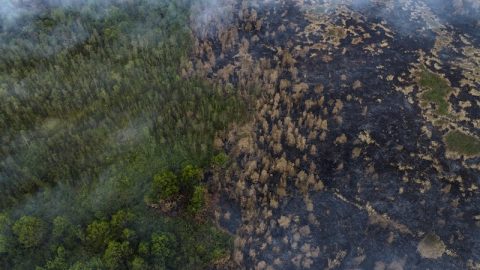
Cecilia Requena is a Bolivian senator with Parliamentarians for a Fossil Free Future and Juan Pablo Osornio is engagement and policy director at Earth Insight.
In late April, delegations from dozens of governments will gather in Colombia for the First Conference on Transitioning Away from Fossil Fuels. Together with the roadmaps announced at November’s UN climate summit in Brazil, which will call on countries to transition away from fossil fuels and halt deforestation by 2030, political will is building to save our most critical natural resources.
Now we need the practical application of where and how this will work – specific places where the line is drawn against new fossil fuel extraction. That is what Fossil Free Zones offer.
What is a Fossil Free Zone?
A Fossil Free Zone is a defined area demarcated by its ecological, biodiversity, or cultural significance, where exploration, extraction, and development of fossil fuels are permanently prohibited. Think tropical rainforests, key biodiversity areas, Indigenous Peoples’ territories, and critical marine ecosystems. They translate the abstract global commitment to transitioning away from fossil fuels into something tangible: a map, a boundary, a legal safeguard.
The stakes for getting this right are enormous. Research shows that oil and gas blocks already overlap with approximately 179 million hectares of tropical moist forests – roughly 21% of the Amazon, Congo Basin, and Southeast Asian forest cover.


Globally, almost 27% of global conventional oil resources overlap with top-priority socio-environmental areas. In 2024 alone, 85% of new oil discoveries were made offshore, frequently overlapping with marine biodiversity hotspots.
Colombia: A model for the world
No country illustrates the possibilities better than Colombia – fittingly, the nation hosting this conference (along with the Netherlands). Last September, Colombia announced a landmark ban on fossil fuel and mining extraction across its entire Amazon region – the world’s first region-wide Fossil Free Zone of its kind.
Colombia’s decision followed in the wake of our new research, which found that developing untapped reserves beneath the country’s forest would generate billions of dollars in stranded assets while doing almost nothing for national energy security. It would, however, threaten 20% of the intact Amazon forest and the territories of nearly 70% of the Indigenous and local communities whose lands overlap with fossil fuel concessions. In most of the Colombian Amazon, the cost of extraction is higher than the cost of conservation.
How a global roadmap can meet the promise to halt deforestation
Other countries are also taking steps in this direction. Mexico has 100 million hectares of similar Safeguard Zones, Guatemala ended oil extraction in the Mayan Biosphere Reserve, and parliamentarians across the Amazon basin have introduced legislation to extend the ban region-wide.
The economic case for leaving fossil fuels in the ground
The fossil fuel endgame – a period of declining global demand as renewable energy scales – means that unconventional and frontier reserves in remote forests are increasingly uncompetitive. They require massive public investment in infrastructure, including roads that themselves become vectors for illegal logging, small-scale mining, and agricultural encroachment. Stranded asset risk is real and growing.
In 2025, wind and solar growth outpaced all new electricity demand, and more than a quarter of all vehicles sold were electric.
For forested nations, there is also an emerging economic logic for protection: intact forests generate jobs and revenue from protected area management, watershed services, and sustainable tourism, while supporting the small-scale agriculture that most rural economies depend on. They also underpin water security for agriculture and energy generation and act as carbon sinks. Over 33 million people are employed directly in the forest sector, and there are more than 1.6 billion small forest farm producers.


Fossil fuel investment amid volatile energy markets
Developing countries with fossil fuel reserves face genuine pressures to develop them – credit ratings, currency stability, social services, and energy security are tied to an ever-growing fossil frontier, particularly in the midst of volatile energy markets.
The conflict in Iran has amplified that volatility, spiking oil prices and giving fossil fuel-dependent governments renewed short-term pressure to expand domestic production – making the case for internationally-backed Fossil Free Zones, paired with real financial support, all the more urgent.
Innovative financial mechanisms like the Tropical Forest Forever Facility – a fund proposed at COP30 that would provide long-term, results-based payments to tropical forest nations to keep forests standing – can shift the economic scales enough to make Fossil Free Zones in high-integrity forests politically viable.
Colombia pledges to exit investment protection system after fossil fuel lawsuits
Industries leading the energy transition – renewable energy developers, green hydrogen producers, sustainable finance institutions, and technology companies with net-zero supply chain commitments – also have a direct stake in the Fossil Free Zone agenda. Moreover, the reputational and legal risks of investments in fossil fuel frontiers are escalating.
Already, 11 banks have applied various levels of financial restrictions to the oil and gas sector in the Amazon. Some of these policies are strong, others are closer to greenwashing, but these commitments prove that banks see the increasing risks.


What should emerge from Colombia conference
Our hope for the upcoming conference in Colombia is that, at a minimum, Fossil Free Zones are uplifted as part of a shared international vision for the energy transition. At best, a coalition of countries commits to include Fossil Free Zones in their national plans and establishes a shared framework with principles to identify new zones and implementation guidance for other countries.
WATCH OUR WEBINAR: Santa Marta – Fossil fuel transition in an unstable world
This is a practical on-ramp for countries that want to align with the global transition but need a concrete, geographically-defined starting point – and as a direct delivery mechanism for the deforestation roadmap, translating a global pledge to halt forest loss into specific action to thwart a real driver of deforestation.
The question is no longer whether fossil fuel extraction will end, but whether that end will be managed or chaotic, putting the planet’s most critical ecosystems in danger. Fossil Free Zones offer a hope of preventing irreversible harm to the forests, marine ecosystems, and Indigenous communities that represent humanity’s best remaining insurance against climate collapse – one territory at a time.
The post Fossil Free Zones can be on-ramps to the clean energy transition appeared first on Climate Home News.
Fossil Free Zones can be on-ramps to the clean energy transition
Climate Change
Woodside’s own modelling reveals catastrophic oil spill risk at Scott Reef
What if Australia’s worst offshore oil spill hasn’t happened yet?
I’m terrified by the thought.
Our new report in partnership with Environs Kimberley analyses Woodside’s own oil spill modelling and it reveals a worst-case blowout at the corporation’s proposed Browse gas project at Scott Reef could be up to 30 times larger than the Montara oil spill – one of Australia’s worst environmental disasters to date.
Woodside’s own modelling warns that oil pollution could spread across Scott Reef, the Kimberley coast and beyond, with impacts Woodside itself describes as “severe”, “potentially irreversible” and “catastrophic”.

What’s at stake?
Scott Reef really is like nowhere else on Earth.
Scott Reef is Australia’s largest freestanding oceanic reef, a pristine marine ecosystem that has thrived for around 15 million years. About 270 kilometres off the Kimberley coast, it supports more than 2,000 marine species, including endangered pygmy blue whales, nesting green sea turtles, the endangered dusky sea snake and ancient corals.
Yet Woodside wants to drill up to 57 toxic wells around and underneath it, causing decades of deafening seismic blasting, light and noise pollution, shipping traffic and, of course, the risk of a ‘catastrophic’ oil spill.

What did Woodside’s modelling find?
Before Browse can be approved, Woodside is required to assess what could happen if something goes wrong. We analysed the corporation’s own environmental assessment documents, and the findings are deeply concerning.
Woodside’s modelling shows that the most severe Browse scenario would be the worst oil spill in Australian history, releasing up to 893,739 barrels of condensate into the Timor Sea. For context, the Montara oil spill released 30,000 barrels of oil.
A blowout of this scale could see oil spread hundreds of kilometres, reaching some of Australia’s most important marine environments, extending into Indonesian and Timor-Leste waters and even washing up along parts of the Kimberley coast. Entrained oil – oil mixed throughout the water column – is predicted to travel up to 863 kilometres from the spill site.
The modelling identifies potential impacts to at least nine marine parks, eight reefs and three Indigenous Protected Areas, as well as important habitats for endangered species, including pygmy blue whales, green sea turtles, seabirds and other marine life.

These aren’t just places on a map. They are globally significant marine ecosystems that support ancient coral reefs, endangered wildlife, tourism, fisheries and coastal communities. A spill of this scale wouldn’t simply affect one reef; it has the potential to impact an entire connected marine ecosystem.
Why this matters now
The most important thing is that Browse has not yet been approved. That means there is still time to stop Browse and the serious risks outlined in Woodside’s own modelling.
The science has been done. The risks have been modelled. The decision now rests with the Australian Government.
Governments are often forced to respond after environmental disasters happen. This is one of those rare moments where they have the opportunity to act before one does.
What you can do
Together, we still have the power to stop Woodside and save Scott Reef.
You can help by:
- Sending an email to Environment Minister Murray Watt and Prime Minister Anthony Albanese, calling on them to reject Browse.
- Sharing this story to help more Australians understand what’s at stake.
- Encouraging your friends and family to take action.
The more people who support saving Scott Reef, the harder it is for governments to approve Woodside’s drilling plans – Browse.
Together, we can ensure a reef that has existed for millions of years is known for its incredible biodiversity – not as the site of Australia’s worst oil spill.
Let’s save Scott Reef.
What if Australia’s worst offshore oil spill hasn’t happened yet?
Climate Change
REPORT: ‘Catastrophic” Browse Oil Spill Report
Analysis by Greenpeace and Environs Kimberley shows that a severe oil spill at Scott Reef could be the worst in Australian history — Woodside has labeled the impact of such a spill ‘catastrophic’.
According to the fossil fuel company the impacts to Scott Reef ‘would likely be severe and potentially irreversible’. Oily pollution could reach as far as the Kimberley coast to the coasts of Indonesia and Timor Leste while endangered marine species live, breed, forage and migrate within the potential disaster zone: whales, seabirds, turtles and other marine life are all at risk.
Report Summary
Woodside’s Browse drilling plans at Scott Reef have been found to pose unacceptable risks to the Western Australian environment once before. To secure their approvals under Federal and Western Australian law, Woodside has modelled a number of possible oil spill scenarios that could result from the Browse project.

Key Findings
- The most severe Browse scenario would be the worst oil spill in Australian history – up to 30 times bigger than the 2009 Montara oil spill disaster. According to Woodside, the environmental impact of such a spill would be ‘catastrophic’.
- Scott Reef and Sandy Islet could be covered in oily pollution. Woodside has conceded that the impacts to Scott Reef from a major spill ‘would likely be severe and potentially irreversible’.
- A blowout of this scale could see oil washing up on the Western Australian Kimberley Coast, and affect at least nine marine parks, eight reefs, three Indigenous Protected Areas, and several islands in Australian, Indonesian and Timor Leste waters.
- Endangered and vulnerable marine species live, breed, forage and migrate within the potential disaster zone: whales, seabirds, turtles and other marine life are all at risk.
- A Browse oil spill threatens important tourism, diving, surfing and fishing hotspots, with potential ‘long term impacts’ for tourism operators in the Kimberley or visiting Rowley Shoals or Scott Reef.

Scott Reef: An ancient oceanic reef system
Scott Reef, located around 270 kilometres off the Western Australian Kimberley coast, is one of Australia’s largest oceanic reef systems. Ancient Scott Reef has been thriving for 15 million years, having adapted to changing seas. Today, it is a haven for marine life, providing vital habitat for more than a thousand species, including corals, fish, sharks and rays.
The deep waters surrounding the reef are home to 29 known species of whale and dolphin, including endangered pygmy blue whales, which travel along the Western Australian coast and stop at Scott Reef during their annual migration to forage and feed. The dusky sea snake, also classified as endangered, lives at Scott Reef. Sandy Islet, part of Scott Reef, is a nesting ground for a small population of genetically distinct green sea turtles, a species classified as vulnerable.
If Woodside, Australia’s largest oil and gas company, were to gain approval to drill for gas at Scott Reef, the ecosystem would face a barrage of industrial impacts, including seismic blasting, gas flaring, underwater noise, artificial lighting, pipe- laying, and fast-moving vessels over years of construction and operation. Add to that the risk of a major oil spill that could be Australia’s worst environmental disaster, with consequences spreading far beyond Scott Reef.

A disaster worse than Montara, according to Woodside itself
Woodside has proposed drilling 50 new wells around Scott Reef to extract oil and gas from beneath the reef as part of the Browse project. Woodside has proposed to build a 900-kilometre-long undersea pipeline to connect the Scott Reef-Browse site with its North West Shelf facility at Karratha in Western Australia, where the gas would be processed, mostly for international export. Woodside has modelled a number of possible oil spill scenarios that could result from the Browse project. Woodside performed this modelling to comply with mandatory environmental impact assessment requirements under Federal and Western Australian laws.
To identify which areas are at risk of an oil spill from the Browse project, Woodside engaged experts to conduct probabilistic modelling. Experts simulated different spills, noting which locations would be contaminated by oil and how much oil would make it to shore. They also assessed how likely each location was to be affected.
” Woodside’s ‘worst case’ scenario is a blowout at the Torosa gasfield, directly under Scott Reef.”
Greenpeace Australia Pacific and Environs Kimberley’s analysis shows an oil spill at Torosa could see 893,739 barrels of condensate spilled into the Timor Sea. This would be up to 30 times bigger than the 2009 Montara oil spill, considered one of Australia’s worst environmental disasters. Oil leaked into the Timor Sea for days after an oil rig caught fire off the Western Australian coast, causing a 90,000 square kilometre oil slick that spread all the way to Indonesia.
People, places and wildlife at risk
Woodside’s modelling shows that an oil spill at Scott Reef could affect eight reefs, at least nine marine parks and three Indigenous Protected Areas. In the event of a worst-case oil spill, Scott Reef and Sandy Islet, being closest to the wellhead, would be worst affected.
Woodside’s modelling finds that the impacts to Scott Reef from a major spill like this ‘would likely be severe and potentially irreversible’. The impacts of an oil spill are not confined to Scott Reef – according to Woodside’s modelling, ‘hydrocarbon spills resulting from the proposed Browse to NWS Project have the potential to significantly impact shoreline habitats at Scott Reef, Ashmore Reef, Cartier Island and Rowley Shoals.’
Oil from a blowout could also reach neighbouring countries, including Pulau Rote, Savu, Sumba and West Timor in Indonesia, and Timor Leste. This is not an exhaustive list of all places that could be affected by an oil spill at Scott Reef. Once oil hits the water, its spread is influenced by the wind, tides, currents and other external conditions. An oil spill from the Browse project could have a less or more severe impact than the modelling indicates. Equally, Woodside cannot rule out other sites being affected.
A disaster for marine life
Woodside’s oil spill modelling shows that a blowout from the Browse project would put whales, turtles, seabirds, coral, significant feedstocks such as plankton and seagrass, fish, dolphins and other marine life at risk. According to Woodside, a Browse oil spill would:
- Directly threaten the coral at Scott Reef, with ‘potential for near total coral mortality in the worst affected areas’; a severe spill could also harm coral at Seringapatam Reef and the Rowley Shoals.
- ‘Significantly impact’ the plankton, seagrass and macroalgae that support the entire food chain.
- ‘Significantly impact bird species, including protected species’, which are ‘particularly vulnerable’ to oil spills.
A spill would not only threaten birds at Scott Reef, but those that nest or breed at Ashmore Reef and Cartier Island, Browse Island, islands along the Kimberley coastline (such as the Lacepede Islands) and Rowley Shoals. Woodside’s oil spill modelling specifically notes the potential risk to thirteen species of seabirds.
Oil spills also threaten whales and other cetaceans, especially concentrations of oil on the surface of the water. This can cause ‘sublethal and lethal effects’, especially when feeding, as whales and other marine mammals have been found to aspirate oil when breathing through an oil slick at the sea surface, thus absorbing hydrocarbons directly into their lungs, leading to sublethal and lethal impacts.
According to Woodside’s modelling, a Browse oil spill could be particularly harmful to the spinner dolphins living at Scott Reef with the potential for ‘a significant portion of this local population to be impacted in the event of a worst-case hydrocarbon spill’.
Marine reptiles, including the green sea turtles found at Scott Reef, are also at risk. Woodside’s modelling warns that an oil spill could cause ‘significant mortality amongst adults and hatchlings’, leading to ‘the potential for longer-term impacts on the Scott Reef – Browse Island genetic stock of green turtles’. Further, an oil spill could have lasting impacts on the breeding populations of olive ridley turtles, flatback turtles and hawksbill turtles. Essentially, all marine life found at or near the sea surface could be impacted by such a spill.

Woodside cannot be trusted
In Woodside’s inadequate response plan, Woodside states that it considers an oil spill to be ‘highly unlikely’ and the threat to the environment and wildlife to be ‘acceptable’. We do not believe these are credible assertions. For instance, the WA Environmental Protection Authority (EPA), which is assessing Woodside’s Browse to NWS proposal, did not agree. In August 2024, it emerged that the EPA advised Woodside that its Browse development posed ‘unacceptable’ risks to WA’s environment.
A potential oil spill from the Torosa field was one of the risks cited by the EPA in its preliminary decision not to approve the project. Woodside has subsequently revised its plans to drill for gas at Scott Reef, proposing to use unproven new technology that the company claims would bring a spill under control more quickly, reducing the spill time from 77 days to 13 days.
However, an independent assessment commissioned by Woodside did not support these claims. Instead, the expert questioned whether the piece of equipment proposed by Woodside — a capping stack — could be deployed in practice, and the time it would likely take to do so.
While Woodside has also claimed that a ‘pyrotechnic shear ram’ would reduce the spill time to as little as 24 hours, the company’s expert noted that this had yet to be ‘used in anger’ and that ‘there remains a risk’ that it fails to function.
Woodside’s alarming track record
Woodside’s stated ability to prevent or control a disaster is undercut by its poor environmental and safety track record. There have been numerous incidents at Woodside’s facilities over the last decade threatening the safety of its workers and the environment. These include:
- Whale calf collision: In August 2023, a tugboat operated by a Woodside contractor hit a whale calf in the Port of Dampier. The incident was only confirmed by the Department of Biodiversity, Conservation and Attractions (DBCA) after media inquiries.
- Explosion at Pluto LNG plant: In May 2023, an explosion forced Woodside to shut down and evacuate its Pluto LNG facility. Woodside was accused by unions of downplaying the incident. Eighteen months later, Woodside was again forced to put Pluto LNG into an emergency shutdown after the control systems failed.
- Oil spill near Ningaloo: In May 2025, Woodside spilled 16,000 litres of ‘hydrocarbons’ into the ocean near World Heritage listed Ningaloo Reef while decommissioning its Griffin facility. Three months later, the government regulator ordered Woodside to stop decommissioning operations at Griffin and nearby Stybarrow following a series of ‘preventable health and safety incidents’ at both sites.
- Oil spill in Cossack field: In 2016, a Woodside oil rig in the Cossack field leaked over 10,500 litres of oil into the ocean due to a degraded seal.
- Northern Endeavour clean-up debacle: Woodside evaded a $362 million decommissioning bill for its Northern Endeavour oil platform in the Timor Sea by offloading it onto a one-person operation. When the buyer went bankrupt, the Federal Government had to step in, eventually putting a levy on offshore oil and gas companies to recover the clean up costs.
- Cost-cutting and corrosion: In 2021, Woodside announced a 30% cut in operating costs, focusing on maintenance, despite repeated warnings from the government regulator about corrosion at its oil and gas facilities. The warnings continued. In July 2023, the regulator blamed Woodside’s ‘inadequate maintenance’ for serious corrosion of the flare bridge and support structure at its North Rankin complex.
- Abandoned infrastructure: Woodside finished extracting oil from the Enfield field in 2018. In 2019, the government regulator ordered Woodside to remove the Nganhurra Riser Turret Mooring (RTM), an 83-metre-long, 2,452 tonne piece of infrastructure. Woodside instead tried to sink the RTM near the World Heritage-listed Ningaloo Reef. After a public outcry, Woodside finally removed the RTM in October 2023.
A lasting legacy for our oceans: Save Scott Reef from Woodside’s pollution
Woodside’s Browse proposal to drill for oil and gas presents unacceptable risks to Scott Reef and the web of life it supports from Western Australia to Indonesia.
Greenpeace Australia Pacific and Environs Kimberley are calling on the WA and Federal Governments to save Scott Reef by rejecting Woodside’s Browse project once and for all.
What you can do
Together, we still have the power to stop Woodside and save Scott Reef.
You can help by:
- Sending an email to Environment Minister Murray Watt and Prime Minister Anthony Albanese, calling on them to reject Browse.
- Sharing this story to help more Australians understand what’s at stake.
- Encouraging your friends and family to take action.
Climate Change
Browse Oil Spill Report

Analysis by Greenpeace and Environs Kimberley shows that a severe oil spill at Scott Reef could be the worst in Australian history — Woodside has labeled the impact of such a spill ‘catastrophic’. According to the fossil fuel company the impacts to Scott Reef ‘would likely be severe and potentially irreversible’. Oily pollution could reach as far as the Kimberley coast to the coasts of Indonesia and Timor Leste while endangered marine species live, breed, forage and migrate within the potential disaster zone: whales, seabirds, turtles and other marine life are all at risk.
Woodside’s Browse drilling plans at Scott Reef have been found to pose unacceptable risks to the Western Australian environment once before. To secure their approvals under Federal and Western Australian law, Woodside has modelled a number of possible oil spill scenarios that could result from the Browse project.

GPAP illustration of a ‘worst case’ senario oil spill based on Woodside’s own modeling.
Key Findings
- The most severe Browse scenario would be the worst oil spill in Australian history – up to 30 times bigger than the 2009 Montara oil spill disaster. According to Woodside, the environmental impact of such a spill would be ‘catastrophic’.
- Scott Reef and Sandy Islet could be covered in oily pollution. Woodside has conceded that the impacts to Scott Reef from a major spill ‘would likely be severe and potentially irreversible’.
- A blowout of this scale could see oil washing up on the Western Australian Kimberley Coast, and affect at least nine marine parks, eight reefs, three Indigenous Protected Areas, and several islands in Australian, Indonesian and Timor Leste waters.
- Endangered and vulnerable marine species live, breed, forage and migrate within the potential disaster zone: whales, seabirds, turtles and other marine life are all at risk.
- A Browse oil spill threatens important tourism, diving, surfing and fishing hotspots, with potential ‘long term impacts’ for tourism operators in the Kimberley or visiting Rowley Shoals or Scott Reef.

Browse and Montara: Location and extent in the Timor Sea: GPAP illustration based on maps from ‘The Montara Oil Spill: A 2009 Well Blowout in the Timor Sea’ and a Browse loss of well containment.
Scott Reef: An ancient oceanic reef system
Scott Reef, located around 270 kilometres off the Western Australian Kimberley coast, is one of Australia’s largest oceanic reef systems. Ancient Scott Reef has been thriving for 15 million years, having adapted to changing seas. Today, it is a haven for marine life, providing vital habitat for more than a thousand species, including corals, fish, sharks and rays.
The deep waters surrounding the reef are home to 29 known species of whale and dolphin, including endangered pygmy blue whales, which travel along the Western Australian coast and stop at Scott Reef during their annual migration to forage and feed. The dusky sea snake, also classified as endangered, lives at Scott Reef. Sandy Islet, part of Scott Reef, is a nesting ground for a small population of genetically distinct green sea turtles, a species classified as vulnerable.
If Woodside, Australia’s largest oil and gas company, were to gain approval to drill for gas at Scott Reef, the ecosystem would face a barrage of industrial impacts, including seismic blasting, gas flaring, underwater noise, artificial lighting, pipe- laying, and fast-moving vessels over years of construction and operation. Add to that the risk of a major oil spill that could be Australia’s worst environmental disaster, with consequences spreading far beyond Scott Reef.

GPAP illustration of drilling sights at Scott Reef.
A disaster worse than Montara, according to Woodside itself
Woodside has proposed drilling 50 new wells around Scott Reef to extract oil and gas from beneath the reef as part of the Browse project. Woodside has proposed to build a 900-kilometre-long undersea pipeline to connect the Scott Reef-Browse site with its North West Shelf facility at Karratha in Western Australia, where the gas would be processed, mostly for international export. Woodside has modelled a number of possible oil spill scenarios that could result from the Browse project. Woodside performed this modelling to comply with mandatory environmental impact assessment requirements under Federal and Western Australian laws.
To identify which areas are at risk of an oil spill from the Browse project, Woodside engaged experts to conduct probabilistic modelling. Experts simulated different spills, noting which locations would be contaminated by oil and how much oil would make it to shore. They also assessed how likely each location was to be affected.
” Woodside’s ‘worst case’ scenario is a blowout at the Torosa gasfield, directly under Scott Reef.”
Greenpeace Australia Pacific and Environs Kimberley’s analysis shows an oil spill at Torosa could see 893,739 barrels of condensate spilled into the Timor Sea. This would be up to 30 times bigger than the 2009 Montara oil spill, considered one of Australia’s worst environmental disasters. Oil leaked into the Timor Sea for days after an oil rig caught fire off the Western Australian coast, causing a 90,000 square kilometre oil slick that spread all the way to Indonesia.
People, places and wildlife at risk
Woodside’s modelling shows that an oil spill at Scott Reef could affect eight reefs, at least nine marine parks and three Indigenous Protected Areas. In the event of a worst-case oil spill, Scott Reef and Sandy Islet, being closest to the wellhead, would be worst affected.
Woodside’s modelling finds that the impacts to Scott Reef from a major spill like this ‘would likely be severe and potentially irreversible’. The impacts of an oil spill are not confined to Scott Reef – according to Woodside’s modelling, ‘hydrocarbon spills resulting from the proposed Browse to NWS Project have the potential to significantly impact shoreline habitats at Scott Reef, Ashmore Reef, Cartier Island and Rowley Shoals.’
Oil from a blowout could also reach neighbouring countries, including Pulau Rote, Savu, Sumba and West Timor in Indonesia, and Timor Leste. This is not an exhaustive list of all places that could be affected by an oil spill at Scott Reef. Once oil hits the water, its spread is influenced by the wind, tides, currents and other external conditions. An oil spill from the Browse project could have a less or more severe impact than the modelling indicates. Equally, Woodside cannot rule out other sites being affected.
A disaster for marine life
Woodside’s oil spill modelling shows that a blowout from the Browse project would put whales, turtles, seabirds, coral, significant feedstocks such as plankton and seagrass, fish, dolphins and other marine life at risk. According to Woodside, a Browse oil spill would:
- Directly threaten the coral at Scott Reef, with ‘potential for near total coral mortality in the worst affected areas’; a severe spill could also harm coral at Seringapatam Reef and the Rowley Shoals.
- ‘Significantly impact’ the plankton, seagrass and macroalgae that support the entire food chain.
- ‘Significantly impact bird species, including protected species’, which are ‘particularly vulnerable’ to oil spills.
A spill would not only threaten birds at Scott Reef, but those that nest or breed at Ashmore Reef and Cartier Island, Browse Island, islands along the Kimberley coastline (such as the Lacepede Islands) and Rowley Shoals. Woodside’s oil spill modelling specifically notes the potential risk to thirteen species of seabirds.
Oil spills also threaten whales and other cetaceans, especially concentrations of oil on the surface of the water. This can cause ‘sublethal and lethal effects’, especially when feeding, as whales and other marine mammals have been found to aspirate oil when breathing through an oil slick at the sea surface, thus absorbing hydrocarbons directly into their lungs, leading to sublethal and lethal impacts.
According to Woodside’s modelling, a Browse oil spill could be particularly harmful to the spinner dolphins living at Scott Reef with the potential for ‘a significant portion of this local population to be impacted in the event of a worst-case hydrocarbon spill’.
Marine reptiles, including the green sea turtles found at Scott Reef, are also at risk. Woodside’s modelling warns that an oil spill could cause ‘significant mortality amongst adults and hatchlings’, leading to ‘the potential for longer-term impacts on the Scott Reef – Browse Island genetic stock of green turtles’. Further, an oil spill could have lasting impacts on the breeding populations of olive ridley turtles, flatback turtles and hawksbill turtles. Essentially, all marine life found at or near the sea surface could be impacted by such a spill.

GPAP illustration of pygmy blue whale and humpback whale migration path through Scott Reef and a ‘worst case’ oil spill senario based on Woodside’s own modeling.
Woodside cannot be trusted
In Woodside’s inadequate response plan, Woodside states that it considers an oil spill to be ‘highly unlikely’ and the threat to the environment and wildlife to be ‘acceptable’. We do not believe these are credible assertions. For instance, the WA Environmental Protection Authority (EPA), which is assessing Woodside’s Browse to NWS proposal, did not agree. In August 2024, it emerged that the EPA advised Woodside that its Browse development posed ‘unacceptable’ risks to WA’s environment.
A potential oil spill from the Torosa field was one of the risks cited by the EPA in its preliminary decision not to approve the project. Woodside has subsequently revised its plans to drill for gas at Scott Reef, proposing to use unproven new technology that the company claims would bring a spill under control more quickly, reducing the spill time from 77 days to 13 days.
However, an independent assessment commissioned by Woodside did not support these claims. Instead, the expert questioned whether the piece of equipment proposed by Woodside — a capping stack — could be deployed in practice, and the time it would likely take to do so.
While Woodside has also claimed that a ‘pyrotechnic shear ram’ would reduce the spill time to as little as 24 hours, the company’s expert noted that this had yet to be ‘used in anger’ and that ‘there remains a risk’ that it fails to function.
Woodside’s alarming track record
Woodside’s stated ability to prevent or control a disaster is undercut by its poor environmental and safety track record. There have been numerous incidents at Woodside’s facilities over the last decade threatening the safety of its workers and the environment. These include:
- Whale calf collision: In August 2023, a tugboat operated by a Woodside contractor hit a whale calf in the Port of Dampier. The incident was only confirmed by the Department of Biodiversity, Conservation and Attractions (DBCA) after media inquiries.
- Explosion at Pluto LNG plant: In May 2023, an explosion forced Woodside to shut down and evacuate its Pluto LNG facility. Woodside was accused by unions of downplaying the incident. Eighteen months later, Woodside was again forced to put Pluto LNG into an emergency shutdown after the control systems failed.
- Oil spill near Ningaloo: In May 2025, Woodside spilled 16,000 litres of ‘hydrocarbons’ into the ocean near World Heritage listed Ningaloo Reef while decommissioning its Griffin facility. Three months later, the government regulator ordered Woodside to stop decommissioning operations at Griffin and nearby Stybarrow following a series of ‘preventable health and safety incidents’ at both sites.
- Oil spill in Cossack field: In 2016, a Woodside oil rig in the Cossack field leaked over 10,500 litres of oil into the ocean due to a degraded seal.
- Northern Endeavour clean-up debacle: Woodside evaded a $362 million decommissioning bill for its Northern Endeavour oil platform in the Timor Sea by offloading it onto a one-person operation. When the buyer went bankrupt, the Federal Government had to step in, eventually putting a levy on offshore oil and gas companies to recover the clean up costs.
- Cost-cutting and corrosion: In 2021, Woodside announced a 30% cut in operating costs, focusing on maintenance, despite repeated warnings from the government regulator about corrosion at its oil and gas facilities. The warnings continued. In July 2023, the regulator blamed Woodside’s ‘inadequate maintenance’ for serious corrosion of the flare bridge and support structure at its North Rankin complex.
- Abandoned infrastructure: Woodside finished extracting oil from the Enfield field in 2018. In 2019, the government regulator ordered Woodside to remove the Nganhurra Riser Turret Mooring (RTM), an 83-metre-long, 2,452 tonne piece of infrastructure. Woodside instead tried to sink the RTM near the World Heritage-listed Ningaloo Reef. After a public outcry, Woodside finally removed the RTM in October 2023.
A lasting legacy for our oceans: Save Scott Reef from Woodside’s pollution
Woodside’s Browse proposal to drill for oil and gas presents unacceptable risks to Scott Reef and the web of life it supports from Western Australia to Indonesia.
Greenpeace Australia Pacific and Environs Kimberley are calling on the WA and Federal Governments to save Scott Reef by rejecting Woodside’s Browse project once and for all.
What you can do
Together, we still have the power to stop Woodside and save Scott Reef.
You can help by:
- Sending an email to Environment Minister Murray Watt and Prime Minister Anthony Albanese, calling on them to reject Browse.
- Sharing this story to help more Australians understand what’s at stake.
- Encouraging your friends and family to take action.
-
Climate Change1 year ago
Guest post: Why China is still building new coal – and when it might stop
-
Greenhouse Gases1 year ago
Guest post: Why China is still building new coal – and when it might stop
-
Greenhouse Gases2 years ago嘉宾来稿:满足中国增长的用电需求 光伏加储能“比新建煤电更实惠”
-
Climate Change2 years ago嘉宾来稿:满足中国增长的用电需求 光伏加储能“比新建煤电更实惠”
-
Climate Change2 years ago
Bill Discounting Climate Change in Florida’s Energy Policy Awaits DeSantis’ Approval
-
Renewable Energy10 months agoSending Progressive Philanthropist George Soros to Prison?
-
Greenhouse Gases1 year ago
嘉宾来稿:探究火山喷发如何影响气候预测
-
Carbon Footprint2 years agoUS SEC’s Climate Disclosure Rules Spur Renewed Interest in Carbon Credits