


Microsoft has temporarily halted all new carbon removal purchases as it reviews its broader climate strategy. The move affects direct air capture, biochar, and other engineered carbon removal solutions supported by its $1 billion Climate Innovation Fund, launched in 2020. It could delay hundreds of millions of dollars in planned investments across the carbon removal sector.
The pause was first reported by Heatmap News, in which a company spokesperson said that Microsoft is not indefinitely halting all of its purchases. Rather, she stated:
“We continually review and assess our carbon removal portfolio along with market conditions for the optimal balance on our path to carbon negative.”
Microsoft has been one of the largest corporate buyers of high-quality carbon removal credits. Its decision signals a shift in how major companies evaluate carbon offsets and removal technologies.
The review focuses on whether current solutions can deliver reliable, long-term emissions reductions at scale. It also reflects growing scrutiny of corporate net-zero claims from regulators, investors, and climate groups.
Impact on Carbon Removal Market Pricing
Microsoft’s pause is expected to have an immediate impact on the voluntary carbon market (VCM). The company has played a leading role in scaling demand for engineered carbon removal credits.
These credits are more expensive than traditional offsets. Microsoft has typically paid between $100 and $600 per metric ton of CO₂ removed, compared with $5 to $15 per ton for many nature-based or avoidance credits.
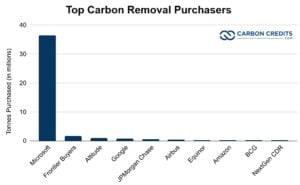
Industry estimates suggest that Microsoft’s pause could significantly reduce demand in the engineered carbon removal market. The tech giant has accounted for as much as 80% to 90% of global purchases of carbon removals, as data from CDR.fyi shows below.
Several suppliers are directly exposed. Companies such as Climeworks and Carbon Engineering have signed multi-year agreements with Microsoft worth a combined $200 million to $300 million. These deals helped fund the early deployment of direct air capture facilities.
The broader voluntary carbon market has already seen price pressure. According to the Ecosystem Marketplace, average prices for carbon credits vary widely depending on quality. Premium removal credits trade at a steep premium due to limited supply and higher verification standards.
Microsoft’s exit, even if temporary, may accelerate a correction in these high prices. It may also reduce near-term funding for early-stage carbon removal technologies.
Microsoft’s Net-Zero Targets Face a Reality Check
Microsoft has some of the most ambitious climate goals in the corporate sector. The company aims to become carbon negative by 2030 and remove all the carbon it has emitted since its founding by 2050.
To support this, the tech giant has committed significant capital to carbon removal. By 2025, it had invested more than $750 million in carbon removal projects and contracted roughly 45 million tonnes of removals.
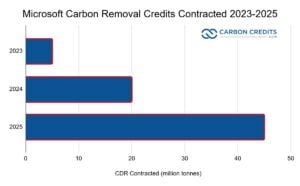
The current review is examining whether these investments can scale fast enough to meet long-term targets. Key concerns include:
- The permanence of carbon storage, especially for geological projects
- The high cost of engineered removal compared to direct emissions cuts
- The limited capacity of current technologies to deliver millions of tons annually
Many removal methods are still in early stages. Direct air capture, for example, currently removes only a small fraction of global emissions. The International Energy Agency estimates that global carbon removal capacity remains well below what is needed to meet net-zero scenarios by mid-century.
Microsoft is also reviewing how carbon removal fits into its broader decarbonization strategy. This includes aligning removal purchases with renewable energy investments and operational emissions reductions
SEE MORE:
- Microsoft Inks Biggest-Ever U.S. Biochar Deal with Liferaft
- Microsoft Buys 60,000 Soil Carbon Credits from Indigo’s Largest Carbon Crop
- Microsoft Strikes 2 Record-Breaking Carbon Credit Deals
Broader Big Tech Climate Strategy Shifts
Microsoft’s move reflects a broader shift across the technology sector. Other major companies, including Amazon, Meta, and Google, have slowed their carbon removal purchases in recent quarters.
Instead, many are focusing more on reducing emissions directly. This includes expanding renewable energy use, improving energy efficiency, and redesigning supply chains.
This trend aligns with updated guidance from the Science Based Targets initiative (SBTi). The SBTi emphasizes that companies should prioritize emissions reductions across Scope 1, 2, and 3 before relying on carbon removal.
Under this framework, carbon removal is treated as a solution for residual emissions that cannot be eliminated. This approach reduces reliance on offsets and increases pressure on companies to decarbonize core operations.
At the same time, regulatory scrutiny is increasing. In the United States, the U.S. Securities and Exchange Commission has proposed new climate disclosure rules. These rules would require companies to provide more detailed reporting on emissions and climate-related risks.
This is pushing companies to strengthen verification standards for carbon credits and avoid reputational risks linked to low-quality offsets.
A Turning Point for Carbon Removal Investment Models
Microsoft’s decision may signal a broader shift in how companies support carbon removal technologies. Instead of buying credits directly, some firms are exploring new funding models.
These include advance market commitments, where companies guarantee future demand, and direct investments in technology development. These approaches can provide more stable funding while reducing reliance on spot market purchases.
The technology sector has been a major driver of carbon removal demand. Since 2022, it has accounted for about 40% of high-quality removal credit purchases. Between 2020 and 2025, major tech companies committed billions of dollars to carbon removal initiatives.
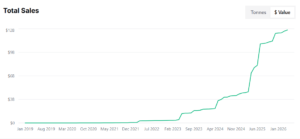
If large buyers step back, developers may face funding gaps in the short term. However, this could also push the industry to improve cost efficiency and scalability.
Current removal costs remain high. Direct air capture can exceed $500 per ton, though companies aim to reduce this below $100 per ton over time. Achieving this will require technological advances, economies of scale, and supportive policy frameworks.
What It Means for Carbon Markets and Climate Goals
Microsoft’s pause marks a key moment for the VCM. It highlights the growing demand for higher standards, better verification, and clearer climate impact.
In the short term, the decision may slow growth in the premium carbon removal segment. Prices could soften, and some projects may face delays or funding challenges.
However, the long-term impact could be positive. Stronger scrutiny may lead to more reliable and transparent carbon removal solutions. This would help build trust in the market and attract new investment.
For companies, the message is clear. Net-zero strategies must focus first on reducing emissions. Carbon removal remains important, but it must be credible, scalable, and cost-effective.
For the carbon removal sector, the challenge is to prove that its technologies can deliver on these expectations. If successful, it will play a critical role in global climate efforts.
The International Energy Agency and other bodies have made it clear that carbon removal will be essential to achieving net-zero emissions by 2050. The question is not whether it is needed, but how fast it can scale.
As the sector evolves, companies that can deliver verified, permanent, and affordable carbon removal solutions are likely to lead the next phase of expansion.
The post Microsoft Hits Pause on All Carbon Removal Purchases: A Major Shift in Corporate Climate Strategy appeared first on Carbon Credits.

The post Promoting Improved Cooking Practices in Nigeria appeared first on Terrapass.
For most companies, the largest figure in the carbon inventory is not the office, the vehicle fleet, or the electricity bill. It sits upstream, in the goods and materials a business buys to make and sell its products. These purchased inputs form the bulk of a company’s Scope 3 emissions, which routinely exceeds everything the business controls directly, and can add up to 90% of their global footprint.




-
Climate Change1 year ago
Guest post: Why China is still building new coal – and when it might stop
-

 Greenhouse Gases2 years ago
嘉宾来稿:满足中国增长的用电需求 光伏加储能“比新建煤电更实惠”
-
Greenhouse Gases1 year ago
Guest post: Why China is still building new coal – and when it might stop
-

 Climate Change2 years ago
嘉宾来稿:满足中国增长的用电需求 光伏加储能“比新建煤电更实惠”
-

 Renewable Energy12 months ago
Sending Progressive Philanthropist George Soros to Prison?
-
Climate Change2 years ago
Bill Discounting Climate Change in Florida’s Energy Policy Awaits DeSantis’ Approval
-
Greenhouse Gases1 year ago
嘉宾来稿:探究火山喷发如何影响气候预测
-

 Climate Change2 years ago
Analysis: China’s CO2 falls 1% in Q2 2024 in first quarterly drop since Covid-19