Connect with us

Published

on

Big Oil’s Showdown, How Shell, Chevron & ExxonMobil Balance Big Profits with Net Zero?

The global energy sector is in transition, with major oil companies under pressure to cut emissions while staying profitable. Shell, Chevron, and ExxonMobil—three of the world’s biggest energy giants—are taking different paths to navigate this shift.

Their latest earnings reveal how each company is balancing investments in oil, gas, and low-carbon initiatives. While some struggle with declining profits, others are outperforming expectations.

Beyond financials, their sustainability goals and net-zero targets set them apart. But are these commitments keeping pace with financial performance? Let’s dive into their latest financial results and see which energy giant leads the charge toward a greener future.

Who’s Winning the Oil Game? A Financial Face-Off

Shell: Struggling Profits, Big Promises

Shell reported Q4 2024 earnings of $1.20 per ADS (American Depository Share), missing the Zacks Consensus Estimate of $1.78 and significantly lower than $2.22 per ADS in Q4 2023. The company’s revenue dropped to $66.8 billion from $80.1 billion, falling short of expectations by 16.6%. The decline was driven by weaker realized prices, reduced trading margins, and lower LNG sales.

Shell repurchased $3.6 billion in shares and increased its dividend by 5%, with plans for another $3.5 billion in repurchases in Q1 2025. Here is the oil giant’s income per segment:

  • Upstream: Profit fell to $1.7 billion from $3.1 billion, missing expectations due to lower oil and gas prices. Liquids prices fell 11%, while natural gas declined 7%.
  • Chemicals & Products: Reported a $229 million loss, reversing a $29 million profit from the previous year, due to lower margins and unfavorable tax movements.
  • Integrated Gas: Adjusted income dropped to $2.2 billion from $4 billion, missing the expected $2.8 billion due to a 14.3% drop in LNG sales.
  • Marketing: Income rose to $839 million from $794 million, but missed expectations of $885 million.
  • Renewables & Energy Solutions: Recorded a $311 million loss, down from a $173 million profit a year earlier, due to rising costs and adverse tax effects.

Chevron: A Mixed Bag of Losses and Growth

Chevron’s Q4 earnings fell below Wall Street expectations, reporting adjusted EPS of $2.06 versus the estimated $2.11. This led to a 4% drop in its stock price. The company’s downstream segment posted a $248 million loss, compared to a $1.15 billion profit in Q4 2023. This is because refining margins weakened amid declining fuel demand in the U.S. and China.

  • Oil & Gas Production: Profits rose to $4.3 billion from $1.59 billion a year ago, despite a flat overall output of 3.35 million boepd (Barrels of oil equivalent per day). Permian Basin production grew 14% to a record 992,000 boepd.
  • Refining: Weak jet fuel demand contributed to the company’s first refining loss since 2020.

Chevron expects global output to grow 6-8% in 2025 and 3-6% in 2026. The company raised its quarterly dividend by 5% and reaffirmed share buyback plans of $10-$20 billion annually.

Exxon: Defying Expectations Amid Industry Headwinds

Exxon announced Q4 2024 earnings of $7.6 billion, or $1.72 per share, exceeding analyst estimates of $1.56. Despite lower oil prices, higher production helped offset the weaker refining margins of this big oil company.

  • Oil & Gas Production: Adjusted earnings rose to $6.28 billion from $4.15 billion a year earlier. Production increased to 4.6 million boepd, driven by low production costs in the Permian Basin and Guyana projects.
  • Refining: Earnings from gasoline and diesel production dropped sharply to $323 million from $3.2 billion a year earlier due to increased refinery capacity in Asia.

Exxon reported $33.7 billion in earnings for 2024, down from $38.57 billion in 2023, but highlighted strong operational efficiency and profitability.

The three energy giants all faced challenges in Q4 2024, with weaker refining margins and lower oil prices impacting profitability. However, Exxon outperformed expectations, while Chevron and Shell struggled with underwhelming results. All three companies remain focused on capital discipline, shareholder returns, and production efficiency moving forward.

The Green Pivot: Are Big Oil’s Net Zero Pledges Enough?

Shell, Chevron, and ExxonMobil are charting distinct paths toward sustainability as the energy landscape evolves. Their climate commitments, emissions targets, and investment in renewables illustrate their vision for a lower-carbon future.

Each of the energy giants has its own roadmap to net-zero emissions, with varying approaches and strategies. To have a clearer picture of how much carbon pollution each of them emitted in 2023, look at the image below.
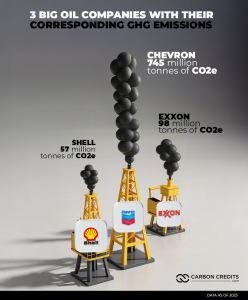
Big Oil emissions 2023 Shell Chevron ExxonMobil

While some are making bolder moves in renewables, others remain focused on carbon capture and efficiency improvements. Understanding Shell, Chevron, and ExxonMobil’s strategies provides insight into the future of the oil and gas industry. 

Shell’s Carbon Commitment: Big Talk or Real Action?

Shell aims to become a net-zero emissions energy business by 2050 as part of its Powering Progress strategy. This commitment includes eliminating operational emissions and reducing the emissions from the energy products it sells. 
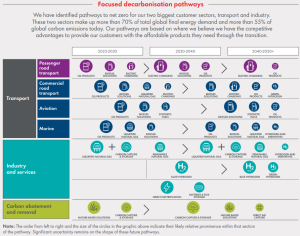
Shell net zero pathways

The company has set several targets to achieve this goal:

  • 50% absolute emissions reduction by 2030 (Scopes 1 and 2) compared to 2016 levels.
  • Eliminate routine flaring of natural gas by 2025 to curb carbon emissions.
  • Reduce methane emissions intensity below 0.2% and reach near-zero methane emissions by 2030.
  • 15-20% reduction in customer emissions from oil products by 2030 (Scope 3, Category 11, 2021 baseline).

Progress Achieved

By the end of 2023, Shell had cut more than 60% of its emissions goal for 2030. The company’s methane emissions intensity was 0.05% for facilities with marketed gas and 0.001% for facilities without marketed gas.
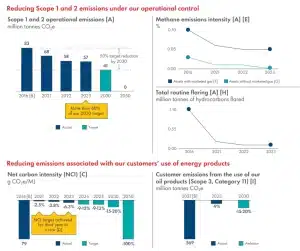
Shell 2050 net zero goal
Charts from Shell report

Shell tracks its emissions reductions through Net Carbon Intensity (NCI), which measures emissions per unit of energy sold. Key milestones include:

  • 6-8% reduction achieved in 2023 (from 2016 levels)
  • 9-12% reduction target for 2024
  • 100% reduction goal by 2050

Shell’s strategy for 2030 balances energy security with sustainability. The company plans to reduce emissions by evolving its product mix and shifting towards low-carbon solutions such as biofuels, hydrogen, and renewables. 

Shell has also invested heavily in carbon offset initiatives to negate its GHG emissions. However, under CEO Wael Sawan’s leadership, the oil giant is reducing its focus on nature-based projects and is considering engineered carbon removals instead.

Today, 70% of Shell’s cash flow comes from Integrated Gas and Upstream businesses, while 75% of its emissions come from Downstream, Renewables, and Energy Solutions. Additionally, Shell has invested heavily in offshore wind projects, with plans to expand its renewable energy portfolio across multiple continents.

Chevron’s Climate Play: Real Solutions or Greenwashing?

Chevron is investing $8 billion in lower-carbon energy projects from 2021-2028, including renewable fuels, carbon capture, hydrogen, and offsets. An additional $2 billion is allocated to reducing emissions within its operations. 
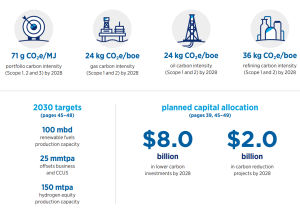
Chevron net zero 2030 targets
Source: Chevron report

The company is also developing new partnerships with tech firms to enhance energy efficiency and reduce its environmental impact.

Chevron targets net-zero upstream Scope 1 and 2 emissions by 2050 but acknowledges that achieving this goal depends on technological advances, regulatory support, and viable carbon capture and offset mechanisms.

2028 Carbon Intensity Targets

Chevron’s plans to lower carbon intensity include:

  • 71 g CO₂e/MJ portfolio carbon intensity (Scope 1, 2, and 3)
  • 24 kg CO₂e/boe oil carbon intensity (Scope 1 and 2)
  • 24 kg CO₂e/boe gas carbon intensity (Scope 1 and 2)
  • 36 kg CO₂e/boe refining carbon intensity (Scope 1 and 2)

GHG Reduction Initiatives

Chevron uses the Marginal Abatement Cost Curve (MACC) to optimize carbon reduction. The company has identified 150+ GHG abatement projects, with over $600 million in investments planned for 2024. 

Between 2021-2028, Chevron expects $2 billion in GHG reduction investments, targeting 4 million metric tons (mt) of annual emissions reductions. Here are the company’s other sustainability plans and strategies to achieve its ambitious 2050 net zero goal. 

Methane and Renewable Energy Expansion

  • Methane emissions goal of 2.0 kg CO₂e/boe by 2028
  • Advanced methane detection programs, including satellite monitoring
  • Growing renewable fuels capacity to 100 mbd by 2030, including renewable diesel and sustainable aviation fuel
  • Significant CCUS investments, including Bayou Bend (Texas) and Gorgon (Australia)
  • Expanding hydrogen production to 150 mtpa by 2030
  • Developing advanced geothermal energy projects to enhance clean energy production

SEE MORE: Chevron Reports Lower Q2 Earnings! What About Its Emissions?

ExxonMobil’s Bold Bet on Decarbonization

ExxonMobil has cut 23% of nitrogen oxides, sulfur oxides, and volatile organic compounds emissions since 2016. In 2023, its GHG emissions stood at 111 MMTCO₂e, marking a 2 MMT reduction from the previous year. The company is also exploring new ways to enhance energy efficiency across its global operations.

ExxonMobil aims for a 20% absolute reduction in GHG emissions by 2030, compared to 2016 levels. The company aligns its emissions reductions with the Paris Agreement while emphasizing intensity-based reductions.
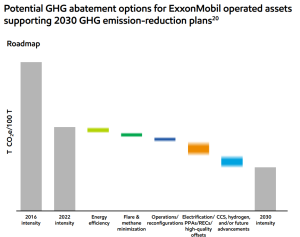
ExxonMobil 2030 emission reduction plans
Chart from ExxonMobil report

Beyond burning down emissions in its own operations, Exxon is also helping other industries decarbonize. Its Low Carbon Solutions business focuses on hard-to-decarbonize sectors like heavy industry, power, and transportation. The oil giant seeks to lead in profitable, large-scale emission reduction solutions, with the following key strategies. 

Key Sustainability Actions

  • Investing in carbon capture, biofuels, and hydrogen
  • Advancing methane management with innovative detection technologies
  • Deploying CCUS projects, including the world’s largest CCUS facility at LaBarge, Wyoming
  • Developing low-carbon solutions for hard-to-abate industries
  • Launching a $17 billion investment plan in lower-carbon solutions through 2027
  • Exploring direct air capture (DAC) technologies to remove CO₂ from the atmosphere

READ MORE: ExxonMobil’s First-of-its-Kind Carbon Capture Solution for the U.S. Data Centers

Big Oil’s Race Against Time

Shell, Chevron, and ExxonMobil are taking different approaches to sustainability and emissions reduction. While Shell focuses on reducing absolute emissions and net carbon intensity, Chevron prioritizes carbon intensity reduction and methane management. ExxonMobil, meanwhile, is expanding CCUS and methane detection efforts to lower emissions. 

As global climate policies tighten, Shell, Chevron, ExxonMobil, and other energy companies should accelerate their transition strategies to meet net-zero targets. 

The post Big Oil’s Showdown: How Shell, Chevron & ExxonMobil Balance Big Profits with Net Zero? appeared first on Carbon Credits.

Continue Reading

Carbon Footprint

McKibben opts for a small-tent climate movement

Published

on

A few months ago I went to a climate change forum at the Center for Brooklyn History. The panel I attended, “Confronting Climate Change: Understanding Deniers,” featured the prominent climate activist, Bill McKibben.

Bill McKibben. Courtesy https://billmckibben.com/.

I was curious to hear McKibben’s take on climate change deniers. I don’t regard the true deniers as a big problem – they’re only 11-15% of our country, according to most polls. Rather, I wondered if McKibben would label as “climate deniers” people who agree that climate change is a significant problem but disagree with his framing and his proposed solutions. I have worked for decades on energy and climate matters as an energy lawyer. Now, more than ever, I believe that to address climate change we need to build a big tent.

In the Q&A I tested where McKibben is on this by asking if he would label as a climate denier someone who subscribes to the main tenets of climate change science yet holds that natural gas has a role to play as a bridge fuel. (Our exchange starts at 1:12:45 of the video.)

This could have been a chance for McKibben to make clear that such a view isn’t climate denialism, even if he feels it’s misguided. But he punted, saying “I don’t care whether they’re deniers or not.” For good measure, he threw in his long-standing refrain that swapping coal for natural gas makes climate change worse, despite coal’s far higher carbon content per unit of energy.

674-MW methane-powered generating station, Salem, MA.

As you can hear in the recording, McKibben’s claim that gas is worse than coal draws on the work of Cornell scientist Robert Howarth. Yet McKibben didn’t mention that Howarth’s work is controversial and disputed by many scientists. The crux of the dispute is whether methane’s impact on warming should be measured with a 20-year or 100-year time frame.

Methane is a relatively short-lived greenhouse gas, with a lifetime of around 10 years, versus the 100-year life applicable to carbon dioxide. But each ton of methane is far more potent while in the atmosphere, trapping roughly 100 times as much heat as a ton of CO2. These cross-cutting facts about atmospheric methane — shorter life but greater potency than CO2 — have resulted in two opposing camps: one insisting on a 20-year timeframe for greenhouse gas accounting, the other adhering to the established 100-year frame. This matters because with a 20-year timeframe, generating electricity with natural gas (which, chemically speaking, is essentially all methane) is more damaging to climate than coal-fired electricity.

McKibben blew past this dispute. To hear him at the Center for Brooklyn History, one would have no inkling that there’s an active disagreement over which timeframe to use, that there are staunch climate activists who favor the 100-year time frame, and that the Intergovernmental Panel on Climate Change  (IPCC) generally uses the 100-year timeframe.

McKibben’s latest (2025) book. Published by W.W. Norton & Company.

McKibben also insisted that a discussion about natural gas’s potential role in mitigating climate change as a replacement for coal is irrelevant because solar “is now our cheapest resource.” McKibben’s claim, of course, suffuses “Here Comes the Sun,” his 2025 book that extols solar power as the cheapest solution for all of our energy needs. But this too is questionable, because it’s based on cost comparisons between solar farms and natural gas power plants (or nuclear power plants) that fail to consider that electricity supply and delivery is a complex system of wires and plants rather than individual power plants. Based on his remarks, McKibben is choosing to ignore studies such as the comprehensive 2025 report from the Clean Air Task Force that concluded that plant-level cost comparison “is a good metric to track historical technology cost evolution [but] is not an appropriate tool to use in the context of long-term planning and policymaking for deep decarbonization.” And the task force is not alone in finding that when electricity is treated as a system, solar loses its place as the cheapest low-carbon resource.

The dogmatism McKibben displayed at the Brooklyn meeting was unfortunate. We’re in a time when efforts to combat climate change are in retreat. A unified front is required to turn the tide. Instead of doubling down on absolutist positions, activists like McKibben who seem convinced that the solution to climate change is all-renewables, end of discussion, should be seeking common ground with others who want climate action but believe that nuclear power and natural gas must also play a role.

NYC Climate March, Sept 17, 2023. Photo: C. Komanoff.

Climate change activists need to build a bigger tent, rather than call anyone who disagrees with their positions a climate change denier. It is striking that McKibben stuck to his guns after saying in the same talk that the most important goal for everyone right now is to help climate change realists win more House and Senate seats in this year’s midterms. As some have noted, an absolutist position on natural gas appears less likely to achieve that win and politicians are following that advice.

Will McKibben evolve? He has demonstrated that he knows how to build a national climate movement centered around issues like divestment. Given the current political situation, he should focus on building an even bigger tent by welcoming all of the 85% who believe that we need to address climate change but do not agree with his ideological positions.

Rich Miller is an energy lawyer who has worked for a variety of stakeholders and now gives walking tours in lower Manhattan on the history of electricity. 

Continue Reading

Carbon Footprint

Rebranding ‘Balcony Solar’ as ‘Guerrilla Solar’ won’t lift its climate value.

Published

on

Image generated with Claude. Why have we juxtaposed a bicycle with balcony solar? Read on.

First it was Plug-In Solar. Then it was Balcony Solar. Now it’s Guerrilla Solar, at least according to Inside Climate News, which yesterday proclaimed that The ‘Guerrilla Solar’ Era Has Arrived.

“It,” of course, is Modular solar panels. They’re the hot new photovoltaic solution: cheap enough to buy at Home Depot, easy to hang or prop to catch maximum rays, and small enough to fit on a balcony (if you’ve got one) and plug into your “home grid.” But, alas, too meager a generator of electricity to be more than a bit player in decarbonizing most U.S. homes.

How do I know? I’ve done the math.

A standard, lower-end 220-watt balcony solar array will produce 337 kilowatt-hours a year, or 28 kWh a month averaged over the course of a year. That’s for a 220W unit measuring 3.5 feet by 3.5 feet. (220W x 1/1000 x 17.5% x 8760 hours per year = 337 kWh. Calculation assumes a 17.5% full-year capacity factor, which is arguably generous for New York, where I live. )

Our balcony solar mashup. Top: an install in Germany. Bottom: Home Depot advert.

A typical U.S. home consumes 10,500 kWh a year, or 28 to 29 kWh per day, says Solartech, drawing on U.S. Energy Information Administration data. That puts a home’s daily power needs on par with a balcony solar unit’s monthly output. In effect, once each month the balcony array gifts a homeowner or renter a bit more than day’s full complement of electricity. And earth’s atmosphere gets the same respite: a 3 percent reduction in carbon emissions caused by the home’s electricity usage.

(The 3 percent figure could also be calculated directly by dividing 337 kWh per year of solar production by 10,500 kWh per year to run the home. For bigger or smaller arrays, just prorate your assumed wattage by my 220W; for 440W, say, double my figures.)

Balcony Solar metrics

Why write about balcony solar if it’s so inconsequential? CTC’s mission includes puncturing would-be climate balloons before they ascend too far. In the same vein, we practice quantification to make clear what does and doesn’t move the climate needle. (More on that further below.)

The best way to depict balcony solar’s climate value is to express it in terms of tangible metrics. We’ve selected two. Both assume the basic, lower-end PV array I assumed at the top: a 3.5 foot-square array whose peak output is 220 watts.

1. It would take 50 million 220W balcony solar units (bsu’s) to restore the climate benefit we destroyed in 2020-2021 when we shut the high-performing Indian Point nuclear power plant 32 miles from Midtown Manhattan.

2. A single person cutting back their driving by a mile a day would provide the same climate benefit over the course of a year as a single 220W bsu.

(Calculations in sidebar. Now you know why we led with images of an urban dweller as cyclist and balcony solar user.)

Yes, it’s dense — as befits a sidebar. The numbers tell a story. Follow the color co-ordination.

Ponder that: It would take fifty million smallish bsu’s to level up to the fossil fuel carbon emissions that Indian Point was keeping at bay by supplying the New York City area year in and year out with abundant carbon-free power. Deploying that many balcony solar units would entail 10 bsu’s for each of the 5 million households in the MTA’s service territory. (The Metropolitan Transportation Authority provides subway, bus and commuter rail transit in the five boroughs and seven suburban counties.) Or, if those same households upgraded to 1100-watt bsu’s, collectively they would still make up only half of the lost Indian Point power.

The second comparison, involving driving, is perhaps trickier to grasp but more interesting, since it relates to people’s behavior. Living differently isn’t part of public discourse, at least not in the USA, and especially when what’s being served up is using less. But “reducing,” as we might call it (remember “Reduce, Reuse, Recycle”? or, “Insulate, then Insolate”?) is just as potent for cutting emissions as switching to renewables — even more so when the reducing means driving less, considering the multitude of benefits that accrue from diminishing cars’ imprints on our communities. Still, staying on topic: driving just one fewer mile per day brings about the same shrinkage in carbon emissions as deploying one 220W solar array.

What Balcony Solar boosters are really saying

To be fair, our friends at Inside Climate News and, yes, The New York Times appear to be trying to modulate their balcony solar enthusiasm.

ICN‘s Dan Gearino, whom we cited up front, said he looked to Germany, the birthplace of balcony solar, to see if the units made sense for U.S. households. His takeaway: “It may make more sense financially to spend the cost of plug-in solar on insulation, air sealing or other basic measures to reduce energy use.” Hooray: insulate before you insolate.

Gearino helpfully interviewed renewables guru (and U.S. emigré) Craig Morris, who currently heads Germany’s plug-in solar trade association, Bundesverband Steckersolar. To Morris, balcony solar’s main advantages are that it provides power without taking up land, and that it affords people a way to “become participants in the transition to clean energy.” Behold, guerrilla solar. That, in turn, bolsters “the political consensus that supports the transition.” But Morris also made clear that widespread adoption of plug-in solar would only meet “about 2 percent of Germany’s electricity demand.”

Morris’s “about 2 percent” feels right for Germany. But not for the U.S., where widespread adoption of virtually any individual carbon alternative seems forever out of reach, and where the energy pie is so much larger — think giant fridges, freezers for beer, steroidal homes bursting with piles of powered toys, not to mention industrial and institutional electricity use that Morris correctly excluded from his figure.

Don’t forget to micro-dose. NYT headline + image for David Wallace-Wells’ guest essay (see text). Image by Rui Pu.

Both Gearino and Morris seem more measured than climate journalist Robinson Meyer, founding editor of Heatmap and frequent contributor to The Times, where he wrote about balcony solar in mid-June.

“New zero-carbon power kits will allow Americans to make their own energy choices,” declares the callout to the print version of Meyer’s NYT guest essay, The Tiny Solar Panel That Could Change America. (The even more expansive print headline invites us to “Forget Roofs. Backyard Solar Is the Next Frontier.”)

Wallace-Wells is of two minds. He calls balcony solar “a small way that apartment- and condo-dwelling Americans can take ownership of their energy choices and cut down their pollution on the margins.” No quarrel there, thanks to his qualifiers “small” and “on the margins.” Earlier, though, he opines that balcony solar units “have the potential to change how Americans understand and consume energy,” But read further and you’ll again see Wallace-Wells cautioning that “Balcony solar will play one small role in [the] drama” of transiting to the new world of clean, abundant energy.

Any such caveats are welcome these days, amid widespread solar hoopla. Still, it doesn’t seem to be in Wallace-Wells’ toolkit — or that of Inside Climate News and other mainstream climate journalists — to tutor their audiences as to the  true limits of balcony solar and other panaceas. Just like it wasn’t in their field of vision a decade ago to lay out the true stakes of shutting Indian Point as Riverkeeper was singing its siren song.

What’s Next for NY Balcony Solar

Meantime, as Canary Media reported recently (and helpfully), New Yorkers concerned with climate and affordability are waiting for NY Gov. Kathy Hochul to sign the recently passed SUNNY (Solar Up Now New York) Act legalizing balcony and other plug-in solar. It would be head-spinning (and politically suicidal) if she didn’t, given near-universal support ranging from Con Edison to DSA Assembly Member Emily Gallagher, who told Canary Media, “This is the most popular bill I’ve [ever] worked on.”

My guess is that Hochul is waiting for the right moment, and perhaps the right “package,” that can advance and not undercut her push to launch five large new nuclear power plants around the state — one to be built by the public New York Power Authority, the others to be constructed and operated privately. A little bit of math, a la what we offered here a la Indian Point, might help her out.

The governor also must manage the veritable hot potato of her deferred implementation of the landmark 2019 Community Leadership and Climate Protection Act. She might do well to consider jettisoning the act’s unwieldy cap-and-invest centerpiece in favor of a straight-up carbon tax (with the revenues distributed pro rata to the state’s households) in its place. That, far more than balcony (or guerrilla) solar, could blow open the door to the “innovations and technologies we cannot yet imagine” that Wallace-Wells fantasized about in his Times essay.

Continue Reading

Carbon Footprint

The new SBTi Corporate Net-Zero Standard: what it means for business

Published

on

On 11 June 2026, the Science Based Targets initiative (SBTi) published the most substantial revision of its flagship corporate framework since its introduction. The SBTi Corporate Net-Zero Standard Version 2.0 takes effect on 1 February 2027 and reshapes the way companies approach their net-zero targets.

Continue Reading

Trending

Copyright © 2022 BreakingClimateChange.com

