Energy giant Shell reported around 1.1 billion metric tons of carbon dioxide equivalent (CO₂e) emissions in 2025. Most of these emissions come from the use of the fuels the company sells, known as Scope 3 emissions.
Scope 3 emissions occur when customers burn oil, gas, and other fuels produced by energy companies. For Shell, these emissions dominate its carbon footprint.
The company’s operational emissions are much smaller. Shell recently reported about 50 million tons of Scope 1 emissions from its operations. It also noted around 8 million tons of Scope 2 emissions from purchased electricity.
Together, these numbers show the scale of emissions linked to global fossil fuel use. In comparison, the United Kingdom’s total emissions were about 480 million tons in 2024, less than half of Shell’s overall carbon footprint. This comparison highlights how emissions linked to energy supply chains can exceed those of entire countries.
Why Scope 3 Emissions Dominate Oil and Gas
Most emissions linked to oil and gas companies come from the fuels consumers burn. This explains why Scope 3 emissions are the largest part of Shell’s carbon footprint.
- Shell’s reporting shows Scope 3 emissions of over 1 billion tons of CO₂ equivalent, far higher than emissions from its direct operations. As seen below, the oil major’s GHG emissions have been declining since 2018.
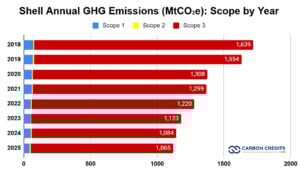
Scope 1 and Scope 2 emissions come from Shell’s operations and purchased energy, based on the company’s sustainability reports. Scope 3 emissions represent the use of fuels sold by Shell. Scope 3 accounts for the vast majority, around 95% of the company’s carbon footprint.
About 78% of these emissions occur downstream, mainly when customers use gasoline, diesel, or natural gas. The rest come from upstream activities such as equipment manufacturing and fuel transport.
This pattern is common across the oil and gas industry. Energy companies produce fuels, but most emissions occur when the fuels are burned.
Because of this structure, reducing emissions in the energy sector requires changes across the whole system. These include cleaner fuels, new technologies, and changes in how energy is used.
Shell’s Net-Zero Targets and Climate Strategy
Shell says it aims to become a net-zero emissions energy company by 2050. To move toward this goal, the company has set several climate targets.
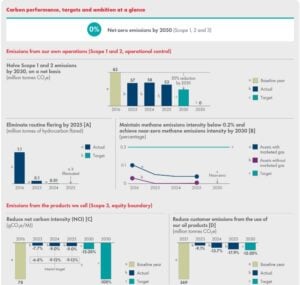
- One key target is to cut emissions from its operations (Scope 1 and 2) by 50% by 2030 compared with 2016 levels.
The oil giant has already made some progress on this goal. By 2024, the company had reduced operational emissions by about 30% compared with 2016.
Another metric Shell uses is Net Carbon Intensity (NCI). This measures emissions per unit of energy sold. In recent reporting, Shell’s NCI stood at 71 grams of CO₂ equivalent per megajoule, unchanged from the previous year.
The company plans to reduce this measure to net zero by 2050 as part of its transition strategy. However, intensity targets measure emissions relative to energy production. This means total emissions can remain stable if energy demand continues to grow.
Shell’s Offset Strategy: Retiring Millions with Certified Credits
In 2025, Shell retired 5.8 million carbon credits. Of these, 5.5 million were tied to its Net Carbon Intensity (NCI) efforts. This included 2.0 million linked to energy product sales. The company emphasizes careful sourcing and screening of credits.

Of the total retired, 59% were certified by Verra’s Verified Carbon Standard (VCS), 22% by Gold Standard, 10% by the ACR program, and 9% via Climate Action Reserve.
Rising Energy Demand Keeps Fossil Fuels in Play
Global energy demand continues to rise. This affects emissions across the energy sector. According to the International Energy Agency, energy-related carbon dioxide emissions grew in many regions due to rising industrial activity and energy demand.
- Emissions from natural gas increased by 2.5% in 2024, while coal emissions rose almost 1% in recent global energy data, per the IEA report.
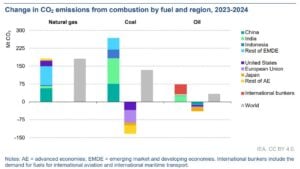
Oil emissions also increased slightly as countries continued to rely on fossil fuels to meet economic growth and energy access needs. This demand helps explain why oil and gas companies still play a large role in global energy supply.
At the same time, the energy transition is accelerating. Governments and companies are investing in renewable power, electric vehicles, and cleaner fuels. These trends are reshaping the global energy system.
LNG and Carbon Capture in Shell’s Transition Plan
Shell continues to expand its liquefied natural gas business. The company expects global LNG demand to grow about 60% by 2040, driven by economic growth and industrial energy needs.
Natural gas produces fewer emissions than coal when burned. Because of this, some countries view LNG as a transitional fuel during the shift to cleaner energy systems.
Shell is also investing in carbon capture and storage (CCS). One major project is the Northern Lights carbon storage project in Norway, developed with industry partners. The facility aims to store at least 5 million tons of CO₂ per year once expanded.
Carbon capture technology can help reduce emissions from industries that are difficult to electrify, such as heavy manufacturing and shipping. However, CCS projects remain limited in number compared with the scale of global emissions.
The Enormous Scale of the Global Energy Transition
The world’s energy system is changing quickly. But the scale of fossil fuel use remains large.
Energy companies like Shell supply fuels used across transportation, power generation, and heavy industry. This explains why emissions linked to these companies are so high.
At the same time, new technologies are reshaping the energy landscape. Renewable power, electric vehicles, hydrogen fuels, and carbon capture are expanding rapidly.
Shell itself notes that new technologies could cut the carbon intensity of the global energy system by half by 2050 if current trends continue. Still, hitting global climate targets will require faster progress.
What Shell’s Emissions Reveal About the Energy System
Shell’s reported 1.1 billion tons of CO₂ emissions in 2025 show the scale of the global energy challenge. The majority of these emissions come not from company operations, but from the fuels used by millions of consumers and industries worldwide.
Reducing emissions across this system will require major changes in energy production, infrastructure, and technology. Oil and gas companies remain central players in this transition. Their investments, technologies, and energy supply decisions will influence how quickly the global economy moves toward lower-carbon energy.
The next decades will determine whether the energy system can meet rising demand while also reducing emissions at the scale required to reach global climate goals.
- READ MORE: Shell’s Initiative to Cut Methane in Rice Farming in the Philippines and Create Carbon Credits
The post Big Oil’s Carbon Reality: Shell’s 1.1 Billion-Ton Footprint Shows the Scale of the Energy Transition appeared first on Carbon Credits.
Carbon Footprint
DOE Launches $500M Funding Drive to Strengthen U.S. Battery Supply Chains and Critical Minerals Processing
The U.S. Department of Energy (DOE) has announced a major funding initiative aimed at strengthening domestic battery supply chains and reducing reliance on foreign sources of critical minerals. The department introduced a Notice of Funding Opportunity (NOFO) worth up to $500 million to expand U.S. capabilities in mineral processing, battery materials manufacturing, and recycling.
Significantly, these investments target industries such as grid storage, transportation, manufacturing, and national defense. At the same time, the initiative reflects growing concerns about supply chain vulnerabilities for minerals that power modern energy technologies.
According to Chris Wright, the United States has relied for too long on foreign suppliers to provide and process key materials used in battery manufacturing. Strengthening domestic supply chains, he explained, will help the country meet rising energy demand while maintaining economic and technological leadership.
Strengthening the Domestic Battery Supply Chain
The DOE’s new funding program focuses on boosting the United States’ ability to process, recycle, and manufacture battery materials domestically. Currently, many minerals used in advanced batteries are mined globally but processed overseas before reaching U.S. manufacturers.

This dependency creates supply risks and exposes the economy to geopolitical disruptions. As a result, the new funding program aims to build a more resilient supply chain across several stages of battery production. Explained in detail below:
Critical Mineral Processing
First, the program seeks to expand domestic processing of critical minerals. Many essential battery materials—including lithium, nickel, graphite, copper, and aluminum—require complex refining processes before they can be used in batteries. By investing in new processing facilities, the United States hopes to reduce reliance on foreign refining capacity and ensure a stable supply of materials for domestic industries.
Battery Recycling Technologies
Second, the initiative emphasizes recycling technologies. Recovering valuable metals from used batteries and manufacturing scrap can significantly reduce the need for new mining while improving supply security. Recycling also lowers environmental impacts by reducing waste and conserving natural resources.

Battery Manufacturing Capacity
Finally, the program aims to expand manufacturing capacity for battery materials and components within the United States. Increasing domestic production of battery precursors, cathode materials, and other key components will help support the entire North American battery supply chain.
The funding is supported by the Infrastructure Investment and Jobs Act, which allocated billions of dollars to strengthen energy infrastructure and domestic manufacturing across the country.
Battery Storage Becomes a Major U.S. Energy Technology
The urgency behind these investments reflects the rapid growth of battery storage across the United States. In recent years, battery systems have emerged as a critical technology for managing modern power grids.
In fact, batteries became the largest form of energy storage in the country in 2024, surpassing traditional pumped hydro storage for the first time. This shift marks a significant milestone in the evolution of the U.S. electricity system.
At the same time, the number of battery projects expanded rapidly. Nearly 1,000 storage projects were either operating or under development across the country. Many of these projects are located in California and Texas, where large-scale renewable energy installations require flexible storage solutions to stabilize the electricity supply.
One notable example is the Moss Landing Energy Storage Facility, one of the largest battery installations in the United States. Located in California, the facility pairs a natural gas power plant with massive battery storage systems that can deliver electricity when demand peaks.
As renewable energy capacity continues to grow, battery storage will play an increasingly important role in maintaining grid reliability and balancing intermittent energy sources such as solar and wind.
EV Battery Manufacturing Market Continues to Grow
The electric vehicle industry is another major driver behind rising battery demand. As EV adoption accelerates globally, automakers and battery companies are investing heavily in new manufacturing facilities.
In the United States, the electric vehicle battery manufacturing market is projected to grow steadily over the coming years. Industry estimates suggest the market will reach approximately $17.94 billion in 2026, increasing from $16.36 billion in 2025.
Looking further ahead, the sector is expected to expand significantly. By 2031, the market could reach around $28.46 billion, reflecting a compound annual growth rate of nearly 9.7 percent.

Multiple factors fuel this growth. Federal incentives for clean energy technologies, rising consumer demand for electric vehicles, and large-scale investments in domestic manufacturing are all contributing to the expansion of the U.S. battery industry.
However, sustaining this growth will require reliable access to the minerals that power advanced batteries.
America’s Critical Mineral Supply Remains a Concern
To address supply risks, the U.S. Geological Survey expanded its official list of critical minerals in 2025. The updated list now includes 60 minerals, up from 50 identified in 2022.
Several new minerals were added due to their growing importance for the economy and national security. These additions include boron, copper, lead, metallurgical coal, phosphate, potash, rhenium, silicon, silver, and uranium.
Despite these efforts, the United States remains heavily dependent on imports for many critical minerals. As of 2024, the country relied entirely on foreign suppliers for twelve critical minerals. Meanwhile, more than half of the domestic demand for twenty-nine minerals came from imports.
Rare earth elements represent one of the most significant vulnerabilities because global supply chains remain highly concentrated. China continues to dominate the production and processing of these materials, raising concerns about potential supply disruptions.
As a result, U.S. policymakers are increasingly focused on strengthening domestic mining, processing, and recycling capabilities.
Global Demand for Energy Minerals Is Rising Fast
The push to secure mineral supply chains also reflects rapidly growing global demand for energy materials. According to the IEA, demand for key minerals used in clean energy technologies is expected to increase dramatically in the coming decades.
Lithium demand, for example, could grow fivefold by 2040 under current policy scenarios. Copper will likely remain the largest mineral market by value, while other materials such as nickel, cobalt, graphite, and rare earth elements will also see strong growth.

Overall, the combined market value for six key energy minerals—copper, lithium, nickel, cobalt, graphite, and rare earth elements—could reach approximately $500 billion by 2040. This surge reflects the rapid expansion of electric vehicles, renewable power systems, battery storage, and other clean energy technologies.
Consequently, governments around the world are competing to secure reliable access to these strategic resources.
Against this backdrop, the DOE’s $500 million funding initiative represents an important step toward strengthening America’s position in the global battery economy. By expanding domestic processing, recycling, and manufacturing capacity, the United States aims to reduce supply risks while supporting the technologies that will power the future energy system.
- READ MORE: Unlocking the Power of Critical Minerals with US DOE’s $45 Million Investment: A Focus on Antimony
The post DOE Launches $500M Funding Drive to Strengthen U.S. Battery Supply Chains and Critical Minerals Processing appeared first on Carbon Credits.
Carbon Footprint
Nickel Demand for EVs Could Flip the 2030 Market Balance
Disseminated on behalf of Alaska Energy Metals Corporation.
On the surface, the global nickel market looks comfortable. Supply appears ample. Prices remain under pressure. Inventories continue to climb. However, this apparent balance hides a deeper problem. The world’s nickel supply has become heavily concentrated in one country, creating long-term risks that today’s surplus does not fully reflect.
The S&P Global Nickel CBS January 2026 report makes this point clear. While Indonesia continues to push large volumes of nickel into the market, warning signs are emerging. Policy uncertainty, slowing demand, and swelling inventories now shape the near-term outlook. At the same time, today’s oversupply is quietly setting the stage for future instability.
The Nickel Market is in Surplus, But Not in Balance
At first glance, the nickel market seems well supplied. S&P Global projects a 156,000-tonne surplus in 2026, even after Indonesia announced sharp cuts to its nickel ore quotas. This surplus explains why prices struggle to move higher, despite occasional rallies.
However, the quota cuts have not reduced output as much as expected. Indonesian smelters continue to run at high utilization rates. They rely on existing ore stockpiles and imports from the Philippines to keep production steady. As a result, global supply still runs ahead of demand.
This imbalance shows up clearly in inventories. LME nickel stocks climbed to 275,634 tonnes in January 2026, marking the largest inflows since 2019. Rising inventories signal that excess nickel has nowhere to go. Even Class 1 nickel remains widely available, keeping prices capped.
Weak Nickel Demand Keeps the Surplus Alive
Strong supply alone does not explain the surplus. Weak demand plays an equally important role.
S&P Global further analysed that in late 2025, manufacturing activity slowed across key regions. U.S. and Eurozone PMIs fell into contraction, weighed down by trade tariffs introduced under President Trump. These tariffs raised costs and disrupted supply chains, hurting industrial activity. At the same time, consumer confidence weakened, reducing demand for stainless steel and other nickel-intensive products.
China offered some support, but not enough to change the overall picture. Its PMI showed mild expansion, backed by measures in the 2026–2030 Five-Year Plan aimed at stabilizing the property sector. Even so, stainless steel production remains oversupplied, and EV battery makers continue to adjust designs to use less nickel.
As a result, near-term nickel demand growth stays muted. Despite this, speculative investors remain optimistic. Net long positions have stayed elevated for seven months, reflecting bets that supply disruptions will eventually outweigh weak fundamentals.
Is Oversupply More Than a Price Problem?
Oversupply does more than suppress prices. It distorts market balance.
When supply consistently exceeds demand, prices lose their ability to send clear signals. Even meaningful policy actions, such as Indonesia’s quota cuts, fail to trigger lasting price increases. The market simply absorbs the news and moves on.
At the same time, oversupply discourages investment outside low-cost regions. Higher-cost producers struggle to survive. In Australia, several operations have already cut output due to poor margins. These curtailments reduce supply diversity without tightening the market.
As a result, the world becomes more dependent on Indonesian nickel. While this keeps prices low today, it increases vulnerability tomorrow.

2030s Set to Flip the Nickel Market Balance
According to S&P Global, today’s surplus will not last forever.
The report projects that global nickel stocks will peak around 2028. After that, inventories begin to fall as demand improves and supply growth slows. By the early 2030s, the market balance flips.
By 2031, S&P Global expects the primary nickel balance to turn negative. EV battery demand accelerates as electrification expands. Stainless steel consumption recovers alongside global manufacturing. Meanwhile, Indonesian supply growth slows as easy expansions run out and regulatory risks increase.
Once inventories drop below comfortable weeks-of-consumption levels, prices respond quickly. S&P Global points to nickel prices rising toward $25,000 per tonne or higher, especially for Class 1 material.
Non-Indonesian Projects Hold the Key to Future Balance
As we understand now, oversupply is reshaping how the market thinks about security. During surplus periods, buyers focus on price. Origin matters less. Reliability takes a back seat. However, as balance tightens, priorities shift. A stable, politically secure supply becomes critical.
This is when non-Indonesian projects regain importance. Oversupply may delay their development, but it also ensures that fewer alternatives exist when demand rebounds. As a result, high-quality projects outside Indonesia gain strategic value.

AEMC’s Nikolai Project Stands Apart
This shifting market context brings Alaska Energy Metals Corp. (AEMC) into focus.
AEMC’s Eureka deposit, part of the Nikolai Nickel Project in Alaska, is now the largest known nickel resource in the United States. Importantly, the project is polymetallic. Alongside nickel, it hosts copper, cobalt, chromium, platinum, and palladium—materials critical to clean energy, infrastructure, and defense.
In March 2025, AEMC released an updated NI 43-101 compliant mineral resource estimate, prepared by Stantec Consulting Services. The update significantly expanded the project’s scale.
The estimate includes:
- 1.19 billion tonnes of Indicated resources, up 46%
- 2.09 billion tonnes of Inferred resources, up 133%
- 61 billion pounds of contained nickel in the Indicated category
- 9.38 billion pounds of nickel in the Inferred category
On a nickel-equivalent basis, the resource exceeds 29 billion pounds, placing it among the world’s largest undeveloped nickel assets.
Long-Life Supply with Strong Economics
Beyond size, the project’s quality strengthens its case.
The Eureka deposit features a low strip ratio of about 1.6:1, which supports lower operating costs. A higher-grade core sits near the surface, reducing early capital requirements. Mineralization remains consistent and continuous, extending in multiple directions with room for expansion.
Early metallurgical work suggests the ore should respond well to conventional processing, avoiding complex or risky technologies. Together, these factors support a long-life, stable supply source—something the U.S. currently lacks.

Why AEMC Fits the U.S. Strategy
The United States faces a widening gap between critical mineral demand and domestic supply. Nickel ranks near the top of that list, driven by EVs, grid infrastructure, and defense needs.
AEMC aligns closely with this strategy. The company is advancing permitting under the FAST-41 framework, plans to deliver a Preliminary Economic Assessment in Q1 2026, and continues hydrometallurgical testing to support future U.S.-based refining.
In a market dominated by Indonesian supply, AEMC offers diversification, security, and scale.
Today’s nickel surplus keeps prices low and inventories high. However, it also hides growing structural risks.
As oversupply fades and demand accelerates, the market will need new, reliable sources of nickel. Projects like AEMC’s Nikolai are not competing with today’s surplus—they are preparing for tomorrow’s shortage.
And when balance finally tightens, supply security may matter just as much as price.
Live Nickel Spot Price
- MUST READ: AEMC’s Nikolai: America’s Answer to Indonesia’s Nickel Crunch
DISCLAIMER
New Era Publishing Inc. and/or CarbonCredits.com (“We” or “Us”) are not securities dealers or brokers, investment advisers, or financial advisers, and you should not rely on the information herein as investment advice. Alaska Energy Metals. (“Company”) made a one-time payment of $75,000 to provide marketing services for a term of three months. None of the owners, members, directors, or employees of New Era Publishing Inc. and/or CarbonCredits.com currently hold, or have any beneficial ownership in, any shares, stocks, or options of the companies mentioned.
This article is informational only and is solely for use by prospective investors in determining whether to seek additional information. It does not constitute an offer to sell or a solicitation of an offer to buy any securities. Examples that we provide of share price increases pertaining to a particular issuer from one referenced date to another represent arbitrarily chosen time periods and are no indication whatsoever of future stock prices for that issuer and are of no predictive value.
Our stock profiles are intended to highlight certain companies for your further investigation; they are not stock recommendations or an offer or sale of the referenced securities. The securities issued by the companies we profile should be considered high-risk; if you do invest despite these warnings, you may lose your entire investment. Please do your own research before investing, including reviewing the companies’ SEDAR+ and SEC filings, press releases, and risk disclosures.
It is our policy that information contained in this profile was provided by the company, extracted from SEDAR+ and SEC filings, company websites, and other publicly available sources. We believe the sources and information are accurate and reliable but we cannot guarantee them.
CAUTIONARY STATEMENT AND FORWARD-LOOKING INFORMATION
Certain statements contained in this news release may constitute “forward-looking information” within the meaning of applicable securities laws. Forward-looking information generally can be identified by words such as “anticipate,” “expect,” “estimate,” “forecast,” “plan,” and similar expressions suggesting future outcomes or events. Forward-looking information is based on current expectations of management; however, it is subject to known and unknown risks, uncertainties, and other factors that may cause actual results to differ materially from those anticipated.
These factors include, without limitation, statements relating to the Company’s exploration and development plans, the potential of its mineral projects, financing activities, regulatory approvals, market conditions, and future objectives. Forward-looking information involves numerous risks and uncertainties and actual results might differ materially from results suggested in any forward-looking information. These risks and uncertainties include, among other things, market volatility, the state of financial markets for the Company’s securities, fluctuations in commodity prices, operational challenges, and changes in business plans.
Forward-looking information is based on several key expectations and assumptions, including, without limitation, that the Company will continue with its stated business objectives and will be able to raise additional capital as required. Although management of the Company has attempted to identify important factors that could cause actual results to differ materially, there may be other factors that cause results not to be as anticipated, estimated, or intended.
There can be no assurance that such forward-looking information will prove to be accurate, as actual results and future events could differ materially. Accordingly, readers should not place undue reliance on forward-looking information. Additional information about risks and uncertainties is contained in the Company’s management’s discussion and analysis and annual information form for the year ended December 31, 2025, copies of which are available on SEDAR+ at www.sedarplus.ca.
The forward-looking information contained herein is expressly qualified in its entirety by this cautionary statement. Forward-looking information reflects management’s current beliefs and is based on information currently available to the Company. The forward-looking information is made as of the date of this news release, and the Company assumes no obligation to update or revise such information to reflect new events or circumstances except as may be required by applicable law.
The post Nickel Demand for EVs Could Flip the 2030 Market Balance appeared first on Carbon Credits.
Carbon Footprint
Lithium Prices Climb Again in 2026, Sending Stocks Skyward
Disseminated on behalf of Surge Battery Metals Inc.
The lithium market is experiencing a major rebound due to rising demand and tightening supply. Battery-grade lithium carbonate spot prices have jumped to about $24,086 per metric ton, based on data from Shanghai Metals Market (SMM). This marks a sharp increase from earlier lows in 2025, after a period of oversupply had weighed on the market.
What Causes Lithium Prices to Rebound

Several factors are behind the lithium price surge. First, the growth in stationary energy storage systems has been rapid. In 2025, demand for lithium in storage applications jumped about 71%, and analysts expect another 55% growth in 2026. As more utilities, data centers, and industrial players adopt battery storage, lithium demand continues to expand beyond just electric vehicles (EVs).
Second, China’s battery manufacturing sector is ramping up production to meet both domestic and global demand. Policy support for clean energy and EV adoption has helped absorb excess lithium that previously contributed to oversupply.
Meanwhile, regions like Europe and North America are boosting support for EVs and energy storage. European demand for batteries could reach 1 terawatt-hour by 2030. At the same time, U.S. incentives from the Inflation Reduction Act have already led to hundreds of new battery projects. These programs are driving additional lithium demand, putting further pressure on an already tight supply.
Third, supply constraints are becoming a concern. Forecasts for 2026 suggest a shift from surplus to a potential supply deficit of 22,000 to 80,000 metric tons, depending on how quickly new projects come online. This deficit is boosting hope among producers and investors. Prices might stay high if demand keeps outstripping supply.

Lithium’s Double Boost: AI + Data Center Batteries
Additional factors include rising interest in AI and data center batteries, which require large amounts of high-quality lithium. Emerging markets are generating new demand for battery-grade lithium. This adds to the existing need for electric vehicles. Coupled with a limited number of major lithium producers and delays in bringing new projects online, the market has become increasingly tight.
Other factors driving lithium prices up are the fast-growing need for batteries in AI data centers and energy storage systems. The global lithium-ion battery market for data centers was around $5.2 billion in 2024, per Prsedence Research. It is set to grow to nearly $17.7 billion by 2034, most of which will come from lithium batteries.

Lithium battery shipments for data center energy storage might rise over 80% in the next five years. Operators are expanding systems to support AI workloads that need steady power and load balancing. This surge in demand from new markets adds to the traditional battery needs of electric vehicles.
In short, the surge in lithium prices reflects a perfect storm of strong demand, constrained supply, and supportive policies. Investors and companies are taking note, as this environment signals higher revenues for producers. It also creates more opportunities for juniors to develop high-grade resources.
Surge Battery Metals Step Into the Spotlight
Surge Battery Metals (TSX-V: NILI | OTCQX: NILIF) is one such company advancing its position in the lithium supply chain. Surge focuses on the Nevada North Lithium Project (NNLP), which hosts the highest-grade lithium clay resource in the United States. It has a mineral resource estimate of 11.24 million tonnes of lithium carbonate equivalent (LCE) grading 3,010 ppm lithium at a 1,250 ppm cutoff.
The company has also seen strong investor interest in recent trading. In early 2026, its stock rose about 35%, and over the past month, it gained nearly 46%. This rally reflects the overall optimism in the lithium market. It also matches the strong gains of major producers like Albemarle. The increase shows growing confidence in NILI’s high-grade Nevada project and its potential role in meeting rising lithium demand.

In early January 2026, Surge announced a key executive hire to strengthen its commercial leadership. The company appointed Steffen Ball as Vice President of Commercial Development for Nevada North Lithium LLC, the joint venture between Surge and Evolution Mining. Mr. Ball brings senior experience from major automakers’ battery material sourcing teams, including roles at Nissan North America and Ford.
This appointment signals Surge’s focus on preparing the project for eventual production and strategic partnerships. It also shows the company’s plan to create a team with strong industry knowledge and connections in the lithium value chain.
Alongside personnel moves, Surge has attracted increased investment from institutional groups. The Quaternary Group, for example, increased its ownership in Surge by buying shares on the open market. Now, it holds about 7.8% of the company on an undiluted basis.
Nevada North: High-Grade, High Stakes
Surge Battery Metals stands out among junior lithium miners. Its main asset, the Nevada North Lithium Project, sits in a well-established U.S. mining region with strong infrastructure.
Early exploration shows lithium clay grades up to 7,630 ppm, with updated drill intercepts as high as 8,070 ppm, considered high for clay-based deposits. A Preliminary Economic Assessment (PEA) shows an after-tax NPV of US$9.2 billion. It also has an IRR of 22.8% when lithium carbonate equivalent (LCE) is priced at US$24,000 per tonne.

The project could produce an average of 86,300 tonnes of LCE annually, peaking at 109,100 tonnes in Year 6. Operating costs are estimated at US$5,243 per tonne of LCE, giving Surge a competitive edge.
The project is now progressing toward a Pre-Feasibility Study targeted for completion in late 2026, led by global engineering firm Fluor Corporation.
Surge is expanding its resource base through drilling across several kilometers of strike. The company recently reported additional strong drill results from Nevada North. It announced a 30.6-meter intercept grading 4,196 ppm lithium from surface in a 640-meter step-out hole to the southeast.
In infill drilling, Surge also reported 116 meters averaging 3,752 ppm lithium, including 32.1 meters grading 4,521 ppm near surface, highlighting a strong high-grade core within the deposit. These results confirm that high-grade lithium extends beyond the current resource area.
The wide step-out distance also shows strong potential for further expansion. Consistent high grades near the surface can support future resource growth and strengthen the project’s development outlook.
Moreover, Nevada’s mining-friendly environment, with access to roads, power, and skilled labor, reduces development risk. Strategic hires with experience in battery supply chains signal the company’s readiness to move toward production and partnerships.
High-grade resources, strong economics, and a strategic location put Surge in a great spot in the growing lithium market.
From Clay to Clean Energy
The recent rise in lithium prices shows how supply and demand dynamics are shifting. As energy storage and electric vehicles expand, major companies are boosting their market positions. Higher lithium prices support stronger revenue forecasts and have led analysts to raise price targets on key stocks.
At the same time, projects further upstream, including junior developers like Surge, are gaining strategic significance. Investments in early-stage lithium resources help diversify supply beyond dominant producers and geographies. Surge’s focus on commercial leadership and resource development reflects how smaller companies can play a role in meeting future demand.
If lithium prices keep rising and demand stays strong, both current producers and new developers could gain. For mining giants, this could mean the expansion of production capacity and stronger earnings. For Surge and similar companies, it could support project financing and advancement toward commercial output.
Live Nickel Spot Price
- READ MORE: Surge Battery Metals Strengthens Nevada North With High-Grade Expansion and Infill Success
DISCLAIMER
New Era Publishing Inc. and/or CarbonCredits.com (“We” or “Us”) are not securities dealers or brokers, investment advisers, or financial advisers, and you should not rely on the information herein as investment advice. Surge Battery Metals Inc. (“Company”) made a one-time payment of $75,000 to provide marketing services for a term of three months. None of the owners, members, directors, or employees of New Era Publishing Inc. and/or CarbonCredits.com currently hold, or have any beneficial ownership in, any shares, stocks, or options of the companies mentioned.
This article is informational only and is solely for use by prospective investors in determining whether to seek additional information. It does not constitute an offer to sell or a solicitation of an offer to buy any securities. Examples that we provide of share price increases pertaining to a particular issuer from one referenced date to another represent arbitrarily chosen time periods and are no indication whatsoever of future stock prices for that issuer and are of no predictive value.
Our stock profiles are intended to highlight certain companies for your further investigation; they are not stock recommendations or an offer or sale of the referenced securities. The securities issued by the companies we profile should be considered high-risk; if you do invest despite these warnings, you may lose your entire investment. Please do your own research before investing, including reviewing the companies’ SEDAR+ and SEC filings, press releases, and risk disclosures.
It is our policy that information contained in this profile was provided by the company, extracted from SEDAR+ and SEC filings, company websites, and other publicly available sources. We believe the sources and information are accurate and reliable but we cannot guarantee them.
CAUTIONARY STATEMENT AND FORWARD-LOOKING INFORMATION
Certain statements contained in this news release may constitute “forward-looking information” within the meaning of applicable securities laws. Forward-looking information generally can be identified by words such as “anticipate,” “expect,” “estimate,” “forecast,” “plan,” and similar expressions suggesting future outcomes or events. Forward-looking information is based on current expectations of management; however, it is subject to known and unknown risks, uncertainties, and other factors that may cause actual results to differ materially from those anticipated.
These factors include, without limitation, statements relating to the Company’s exploration and development plans, the potential of its mineral projects, financing activities, regulatory approvals, market conditions, and future objectives. Forward-looking information involves numerous risks and uncertainties and actual results might differ materially from results suggested in any forward-looking information. These risks and uncertainties include, among other things, market volatility, the state of financial markets for the Company’s securities, fluctuations in commodity prices, operational challenges, and changes in business plans.
Forward-looking information is based on several key expectations and assumptions, including, without limitation, that the Company will continue with its stated business objectives and will be able to raise additional capital as required. Although management of the Company has attempted to identify important factors that could cause actual results to differ materially, there may be other factors that cause results not to be as anticipated, estimated, or intended.
There can be no assurance that such forward-looking information will prove to be accurate, as actual results and future events could differ materially. Accordingly, readers should not place undue reliance on forward-looking information. Additional information about risks and uncertainties is contained in the Company’s management’s discussion and analysis and annual information form for the year ended December 31, 2025, copies of which are available on SEDAR+ at www.sedarplus.ca.
The forward-looking information contained herein is expressly qualified in its entirety by this cautionary statement. Forward-looking information reflects management’s current beliefs and is based on information currently available to the Company. The forward-looking information is made as of the date of this news release, and the Company assumes no obligation to update or revise such information to reflect new events or circumstances except as may be required by applicable law.
The post Lithium Prices Climb Again in 2026, Sending Stocks Skyward appeared first on Carbon Credits.
-
Greenhouse Gases7 months ago
Guest post: Why China is still building new coal – and when it might stop
-
Climate Change7 months ago
Guest post: Why China is still building new coal – and when it might stop
-
Greenhouse Gases2 years ago嘉宾来稿:满足中国增长的用电需求 光伏加储能“比新建煤电更实惠”
-

Climate Change2 years ago
Bill Discounting Climate Change in Florida’s Energy Policy Awaits DeSantis’ Approval
-
Climate Change2 years ago
Spanish-language misinformation on renewable energy spreads online, report shows
-
Climate Change2 years ago嘉宾来稿:满足中国增长的用电需求 光伏加储能“比新建煤电更实惠”
-
Climate Change Videos2 years ago
The toxic gas flares fuelling Nigeria’s climate change – BBC News
-
Carbon Footprint2 years agoUS SEC’s Climate Disclosure Rules Spur Renewed Interest in Carbon Credits


