

Jeremy Porter can see beauty in many things: cars, go-carts, motorcycles – even solar panels.
As chief executive of the Atlanta Motorsports Park (AMP) in Dawsonville, Georgia, Porter is turning his speedway into a clean-energy haven, which is promoting renewable energy, recycling, and the transition to electric vehicles.
“Personally, I think solar arrays are beautiful,” he says. “I want to create a facility that is a premier destination for our customers, but also one that is making a difference in the environment.”
The facility recently installed a 402-kilowatt (kW) solar array that will power about 60% of the daily operational electrical needs at the facility – a total of five buildings.
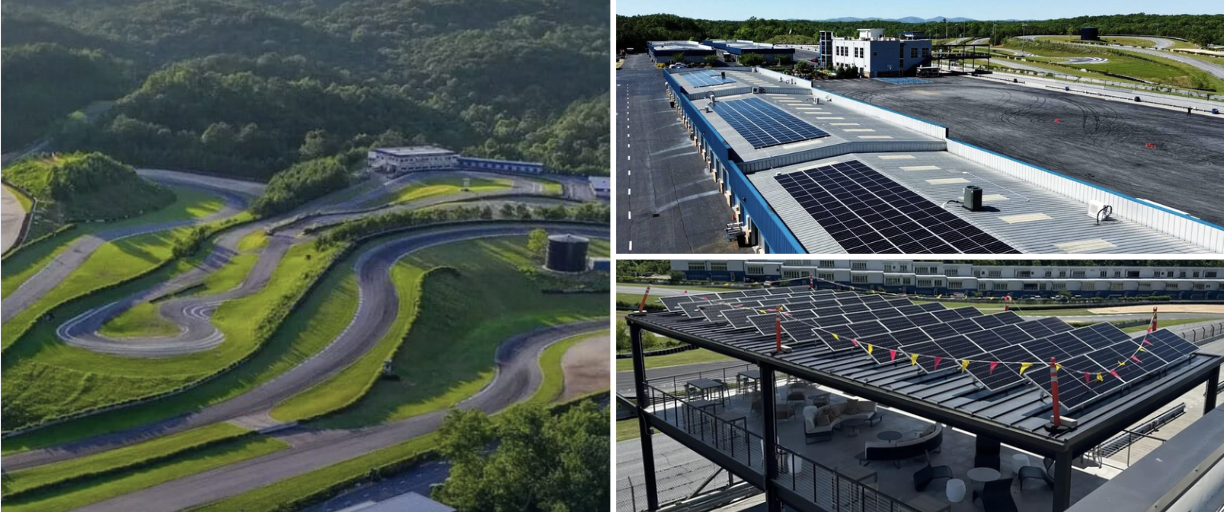
Left: Tracks at the Atlanta Motorsports Park (AMP) in Dawsonville, Georgia (Photo courtesy of Atlanta Motorsports Park). Right: Solar arrays at the AMP. Photos courtesy of Hannah Solar.
“The ability to generate over half of our energy needs through solar pushes us closer to our vision of making AMP’s campus its own self-sustaining community and resort,” he says. “We are thrilled at our ability to reduce strain on the local grid while achieving a substantial positive environmental impact.”
In Dawson County, AMP is already the largest recycler, including used tires and asphalt. AMP also utilizes recycled guardrails from the highway. That commitment to sustainability is appealing to new residents. AMP boasts some 300 condos, which have attracted plenty of current and future buyers.
AMP echoes a nationwide effort by NASCAR, which is aiming to lower the sport’s carbon footprint to zero by 2035.
Federal Funding Slashed Costs
Porter worked with Georgia-based companies Hannah Solar and Amicalola EMC on the solar project and was able to recoup 50% of its total costs thanks to a U.S. Department of Agriculture (USDA) Rural Energy for America (REAP) grant.
He says AMP hired a grant writer to help them through the process and was “pleasantly surprised” when the facility was awarded a grant.
REAP grants support small businesses and agricultural producers in rural areas, making renewable energy technologies like solar and energy efficiency improvements more accessible and affordable. With the passage of the Inflation Reduction Act in 2022, over $2 billion in REAP funding has been allocated through 2031.
Solar Panels Made at Qcells in Georgia
The solar panels at the AMP facility were manufactured at the Qcells’ Dalton, Georgia, factory, which manufactures nearly 30,000 solar panels per day and employs around 500 workers. Qcells is not only a Georgia success story but a national one as well. Qcells has transformed Dalton from once being known as the “carpet capital of the world” to now being the largest producer of American-made solar panels.
“Whenever we can keep it local – we will do that,” says Porter.
The installation can generate 450,300 kWh of solar power annually, which will offset more than 7,000 pounds of CO2 emissions over a 30-year period.
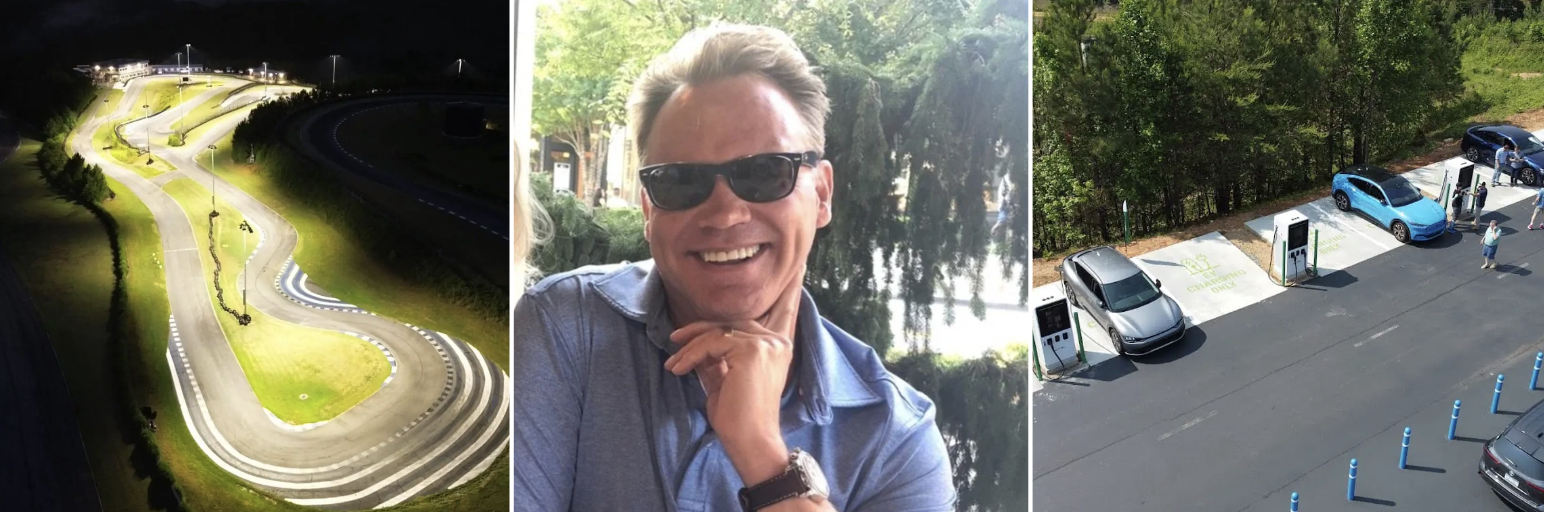
Left to right: Tracks lit up at night at the Atlanta Motorsports Park (AMP) in Dawsonville, Georgia; Jeremy Porter, chief executive of AMP; electric vehicle chargers at AMP.
AMP is serious about sustainable operations in other ways, too. The facility also has all LED lighting and solar-powered CCTV/Signs. The site also recently added electric vehicle (EV) chargers: 10 Level 3 DC Superchargers; and 8 Level 2 chargers.
“We often host film crews shooting footage of cars in action,” he says. “Our Superchargers mean they can be more productive with those cars. Plus, it gives many of our customers easy access to chargers when they visit the facility.”
Porter sees EV racing as another offering AMP may have in the future.
“I always want to be innovating,” he says. “It’s exciting to create something new, but also do right by the environment.”
Get Involved in the Clean Energy Generation
Examples of clean energy innovation are everywhere, whether it’s a solar-powered speedway, an EV charger at your local coffee shop, or a heat pump in your basement. As the Clean Energy Generation, we’re alive amidst unprecedented climate disruption, but also during a historic push for clean energy – and there’s a role for all of us. To learn more about actions you can take, meet others from across the Southeast, and get inspired by more stories like this one, we invite you to say “I’m in!” and join the movement using the buttons below.
Join the Clean Energy Generation
The post Atlanta Motorsports Park Revs Up With Solar Power appeared first on SACE | Southern Alliance for Clean Energy.

Weather Guard Lightning Tech

Trump Targets Revolution Wind, Nordex Q3 EBITDA Doubles
Allen covers the Trump administration’s bid to reopen Revolution Wind’s permit, a bipartisan Senate permitting deal, Nordex’s doubled third-quarter profit, and GE Vernova’s new wind chief.
The Uptime Wind Energy Podcast is brought to you by Weather Guard Lightning Tech, creators of the StrikeTape Ultra LPS retrofit. Subscribe to Uptime’s Substack newsletter. And check out Rosemary’s “Engineering with Rosie” Youtube channel. Have a question we can answer on the show? Email us!
 Have you ever wondered why every dictator in human history follows the exact same playbook? Check this out
Plato nailed this 2400 years ago, and it’s been on “rinse/repeat” ever since.
 On average, I meet perhaps 50 K-12 teachers each year, and I often ask them: What is the biggest challenge you face that impacts your ability to connect with and educate your students?
Here’s a rough tabulation:
Screen time, how it robs kids of their ability to pay attention, impedes social interaction, and makes parenting more difficult: 80%
Everything else combined: 20%
Maybe this is a cynical viewpoint, but it seems like that world of today revolves around the mega-corporations profiting by punishing their customers.
In this case, we have the tech giants ruining the lives of our children. Elsewhere, we have healthcare industry driving people into bankruptcy, Big Oil ruining our planet, the gun lobby murdering our kids, and, of course, an ultra-corrupt government looting our treasury to pay off billionaire donors.
Note that this wasn’t the case when we boomers were growing up 60 years ago. This is a distinctive shift from the 1960s when corporate America was focused on things like color TVs and the Ford Mustang.


Sustainability In Your Ear: XPRIZE’s David Babson on Why Climate Grand Challenges Need Buyers, Too
Trump Targets Revolution Wind, Nordex Q3 EBITDA Doubles

Protecting nature is a public duty, not a Wall Street profit opportunity
-
Climate Change1 year ago
Guest post: Why China is still building new coal – and when it might stop
-

 Greenhouse Gases2 years ago
嘉宾来稿:满足中国增长的用电需求 光伏加储能“比新建煤电更实惠”
-
Greenhouse Gases1 year ago
Guest post: Why China is still building new coal – and when it might stop
-

 Climate Change2 years ago
嘉宾来稿:满足中国增长的用电需求 光伏加储能“比新建煤电更实惠”
-

 Renewable Energy12 months ago
Sending Progressive Philanthropist George Soros to Prison?
-
Climate Change2 years ago
Bill Discounting Climate Change in Florida’s Energy Policy Awaits DeSantis’ Approval
-
Greenhouse Gases1 year ago
嘉宾来稿:探究火山喷发如何影响气候预测
-

 Climate Change2 years ago
Analysis: China’s CO2 falls 1% in Q2 2024 in first quarterly drop since Covid-19