


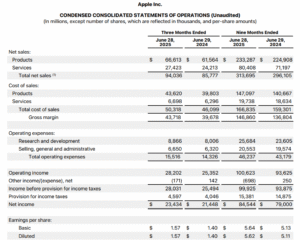
For its fiscal Q3 ended June 28, 2025, Apple reported revenue of over $94 billion, up nearly 10% year-over-year and ahead of analyst expectations.
The company also posted earnings per share (EPS) of $1.57, beating forecasts of $1.43. Net income came in at approximately $23.4 billion.
iPhone sales surged 13.5%, reaching $44.58 billion, driven by early purchases ahead of possible tariffs. Mac revenue rose to $8.05 billion, surpassing estimates, while iPad sales reached $6.58 billion, slightly below forecasts.
Wearables and accessories sales fell short at $7.4 billion. Meanwhile, services revenue totaled $27.42 billion, marking steady growth. Gross margin stood at 46.5%, slightly above analyst expectations. Overall, financial performance is strong and has mostly beaten expectations.
Tim Cook, Apple’s CEO remarked:
“Today Apple is proud to report a June quarter revenue record with double-digit growth in iPhone, Mac and Services and growth around the world, in every geographic segment. At WWDC25, we were excited to introduce a beautiful new software design that extends across all of our platforms, and we announced even more great Apple Intelligence features.”
Investors React: Small Stock Bump, Big AI Optimism
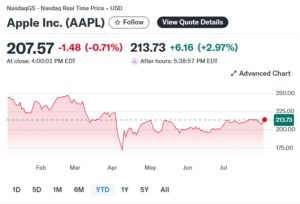
Following the earnings release, Apple’s stock rose slightly in after-hours trading, reflecting investor satisfaction over Q3 2025’s stronger-than-expected iPhone results and service growth. Analysts consider Apple better positioned as it accelerates AI investments and continues to diversify its supply chain.
Still, the stock remains down around 15–16% year to date, lagging behind other major tech companies. Analysts broadly expect potential upside, with many targeting price levels around $235. This is supported by confidence in Apple’s next steps in AI and hardware innovation.
Scaling Up Services and Supply Chain Smarts
Services revenue, which includes the App Store, iCloud, and Apple Music, continues to be a key growth engine with 13% year-over-year growth. This segment now contributes nearly 29% of total revenue.
Additionally, Apple’s move to shift iPhone production from China to India helped avoid roughly $900 million in tariff exposure. Sales in Greater China recovered, rising to $15.37 billion, while Americas revenue grew 9.3% to $41.2 billion.
AI Investments and Product Evolution
Apple is increasing its focus on artificial intelligence. The company plans to make a more personal Siri. It is also investing in on-device intelligence. This will improve user privacy and performance.
Moreover, research and development spending reached an estimated $8.8 billion, about $800 million more than the same period last year.
Some experts think Apple is behind rivals like Microsoft and Google in AI. However, others back its focus on privacy and integration with products.
Apple’s strategy is to add AI features to its current ecosystem. Instead of launching separate products, they enhance what they already have.
Apple’s Climate Strategy: Net Zero, Circular Design, and Carbon Removal
Apple has committed to becoming carbon neutral across its entire value chain by 2030. It has achieved carbon neutrality for its corporate operations. Now, it aims to cut Scope 3 emissions, which account for most of its total footprint.

To get there, Apple is working with over 300 suppliers that now use 100% renewable energy for Apple production.
Recent Apple Watch models were the first to be labeled as carbon neutral, and Apple has also eliminated most plastics from its packaging.
Apple is also redesigning its products with the climate in mind. The company is steadily using more recycled materials. This is especially true for device enclosures and internal parts. These include aluminum, rare-earth elements, and recycled gold in important parts.
Many recent Mac and iPad models are made with 100% recycled aluminum, and newer iPhones now include recycled rare earth elements in key parts.
Packaging is also changing. Apple has switched most plastic in its boxes to fiber-based options. This change cuts waste and boosts recyclability.
In 2023, the company introduced its first carbon-neutral products, starting with select models of the Apple Watch. These products combined a lower-emission design with clean energy use and carbon removal investments.
Energy efficiency is another priority. Apple’s hardware is designed to consume less electricity during everyday use. This not only benefits the environment but also saves energy costs for consumers.
In terms of emissions Apple cannot yet eliminate, the company supports carbon removal initiatives, including:
- reforestation,
- wetland restoration, and
- advanced tech, which features direct air capture and enhanced rock weathering.
The company publishes a Carbon Removal Progress Report to keep stakeholders informed of its progress.
Apple remains highly rated in ESG assessments and is aligned with the Science Based Targets initiative. It regularly receives top scores from groups like CDP and MSCI.
Final Take: Stable Growth Meets Purpose-Driven Innovation
Apple’s Q3 2025 performance shows its ability to deliver strong financial results while advancing in new areas like AI and sustainability. Robust iPhone sales, healthy service growth, and tight cost control helped Apple exceed expectations.
At the same time, its long-term climate commitments and innovation in design, materials, and carbon removal reinforce the company’s broader mission.
As Apple prepares for future product launches and further develops its AI ecosystem, its ability to balance profitability, innovation, and environmental responsibility will remain central to its identity—and its value to investors.
The post Apple (AAPL Stock) Rings Up $94B Q3 Win Fueled by iPhones, AI Push, and Climate Smarts appeared first on Carbon Credits.

EU carbon credit claims changed on 27 September 2026, the day the Directive (EU) 2024/825 began to apply across the European Union. The change is narrow. It changes how a company can talk about the credits it buys. A product can no longer be called neutral on the strength of compensation alone; however, every specific, evidenced statement about what a company measured, reduced, and funded stays fully available.

The post Promoting Improved Cooking Practices in Nigeria appeared first on Terrapass.



-
Climate Change1 year ago
Guest post: Why China is still building new coal – and when it might stop
-

 Greenhouse Gases2 years ago
嘉宾来稿:满足中国增长的用电需求 光伏加储能“比新建煤电更实惠”
-
Greenhouse Gases1 year ago
Guest post: Why China is still building new coal – and when it might stop
-

 Climate Change2 years ago
嘉宾来稿:满足中国增长的用电需求 光伏加储能“比新建煤电更实惠”
-

 Renewable Energy12 months ago
Sending Progressive Philanthropist George Soros to Prison?
-
Climate Change2 years ago
Bill Discounting Climate Change in Florida’s Energy Policy Awaits DeSantis’ Approval
-
Greenhouse Gases1 year ago
嘉宾来稿:探究火山喷发如何影响气候预测
-

 Climate Change2 years ago
Analysis: China’s CO2 falls 1% in Q2 2024 in first quarterly drop since Covid-19