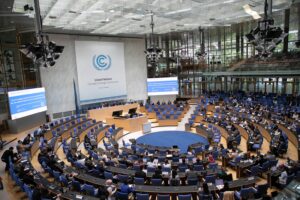
More than 65,000 delegates have registered to attend the COP29 climate summit in Baku, Azerbaijan, potentially making it the second-largest COP on record.
This total is more than 15,000 lower than the record-breaking COP in Dubai last year – and marks the first time in seven years that a COP is not larger than its predecessor.
The figures are released amid reports that numerous world and industry leaders are skipping the summit, while Papua New Guinea has pulled its delegation out entirely.
Nonetheless, the size of the Baku summit still likely outstrips major COPs of the past, including Copenhagen, Paris and Glasgow.
COP29 host Azerbaijan has the largest delegation at the summit, with 2,229 people registered for badges. This is followed by Brazil (1,914) and Turkey (1,862) with the second and third-largest delegations, respectively.
The United Arab Emirates (UAE), hosts of COP28 in Dubai, has the fourth-largest delegation (1,011) and China (969) has the fifth.
While China’s delegation is smaller than at COP28 (when it was 1,296), both summits have seen a much larger presence for the country. For the 10 COPs before COP28, China’s average delegation of named participants was around 100 people.
All aboard to Baku
COP28 in Dubai last year was the largest COP in an almost 30-year history of summits – by some distance. More than 83,000 people attended the summit in person, beating the previous record of around 50,000 set in Sharm El-Sheikh in Egypt the year before.
The total number of registered delegates for COP29 in Baku clocks in at 66,778 – falling between the totals of the previous two COPs. With 3,975 “virtual” participants, this takes the overall provisional delegate total for COP29 to more than 70,000.
As the chart below shows, this bucks the recent trend that has seen the size of COPs increase every year since the 16,000 participants that travelled to Bonn, Germany, for COP23 in 2017.
It is worth noting that these are provisional figures, based on the delegates that have registered for the summit. The UNFCCC will release the final figures – based on participants collecting a physical badge at the venue – after the summit has closed.
Overall totals for delegates from parties, observers and the media for all COPs, as published by the UNFCCC (see this article for more details on the data). Data for COPs 1-28 are the “final” figures, while COP29 data is “provisional”. Chart by Carbon Brief.
This group adds up to 17,680 delegates – second only to COP28 in Dubai.
At last year’s COP, the participant lists published by the United Nations Framework Convention on Climate Change (UNFCCC) – for the first time – named every single person that had registered for the summit (excluding support staff). Previously, COPs have typically included thousands of “overflow” participants in which countries and UN agencies could nominate delegates without their names appearing on their official lists.
The Baku summit continues this more transparent approach, providing spreadsheets that name all participants.
For consistency with Carbon Brief’s analysis of previous COPs, the above chart includes overflow delegates as a single group. However, the participant lists do divide the overflow delegates between parties and observer groups. Including the overflow numbers takes the total for party representatives to 33,158.
The next-largest group is that of observers from non-governmental organisations (NGOs), which totals 9,881 delegates. This is the third-largest total in COP history (after the previous two COPs).
Along with the NGOs, there are several other groups that fall into the category of “observer organisations” – such as those participants representing UN bodies, intergovernmental organisations, other agencies and business representatives. These total 2,377 registered delegates – or 3,204 when overflow badges are included.
Finally, 3,575 media delegates have registered for COP29, a provisional total that is second only to COP3 in Kyoto in 1997.
Host lead
As is common at COP summits, the largest delegation at COP29 represents the host country. Azerbaijan has registered a delegation – including party overflow badges – of 2,229.
This is a far cry from Azerbaijan’s tiny delegations of the past. Before COP28 in Dubai, Azerbaijan’s delegation amounted to an average of six people.
The second-largest delegation comes from Brazil with 1,914 participants. Brazil typically brings one of the largest delegations and this year is no exception. A substantial delegation from Brazil was also likely considering they will be hosting COP30 next year.
(It is worth noting that some countries allocate some of their party badges to NGOs, which can artificially inflate the size of their official delegation.)
The third-largest delegation comes from Turkey (1,892), followed by UAE (1,011) and China (969). The rest of the top 10 comprises Russia (900), Indonesia (810), Nigeria (634), Japan (595) and Kazakhstan (478).
Just outside the top 10 is the UK in 11th (470), as well as the US (405) in 16th and Australia (394) in 19th.
Azerbaijan has seen the biggest increase in delegation size since COP28, increasing by 995 people. This is followed by Turkey (966 more) and Russia (448).
The smallest delegations belong to Niger and San Marino (two), Nicaragua (three), and Andorra and North Korea (five).
Unsurprisingly, the largest decrease in delegation size is for UEA (dropping by 3,148). Next is India (909) and France (649), while the US delegation has shrunk by 434.
Papua New Guinea has registered a delegation of 28, although prime minister James Marape announced back in August that the country would not be attending to “signal our protest at the big nations…for their lack of quick support to those who are victims of climate change, and those of us who are forest and ocean nations”.
Also, according to the provisional participant lists, Afghanistan has not registered a delegation. However, reports earlier this week suggested that Taliban officials will attend as observers. Therefore, their invitation from COP hosts Azerbaijan may have come outside the usual registration process.
The map and table below present the delegation size – split between party and overflow badges – for all the countries registered for COP29. The darker the shading, the more delegates that country has signed up. Use the search box to find the data for a specific party.
Gender split
The UNFCCC’s participant lists typically provide a title – such as Mr, Ms, Sr or Sra – for each registered delegate. In the past, this has allowed Carbon Brief to work out the balance of men to women in the delegations that each country has sent to a COP.
(This analysis always carries the caveat that the titles are designated by UNFCCC and not by Carbon Brief. In addition, Carbon Brief recognises that gender is not best categorised using a binary “male” or “female” label and appreciates that the UNFCCC’s lists may not be wholly accurate.)
However, since COP28 last year, the UNFCCC has started using other titles that do not indicate gender – such as Dr, Prof, Ambassador and Honourable. Therefore, for this analysis, these non-gendered titles – which make up around 150 names of more than 17,000 in the list of party delegates – have not been included.
This gives an average gender balance of party delegations of 60% male to 40% female.
As the chart below shows, this makes COP29 the most balanced COP in history. (Note that, for consistency, the COP28 and COP29 figures only include those on party badges, not overflow ones.
The average size of named party delegations (not including overflows) for each COP, divided by male (orange) and female (purple) participants. The lines show what percentage of the average delegation is male (orange) and female (purple). Data for COPs 1-28 collated from “final” participant lists published by the UNFCCC, while COP29 data is based on the “provisional” list. Note that 145 delegates in the COP29 provisional list are not included because there is no information on their gender. Chart by Carbon Brief.
There are two all-male party delegations this year – North Korea (five delegates) and Niger (two delegates).
In addition, this year, Carbon Brief’s analysis reveals that the gender balance across all registered delegates – both in-person and virtual – for COP29 is 59% male to 41% female.
The full list of COP29 party delegation sizes can be found here.



The post Analysis: Which countries have sent the most delegates to COP29? appeared first on Carbon Brief.
Analysis: Which countries have sent the most delegates to COP29?

Jacynta Fa’amau is a Pacific campaigner at global grassroots climate movement 350.org and a secretariat member of Pacific Climate Warriors.
The first thing that struck me was the sheer size of Queensland’s Saraji coal mine. Standing at the edge of the enormous pit, my brain scrambled for words as I scanned the earth’s open wound – a whole island could probably fit inside it.
Looking down, I noticed footprints of an emu and a koala, pressed and dried in what was once a puddle – signs of how drought had driven animals in desperate search of water, so dangerously close to the coal trucks and heavy machinery ahead.
Earlier this year, I joined a small group of Pacific Islanders on a journey through the Bowen Basin to learn from First Nations communities battling Australia’s mammoth coal industry. Of the more than 40 coal mines operating in the area, BHP & Mitsubishi Alliance’s Saraji mine is one of the largest. So it came as a painful shock to us when in August, the Australian government approved the mine’s extension just months after our visit.
-
As COP31 co-host, Australia should make its polluters pay for climate damage
With UN climate funds running short on cash, now is the time to start taxing the companies whose emissions are driving harm in the Pacific and other vulnerable parts of the world -
At pre-COP, UN climate chief warns of heat threat to mothers and babies
The spotlight on maternal health came on the first day of the pre-COP31 meeting in Fiji, where Pacific concerns are set to top the agenda as ministers gather for talks

Witnessing coal extraction is devastating. It is bad enough to see what pillaging tonnes of coal can do to a mine’s immediate surroundings: dry creek beds, dwindling wildlife, denuded land. But to know that this coal will be shipped across the ocean, bring air pollution, and eventually lead to the destruction of Pacific islands thousands of miles away is another kind of heartbreak.
Rising ocean waters
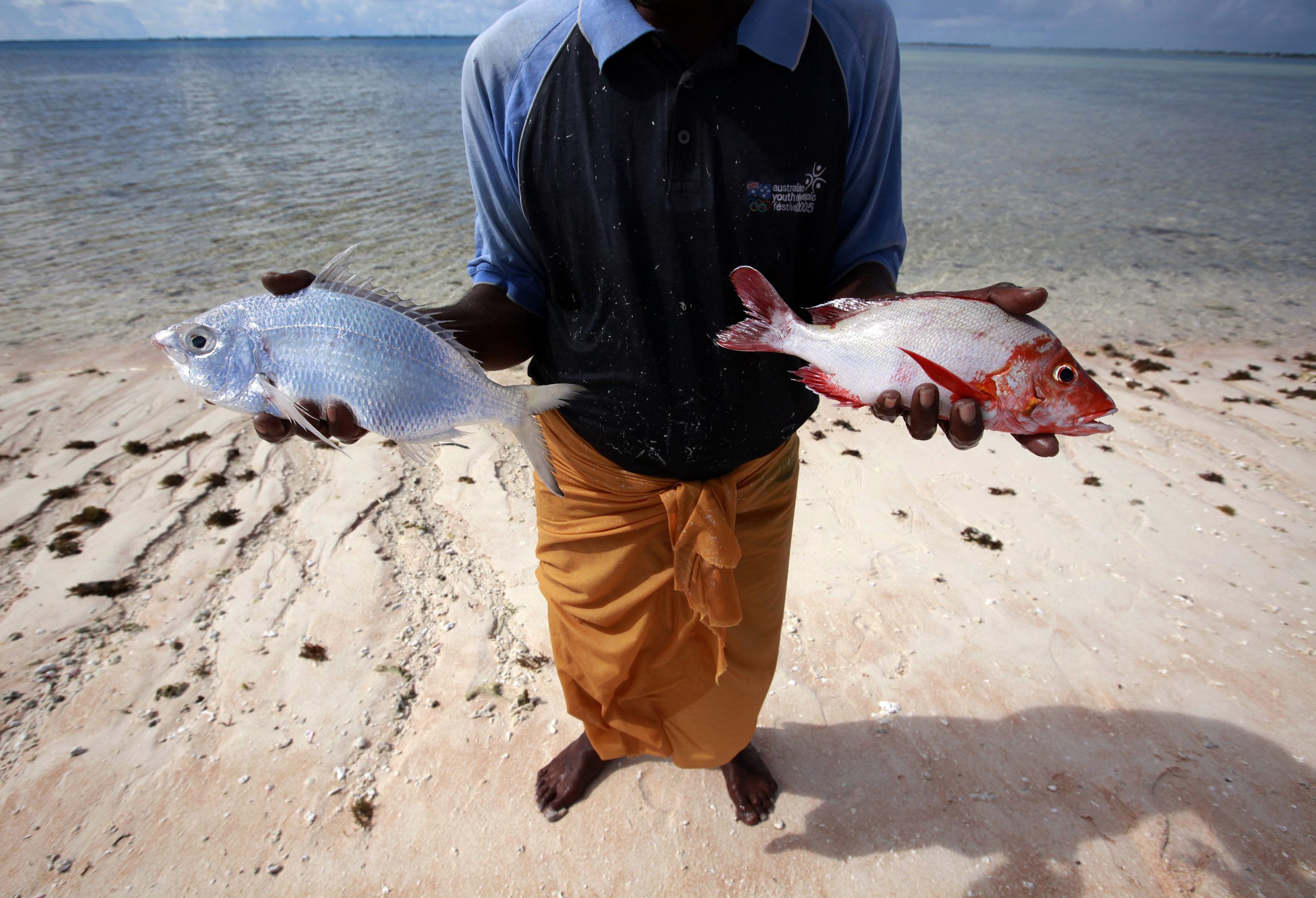
I’m an Australian-born Samoan. In 2002, I visited my family home for the first time. My father took me to the rural community where generations of my family were raised. He did not have the words to describe how much has changed since rising ocean waters had taken away almost a third of the beach.
I learned of how we had to relocate my great‑great‑grandparents’ grave to higher ground twice in the last 15 years. Of how my cousins have to paddle out further to sea to catch fish, since warmer waters have destroyed much of the reef. Of how the ocean crashes so close to my uncle’s home that he had to build a new house further away.
We saw reflections of our own climate destruction in the Pacific when we shared these stories with our First Nations relatives at the edge of the Saraji mine. Murrawah Johnson and Teila Watson, both Birri Gubba and Gangulu women, made clear connections between their struggles and ours. “We don’t get to inherit our land and we don’t get to inherit our traditional roles. We are fighting a war on extinction,” Murrawah said.
Coal extraction devastated their lands and cultures – totems have disappeared, fresh water has become scarce – while the effects of using it have devastated ours. “King tide, cyclones, all the violence that has been enacted on your country and people is because of the violence that has been allowed here, to us and our country,” Teila said.
Wearing the mantle of climate leadership
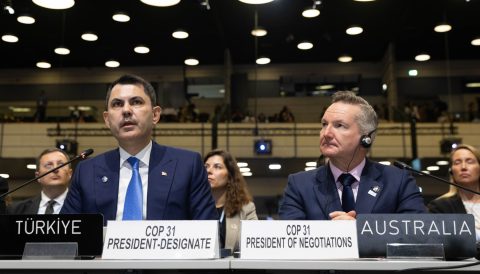
This week, Australia is assuming the mantle of climate leadership as co-president and head of negotiations of this year’s UN Climate Change Conference, COP31. It will lead on deliberating the summit’s priorities as world leaders and climate negotiators descend on Fiji and Tuvalu for the pre-COP meetings.
Ironically, just days before the pre-COP began, the New South Wales Independent Planning Commission approved the largest-ever coal project the state has seen, set to emit an extra 800 million tonnes of carbon emissions. I joined the Pacific Climate Warriors and other communities in submitting about 4,000 appeals to oppose the project – yet these all fell on deaf ears.
-
Fossil fuel expansion threatens COP31 hosts’ credibility, experts warn
Türkiye and Australia are pushing coal, oil and gas at home with no national timeline for their own fossil fuel phase-out -
This Australian coal community is co-designing its own green future
The mining town of Collie offers a promising example of how to survive – and even thrive – amid the global transition to net-zero emissions

But the fight is not yet over. The project still requires federal approval to proceed, so every promise that Australia makes while at the helm of the climate talks counts. These promises will be measured against actual decisions it makes at home: to either lock us into more decades of climate pollution, or begin shutting down coal and gas once and for all.
Pacific leaders have made it clear that countries must align their policies with the 1.5-degree warming goal, a limit that we already know will be breached within the decade. Any chance of keeping this still within reach requires an immediate end to fossil fuel expansion and concrete plans to phase out existing projects. But success will be an uphill battle if COP31’s own head of negotiations refuses to lead by example.
Australia remains the second-largest coal exporter in the world. It is one of the very few industrialised countries under the Paris Agreement’s Annex I that still has no coal phase-out plan. Since 2022, the Albanese government has approved 37 new, expanded or extended coal, oil and gas projects. It is thus unsurprising that its own mitigation policies have been rated by Climate Action Tracker as “insufficient”, even without factoring in fossil fuel exports and related expansion.
Keeping 1.5C alive
Australia must course-correct to earn the mantle it has been given, especially by Pacific nations that backed the country’s bid for the COP31 co-presidency. As a first step, the government must end all coal expansion and explicitly declare a coal phase-out date. It’s the only way to show that it’s capable of leadership that moves beyond endlessly deliberating the “if”, and starts implementing the “how” of keeping the 1.5C target alive.
The dread I felt staring down at the abyss on the edge of that coal mine months ago still exists. I carry it with me as I show up at the pre-COP to demand that leaders heed the calls of Pacific people. But it is tempered with resolve to keep our lands and communities alive. We remain steadfast in our efforts to secure an outcome that protects people everywhere and brings us back below 1.5 degrees as soon as possible.
The post Coal mines and hypocrisy must not be Australia’s COP31 legacy appeared first on Climate Home News.
Coal mines and hypocrisy must not be Australia’s COP31 legacy
When José Antonio Kast took office as Chile’s new president in March, one of his first moves was to put the brakes on plans to expand two protected marine parks – raising doubts about the country’s high-profile bid to host the headquarters of the High Seas Treaty.
But during the UN General Assembly last month, the right-wing leader reaffirmed his leftist predecessor’s ambition for Chile to host the landmark global pact, which came into effect in January and provides a legal framework to protect the waters of the high seas beyond national jurisdiction that cover about two-thirds of the world’s oceans.
Hailing the country’s “maritime vocation”, Kast’s government said the bid to host the treaty’s secretariat in the port city of Valparaíso was state policy and testament to its commitment to multilateralism.
“For the government of Chile, it is of high interest to achieve this recognition, and we will carry out all the efforts to obtain the necessary support,” Foreign Minister Francisco Pérez Mackenna was quoted as saying by local media.
-
At pre-COP, UN climate chief warns of heat threat to mothers and babies
The spotlight on maternal health came on the first day of the pre-COP31 meeting in Fiji, where Pacific concerns are set to top the agenda as ministers gather for talks