

Global carbon dioxide emissions from fossil fuels and cement have increased by 1.1% in 2023, hitting a new record high of 36.8bn tonnes of CO2 (GtCO2), according to the 2023 Global Carbon Budget report by the Global Carbon Project.
The new report finds that the increase in fossil emissions in 2023 has been largely driven by increased emissions in China – without which the global total would have remained approximately flat at 2022 levels.
Total global CO2 emissions – including land use and fossil CO2 – increased by approximately 0.5% in 2023, driven by a combination of a small drop in land-use emissions, but an increase in fossil CO2 emissions.
However, total CO2 emissions remain ever so slightly below the highs set in 2019 and have been relatively flat since 2015.
The 18th edition of the Global Carbon Budget, which is published today, also reveals:
- Global land-use emissions have likely been falling over the past two decades, driven by decreasing rates of deforestation in Brazil and other countries. However, land-use emissions remain highly uncertain and trends should be interpreted with caution.
- Most of the increase in fossil emissions was from coal and oil. Global coal emissions reached a new record high, though oil emissions still remain below pre-pandemic levels. Gas emissions and those from cement and other sources remained relatively unchanged.
- China’s fossil CO2 emissions are estimated to be up 4% this year, while India’s are up 8.2%. US and European Union emissions are expected to fall by 3% and 7.5%, respectively.
- Emissions from international aviation and shipping have grown by an estimated 11.9% in 2023, reflecting a 28% increase in aviation emissions (as the sector continues to recover from pandemic lows) and a 1% increase in shipping emissions.
- Global CO2 concentrations in 2023 set a new record of 419.3 parts per million (ppm), up 2.4ppm from 2022 levels. Atmospheric CO2 concentrations are now 51% above pre-industrial levels.
Global CO2 emissions virtually tie 2019 record
While CO2 emissions from fossil fuels have exceeded pre-pandemic levels over the past two years, total CO2 global emissions – which includes those from land-use change – have remained marginally below 2019’s record of 40.9GtCO2.
In 2023, the global total effectively tied the 2019 record. The central estimate provided by the Global Carbon Budget is 0.1% lower than the prior record, though the large uncertainties – particularly for land-use change emissions – reduces confidence in the relative ranking of the two.
Each year the Global Carbon Budget is estimated to include the latest data as well as improvements to modelling sources and sinks, resulting in some year-to-year revisions to the historical record.
The figure below shows the 2023 (dark blue solid line), 2022 (yellow dotted), 2021 (bright blue dotted) and 2020 (red dotted) global CO2 emissions estimates, along with the uncertainty (shaded area) of the new 2023 budget.
The 2023 figures are quite similar to the 2022 numbers over the past decade, though it shows somewhat higher emissions during the 1980s and 1990s.

Annual total global CO2 emissions – from fossil and land-use change – between 1959 and 2023 for the 2020, 2021, 2022 and 2023 versions of the Global Carbon Project’s Global Carbon Budget, in billions of tonnes of CO2 per year (GtCO2). Shaded area shows the estimated one-sigma uncertainty for the 2023 budget. Data from the Global Carbon Project; chart by Carbon Brief.
Growth in total CO2 emissions has substantially slowed down over the past decade (2013-22), with an average growth of 0.14% per year. This is much lower than the 2.1% per year average growth rate over the previous decade (2003-12) and the longer-term average growth rate of 1.7% between 1959 and 2012.
The continued growth in fossil-fuel emissions has been largely counterbalanced by a slight decline in land-use emissions. However, the uncertainties surrounding land-use emissions remain quite large. As more data is collected there may be upward or downward revisions in the record over the past decade – as seen in both 2021 and 2022 versions of the Global Carbon Budget.
The figure below breaks down global emissions (black line) in the 2023 budget into fossil and (grey) land-use (yellow) components. Fossil CO2 emissions represent the bulk of total global emissions in recent years, accounting for approximately 90% of emissions in 2023 (compared to 10% for land-use). This represents a large change from the first half of the 20th century, when land-use emissions were approximately the same as fossil emissions.
Global fossil emissions include CO2 emitted from burning coal, oil and gas, as well as the production of cement. However, the Global Carbon Budget also subtracts the cement carbonation sink – CO2 slowly absorbed by cement once it is exposed to the air – from fossil emissions in each year to determine total fossil emissions.

Global CO2 emissions separated out into from fossil and land-use change components between 1959 and 2023 from the 2023 Global Carbon Budget. Note that fossil CO2 emissions are inclusive of the cement carbonation sink. Data from the Global Carbon Project; chart by Carbon Brief.
Recent analyses by both the International Energy Agency (IEA) and Climate Analytics have suggested that global fossil emissions may peak in 2023, as the growth of clean energy accelerates and fossil fuel use declines.
However, hopes for an imminent peak in global emissions should be tempered by past failed predictions. Back in 2016, there were suggestions that global emissions had peaked and would decline. Similarly, a number of researchers (including one of the authors of this article) estimated that fossil emissions would peak in 2019 in the wake of Covid-19 disruptions. In reality, fossil emissions set new records in both 2022 and 2023.
It is also important to emphasise that stopping the growth of CO2 emissions does not stop CO2 from accumulating in the atmosphere or stop the world continuing to warm. For warming to stop, global CO2 emissions need to not only peak, but rapidly fall to net-zero.
Land-use emissions
The Global Carbon Budget estimates that land-use emissions will be 4.1GtCO2 in 2023, down around 5% from 2022 and continuing a small downward trend over the past two decades. However, despite declines in land-use emissions from deforestation, they remain substantially higher than CO2 removals from intentional reforestation and afforestation projects.
The Global Carbon Project now provides a database of land-use emissions by country, though it does not provide country-level emissions through to 2023 yet. The figure below highlights the four countries with the largest land-use emissions in 2022 – Brazil (grey shading), Indonesia (red), the Democratic Republic of Congo (bright blue) and China (yellow) – as well as land-use emissions in the rest of the world (purple).

Annual CO2 emissions from land-use change by major emitting countries and the rest of world from 1959-2022. Note that country-level land-use change emissions are not yet available for 2023. Data from the Global Carbon Project; chart by Carbon Brief.
The decline in global land-use emissions over the past two decades was driven in part by decreasing rates of deforestation in countries such as Brazil, as well as slightly increasing removals of CO2 from reforestation and afforestation projects.
However, these estimates are subject to large uncertainties – as recently as 2020 researchers thought land-use emissions had been increasing – and the Global Carbon Budget authors suggest that long-term trends should be interpreted with caution.
This year’s budget provides a first estimate of how land-use emissions break down into different categories. They find that permanent deforestation is responsible for emissions of around 4.2GtCO2 per year, with around 1.9GtCO2 removed per year by reforestation and afforestation.
(In addition, there is currently a tiny 0.00001GtCO2 removed by permanent carbon removal technologies, such as direct air capture and enhanced rock weathering.)
Deforestation due to shifting cultivation cycles (where deforestation is temporary before land is abandoned to return to forest cover) is responsible for emissions of around 2.9GtCO2 per year, while regrowth in previously cultivated areas removes around 2.8GtCO2 per year. This results in only a small net source of emissions (~0.1GtCO2 per year).
The harvesting of trees for wood (as well as other forest management) leads to net emissions of around 0.8GtCO2 per year, as deforestation for timber production is higher than regrowth rates globally – though this will vary substantially by country and region.
Finally, other emissions from land management, such as peat drainage and burning as well as other land transitions, are responsible for around 1.4GtCO2 per year.
Emissions from wildfires are also presented in the new report, which notes that it is not an additional CO2 source – rather, forest fires are part of the net land carbon sink (or included as land-use emissions if triggered by humans for deforestation purposes).
Chinese emissions drive rising global fossil CO2
Global emissions of fossil CO2 – including coal, oil, gas and cement – increased by around 1.1% in 2023, relative to 2022, with an uncertainty range of 0.0% to 2.1%. This represents a new record high and is 1.4% above the 2019 pre-Covid levels.
The figure below shows global CO2 emissions from fossil fuels, divided into emissions from China (red shading), India (yellow), the US (bright blue), EU (dark blue) and the remainder of the world (grey).

Annual fossil CO2 emissions by major countries and the rest of the world from 1959-2023, excluding the cement carbonation sink as national-level values are not available. Data from the Global Carbon Project; chart by Carbon Brief.
China represents 31% of global CO2 emissions. Their emissions in 2023 are projected to increase by 4% (with an uncertainty range of 1.9% to 6.1%), driven by a rise in emissions from coal (+3.3%), oil (+9.9%) and natural gas (+6.5%). The strong growth in Chinese emissions in 2023 is partly due to a delayed rebound from Covid-19 lockdowns.
India represents 8% of global emissions. In 2023, Indian emissions are projected to increase by 8.2% (ranging from 6.7% to 9.7%), with a 9.5% increase in emissions from coal, a 5.3% increase in emissions from oil, a 5.6% increase in emissions from natural gas and a 8.8% increase in emissions from cement.
The large growth in coal in India is being driven by rapid increases in electricity demand. While India is installing large amounts of renewable energy, it is still far from sufficient to meet the growth in demand. Emissions from India now exceed those from the European Union, though they remain much smaller on a per-capita basis.
The US represents 14% of global emissions (though is responsible for a much larger portion of historical emissions and associated atmospheric accumulation of CO2). US emissions are projected to decrease by 3% in 2023 (ranging from -5.0% to -1.0%). This is being driven by a large decrease in coal emissions, which are expected to fall by more than 18% compared with 2022 levels. Oil emissions are expected to decline by a slight 0.3%, reflecting the rise of electric vehicles, while emissions from gas are expected to increase by 1.4%.
The European Union represents 7% of global emissions. EU emissions are expected to decrease by a sizable 7.4% in 2023, driven by a 18.8% decline in coal emissions, a 1.5% decline in oil emissions and a 6.6% decline in natural gas emissions (driven in part by higher prices and the phaseout of Russian gas).
A combination of rapidly increasing renewable capacity, electric vehicle adoption, lower energy demand and generally high fossil energy prices are driving fairly rapid emissions reductions.
The rest of the world represents 40% of global emissions, of which 2.8% is international aviation and shipping. Emissions in the rest of the world are expected to grow by 0.4% in 2023 – though this is entirely due to growth in international aviation and shipping, which are expected to grow by 11.9% (reflecting a 28% increase in aviation emissions and a 1% increase in shipping emissions). The large increase in aviation emissions reflects the ongoing recovery from pandemic-era declines.
Excluding international aviation and shipping, emissions in the rest of the world are expected to fall by 0.4%.
The total emissions for each year between 2019 and 2023, as well as the countries and regions that were responsible for the changes in absolute emissions, are shown in the figure below. Annual emissions for 2019, 2020, 2021, 2022 and estimates for 2023 are shown by the black bars. The coloured bars show the change in emissions between each set of years, broken down by country or region – the US (bright blue), European Union (dark blue), China (red), India (yellow) and the rest of the world (grey). Negative values show reductions in emissions, while positive values reflect emission increases.

Annual global CO2 emissions from fossil fuels (black bars) and drivers of changes between years by country (coloured bars), excluding the cement carbonation sink as national-level values are not available. Negative values indicate reductions in emissions. Note that the y-axis does not start at zero. Data from the Global Carbon Project; chart by Carbon Brief.
In the absence of an increase in Chinese emissions, global CO2 emissions would have remained flat between 2022 and 2023, with declines in the US, the EU and the rest of the world counterbalancing increases in India and in shipping and aviation.
The large (0.5GtCO2) increase in Chinese emissions relative to 2022 resulted in an overall year-over-year increase in global fossil CO2.
However, there is reason to think that the large increase in Chinese emissions in 2023 will not persist, given that it in part reflected economic recovery after extended Covid lockdowns. As a recent Carbon Brief guest post argued, the combination of slowing economic growth and rapidly expanding clean energy deployments suggests that Chinese emissions might fall in 2024, though it is too early to know with confidence.
The Global Carbon Project also notes that emissions have declined over the past decade (2013-22) in 26 nations despite continued domestic economic growth, representing a long-term decoupling of CO2 emissions and the economy.
These countries include Belgium, Brazil, Czechia, Denmark, Estonia, Finland, France, Germany, Greece, Hong Kong, Israel, Italy, Jamaica, Japan, Luxembourg, Netherlands, Norway, Portugal, Romania, Slovenia, South Africa, Sweden, Switzerland, UK, US and Zimbabwe. Collectively they represent 28% of global emissions.
Coal emissions reach record highs
Global fossil fuel emissions primarily result from the combustion of coal, oil and natural gas. Coal is responsible for more emissions than any other fossil fuel, representing approximately 41% of global fossil CO2 emissions in 2023. Oil is the second largest contributor at 32% of fossil CO2, while gas rounds out the pack at 21%.
These percentages reflect both the amount of each fossil fuel consumed globally, but also differences in CO2 intensities. Coal results in the most CO2 emitted per unit of heat or energy produced, followed by oil and natural gas.
The figure below shows global CO2 emissions from different fuels over time, covering coal (grey shading), oil (red) and gas (blue), as well as cement production (yellow) and other sources (purple). While coal emissions increased rapidly in the mid-2000s, it has largely plateaued since 2013. However, coal use increased significantly in 2021 and modestly in 2022 and 2023.

Annual CO2 emissions by fossil fuel from 1959-2023, excluding the cement carbonation sink. Data from the Global Carbon Project; chart by Carbon Brief.
Global emissions from coal increased by 1.1% in 2023 compared to 2023, while oil emissions increased 1.5% and gas emissions increased by 0.47%. Emissions from cement and other sources increased by 0.64%.
Despite setting a new record this year, global coal use is only 4% above 2011 levels – a full 12 years ago. By contrast, during the 2000s, global coal use grew at a rate of around 4% every single year.
The total emissions for each year between 2019 and 2023 (black bars), as well as the absolute change in emissions for each fuel between years, are shown in the figure below.

Annual global CO2 emissions from fossil fuels (black bars) and drivers of changes between years by fuel (coloured bars), excluding the cement carbonation sink. Negative values indicate reductions in emissions. Note that the y-axis does not start at zero. Data from the Global Carbon Project; chart by Carbon Brief.
Even though they have been increasing over the past three years, global CO2 emissions from oil remain below pre-pandemic highs of 2019.
Similarly, emissions from natural gas decreased notably in 2022 and were flat in 2023, reflecting the effect of higher prices due to geopolitical instability associated with the conflict in Ukraine.
The global carbon budget
Every year, the Global Carbon Project provides an estimate of the overall “global carbon budget”. This is based on estimates of the release of CO2 through human activity and its uptake by the oceans and land, with the remainder adding to atmospheric concentrations of the gas.
(This differs from the commonly used term “carbon budget”, referring to the amount of CO2 that can be released while keeping warming below global limits of 1.5 or 2C.)
The most recent budget, including estimated values for 2023, is shown in the figure below. Values above zero represent sources of CO2 – from fossil fuels and industry (grey shading) and land use (yellow) – while values below zero represent “carbon sinks” that remove CO2 from the atmosphere. Any CO2 emissions that are not absorbed by the oceans (dark blue) or land vegetation (green) accumulate in the atmosphere (blue).

Annual global carbon budget of sources and sinks from 1959-2023. Fossil CO2 emissions include the cement carbonation sink. Note that the budget does not fully balance every year due to remaining uncertainties, particularly in sinks. Data from the Global Carbon Project; chart by Carbon Brief.
The ocean takes up around 26% of total human emissions, or around 10.4GtCO2 per year. The ocean CO2 sink has been relatively flat from 2019 to 2022 due to persistent La Niña conditions (which tend to result in lower ocean CO2 uptake), but increased in 2023 in response to the emerging El Niño event.
The land sink takes up around 31% of global emissions, or 12.3GtCO2 per year on average. However, the land sink is expected to be notably lower in 2023 – only 10.4GtCO2 – due to the effect of El Niño on global vegetation.
Global CO2 emissions from fires were above average this year – at 7-8GtCO2 over the first 10 months of the year – largely due to the extreme wildfire season in Canada.
While fire emissions are presented alongside the global carbon budget for the first time in the 2023 report, a direct comparison cannot be made between fire emissions and other carbon budget components as they already show up in both parts of the land sink and land use emissions.
Overall, the impact of the ongoing emissions from human activity is that atmospheric CO2 continues to increase.
The growth rate of atmospheric CO2 in 2023 is expected to be around 2.4ppm, which matches the average rate over the past decade (2013-22). The emerging El Niño event is expected to contribute to a somewhat higher growth of atmospheric CO2 in 2024.
Atmosphere accumulation hits new heights
More than 40% of human emissions since the industrial revolution have accumulated in the atmosphere, with the remainder absorbed by land and ocean sinks.
The upper chart in the figure below shows the cumulative human emissions (dark blue line) and atmospheric CO2 accumulation (red) since 1750. The lower chart shows the percentage of cumulative emissions remaining in the atmosphere.

Cumulative CO2 emissions from fossil fuels (with the carbonation sink removed) and land use as well as atmospheric CO2 accumulation between 1750 and 2023 (top). Percentage of cumulative CO2 emissions remaining in the atmosphere over time (bottom). Data from the Global Carbon Project; chart by Carbon Brief.
The fact that global emissions substantially exceed atmospheric accumulation is a clear sign that the increase in atmospheric CO2 is due to human emissions, and that other natural systems including the ocean and biosphere are net sinks rather than sources.
This is reinforced by direct measurements showing that both are absorbing more carbon from the atmosphere over time.
The fact that less than half of human-caused emissions remain in the atmosphere over time is, ultimately, a good thing; it means that the world has experienced much less severe climate change than if all emissions remained in the atmosphere.
However, as the world continues to warm, the oceans and potentially the land will become less able to absorb a portion of our emissions. This means that the portion of human emissions remaining in the atmosphere is expected to increase in future.


The post Analysis: Growth of Chinese fossil CO2 emissions drives new global record in 2023 appeared first on Carbon Brief.
Analysis: Growth of Chinese fossil CO2 emissions drives new global record in 2023

Climate Change
After a week of plenty of activity and drama for Greenpeace at sea, I felt like writing to you on a much quieter theme…
Do you have a favourite book, poem or story about the ocean?

When I was very small, it was the TimeLife book of The Fishes, by F. D. Ommanney, which I remember endlessly poring over, my child’s mind gripped, in total fascination. The cover illustration showed a shoal of barracuda, mid-water and heading upwards, lit up as an iridescent blue by a column of sunlight. Oddly, it is only the cover and the illustrations of the deep sea creatures which I now remember—but I loved that book, as the weakened spine, blunted pages and dog-eared corners attested.
The Fishes has been on my mind recently, because I’ve been working with some dear friends on our own illustrated oceans book, to be published by Upswell Publishing. The book is called Scott Reef: Like Nowhere Else on Earth, and I want to share with you a bit of the story behind its creation.
Scott Reef is absolutely magnificent: Australia’s largest freestanding oceanic reef, brimming with life, including rare and threatened species such as a genetically distinct population of green sea turtles, pygmy blue whales and the wonderfully elegant dusky sea snake. But Scott Reef isn’t near our capital cities; it is way off the north-west coast of WA. And it is threatened with devastation by Woodside, which wants to drill up to 57 toxic wells at the Reef for its vast, dirty Browse gas project.
One of the main challenges in the fight to save Scott Reef from being turned into an industrialised gas zone by Woodside is bringing this incredible location to life for people who haven’t actually experienced it first hand. Because despite its ecological significance and dazzling beauty, ‘Scott Reef’ is also—at least not yet—exactly a household name.
To help get over this barrier, Greenpeace has enabled a number of photographers to travel to Scott Reef by boat (including the Rainbow Warrior) to document its astonishing diversity of colour and life. We then brought these images together in a remarkable photobook, produced by our talented in-house team, which we’ve been putting into the hands of as many leaders as possible—including the MPs whose decisions can determine the Reef’s future.
Back in June this year, I was sharing a copy of our in-house book at a business gathering in Perth when someone pulled me aside. Had we thought about publishing the book commercially? Apart from anything else, he wanted to buy a copy himself! He had a point. We were proud of what we’d created, but a commercially published version could reach a much wider audience and have even greater campaign impact. I immediately turned to my dear friend, Terri-ann White, who runs Upswell Publishing in WA, for advice.
Terri-ann has a huge heart and terrific vision. So many wonderful things in WA owe their existence to her doings, and, true to form, she was immediately encouraging and enthusiastic. “But,” she said, “it would add a whole new dimension if we had some words to accompany the incredible pictures.”
Fair enough, I thought. I could ask a few authors.
“And when would you like it published?” she asked.
“Ideally November,” I answered sheepishly.
Now, in publishing terms, nobody goes from idea to finished work, beautifully produced by a commercial publisher, in just four months. It. Just. Doesn’t. Happen. A book of this scale would ordinarily take nine months, I was told. But Terri-ann was undeterred. “If you can get a rapid turnaround on the writing, I will give it a shot.”
Over the following few days, I sent out 24 emails to prospective writers. To my joy and surprise 23 of them responded almost immediately with an enthusiastic yes!
Terri-ann was somewhat alarmed and perplexed when I told her the good news… we’d discussed a few authors, not more than twenty! “Impossible,” she texted. “Editing is important and you are talking about thousands of words!” But I also know Terri-ann. She does the impossible. And so, here we are… Terri-ann is going to hit that improbable deadline. Scott Reef: Like Nowhere Else on Earth will be on shelves in November.
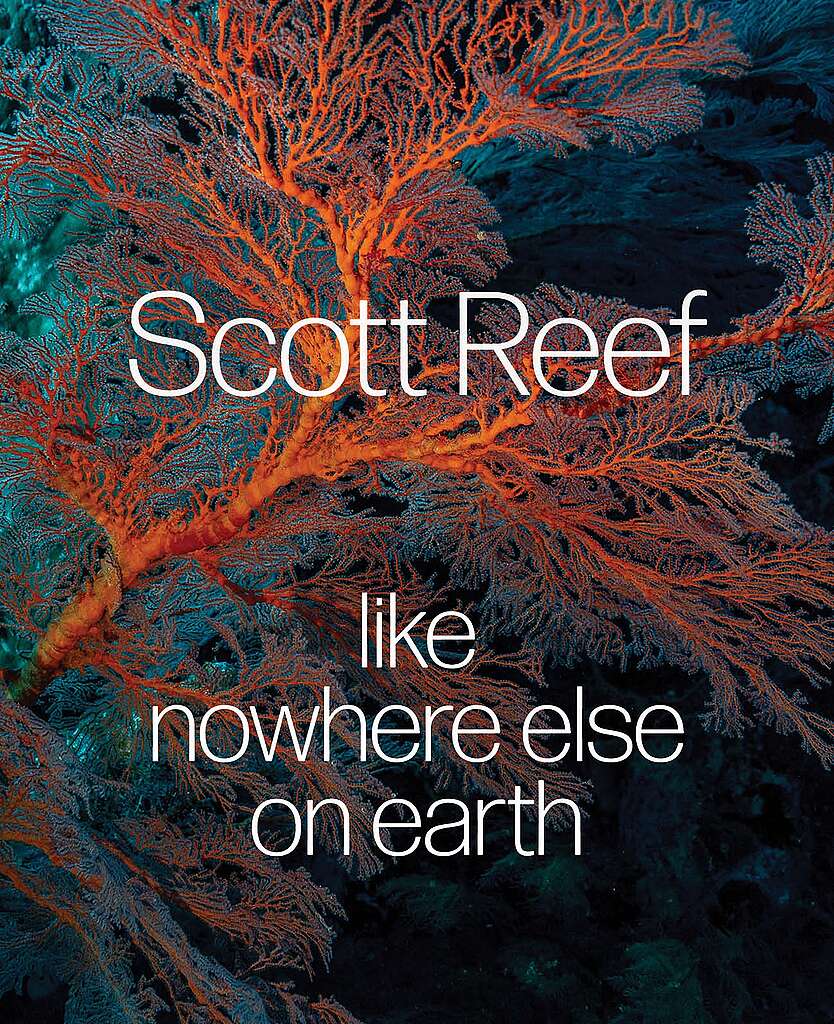
The contributors are a wonderfully diverse bunch, united by their enthusiasm for Scott Reef — and their extraordinary speed!
It’s a brilliant mix. The book brings together national icons like Peter Garrett, Tim Winton, Mick Dodson, Janet Holmes à Court and Fiona Stanley; the intellectual heft of professors Frank Bongiorno, Jessica Meeuwig, Rick Steiner and Samantha Hepburn; the poetic vision of Prema Arasu, Berndt Sellheim and Saadiah Freeman; the field expertise and passionate first hand witnessing of Imogen Zethoven, Tooni Mahto, Ben Fitzpatrick, Geoff Bice, Olaf Meynecke, Paul Gamblin, Sarah Gittoes and Hayley Baillie; and the determination of emerging activist voices Jackson Reid and Emma Sangalli.
Their elegant words wrap themselves around the sheer wonder of the underwater world, brought to life by the work of the photographers — of whom one, Wendy Mitchell, has also contributed a wonderful essay.
Terri-ann showed me the full physical proofs this week and they are breathtaking. This book contains some of my absolute favourite images of wildlife beneath the waves -– and believe me, after almost 20 years at Greenpeace, I’ve been privileged enough to see some remarkable shots! The essays bring a whole new depth and richness to the story of Scott Reef.
If I am being honest, and maybe a bit sentimental, I hope that a four or five-year-old child somewhere in Australia will spend part of their summer holidays turning the pages of this book, wide-eyed with curiosity and awe at the beauty and strangeness of the creatures that call our oceans home.
Our shared commitment is to make sure that, as those children grow up, the wonders of Scott Reef will exist not just in the pages of the book, but out there in the wild waters off north-western Australia—alive, thriving, and every bit as extraordinary as they are today; a living wonder beneath the waves.
Pre-orders of Scott Reef: Like Nowhere Else on Earth are available here.