

Carbon dioxide (CO2) emissions from fossil fuels and cement will rise around 0.8% in 2024, reaching a record 37.4bn tonnes of CO2 (GtCO2), according to the 2024 Global Carbon Budget report by the Global Carbon Project.
This is 0.4GtCO2 higher than the previous record, set in 2023.
Total CO2 emissions – including both fossil and land-use emissions – will also set a new record at 41.6GtCO2, reflecting a growth of 2% over 2023 levels.
This is due, in part, to higher than usual land-use emissions driven by extreme wildfire activity in South America.
Despite the increase in 2024, total CO2 emissions have largely plateaued over the past decade, a sign that the world is making some modest progress tackling emissions.
But a flattening of emissions is far from what is needed to bring global emissions down to zero and stabilise global temperatures in-line with Paris Agreement goals.
The 19th edition of the Global Carbon Budget, which is published today, also reveals:
- Emissions emissions are projected to decrease significantly in the EU (down 3.8%) and slightly in the US (down 0.6%) in 2024. They are expected to increase slightly in China (up 0.2%), and increase significantly in India (up 4.6%) and the rest of the world (up 1.6%, including international shipping and aviation).
- Global emissions from coal increased by 0.2% in 2024 compared to 2023, while oil emissions increased 0.9% and gas emissions increased by 2.4%. Emissions from cement and other sources fell by 2.8%.
- Global land-use emissions clocked in at 4.2GtCO2 in 2024. This represents a 0.5GtCO2 increase over 2023 and was primarily driven by wildfire emissions linked to deforestation and forest degradation in South America. Overall, land-use emissions have decreased by around 28% since their peak in the late-1990s, with a particularly large drop in the past decade.
- While the land sink was quite weak in 2023 – leading to speculation that it may be on a path toward collapse – it appears to have largely recovered back to close to its average for the past decade.
- If global emissions remain at current levels, the remaining carbon budget to limit warming to 1.5C (with a 50% chance) will be exhausted in the next six years. Carbon budgets to limit warming to 1.7C and 2C would similarly be used up in 15 and 27 years, respectively.
- The concentration of CO2 in the atmosphere is set to reach 422.5 parts per million (ppm) in 2024, 2.8ppm above 2023 and 52% above pre-industrial levels.
Both global fossil and total CO2 emissions at record levels
The 2024 Global Carbon Budget finds that CO2 emissions from fossil use are projected to rise 0.8% in 2024, reaching a record 37.4GtCO2 – 0.4GtCO2 higher than the previous record, set last year.
Total CO2 emissions, which include land-use change, are also expected to reach record highs at 41.6GtCO2, or 2.0% above the previous record set in 2023.
This large increase was driven both by consistent growth in fossil-fuel emissions and abnormally high land-use emissions in 2024 – due in part to wildfires in South America exacerbated by a strong El Niño event and high temperatures.
Each year the Global Carbon Budget is updated to include the latest data as well as improvements to modelling sources and sinks, resulting in some year-to-year revisions to the historical record.
The figure below shows the 2024 global CO2 emissions update (dark blue solid line) alongside 2023 (grey dotted) 2022 (yellow dotted), 2021 (bright blue dotted) and 2020 (red dotted). The shaded area indicates the uncertainty around the new 2024 budget.
The 2024 figures are generally quite similar to those in the 2023 Global Carbon Budget, though they show somewhat higher emissions prior to 1980 and slightly lower emissions over the past seven years. Revisions to the data mean that 2023 is no longer a hair below 2019 levels, as was reported by Carbon Brief last year, but rather exceeds them by nearly 0.5GtCO2.
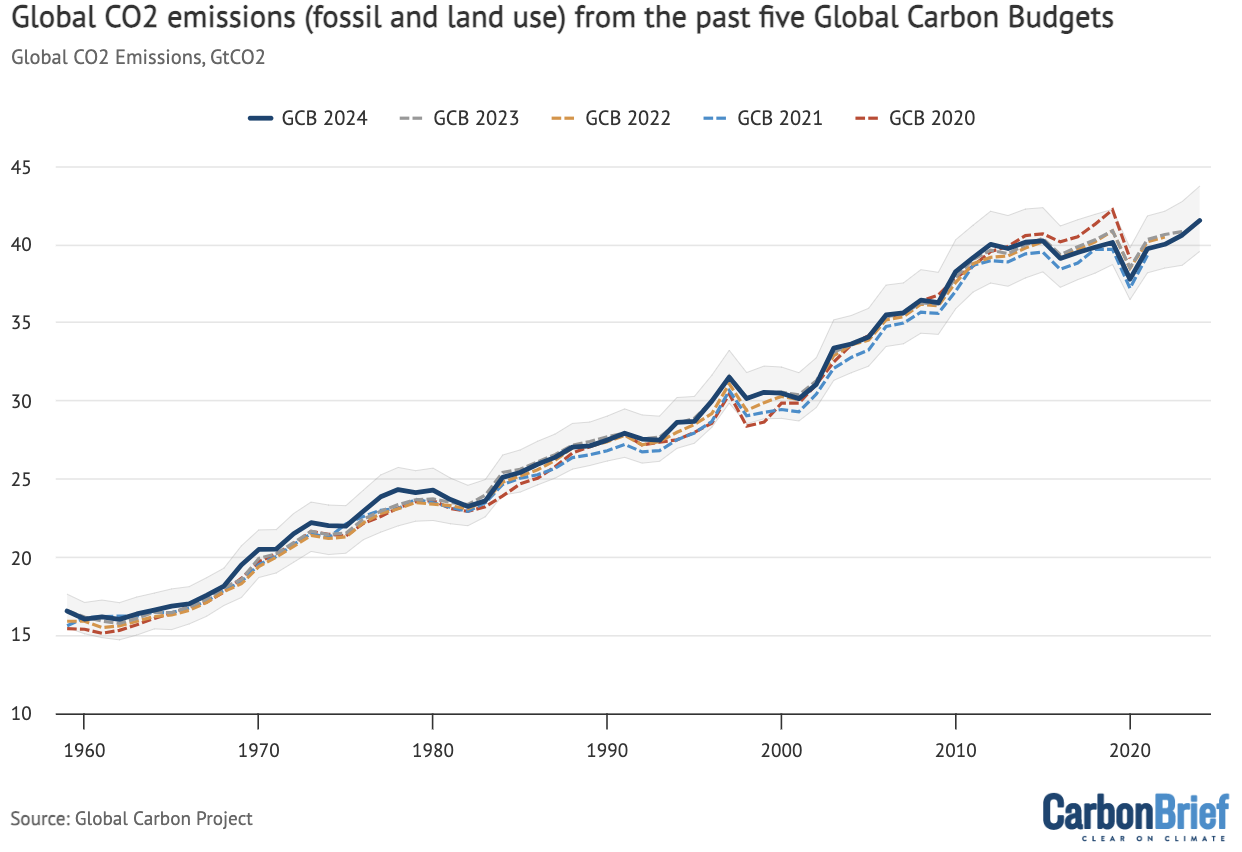
Annual total global CO2 emissions – from fossil and land-use change – between 1959 and 2024 for the 2020, 2021, 2022, 2023 and 2024 versions of the Global Carbon Project’s Global Carbon Budget, in billions of tonnes of CO2 per year (GtCO2). Shaded area shows the estimated one-sigma uncertainty for the 2024 budget. Data from the Global Carbon Project; chart by Carbon Brief.
Total global CO2 emissions have notably plateaued in the past decade (2015-24), growing at only 0.2% per year compared to the 1.9% rate of growth over the previous decade (2005-214) and the longer-term average growth rate of 1.7% between 1959 and 2014.
This apparent flattening is due to declining land-use emissions compensating for continued increases in fossil CO2 emissions. Fossil emissions grew around 0.2GtCO2 per year over the past decade, while land-use emissions decreased by a comparable amount.
However, despite the emissions plateau, there is still no sign of the rapid and deep decrease in CO2 emissions needed to reach net-zero and stabilise global temperatures in-line with Paris Agreement goals.
If global emissions remain at current levels, the remaining carbon budget to limit warming to 1.5C (with a 50% chance) will be exhausted in the next six years. Carbon budgets to limit warming to 1.7C and 2C would similarly be used up in 15 and 27 years, respectively.
Global fossil CO2 emissions also grew more slowly in the past decade (0.7% per year) compared to the previous decade (2.1%). This was driven by the continued decarbonisation of energy systems – including a shift from burning coal to gas and replacing fossil fuels with renewables – as well as slightly weaker global economic growth during the past decade.
The figure below breaks down global emissions (dark blue line) in the 2024 budget into fossil (mid blue) and land-use (light blue) components. Fossil CO2 emissions represent the bulk of total global emissions in recent years, accounting for approximately 90% of emissions in 2024 (compared to 10% for land use). This represents a large change from the first half of the 20th century, when land-use emissions were approximately the same as fossil emissions.
Global fossil emissions include CO2 emitted from burning coal, oil and gas, as well as the production of cement. However, the Global Carbon Budget also subtracts the cement carbonation sink – CO2 slowly absorbed by cement once it is exposed to the air – from fossil emissions in each year to determine total fossil emissions.
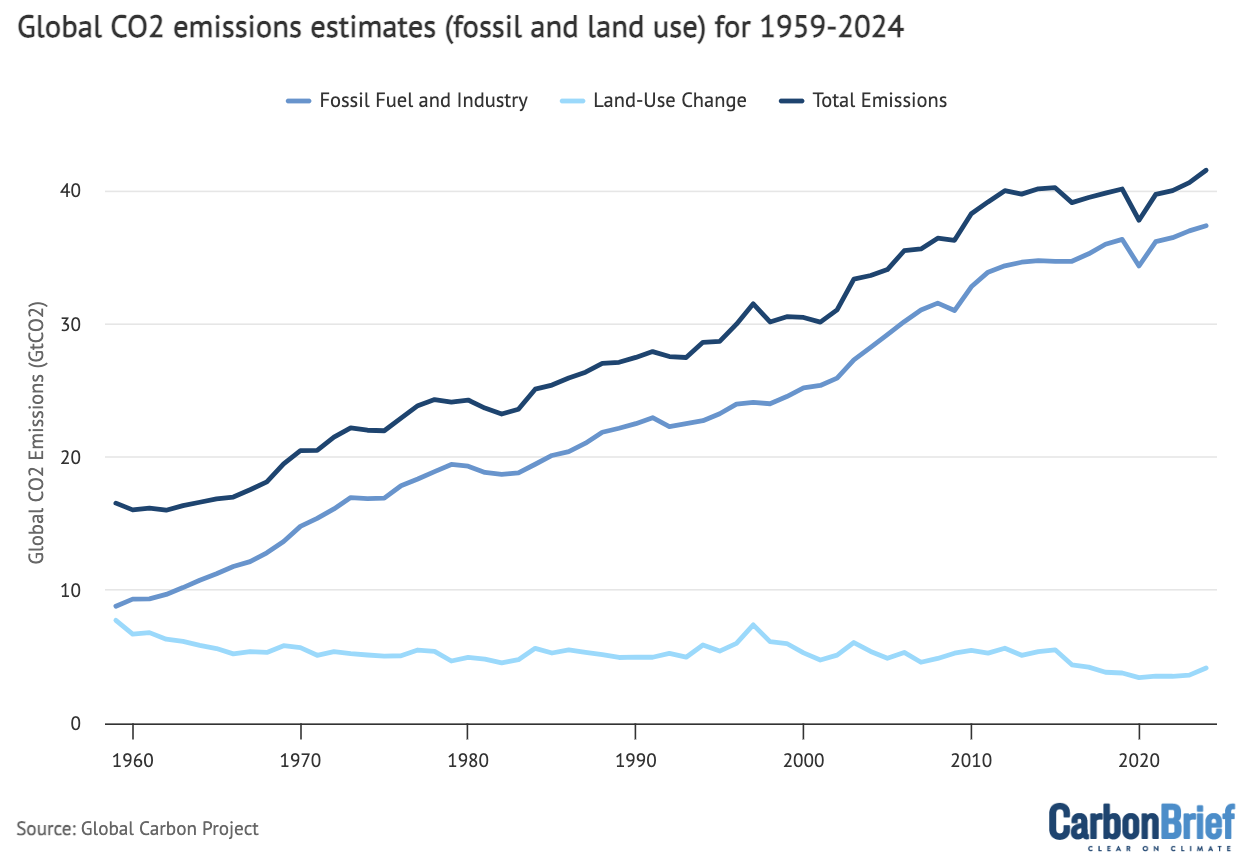
Global CO2 emissions separated out into fossil and land-use change components between 1959 and 2024 from the 2024 Global Carbon Budget. Note that fossil CO2 emissions are inclusive of the cement carbonation sink. Data from the Global Carbon Project; chart by Carbon Brief.
Global emissions can also be expressed on a per-capita basis, as shown in the figure below. While it is ultimately total global emissions that matter for the Earth’s climate – and a global per-capita figure glosses over a lot of variation among and within countries it is noteworthy that global per-capita emissions peaked in 2012 and have been slightly declining in the years since.
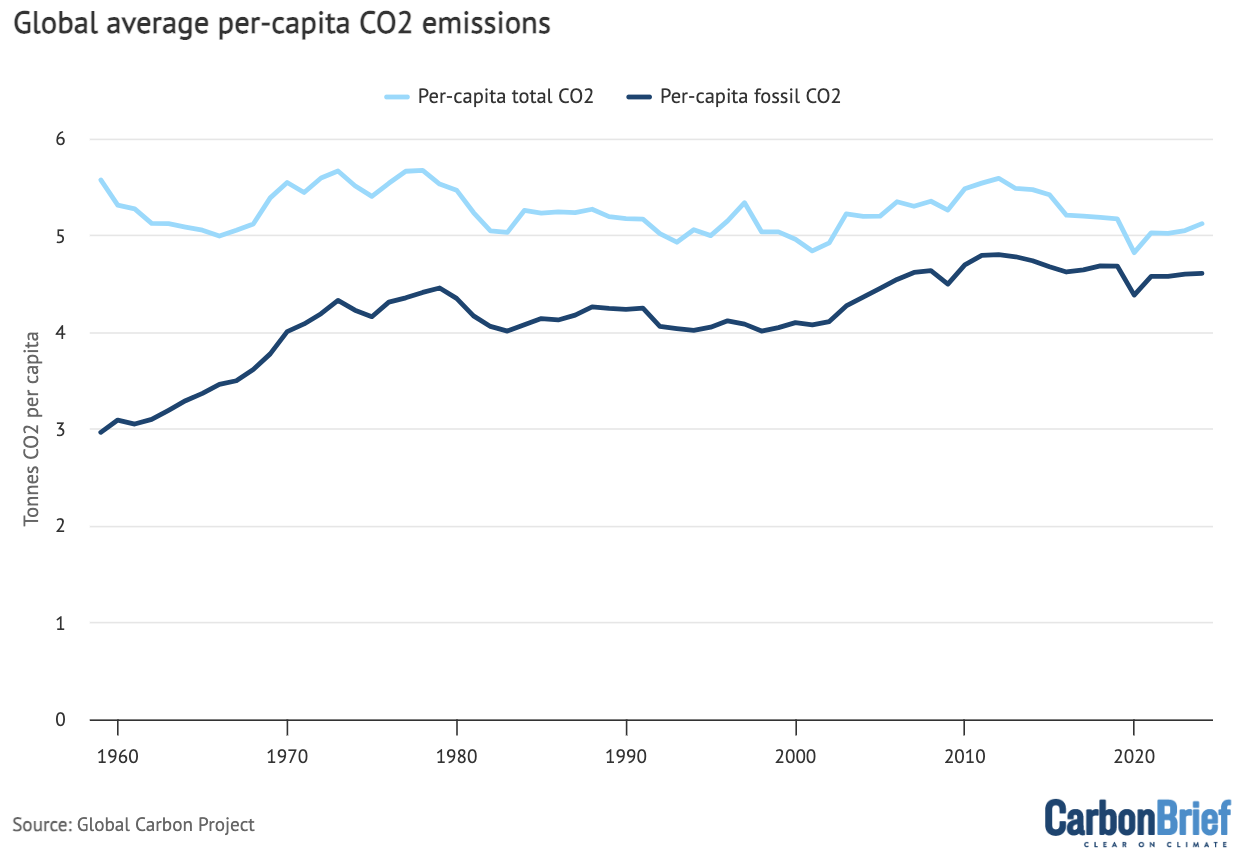
Global per-capita CO2 emissions between 1959 and 2024. Note that fossil CO2 emissions are inclusive of the cement carbonation sink. Data from the Global Carbon Project; chart by Carbon Brief.
Land-use emissions trending downward
Global land-use emissions stem from deforestation, degradation, loss of peatlands and harvesting trees for wood. They averaged 4GtCO2 over the past decade (2015-24) and the Global Carbon Budget provides an initial projection for 2024 of 4.2GtCO2.
This represents a 0.5GtCO2 increase over land-use emissions in 2023. This was primarily driven by wildfire emissions linked to deforestation and forest degradation in South America. Drought conditions associated with this year’s El Niño event contributed to the severity of the fires.
Overall, land-use emissions have decreased by around 28% since their peak in the late-1990s, with a particularly large drop in the past decade.
This decline is statistically significant and is due both to decreasing deforestation and increasing levels of reforestation and afforestation globally (though rates of reforestation and afforestation have largely stagnated over the past decade).
This year’s Global Carbon Budget features a number of important improvements to land-use change emissions estimates, including updated estimates of cropland and pasture area in major countries.
Four countries – Brazil, Indonesia, China and the Democratic Republic of the Congo (DRC) – collectively contribute approximately 60% of the global land-use emissions.
The figure below shows changes in emissions over time in these countries, as well as land-use emissions in the rest of the world (grey). Note that Chinese land-use emissions are negative in recent years.

Annual CO2 emissions from land-use change by major emitting countries and the rest of world over 1959-2023. Note that country-level land-use change emissions are not yet available for 2024. Data from the Global Carbon Project; chart by Carbon Brief.
Fossil CO2 in major emitting countries
Global emissions of fossil CO2 – including coal, oil, gas and cement – increased by around 0.8% in 2024, relative to 2023, with an uncertainty range of -0.3% to 1.9%. This represents a new record high and is 2.6% above the 2019 pre-Covid levels.
The figure below shows global CO2 emissions from fossil fuels, divided into emissions from major emitting countries including China (dark blue shading), India (mid blue), the US (light blue), EU (pale blue) and the remainder of the world (grey).

Annual fossil CO2 emissions by major countries and the rest of the world over 1959-2024, excluding the cement carbonation sink as national-level values are not available. Data from the Global Carbon Project; chart by Carbon Brief.
For this year, China represents 32% of global CO2 emissions. Their emissions in 2024 are projected to increase by a relatively small 0.2% (with an uncertainty range of -1.6% to +2%), driven by a small rise in emissions from coal (0.3%) and a large rise in natural gas emissions (8%). Emissions from oil are expected to decrease modestly (-0.8%), while emissions from cement are expected to fall sharply (-8.1%).
The Global Carbon Budget report suggests that Chinese oil emissions have probably already peaked, reflecting the acceleration of vehicle electrification.
India represents 8% of global emissions. In 2024, Indian emissions are projected to increase by 4.6% (with a range from 3.0% to 6.1%), with a 4.5% increase in emissions from coal, a 3.6% increase in emissions from oil, a 11.8% increase in emissions from natural gas and a 4% increase in emissions from cement.
While renewable energy is expanding quickly in India, it remains far slower than the rate of power demand growth as the economy rapidly expands.
The US represents 13% of global emissions this year – though is responsible for a much larger portion of historical emissions and associated atmospheric accumulation of CO2.
US emissions are projected to decrease by 0.6% in 2024 (ranging from -2.9% to +1.7%). This is being driven by a modest decrease in coal emissions (falling 3.5%). Oil emissions are expected to decline by a slight 0.7%, reflecting the rise of electric vehicles, while emissions from gas are expected to increase by 1%.
The EU represents 7% of global emissions. EU emissions are expected to decrease by 3.8% in 2024, driven by a 15.8% decline in coal emissions, a 1.3% decline in natural gas emissions, and a 3.5% decline in cement emissions. EU oil emissions are expected to increase slightly, by 0.2%.
The EU’s overall emissions decline is being driven by a combination of rapid clean energy adoption as well as relatively weak economic growth and high energy prices.
International aviation and shipping (included in the “rest of world” in the figure above) are responsible for 3% of global emissions. They are projected to increase by
7.8% in 2024, but remain below their 2019 pre-pandemic level by 3.5%.
The rest of the world (excluding aviation) represents 38% of global emissions. Emissions are expected to grow by 1.1% in 2024 (ranging from -1.0% to +3.3%), with increases in emissions from coal (0.5%), oil (0.5%), natural gas (2.2%) and cement (2%).
Overall, emissions are projected to decrease in the EU and US in 2024, increase slightly in China, and increase significantly in India and the rest of the world.
The total emissions for each year between 2021 and 2024, as well as the countries and regions that were responsible for the changes in absolute emissions, are shown in the figure below.
Annual emissions for 2021, 2022, 2023 and estimates for 2024 are shown by the navy blue bars. The smaller bars show the change in emissions between each set of years, broken down by country or region – the US (dark blue), EU (mid blue), China (light blue), India (pale blue) and the rest of the world (grey). Negative values show reductions in emissions, while positive values reflect emission increases.
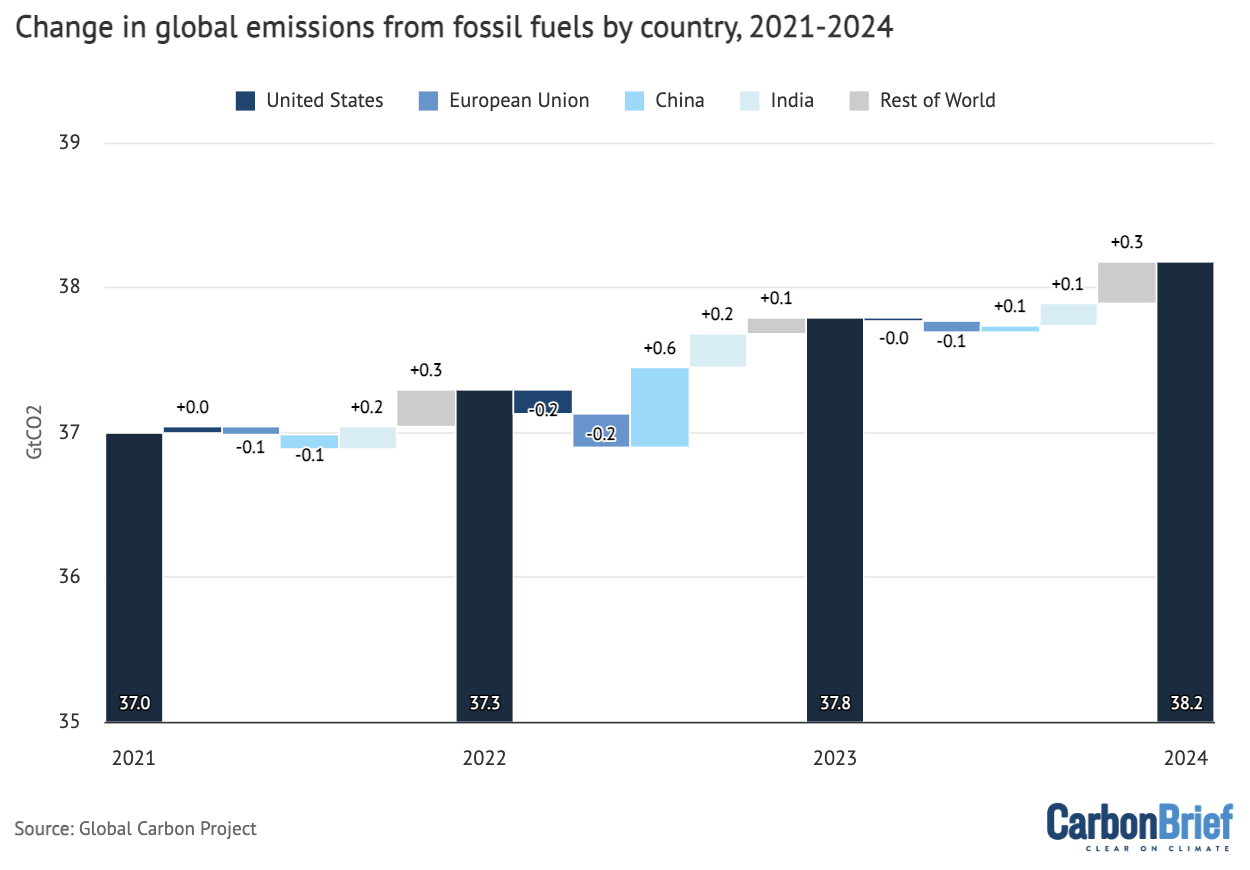
Annual global CO2 emissions from fossil fuels (navy blue bars) and drivers of changes between years by country (smaller bars), excluding the cement carbonation sink as national-level values are not available. Negative values indicate reductions in emissions. Note that the y-axis does not start at zero. Data from the Global Carbon Project; chart by Carbon Brief.
The Global Carbon Project notes that emissions have declined over the past decade (2014-23) in 22 nations – up from 18 countries during the decade prior to that (2004-13). This decrease comes despite continued domestic economic growth and represents a long-term decoupling of CO2 emissions and the economy.
CO2 emissions decreased in Organisation for Economic Co-operation and Development (OECD) countries by 1.4% per year over the past decade, compared to a decrease of 0.9% per year in the decade prior. Non-OECD countries saw their emissions grow more slowly (1.8%) over the last decade than the prior one (4.9%).
Growth in emissions from coal, oil, and gas
Global fossil-fuel emissions primarily result from the combustion of coal, oil and natural gas. Coal is responsible for more emissions than any other fossil fuel, representing approximately 41% of global fossil CO2 emissions in 2024. Oil is the second largest contributor at 33% of fossil CO2, while gas rounds out the pack at 22%.
These percentages reflect both the amount of each fossil fuel consumed globally, but also differences in CO2 intensities. Coal results in the most CO2 emitted per unit of heat or energy produced, followed by oil and natural gas.
The figure below shows global CO2 emissions from different fuels over time, covering coal (dark blue shading), oil (mid blue) and gas (light blue), as well as cement production (pale blue) and other sources (grey).
While coal emissions increased rapidly in the mid-2000s, it has largely plateaued since 2013. However, coal use increased significantly in 2021 and then slightly in the subsequent three years.
Annual CO2 emissions by fossil fuel over 1959-2024, excluding the cement carbonation sink. Data from the Global Carbon Project; chart by Carbon Brief.
Global emissions from coal increased by 0.2% in 2024 compared to 2023, while oil emissions increased 0.9% and gas emissions increased by 2.4%. Emissions from cement and other sources fell by 3%.
Despite setting a new record this year, global coal use is only 3% above 2013 levels – a full 12 years ago. By contrast, during the 2000s, global coal use grew at a rate of around 4% every single year.
The total emissions for each year between 2021 and 2024 (navy blue bars), as well as the absolute change in emissions for each fuel between years, are shown in the figure below.

Annual global CO2 emissions from fossil fuels (navy blue bars) and drivers of changes between years by fuel, excluding the cement carbonation sink. Negative values indicate reductions in emissions. Note that the y-axis does not start at zero. Data from the Global Carbon Project; chart by Carbon Brief.
Even though they have been increasing over the past four years, global CO2 emissions from oil remain very slightly (0.8%) below the pre-pandemic highs of 2019.
The global carbon budget
Every year, the Global Carbon Project provides an estimate of the overall “global carbon budget”. This is based on estimates of the release of CO2 through human activity and its uptake by the oceans and land, with the remainder adding to atmospheric concentrations of the gas.
(This differs from the commonly used term “remaining carbon budget”, which refers to the amount of CO2 that can be released while keeping warming below global limits of 1.5 or 2C.)
The most recent budget, including estimated values for 2024, is shown in the figure below. Values above zero represent sources of CO2 – from fossil fuels and industry (dark blue shading) and land use (mid blue) – while values below zero represent “carbon sinks” that remove CO2 from the atmosphere. Any CO2 emissions that are not absorbed by the oceans (light grey) or land vegetation (mid grey) accumulate in the atmosphere (dark grey).

Annual global carbon budget of sources and sinks over 1959-2024. Fossil CO2 emissions include the cement carbonation sink. Note that the budget does not fully balance every year due to remaining uncertainties, particularly in sinks. Data from the Global Carbon Project; chart by Carbon Brief.
Over the past decade (2015-24), the world’s oceans have taken up approximately 26.5% of total human emissions, or around 10.6GtCO2 per year. The ocean CO2 sink has been relatively flat since 2016 after growing rapidly over the prior decades, reflecting the plateauing of global emissions during that period.
The land sink takes up around 29% of global emissions, or 11.5GtCO2 per year on average. While the land sink was quite weak in 2023 – leading some to speculate that it may be on a path toward collapse – it appears to have largely recovered back to close to its average level over the past decade in 2024 as El Niño conditions have faded.
Global CO2 emissions from fires were quite high in 2024, around 7GtCO2 over the first 10 months of the year and similar to the above average values in 2023.
This was driven by large emissions in North and South America, particularly in Canada and Brazil. (It is not possible to make a direct comparison between reported fire CO2 emissions and other components of the global carbon budget as they already show up in both parts of the land sink and land-use emissions.)
Overall, the impact of the ongoing emissions from human activity is that atmospheric CO2 continues to increase.
The growth rate of atmospheric CO2 in 2024 is expected to be around 2.76ppm, which is above average compared to the rate of 2.46% over the past decade (2014-23).
The 2024 rise in atmospheric CO2 concentration was the fifth largest over the 1959-2024 period, closely following 2023, 2015, 2016 and 1998 – most of which were strong El Niño years.
Atmospheric CO2 concentrations are set to reach an annual average of 422.5ppm in 2024, representing an increase of 52% above pre-industrial levels of 280ppm.

The post Analysis: Global CO2 emissions will reach new high in 2024 despite slower growth appeared first on Carbon Brief.
Analysis: Global CO2 emissions will reach new high in 2024 despite slower growth

Climate Change
“Sink or swim”: WA Gov hugely underestimating decline in regional gas demand while sleeping on green exports, new report finds
PERTH, Tuesday 13 October 2026 — A new report from Greenpeace Australia Pacific and Springmount Advisory reveals green commodity exports are an untapped economic opportunity for Western Australia in a declining Asian gas market, while offering a genuine solution for decarbonising Asia.
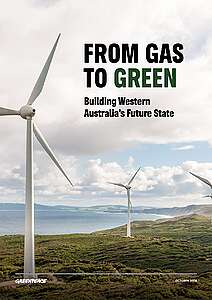
From Gas to Green: Building Western Australia’s Future State is a comprehensive analysis of the declining gas market in Asia, and the untapped economic opportunity for WA to become a global leader in green commodity exports while driving the regional shift away from fossil fuels.
The report offers key recommendations for the WA Government to support regional decarbonisation through an orderly phase out of gas exports in favour of green iron and other green exports. It comes as global climate leaders from across business, politics and advocacy prepare to meet for the Global Citizen Now: Perth event focused on decarbonising WA.
Key findings:
- Gas demand is falling across WA’s core markets in Asia: Gas demand fell in 2025 and is projected to continue to decline, driven by a combination of global geopolitical factors and domestic concerns.
- Policy shifts in key markets since the war on Iran now prioritise renewables and nuclear over gas: Japan, South Korea and China have legislated energy plans that prioritise renewables and nuclear over gas.
- New WA gas would arrive in a saturated, uncertain Asian market filled with cheaper gas: The US is now the world’s largest liquefied gas producer and plans to double its capacity as it also targets Asian markets.
- Green commodities offer a real solution to sustain WA’s economy: WA can lead Australia’s green commodity exports, which by 2060 could be worth almost a trillion dollars.
- Exporting more WA gas is likely to delay or impede Asia decarbonisation: Despite claims by the gas industry, there is no evidence that WA gas is displacing coal in Asia, and in fact diverts resources from genuine decarbonisation options.
Geoff Bice, WA Campaign Lead at Greenpeace Australia Pacific said: “As our export partners in Asia shift away from expensive and polluting gas, the WA Government has a golden opportunity to pivot our economy to green exports, like green iron, which is the most effective way to help our region to decarbonise.
“The writing is on the wall: gas is in decline, renewables are our future. In this context, it makes zero sense for the government to encourage high risk projects like Woodside’s reckless Browse gas proposal at Scott Reef.
“This report clearly shows that the WA Government faces a choice: sink or swim. They can either allow the gas industry to keep ripping off West Australians and continue propping up its decline, or choose the path that will deliver enormous benefits to the state and the world by becoming a leader in the rapidly expanding green economy.”
Tom Quinn, Managing Director of Springmount Advisory: “Western Australia prospers when it looks to the future and builds for future demand. Twenty years from now, what the world needs is green commodities made using WAs abundant renewable resources. Just like it did with iron ore in the 1950s and gas in the 1970s, WA should look to the future and build what the world will need, not sunsetting industries like gas that are already past their peak.”
-ENDS-
Media contact
Kate O’Callaghan on 0406 231 892 or kate.ocallaghan@greenpeace.org
Lucy Keller on 0491 135 308 or lucy.keller@greenpeace.org
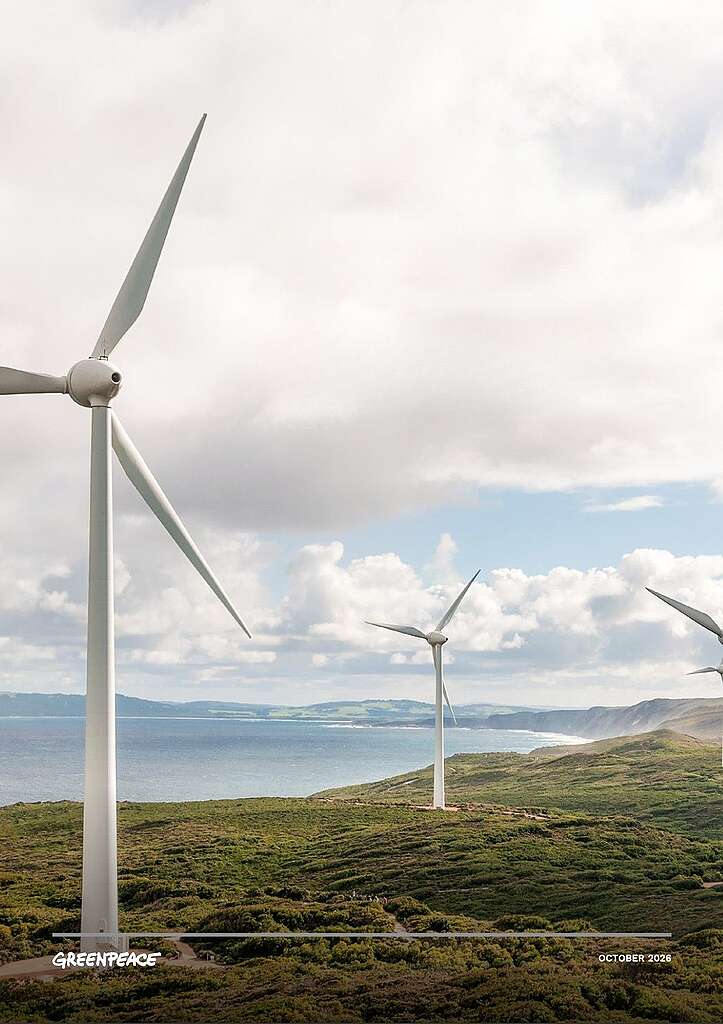
A report from Greenpeace Australia Pacific and Springmount Advisory reveals the untapped green economic opportunity for Western Australia in a declining Asian gas market, which also offers a genuine solution for decarbonisation in Asia.
Is Western Australia clinging to a fading gas industry while a thriving green future passes it by? As major Asian trading partners rapidly pivot away from volatile gas imports toward cheap solar and battery storage, this report exposes a high-stakes choice: risk becoming stranded in an oversupplied fossil fuel market, or harness WA’s unmatched sun and wind to lead the global clean energy transition.
Summary
From Gas to Green: Building Western Australia’s Future State reveals that Western Australia (WA) faces a critical juncture as falling Asian gas demand, geopolitical gas supply volatility and accelerating renewable energy deployment undermine the long-term economic viability of gas exports. By harnessing its world-class wind and solar resources, the report demonstrates that WA can execute an orderly phase-out of gas and pioneer a green commodity export economy that could generate $987 billion in economic value by 2060, create 24,000 ongoing jobs, and drive a 9.6% reduction in global greenhouse gas emissions.
Key Findings
- Gas demand is falling in Asia – WA can no longer rely on gas exports: Gas demand in core Asian markets fell in 2025 and is projected to continue to decline in 2026. Legislated energy plans in Japan, South Korea, and China now prioritise renewables and nuclear over gas.
- Asia is increasing renewables, importing gas just gets in the way: Evidence from markets like Thailand suggests that gas imports are increasingly crowding out cheaper renewable energy investments and battery storage rather than displacing coal, locking in more emissions over time.
- Green commodities offer a real solution to decarbonise Asia – this is a major win for WA: With world-class renewables, WA can lead Australia’s green commodity exports, which by 2060 could be worth almost a trillion dollars ($987 billion) and support a genuine 9.6% reduction in global emissions.
Recommendations to WA government
Recommendation 1: Plan an orderly gas phase-out aligned with a trading partner pivot plan
Implement a managed, orderly phase-out of gas exports aligned with trading partners’ decarbonisation pathways, rather than waiting for demand to collapse, by: