Solar power, electric vehicles (EVs) and other clean-energy technologies drove more than a third of the growth in China’s economy in 2025 – and more than 90% of the rise in investment.
Clean-energy sectors contributed a record 15.4tn yuan ($2.1tn) in 2025, some 11.4% of China’s gross domestic product (GDP) – comparable to the economies of Brazil or Canada.
The new analysis for Carbon Brief, based on official figures, industry data and analyst reports, shows that China’s clean-energy sectors nearly doubled in real value between 2022-25 and – if they were a country – would now be the 8th-largest economy in the world.
Other key findings from the analysis include:
- Without clean-energy sectors, China would have missed its target for GDP growth of “around 5%”, expanding by 3.5% in 2025 instead of the reported 5.0%.
- Clean-energy industries are expanding much more quickly than China’s economy overall, with their annual growth rate accelerating from 12% in 2024 to 18% in 2025.
- The “new three” of EVs, batteries and solar continue to dominate the economic contribution of clean energy in China, generating two-thirds of the value added and attracting more than half of all investment in the sectors.
- China’s investments in clean energy reached 7.2tn yuan ($1.0tn) in 2025, roughly four times the still sizable $260bn put into fossil-fuel extraction and coal power.
- Exports of clean-energy technologies grew rapidly in 2025, but China’s domestic market still far exceeds the export market in value for Chinese firms.
These investments in clean-energy manufacturing represent a large bet on the energy transition in China and overseas, creating an incentive for the government and enterprises to keep the boom going.
However, there is uncertainty about what will happen this year and beyond, particularly for solar power, where growth has slowed in response to a new pricing system and where central government targets have been set far below the recent rate of expansion.
An ongoing slowdown could turn the sectors into a drag on GDP, while worsening industrial “overcapacity” and exacerbating trade tensions.
Yet, even if central government targets in the next five-year plan are modest, those from local governments and state-owned enterprises could still drive significant growth in clean energy.
This article updates analysis previously reported for 2023 and 2024.
Clean-energy sectors outperform wider economy
China’s clean-energy economy continues to grow far more quickly than the wider economy. This means that it is making an outsize contribution to annual economic growth.
The figure below shows that clean-energy technologies drove more than a third of the growth in China’s economy overall in 2025 and more than 90% of the net rise in investment.
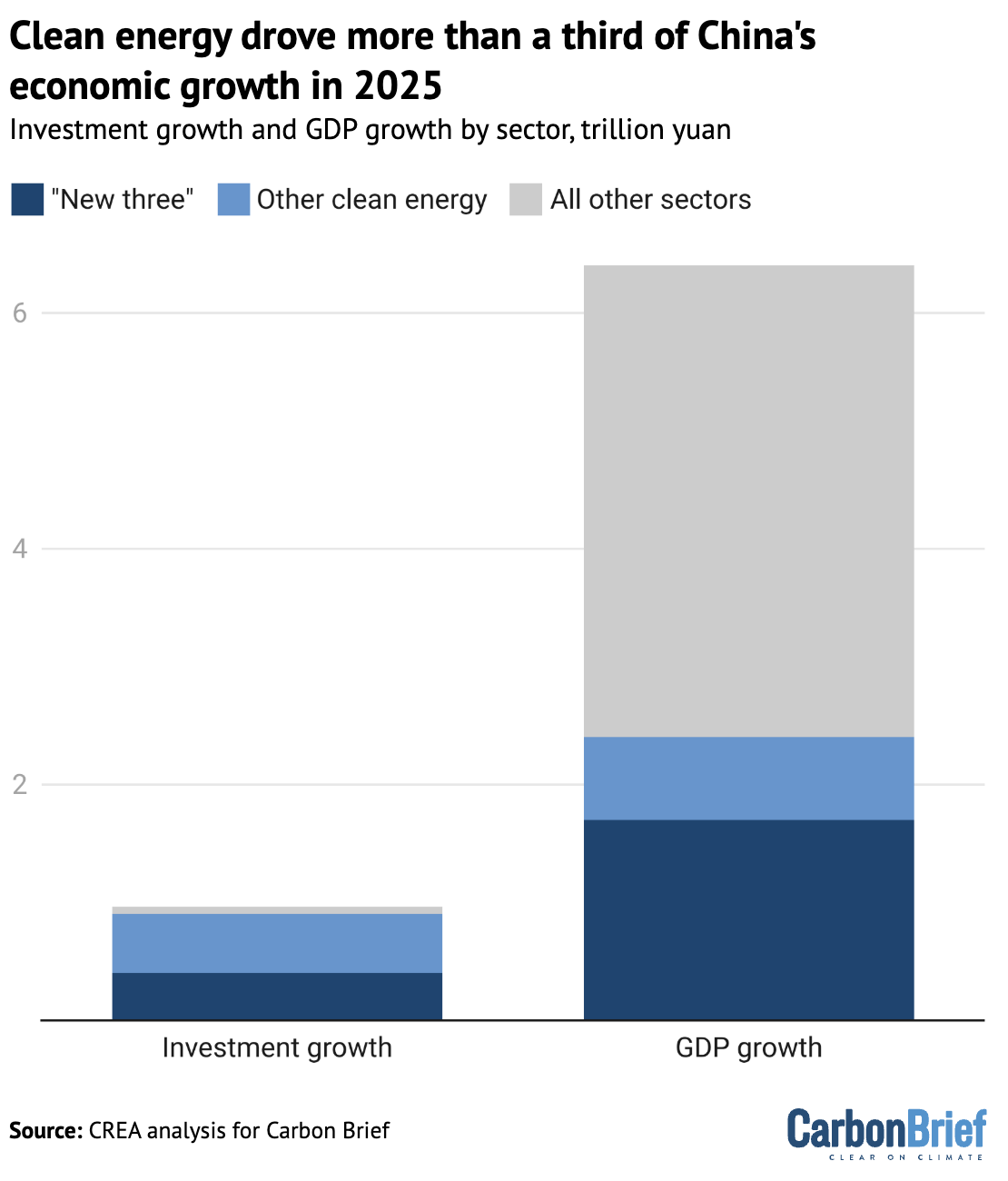
In 2022, China’s clean-energy economy was worth an estimated 8.4tn yuan ($1.2tn). By 2025, the sectors had nearly doubled in value to 15.4tn yuan ($2.1tn).
This is comparable to the entire output of Brazil or Canada and positions the Chinese clean-energy industry as the 8th-largest economy in the world. Its value is roughly half the size of the economy of India – the world’s fourth largest – or of the US state of California.
The outperformance of the clean-energy sectors means that they are also claiming a rising share of China’s economy overall, as shown in the figure below.
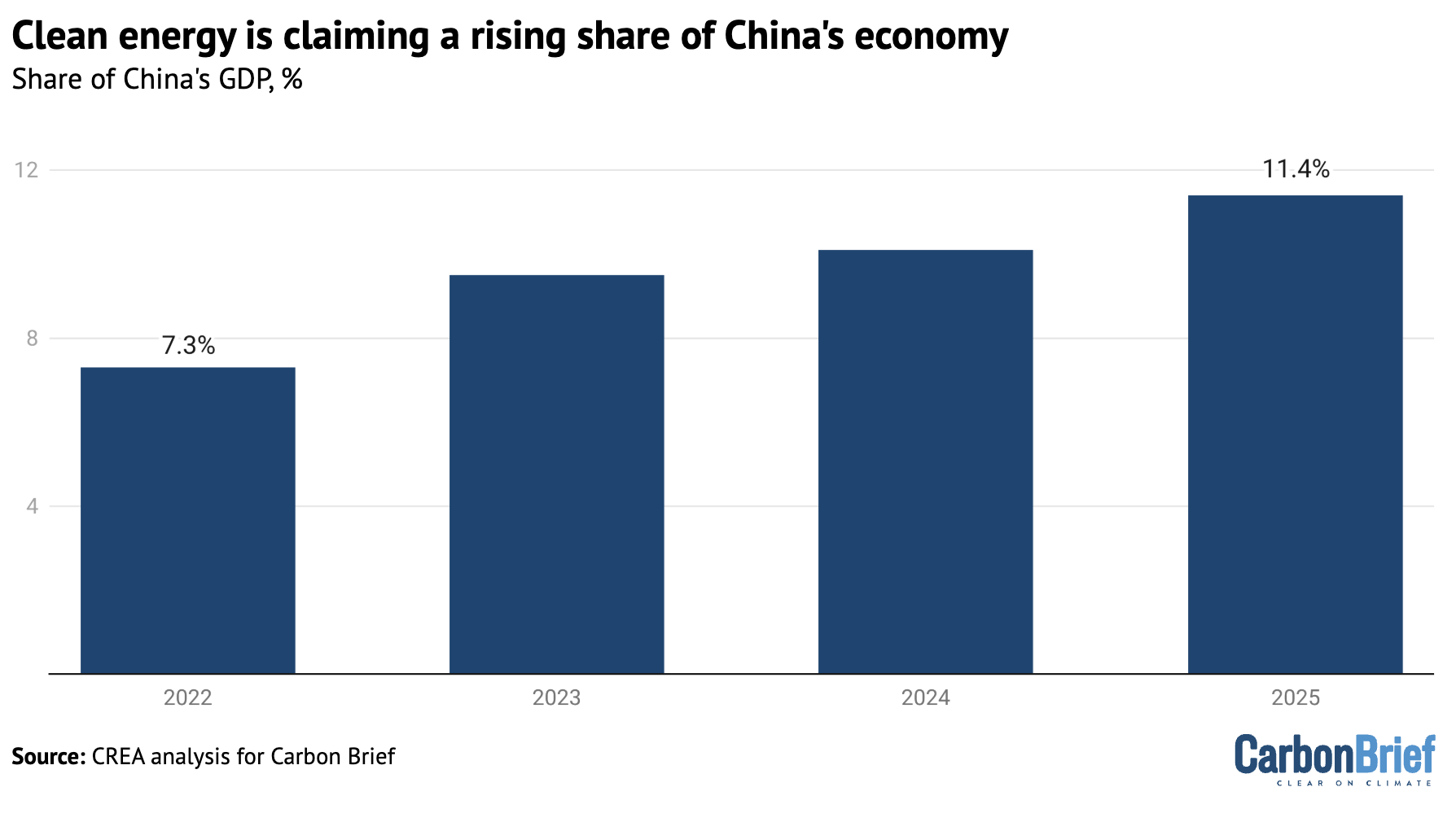
This share has risen from 7.3% of China’s GDP in 2022 to 11.4% in 2025.
Without clean-energy sectors, China’s GDP would have expanded by 3.5% in 2025 instead of the reported 5.0%, missing the target of “around 5%” growth by a wide margin.
Clean energy thus made a crucial contribution during a challenging year, when promoting economic growth was the foremost aim for policymakers.
The table below includes a detailed breakdown by sector and activity.
| Sector | Activity | Value in 2025, CNY bln | Value in 2025, USD bln | Year-on-year growth | Growth contribution | Value contribution | Value in 2025, CNY trn | Value in 2024, CNY trn | Value in 2023, CNY trn | Value in 2022, CNY trn |
|---|---|---|---|---|---|---|---|---|---|---|
| EVs | Investment: manufacturing capacity | 1,643 | 228 | 18% | 10.4% | 10.7% | 1.6 | 1.4 | 1.2 | 0.9 |
| EVs | Investment: charging infrastructure | 192 | 27 | 58% | 2.9% | 1.2% | 0.192 | 0.122 | 0.1 | 0.08 |
| EVs | Production of vehicles | 3,940 | 548 | 29% | 36.4% | 25.6% | 3.94 | 3.065 | 2.26 | 1.65 |
| Batteries | Investment: battery manufacturing | 277 | 38 | 35% | 3.0% | 1.8% | 0.277 | 0.205 | 0.32 | 0.15 |
| Batteries | Exports: batteries | 724 | 101 | 51% | 10.1% | 4.7% | 0.724 | 0.48 | 0.46 | 0.34 |
| Solar power | Investment: power generation capacity | 1,182 | 164 | 15% | 6.3% | 7.7% | 1.182 | 1.031 | 0.808 | 0.34 |
| Solar power | Investment: manufacturing capacity | 506 | 70 | -23% | -6.5% | 3.3% | 0.506 | 0.662 | 0.95 | 0.51 |
| Solar power | Electricity generation | 491 | 68 | 33% | 5.1% | 3.2% | 0.491 | 0.369 | 0.26 | 0.19 |
| Solar power | Exports of components | 681 | 95 | 21% | 4.9% | 4.4% | 0.681 | 0.562 | 0.5 | 0.35 |
| Wind power | Investment: power generation capacity, onshore | 612 | 85 | 47% | 8.1% | 4.0% | 0.612 | 0.417 | 0.397 | 0.21 |
| Wind power | Investment: power generation capacity, offshore | 96 | 13 | 98% | 2.0% | 0.6% | 0.096 | 0.048 | 0.086 | 0.06 |
| Wind power | Electricity generation | 510 | 71 | 13% | 2.4% | 3.3% | 0.51 | 0.453 | 0.4 | 0.34 |
| Nuclear power | Investment: power generation capacity | 173 | 24 | 18% | 1.1% | 1.1% | 0.17 | 0.15 | 0.09 | 0.07 |
| Nuclear power | Electricity generation | 216 | 30 | 8% | 0.7% | 1.4% | 0.216 | 0.2 | 0.19 | 0.19 |
| Hydropower | Investment: power generation capacity | 54 | 7 | -7% | -0.2% | 0.3% | 0.05 | 0.06 | 0.06 | 0.06 |
| Hydropower | Electricity generation | 582 | 81 | 3% | 0.6% | 3.8% | 0.582 | 0.567 | 0.51 | 0.51 |
| Rail transportation | Investment | 902 | 125 | 6% | 2.1% | 5.8% | 0.902 | 0.851 | 0.764 | 0.714 |
| Rail transportation | Transport of passengers and goods | 1,020 | 142 | 3% | 1.3% | 6.6% | 1.02 | 0.99 | 0.964 | 0.694 |
| Electricity transmission | Investment: transmission capacity | 644 | 90 | 6% | 1.5% | 4.2% | 0.64 | 0.61 | 0.53 | 0.5 |
| Electricity transmission | Transmission of clean power | 52 | 7 | 14% | 0.3% | 0.3% | 0.052 | 0.046 | 0.04 | 0.04 |
| Energy storage | Investment: Pumped hydro | 53 | 7 | 5% | 0.1% | 0.3% | 0.05 | 0.05 | 0.04 | 0.03 |
| Energy storage | Investment: Grid-connected batteries | 232 | 32 | 52% | 3.3% | 1.5% | 0.232 | 0.152 | 0.08 | 0.02 |
| Energy storage | Investment: Electrolysers | 11 | 2 | 29% | 0.1% | 0.1% | 0.011 | 0.009 | 0 | 0 |
| Energy efficiency | Revenue: Energy service companies | 620 | 86 | 17% | 3.8% | 4.0% | 0.62 | 0.528003 | 0.52 | 0.45 |
| Total | Investments | 7,198 | 1001 | 15% | 38.2% | 46.7% | 7.20 | 6.28 | 6.00 | 4.11 |
| Total | Production of goods and services | 8,216 | 1,143 | 22% | 61.8% | 53.3% | 8.22 | 6.73 | 5.58 | 4.32 |
| Total | Total GDP contribution | 15,414 | 2144 | 18% | 100.0% | 100.0% | 15.41 | 13.01 | 11.58 | 8.42 |
EVs and batteries were the largest drivers of GDP growth
In 2024, EVs and solar had been the largest growth drivers. In 2025, it was EVs and batteries, which delivered 44% of the economic impact and more than half of the growth of the clean-energy industries. This was due to strong growth in both output and investment.
The contribution to nominal GDP growth – unadjusted for inflation – was even larger, as EV prices held up year-on-year while the economy as a whole suffered from deflation. Investment in battery manufacturing rebounded after a fall in 2024.
The major contribution of EVs and batteries is illustrated in the figure below, which shows both the overall size of the clean-energy economy and the sectors that added the most to the rise from year to year.

The next largest subsector was clean-power generation, transmission and storage, which made up 40% of the contribution to GDP and 30% of the growth in 2025.
Within the electricity sector, the largest drivers were growth in investment in wind and solar power generation capacity, along with growth in power output from solar and wind, followed by the exports of solar-power equipment and materials.
Investment in solar-panel supply chains, a major growth driver in 2022-23, continued to fall for the second year. This was in line with the government’s efforts to rein in overcapacity and “irrational” price competition in the sector.
Finally, rail transportation was responsible for 12% of the total economic output of the clean-energy sectors, but saw relatively muted growth year-on-year, with revenue up 3% and investment by 6%.
Note that the International Energy Agency (IEA) world energy investment report projected that China invested $627bn in clean energy in 2025, against $257bn in fossil fuels.
For the same sectors as the IEA report, this analysis puts the value of clean-energy investment in 2025 at a significantly more conservative $430bn. The higher figures in this analysis overall are therefore the result of wider sectoral coverage.
Electric vehicles and batteries
EVs and vehicle batteries were again the largest contributors to China’s clean-energy economy in 2025, making up an estimated 44% of value overall.
Of this total, the largest share of both total value and growth came from the production of battery EVs and plug-in hybrids, which expanded 29% year-on-year. This was followed by investment into EV manufacturing, which grew 18%, after slower growth rates in 2024.
Investment in battery manufacturing also rebounded after a drop in 2024, driven by new battery technology and strong demand from both domestic and international markets. Battery manufacturing investment grew by 35% year-on-year to 277bn yuan.
The share of electric vehicles (EVs) will have reached 12% of all vehicles on the road by the end of 2025, up from 9% a year earlier and less than 2% just five years ago.
The share of EVs in the sales of all new vehicles increased to 48%, from 41% in 2024, with passenger cars crossing the 50% threshold. In November, EV sales crossed the 60% mark in total sales and they continue to drive overall automotive sales growth, as shown below.

Electric trucks experienced a breakthrough as their market share rose from 8% in the first nine months of 2024 to 23% in the same period in 2025.
Policy support for EVs continues, for example, with a new policy aiming to nearly double charging infrastructure in the next three years.
Exports grew even faster than the domestic market, but the vast majority of EVs continue to be sold domestically. In 2025, China produced 16.6m EVs, rising 29% year-on-year. While exports accounted for only 21% or 3.4m EVs, they grew by 86% year-on-year. Top export destinations for Chinese EVs were western Europe, the Middle East and Latin America.
The value of batteries exported also grew rapidly by 41% year-on-year, becoming the third largest growth driver of the GDP. Battery exports largely went to western Europe, north America and south-east Asia.
In contrast with deflationary trends in the price of many clean-energy technologies, average EV prices have held up in 2025, with a slight increase in average price of new models, after discounts. This also means that the contribution of the EV industry to nominal GDP growth was even more significant, given that overall producer prices across the economy fell by 2.6%. Battery prices continued to drop.
Clean-power generation
The solar power sector generated 19% of the total value of the clean-energy industries in 2025, adding 2.9tn yuan ($41bn) to the national economy.
Within this, investment in new solar power plants, at 1.2tn yuan ($160bn), was the largest driver, followed by the value of solar technology exports and by the value of the power generated from solar. Investment in manufacturing continued to fall after the wave of capacity additions in 2023, reaching 0.5tn yuan ($72bn), down 23% year-on-year.
In 2025, China achieved another new record of wind and solar capacity additions. The country installed a total of 315GW solar and 119GW wind capacity, adding more solar and two times as much wind as the rest of the world combined.
Clean energy accounted for 90% of investment in power generation, with solar alone covering 50% of that. As a result, non-fossil power made up 42% of total power generation, up from 39% in 2024.
However, a new pricing policy for new solar and wind projects and modest targets for capacity growth have created uncertainty about whether the boom will continue.
Under the new policy, new clean-power generation has to compete on price against existing coal power in markets that place it at a disadvantage in some key ways.
At the same time, the electricity markets themselves are still being introduced and developed, creating investment uncertainty.
Investment in solar power generation increased year-on-year by 15%, but experienced a strong stop-and-go cycle. Developers rushed to finish projects ahead of the new pricing policy coming into force in June and then again towards the end of the year to finalise projects ahead of the end of the current 14th five-year plan.
Investment in the solar sector as a whole was stable year-on-year, with the decline in manufacturing capacity investment balanced by continued growth in power generation capacity additions. This helped shore up the utilisation of manufacturing plants, in line with the government’s aim to reduce “disorderly” price competition.
By late 2025, China’s solar manufacturing capacity reached an estimated 1,200GW per year, well ahead of the global capacity additions of around 650GW in 2025. Manufacturers can now produce far more solar panels than the global market can absorb, with fierce competition leading to historically low profitability.
China’s policymakers have sought to address the issue since mid-2024, warning against “involution”, passing regulations and convening a sector-wide meeting to put pressure on the industry. This is starting to yield results, with losses narrowing in the third quarter of 2025.
The volume of exports of solar panels and components reached a record high in 2025, growing 19% year-on-year. In particular, exports of cells and wafers increased rapidly by 94% and 52%, while panel exports grew only by 4%.
This reflects the growing diversification of solar-supply chains in the face of tariffs and with more countries around the world building out solar panel manufacturing capacity. The nominal value of exports fell 8%, however, due to a fall in average prices and a shift to exporting upstream intermediate products instead of finished panels.
Hydropower, wind and nuclear were responsible for 15% of the total value of the clean-energy sectors in 2025, adding some 2.2tn yuan ($310bn) to China’s GDP in 2025.
Nearly two-thirds of this (1.3tn yuan, $180bn) came from the value of power generation from hydropower, wind and nuclear, with investment in new power generation projects contributing the rest.
Power generation grew 33% from solar, 13% from wind, 3% from hydropower and 8% from nuclear.
Within power generation investment, solar remained the largest segment by value – as shown in the figure below – but wind-power generation projects were the largest contributor to growth, overtaking solar for the first time since 2020.

In particular, offshore wind power capacity investment rebounded as expected, doubling in 2025 after a sharp drop in 2024.
Investment in nuclear projects continued to grow but remains smaller in total terms, at 17bn yuan. Investment in conventional hydropower continued to decline by 7%.
Electricity storage and grids
Electricity transmission and storage were responsible for 6% of the total value of the clean-energy sectors in 2025, accounting for 1.0 tn yuan ($140bn).
The most valuable sub-segment was investment in power grids, growing 6% in 2025 and reaching $90bn. This was followed by investment in energy storage, including pumped hydropower, grid-connected battery storage and hydrogen production.
Investment in grid-connected batteries saw the largest year-on-year growth, increasing by 50%, while investments in electrolysers also grew by 30%. The transmission of clean power increased an estimated 13%, due to rapid growth in clean-power generation.
China’s total electricity storage capacity reached more than 213GW, with battery storage capacity crossing 145GW and pumped hydro storage at 69GW. Some 66GW of battery storage capacity was added in 2025, up 52% year-on-year and accounting for more than 40% of global capacity additions.
Notably, capacity additions accelerated in the second half of the year, with 43GW added, compared with the first half, which saw 23GW of new capacity.
The battery storage market initially slowed after the renewable power pricing policy, which banned storage mandates after May, but this was quickly replaced by a “market-driven boom”. Provincial electricity spot markets, time-of-day tariffs and increasing curtailment of solar power all improved the economics of adding storage.
By the end of 2025, China’s top five solar manufacturers had all entered the battery storage market, making a shift in industry strategy.
Investment in pumped hydropower continued to increase, with 15GW of new capacity permitted in the first half of 2025 alone and 3GW entering operation.
Railways
Rail transportation made up 12% of the GDP contribution of the clean-energy sectors, with revenue from passenger and goods rail transportation the largest source of value. Most growth came from investment in rail infrastructure, which increased 6% year-on-year
The electrification of transport is not limited to EVs, as rail passenger, freight and investment volumes saw continued growth. The total length of China’s high-speed railway network reached 50,000km in 2025, making up more than 70% of the global high-speed total.
Energy efficiency
Investment in energy efficiency rebounded strongly in 2025. Measured by the aggregate turnover of large energy service companies (ESCOs), the market expanded by 17% year-on-year, returning to growth rates last seen during 2016-2020.
Total industry turnover has also recovered to its previous peak in 2021, signalling a clear turnaround after three years of weakness.
Industry projections now anticipate annual turnover reaching 1tn yuan in annual turnover by 2030, a target that had previously been expected to be met by 2025.
China’s ESCO market has evolved into the world’s largest. Investment within China’s ESCO market remains heavily concentrated in the buildings sector, which accounts for around 50% of total activity. Industrial applications make up a further 21%, while energy supply, demand-side flexibility and energy storage together account for approximately 16%.
Implications of China’s clean-energy bet
Ongoing investment of hundreds of billions of dollars into clean-energy manufacturing represents a gigantic economic and financial bet on a continuing global energy transition.
In addition to the domestic investment covered in this article, Chinese firms are making major investments in overseas manufacturing.
The clean-energy industries have played a crucial role in meeting China’s economic targets during the five-year period ending this year, delivering an estimated 40%, 25% and 37% of all GDP growth in 2023, 2024 and 2025, respectively.
However, the developments next year and beyond are unclear, particularly for solar power generation, with the new pricing system for renewable power generation leading to a short-term slowdown and creating major uncertainty, while central government targets have been set far below current rates of clean-electricity additions.
Investment in solar-power generation and solar manufacturing declined in the second half of the year, while investment in generation clocked growth for the full year, showing the risk to the industries under the current power market set-ups that favour coal-fired power.
The reduction in the prices of clean-energy technology has been so dramatic that when the prices for GDP statistics are updated, the sectors’ contribution to real GDP – adjusted for inflation or, in this case deflation – will be revised down.
Nevertheless, the key economic role of the industry creates a strong motivation to keep the clean-energy boom going. A slowdown in the domestic market could also undermine efforts to stem overcapacity and inflame trade tensions by increasing pressure on exports to absorb supply.
A recent CREA survey of experts working on climate and energy issues in China found that the majority believe that economic and geopolitical challenges will make the “dual carbon” goals – and with that, clean-energy industries – only more important.
Local governments and state-owned enterprises will also influence the outlook for the sector. Their previous five-year plans played a key role in creating the gigantic wind and solar power “bases” that substantially exceeded the central government’s level of ambition.
Provincial governments also have a lot of leeway in implementing the new electricity markets and contracting systems for renewable power generation. The new five-year plans, to be published this year, will therefore be of major importance.
About the data
Reported investment expenditure and sales revenue has been used where available. When this is not available, estimates are based on physical volumes – gigawatts of capacity installed, number of vehicles sold – and unit costs or prices.
The contribution to real growth is tracked by adjusting for inflation using 2022-2023 prices.
All calculations and data sources are given in a worksheet.
Estimates include the contribution of clean-energy technologies to the demand for upstream inputs such as metals and chemicals.
This approach shows the contribution of the clean-energy sectors to driving economic activity, also outside the sectors themselves, and is appropriate for estimating how much lower economic growth would have been without growth in these sectors.
Double counting is avoided by only including non-overlapping points in value chains. For example, the value of EV production and investment in battery storage of electricity is included, but not the value of battery production for the domestic market, which is predominantly an input to these activities.
Similarly, the value of solar panels produced for the domestic market is not included, as it makes up a part of the value of solar power generating capacity installed in China. However, the value of solar panel and battery exports is included.
In 2025, there was a major divergence between two different measures of investment. The first, fixed asset investment, reportedly fell by 3.8%, the first drop in 35 years. In contrast, gross capital formation saw the slowest growth in that period but still inched up by 2%.
This analysis uses gross capital formation as the measure of investment, as it is the data point used for GDP accounting. However, the analysis is unable to account for changes in inventories, so the estimate of clean-energy investment is for fixed asset investment in the sectors.
The analysis does not explicitly account for the small and declining role of imports in producing clean-energy goods and services. This means that the results slightly overstate the contribution to GDP but understate the contribution to growth.
For example, one of the most important import dependencies that China has is for advanced computing chips for EVs. The value of the chips in a typical EV is $1,000 and China’s import dependency for these chips is 90%, which suggests that imported chips represent less than 3% of the value of EV production.
The estimates are likely to be conservative in some key respects. For example, Bloomberg New Energy Finance estimates “investment in the energy transition” in China in 2024 at $800bn. This estimate covers a nearly identical list of sectors to ours, but excludes manufacturing – the comparable number from our data is $600bn.
China’s National Bureau of Statistics says that the total value generated by automobile production and sales in 2023 was 11tn yuan. The estimate in this analysis for the value of EV sales in 2023 is 2.3tn yuan, or 20% of the total value of the industry, when EVs already made up 31% of vehicle production and the average selling prices for EVs was slightly higher than for internal combustion engine vehicles.
The post Analysis: Clean energy drove more than a third of China’s GDP growth in 2025 appeared first on Carbon Brief.
Analysis: Clean energy drove more than a third of China’s GDP growth in 2025
Climate Change
The 2026 budget test: Will Australia break free from fossil fuels?
In 2026, the dangers of fossil fuel dependence have been laid bare like never before. The illegal invasion of Iran has brought pain and destruction to millions across the Middle East and triggered a global energy crisis impacting us all. Communities in the Pacific have been hit especially hard by rising fuel prices, and Australians have seen their cost-of-living woes deepen.
Such moments of crisis and upheaval can lead to positive transformation. But only when leaders act with courage and foresight.
There is no clearer statement of a government’s plans and priorities for the nation than its budget — how it plans to raise money, and what services, communities, and industries it will invest in.
As we count down the days to the 2026-27 Federal Budget, will the Albanese Government deliver a budget for our times? One that starts breaking the shackles of fossil fuels, accelerates the shift to clean energy, protects nature, and sees us work together with other countries towards a safer future for all? Or one that doubles down on coal and gas, locks in more climate chaos, and keeps us beholden to the whims of tyrants and billionaires.
Here’s what we think the moment demands, and what we’ll be looking out for when Treasurer Jim Chalmers steps up to the dispatch box on 12 May.
1. Stop fuelling the fire
2. Make big polluters pay
3. Support everyone to be part of the solution
4. Build the industries of the future
5. Build community resilience
6. Be a better neighbour
7. Protect nature
1. Stop fuelling the fire

In mid-April, Pacific governments and civil society met to redouble their efforts towards a Fossil Fuel Free Pacific. Moving beyond coal, oil and gas is fundamental to limiting warming to 1.5°C — a survival line for vulnerable communities and ecosystems. And as our Head of Pacific, Shiva Gounden, explained, it is “also a path of liberation that frees us from expensive, extractive and polluting fossil fuel imports and uplifts our communities”.
Pacific countries are at the forefront of growing global momentum towards a just transition away from fossil fuels, and it is way past time for Australia to get with the program. It is no longer a question of whether fossil fuel extraction will end, but whether that end will be appropriately managed and see communities supported through the transition, or whether it will be chaotic and disruptive.
So will this budget support the transition away from fossil fuels, or will it continue to prop up coal and gas?
When it comes to sensible moves the government can make right now, one stands out as a genuine low hanging fruit. Mining companies get a full rebate of the excise (or tax) that the rest of us pay on diesel fuel. This lowers their operating costs and acts as a large, ongoing subsidy on fossil fuel production — to the tune of $11 billion a year!
Greenpeace has long called for coal and gas companies to be removed from this outdated scheme, and for the billions in savings to be used to support the clean energy transition and to assist communities with adapting to the impacts of climate change. Will we see the government finally make this long overdue change, or will it once again cave to the fossil fuel lobby?
2. Make big polluters pay

While our communities continue to suffer the escalating costs of climate-fuelled disasters, our Government continues to support a massive expansion of Australia’s export gas industry. Gas is a dangerous fossil fuel, with every tonne of Australian gas adding to the global heating that endangers us all.
Moreover, companies like Santos and Woodside pay very little tax for the privilege of digging up and selling Australians’ natural endowment of fossil gas. Remarkably, the Government currently raises more tax from beer than from the Petroleum Resource Rent Tax (PRRT) — the main tax on gas profits.
Momentum has been building to replace or supplement the PRRT with a 25% tax on gas exports. This could raise up to $17 billion a year — funds that, like savings from removing the diesel tax rebate for coal and gas companies, could be spent on supporting the clean energy transition and assisting communities with adapting to worsening fires, floods, heatwaves and other impacts of climate change.
As politicians arrive in Canberra for budget week, they will be confronted by billboards calling for a fair tax on gas exports. The push now has the support of dozens of organisations and a growing number of politicians. Let’s hope the Treasurer seizes this rare window for reform.
3. Support everyone to be part of the solution
As the price of petrol and diesel rises, electric vehicles (EVs) are helping people cut fuel use and save money. However, while EV sales have jumped since the invasion of Iran sent fuel prices rising, they still only make up a fraction of total new car sales. This budget should help more Australians switch to electric vehicles and, even more importantly, enable more Australians to get around by bike, on foot, and on public transport. This means maintaining the EV discount, investing in public and active transport, and removing tax breaks for fuel-hungry utes and vans.
Millions of Australians already enjoy the cost-saving benefits of rooftop solar, batteries, and getting off gas. This budget should enable more households, and in particular those on lower incomes, to access these benefits. This means maintaining the Cheaper Home Batteries Program, and building on the Household Energy Upgrades Fund.
4. Build the industries of the future

If we’re to transition away from fossil fuels, we need to be building the clean industries of the future.
No state is more pivotal to Australia’s energy and industrial transformation than Western Australia. The state has unrivaled potential for renewable energy development and for replacing fossil fuel exports with clean exports like green iron. Such industries offer Western Australia the promise of a vibrant economic future, and for Australia to play an outsized positive role in the world’s efforts to reduce emissions.
However, realising this potential will require focussed support from the Federal Government. Among other measures, Greenpeace has recommended establishing the Australasian Green Iron Corporation as a joint venture between the Australian and Western Australian governments, a key trading partner, a major iron ore miner and steel makers. This would unite these central players around the complex task of building a large-scale green iron industry, and unleash Western Australia’s potential as a green industrial powerhouse.
5. Build community resilience
Believe it or not, our Government continues to spend far more on subsidising fossil fuel production — and on clearing up after climate-fuelled disasters — than it does on helping communities and industries reduce disaster costs through practical, proven methods for building their resilience.
Last year, the Government estimated that the cost of recovery from disasters like the devastating 2022 east coast floods on 2019-20 fires will rise to $13.5 billion. For contrast, the Government’s Disaster Ready Fund – the main national source of funding for disaster resilience – invests just $200 million a year in grants to support disaster preparedness and resilience building. This is despite the Government’s own National Emergency Management Agency (NEMA) estimating that for every dollar spent on disaster risk reduction, there is a $9.60 return on investment.
By redirecting funds currently spent on subsidising fossil fuel production, the Government can both stop incentivising climate destruction in the first place, and ensure that Australian communities and industries are better protected from worsening climate extremes.
No communities have more to lose from climate damage, or carry more knowledge of practical solutions, than Aboriginal and Torres Strait Islander peoples. The budget should include a dedicated First Nations climate adaptation fund, ensuring First Nations communities can develop solutions on their own terms, and access the support they need with adapting to extreme heat, coastal erosion and other escalating challenges.
6. Be a better neighbour
The global response to climate change depends on the adequate flow of support from developed economies like Australia to lower income nations with shifting to clean energy, adapting to the impacts of climate change, and addressing loss and damage.
Such support is vital to building trust and cooperation, reducing global emissions, and supporting regional and global security by enabling countries to transition away from fossil fuels and build greater resilience.
Despite its central leadership role in this year’s global climate negotiations, our Government is yet to announce its contribution to international climate finance for 2025-2030. Greenpeace recommends a commitment of $11 billion for this five year period, which is aligned with the global goal under the Paris Agreement to triple international climate finance from current levels.
This new commitment should include additional funding to address loss and damage from climate change and a substantial contribution to the Pacific Resilience Facility, ensuring support is accessible to countries and communities that need it most. It should also see Australia get firmly behind the vision of a Fossil Fuel Free Pacific.
7. Protect nature

There is no safe planet without protection of the ecosystems and biodiversity that sustain us and regulate our climate.
Last year the Parliament passed important and long overdue reforms to our national environment laws to ensure better protection for our forests and other critical ecosystems. However, the Government will need to provide sufficient funding to ensure the effective implementation of these reforms.
Greenpeace has recommended $500 million over four years to establish the National Environment Agency — the body responsible for enforcing and monitoring the new laws — and a further $50 million to Environment Information Australia for providing critical information and tools.
Further resourcing will also be required to fulfil the crucial goal of fully protecting 30% of Australian land and seas by 2030. This should include $1 billion towards ending deforestation by enabling farmers and loggers to retool away from destructive practices, $2 billion a year for restoring degraded lands, $5 billion for purchasing and creating new protected areas, and $200 million for expanding domestic and international marine protected areas.
Conclusion
This is not the first time that conflict overseas has triggered an energy crisis, or that a budget has been preceded by a summer of extreme weather disasters, highlighting the urgent need to phase out fossil fuels. What’s different in 2026 is the availability of solutions. Renewable energy is now cheaper and more accessible than ever before. Global momentum is firmly behind the transition away from fossil fuels. The Albanese Government, with its overwhelming majority, has the chance to set our nation up for the future, or keep us stranded in the past. Let’s hope it makes some smart choices.
The 2026 budget test: Will Australia break free from fossil fuels?
Climate Change
What fossil fuels really cost us in a world at war
Anne Jellema is Executive Director of 350.org.
The war on Iran and Lebanon is a deeply unjust and devastating conflict, killing civilians at home, destroying lives, and at the same time sending shockwaves through the global economy. We, at 350.org, have calculated, drawing on price forecasts from the International Monetary Fund (IMF) and Goldman Sachs, just how much that volatility is costing us.
Even under the IMF’s baseline scenario – a de facto “best case” scenario with a near-term end to the war and related supply chain disruptions – oil and gas price spikes are projected to cost households and businesses globally more than $600 billion by the end of the year. Under the IMF’s “adverse scenario”, with prolonged conflict and sustained price pressures, we estimate those additional costs could exceed $1 trillion, even after accounting for reduced demand.
Which is why we urgently need a power shift. Governments are under growing pressure to respond to rising fuel and food costs and deepening energy poverty. And it’s becoming clearer to both voters and elected officials that fossil dependence is not only expensive and risky, but unnecessary.
People who can are voting with their wallets: sales of solar panels and electric vehicles are increasing sharply in many countries. But the working people who have nothing to spare, ironically, are the ones stuck with using oil and gas that is either exorbitantly expensive or simply impossible to get.
Drain on households and economies
In India, street food vendors can’t get cooking gas and in the Philippines, fishermen can’t afford to take their boats to sea. A quarter of British people say that rising energy tariffs will leave them completely unable to pay their bills. This is the moment for a global push to bring abundant and affordable clean energy to all.
In April, we released Out of Pocket, our new research report on how fossil fuels are draining households and economies. We were surprised by the scale of what we found. For decades, governments have reassured people that energy price spikes are unfortunate but unavoidable – the result of distant conflicts, market forces or geopolitical shocks beyond anyone’s control. But the numbers tell a different story.
What we are living through today is not an energy crisis. It is a fossil fuel crisis. In just the first 50 days of the Middle East conflict, soaring oil and gas prices have siphoned an estimated $158 billion–$166 billion from households and businesses worldwide. That is money extracted directly from people’s pockets and transferred, almost instantly, into fossil fuel company balance sheets. And this figure only captures the immediate impact of price spikes, not the permanent economic drain of fossil dependence. Fossil fuels don’t just cost us once, they cost us over and over again.
First, through our bills. Every time there is a war, an embargo or a supply disruption, fossil fuel prices surge. For ordinary people, this means higher costs for energy, transport and food. Many Global South countries have little or no fiscal space to buffer the shock; instead, workers and families pay the price.
Second, through our taxes. Governments around the world continue to pour vast sums of public money into fossil fuel subsidies. These are often justified as a way to protect the most vulnerable at the petrol pump or in their homes. But in reality, the benefits are overwhelmingly captured by wealthier households and corporations. The poorest 20% receive just a fraction of this support, while public finances are drained.
Third, through climate impacts. New research across more than 24,000 global locations gives a granular account of the true costs of extreme heat, sea level rise and falling agricultural yields. Using this data to update IMF modelling of the social cost of carbon, we found that fossil fuel impacts on health and livelihoods amount to over $9 trillion a year. This is the biggest subsidy of all, because these massive and mounting costs are not charged to Big Oil – they are paid for by governments and households, with the poorest shouldering the lion’s share.
Massive transfer of wealth to fossil fuel industry
Adding up direct subsidies, tax breaks and the unpaid bill for climate damages, the total transfer of wealth from the public to the fossil fuel industry amounts to $12 trillion even in a “normal” year without a global oil shock. That’s more than 50% higher than the IMF has previously estimated, and equivalent to a staggering $23 million a minute.
The fossil fuel industry has become extraordinarily adept at profiting from instability. When conflict drives up prices, companies do not lose, they gain. In the current crisis, oil producers and commodity traders are on track to secure tens of billions of dollars in additional windfall profits, even as households face rising bills and governments struggle to manage the fallout.
Fossil fuel crisis offers chance to speed up energy transition, ministers say
This growing disconnect is impossible to ignore. Investors are advised to buy into fossil fuel firms precisely because of their ability to generate profits in times of crisis. Meanwhile, ordinary people are told to tighten their belts.
In 2026, unlike during the oil shocks of the 1970s, clean energy is no longer a distant alternative. Now, even more than when gas prices spiked due to Russia’s invasion of Ukraine in 2022, renewables are often the cheapest option available. Solar and wind can be deployed quickly, at scale, and without the volatility that defines fossil fuel markets.
How to transition from dirty to clean energy
The solutions are clear. Governments must implement permanent windfall taxes on fossil fuel companies to ensure that extraordinary profits generated during crises are redirected to support households. These revenues can be used to reduce energy bills, invest in public services, and accelerate the rollout of clean energy.
Second, we must shift subsidies away from fossil fuels and towards renewable solutions, particularly those that can be deployed quickly and equitably, such as rooftop and community solar. This is not just about cutting emissions. It is about building a more stable, fair and resilient energy system.
Finally, we need binding plans to phase out fossil fuels altogether, replacing them with homegrown renewable energy that can shield economies from future shocks. Because what the current crisis has made clear is this: as long as we remain dependent on fossil fuels, we remain vulnerable – to conflict, to price volatility and to the escalating impacts of climate change.
The true price of fossil fuels is no longer hidden. It is visible in rising bills, strained public finances and communities pushed to the brink. And it is being paid, every day, by ordinary people around the world.
It’s time for the great power shift.
Full details on the methodology used for this report are available here.
The Great Power Shift is a new campaign by 350.org global campaign to pressure governments to bring down energy bills for good by ending fossil fuel dependence and investing in clean, affordable energy for all


The post What fossil fuels really cost us in a world at war appeared first on Climate Home News.
Climate Change
Traditional models still ‘outperform AI’ for extreme weather forecasts
Computer models that use artificial intelligence (AI) cannot forecast record-breaking weather as well as traditional climate models, according to a new study.
It is well established that AI climate models have surpassed traditional, physics-based climate models for some aspects of weather forecasting.
However, new research published in Science Advances finds that AI models still “underperform” in forecasting record-breaking extreme weather events.
The authors tested how well both AI and traditional weather models could simulate thousands of record-breaking hot, cold and windy events that were recorded in 2018 and 2020.
They find that AI models underestimate both the frequency and intensity of record-breaking events.
A study author tells Carbon Brief that the analysis is a “warning shot” against replacing traditional models with AI models for weather forecasting “too quickly”.
AI weather forecasts
Extreme weather events, such as floods, heatwaves and storms, drive hundreds of billions of dollars in damages every year through the destruction of cropland, impacts on infrastructure and the loss of human life.
Many governments have developed early warning systems to prepare the general public and mobilise disaster response teams for imminent extreme weather events. These systems have been shown to minimise damages and save lives.
For decades, scientists have used numerical weather prediction models to simulate the weather days, or weeks, in advance.
These models rely on a series of complex equations that reproduce processes in the atmosphere and ocean. The equations are rooted in fundamental laws of physics, based on decades of research by climate scientists. As a result, these models are referred to as “physics-based” models.
However, AI-based climate models are gaining popularity as an alternative for weather forecasting.
Instead of using physics, these models use a statistical approach. Scientists present AI models with a large batch of historical weather data, known as training data, which teaches the model to recognise patterns and make predictions.
To produce a new forecast, the AI model draws on this bank of knowledge and follows the patterns that it knows.
There are many advantages to AI weather forecasts. For example, they use less computing power than physics-based models, because they do not have to run thousands of mathematical equations.
Furthermore, many AI models have been found to perform better than traditional physics-based models at weather forecasts.
However, these models also have drawbacks.
Study author Prof Sebastian Engelke, a professor at the research institute for statistics and information science at the University of Geneva, tells Carbon Brief that AI models “depend strongly on the training data” and are “relatively constrained to the range of this dataset”.
In other words, AI models struggle to simulate brand new weather patterns, instead tending forecast events of a similar strength to those seen before. As a result, it is unclear whether AI models can simulate unprecedented, record-breaking extreme events that, by definition, have never been seen before.
Record-breaking extremes
Extreme weather events are becoming more intense and frequent as the climate warms. Record-shattering extremes – those that break existing records by large margins – are also becoming more regular.
For example, during a 2021 heatwave in north-western US and Canada, local temperature records were broken by up to 5C. According to one study, the heatwave would have been “impossible” without human-caused climate change.
The new study explores how accurately AI and physics-based models can forecast such record-breaking extremes.
First, the authors identified every heat, cold and wind event in 2018 and 2020 that broke a record previously set between 1979 and 2017. (They chose these years due to data availability.) The authors use ERA5 reanalysis data to identify these records.
This produced a large sample size of record-breaking events. For the year 2020, the authors identified around 160,000 heat, 33,000 cold and 53,000 wind records, spread across different seasons and world regions.
For their traditional, physics-based model, the authors selected the High RESolution forecast model from the Integrated Forecasting System of the European Centre for Medium-Range Weather Forecasts. This is “widely considered as the leading physics-based numerical weather prediction model”, according to the paper.
They also selected three “leading” AI weather models – the GraphCast model from Google Deepmind, Pangu-Weather developed by Huawei Cloud and the Fuxi model, developed by a team from Shanghai.
The authors then assessed how accurately each model could forecast the extremes observed in the year 2020.
Dr Zhongwei Zhang is the lead author on the study and a researcher at Karlsruhe Institute of Technology. He tells Carbon Brief that many AI weather forecast models were built for “general weather conditions”, as they use all historical weather data to train the models. Meanwhile, forecasting extremes is considered a “secondary task” by the models.
The authors explored a range of different “lead times” – in other words, how far into the future the model is forecasting. For example, a lead time of two days could mean the model uses the weather conditions at midnight on 1 January to simulate weather conditions at midnight on 3 January.
The plot below shows how accurately the models forecasted all extreme events (left) and heat extremes (right) under different lead times. This is measured using “root mean square error” – a metric of how accurate a model is, where a lower value indicates lower error and higher accuracy.
The chart on the left shows how two of the AI models (blue and green) performed better than the physics-based model (black) when forecasting all weather across the year 2020.
However, the chart on the right illustrates how the physics-based model (black) performed better than all three AI models (blue, red and green) when it came to forecasting heat extremes.

The authors note that the performance gap between AI and physics-based models is widest for lower lead times, indicating that AI models have greater difficulty making predictions in the near future.
They find similar results for cold and wind records.
In addition, the authors find that AI models generally “underpredict” temperature during heat records and “overpredict” during cold records.
The study finds that the larger the margin that the record is broken by, the less well the AI model predicts the intensity of the event.
‘Warning shot’
Study author Prof Erich Fischer is a climate scientist at ETH Zurich and a Carbon Brief contributing editor. He tells Carbon Brief that the result is “not unexpected”.
He adds that the analysis is a “warning shot” against replacing traditional models with AI models for weather forecasting “too quickly”.
The analysis, he continues, is a “warning shot” against replacing traditional models with AI models for weather forecasting “too quickly”.
AI models are likely to continue to improve, but scientists should “not yet” fully replace traditional forecasting models with AI ones, according to Fischer.
He explains that accurate forecasts are “most needed” in the runup to potential record-breaking extremes, because they are the trigger for early warning systems that help minimise damages caused by extreme weather.
Leonardo Olivetti is a PhD student at Uppsala University, who has published work on AI weather forecasting and was not involved in the study.
He tells Carbon Brief that “many other studies” have identified issues with using AI models for “extremes”, but this paper is novel for its specific focus on extremes.
Olivetti notes that AI models are already used alongside physics-based models at “some of the major weather forecasting centres around the world”. However, the study results suggest “caution against relying too heavily on these [AI] models”, he says.
Prof Martin Schultz, a professor in computational earth system science at the University of Cologne who was not involved in the study, tells Carbon Brief that the results of the analysis are “very interesting, but not too surprising”.
He adds that the study “justifies the continued use of classical numerical weather models in operational forecasts, in spite of their tremendous computational costs”.
Advances in forecasting
The field of AI weather forecasting is evolving rapidly.
Olivetti notes that the three AI models tested in the study are an “older generation” of AI models. In the last two years, newer “probabilistic” forecast models have emerged that “claim to better capture extremes”, he explains.
The three AI models used in the analysis are “deterministic”, meaning that they only simulate one possible future outcome.
In contrast, study author Engelke tells Carbon Brief that probabilistic models “create several possible future states of the weather” and are therefore more likely to capture record-breaking extremes.
Engelke says it is “important” to evaluate the newer generation of models for their ability to forecast weather extremes.
He adds that this paper has set out a “protocol” for testing the ability of AI models to predict unprecedented extreme events, which he hopes other researchers will go on to use.
The study says that another “promising direction” for future research is to develop models that combine aspects of traditional, physics-based weather forecasts with AI models.
Engelke says this approach would be “best of both worlds”, as it would combine the ability of physics-based models to simulate record-breaking weather with the computational efficiency of AI models.
Dr Kyle Hilburn, a research scientist at Colorado State University, notes that the study does not address extreme rainfall, which he says “presents challenges for both modelling and observing”. This, he says, is an “important” area for future research.
The post Traditional models still ‘outperform AI’ for extreme weather forecasts appeared first on Carbon Brief.
Traditional models still ‘outperform AI’ for extreme weather forecasts
-
Climate Change9 months ago
Guest post: Why China is still building new coal – and when it might stop
-
Greenhouse Gases9 months ago
Guest post: Why China is still building new coal – and when it might stop
-
Greenhouse Gases2 years ago嘉宾来稿:满足中国增长的用电需求 光伏加储能“比新建煤电更实惠”
-
Climate Change2 years ago
Bill Discounting Climate Change in Florida’s Energy Policy Awaits DeSantis’ Approval
-
Climate Change2 years ago嘉宾来稿:满足中国增长的用电需求 光伏加储能“比新建煤电更实惠”
-
Renewable Energy6 months agoSending Progressive Philanthropist George Soros to Prison?
-
Climate Change Videos2 years ago
The toxic gas flares fuelling Nigeria’s climate change – BBC News
-
Carbon Footprint2 years agoUS SEC’s Climate Disclosure Rules Spur Renewed Interest in Carbon Credits