China’s carbon dioxide (CO2) emissions were unchanged from a year earlier in the third quarter of 2025, extending a flat or falling trend that started in March 2024.
The rapid adoption of electric vehicles (EVs) saw CO2 emissions from transport fuel drop by 5% year-on-year, while there were also declines from cement and steel production.
The new analysis for Carbon Brief shows that while emissions from the power sector were flat year-on-year, a big rise in the chemical industry’s CO2 output offset reductions elsewhere.
Other key findings include:
- Power-sector CO2 emissions were flat in the third quarter, even as electricity demand growth accelerated to 6.1%, from 3.7% in the first half of the year.
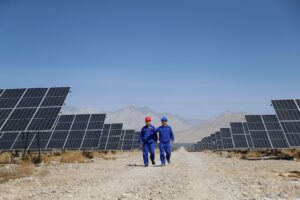
- This was achieved thanks to electricity generation from solar growing by 46% and wind by 11% year-on-year in the third quarter of 2025.
- In the first nine months of the year, China completed 240 gigawatts (GW) of solar and 61GW of wind capacity, putting it on track for a new renewable record in 2025.
- Oil demand and emissions in the transport sector fell by 5% in the third quarter, but grew elsewhere by 10%, as the production of plastics and other chemicals surged.
After the first three quarters of the year, China’s CO2 emissions in 2025 are now finely balanced between a small fall or rise, depending on what happens in the last quarter.
A drop in the full-year total became much more likely after September, which recorded an approximately 3% drop in emissions year-on-year.
Electricity demand – and associated emissions – have tended to grow fastest during the summer months, due to rapidly rising demand for air conditioning amid hotter summers.
If this pattern repeats, then China’s CO2 emissions will record a fall for the full year of 2025.
While an emission increase or decrease of 1% or less might not make a huge difference in an objective sense, it has heightened symbolic meaning, as China’s policymakers have left room for emissions to increase for several more years, leaving the timing of the peak open.
Either way, China is set to miss its target to cut carbon intensity – the CO2 emissions per unit of GDP – from 2020 to 2025, meaning steeper reductions are needed to hit the county’s 2030 goal.
Finely balanced emissions
China’s CO2 emissions have now been flat or falling for 18 months, starting in March 2024. This trend continued in the third quarter of 2025, when emissions were unchanged year-on-year.
This picture is finely balanced, however, with contrasting trends in different sectors of the economy underlying the ongoing plateau in CO2 emissions, shown in the figure below.
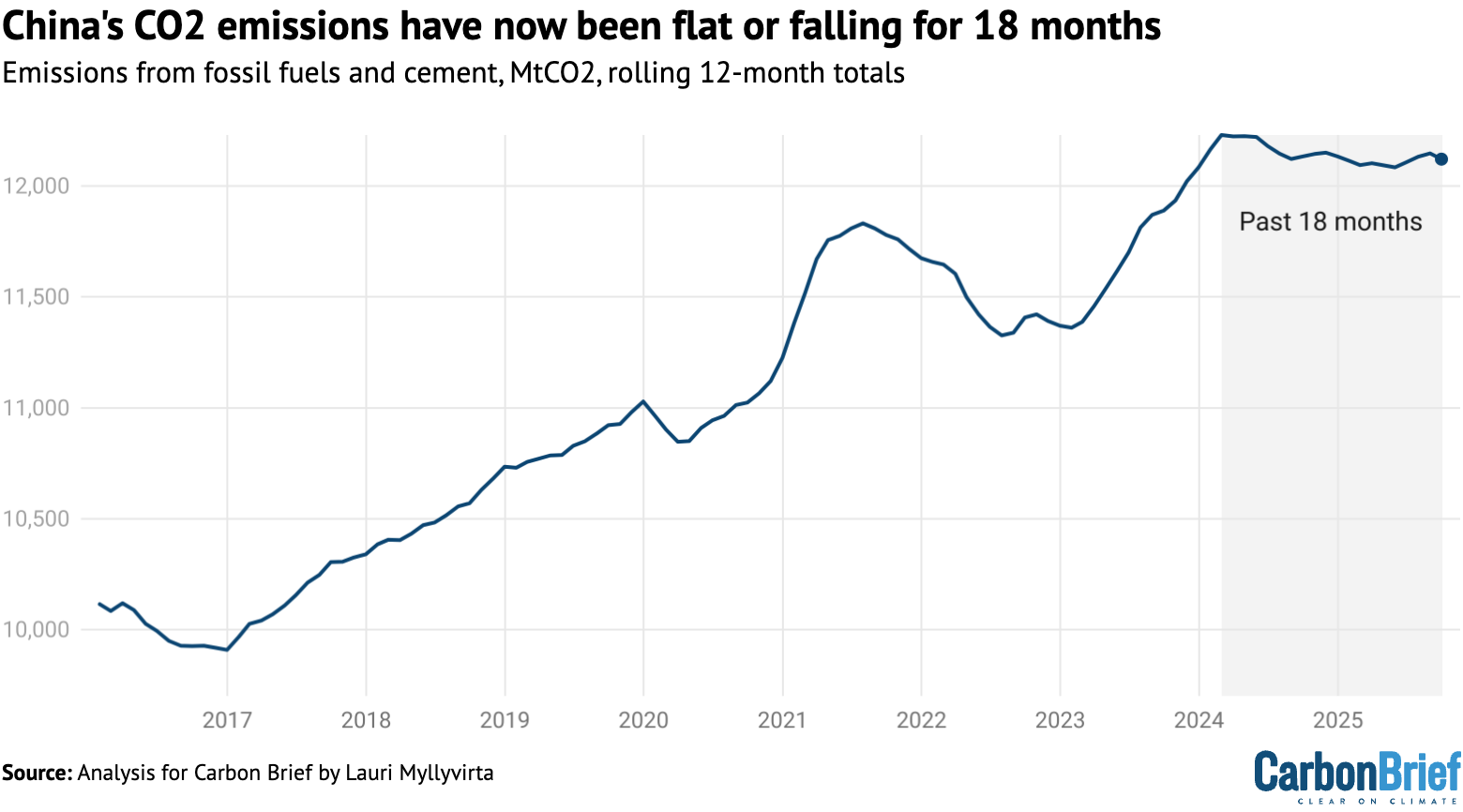
Emissions from the production of cement and other building materials fell by 7% in the third quarter of 2025, while emissions from the metals industry fell 1%. This is due to the ongoing real-estate contraction, as the construction sector uses most of the country’s steel and cement output.
Emission reductions from steel production continued to lag the reductions in output, which fell 3%. This is because the fall in demand was absorbed by the lower-carbon electric-arc steelmakers, whereas carbon-intensive coal-based steel production was less affected.
China has struggled to increase the share of electric-arc steelmaking despite targets, due to the large capacity base and entrenched position of coal-based steelmaking crowding out the lower-emission producers.
Power-sector emissions were unchanged year-on-year in the third quarter, as strong growth from solar and wind generation, along with small increases from nuclear and hydro, nearly matched a rapid rise in demand.
Emissions from transport fell by 5% over the period, but oil consumption in other sectors grew by 10%, driven by chemical industry expansion. This resulted in a 2% rise in oil consumption overall.
Gas demand and emissions grew by 3% overall in the three-month period, with consumption in the power sector up by 9% and by 2% in other sectors.
The figure below shows how emissions in each of these sectors has changed in the first nine months of 2025, for example, power-sector CO2 output is down 2% in the year so far.
The rapid recent growth of CO2 emissions in the chemical industry is a continuation of recent trends and, as such, the sector’s coal and oil use have both surged in 2025 to date.
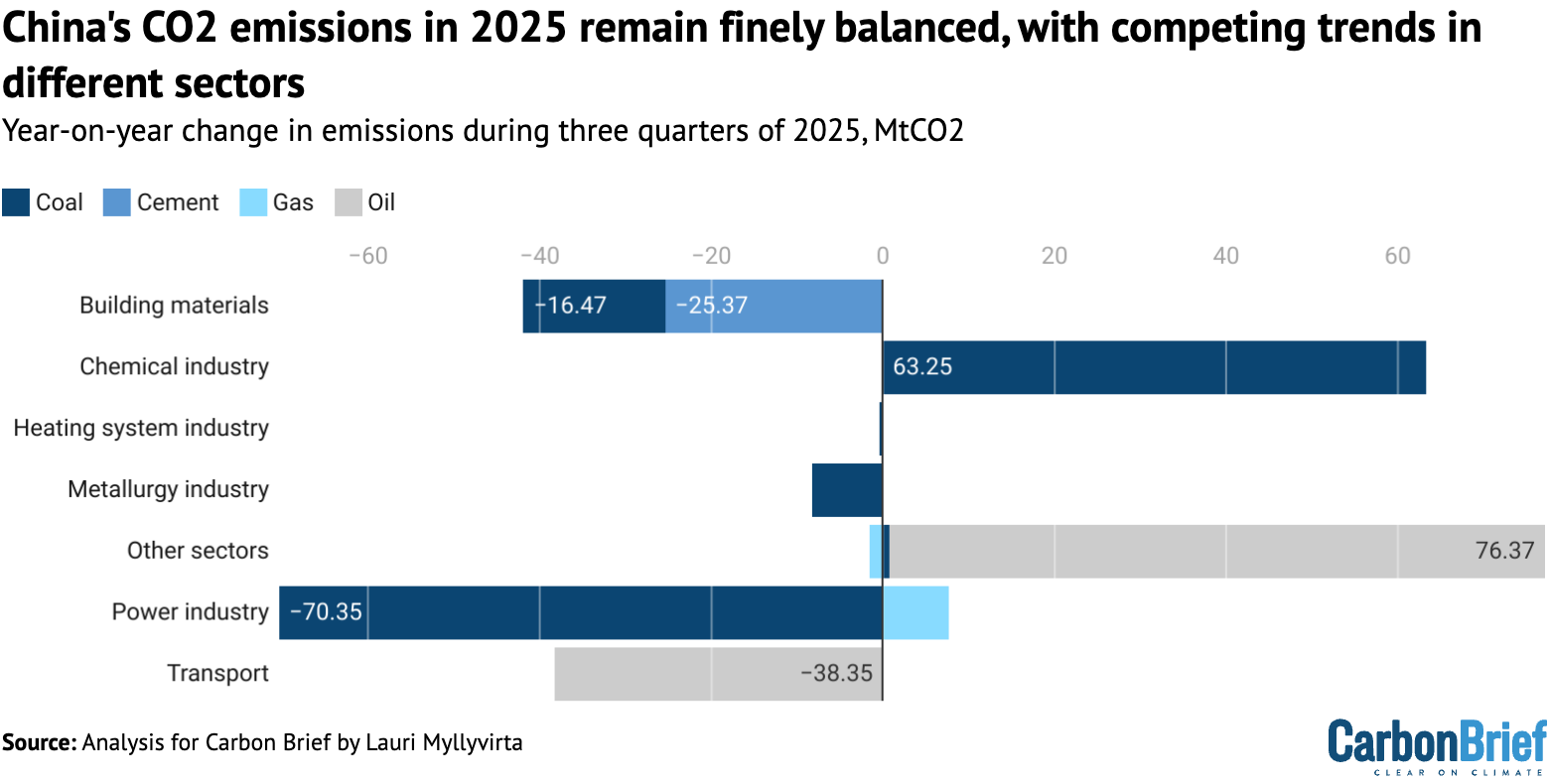
The outlook for emissions in the final quarter of 2025 – and the year as a whole – depends on whether further declines in cement, transport and power are enough to offset increases elsewhere.
Solar and wind growth keep power sector emissions flat
In the power sector, China’s dominant source of CO2, emissions remained flat in the third quarter even as electricity demand grew strongly.
Electricity generation from solar and wind grew by 30%, with solar up 46% and wind power generation increasing 11%. With small increases from nuclear and hydropower, non-fossil power sources covered almost 90% of the increase in demand, even as demand growth accelerated to 6.1% in the third quarter, up from 3.7% in the first half of the year.
This is illustrated in the figure below, where the columns show the change in generation by each source of non-fossil power every quarter and the line shows the increase in electricity demand.
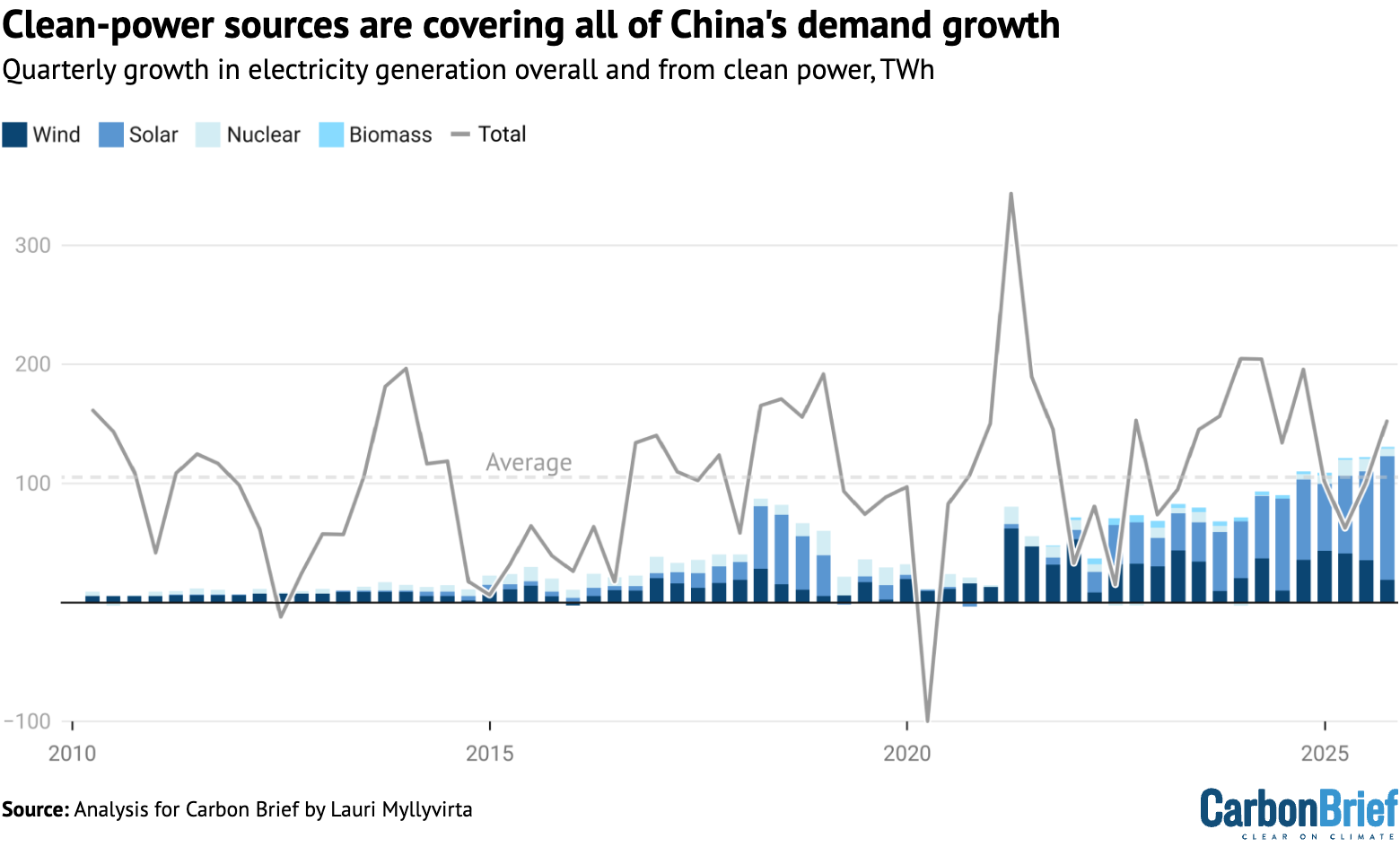
Despite a small increase in electricity generation from fossil fuels to cover the remaining 10% of demand growth, power sector emissions stayed unchanged in the third quarter of 2025.
This is because the average thermal efficiency of coal power – the amount of fuel per unit of output – improved slightly, while the share of gas-fired generation increased at the expense of coal.
The figure above shows that the growth in clean-power sources has been covering all or nearly all of the rise in electricity demand in recent quarters, but once again there is a fine balance.
As such, the outlook for the final quarter of 2025 and for power-sector emissions over the years ahead depends on the relative strength of rising demand and clean-power output.
From 2021 to 2025, there has been a marked seasonal pattern in electricity demand growth, with more rapid rises in the summer peak “cooling season”, from June to August.
In these months, residential electricity consumption grew by a striking 13% per year, compared with just 6% during other parts of the year. Industry and service-sector consumption also grew faster in the summer months.
As a result, growth in total power demand has been significantly faster, at 6.8% during the summer months, compared with 4.6% in the rest of the year.
This is due to both increased prevalence of air conditioning and to hotter summers, with the average number of “cooling-degree days” increasing by one third from 2015–16 to 2024–25, as shown in the figure below.
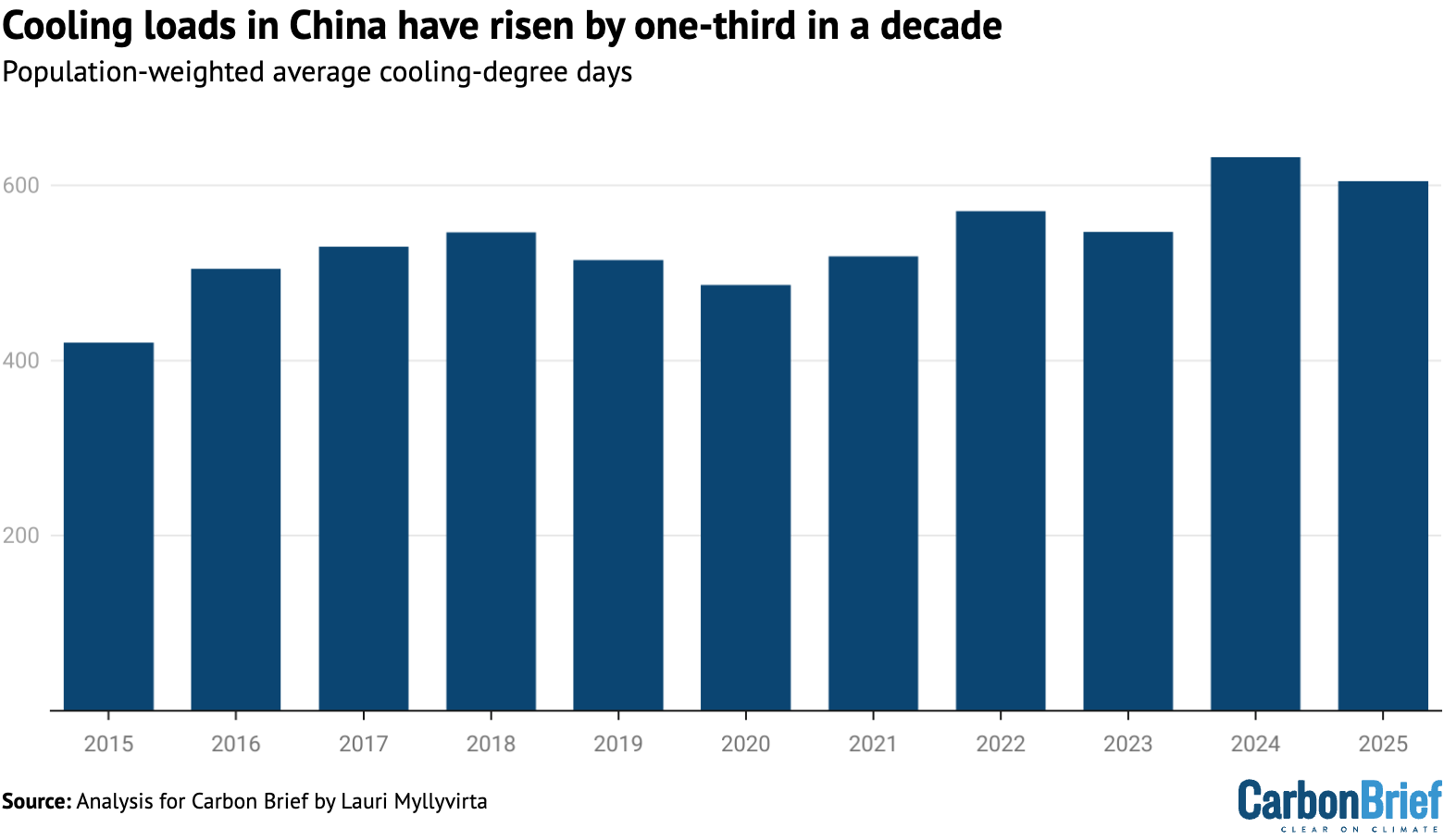
This seasonal pattern implies that electricity consumption might ease off in the final quarter of 2025, which would set a lower bar for clean-power growth to meet or exceed rising demand.
On the generation side, the first nine months of 2025 has seen China adding 240GW of solar and 61GW of wind power capacity. While the rate of new installations has slowed down sharply since May, China is still on track for a new record for the whole year as developers rush to complete projects included in the 14th five-year plan, which finishes at the end of 2025.
China had 181GW of wind and 234GW of utility-scale solar under construction in early 2025, according to the Global Energy Monitor. After the capacity additions in the first nine months of 2025, this leaves 120GW of wind and 123GW of utility-scale solar under construction, much of which is likely to be commissioned this year.
The rate of new wind and solar additions in 2025 to date is shown in the figure below, alongside comparable figures for each year since 2020.
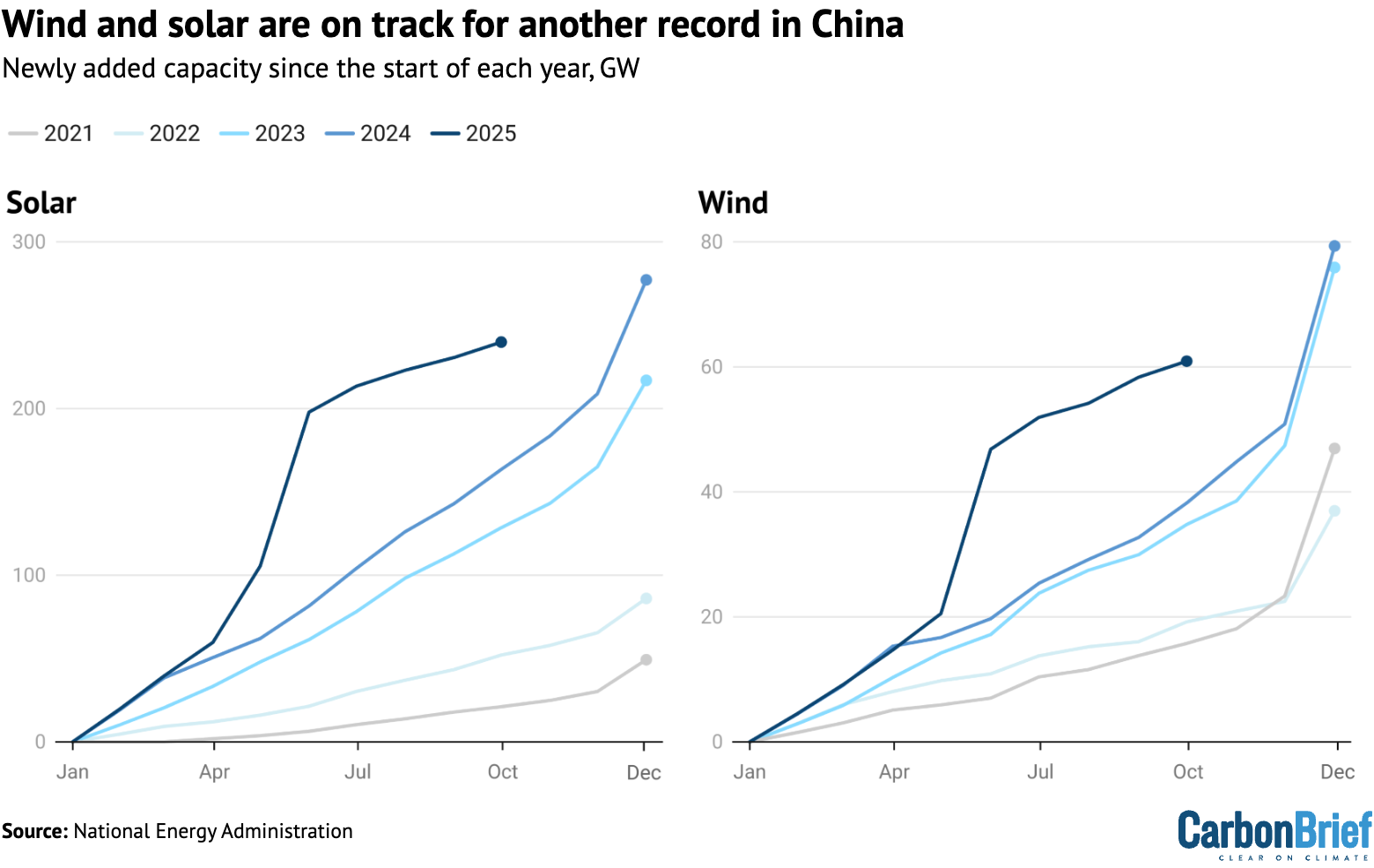
The slowdown in installations in recent months is due to a new pricing system that requires developers of new solar and wind-power plants to secure contracts directly with buyers, instead of being guaranteed the benchmark price for coal power, which was the case until May.
The change in pricing led to a major rush to complete projects faster than originally scheduled, seen in the May 2025 bump in the figure above.
This left few projects to complete in the third quarter, meaning that the current slow pace in installations does not yet reflect the capacity growth that can be expected under the new system.
China’s power-sector emissions have been falling slowly since early 2024, due to the rapid growth of solar and wind power generation. The unprecedentedly large capacity additions have enabled non-fossil power generation to cover electricity demand growth, but only barely.
Any sustained slowdown in solar and wind deployment would mean that power-sector emissions would begin to creep up again, unless electricity demand slows sharply. This is not expected – the State Grid has forecast 5.6% annual demand growth until 2030, compared with 6.1% from 2019 to 2025.
One indicator pointing towards robust ongoing solar capacity growth is that the production of solar cells has continued at or above 2024 levels – even after the slowdown in installations in recent months – growing 8% year-on-year in the third quarter.
The amount of new solar-cell capacity produced in Chinese factories each month, minus exports, has tended to predict new domestic solar installations, with a lag.
However, the outlook for wind and solar growth in China is clouded by a large gap between industry and government expectations for the sector.
The China Wind Energy Association is targeting at least 120GW of wind-power capacity added per year in the next five years, while the China Photovoltaic Industry Association projects 235-270GW of solar added in 2026, rising to 280-340GW in 2030.
In contrast, president Xi Jinping recently announced that China would “strive to” bring the county’s installed solar and wind capacity to 3,600GW by 2035. This implies just 200GW of capacity added per year over the next decade, extending a target set earlier for 2025-27.
The pace of solar and wind deployment under the new pricing system depends heavily on the implementation of the national-level rules at the provincial level, particularly the choice of minimum pricing. Most provinces are yet to finalise their rules and only six provinces have published results from auctions for “contracts for difference” – the key policy instrument under the new rules – so far, with nine more auctions underway.
Meanwhile, the additions of new coal and gas-fired power capacity have accelerated, as the projects started after the government loosened permitting and started to promote coal-fired power projects in 2020 are starting to complete.
The result has been that the utilisation of coal-fired power capacity – the share of hours during which each unit is in operation – has begun to fall significantly, as power generation from coal has declined since April 2024. Utilisation peaked at 54% in the 12 months to February 2024 and fell to 51% in the 12 months to September 2025.
Another 230GW of coal-fired power capacity is under construction. If power generation from coal continues to stay stagnant and if all of this new capacity is added to the system, then utilisation would fall to 43%. This could prompt a rethink of the government’s promotion of coal-fired power projects.
Chemical industry’s runaway growth pushes up oil demand
In the oil sector, there are once again competing factors at work. China’s transport oil consumption has been falling since April 2024, driven in large part by the rapid adoption of EVs.
However, total oil consumption still increased 2% in the year to September, as a 4% fall in transport fuel use was more than offset by an 8% rise elsewhere, dominated by industrial demand.
Consumption fell by 4-5% across each of the three main transport fuels: diesel, used in trucks and other heavy vehicles; petrol, mainly used in cars; and jet fuel.
The reduction in petrol consumption accelerated in October, falling 8% year-on-year, erasing the usual spike seen at this time of year related to the week-long national holiday.
Within industry, the production of primary plastics grew 12% year-on-year in the first three quarters of 2025, while the production of chemical fibres grew by 11% and the production of ethylene by 7%. The increase in the output of these products accounts for the entire increase in oil use outside the transportation sector.
These sharp increases in chemical production are shown in the figure below.
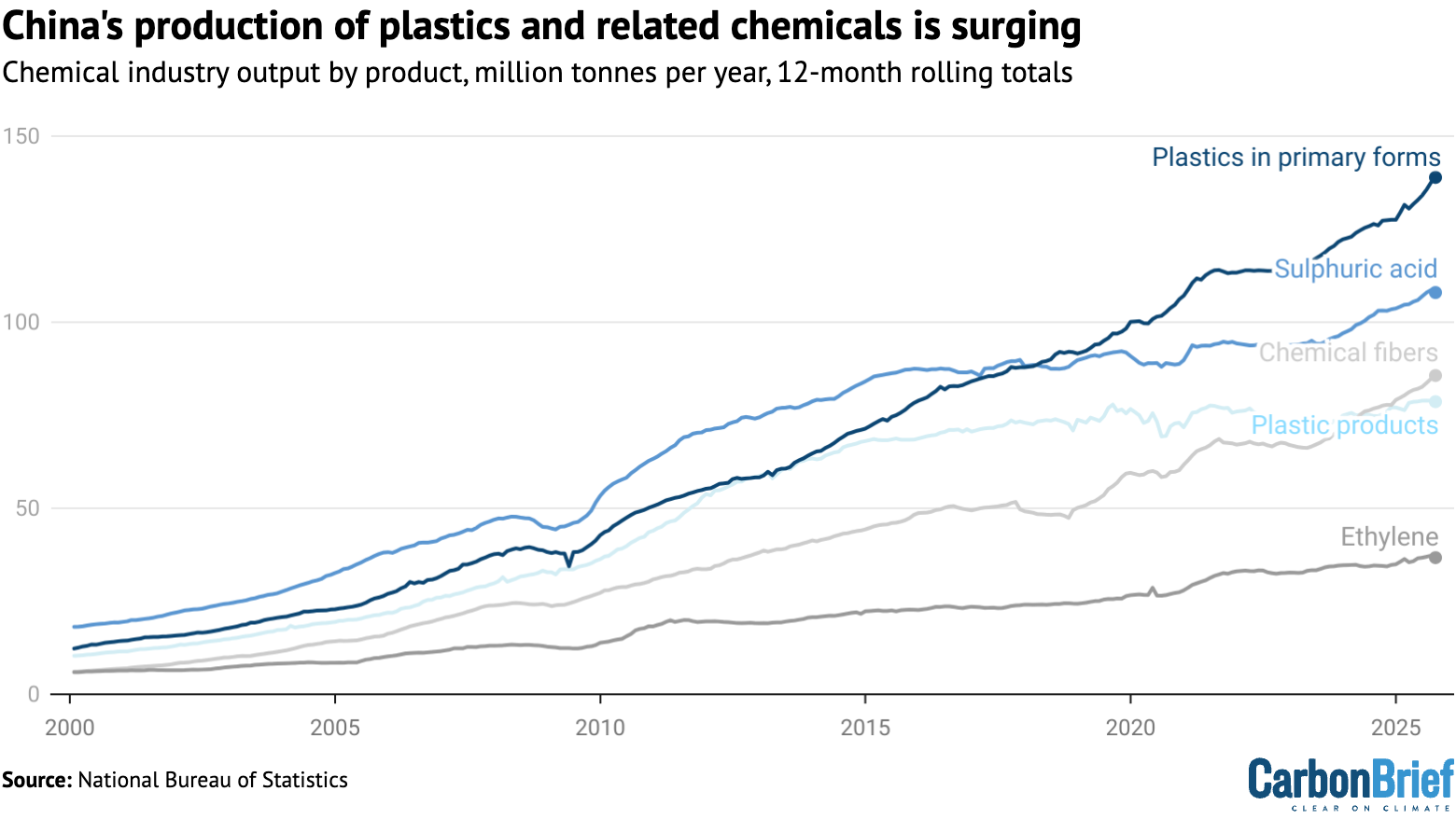
One clear driver of the growth in plastics production is import substitution – replacing equivalent products imported from overseas – as well as growing exports.
China is still a net importer of primary plastics by value in 2025 so far, but only just. The value of imports fell by 8% while the value of exports increased by 8% in the first nine months of the year.
The five-year plan for 2021-25 targeted an increase in chemicals production to reduce the imports of key raw materials to less than 40% of demand, with projects launched to meet this target coming online this year.
More recently, the government has encouraged oil refineries to shift from the production of transport fuels to chemicals, in order to adapt to falling demand for oil in transportation. It set a target for the petrochemical and chemical sector’s economic output to grow by more than 5% per year in 2025-26.
The US-China tariff tit-for-tat has added further momentum to import substitution. The US has been China’s largest source of imports of polyethylene – the most widely used plastic in the world – since 2023, but China has expanded its domestic production in response to the trade spat.
Still, the change in China’s net exports of plastics cannot account for more than a fraction of the increase in output volume, however, as estimated based on reported polymer prices. This indicates that growing domestic demand is a major driver of the rapid growth in plastics production.
Packaging is the largest use of plastics in China, with the booming online retail and food delivery industry driving rapid growth.
Express parcel volumes grew 21% in 2024 and 17% through September 2025. The value of the single-use plastic tableware market averaged 21% annual growth from 2017 to 2022 and the revenue of the online food delivery industry is projected to grow 11% in 2025.
The government is taking measures to curb single-use plastics, but these would need to be intensified to fully counteract the growth rates seen in food deliveries and other drivers. The demand for high-performance materials in new manufacturing industries is also a significant driver.
Will China’s emissions peak early or rebound?
After the third quarter of 2025, it is clear that the plateau or slow decline of China’s CO2 emissions that started in early 2024 continues.
Whether emissions increased or decreased marginally in the first three quarters of the year is too close to call, given the uncertainties involved, but a drop in full-year emissions became much more likely after September, which recorded an approximately 3% drop in emissions year-on-year.
Still, either a small increase or decrease in the calendar year of 2025 remains possible and will be ultimately be decided by developments in the fourth quarter.
China’s emissions from fossil-fuel use are highly likely to increase this year, with the increase of coal and oil use in the chemical industry outweighing the reductions in emissions from the power, metals, building materials and transportation sectors. This will be balanced out by a fall in cement process emissions.
What is already clear is that the 2025 carbon-intensity target will be missed, as it would have required absolute emission reductions of 4% or more this year, after slow progress during the earlier years of the five-year period.
This also means that the carbon-intensity target in the next 15th five-year plan for 2026-2030 would need to be more ambitious than the one that China missed during the current period, to close the shortfall to the country’s 2030 intensity target.
China targeted an 18% reduction in 2021-25, but will only have achieved around 12% by the end of this year. It would then need a reduction of around 22-24% in the next five years to achieve its headline climate commitment for 2030, a 65% carbon-intensity reduction on 2005 levels.
Whether emissions fall this year – or not – has high symbolic significance. Having committed to peaking emissions “before 2030”, China’s policymakers have left their specific peaking year open.
China’s new greenhouse gas emission target for 2035, announced by Xi in September, was set as a reduction of 7-10% below an undefined “peak level”, making it clear that policymakers are still planning for – or at least leaving the door open to – a late peak, only just before 2030.
Setting this target from “peak levels” means that the timing and level of China’s emissions peak affects not only the path of its CO2 output in the next few years, but also the size of cuts needed to meet the 2035 goal – and presumably also subsequent targets thereafter.
The target of reducing emissions from “peak levels” could also create an incentive for provinces to increase emissions before the expected peak year, known as “storming the peak” in Chinese.
This incentive could be curbed by the creation of the “dual control” system for carbon intensity and total carbon emissions. The Central Committee of the Communist Party recently reiterated that this should happen during the next five-year period, but the specific timeline is an open question.
If the system is not operational from 2026, with annual carbon intensity and possibly absolute carbon emission targets allocated to provinces, then that could further allow for and incentivise emissions increases in the short term.
At the same time, China has made commitments to peak emissions before 2030, reduce coal consumption gradually during the 2026-30 period and to reduce carbon emissions per unit of GDP by more than 65% by 2030, from 2005 levels.
Meeting the last target – which China has made internationally as part of its 2030 Paris pledge – would require, in practice, that emissions in 2030 are limited at or below their 2024 level, given progress to date and expected GDP growth rates.
Realising these targets, in turn, would require clean-energy growth rates well above the minimum of 200GW of new wind and solar capacity per year, set by China’s 2035 pledge – unless the rate of energy-demand growth sees a sharp and unexpected slowdown.
Beating these minimum clean-energy growth rates would also be necessary if policymakers want to maintain the tailwind that these sectors have provided to China’s economy in recent years.
About the data
Data for the analysis was compiled from the National Bureau of Statistics of China, National Energy Administration of China, China Electricity Council and China Customs official data releases, from WIND Information, an industry data provider, and Sinopec, China’s largest oil refiner.
Wind and solar output, and thermal power breakdown by fuel, was calculated by multiplying power generating capacity at the end of each month by monthly utilisation, using data reported by China Electricity Council through Wind Financial Terminal.
Total generation from thermal power and generation from hydropower and nuclear power was taken from National Bureau of Statistics monthly releases.
Monthly utilisation data was not available for biomass, so the annual average of 52% for 2023 was applied. Power sector coal consumption was estimated based on power generation from coal and the average heat rate of coal-fired power plants during each month, to avoid the issue with official coal consumption numbers affecting recent data.
CO2 emissions estimates are based on National Bureau of Statistics default calorific values of fuels and emissions factors from China’s latest national greenhouse gas emissions inventory, for the year 2021. Cement CO2 emissions factor is based on annual estimates up to 2024.
For oil consumption, apparent consumption of transport fuels (diesel, petrol and jet fuel) is taken from Sinopec quarterly results, with monthly disaggregation based on production minus net exports. The consumption of these three fuels is labeled as oil product consumption in transportation, as it is the dominant sector for their use.
Apparent consumption of other oil products is calculated from refinery throughput, with the production of the transport fuels and the net exports of other oil products subtracted. Fossil-fuel consumption includes non-energy use, as most products are short-lived and incineration is the dominant disposal method.

The post Analysis: China’s CO2 emissions have now been flat or falling for 18 months appeared first on Carbon Brief.
Analysis: China’s CO2 emissions have now been flat or falling for 18 months
Greenhouse Gases
Cropped 3 December 2025: Extreme weather in Africa; COP30 roundup; Saudi minister interview
We handpick and explain the most important stories at the intersection of climate, land, food and nature over the past fortnight.
This is an online version of Carbon Brief’s fortnightly Cropped email newsletter. Subscribe for free here.
Key developments
COP30 roundup
FOOD OFF THE MENU: COP30 wrapped up in the Brazilian Amazon city of Belém, with several new announcements for forest protection, but with experts saying that food systems were seemingly “erased” from official negotiations, Carbon Brief reported. Other observers told the Independent that the lack of mention of food in some of the main negotiated outcomes was “surprising” and “deeply disappointing”. The outlet noted that smallholder farmers spend an “estimated 20 to 40% of their annual income on adaptive measures…despite having done next to nothing to contribute to the climate crisis”.
‘BITTERSWEET’: Meanwhile, Reuters said that the summit’s outcomes for trees and Indigenous peoples were “unprecedented”, but “bittersweet”. It noted that countries had “unlocked billions in new funds for forests” through the Tropical Forest Forever Facility. (For more on that fund, see Carbon Brief’s explainer.) However, the newswire added, “nations failed to agree on a plan to keep trees standing as they have repeatedly promised to do in recent summits”. Mongabay noted that pledges to the new forest fund totalled “less than a quarter of the $25bn initially required for a full-scale rollout”.
‘MIXED OUTCOMES’: A separate piece in Mongabay said that COP30 “delivered mixed outcomes” for Indigenous peoples. One positive outcome was a “historic pledge to recognise Indigenous land tenure rights over 160m hectares” of tropical forest land, the outlet said. This was accompanied by a monetary pledge of $1.8bn to support “Indigenous peoples, local and Afro-descendant communities in securing land rights over the next five years”, it added. However, Mongabay wrote, there were some “major disappointments” around the summit’s outcomes, particularly around the absence of mention of critical minerals and fossil-fuel phaseout in the final texts.
Africa on edge
SOMALIA DROUGHT: Somalia officially declared a drought emergency last month “after four consecutive failed rainy seasons left millions at risk of hunger and displacement”, allAfrica reported, with 130,000 people in “immediate life-threatening need”. According to Al Jazeera, more than 4.5 million people “face starvation”, as “failed rains and heat devastated” the country, with displaced communities also “escaping fighting” in their villages and aid cuts impacting relief. Down to Earth, meanwhile, covered an Amnesty International report that demonstrated that Somalia failed to “implement a functional social-security system for the marginalised, particularly those negatively affected by drought”.
COCOA CRASH: Ivory Coast’s main cocoa harvest is expected to “decline sharply for [the] third consecutive year” due to erratic rainfall, crop disease, ageing farms and poor investment, Reuters reported. Africa Sustainability Matters observed that the delayed implementation of the EU’s deforestation law – announced last week – could impact two million smallholder farmers, who may see “delays in certification processes ripple through payment cycles and export volumes”. Meanwhile, SwissInfo reported that the “disconnect between high global cocoa prices and the price paid to farmers” is leading to “unprecedented cocoa smuggling” in Ghana.
‘FERTILISER CRISIS’: Nyasa Times reported that, “for the first time”, Malawian president Peter Mutharika admitted that the country is “facing a planting season…for which his government is dangerously unprepared”. According to the paper, Mutharika acknowledged that the country is “heading into the rains without adequate fertiliser and with procurement dangerously behind schedule” at a meeting with the International Monetary Fund’s Africa director. “We are struggling with supplies… We are not yet ready in terms of fertiliser,” Mutharika is quoted as saying, with the paper adding that his administration is “overwhelmed” by a fertiliser crisis.
News and views
PLANT TALKS COLLAPSE: “Decade-long” talks aimed at negotiating new rules for seed-sharing “collapsed” after week-long negotiations in Lima, Euractiv reported. The International Treaty on Plant Genetic Resources for Food and Agriculture allows “any actor to access seed samples of 64 major food crops stored in public gene banks”, but “virtually no money flows back to countries that conserve and share seed diversity”, the outlet said. Observers “criticised the closed-door nature of the final talks”, which attempted to postpone a decision on payments until 2027, it added.
UNSUSTAINABLE: The UK food system is driving nature loss and deepening climate change, according to a new WWF report. The report analysed the impacts on nature, climate and people of 10 UK retailers representing 90% of the domestic grocery market. Most of the retailers committed in 2021 to halving the environmental impact of the UK grocery market by 2030. However, the report found that the retailers are “a long way off” on reducing their emissions and sourcing products from deforestation-free areas.
GREY CARBON: A “flurry” of carbon-credit deals “covering millions of hectares of landmass” across Africa struck by United Arab Emirates-based firm Blue Carbon on the sidelines of COP28 “have gone nowhere”, according to a joint investigation by Agence-France Presse and Code for Africa. In Zimbabwe – where the deal included “about 20% of the country’s landmass” – national climate change authorities said that the UAE company’s memorandum of understanding “lapsed without any action”. AFP attempted multiple ways to contact Blue Carbon, but received no reply. Meanwhile, research covered by New Scientist found that Africa’s forests “are now emitting more CO2 than they absorb”.
UK NATURE: The UK government released an updated “environmental improvement plan” to help England “meet numerous legally binding goals” for environmental restoration, BusinessGreen reported. The outlet added that it included measures such as creating “wildlife-rich habitats” and boosting tree-planting. Elsewhere, a study covered by the Times found that England and Wales lost “almost a third of their grasslands” in the past 90 years. The main causes of grassland decline were “increased mechanisation on farms, new agrochemicals and crop-growing”, the Times said.
IN DANGER: The Trump administration proposed changes to the US Endangered Species Act that “could clear the way for more oil drilling, logging and mining” in key species habitats, reported the New York Times. This act is the “bedrock environmental law intended to prevent animal and plant extinctions”, the newspaper said, adding that one of the proposals could make it harder to protect species from future threats, such as the effects of climate change. It added: “Environmental groups are expected to challenge the proposals in court once they are finalised.”
‘ALREADY OVERSTRETCHED’: Producing enough food to feed the world’s growing population by 2050 “will place additional pressure on the world’s already overstretched” resources, according to the latest “state of the world’s land and water resources” report from the UN Food and Agriculture Organization. The report said that degradation of agricultural lands is “creating unprecedented pressure on the world’s agrifood systems”. It also found that urban areas have “more than doubled in size in just two decades”, consuming 24m hectares “of some of the most fertile croplands” in the process.
Spotlight
Saudi minister interviewed
During the second week of COP30 in Belém, Carbon Brief’s Daisy Dunne conducted a rare interview with a Saudi Arabian minister.
Dr Osama Faqeeha is deputy environment minister for Saudi Arabia and chief adviser to the COP16 presidency on desertification.
Carbon Brief: Thank you very much for agreeing to this interview. You represent the Saudi Arabia COP16 presidency on desertification. What are your priorities for linking desertification, biodiversity and climate change at COP30?
Dr Osama Faqeeha: First of all, our priority is to really highlight the linkages – the natural linkage – between land, climate and biodiversity. These are all interconnected, natural pillars for Earth. We need to pursue actions on the three together. In this way, we can achieve multiple goals. We can achieve climate resilience, we can protect biodiversity and we can stop land degradation. And this will really give us multiple benefits – food security, water security, climate resilience, biodiversity and social goals.
CB: Observers have accused Saudi Arabia, acting on behalf of the Arab group, of blocking an ambitious outcome on a text on synergies between climate change and biodiversity loss, under the item on cooperation with international organisations. [See Carbon Brief’s full explanation.] What is your response?
OF: We support synergies in the action plans. We support synergies in the financial flows. We support synergies in the political [outcome]. What we don’t support is trying to reduce all of the conventions. We don’t support dissolving the conventions. We need a climate convention, we need a biodiversity convention and we need a desertification convention. There was this incident, but the discussion continued after that and has been clarified. We support synergies. We oppose dissolution. This way we dilute the issues. No. This is a challenge. But we don’t have to address them separately. We need to address them in a comprehensive way so that we can really have a win-win situation.
CB: But as the president of the COP16 talks on desertification, surely more close work on the three Rio conventions would be a priority for you?
OF: First of all, we have to realise the convention is about land. Preventing land degradation and combating drought. These are the two major challenges.

CB: We’re at COP30 now and we’re at a crucial point in the negotiations where a lot of countries have been calling for a roadmap away from fossil fuels. What is Saudi Arabia’s position on agreeing to a roadmap away from fossil fuels?
OF: I think the issue is the emissions, it’s not the fuel. And our position is that we have to cut emissions regardless. In Saudi Arabia, in our nationally determined contribution [NDC], we doubled [the 2030 emissions reductions target] – from 130MtCO2 to 278MtCO2 – on a voluntary basis. So we are very serious about cutting emissions.
CB: The presidency said that some countries see the fossil-fuel roadmap as a red line. Is Saudi Arabia seeing a fossil-fuel roadmap as a red line for agreement in the negotiations?
OF: I think people try to put pressure on the negotiation to go in one way or another. And I think we should avoid that because, trying to demonise a country, that’s not good. Saudi Arabia is a signatory to the Paris Agreement. Saudi Arabia made the Paris Agreement possible. We are committed to the Paris Agreement.
[Carbon Brief obtained the “informal list” of countries that opposed a fossil-fuel roadmap at COP30, which included Saudi Arabia.]
CB: You mention that you feel sometimes the media demonises Saudi Arabia. So could you clarify, what do you hope to be Saudi Arabia’s role in guiding the negotiations to conclusion here at this COP?
OF: I think we have to realise that there is common but differentiated responsibilities. We have developed countries and developing countries. We have to realise that this is very well established in the convention. We can reach the same end point, but with different pathways. And this is what the negotiation is all about. It’s not one size fits all. What works with a certain country may not work with another country. So, I think people misread the negotiations. We, as Saudi Arabia, officially announced that we will reach carbon neutrality by 2060 – and we are putting billions and billions of dollars to reach this goal. But it doesn’t mean that we agree on everything. On every idea. We agree to so many things, you never hear that. Saudi Arabia agrees on one thousand points and we disagree on one point, then suddenly it becomes the news. Now, why does the media do that? Maybe that gives them more attention. I don’t know. But all I can tell you is that Saudi Arabia is part of the process. Saudi Arabia is making the process work.
This interview has been edited for length.
Watch, read, listen
NEW CHALLENGE: CNN discussed the environmental impacts of AI usage and how scientists are using it to conserve biodiversity.
AMAZON COP: In the Conversation, researchers argued that hosting COP30 in the Amazon made the “realities of climate and land-use change jarringly obvious” and Indigenous voices “impossible to ignore”.
DUBIOUS CLAIMS: DeSmog investigated an EU-funded “campaign blitz” that “overstated the environmental benefits of eating meat and dairy, while featuring bizarre and misleading claims”.
WASP’S NEST: In a talk for the Leverhulme Centre for Nature Recovery, Prof Seirian Sumner explained the “natural capital” of wasps and why it is important to “love the unlovable parts of nature”.
New science
- Climate change can “exacerbate” the abundance and impacts of plastic pollution on terrestrial, freshwater and marine ecosystems | Frontiers in Science
- The North Sea region accounts for more than 20% of peatland-related emissions within the EU, UK, Norway and Iceland, despite accounting for just 4% of the region’s peatland area | Nature Communications
- Economic damages from climate-related disasters in the Brazilian Amazon rose 370% over 2000-22, with farming experiencing more than 60% of total losses | Nature Communications
In the diary
- 1-5 December: Meeting of the implementation review committee of the UN desertification convention | Panama City
- 2-5 December: Meeting of the contracting parties to the Barcelona Convention on the protection of the Mediterranean Sea | Cairo
- 5 December: World soil day
- 8-12 December: International Water Association water and development congress and exhibition | Bangkok
Cropped is researched and written by Dr Giuliana Viglione, Aruna Chandrasekhar, Daisy Dunne, Orla Dwyer and Yanine Quiroz. Ayesha Tandon also contributed to this issue. Please send tips and feedback to cropped@carbonbrief.org
The post Cropped 3 December 2025: Extreme weather in Africa; COP30 roundup; Saudi minister interview appeared first on Carbon Brief.
Cropped 3 December 2025: Extreme weather in Africa; COP30 roundup; Saudi minister interview
Greenhouse Gases
Analysis: Why COP30’s ‘tripling adaptation finance’ target is less ambitious than it seems
One of the headline outcomes to emerge from COP30 was a new target to “at least triple” finance for climate adaptation in developing countries by 2035.
Vulnerable nations stress that they urgently need to strengthen their infrastructure as climate hazards intensify, but they struggle to attract funding for these efforts.
The new goal, which builds on a previous target agreed four years ago to double adaptation finance by 2025, was a central demand for many developing countries at the UN climate summit in Belém.
Yet, throughout the two-week negotiations, developed-country parties opposed new targets that would give them more financial obligations.
As a result of this opposition, the final target is less ambitious than the idea originally floated by developing countries, resulting in less pressure on developed countries to provide public funds.
This article looks at precisely what the final COP30 outcome does – and does not – say about tripling adaptation finance, as well as the implications for developing countries.
- 1) The final COP30 decision delayed the ‘tripling’ target by five years and added uncertainty
- 2) The new target is looser than the previous ‘doubling’ goal for adaptation finance
- 3) The target also falls far short of developing countries’ adaptation needs
1. The final COP30 decision delayed the ‘tripling’ target by five years and added uncertainty
At COP26 in Glasgow in 2021, a target was agreed for developed nations to double the amount of adaptation finance they would provide to developing countries by 2025.
This target has been broadly interpreted as approximately $40bn by 2025, using the agreed baseline of $18.8bn in 2019.
As of 2022, the latest year for which official data is available, annual adaptation finance from developed countries had reached $28.9bn. (Final confirmation of whether the target has been met will not come until 2027, due to the delay in climate-finance reporting.)
With the “doubling” target set to expire this year, some developing countries came to COP30 with the aim of agreeing on a new target.
The least-developed countries (LDCs) group called for “a tripling of grant-based adaptation finance by 2030 to at least $120bn”. They were backed by small-island states, the African group and some Latin American countries.
This proposal was included in the first draft of the “global mutirão“, the key overarching decision text produced by the COP30 presidency.
However, the text that ultimately emerged pushed the “tripling” deadline back to 2035. As the chart below shows, this delayed target could mean far less adaptation finance in the short term, due to developed countries taking longer to ramp up their contributions.

Lina Yassin, an adaptation advisor to the LDCs, tells Carbon Brief that this goal is “fundamentally out of step” with the obligation for developed countries to achieve a “balance” between adaptation and mitigation finance.
(This obligation is set out in the Paris Agreement, but, in practice, developed countries provide far more finance for mitigation initiatives, such as clean-energy projects. Adaptation finance has been around a third of the total in recent years and this would still be the case if the overall $300bn climate-finance and tripling adaptation finance targets are both met.)
The final text also removed a mention of 2025 as the baseline year, adding uncertainty as to what precisely the 2035 target means.
“The [LDCs] wanted a clear number, tied to a clear baseline year, that you can actually track and hold providers accountable for,” Yassin explains.
The text does allude to the “doubling” target agreed at COP26 in Glasgow, which some analysts say is an indicator of what the baseline should be.
“It is obviously deliberately vaguely written, but we think the reference to the Glasgow pledge means they should triple that pledge,” Gaia Larsen, director for climate finance access at the World Resources Institute (WRI), tells Carbon Brief.
2. The new target is looser than the previous ‘doubling’ goal for adaptation finance
The “doubling” target set at COP26 was based on adaptation finance “provided” by developed countries.
This means it exclusively comes as publicly funded grants and loans from many EU member states, the US, Japan and a handful of other nations, including finance they raise via multilateral development banks (MDBs) and funds.
The LDCs’ original proposal for the “tripling” goal was even more specific. It called for “grant-based finance”, meaning any loans would not be included.
Amid widespread cuts to aid budgets, notably in the US, developed countries have been unwilling to commit to new targets based solely on them providing public finance.
Instead, they stressed at COP30 that any new pledges should align with the “new collective quantified goal” (NCQG) to raise $300bn by 2035, which was agreed last year. This is reflected in the final decision, which says the tripling target is “in the context of” the NCQG.
Unlike the COP26 goal, the NCQG covers finance from a variety of sources, including “mobilised” private finance and voluntary contributions from wealthier developing countries.
Assuming $120bn as the 2035 objective, WRI has estimated what its composition could be, based on the looser accounting allowed under the new adaptation-finance goal.
As the chart below shows, the institute estimates that more than a quarter of the target could be met by these new sources, with the rest coming from developed-country governments.

WRI assumes that MDBs will play a “critical role” in meeting the 2035 target, amid calls for them to triple their overall finance. More MDB funding would also automatically be counted, as the new adaptation goal includes MDB funds that are attributable to developing countries, as set out in the NCQG.
The WRI analysis also assumes a big increase in the amount of private finance for adaptation that is “mobilised” by public spending, scaling up significantly to $18bn by 2035.
Traditionally, it has been difficult to raise private investment for adaptation initiatives, as they provide less return on investment than clean-energy projects.
3. The target also falls far short of developing countries’ adaptation needs
The UN Environment Programme’s (UNEP) recent “adaptation gap” report estimates that developing countries’ adaptation investment requirements – based on modelled costs – will likely hit $310bn each year by 2035.
Developing countries have self-reported even higher financial “needs” in their nationally determined contributions (NDCs) and national adaptation plans (NAPs) submitted to the UN.
When added together, UNEP concludes these needs amount to $365bn each year for developing countries between 2023 and 2035.
(According to NRDC, most of this discrepancy comes from middle-income countries reporting significantly higher needs than the UNEP-modelled costs.)
As the chart below shows, the new COP30 target would not cover more than a third of these estimated needs by 2035.

Both domestic spending and private-sector investment that is independent of developed-country involvement are expected to play a role in meeting developing countries’ adaptation needs.
Nevertheless, UNEP states that the overarching climate-finance goals set by countries are “clearly insufficient” to close the adaptation-finance “gap”.
Even in a scenario based on the LDCs’ original proposal of tripling adaptation finance to $120bn by 2030, the UNEP report concluded that a “significant” gap would have remained.
The post Analysis: Why COP30’s ‘tripling adaptation finance’ target is less ambitious than it seems appeared first on Carbon Brief.
Analysis: Why COP30’s ‘tripling adaptation finance’ target is less ambitious than it seems
Greenhouse Gases
Asia-Pacific faces ‘$500bn-a-year’ hit from rising seas if current policies continue
Coastal flooding could bring $500bn of annual damages to the Asia-Pacific by the year 2100, if countries do not adapt to rising sea levels.
This is according to new research, published in the journal Scientific Reports, which assesses how coastal flooding is impacting the Asia-Pacific region – and models how the damages could worsen as sea level rises over the 21st century.
The paper finds that coastal flooding is already driving $26.8bn of damage every year across 29 countries in Asia and the Pacific, equivalent to 0.1% of the region’s GDP.
It projects that, under current policies, annual coastal flood damages in the region could rise to $518bn by 2100 – but this could drop to $338bn if warming is capped at 1.5C.
Small island states face the greatest risks from coastal flooding and will continue to bear the brunt of the damage as the planet continues to warm, according to the research.
For example, it finds that Tuvalu will face annual coastal flood damage equivalent to 38% of its GDP by the end of the century.
Meanwhile, small island states such as Kiribati, the Maldives, Micronesia and Tuvalu will permanently lose around 10% of their total land area.
The study’s lead author says the research shows how “rising seas” create “existential” and “economic” risks for low-lying islands in the Asia-Pacific.
He tells Carbon Brief that the paper highlights a “sharp inequality”, as developing nations with little historical responsibility for sea level rise face the brunt of its impacts.
Coastal damage
More than one billion people – about 15% of the world’s population – currently live within 10km of a coast.
Asia is home to some of the largest cities in the world, many of which are located near the sea, such as Mumbai, Tokyo, and Shanghai. The continent is home to 60% of the world’s coastal population.
However, there are hazards to living near the water.
Coastal flooding is caused by a combination of gradually rising sea levels and “episodic extreme sea levels”, such as high tides and storm surges, the study explains.
To assess these two factors, the study combines components including an ocean model and tide-height data.
The authors model flooding in all coastal Pacific and Asian countries that are listed as “developing member countries” by the Asian Development Bank. These 29 countries include Bangladesh, the Philippines and Tuvalu.
They calculate the economic damage caused by flooding, by combining their flood model with data on land use and “asset values” across the residential, commercial, industrial, infrastructure and agricultural sectors.
The authors assume when land floods permanently, the “assets” are completely lost. For areas that only flood periodically, the authors use a model linking flood depth to a percentage of land damaged to calculate the economic consequences.
They find that coastal flooding currently drives $27bn of damage every year in the Asia-Pacific.
China and Indonesia bear the greatest damage, each losing more than $6bn every year. The study authors say this is because both countries have “extensive coastlines, large populations in flood-prone areas and critical economic infrastructure concentrated near the coast”.
However, the study finds that small islands face the greatest economic damage as a percentage of their GDP.

The study shows that the five most-severely affected countries are small island states. Vanuatu tops the ranking, losing 1.5% of its GDP to flooding every year. It is followed by Papua New Guinea and Micronesia.
Dr Michalis Vousdoukas is a researcher in coastal geography at the University of the Aegean in Greece and lead author of the study.
He tells Carbon Brief that even these damage estimates are “conservative” as they do not consider indirect economic losses, such as disruption to business, the loss of critical infrastructure, such as airports, or social impacts, such as migration.
Vousdoukas tells Carbon Brief that the study “highlights a sharp inequality between responsibility and impact”, explaining that the “countries that contributed the least to global emissions, particularly atoll nations, face the highest relative damages”.
Island nations in the Asia-Pacific region made of atolls – ring-shaped coral reefs or islands – include Kiribati, the Marshall Islands and Tuvalu.
Exposure
The authors also calculate population exposure to flooding, by overlaying their flood model with world population data.
Vousdoukas explains that “a person is considered exposed if they live in an area that appears as flooded in our model”.
The paper finds that six million people across the Asia-Pacific are currently at risk of coastal flooding each year, accounting for 0.2% of the region’s total population. The paper says:
“Although this may appear to be a small percentage, it still represents millions of individuals and families whose lives and livelihoods are under constant threat.”
Ranjan Panda is the convenor of the Combat Climate Change Network in India. Panda, who was not involved in the study, tells Carbon Brief that sea level rise is already forcing “millions of people to migrate out in distressed conditions to cities and other countries”.
China and Bangladesh rank the highest, with 2.2 million and 1.5 million people, respectively, exposed to coastal flooding each year.
However, small islands have the greatest percentage of their population exposed to flooding. Vanuatu again tops the table, with 2% of its population facing coastal flooding every year, according to the study. It is followed by Micronesia and the Maldives.
Bangladesh is the highest ranking non-island country, due to its “densely populated and flood-prone delta region”, the study finds.
Rising seas
As the climate warms, coastal flooding is worsening.
Average global sea levels have risen by more than 20cm since 1900, driven mainly by the thermal expansion of the ocean and the melting of glaciers and ice sheets.
Global warming is also “supercharging” hurricanes and typhoons, causing storm surges – the temporary rise in sea level that happens during a storm – to become more intense.
The study uses projections from the IPCC’s sixth assessment report to model sea level rise over the 21st century. These include thermal expansion and meltwater from glaciers and ice sheets, but exclude “low-likelihood, high-impact” events, such as ice-sheet collapse.
The authors assess five future scenarios:
- SSP1-1.9: A very-low emissions reductions pathway that “aligns with” the Paris Agreement’s 1.5C limit
- SSP1-2.6: A “low” emissions pathway achieving net-zero emissions after 2050
- SSP2-4.5: A “moderate” emissions scenario, often described as the trajectory under current climate policies.
- SSP3-7.0: A “high” emissions pathway
- SSP5-8.5: A very-high emissions pathway of “high fossil fuel reliance” throughout the 21st century
They find that, even under the lowest 1.5C warming scenario, countries in the Asia-Pacific will face damages of $338bn due to coastal flooding every year by the end of the century. This accounts for 1.3% of the region’s present-day GDP. (The authors assume no adaptation measures, changes in land use or inflation over the century.)
Under the current policy scenario, annual damage from coastal flooding rises to $518bn by the end of the century.
The chart below shows coastal flood damage as a percentage of annual GDP by the end of the century under the five scenarios for each country. Each horizontal bar shows the damage for one country, with the lowest warming SSP1-1.9 scenario on the left (grey) and highest warming SSP5-8.5 scenario (black) on the right.

The study finds that, by the end of the century, the Pacific island of Tuvalu will face the worst economic consequences from coastal flooding. Even under the 1.5C warming scenario, its annual economic losses due to coastal flooding will reach 38% of its GDP.
The authors also assess the amount of land that will be permanently lost to the sea.
They find that small island states – such as Kiribati, the Maldives, Micronesia and Tuvalu – will experience the highest percentage of their land permanently submerged, each losing around 10% of their total land area.
Two million people currently live in areas of the Asia-Pacific that will be permanently flooded by the end of the century under the 1.5C warming scenario, according to the research.
Finance gap
Countries can reduce the impacts of coastal flooding through adaptation. This can include building flood defenses, making infrastructure more resilient to flooding, or arranging “managed retreat” to move people away from vulnerable areas as the seas encroach.
The study authors model the cost of building defences – such as sea walls, levees, embankments and sand dunes – high enough that the economic damage from coastal flooding over the 21st century does not worsen beyond 2020 levels.
The research highlights that the cost of investing in these defences is substantially lower than the potential economic damages of sea level rise.
The authors estimate that, under a 1.5C warming scenario, building flood defenses to limit flood damage to 2020 levels would cost $9bn in total. However, building these defences would avoid $157bn in damages due to coastal flooding, they find.
Dr Rafael Almar is a researcher at the Laboratory of Space Geophysical and Oceanographic Studies in France and was not involved in the study. He says the study has “significant implications for development banks and financial institutions” as it could help them prioritise investments in “clearly identified hotspots”.
However, he emphasises that building flood defences “is not the only solution”. For example, he argues that “relocation and renaturalisation” – the process of moving people away from the coast and allowing the area to return to its natural state – can make an area “more resilient”.
Panda also warns that physical flood defenses “could actually be triggering further local environmental crises that accelerate the losses and damages faced by people due to sea level rise and flooding impacts”.
Sea walls have been shown to damage wildlife – for example, blocking animals such as turtles from reaching parts of the beach – according to an article in Climate Home News. The piece adds that physical defenses are “inflexible” and “mainly benefit the rich and encourage risky building near the coast”.
Sourcing money for developing countries to adapt to the impacts of climate change is an ongoing talking point at international climate negotiations.
A group of developed nations, including much of Europe, the US and Japan, is obliged under the Paris Agreement to provide international “climate finance” to developing countries. This money can be used for both mitigation – reducing emissions to limit warming – and adaptation.
In 2023, developed nations provided $26bn in international adaptation finance to developing nations, according to a recent UN report. This is roughly the amount that Asia-Pacific countries currently lose every year due to coastal flooding alone.
The post Asia-Pacific faces ‘$500bn-a-year’ hit from rising seas if current policies continue appeared first on Carbon Brief.
Asia-Pacific faces ‘$500bn-a-year’ hit from rising seas if current policies continue
-
Climate Change4 months ago
Guest post: Why China is still building new coal – and when it might stop
-
Greenhouse Gases4 months ago
Guest post: Why China is still building new coal – and when it might stop
-
Climate Change2 years ago
Spanish-language misinformation on renewable energy spreads online, report shows
-
Greenhouse Gases2 years ago嘉宾来稿:满足中国增长的用电需求 光伏加储能“比新建煤电更实惠”
-
Climate Change Videos2 years ago
The toxic gas flares fuelling Nigeria’s climate change – BBC News
-
Climate Change2 years ago嘉宾来稿:满足中国增长的用电需求 光伏加储能“比新建煤电更实惠”
-
Carbon Footprint2 years agoUS SEC’s Climate Disclosure Rules Spur Renewed Interest in Carbon Credits
-
Climate Change2 years ago
Why airlines are perfect targets for anti-greenwashing legal action