

Researchers are using satellite images and AI-powered modelling to map global mining activity, seeking to plug gaps in existing data as the rush for “transition minerals” fuels concerns about the industry’s impact on the environment and local communities.
Countries are scrambling to shore up supplies of metals vital for the transition to renewables, such as lithium used in electric vehicle (EV) batteries, and copper – used in solar panels and wind turbines, many of which are produced in environmentally sensitive areas.
“New mines will likely be in areas of high biodiversity, or where water and Indigenous rights are at stake,” project lead Victor Maus from the Vienna University of Economics and Business told Climate Home News.
More than half of energy transition mineral resources are located on or near the lands of Indigenous peoples and subsistence farmers, according to a 2022 study published in the Nature journal.
“Monitoring those impacts is critical,” said Maus, whose team members have identified massive gaps in current data when it comes to what, how and even where minerals are being extracted around the world.
-
Colombia proposes expert group to advance talks on minerals agreement
A draft resolution aimed at advancing talks on a global minerals treaty will be discussed at a major UN environment meeting later this year -
Global renewables goal slips off course after Trump, China moves
The IEA downgrades its forecast for renewables growth due to the US cutting renewable tax credits and China’s electricity market reforms -
Turkey’s new climate pledge would control emissions growth, not offer real cuts
The world’s 15th-largest emitter has made progress in boosting clean energy, but it could do much more to decarbonise


During a previous project, they compared global satellite imagery of 120,000 square kilometres of visible mine footprints with the S&P Capital IQ Pro database of mining production. The results were stark. More than half of the mining areas identified from space had no corresponding production data in the official record.
To address these gaps, Maus and his team are building a mining database using satellite images. The project, which is part of the European Union-funded Mine the Gap initiative, will be a vital tool for policymakers and help foster transparency in the mining industry, he added.
“We’re hoping to create not only a research tool but also a means of validating and complementing what companies report, supporting greater transparency across the sector.”
Mapping environmental impact
As well as counting mines and assessing overall production, the database will give a clearer picture about where the biggest environmental and social risks lie by tracking land use around mines, waste generation and signs of environmental degradation.
“Simply knowing how much is being produced isn’t a direct measurement of impact,” said Tim Werner, a senior lecturer at The University of Melbourne who has worked with Maus on previous research into critical minerals.
“We simply don’t have all the information we need to scientifically prove where impacts for one area are worse than others. This is a big problem for strategic environmental management at national and global scales,” he added, describing the data gaps as “mind-boggling”.
A range of satellites are being used to collect the required information, including multispectral imagery, radar and hyperspectral sensors, collected from sources including the EU’s Sentinel constellation and German DLR satellites, chosen for their global coverage and accuracy.
AI will then be used to scan these images, learning how to identify and track potential issues as the project develops.
The challenges of collecting mining data
There have been previous attempts to map the overlap between energy transition mineral mines and key biodiversity hotspots in different mineral-rich countries, as well as industry efforts to plug the gaps in data about global mining production.
But past efforts to map global mining more accurately have struggled to document small-scale and artisanal mining operations, which are often unregulated despite their significant social and environmental impacts.
-
Migrant workers building Saudi Arabia’s green future face exploitation, report finds
Heat stroke, long hours and punishment for taking breaks – low-paid foreign workers compare jobs on Saudi renewable energy projects to a prison sentence -
The company tracking energy transition minerals back to the mines
Australian firm Source Certain traces minerals back to the exact point where they were extracted from the Earth – a technique that could help make cleantech supply chains more accountable -
Digging beyond oil: Saudi Arabia bids to become a hub for energy transition minerals
The top crude exporter is using its oil riches to position itself as a major player in clean energy supply chains. Investors are interested, but hurdles remain


In September, the International Council on Mining and Metals (ICMM) launched its global mining database – reportedly the most comprehensive mining resource to date, with information about more than 15,000 active facilities in 151 countries, but it does not include informal mining sites.
“We had to draw some scope boundaries,” said Emma Gagen, the ICMM’s data and research director. “The industry is huge and that’s been the challenge this whole time – people haven’t tried to collect this data before because it’s so vast.”
The case for clearer global standards
Despite such data initiatives, which reflect growing pressure on the industry to clean up its act, researchers say structural and legislative changes will be needed to reduce the harms caused by mining.
Gagen said more uniform regulatory standards would “drive performance improvements across the industry.”
“What’s most needed is alignment,” Maus said. “Clearer global standards on what should be measured and reported, and policies that encourage disclosure of mining data.”
For Maus and his team, having an accurate picture is a crucial first step.
“If we don’t even know how many materials are being produced, we’ve got very little basis to even understand the scale of possible impacts in an area,” Werner said.
Main image: Satellite image showing the expansion of nickel mining in Sulawesi, Indonesia (Photo: Sentinel-2 cloudless by EOX IT Services GmbH, which contains modified Copernicus Sentinel data 2024)
The post AI and satellite data help researchers map world’s transition minerals rush appeared first on Climate Home News.
AI and satellite data help researchers map world’s transition minerals rush

For the first time, new-energy vehicles (NEVs) made up 67% of new car sales in China in September, according to the latest data from the China Passenger Car Association (CPCA).
The figures show that NEVs, which include battery electric cars and plug-in hybrids, captured a record share of sales, even though fewer were sold than last year.
This is because sales of combustion-engine cars are falling steeply, a trend that the CPCA has attributed to rising petrol prices following the start of the Hormuz crisis.
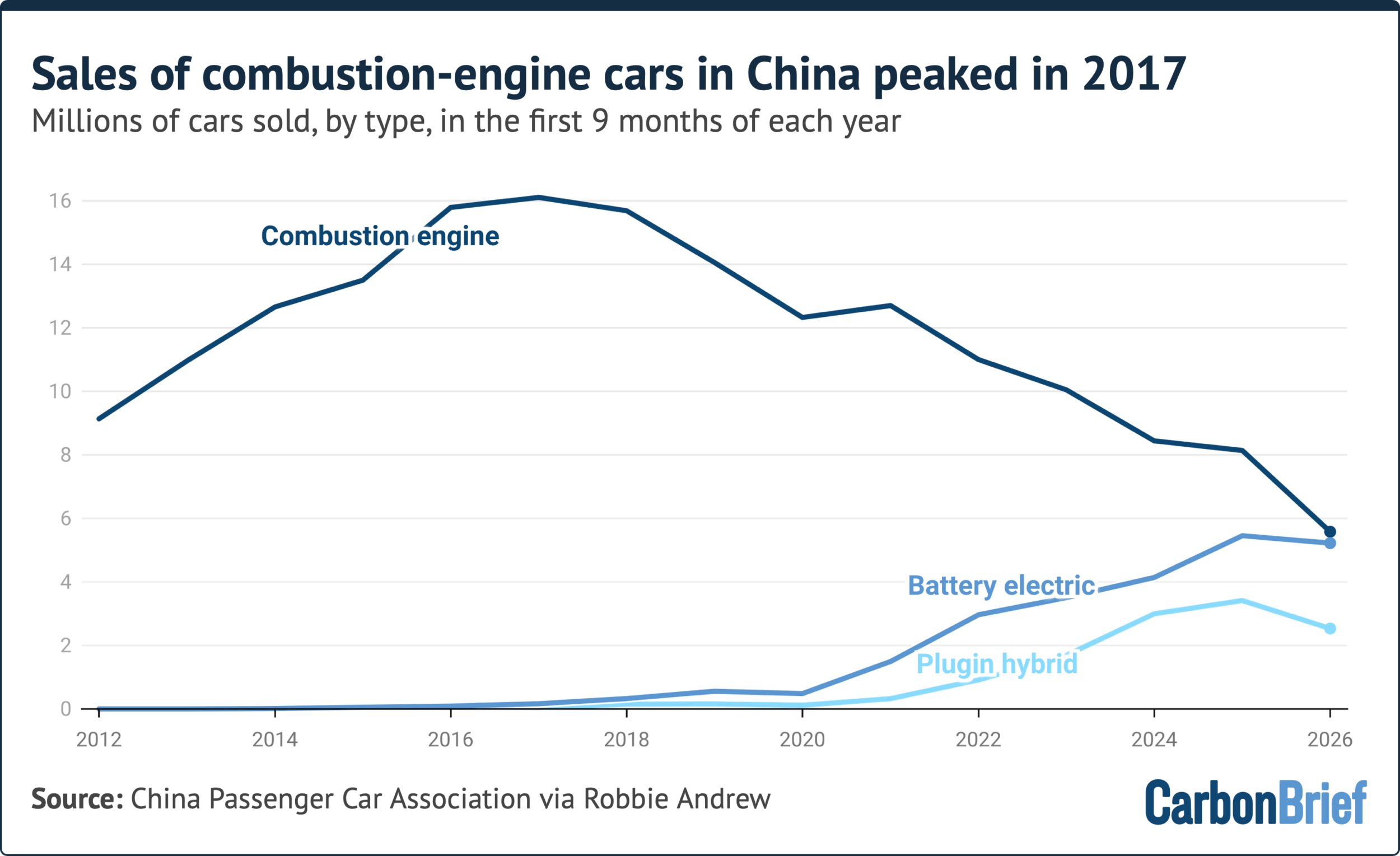
Indeed, sales of fuel-only cars were down 31% year-on-year in the first nine months of 2026, with plug-in hybrid sales down 26% – whereas battery EV sales were only down 4%.
One analyst tells Carbon Brief that China’s rapidly growing EV fleet has offset demand for 143m barrels of oil since the start of the Hormuz crisis.
Another says that the crisis is “reinforcing China’s electrification of road transport”.
Meanwhile, amid slowing domestic sales, Chinese carmakers’ exports of NEVs more than doubled [in 2026 to date / in September] from a year earlier.
NEV record
A record two out of every three cars sold in September in China were NEVs, according to CPCA data, as shown in the figure below.
(NEVs predominantly include battery electric vehicles – BEVs – and plug-in hybrids – PHEVs. BEVs only run on electricity, whereas PHEVs also have a combustion engine.)
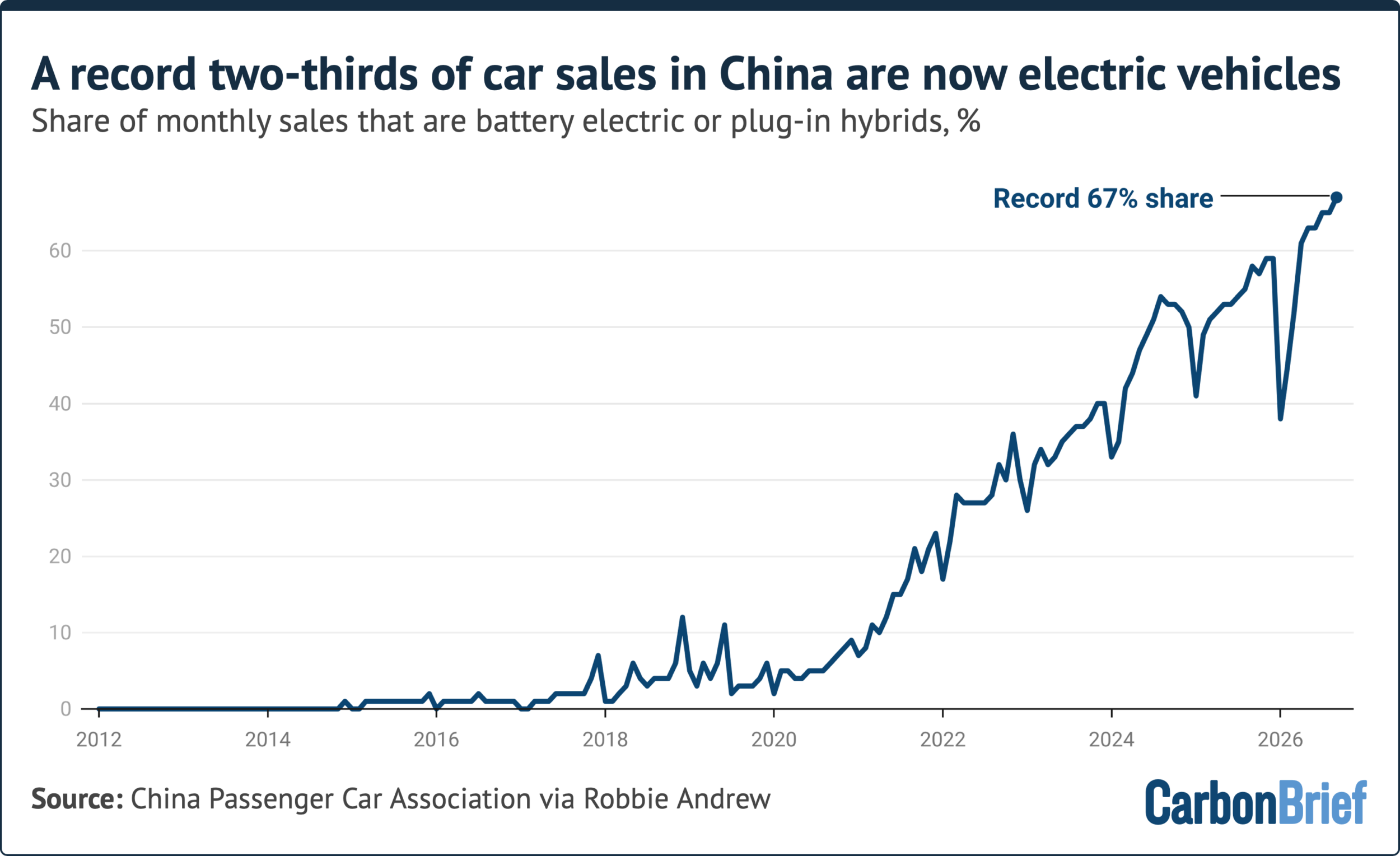
This marks a rapid rise for NEVs from just 6% of new car sales in 2020 up to 58% in 2026 to date – and a record 67% in the month of September.
This year, NEVs’ share of sales has also bounced back from a low of 39% in January, after the full purchase tax exemption that had been in place for more than a decade came to an end in December 2025.
The gain in NEV share in 2026 has come amid a slowdown across the wider domestic passenger-car market, which has hit sales of combustion-engine vehicles particularly hard.
This September, passenger-car retail sales across all categories declined, with overall sales volumes falling 28% year-on-year.
The contraction was led by combustion-engine vehicles, which saw sales fall 43% year-on-year in September and 31% in 2026 to date.
However, sales of PHEVs also fell by 36% year-on-year in September and by 26% in 2026 to date. By comparison, BEVs performed better, although sales still declined 8.5% from a year earlier in September and 4% in 2026 to date.
As a result, NEV sales overall fell by 17% in September and 13% in 2026 to date.
While the market changes in 2026 to date were particularly dramatic, they reflect a broad continuation of trends seen over the past decade.
Indeed, sales of combustion-engine cars in China peaked in 2017 and they have been declining ever since, shown in the figure below.
Impact of Hormuz
Part of the reason for the advance of NEVs in 2026, said Chinese technology news outlet OFweek, was petrol cars “giving up market share” as they were outperformed by electric alternatives.
Cui Dongshu, secretary-general of the CPCA, cited higher petrol prices as an explanation for September’s weak combustion-car sales, in comments to financial news outlet National Business Daily.
Imports of oil into China in January-September have fallen 15% compared to 2025, equivalent to 470m barrels, as ongoing conflict tightened supply and drove up prices.
China’s passenger-car NEV fleet has displaced 143m barrels of oil so far during the strait of Hormuz crisis, Euan Graham, senior energy analyst at thinktank Ember, tells Carbon Brief.
EVs “accounted for 12% of the decrease in China’s oil use post-Hormuz”, according to an estimate provided to thinktank the Brookings Institute by an unnamed analyst.