

After the United States announced last week it would withdraw from the International Renewable Energy Agency (IRENA), effectively slashing more than a fifth of its core budget, the organisation’s head said it could “manage” the US exit, as top officials argued the energy transition is “unstoppable”.
Speaking to reporters at IRENA’s 16th Assembly in Abu Dhabi, Director-General Francesco La Camera said the US had yet to formally notify the agency it would be leaving. IRENA’s statute says withdrawal of a member country takes effect at the end of the year in which it is notified.
Until that point, they remain a member with all its rights, including the right to vote, but also “the duty to pay”, La Camera added.
-
Trump to pull US out of UN climate convention and climate science body
The decision will make the US the only country to leave the UNFCCC, with the UN climate chief calling it a “colossal own goal” that will harm the US economy -
Renewables create fewer jobs globally as energy transition enters “new phase”
The surge in employment linked to clean energy equipment and installation is slowing as large-scale plants and increasing automation require less labour -
Israel’s fossil gas power play pushes climate action to the sidelines
Even as it faces international condemnation over the Gaza war, Israel is working to boost natural gas exports and offshore exploration to strengthen its strategic and regional ties


On Sunday, IRENA’s member countries – around 170 in total – adopted a budget for the coming two years, which shows the US is expected to contribute 22% of IRENA’s core funding, with its share amounting to nearly $5.7 million for 2026.
La Camera said IRENA is already talking to governments and the private sector to fill the potential financial hole if the US does not deliver on its financial obligations, as has been the case in previous years with the UN climate secretariat and the Green Climate Fund.
“We know that some of these usual donors are considering to put something in our budget – we are also trying to get some money from the companies that are part of our initiatives… and we will see other ways that we can pursue,” he added. “I know that we can manage one way or another.”
During country statements made on Sunday afternoon, which were closed to the media, there had been expectations that China might step up to close the gap, but that did not happen.
The United Arab Emirates, Germany and other European nations are substantial government donors to IRENA, although the agency’s core budget has barely risen since 2018, documents show. That has limited its ability to expand its activities even as demand rises across developing countries and small island states for greater technical and policy support to boost renewables.
La Camera noted that, following the US decision to pull out under Donald Trump, IRENA’s council may need to propose amendments to its approved budget for 2026-2027 ahead of its next meeting in May.
Melford Nicholas, minister of information technologies, utilities and energy for Antigua and Barbuda, who is also a newly elected vice president of IRENA, told Climate Home News the US move would “not be an insignificant development” but Europeans had indicated they could help make up the shortfall.
Clean energy for “opportunity and necessity”
At the opening session of the two-day assembly, La Camera and other top officials affirmed the importance of renewable energy as the best choice for energy and economic security at a time of rising geopolitical tensions driven by fossil fuel interests.
Selwin Hart, special adviser to the UN Secretary-General on Climate Action and Just Transition, said the world is clearly changing its energy system to clean sources “not out of idealism, but out of opportunity and necessity”.
He noted that three out of four people live in countries that are net importers of fossil fuels, exposing them to geopolitical shocks, volatile prices and balance of payment pressures.
Examples of this include the rise in gas prices in Europe after Russia’s invasion of Ukraine in 2024 led to sanctions.
“The energy transition is taking place… not only based on climate considerations, but based on costs, based on competitiveness and energy security and energy independence,” Hart added. “These are the driving forces now – hardcore economic, hardcore national security [and] strategic reasons.”
Brazil’s Lula requests national roadmap for fossil fuel transition
In a video message, Annalena Baerbock, president of the UN General Assembly and former foreign minister of Germany, said “we are living in heavy, challenging times” – but despite setbacks and political headwinds, “the march to a renewable energy future has proven unstoppable”.
She added that global renewable capacity has now reached more than 4,400 gigawatts, almost 30 times that of 2015 when the Paris climate agreement was adopted, while a record $2.4 trillion was invested in the energy transition in 2024. “There is no way back,” she added.
However, she and Hart both noted that more needs to be done to support African countries to unlock finance for clean energy, as it lags far behind other regions and receives only around 2% of investment in the sector.
Challenges for small island states
The substantial needs of small island developing states (SIDS) are also front and centre at the IRENA Assembly, where ministers have discussed the challenges of shifting away from costly diesel and other polluting fuels while being exposed to rising climate shocks such as destructive cyclones.
Antigua and Barbuda’s minister Nicholas pointed to the difficulty of gaining insurance for renewable energy facilities as a key barrier in an era when storms can cause huge damage.
This happened in Barbuda in 2017 when Hurricane Irma wiped out a solar plant that was not insured. Governments including the United Arab Emirates and New Zealand helped to rebuild it.

Nicholas said SIDS are still in need of concessional finance, which could “become increasingly challenging for us” in the current international environment.
“It’s an issue, because that retards the speed at which we’re able to get to renewable energy transition,” he added, noting his country is likely to reach an energy mix of around 60% renewables by 2030 rather than the 100% it had aimed for.
Despite the obstacles, ministers from Caribbean countries like St Kitts and Nevis and Dominica showcased examples of planned geothermal plants that will enable them to phase down fossil fuels dramatically.
IRENA’s La Camera said he was optimistic the world would get very close to realising a global goal of tripling renewable energy capacity by the end of this decade, but was still lagging behind on a twin target of doubling energy efficiency by 2030.
To help catalyse a global transition away from fossil fuels, he added that IRENA would work with COP host nations on a roadmap to that end, which they are due to present at the COP31 UN climate summit in Turkey in November, as well as a potential target for electrification consistent with that plan.
The post Governments defend energy transition as US snubs renewables agency appeared first on Climate Home News.
Governments defend energy transition as US snubs renewables agency

Anuradha Barua, Aakriti Wanchoo and Swapan Mehra are from Iora Ecological Solutions, a New Delhi-based company focused on nature-based solutions, climate action, conservation and environmental policy.
When Rojo Neog’s village in northeast India was hit by a power cut in July, he headed out to buy candles. Three days later, his body was recovered – swept away by surging floodwaters. His niece said the water had risen from knee- to neck-level in about half an hour.
The devastating floods highlight how climate risk across India is becoming harder to confine to a season or a disaster bulletin. Just weeks before the disaster in Assam, authorities in Mumbai rationed water as reservoir storage fell to just over 10%.
India does not lack warnings about climate risk. The more difficult task is making sure money, institutions and communities are ready to act before those warnings become disasters. Adaptation should not be just an obligation once a crisis has arrived, but an investment made while there is still something to protect.
-
Bonn climate talks end in “gridlock” on adaptation and emissions-cutting
Splits between developed and developing countries over finance and science held back progress on key areas of climate action, leaving disappointment and much work for COP31

As governments head towards COP31 in Antalya this November, India should push not only for more adaptation finance, but for finance that arrives earlier and can be traced to outcomes on the ground.
That is the gap India needs to close if we wish to become truly resilient in the face of the changing climate. Money must move with risk, institutions must know what to do before an emergency is declared, and long-term spending must reduce vulnerability before it becomes loss.
India’s adaptation disconnect
This year the disconnect has become painfully clear in Assam, where more than 100 people have died due to the flooding, with nearly 140,000 people across seven districts affected. More than 450 villages remain inundated, while some 49,000 people are taking shelter in relief camps after losing everything.
No financing mechanism can stop a river from rising. But timely measures can change what happens before it does. If forecasts and river levels triggered financing before the water arrived, authorities could position boats and stock shelters, and evacuate people where needed, while families could move cattle, seed, medicines and documents before roads disappeared.
For Indian women workers, a just transition means surviving climate impacts with dignity
India already has much of the information needed to address climate change. High-risk states and districts should agree in advance which local thresholds trigger action, who is responsible and how funds will be released, so officials do not have to negotiate responsibility and budgets from scratch once risk becomes an emergency.
Linking community know-how to financing
Our work in Majuli, a river island district in Assam, shows why this matters.
Across 64 villages, communities helped identify flood and erosion risks, assess their capacity to respond, and to develop resilience measures with indicative budgets and possible funding sources.
Communities often know what would help; the harder task is connecting that knowledge to institutions and finance that can act on it.
Extreme heat costing India’s poorest workers 2% of GDP, survey finds
Public health offers an example of how systems can adapt as risks change. In New Delhi, vector-control workers who once prepared for a defined “dengue season” now remain on alert throughout the year, using surveillance and hotspot mapping to identify risks earlier.
The next step is to make these systems more predictive by integrating climate forecasts into public health planning.
India needs sustained investment in drainage, health systems, wetlands, water security and climate-resilient agriculture. Some will remain public responsibilities; others, including water reuse, efficient irrigation, resilient cold chains and risk-proofed infrastructure, can generate savings or revenue and attract private capital if projects are prepared well.
The economic case for adaptation is not always about generating new revenue. Often, it is about avoiding future costs. Flood shelters, public-health preparedness, early-warning systems and support for the poorest households will still need public or grant finance. The point is to match the finance to the risk rather than treat adaptation as a single financing problem.

Rising disaster bill shows cost of inaction
India is already spending heavily on adaptation, with related expenditure reaching 5.6% of GDP in 2021-22. Yet tracked adaptation finance was only about $15 billion annually, almost entirely from domestic public sources, against estimated needs of about $100 billion a year through 2030.
Internationally, the shortfall is wider: developing countries may need $310 billion-$365 billion annually by 2035, compared with just $26 billion in international public adaptation finance in 2023.
For governments repeatedly paying for flood, droughts and heat relief, the cost of inaction can quickly exceed the cost of building resilience, though not all the costs of inaction appear neatly on a balance sheet.
In floodplain landscapes such as Assam’s Kaziranga National Park, animals move towards higher ground every monsoon as the floodplain fills, crossing roads and leaving the park in search of safety. During the 2024 floods, 215 animals died, including 13 one-horned rhinos.
Development plans in such sensitive landscapes must leave room for water, wildlife and communities to move safely. A wetland may not generate monetary revenue, but the floodwater it stores has real value. The cost of losing that capacity may only become visible when the next flood arrives.
Comment: Climate adaptation in Africa needs investment, not imported solutions
Success should not be measured only by how quickly relief follows a disaster. It should also be measured by what never had to be replaced: people and animals moved before the water rose, seeds kept dry, medicines waiting at the shelter, a wetland that still had room to hold water, and a family that could leave while the road was still open.
Adaptation becomes an investment when it preserves those choices before they disappear.
The post India needs climate adaptation cash to be an investment, not a quick fix appeared first on Climate Home News.
India needs climate adaptation cash to be an investment, not a quick fix
The African continent’s hopes for a legally binding agreement to combat drought have been dashed again, as UN land restoration talks in Mongolia passed the issue onto the next set of talks in Egypt in two years’ time.
For over a decade, Africa has pushed for a UN protocol on drought risk management that would acknowledge drought as an issue requiring a regional and global – not just a national – response, potentially paving the way for more finance to help ensure water is available when drought hits.
A formal protocol would enable countries to transition from reacting to drought once it hits to “a proactive enabling mechanism to address drought and its effects such as migration”, said a Tunisian negotiator on behalf of the African Group of countries last week. Once land is regularly too dry and infertile to grow crops or graze animals, people often leave to seek a living elsewhere.
But this effort to adopt a protocol, led by Africa, has been resisted at successive land restoration COPs under the UN Convention to Combat Desertification (UNCCD), mainly by developed countries, which argue that a legally weaker alternative – a framework – would be faster and cheaper to set up.
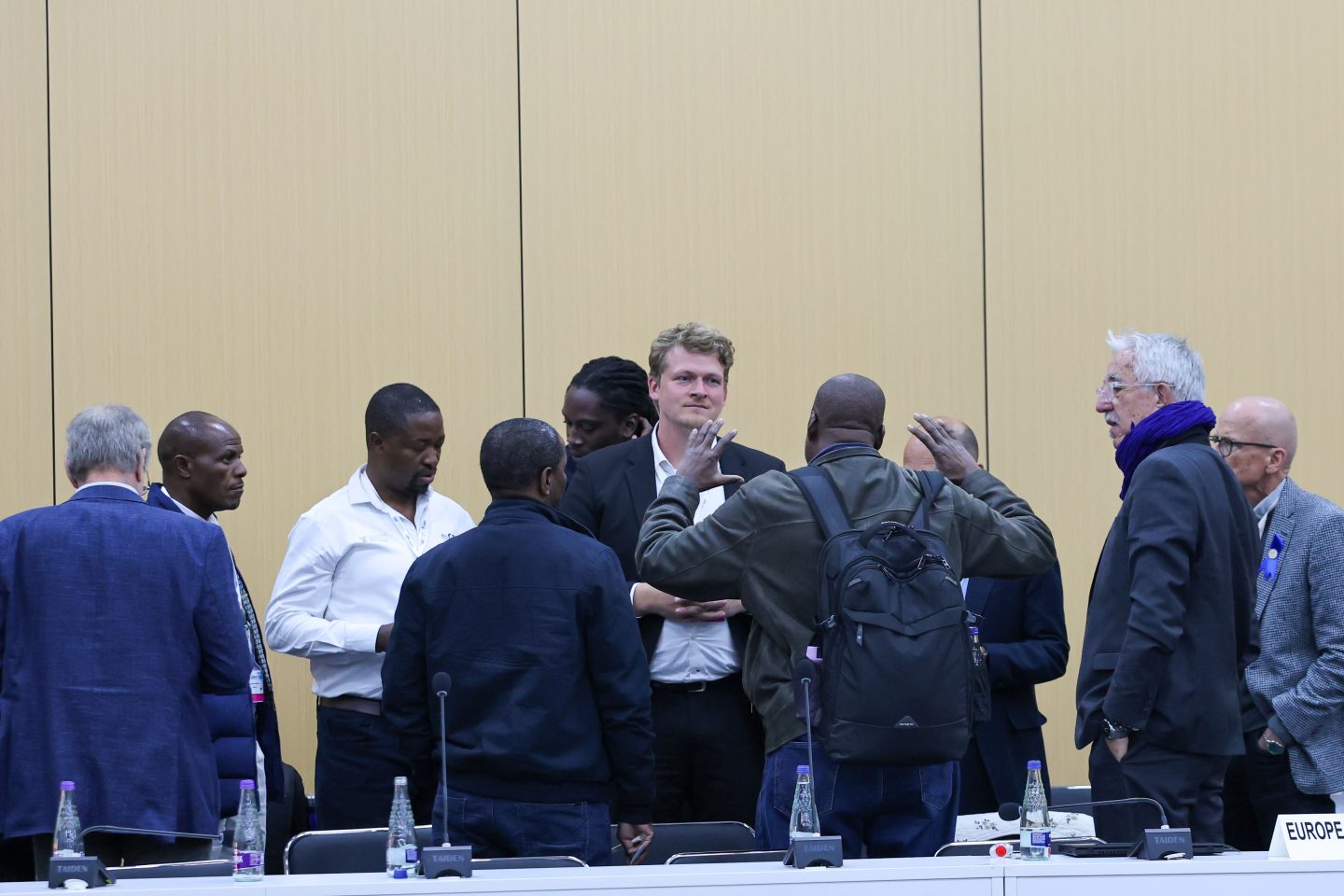
Governments at the previous COP in Saudi Arabia in 2024 failed to reach agreement despite talks running past midnight, while this year’s saw African officials coordinate a walkout from negotiating rooms on Wednesday morning, according to two sources at the talks.
Drought deal delayed until 2028
The IISD’s Earth Negotiations Bulletin, a non-governmental organisation which unlike the media is allowed to watch and report on closed-door talks, said a call to suspend negotiations on Wednesday showed negotiations had reached “boiling point” and “made some jaws drop”.
Negotiations resumed after a lunchtime meeting with the Mongolian COP presidency although governments were only eventually able to agree that they could not find consensus in Ulaanbaatar and should resume talks on an instrument to deal with drought in 2028.
Christine Colvin, WWF’s head of freshwater policy, told Climate Home News that, with droughts hitting from Honduras to the English region of Hampshire, something concrete – whether a protocol or a framework – is needed urgently “rather than the can being kicked down the road for another two years as will now happen with the protocol procrastination”.
But, in a closing press conference on Friday, the Mongolian minister presiding over talks celebrated that governments had reached consensus on several “contentious” issues and that agenda items blocked at this year’s COP17 would be put on the agenda for COP18 in Egypt.
US blocks agenda items
Other agenda items that divided countries were on measuring land degradation’s effects on women, enhancing the involvement of civil society and women in land COPs, and the UNCCD working more closely and effectively with the UN’s climate and nature conventions.
On the COP’s opening day two weeks ago, the US representative said the Trump government objects to these agenda items “on their premise and no amount of negotiation will allow us to join consensus on these items. As such we request that they be struck from the agenda at which time we will then be able to approve it, saving us valuable negotiating time.”
A US State Department spokesperson later told Climate Home News that the US wants the UN “to get back to basics by refocusing on its core mandate, eliminating overlap, and reducing competition for scarce resources”.
The spokesperson added, “that means prioritising the concrete work member states created [the UN] to do – rather than diverting limited time, attention, and resources toward social and political agendas, including gender-related initiatives.”

On COP’s first day, the European Union and Brazil pushed back against the blocking of these agenda items, with a Brazilian negotiator saying his country attaches “great importance” to them. But the Mongolian presidency directed governments to adopt the rest of the agenda without the controversial items, which were discussed privately with countries throughout the two weeks.
An EU statement, read out later by Irish minister Timmy Dooley, accused “some parties” (meaning national governments) of having adopted a “less constructive approach” and preventing “discussions on important matters from even commencing”.
The agenda items the US refused to engage with were never discussed and were only placed onto the agenda for the next COP on the last day. Those talks will take place in Egypt in two years’ time, with Donald Trump due then to be in his last year as US president.
No restoration without women
The blocking of the gender agenda item has stymied attempts, agreed on by governments at the last COP, to develop gender-specific indicators for the UNCCD’s next overall framework and to facilitate more women delegates at COPs. Women made up only about a quarter of delegates to COP15 in 2022, UNCCD analysis with the latest data shows
Criticising the move to keep gender off the agenda, the EU said in a statement that it welcomes “the attention being given at COP17 to women pastoralists and herders, recognising their contribution to sustainable land management and resilient rural livelihoods”.
The head of the UNCCD, former Egyptian environment minister Yasmine Fouad, said on Friday that “regardless that the agenda item was blocked”, she was proud that she and COP17 President Batmunkh Battsetseg had led the COP as women and attended the gender caucus (a meeting of groups supporting women at the talks).

“Without the women,” she told the closing press conference on Friday, “we will not be able to restore land, restore hope, restore life or restore even our children and grandchildren. And we will keep on pushing that agenda.”
The civil society agenda item aimed to allow NGOs to attend land COP negotiations, as they do at climate COPs, and included terms of reference for an Indigenous Peoples Caucus.
A representative of Indigenous Peoples told the COP’s closing plenary meeting that the group had “deep disappointment that the agenda of this COP has removed the dedicated space for indigenous peoples”. “We cannot restore the land while removing the voices of those who care for it,” she said.
On Tuesday, the UNCCD’s deputy head Andrea Meza was asked about Indigenous Peoples’ participation. She said that the blocking of “one agenda item” is “generating uncertainty in the progress” towards creating caucuses for Indigenous Peoples and for Local Communities within the talks.
Because of the “complex geopolitical situation” making it hard to obtain consensus, coalitions of the willing have become more important, she added.
Mining out, money in
Outside the formal negotiations, the summit was marked by a focus on the strongly Mongolian issues of the role played by pastoralists and rangelands like grasslands, as well as mining, in both degrading and restoring land.
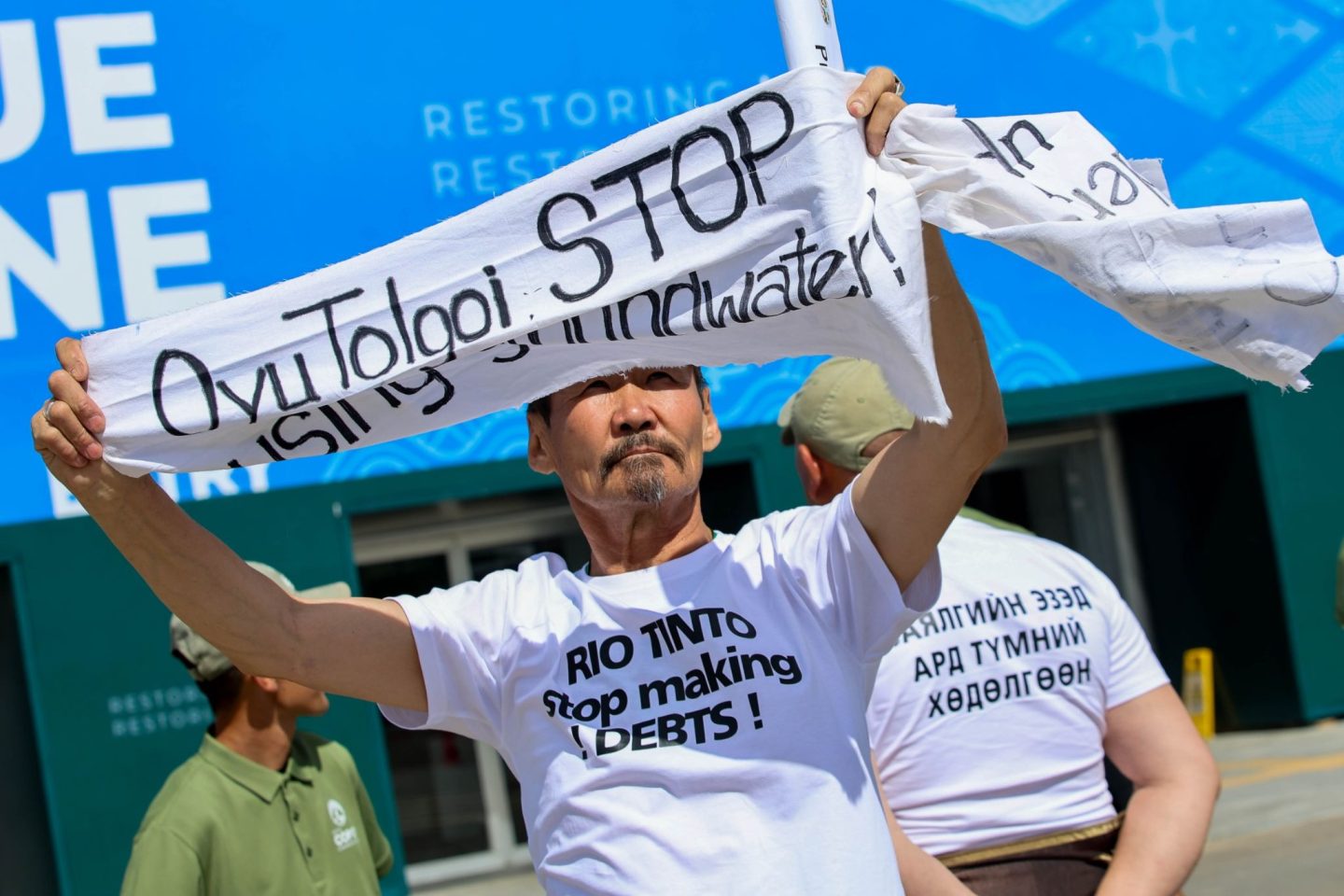
Part of the conference was sponsored by Australian mining company Rio Tinto and its local partner Oyu Tolgoi. Their presence was protested by campaigners wearing T-shirts calling on the companies to “stop wasting drinking water” and to “get out of Mongolia”.
The UNCDD and others praised the success of the summit in raising more finance for land restoration. The COP saw institutions like the Asian Development Bank and Global Environment Facility pledge money to combat land degradation, with the UNCCD estimating that $645 million of new commitments were made.
An estimated $355 billion a year is needed through 2030 to meet global land restoration commitments, compared with around $77 billion currently invested. Private finance accounts for only around 6% of global investment, according to the UNCCD.
UNCCD chief scientist Baron Orr told a press conference that many of the announcements were public-private partnerships that use government money to “even the playing field” for companies that want to protect land, in a bid to ensure they are not disadvantaged compared with those that do not.
Such partnerships are a “huge opportunity”, he said, especially as “we’re not in a moment of public finance – public finance is tight in every country.”
The post Despite African walkout, fractious land COP ends without drought deal appeared first on Climate Home News.
Despite African walkout, fractious land COP ends without drought deal
Burdened by rising fuel import costs and an “ocean crisis” of record-breaking heat, Pacific island nations are seeking to build support for a new regional fund ahead of COP31, intended to channel investment into renewable energy, community resilience and ocean protection, experts said.
Leaders from the 18-member Pacific Islands Forum (PIF), including Australia and New Zealand, are expected to issue a call for global pledges to the Pacific Resilience Facility (PRF) at a high-level meeting this coming week in Palau, seeking to build a new model for financing climate action.
The new regional fund was formally launched in May this year and is meant to “serve communities at a community level”, swiftly channelling investments for their projects on the ground, according to Fiji’s assistant minister for foreign affairs, Lenora Qereqeretabua.
“We are expecting pledges for the PRF, and these funds will go to communities that apply,” she told journalists at an online briefing. “We have organised it in such a way that it makes our application processes much, much easier than applying for global funding.”
Qereqeretabua added that she expects that PRF funds will be “utilised by communities to protect themselves from climate change and the effects of climate change.”
The Pacific Islands Forum meeting is expected to shape the region’s priorities ahead of this year’s pre-COP, hosted by Fiji and Tuvalu, and COP31, which will be co-led by Australia and Türkiye.
At COP31, a dedicated session on the climate finance needs of small island states will seek to drive pledges into the PRF. The fund has so far received about $172 million in capital – with about $67 million coming from Australia – and aims to close the year with $500 million.
-
Battle over cleaning up shipping set to resume at London talks
The US and Saudi Arabia want to scrap shipping’s Net-Zero Framework and have swung behind a far less ambitious alternative -
As marine heat breaks records, countries seek ocean roadmap at COP31
Africa and the EU are leading a push for COP31 to deliver a roadmap that lays out measures to protect fast-warming oceans -
Indonesia’s nickel production cuts are not enough to create a sustainable industry
The government is restricting nickel production to push up prices but producing more sustainable nickel for a premium requires addressing the industry’s coal issue


Ocean heat and fossil fuel shocks
Leaders from the Pacific will meet in Palau from Sunday amid an “ocean crisis” of record-breaking ocean heat caused by this year’s “super El Niño”, according to Kevin Chand, Pacific ocean policy director at National Geographic’s Pristine Seas conservation project.
Leaders at the PIF are expected to put forward commitments towards new marine protected areas, which will be key for shielding ecosystems from future climate extremes, Chand said. The forum is expected to issue a statement on the need for ocean action at COP31, and announce commitments towards reaching the global goal of protecting 30% of the planet’s land and sea ecosystems by 2030.
Rising ocean heat could lead to food insecurity and lost government earnings in the region, as key fish stocks like tuna start migrating away from their coastline in search of colder waters, said Coral Pasisi, director of climate change and sustainability at the Pacific Community (SPC).
Climate shocks are deepening existing economic pressures, as Pacific nations have spent up to a quarter of their GDP on fossil fuel imports due to the war in Iran, according to a recent report by the University of New South Wales (UNSW) in Australia.
Wesley Morgan, one of the study’s authors, told journalists that partner nations “ought to be putting their money where their mouth is”, and should support the energy transition in the Pacific by covering the upfront costs of switching from polluting diesel to solar power, batteries and electricity grid upgrades.
China keeps Indonesia’s battery dream afloat but future less certain
Given the increase in climate-related shocks and sea-level rise, the PIF should also mention the need to phase out fossil fuel extraction and consumption, said Sindra Sharma, international policy lead at the Pacific Islands Climate Action Network (PICAN).
Last year’s COP30 failed to deliver a global roadmap on transitioning away from fossil fuels, which led to a group of countries – including several Pacific island nations – pursuing their own fossil fuel phase-out summit in Santa Marta, Colombia. Next year’s conference will be hosted by Tuvalu and co-chaired by Ireland, which should also receive backing from the PIF, Sharma said.
Both the chairs of the Santa Marta coalition and the Australian COP31 co-presidency have vowed to continue a push for this topic to be discussed at COP31.

New fund to test allies
As local communities in the Pacific struggle to access global climate funds, the PRF’s planned model for quick, direct disbursements has “very solid and good” intentions, Sharma said, but it will need political and financial backing from donor countries.
“The proof is going to be when the fund actually starts operating and delivering to communities,” she added. “If there is too much bureaucracy in being able to access the funds, for example. These things will have to be scrutinised.”
The facility aims to deliver funds in two categories: one for climate adaptation and “disaster resilience”, and another for social and community resilience that includes areas like community capacity-building, education, data analytics and financial management, among others. It will launch its first call for proposals at the PIF.
Morgan added that Australia will need to “leverage global interests” so that funding is directed to the Pacific Resilience Facility “or else the Pacific won’t be able to trust Australia as a partner”. The country ratified the PRF treaty in May, triggering its entry into force.
“The perception [of Australia] in the region is genuinely divided, and it’s worth being honest about it,” Sharma said, adding that the pre-COP31 in Fiji, which is usually limited to a technical space for negotiations, will determine how meaningful Australia’s advocacy for the Pacific can be.
This time, Pacific nations want to use the pre-COP in early October as an opportunity to demonstrate the challenges their largely low-lying islands face and to advocate for their political priorities, including a renewed global effort to limit global warming to 1.5C by cutting emissions faster and deeper. World leaders are due to visit Tuvalu to experience the frontline of rising sea levels, although Australia and Fiji have yet to confirm who will attend.
“In Bonn, Australia was largely missing on the negotiated outcomes that we so urgently need to see. It’s not enough to get Pacific priorities on the agenda. Agenda placement is not delivery,” Sharma added.
The post Pacific islands seek backing for new regional fund ahead of COP31 appeared first on Climate Home News.
Pacific islands seek backing for new regional fund ahead of COP31



-
Climate Change1 year ago
Guest post: Why China is still building new coal – and when it might stop
-
Greenhouse Gases1 year ago
Guest post: Why China is still building new coal – and when it might stop
-

 Greenhouse Gases2 years ago
嘉宾来稿:满足中国增长的用电需求 光伏加储能“比新建煤电更实惠”
-

 Climate Change2 years ago
嘉宾来稿:满足中国增长的用电需求 光伏加储能“比新建煤电更实惠”
-
Climate Change2 years ago
Bill Discounting Climate Change in Florida’s Energy Policy Awaits DeSantis’ Approval
-

 Renewable Energy10 months ago
Sending Progressive Philanthropist George Soros to Prison?
-
Greenhouse Gases1 year ago
嘉宾来稿:探究火山喷发如何影响气候预测
-

 Carbon Footprint2 years ago
US SEC’s Climate Disclosure Rules Spur Renewed Interest in Carbon Credits