Connect with us

Published

on

In Australia, as the commercial real estate landscape started to shift, the property owners are facing greater
pressure to adapt to the new environmental standards.

However, those who lead with the smart energy solution are the ones who are gaining the real advantages.

You might be wondering how. Well, the answer is simple: by adding solar panels, you can turn your rooftops into
active assets, producing clean energy that not only reduces
energy bills
but also increases your property values.

Additionally, nowadays, modern tenants and investors are demanding more from the buildings they lease or buy. They
look for sustainability, efficiency, and long-term value.

And guess what? Solar ticks all the boxes that are best for your commercial property.

Data says, in Australia, properties equipped with solar are seeing low operating costs, offer better energy
performance ratings, and increased appeal in the market, making your asset more resilient in this competitive
market.

So now let’s move forward and discover how solar power helps commercial properties increase property value in
Australia and why it might be the smartest move for you, too!

Solar Power: Is It More Than Just an Energy Solution for Today’s Renters?

As the rental market evolves, one thing is clear: today’s younger generations are leading the charge toward sustainability. They are more environmentally aware than ever before, and their housing choices clearly reflect that.

If you look deeper, you’ll understand that they’re not just looking for a place to live; they’re seeking spaces that align with their values and support a greener lifestyle.

Having energy-efficient appliances, smart thermostats, solar panels, and low-impact building materials, along with amazing solar products, can be a real luxury.

These features not only help reduce energy costs but also empower tenants to live in ways that align with their environmental beliefs.

A recent research backs this trend, that in one, over 70% of millennial renters say they’d prefer to live in a sustainable building, and many are even willing to pay a premium for eco-friendly upgrades.

With that being said, property owners and managers can take this as a key opportunity.

Thinking how?

By investing in green features, they can increase their property’s appeal, reduce operational costs, and tap into a market of renters who are ready to make a long-term commitment to the environment.

Do Solar Installations Boost Commercial Property Value? | How?

Yes, installing a solar panel on your property can actually increase its value.

Let’s break down the economics of solar panels and exactly how these can increase the value of a commercial property in Australia:

1. Reduced Operating Costs, Increased Net Operating Income!

One of the most straightforward, compelling reasons solar increases property value is through reduced electricity bills.

When a commercial building generates its own energy, it ultimately draws less from the grid, lowering operating costs.

In any commercial property valuation, Net Operating Income (NOI) plays a significant role. Therefore, when operating costs go down, NOI goes up. This increase in NOI directly translates into a higher property value.

2. A Marketing Tool for Eco-Conscious Tenants & Investors

For Australians, sustainability is no longer just a concern. With frequent bushfires, floods, and other catastrophic environmental disasters, residents and businesses are under increasing pressure to reduce their carbon footprint.

Tenants, especially large corporations, are actively seeking green-certified buildings with renewable energy capabilities to make this transition faster.

By installing solar, property owners can meet this demand, offering carbon-neutral or low-emission facilities that meet tenants’ sustainability goals. This makes the property more attractive, competitive, and often allows for premium lease terms or lower vacancy rates.

Therefore, buildings with green stars or energy efficiency ratings powered by renewables make you stand out in a competitive market.

3. Higher Rent Premiums: Revenue Generation

Whether you are in Australia or any part of the globe, always remember one thing that green buildings command higher rents.

According to the Green Building Council of Australia, sustainable buildings can attract up to 5-10% more in rental income, depending on their rating and energy profile.

In Australia, commercial electricity prices have seen dramatic increases over the past decade, making solar-powered properties particularly appealing.

For these electricity price volatility tenants are often willing to pay more for buildings with lower ongoing energy costs instead of paying extra for electric bills. These commercial properties with solar can participate in net metering programs.

That’s not the end, you can also earn credits from feed-in-tariff programs for sending excess solar power into the grid.

4. Government Tax Incentives and Financial Benefits

The Australian government offers several financial incentives that further enhance the ROI of solar installations on commercial buildings.

Eager to know them? Let’s take a look:

  • In some states like VIC and NSW, eligible businesses can claim an immediate deduction for the business portion of the cost of the solar system.
  • Small-scale Technology Certificates (STCs) and Large-scale Generation Certificates (LGCs) are part of Australia’s Renewable Energy Target and offer rebates or tradable credits for solar installations.

Not only solar panels, but the Australian government also offers federal battery rebates to make solar widely available. For example:

  • Cheaper Home Batteries Program: Launched on July 1, 2025, this program offers approximately 30% off on eligible home battery installations. For eligibility, you have to follow a few criteria.

These incentives help to make the payback period on a solar investment short, like between 3–5 years, while the panels themselves last 25+ years.

5. Future-Proofing Against Energy Price Volatility

Energy prices in Australia are already among the highest, and they’re expected to rise further due to grid upgrades, supply challenges, and fossil fuel market fluctuations.

So, through energy production with solar, commercial buildings become less vulnerable to future price shocks, offering greater resilience that’s highly attractive to both investors and long-term tenants.

How Much Can Solar Increase Property Value in Australia?

If you are planning to install solar panels on your property, the first thing that comes to mind is:

How much is solar actually worth when it comes to commercial property valuation? Do commercial solar panels increase property value in the long term?

However, the results might vary based on location, system size, tenant profile, and property type.

Solar Value Formula: NOI / Cap Rate

In commercial real estate, one of the most reliable methods to estimate how much solar increases value is by using this formula:

Increased Property Value = Annual Energy Savings ÷ Capitalisation Rate (Cap Rate)

Here, the capitalization rate of a property is calculated by dividing the annual net operating income, or NOI, by the property’s market value.

Let’s look at a real-world example.

For Example:

  • A warehouse installs a 100kW solar system
  • Annual energy savings = $25,000
  • Local market cap rate = 6%

$25,000 / 0.06 = $416,666 increase in property value

So, this reveals that even modest energy savings can translate into substantial value increases, especially in low cap rate markets where demand for well-performing commercial assets is high.

Average Value Increase in Australia

Based on case studies and market reports from Australian solar providers and commercial property analysts:

  • Small commercial buildings, such as retail shops, offices, you can expect $30,000–$100,000 added value from a 20–50kW system.
  • In mid-size warehouses or offices, the value increase can be $150,000–$400,000 after adding a 50–100kW system.
  • On large commercial or industrial properties, a $500,000+ value boost is possible with systems over 100kW.

Are There Any Hidden Values?

Besides satisfactory direct financial value, solar also delivers indirect value for its owners. This includes:

Tenant Retention: Solar helps to secure long-term leases by lowering energy costs, making tenants more likely to stay.

Marketing Advantage: Properties with solar are easier to lease or sell for their amazing cost-saving features.

Sustainability Ratings: Solar boosts your Green Star scores, improving your asset’s value.

Future-Proofing: With solar, your asset’s resale value increases, shielding your property in a carbon-constrained future.

Commercial Solar Installation Effect: Real-World Case Studies with Cyanergy

Here, we shared two of our most impactful commercial solar installation stories, showing how businesses not only slashed their energy costs but also increased their property value through smart investment using solar power.

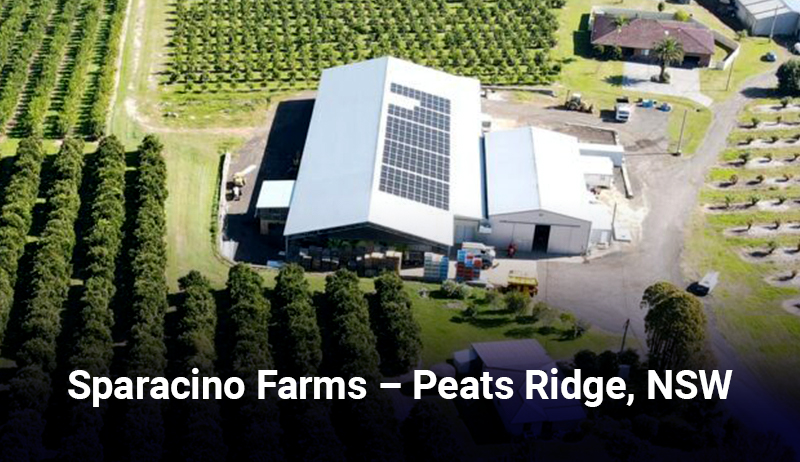
Case Study 1: Sparacino Farms – Peats Ridge, NSW

Sparacino Farms is a large farming operation in New South Wales. The fruit farm was facing high electricity bills of around $48,000 per year due to irrigation pumps, machinery, and other agricultural systems.

To cut these rising energy costs, they partnered with Cyanergy to install a 99.76 kW solar system for the farm and a 27.7 kW system with a solar battery for the owner’s residence.

Primary Goal: Reduce electricity costs and become more energy independent.

Size & Investment: 99.76 kW commercial system for the farm + 27.7 kW plus 19.2 kWh battery for the residence.

Total investment = $96,819.05.

Financial Impact: Yearly electricity cost dropped from about $48,000 to $12,000 — a 75% reduction. Monthly savings are around $3,000 with a 30-month payback period.

Impacts on Property or Business Value:

  1. Adding solar improved cash flow and profitability due to significantly reduced operating costs. This makes the business or farm more financially attractive to investors or lenders.
  2. Reduced exposure to rising electricity prices provides long‑term cost savings, which adds stability to the property or business.
  3. Sustainability credentials add value and brand reputation, possibly qualifying for other incentives or attracting buyers who value green, sustainable farming.

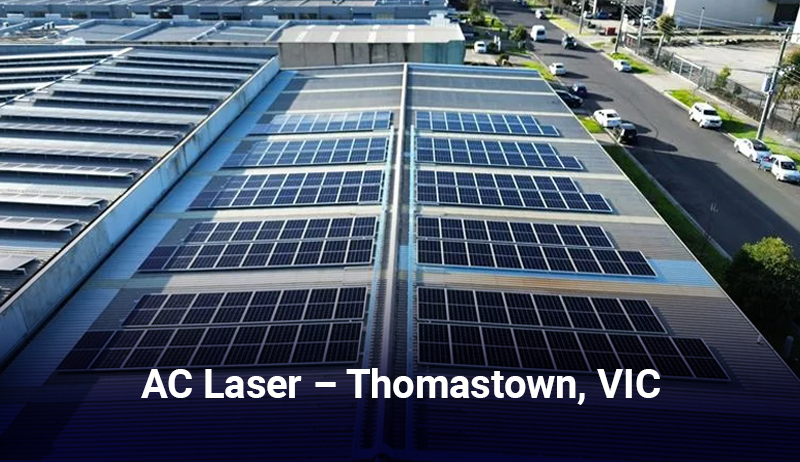
Case Study 2: AC Laser – Thomastown, VIC

AC Laser is a precision laser-cutting and manufacturing business that uses significant electricity for its machinery.
They were spending around $79,000 annually on power.

However, Cyanergy’s expert team installed a 99.45 kW solar system to offset these costs, enhancing sustainability.

Primary Goal: Reduce energy expenses to increase profitability and long-term sustainability.

Size & Investment: 99.45 kW system with investment of approx $90,600.

Financial Impact: Annual electricity cost dropped from roughly $79,000 to
$38,160, with a Payback period of 26 months.

Property and  Business Value Impacts:

  1. Lower operational costs improve profitability, which contributes to a higher valuation.
  2. Better property desirability for tenants or buyers as the cost of occupancy or operations is lowered.
  3. Mitigating risk by minimizing dependency on grid power and protecting the business from electricity price
    volatility.

  4. A long lifespan adds more value to the commercial property.

Things to Consider Before Installing Solar on a Commercial Property

Even though the benefits of solar power are clear, you have to ensure successful installation and proper planning. Here’s how you can proceed

  • Check your roof Condition to ensure it’s safe and has enough surface area.
  • Keep track of your energy Load Profile.
  • Research about grid connection and export limits, as some areas have limitations.
  • Find suitable financing options, such as solar leases, PPAs, or green loans.
  • Ensure proper agreement with local councils, state energy regulations, and network providers.

Working with an experienced commercial solar installer can help you navigate these issues and design a system that maximises ROI.

Concluding Thoughts

From all of the above information, maybe you understand, it’s no longer a question of if solar makes sense for
commercial property; it’s a question of how soon you can make it happen.

But remember, working with an experienced commercial solar installer can help you navigate any solar-related issue
faster. They also help you by designing a system that maximises ROI.

Do you want to maximize the value of your commercial property?

Contact us and talk with our expert team without any further
delay. So, from today, start saving while increasing your property value with Cyanergy’s commercial solar solutions.

Your Solution Is Just a Click Away

The post How Solar Power Increases Commercial Property Value?  appeared first on Cyanergy.

How Solar Power Increases Commercial Property Value? 

Continue Reading

Renewable Energy

CIP Buys Ørsted EU Onshore Wind

Published

on

Weather Guard Lightning Tech

CIP Buys Ørsted EU Onshore Wind

Allen covers CIP’s €1.44 billion buyout of Ørsted’s European onshore wind, the new Perigus Energy name, and Vestas paying €506 million for its stake in the firm.

Sign up now for Uptime Tech News, our weekly newsletter on all things wind technology. This episode is sponsored by Weather Guard Lightning Tech. Learn more about Weather Guard’s StrikeTape Wind Turbine LPS retrofit. Follow the show on YouTubeLinkedin and visit Weather Guard on the web. And subscribe to Rosemary’s “Engineering with Rosie” YouTube channel here. Have a question we can answer on the show? Email us!

In Denmark, there is an old expression. “What goes around comes around.” The founders of Copenhagen Infrastructure Partners — known in the industry simply as CIP — know exactly what that means.

Back in 2012, four executives were fired from DONG Energy, the Danish energy giant that would later rebrand itself as Ørsted. Their offense? Their paychecks were considered too large. So large that DONG Energy’s own CEO was forced out as well. Four men shown the door were. A year later, a woman joined them from that same company. The Danish press had a name for these five. They called them “the golden birds.”

With six billion Danish krone from the pension fund PensionDanmark, they launched what is now one of the world’s largest clean energy fund managers.

In 2020, turbine maker Vestas purchased a 25 percent stake in CIP. The deal included a performance-based earn-out arrangement. This week, the books revealed the size of that windfall.

The five partners have now collected a combined 1.8 billion Danish krone — roughly 240 million euros. Vestas expects to make one final payment of 71 million euros this year. Including interest, Vestas will have paid 506 million euros for its stake in CIP. Not a bad return for a group of people who were shown the door.

And. This week, CIP completed its acquisition of Ørsted’s European onshore wind business for 1.44 billion euros. They renamed it Perigus Energy. The new company holds 826 megawatts of wind and solar capacity, operating in Ireland, Germany, the United Kingdom, and Spain.

Let that circle close. The executives fired from DONG Energy — the company that became Ørsted — just bought Ørsted’s business.

Meanwhile, CIP’s annual report for 2025 tells the story of a company in transition. Profit for the year came in at 561 million Danish krone, down from 683 million the year before. The employee count fell by nearly a fifth, to 441 people. And yet, their CI Five fund closed this year at 12.3 billion euros — the largest greenfield renewable infrastructure fund ever raised. Looking ahead, CIP expects profit of 600 to 800 million Danish krone in 2026 as new fund closings take shape.

So the picture this week is this. The men and women once considered overpaid, at a company that no longer carries the same name, have built the world’s largest greenfield renewable energy fund. And they now own a piece of the legacy that fired them.

The golden birds are still flying.

And that is the wind energy news for the fourth of May, 2026. Join us for more on the Uptime Wind Energy Podcast.

CIP Buys Ørsted EU Onshore Wind

Continue Reading

Renewable Energy

We Need to Choose Our Online Influencers More Carefully

Published

on

Here’s Lucy Biggers, social media powerhouse, explaining how solar and wind energy actually aren’t free, because they require materials that need to be mined from the Earth.

Yes, Lucy.  I think most of us already knew that.

It’s hard for me to understand how a person with zero training in science has any relevance to what climate scientists are telling us. If I want a good recipe for carrot soup, I don’t ask a baseball coach or an auto mechanic.

They call this woman an “influencer.” What type of idiot does she influence?

We Need to Choose Our Online Influencers More Carefully

Continue Reading

Renewable Energy

Are We that Dumb?

Published

on

Yes, part of this is stupidity.  But a larger part is that people who still support Trump at this point are desperate to believe whatever comes out of his mouth, regardless of how nonsensical it may be.

I wish my mother were still here so I could see where she would stand.  She was extremely well-educated, and a voracious reader, but somehow remained a Fox News viewer until the end.  I just wonder if the last 15 months may have turned her around.

Are We that Dumb?

Continue Reading

Trending

Copyright © 2022 BreakingClimateChange.com