

After Brazil’s COP30 presidency insisted on its plan to gavel through a political package on some of the most divisive issues at the UN climate talks “very late” on Wednesday, promised new draft texts had yet to materialise by early evening.
Brazilian President Luiz Inácio Lula da Silva is in town for a series of high-level meetings, including talks with delegations from the EU and China. UN Secretary-General António Guterres is also conducting bilateral engagements on the sidelines.
Key sticking points – from trade and finance from developed countries to a proposed roadmap for transitioning away from fossil fuels – remain unresolved. Brazilian negotiators are pushing to bridge divisions in hopes of securing an early win.
China and Russia oppose critical minerals in draft
Minerals needed for the transition from fossil fuels to clean energy systems made their first appearance in a draft COP text last week. But not everyone is happy about it.
Observers at the talks say China has opposed the inclusion of language on minerals in the text on ensuring a just energy transition within and among countries, while one with access to the negotiation rooms told Climate Home News that Russia is also resisting.
The current draft text for an area of the negotiations known as the Just Transition Work Programme (JTWP) includes an option to recognise the social and environmental risks from extracting minerals needed to manufacture batteries, solar panels and wind turbines. If adopted it would be the first mention of energy-transition minerals in the UN climate regime.
The same option also recalls principles and recommendations outlined by a UN of experts convened by UN Secretary General Antonio Guterres, which suggested that human rights must be “at the core” of mining for transition minerals.
Observers say China has been adamant about dropping all references to critical minerals in the COP30 draft. Russia took particular aim at the reference to the UN panel and wants it removed.
COP30 draft text includes energy transition minerals in UN climate first
To pressure China away from its current position, a group of activists sought to approach China’s second-in-command at COP30, Xia Yingxian, director general of the Department of Climate Change at China’s Ministry of Ecology and Environment (MEE).
After he concluded an appearance in an unrelated event at the WWF pavilion, a group of activists approached Xia to give him a letter “respectfully” calling on China to agree to the inclusion of minerals in the text, arguing that “China’s support would carry significant weight” and signal climate leadership.
“The explicit inclusion of critical energy transition minerals is a paramount priority for key delegates and partners across the Global South and developing parties here at COP30,” the letter read.
After being offered the letter, Xia rejected the document several times and, after the activists insisted, he sped away towards delegation offices.

China is a dominant actor in the transition minerals supply chain, producing more than 70% of the world’s refined lithium, 78% of the world’s refined cobalt and 91% of rare earth minerals, according to the International Energy Agency (IEA).
China wants a transition towards renewables
Battling the deafening roar of pouring rain in a remote corner of the COP venue, Xia Yingxian, director general of China’s Department of Climate Change, dropped subtle hints on where the country stands on the transition away from fossil fuels.
Speaking in English at the WWF pavilion, Yingxian said “we are trying to push for a transition to renewables, transitioning away from fossil fuels…how to make it just, orderly and fair. We understand it’s not easy, but this is the journey we have to go together.”
He suggested that, while there has been lots of talk about transitioning away, “such kind of narrative” could be reframed to overcome divisions.
How could we promote renewables? Trying to change the tone from negative to positive. This will be more than welcome,” he added.
Xia concluded his speech saying that a change in framing to “positive prosperity” could help “unite all of us” and send the message that “we can do it together”. He added the framing should not be about “losing” but “how we can win”.
China – the world’s largest producer of solar and wind technologies – has so far not publicly voiced a position on calls for a roadmap to transition away from fossil fuels at COP30.
Yesterday, more than 80 countries asked that a process to craft a roadmap to shift the world away from oil, coal and gas be agreed as one of the main outcomes from Belém.

Roadmap to end deforestation lags fossil fuel plan at Amazon COP
As countries ramp up pressure for a COP30 decision on a roadmap to transition away from fossil fuels, they have yet to push hard in the Amazon city of Belém for another much-anticipated roadmap to end deforestation.
Discussions on both mechanisms took off after Brazilian President Luiz Inácio Lula da Silva told world leaders at the summit’s opening that COP30 must deliver “roadmaps to plan in a fair way the reversal of deforestation, reducing the dependency on fossil fuels and to mobilise the necessary resources to reach these objectives”.
Since then, more than 80 countries have rallied behind a fossil fuel transition roadmap – yet negotiators from tropical countries and observers say a roadmap to end deforestation has not gained the same momentum at the UN climate talks.
At least 42 countries have expressed support for a deforestation roadmap – among them the European Union, the AILAC group of Latin American countries and the Environmental Integrity Group which includes Mexico, Liechtenstein, Monaco, South Korea, Switzerland and Georgia.
World failing on goal to halt deforestation by 2030, raising stakes for Amazon COP
Current negotiating drafts include an option to convene a dialogue of ministers on the creation of national roadmaps to end deforestation, which observers told Climate Home News is a weak option that must be improved with more pressure from countries.
Panama’s head of delegation Juan Carlos Monterrey told an event hosted by Climate Home News this week that a plan to protect forests has to be one of the key outcomes of COP30. “If we don’t get a roadmap to end deforestation at the Amazonia COP, we will never get it,” he said.
Latin America issues joint call for adaptation indicators in Belém
Latin American countries in the AILAC group advocated for a strong adaptation outcome at COP30, after African countries called for a two-year delay in the adoption of metrics to track climate resilience – a key deliverable at the summit.
Countries are discussing a set of indicators under the Global Goal on Adaptation (GGA), which they are expected to use to track progress on how they are coping with the impacts of climate change. But African countries want to hold off unless developed countries agree to triple adaptation finance to $120 billion a year by 2030, saying the metrics are meaningless without money to help them ramp up resilience.
Poorest countries appeal for more adaptation finance at COP30
The current draft texts of the “Mutirão” pact – the main expected outcome at COP30 – and the GGA both include options to establish a finance goal for adaptation. COP30 president André Correa do Lago said the two decisions are “interlinked”.
“It’s very important that we finish the indicators here. We’ve had two years of work. Technical teams have made progress on a list. It’s not perfect – nothing is – but it exists. We need that list approved so we can begin to implement it,” said Chile’s Environment Minister Maisa Rojas.
“We can’t leave a Latin American COP here in Belém without that set of indicators that can help us make progress in this area,” she added.

As dozens of reporters surrounded the group of Latin American ministers in an impromptu press huddle, the heads of delegation reiterated the need for finance to back up those indicators, which the Least Developed Countries (LDCs) appealed for on Tuesday.
Edwin Castellanos, environment minister of Guatemala, said vulnerable countries “cannot keep adapting with our own resources”, adding that developed countries must provide accessible finance.
“We cannot keep waiting for years while projects are developed and our communities keep suffering the impacts of climate change,” he said.
A UN report issued in the run-up to COP30 said developing countries will need to spend between $310 billion and $365 billion per year on measures to adapt to worsening climate change impacts by 2035.
Rojas of Chile said “we must ensure that finance reaches communities”, adding that one option would be to allocate a share of last year’s finance goal agreed in Baku for adaptation. It promises to mobilise $300 billion a year by 2035 in public finance for climate action in developing countries.
This is the preferred option of European countries, which have opposed reopening finance talks in Belem.
Gender Action Plan negotiations still haggling over definitions
The latest draft of the Gender Action Plan (GAP) was released yesterday and has six footnotes, four of them about the mere definition of gender. They were added by Paraguay, Argentina, Iran and the Vatican.
There are also two placeholders for footnotes from Indonesia, also related to the same topic. Climate Home News understands that, even if Russia doesn’t have a footnote to its name, it is one of the main countries pushing for the use of “women and girls” instead of the word “gender”. Other blockers include Saudi Arabia and Iran.
“We’ve always had fights on the Gender Action Plan… but this is different. This is trying to actually push women back by having this binary definition,” said Mary Robinson, former Irish president who is now a member of the Elders. “It’s so cruel. I mean, it’s actually unbelievable that this would enter into our space.”

Campaigners say that this row over gender hasn’t been limited to the GAP negotiations, but forms part of a bigger, coordinated effort to backtrack on human rights language. A recent press release by the Women and Gender Constituency shows that gender references have received pushback in the negotiations on adaptation, mitigation, the Global Stocktake of climate action and the Green Climate Fund.
Bridget Burns, from the Women’s Environment and Development Organization (WEDO), told a press conference that in the past two years those wanting to undermine gender progress have been “emboldened by elections around the world that have shifted countries to the right”, including in the US election. In turn, she added that has triggered “a much stronger and more coordinated pushback to the pushback.”
On day one of COP, 92 countries signed a “Global Statement on Gender Equality and Climate Action Ahead of COP30”, reaffirming their commitment to a strong GAP, “because there was an awareness of what we might face in this process,” said Burns.
As the days went by and the negotiations seemed to unfold in a more or less peaceful way, the “Belém GAP” was supposed to appear on the first “Mutirão” decision package, but in the end it was left out as COP30 President André Correa do Lago said it was not directly related to the issues addressed in that planned decision. The topic is now being discussed in consultations led by ministers, as with other negotiating tracks.
“I would like to remind President Lula and the negotiators from Brazil that President Lula was mainly elected by women in this country,” said Michelle Ferreti, founder of the Brazilian Instituto Alzira. “It’s time to honour those who put them into power.”
The post COP30 Bulletin Day 9: China and Russia oppose critical minerals mention in draft text appeared first on Climate Home News.
COP30 Bulletin Day 9: Belém package elusive as Lula steals the show

When oil and gas shipments stopped flowing through the Strait of Hormuz at the start of the Iran war, Southeast Asian nations were left reeling as the supply crunch laid bare their acute reliance on fossil fuel imports.
As prices soared, governments in the region scrambled to introduce emergency energy-saving measures – from a four-day working week to curbs on air conditioning. Thailand revived decommissioned coal plants while the Philippines, which imports nearly all of its oil, declared a “national energy emergency”.
But the crisis has also prompted renewed resolve to find a long-term solution to their vulnerability at a time when electricity demand is booming to power the region’s growing industry, cooling needs and the mushrooming of energy-hungry data centres.
At the heart of Southeast Asian nations’ response is a longstanding infrastructure project to connect the region’s power grids by 2045 and enable cross-border trading of clean electricity through a network of underground and subsea interconnectors.
-
Southeast Asia’s fragile grids threaten billions in clean energy investment
Renewables developers need reliable electricity infrastructure and stable policies to help the region meet climate goals and surging demand for power -
UN backs push to upgrade grids slowing clean power uptake in Africa and SE Asia
The Global Grids Accelerator will help turn national and regional plans to expand electricity infrastructure into viable projects on the ground -
China keeps Indonesia’s battery dream afloat but future less certain
Chinese capital and technology turned Indonesia into the world’s top nickel supplier, but its dependence on China and the rise of nickel-free batteries could upset its battery ecosystem plans
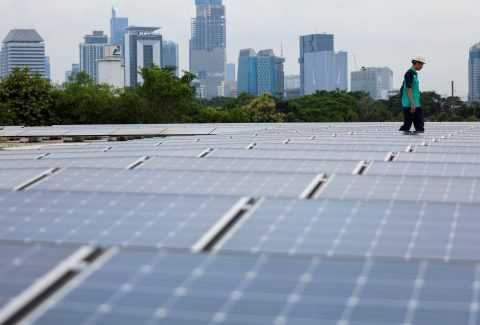
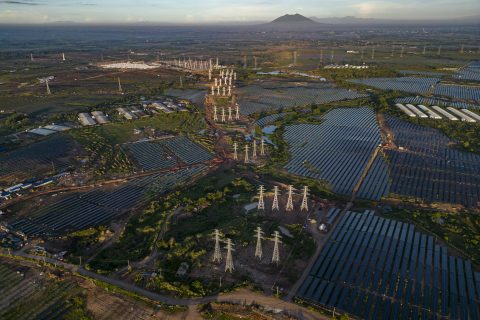
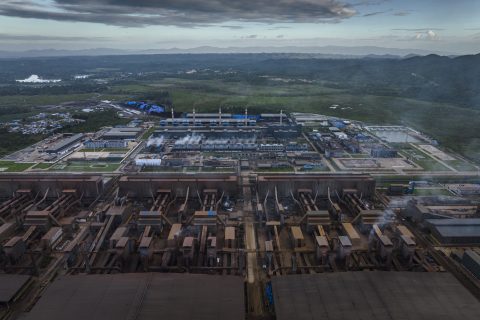
The plans will allow nations with high renewable energy generation potential to trade surplus power to their neighbours and major demand centres like Singapore, helping to integrate more renewables into the power mix and reduce reliance on fossil fuel imports.
“[It] will give us more energy security,” the Philippines’ energy secretary, Sharon Garin, told a press conference after a meeting of the Association of Southeast Asian Nations’ (ASEAN) energy ministers last week, when they discussed accelerating the delivery of the regional grid as part of measures to respond to the energy crisis.
“The Philippines is rich in solar power, Malaysia is rich in hydropower and Indonesia has geothermal: different countries have different resources. [The ASEAN Power Grid] will optimise the utilisation of renewables to the benefits of each member state,” said Garin.
But turning this decade-old political vision into a reality has been slow, held up by painstaking work to harmonise a patchwork of regulatory and legal frameworks and mobilise the private capital needed to build cross-border infrastructure.
More than $300 billion is needed to expand and modernise the region’s fragile grids to support the projected energy demand increase by 2050. This includes $27 billion required to deliver the cross-border interconnections by 2040, according to the International Energy Agency (IEA).
Every year of delay could cost the region billions of dollars in additional fuel costs and lock in new gas infrastructure for decades to come, according to analysis by global energy think-tank Ember.
The building block for energy security
With electrification high on the agenda of the COP31 climate talks in Türkiye next month, there is growing attention on the need to modernise and expand grid infrastructure to cope with growing electricity use and more renewables in the power mix.
Clean electrification and energy efficiency could deliver about a third of cumulative carbon emission reductions between 2026 and 2050, according to the International Renewable Energy Agency’s World Energy Outlook. But delivering that would require doubling annual global grid investment to $1 trillion between now and 2035.
Last month, the UN launched an initiative to accelerate investment into expanding and modernising grids in Southeast Asia and Africa.
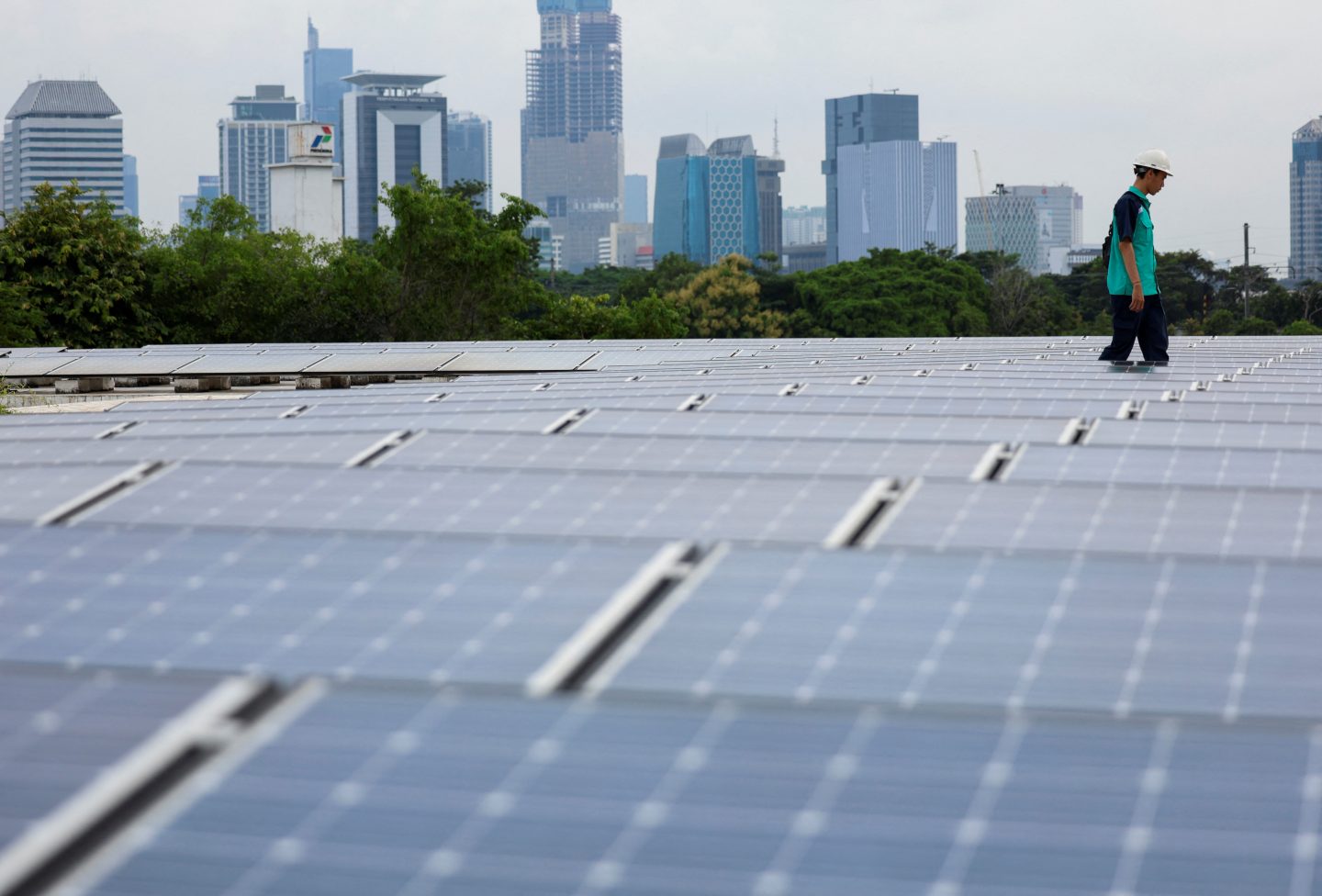
First conceptualised in 1997, the ASEAN Power Grid has gained fresh impetus in recent years as countries turn to renewables to cut their emissions and move away from volatile fossil fuel markets.
Energy supply disruption caused by wars in Ukraine and the Middle East has strengthened the case for regional grid connections. Before this year’s conflict began, the Middle East accounted for 60% of Southeast Asia’s crude oil imports. Competition for fewer, more expensive oil and gas shipments has left Southeast Asia facing a $160 billion energy import bill this year. Based on current policies, this could rise to $400 billion by mid-century.
In the Philippines last week, energy ministers agreed on an enhanced planning framework to deliver the ASEAN Power Grid and made progress on regulatory guidelines.
Garin said ministers were considering accelerating the project’s delivery. “The first study was to connect [by] 2045 – that’s too far,” she said.
A strong business case
The economic benefits of the plan have “captured the political imagination” of leaders in the region, Robert Cooke, grids advocacy lead at the Global Renewables Alliance, told Climate Home News. “The business case is stronger than ever,” he said.
“If countries were to go about building their own separate grids, of course that would be an expensive endeavour. But the discussion around the ASEAN Power Grid includes what costs could we share in building out this grid,” added Tiza Mafira, director of the Indonesia office for the Climate Policy Initiative.
Stronger grids would help the region meet collective targets to increase the share of renewable energy in total primary energy supply from 14% to 30% and in installed power capacity from 34% to 45% by 2030.
Connecting and pooling dispersed renewable resources would also help smooth local power shortages caused by daily and seasonal variations, reducing the need for backup gas plants and battery storage.
The IEA found the ASEAN Power Grid could help unlock some of the 20 terawatts of untapped solar and wind potential across Southeast Asia – an amount around 55 times the region’s current total power capacity.
From lines on a map to shovels in the ground
Rather than building a single unified network, the ASEAN Power Grid is developing cross-border links between neighbouring countries and smaller groups of nations.
As of 2025, nine of 18 priority interconnection projects are operational – accounting for around 10 GW of capacity with an additional 13.7 GW planned by 2040.
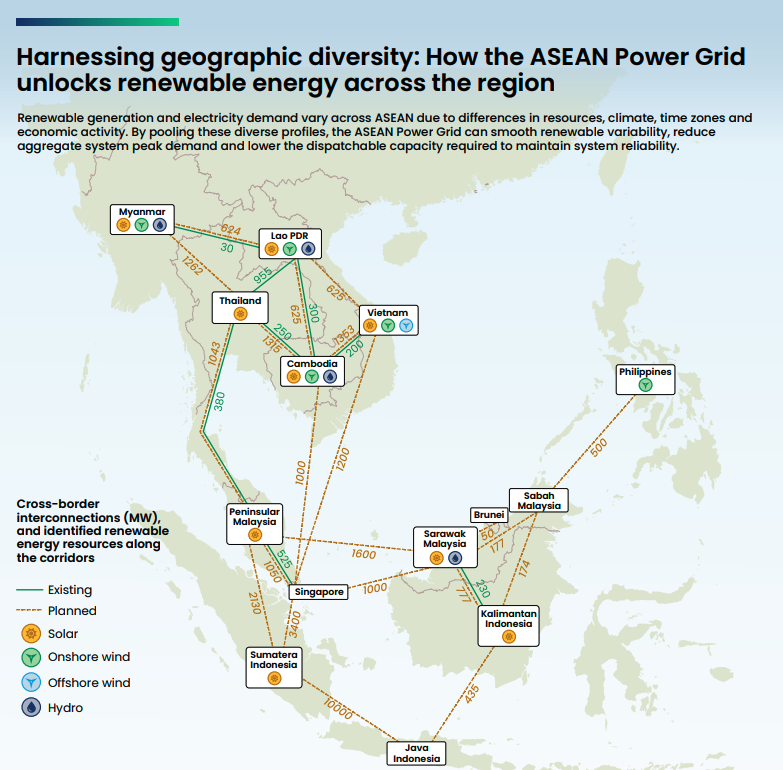
Source: Ember
A power line channelling up to 200 MW of clean electricity generated from hydropower in Laos to Singapore via Thailand and Malaysia has emerged as a key building block for grid-to-grid trading.
Progress on technical discussions will also help provide the clarity the private sector needs to invest in bankable projects, said Cooke.
In 2025, the Asian Development Bank and the World Bank announced a dedicated funding initiative to support the project.
“The enabling pieces are emerging,” said Monalisa Dimalanta, former chair of the Philippine Energy Regulatory Commission and the National Renewable Energy Board. “But the timelines remain unclear and a 2045 vision cannot answer today’s emergency,” she said.
“A power grid… that exists only on paper will not keep the lights on.”
Singapore: the delivery test
The implications of failing to deliver the ASEAN Power Grid are most acute in Singapore.
Constrained by space, with few renewable energy resources and dependent on gas for more than 90% of its electricity mix, Singapore has emerged as a leading proponent of a regional power grid as it seeks to achieve net-zero emissions by 2050.
To meet its power needs, the city-state aims to import 6 GW of low-carbon electricity by 2035, around one-third of its energy demand – a target which it is set to miss, however.
The plans heavily rely on building interconnectors to import solar power from Indonesia across the South China Sea. Around 40% of the ASEAN Power Grid’s planned interconnections are directed towards Singapore.
Ember’s analysis found that delivering the planned interconnectors by 2035 could enable renewables to meet nearly half of Singapore’s electricity demand. Delays could drop this to only a fraction of the country’s needs, and risk locking in new gas capacity until the 2050s. Without the ASEAN Power Grid, Singapore would need to install an additional 300 MW of gas-fired power capacity to bridge the gap by 2035.
Already home to the largest data centre capacity in Southeast Asia, Singapore’s electricity demand keeps rising, driven by the boom in AI infrastructure. “At one point, [it] either has to build a new gas plant, or it has to get the interconnection to su