

Welcome to Carbon Brief’s DeBriefed.
An essential guide to the week’s key developments relating to climate change.
This week
Hurricane Melissa
‘TOTAL DEVASTATION’: Hurricane Melissa has killed at least 49 people after sweeping through the Caribbean islands of Jamaica, Cuba, Haiti and Bermuda, reported Independent. Jamaica’s prime minister Andrew Holness said the storm left “total devastation”, destroying homes and infrastructure and leaving people “stranded on roofs and without power”, said BBC News. In Haiti, at least 30 people were killed in floods, Reuters added.
WARM WATERS: Melissa is tied as the strongest Atlantic hurricane to ever hit land, slamming Jamaica with winds of 185mph and fuelled by anomalously warm waters, reported the Associated Press. Fossil-fuelled climate change made the storm “four times more likely”, according to analysis cited by Agence France-Presse. Early estimates suggest infrastructure damage alone could amount to 40% of Jamaica’s gross domestic product, said the newswire.
RECORD RAINS: Elsewhere, Al Jazeera reported on major floods in central Vietnam, where the former imperial city of Huế saw record rainfall of more than 1,000mm over a 24-hour period, according to the country’s weather agency. The Associated Press reported that climate change is “driving more intense winds, heavier rainfall and shifting precipitation patterns across East Asia”.
Climate plans off track for 1.5C
‘DRASTICALLY SHORT’: The latest national climate plans will cause global emissions to drop 10% by 2035 from 2019 levels, “bending the emissions curve downwards for the first time”, but falling “drastically short” of the 60% cut needed to keep 1.5C in sight, said the Guardian. The plans – known as nationally determined contributions (NDCs) under the Paris Agreement – were assessed by the UN in a synthesis report ahead of COP30, the publication said. The 10% cut reflects plans announced by China and the EU, in addition to formal submissions from 64 countries, according to Reuters.
OVERSHOOT ‘INEVITABLE’: UN secretary-general António Guterres said in a joint interview with the Guardian and the Amazonian publication Sumaúma that overshooting 1.5C of global warming was now “inevitable” and would have “devastating consequences”. Guterres “did not give up on the [1.5C] target”, but urged world leaders to “change course” during COP30 to ensure the “overshoot is as short as possible and as low in intensity as possible to avoid tipping points like the Amazon”.
Around the world
- DELIVERY: The UK government published its “carbon budget and growth delivery” plan, outlining policies to meet its mid-2030s climate targets. Read more in Carbon Brief’s in-depth coverage of the plan.
- DEAL UNEARTHED: Donald Trump and Xi Jinping have settled a dispute over rare-earth mineral supplies during trade talks, said the Guardian. Trump described the talks as “amazing” and agreed to reduce tariffs on Chinese goods by 10%, it added.
- AVOIDABLE DEATHS: Climate change and policy “failures” are leading to “millions” of avoidable deaths each year, according to Le Monde’s coverage of the latest Lancet Countdown report on health and climate change.
- DEFORESTATION DOWN: On the eve of hosting COP30, Brazil’s government announced an 11% drop in annual deforestation in the Brazilian Amazon, the fourth consecutive annual fall and lowest deforestation rate since 2014, reported Agence France-Presse.
- DUTCH ELECTION: Democrats 66 (D66), the centrist party led by former climate minister Rob Jetten, narrowly won a snap general election in the Netherlands, said Brussels Signal.
- EU FLEXIBILITY: As the EU continues to negotiate 2040 emissions targets, the bloc is considering a “more flexible path” for industries to meet the goals, reported Reuters.
12 times
The extent to which current finance flows would have to increase to meet developing countries’ adaptation finance needs in 2035, according to the latest UN adaptation gap report covered by Carbon Brief.
Latest climate research
- Young children in sub-Saharan Africa are 77% more at risk from malaria for every 1C temperature increase | PLOS One
- Social media use is linked to “climate anxiety, climate doom and support for radical action” | Climatic Change
- Future droughts could weaken peatlands’ ability to store carbon, creating a positive feedback cycle for climate change | Science
(For more, see Carbon Brief’s in-depth daily summaries of the top climate news stories on Monday, Tuesday, Wednesday, Thursday and Friday.)
Captured
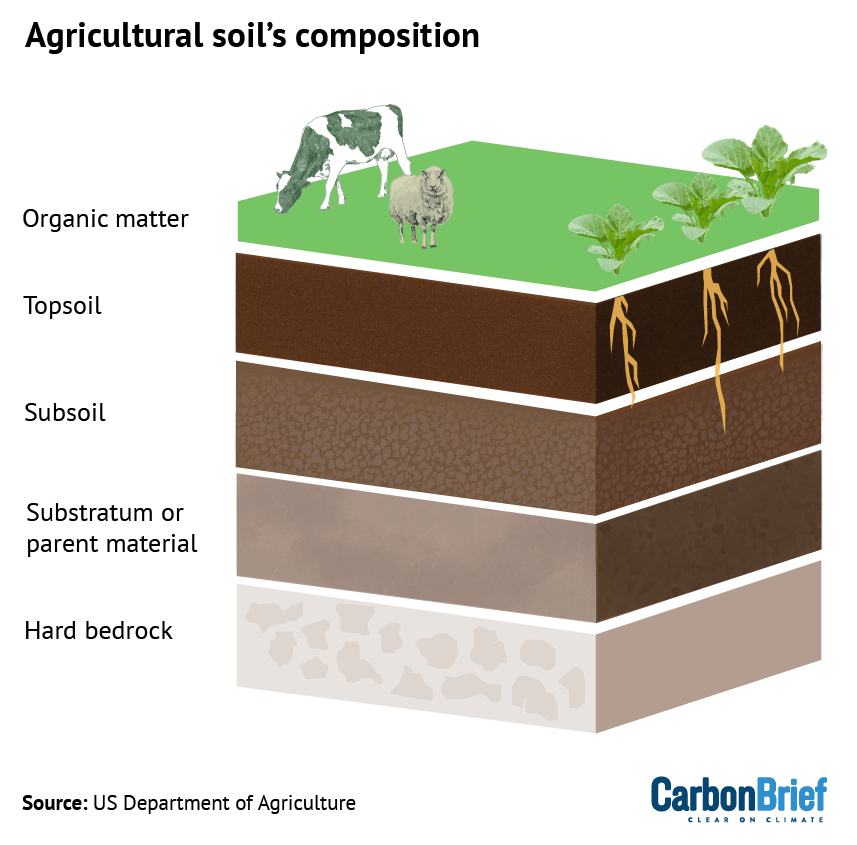
Carbon Brief explored the importance of soil health for food security and climate change in a new Q&A. As the diagram above illustrates, agricultural soil is composed of four layers – known as soil horizons – containing varying quantities of minerals, organic matter, living organisms, air and water. The world’s soils have lost 133bn tonnes of carbon since the advent of agriculture around 12,000 years ago, with crop production and cattle grazing responsible in equal part.
Spotlight
Crackdowns on climate and environmental activism
This week, Carbon Brief speaks to Mary Lawlor, UN special rapporteur on human rights defenders, who led a recent report highlighting crackdowns on the rights of climate and environmental activists around the world.
Carbon Brief: Why do you see climate change as a human-rights issue?
Mary Lawlor: I don’t think there’s any doubt about climate change being a human-rights issue nowadays, because everyone can see it. It interferes with so many rights. The right to food, for example. We’ve seen the situation where drought, storms and floods interfere with food production. And then if you look at the right to life – according to the WHO, we’re currently seeing an average of 175,000 heat-related deaths per year around the world, and those numbers will increase. But we now also have advisory opinions of the ICJ, the Inter-American Court of Human Rights, the International Tribunal for the Law of the Sea, all of which state clearly that climate change is a reality. They see it as a human-rights crisis.
CB: What human-rights violations are being faced by climate and environmental activists around the world right now?
ML: We went to a lot of Indigenous communities in the Amazon and we saw firsthand the threats against Indigenous defenders in Brazil who are opposing carbon-credit projects in their territories, where they themselves have been reducing deforestation with success for years. Then, for example, there were smears against a lawyer in Argentina who was supporting communities in their legal fight against the extraction of lithium from their territories without their consent. And, then, you have surveillance of climate activists organising peaceful protests against new fossil-fuel projects, for example, in the Philippines. So it’s kind of like an octopus, the tentacles are reaching out.
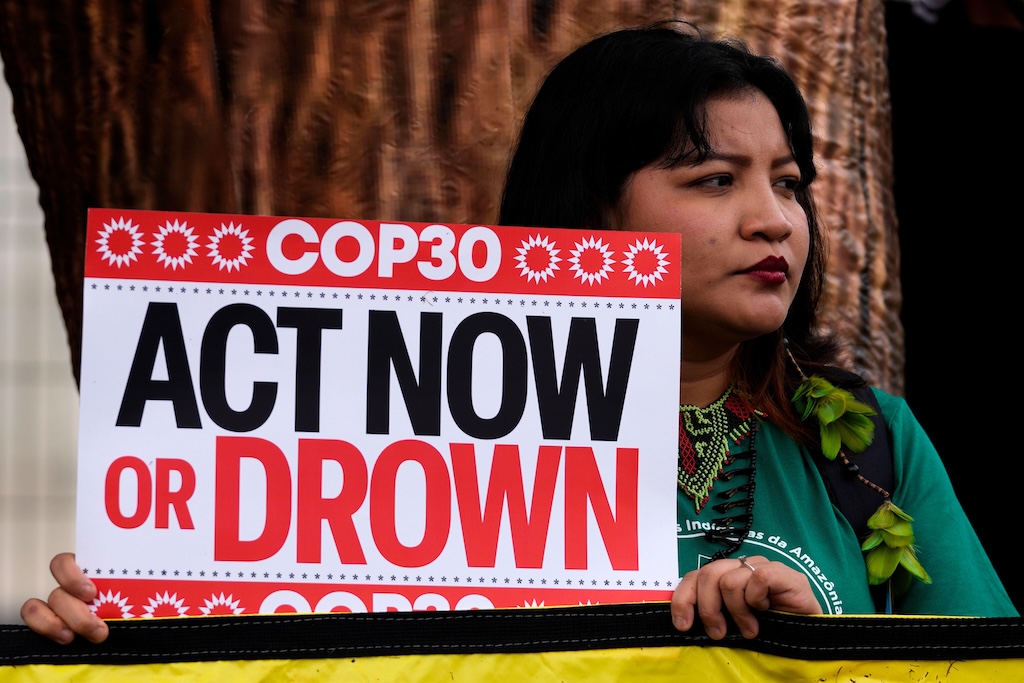
In some of the more developed countries, like France and Spain, you have accusations of terrorism against peaceful climate-justice movements. In Germany, you had the investigation and prosecution of a climate-justice group for alleged organised crime based solely on their peaceful protests that put no human being in danger and did no harm to anyone.
CB: What are some examples that you’ve seen of good practice by governments in relation to the work of climate and environmental activists?
ML: My favourite is Brazil and MST [Landless Workers’ Movement]. They were aided in their tree-planting programme by the federal authorities, who provided helicopters and the federal highway police piloted these helicopters. Seeds of the endangered juçara palm and araucaria trees could be air-dropped over land in Paraná, after the devastating fires that took place. So that’s my absolute favourite, because it showed how a state and defenders can work together as allies to prevent destruction and even worse climate change.
CB: According to Global Witness, 413 land and environmental defenders were killed in Brazil during 2012-2024. What is the current situation for environmental defenders in Brazil going into COP30?
[Brazil] are really making efforts, as far as I can see, to address the root causes – and this is really why human-rights defenders are in such danger – that is, land is at the heart of all the problems there. But progress is still very slow. At the moment, only 16 territories have been demarcated by [Brazilian president] Lula and that is hugely important because, as I said, it’s at the root of pretty much all the attacks and killings by either the thugs associated with the companies, or the big landowners, the illegal logging, and all the stuff that is happening there. So that is something that we really need a speed up of – the demarcation of Indigenous lands.
When it comes to COP30, they’ve put some effort into making it more inclusive, especially when it comes to bringing the voices and experiences of Indigenous defenders into the negotiations. Now we’ll see what will happen in November and what the negotiations bring.
This interview has been edited for length.
Watch, read, listen
‘GOD’S WILL’: Samaa TV followed four street workers across Pakistan, exploring their views on climate change through the lens of faith.
COP EXPECTATIONS: Down to Earth unpacked what to expect from COP30 from a global-south perspective in their Carbon Politics podcast.
1.5C ALIGNED: Scientist and former UN climate lead Ploy Achakulwisut grappled via a LinkedIn post with the challenges of assessing whether national targets are aligned with a 1.5C world.
Coming up
- 4 November: UN emissions gap 2025 report launch
- 4 November: International Energy Agency (IEA) world energy outlook 2025 report launch
- 6-7 November: COP30 leaders summit, Belém, Brazil
Pick of the jobs
- International Institute for Sustainable Development, head of secretariat, national adaptation plan global network | Salary: CA$129,000-CA$161,000. Location: Ottawa or Toronto, Canada (hybrid)
- SRM360, lead writer/editor | Salary: $100,000-$120,000. Location: Remote
- Project Drawdown, senior analyst, climate philanthropy and investing | Salary: $120,000-$160,000. Location: US
- Climate News Tracker, journalism insights analyst | Salary: Unknown. Location: London (hybrid)
- University of Birmingham, climate and public health policy impact fellow | Salary: £36,636-£46,049. Location: Birmingham, UK
DeBriefed is edited by Daisy Dunne. Please send any tips or feedback to debriefed@carbonbrief.org.
This is an online version of Carbon Brief’s weekly DeBriefed email newsletter. Subscribe for free here.

The post DeBriefed 31 October 2025: Hurricane Melissa strikes Jamaica; Climate plans overshoot 1.5C; Protest crackdowns appeared first on Carbon Brief.

When oil and gas shipments stopped flowing through the Strait of Hormuz at the start of the Iran war, Southeast Asian nations were left reeling as the supply crunch laid bare their acute reliance on fossil fuel imports.
As prices soared, governments in the region scrambled to introduce emergency energy-saving measures – from a four-day working week to curbs on air conditioning. Thailand revived decommissioned coal plants while the Philippines, which imports nearly all of its oil, declared a “national energy emergency”.
But the crisis has also prompted renewed resolve to find a long-term solution to their vulnerability at a time when electricity demand is booming to power the region’s growing industry, cooling needs and the mushrooming of energy-hungry data centres.
At the heart of Southeast Asian nations’ response is a longstanding infrastructure project to connect the region’s power grids by 2045 and enable cross-border trading of clean electricity through a network of underground and subsea interconnectors.
-
Southeast Asia’s fragile grids threaten billions in clean energy investment
Renewables developers need reliable electricity infrastructure and stable policies to help the region meet climate goals and surging demand for power -
UN backs push to upgrade grids slowing clean power uptake in Africa and SE Asia
The Global Grids Accelerator will help turn national and regional plans to expand electricity infrastructure into viable projects on the ground -
China keeps Indonesia’s battery dream afloat but future less certain
Chinese capital and technology turned Indonesia into the world’s top nickel supplier, but its dependence on China and the rise of nickel-free batteries could upset its battery ecosystem plans
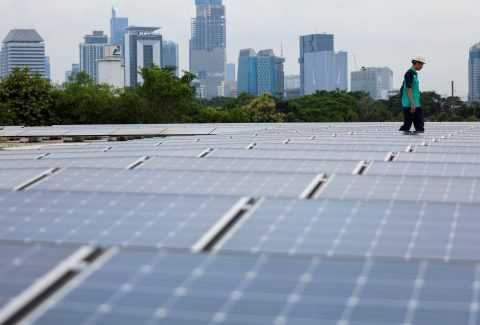
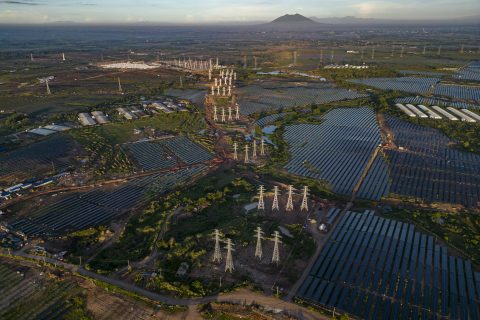
The plans will allow nations with high renewable energy generation potential to trade surplus power to their neighbours and major demand centres like Singapore, helping to integrate more renewables into the power mix and reduce reliance on fossil fuel imports.
“[It] will give us more energy security,” the Philippines’ energy secretary, Sharon Garin, told a press conference after a meeting of the Association of Southeast Asian Nations’ (ASEAN) energy ministers last week, when they discussed accelerating the delivery of the regional grid as part of measures to respond to the energy crisis.
“The Philippines is rich in solar power, Malaysia is rich in hydropower and Indonesia has geothermal: different countries have different resources. [The ASEAN Power Grid] will optimise the utilisation of renewables to the benefits of each member state,” said Garin.
But turning this decade-old political vision into a reality has been slow, held up by painstaking work to harmonise a patchwork of regulatory and legal frameworks and mobilise the private capital needed to build cross-border infrastructure.
More than $300 billion is needed to expand and modernise the region’s fragile grids to support the projected energy demand increase by 2050. This includes $27 billion required to deliver the cross-border interconnections by 2040, according to the International Energy Agency (IEA).
Every year of delay could cost the region billions of dollars in additional fuel costs and lock in new gas infrastructure for decades to come, according to analysis by global energy think-tank Ember.
The building block for energy security
With electrification high on the agenda of the COP31 climate talks in Türkiye next month, there is growing attention on the need to modernise and expand grid infrastructure to cope with growing electricity use and more renewables in the power mix.
Clean electrification and energy efficiency could deliver about a third of cumulative carbon emission reductions between 2026 and 2050, according to the International Renewable Energy Agency’s World Energy Outlook. But delivering that would require doubling annual global grid investment to $1 trillion between now and 2035.
Last month, the UN launched an initiative to accelerate investment into expanding and modernising grids in Southeast Asia and Africa.
First conceptualised in 1997, the ASEAN Power Grid has gained fresh impetus in recent years as countries turn to renewables to cut their emissions and move away from volatile fossil fuel markets.
Energy supply disruption caused by wars in Ukraine and the Middle East has strengthened the case for regional grid connections. Before this year’s conflict began, the Middle East accounted for 60% of Southeast Asia’s crude oil imports. Competition for fewer, more expensive oil and gas shipments has left Southeast Asia facing a $160 billion energy import bill this year. Based on current policies, this could rise to $400 billion by mid-century.
In the Philippines last week, energy ministers agreed on an enhanced planning framework to deliver the ASEAN Power Grid and made progress on regulatory guidelines.
Garin said ministers were considering accelerating the project’s delivery. “The first study was to connect [by] 2045 – that’s too far,” she said.
A strong business case
The economic benefits of the plan have “captured the political imagination” of leaders in the region, Robert Cooke, grids advocacy lead at the Global Renewables Alliance, told Climate Home News. “The business case is stronger than ever,” he said.
“If countries were to go about building their own separate grids, of course that would be an expensive endeavour. But the discussion around the ASEAN Power Grid includes what costs could we share in building out this grid,” added Tiza Mafira, director of the Indonesia office for the Climate Policy Initiative.
Stronger grids would help the region meet collective targets to increase the share of renewable energy in total primary energy supply from 14% to 30% and in installed power capacity from 34% to 45% by 2030.
Connecting and pooling dispersed renewable resources would also help smooth local power shortages caused by daily and seasonal variations, reducing the need for backup gas plants and battery storage.
The IEA found the ASEAN Power Grid could help unlock some of the 20 terawatts of untapped solar and wind potential across Southeast Asia – an amount around 55 times the region’s current total power capacity.
From lines on a map to shovels in the ground
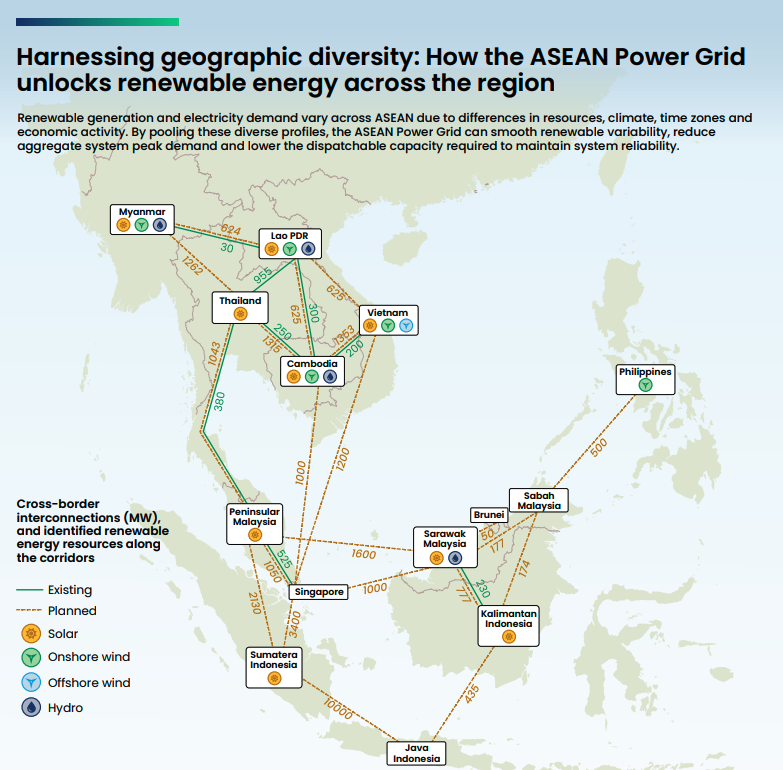
Rather than building a single unified network, the ASEAN Power Grid is developing cross-border links between neighbouring countries and smaller groups of nations.
As of 2025, nine of 18 priority interconnection projects are operational – accounting for around 10 GW of capacity with an additional 13.7 GW planned by 2040.
Source: Ember
A power line channelling up to 200 MW of clean electricity generated from hydropower in Laos to Singapore via Thailand and Malaysia has emerged as a key building block for grid-to-grid trading.
Progress on technical discussions will also help provide the clarity the private sector needs to invest in bankable projects, said Cooke.
In 2025, the Asian Development Bank and the World Bank announced a dedicated funding initiative to support the project.
“The enabling pieces are emerging,” said Monalisa Dimalanta, former chair of the Philippine Energy Regulatory Commission and the National Renewable Energy Board. “But the timelines remain unclear and a 2045 vision cannot answer today’s emergency,” she said.
“A power grid… that exists only on paper will not keep the lights on.”
Singapore: the delivery test
The implications of failing to deliver the ASEAN Power Grid are most