Expensive accommodation, combined with restricted funding and accreditation, are set to limit the participation of Global South climate activists in COP30, casting doubt on Brazil’s promise to host the most inclusive UN climate summit ever.
Civil society groups told Climate Home News that the COP30 presidency’s failure to make affordable lodgings available in the Amazon city is pricing out many activists from countries at the forefront of the climate crisis, who are struggling to pay their way.
Campaigners had been enthusiastically preparing for this year’s talks in Brazil after their ability to demonstrate was severely limited at the last three COPs hosted in Egypt, the United Arab Emirates and Azerbaijan – authoritarian regimes with limited or no freedom to protest and poor human rights records.
But with basic rooms in Belém costing hundreds of dollars per night, many are being forced to stay at home this time around.
“Brazil has been a disappointment for a lot of us,” said Rachitaa Gupta, global coordinator of the Global Campaign to Demand Climate Justice (DCJ), a network of over 200 organisations primarily from the Global South.
-
NGOs urge Brazil to prevent fossil fuel capture of COP30 climate summit
More than 200 civil society groups are asking Brazil’s COP30 team to commit to “polluter-free” climate negotiations in Belém -
UN raises COP30 allowance to help with Belém accommodation crisis
But funding shortfalls risk reducing the number of government negotiators who can receive the payment unless more money is put on the table -
COP observers invited to reveal who is bank-rolling their participation at climate talks
As UN climate change body introduces new voluntary transparency measures, campaigners welcome “much needed step” to keep fossil fuel influence out of the talks


“This was a key moment for us because for the first time in many years we have been able to organise a huge people’s movement and mobilisation on the ground,” she added. “But we have had to scale that down significantly.”
A COP30 presidency spokesperson told Climate Home that the Brazilian government is taking concrete measures to ensure broad civil society participation, with a particular focus on the Global South, and has been responding to concerns expressed by organisations.
The measures include making available lower cost accommodation in university dormitories, schools and temporary housing facilities, they said, as well as negotiating discounted rates with hotels and transport providers.
Lula aims to host “the best COP in history”
Since President Luiz Inácio Lula da Silva first announced in early 2023 that Belém would host COP30, the Brazilian government has been talking up the symbolism of bringing the annual UN climate summit to the Amazon rainforest, which plays a vital role in absorbing planet-heating carbon and regulating the Earth’s climate.
“I leave Pará with the certainty that we will hold the best COP in history,” Lula said in February after he visited the northeastern state of Pará, whose capital is Belém.

Pará state governor, Helder Barbalho, told The Guardian in April that “it will be the COP with the greatest popular participation in history and that is something we have particularly encouraged”.
However, local hotels hiked rates to exorbitant levels in anticipation of high demand, despite efforts by the COP30 presidency to persuade them to bring them down. A deal was done to help developing-countries’ official delegations find cheaper accommodation at fixed rates, but those were not extended to non-governmental organisations, businesses or media.
Official booking platform late and “glitchy”
The DCJ’s Gupta said the logistical chaos has more to do with the COP presidency’s “complete planning failure”, rather than being an issue with an Amazon port city itself.
As room prices on commercial accommodation sites like Booking.com and Airbnb skyrocketed early this year, local officials insisted the market would “stabilise” once the COP30 team launched its own platform.
But when it finally appeared in mid-July after repeated delays, it was met with disappointment.
“There were frankly horrendous accommodation options that were very, very expensive,” Gupta said. She added that information is often “misleading” and those who managed to book couldn’t keep the accommodation because the system is “glitchy”.
Brazil launches COP30 accommodation platform after pressure from UN committee
When civil society groups voiced their concerns with the presidency in August, Gupta said the COP30 team responded with a plan to convert large buildings, such as schools and offices, into shared accommodation.
“For us, this was problematic because we cannot be seen as an afterthought and it’s not fair that civil society is reduced to being put into dormitory-style accommodation, like some kind of cattle being hoarded,” she said.
She added that many Global South campaigners come from conservative cultures and find it difficult to share rooms in mixed settings.
Reduced numbers attending
As a result, NGOs are slimming down the size of their delegations compared to COP28 in Dubai and what they had originally planned for Belém.
According to Gupta, many people in the DCJ network have ultimately decided against attending COP30 because of the pricey accommodation on top of costly flights to get there.
“It is specifically disappointing because we had anticipated doubling participation this year,” Gupta added.
Mariano Villares, co-founder of the Argentine organisation Sustentabilidad Sin Fronteras, told Climate Home that five members of their team had been planning to travel to Belém “to make the most of the COP’s return to Latin America after 11 years” – but only two will now be able to go.
“The prices and conditions of accommodation drive out civil society from the Global South. The climate conversation loses diversity when the voices most affected by the impacts are left out,” he said.

Marina Agortimevor, coordinator of the Africa Just Transition Network, told Climate Home the network had sent more than 15 of its members from grassroots organisations to past climate talks. But this time, because of funding cuts and the high cost of accommodation, it can barely manage to send four members to Belém.
While this COP has been billed as an inclusive conference, “inclusivity is still based on what is in your pocket”, Agortimevor said.
Other African civil society groups told Climate Home funders who had supported their attendance at previous climate talks had backed out of financing their participation at COP30 due to the high costs.
Limited accreditation allocations
In addition, Agortimevor said some Africa Just Transition Network members have struggled to get accreditation for the COP in Brazil, another factor that appears to be working against the wide participation of civil society.
Sustentabilidad Sin Fronteras said it had received less than a third of the accreditations it got last year, also limiting the size of its delegation in Belém.
One Latin American organisation – which asked not to be named – said it would have to divide up the three badges it had received so that some team members can attend the first week and others the second. “Some people need to be there for both weeks due to the work being done, and this situation has limited our activities,” they said.
The lower number of accreditations is a trend heard from most of the Latin American organisations Climate Home spoke with. Some are seeking other ways to get their staff into the conference, such as asking their countries’ governments to register them as “party overflow”.
When asked about this issue by Climate Home, a UN official said requests for COP accreditation by NGOs had increased “significantly” in recent years, with 4,000 organisations now registered as observer groups. The size of COP venues, however, has stayed the same, meaning that “the portions available to each organisation naturally become smaller”.
“This is not about restricting participation for any particular group, but rather a reflection of the growing interest, which affects everyone,” the official said, adding that the UN climate change body has been working specifically to enhance representation from developing countries as requested by governments at last year’s mid-year climate talks.

Blow to climate justice?
Osver Polo Carrasco, coordinator of the ambition and NDC working group of the CAN Latin America network, expressed concern about the limitations all this may pose on civil society in doing its job of monitoring and providing oversight of developments at COP30.
This problem was already been experienced at last week’s pre-COP in Brasilia, he added, “where access was very limited for civil society and also for the written press”.
One African Group negotiator – who is not attending COP30 because of the “prohibitive costs” – said the exclusion of himself and other representatives of governments and civil society from the continent “is not just an economic failure – it’s a political one”.
“It undermines representation, weakens multilateralism amid uncertainties like a potential US absence, and threatens the legitimacy and momentum needed for an inclusive and ambitious COP30,” he said.
He warned that “without the voices of those on the frontlines, climate justice becomes a hollow promise.”
The COP30 presidency said the substantive participation of Global South organisations “is essential for the credibility of the conference”, noting that it had already consulted with a wide range of groups, representing Indigenous peoples, youth and women among others, to ensure they can influence and engage in the summit.
“COP30 is being planned as a milestone for placing climate justice at the center, treating the full participation of civil society organisations as a pillar of this commitment,” the presidency spokesperson told Climate Home.
The post Global South campaigners question inclusivity of COP30 as some stay home appeared first on Climate Home News.
Global South campaigners question inclusivity of COP30 as some stay home

When the Turkish COP31 presidency presented its priorities to international business leaders for the first time in New York in September, among those invited to give the private sector’s first response was Ali Koç, scion of one of Türkiye’s wealthiest families.
On stage, the vice chair of the board of Koç Holding said the family company, which weeks earlier had been announced as one of the top sponsors for the UN climate summit, can be seen as “quite exemplary” for its climate record.
What Koç did not mention was that the group’s biggest money-making arm – Türkiye’s largest oil refiner Tüpraş – plans to keep running its refineries “at maximum potential”. Nor did he say that, in 2025, both parent company and subsidiary cut their 2030 climate targets to a level they had already nearly achieved, as Climate Home News’ analysis of company records reveals.
The decision to hand Koç Holding a prominent role at COP31 – the company is also the summit’s “Global Business Partner” – has reignited a long-running controversy over the platforming of fossil fuel interests at the annual UN climate conference.
It has also thrown into question how COP sponsors are chosen and screened. The hosting agreement between the Turkish government and the UN climate secretariat (UNFCCC) says that a partner company’s “climate integrity” should be taken into account.
COP31 electrification pledge leaves out clean power commitment
But how that test is applied is unclear and the process for picking sponsors remains largely opaque. The Turkish COP31 presidency has not published its selection criteria, nor the financial terms of any of its partnership agreements, including Koç’s. The UNFCCC declined to clarify how it advises on such deals.
Campaigners have long argued that accepting sponsorship from polluting companies is wrong because it gives them a global stage, visibility and access to policymakers at talks that are meant to move the world away from fossil fuels, and tarnishes the reputation of the COPs.
Koç’s energy division, which is dominated by oil refiner Tüpraş, accounted for three-quarters of the parent firm’s income in the first half of 2026.
“How was Koç Holding ever chosen as a COP31 sponsor? Any corporation that makes most of its money from oil refining should not qualify as sustainable,” said Pascoe Sabido, a campaigner at Corporate Europe Observatory, which exposes company lobbying. “This is hugely embarrassing for the UNFCCC and its climate integrity check, which doesn’t appear to be worth the paper it’s written on.”
Koç Holding “is not just standing still but walking backwards”, he told Climate Home News.
Koç Holding and Tüpraş did not reply to multiple requests for comment. The UNFCCC secretariat and the Turkish COP31 presidency declined to respond to questions from Climate Home News on the sponsorship agreement.
Oil refining windfall
Türkiye’s biggest industrial group, Koç Holding has stakes in several key sectors of the economy, spanning vehicle manufacturing in a joint venture with Ford to electronics, home appliances and banking.
But the conglomerate’s crown jewel is oil refiner Tüpraş, which Koç controls. Last year its four refineries turned crude oil into 26.8 million tonnes of petrol, diesel, jet fuel and other products, enough to fill about 36 Olympic swimming pools every day.
The company plans to raise its production to 29 million tonnes in 2026 – already a bumper year so far with soaring profits, thanks to sky-rocketing refining margins driven by a crunch in global oil processing capacity caused by the Middle East crisis.
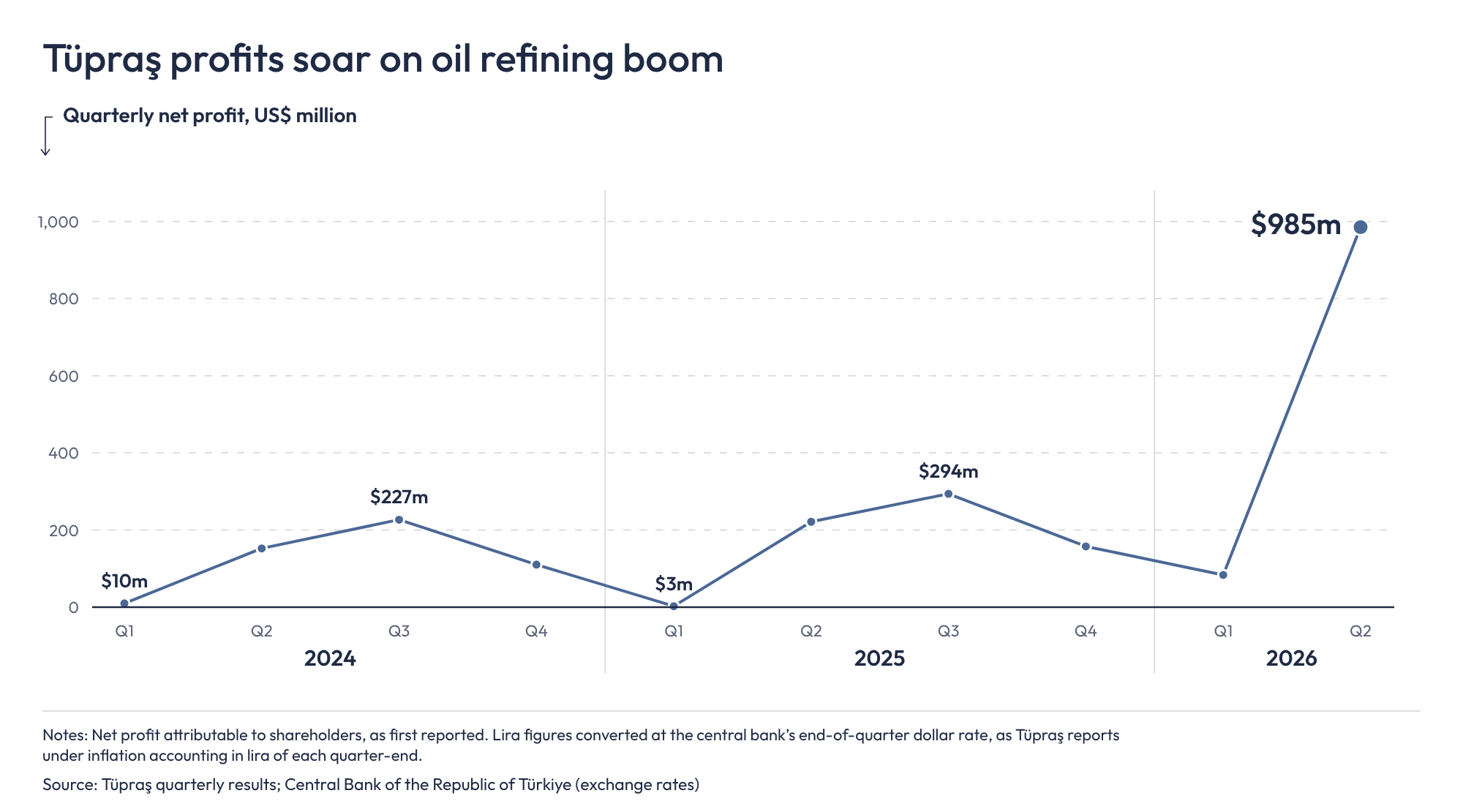
The oil business boom sits awkwardly with the climate and energy transition plans Koç and Tüpraş unveiled in 2021, when both pledged to become carbon neutral by 2050. Then, Tüpraş set out its aim to become “a leading carbon-neutral energy company”.
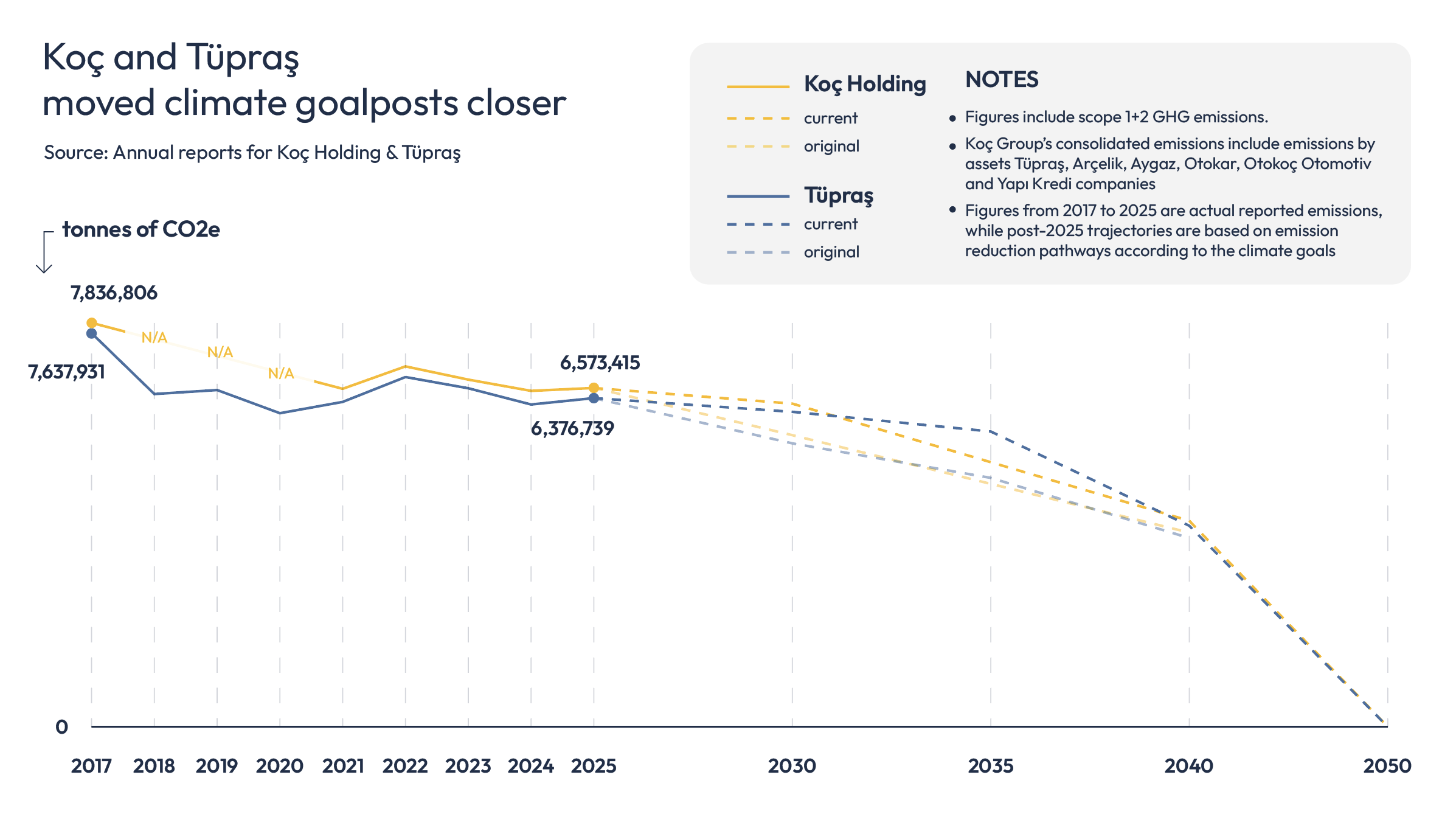
Despite these promises, in 2025, both companies lowered their targets for cutting emissions from their own operations by 2030, from 27% to 20% below 2017 levels. Tüpraş also cut its 2035 goal from 35% to 25%. The company still technically retains its long-term target of carbon neutrality by 2050, but the new plan will require much more drastic cuts after 2035.
Lowering the climate bar
Tüpraş blamed its weakening of climate ambition on “changing market dynamics, economic conditions and technological developments”. In a presentation announcing the revision to investors, the refiner said the energy outlook had changed since 2021.
The reasons it listed included elevated geopolitical tensions, increased investment in oil and gas extraction, which it said showed refined fuels remain vital for energy security – and even the depletion of the carbon budget to keep global warming to 1.5C.
Its parent company Koç pointed the finger at the slow pace of green hydrogen development, which the group said now had a “low feasibility” of transforming the energy sector after it had previously pinned much of its transition plan on the sustainable fuel.
The Turkish company’s new 2030 targets are certainly within reach. Tüpraş had already cut its operational emissions by 17% from 2017 levels by 2025, with nearly all of that progress achieved before the transition plan was unveiled, while Koç had reduced them by 16%.
The softer targets also exclude the bulk of the group’s climate impact. Most of its emissions come not from its own refineries and factories but from the products it sells: petrol, diesel and jet fuel burned in the engines of cars or planes.
These so-called Scope 3 emissions make up about 97% of Koç’s carbon footprint. They rose by around a sixth between 2019 and 2024, and neither Koç nor Tüpraş has set a target to cut them.
Efe Baysal, Türkiye team lead at campaign group 350.org, said there is a “clear contradiction” between talking about climate action while weakening emission targets and seeing emissions from the use of petroleum products keep rising.
“If the company is serious about the transition, it needs a clear plan to wind down fossil fuel operations, rather than relying on efficiency measures and technologies that let business as usual continue,” she told Climate Home News.
‘Sustainable refining’ push
Tüpraş’s updated transition plan rules out expanding its oil refineries, but commits to “maintaining the existing capacity” and running it “at maximum potential”. Oil refining is expected to remain its main source of earnings for years to come. Koç listed “growing oil demand and diesel deficit” in Türkiye as a competitive advantage for its energy business in a pitch to investors last month.
The biggest component of the Tüpraş transition plan is what the company calls “sustainable refining”. It plans to invest $3.9 billion between 2025 and 2035 in programmes to modernise its refineries, improve their energy efficiency and bring down the direct emissions they generate. The company is also shifting some of its production to petrochemicals, which it expects to reduce its Scope 3 emissions.
Australia says COP31 co-presidency will work on a cover decision
Alongside these “sustainable refining” efforts, Tüpraş is also investing in renewable power.
Four years ago, it bought Entek, which produces electricity primarily from six hydropower plants and one gas plant. Since the acquisition, Tüpraş has started building a utility-scale solar farm in Romania and a wind power plant with storage in Türkiye, alongside smaller solar energy installations at some of its refineries. A dozen more renewable energy projects are currently in the pipeline, according to its latest annual report.
In a self-declared bid to become “Türkiye’s leading producer of zero-carbon electricity”, Tüpraş wants to reach installed capacity of 1.6 gigawatts (GW) by 2030 – a target it raised in its updated plan – and 2.5GW by 2035. The Turkish government has committed to rolling out 120GW of wind and solar capacity nationwide by then.
Setback for green fuels
Tüpraş plans to supply most of its low-carbon electricity to run its future production plants for green hydrogen, an alternative fuel that can replace fossil fuels in some heavy industries and long-distance transport.
A few years ago, green hydrogen looked set to become a key pillar of the global energy transition, with companies pitching visionary projects and governments rolling out strategies for the fuel to decarbonise economies. But inflated forecasts, high costs and weak demand have led to a reality check for prospective producers like Tüpraş.
The Turkish refiner significantly scaled back its green hydrogen plans last year. While it originally hoped to start producing the clean fuel in 2025, it now targets a first pilot project by 2030 with commercial large-scale production not expected before 2035. That’s primarily because the cost of electrolysers, the machines that split water into hydrogen and oxygen, has risen fourfold since its original projections, the company said.
Is the world’s big idea for greener air travel a flight of fancy?
Tüpraş’s ambition to become Türkiye’s leading producer of sustainable aviation fuel (SAF) has also seen a partial rethink. The firm originally said it would convert by 2026 a unit in its sprawling oil refinery in the port city of Izmir into a plant that would produce SAF from waste cooking oil into “green” jet fuel.
But it is now planning to build a dedicated plant which is expected to be commissioned towards the end of 2028. That means its SAF output will be added to its existing fossil fuel refining capacity rather than replacing any of it.